
The Open Science Grid Ruth Pordes OSG Executive
- Slides: 25
The Open Science Grid Ruth Pordes OSG Executive Director, Fermilab Supported by the Department of Energy Office of Science Sci. DAC-2 program from the High Energy Physics, Nuclear Physics and Advanced Supported by the Department of Energy Office of Science Sci. DAC-2 program from the High Energy Physics, Software and Research programs, the National Science Nuclear Physics and. Computing Advanced Software and Computing Researchand programs, and the National Science Foundation Math and Physical Office of Cyber. Infrastructure Office of International Science and Foundation Math and Sciences, Physical Sciences, Office of and Cyber-Infrastructure Engineering Directorates. Open Science Grid Status and Architecture and Office of International Science and Engineering Directorates.
The OSG Vision Transform compute and data intensive science through a national cyber- infrastructure that includes from the smallest to the largest organizations. Bridge local, national, & international cyberinfrastructures. Engage communities, facilities and software providers working together towards the common goals. 9/18/2020 Open Science Grid Status and Architecture 2
The OSG Reality Broad community building through a Consortium. Support of end-to-end distributed systems for research communities through a funded Project collaborating with the stakeholders. Deliverables, schedule, priorities driven by the stakeholder members of the governing Council and “project managed” through the Executive Board. Commitments to the LHC experiments, & to the World Wide LHC Computing Grid Collaboration, subject to the agreements with US ATLAS and US CMS. 9/18/2020 Open Science Grid Status and Architecture 3
OSG is a funded project Starting in September 2006 OSG is funded for five years by DOE and NSF. Funding covers 34 FTEs at 18 institutions. Joint Oversight Team from 6 funding agency program offices. Mix of physics and computer science in management roles. Science Advisory Committee of 4 senior scientists. 9/18/2020 Open Science Grid Status and Architecture 4
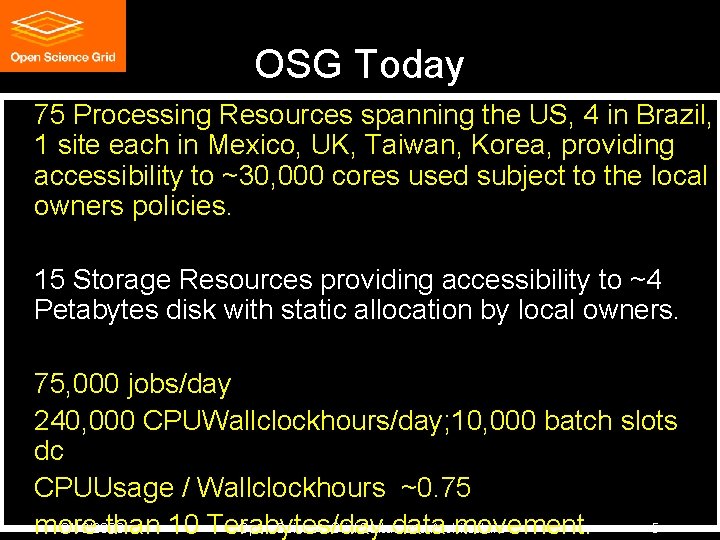
OSG Today 75 Processing Resources spanning the US, 4 in Brazil, 1 site each in Mexico, UK, Taiwan, Korea, providing accessibility to ~30, 000 cores used subject to the local owners policies. 15 Storage Resources providing accessibility to ~4 Petabytes disk with static allocation by local owners. 75, 000 jobs/day 240, 000 CPUWallclockhours/day; 10, 000 batch slots dc CPUUsage / Wallclockhours ~0. 75 9/18/2020 Open Science Grid Status and Architecture 5 more than 10 Terabytes/day data movement.
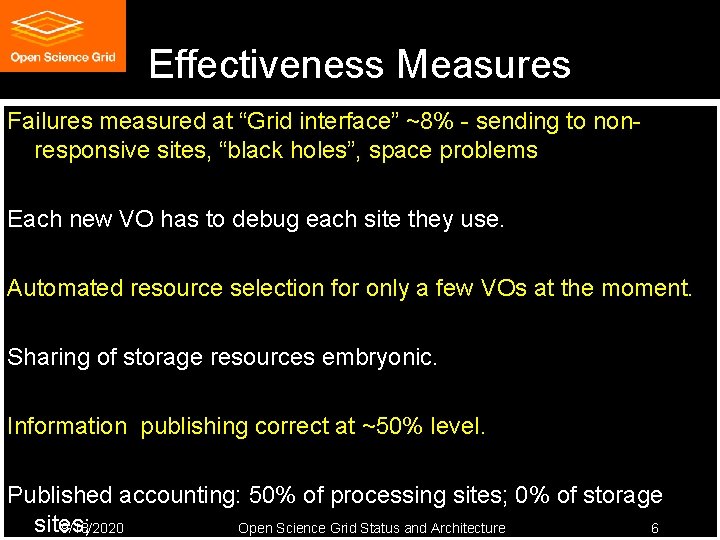
Effectiveness Measures Failures measured at “Grid interface” ~8% - sending to nonresponsive sites, “black holes”, space problems Each new VO has to debug each site they use. Automated resource selection for only a few VOs at the moment. Sharing of storage resources embryonic. Information publishing correct at ~50% level. Published accounting: 50% of processing sites; 0% of storage sites; 9/18/2020 Open Science Grid Status and Architecture 6
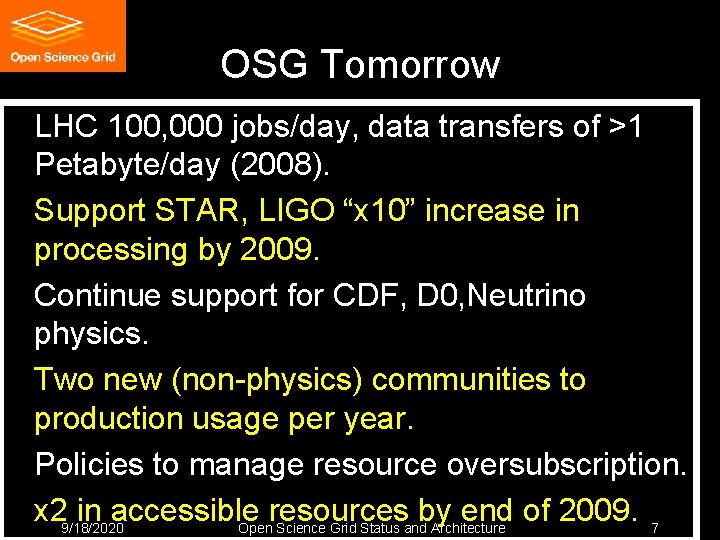
OSG Tomorrow LHC 100, 000 jobs/day, data transfers of >1 Petabyte/day (2008). Support STAR, LIGO “x 10” increase in processing by 2009. Continue support for CDF, D 0, Neutrino physics. Two new (non-physics) communities to production usage per year. Policies to manage resource oversubscription. x 29/18/2020 in accessible resources by end of 2009. 7 Open Science Grid Status and Architecture
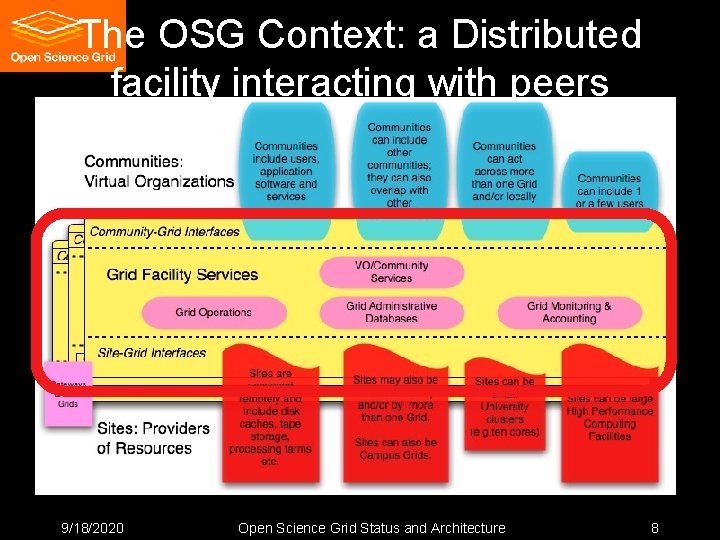
The OSG Context: a Distributed facility interacting with peers 9/18/2020 Open Science Grid Status and Architecture 8
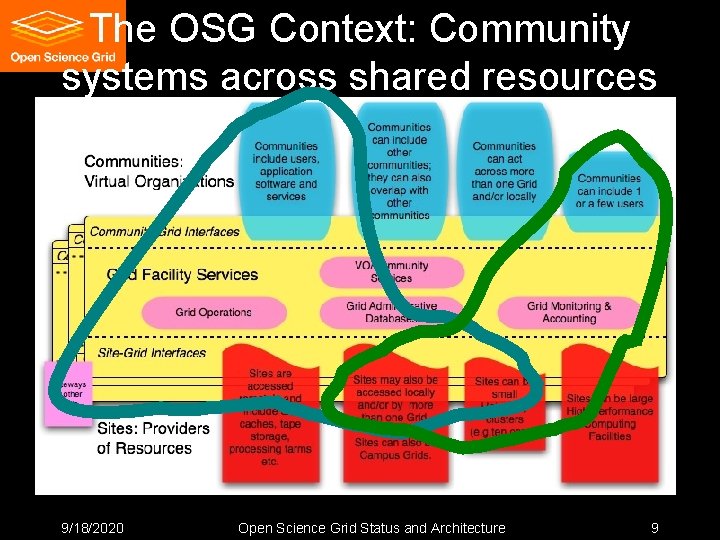
The OSG Context: Community systems across shared resources 9/18/2020 Open Science Grid Status and Architecture 9
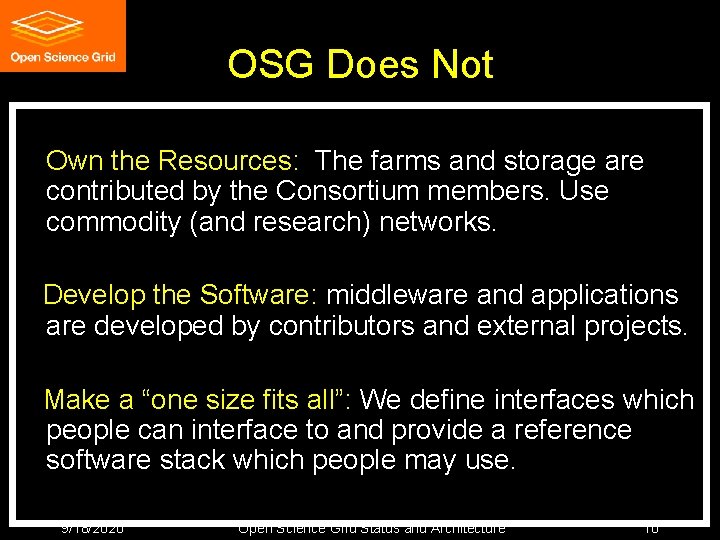
OSG Does Not Own the Resources: The farms and storage are contributed by the Consortium members. Use commodity (and research) networks. Develop the Software: middleware and applications are developed by contributors and external projects. Make a “one size fits all”: We define interfaces which people can interface to and provide a reference software stack which people may use. 9/18/2020 Open Science Grid Status and Architecture 10
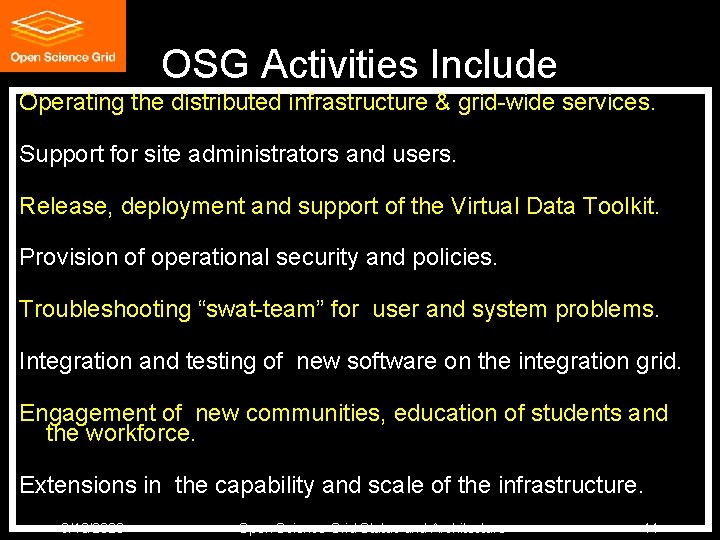
OSG Activities Include Operating the distributed infrastructure & grid-wide services. Support for site administrators and users. Release, deployment and support of the Virtual Data Toolkit. Provision of operational security and policies. Troubleshooting “swat-team” for user and system problems. Integration and testing of new software on the integration grid. Engagement of new communities, education of students and the workforce. Extensions in the capability and scale of the infrastructure. 9/18/2020 Open Science Grid Status and Architecture 11
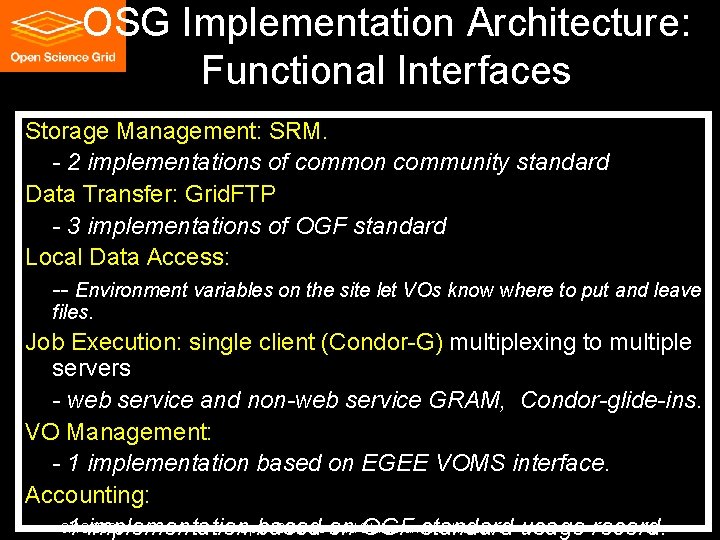
OSG Implementation Architecture: Functional Interfaces Storage Management: SRM. - 2 implementations of common community standard Data Transfer: Grid. FTP - 3 implementations of OGF standard Local Data Access: -- Environment variables on the site let VOs know where to put and leave files. Job Execution: single client (Condor-G) multiplexing to multiple servers - web service and non-web service GRAM, Condor-glide-ins. VO Management: - 1 implementation based on EGEE VOMS interface. Accounting: Science on Grid Status Architecture usage record. 12 - 9/18/2020 1 implementation. Open based OGFandstandard
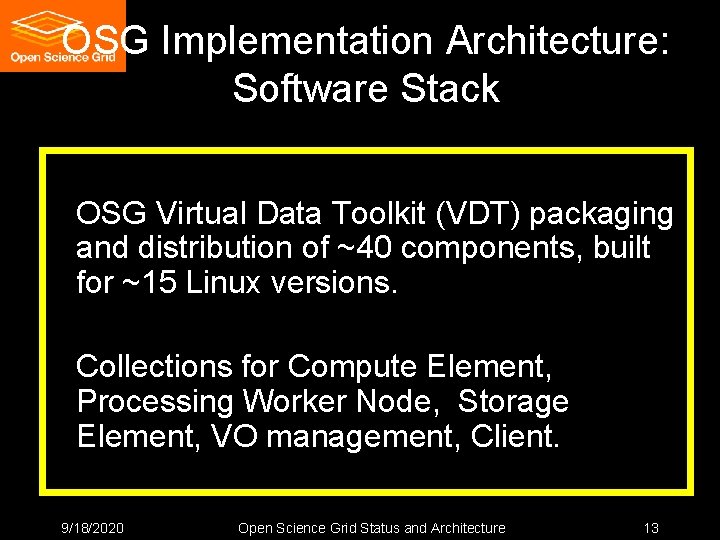
OSG Implementation Architecture: Software Stack OSG Virtual Data Toolkit (VDT) packaging and distribution of ~40 components, built for ~15 Linux versions. Collections for Compute Element, Processing Worker Node, Storage Element, VO management, Client. 9/18/2020 Open Science Grid Status and Architecture 13
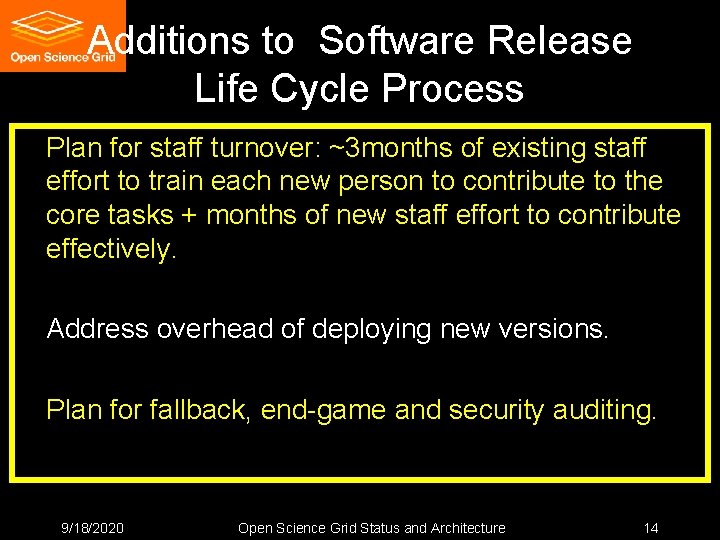
Additions to Software Release Life Cycle Process Plan for staff turnover: ~3 months of existing staff effort to train each new person to contribute to the core tasks + months of new staff effort to contribute effectively. Address overhead of deploying new versions. Plan for fallback, end-game and security auditing. 9/18/2020 Open Science Grid Status and Architecture 14
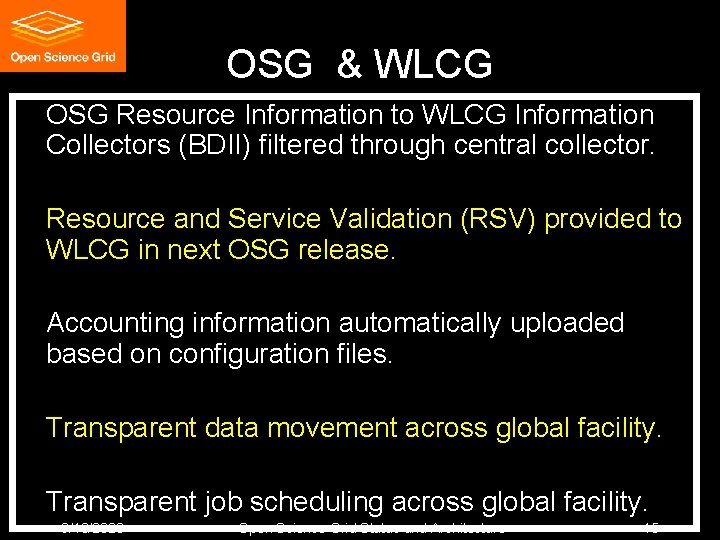
OSG & WLCG OSG Resource Information to WLCG Information Collectors (BDII) filtered through central collector. Resource and Service Validation (RSV) provided to WLCG in next OSG release. Accounting information automatically uploaded based on configuration files. Transparent data movement across global facility. Transparent job scheduling across global facility. 9/18/2020 Open Science Grid Status and Architecture 15
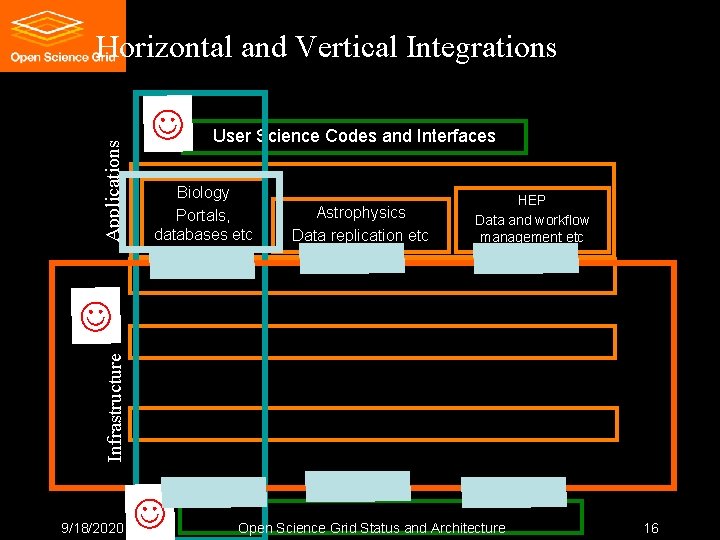
Applications Horizontal and Vertical Integrations User Science Codes and Interfaces Biology Portals, databases etc Astrophysics Data replication etc HEP Data and workflow management etc Infrastructure 9/18/2020 Open Science Grid Status and Architecture 16
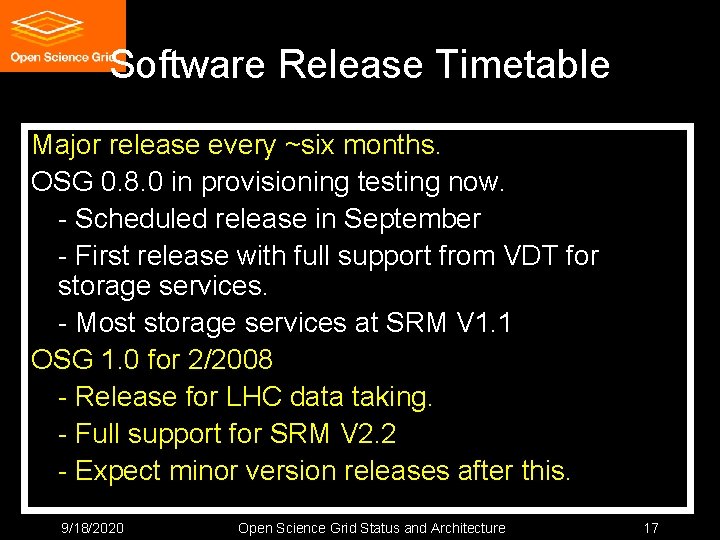
Software Release Timetable Major release every ~six months. OSG 0. 8. 0 in provisioning testing now. - Scheduled release in September - First release with full support from VDT for storage services. - Most storage services at SRM V 1. 1 OSG 1. 0 for 2/2008 - Release for LHC data taking. - Full support for SRM V 2. 2 - Expect minor version releases after this. 9/18/2020 Open Science Grid Status and Architecture 17
Reliance on External Software Providers Model is open source software. Groups -communities, projects -- contribute to the software for value to them. 9/18/2020 Open Science Grid Status and Architecture 18
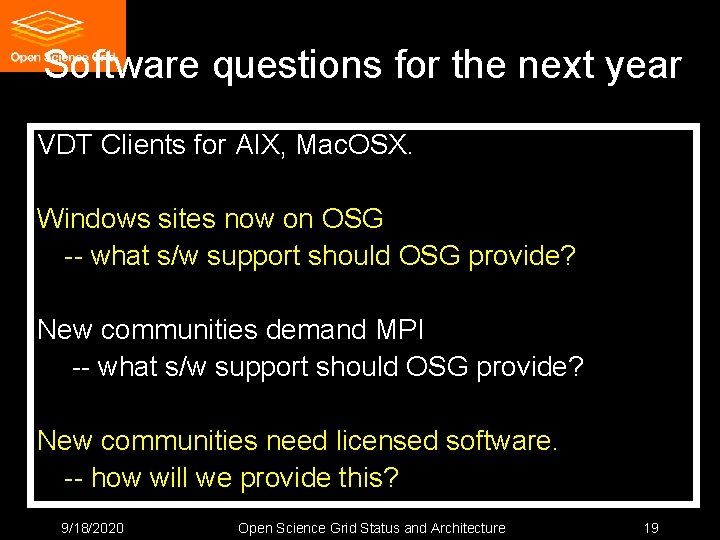
Software questions for the next year VDT Clients for AIX, Mac. OSX. Windows sites now on OSG -- what s/w support should OSG provide? New communities demand MPI -- what s/w support should OSG provide? New communities need licensed software. -- how will we provide this? 9/18/2020 Open Science Grid Status and Architecture 19
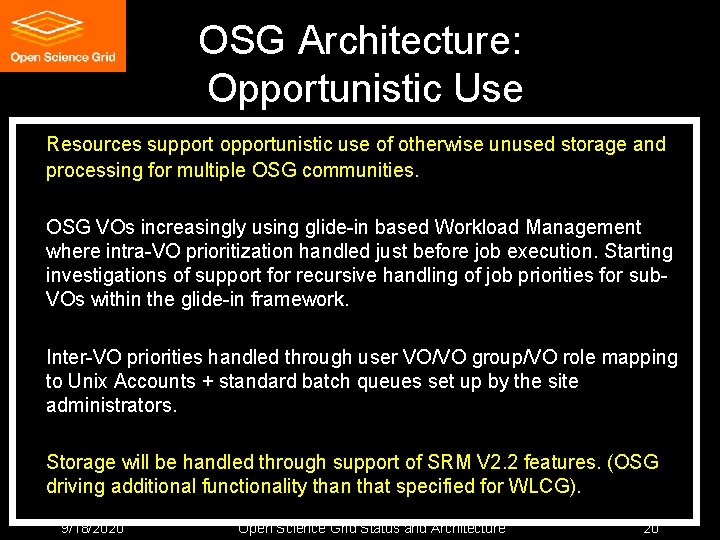
OSG Architecture: Opportunistic Use Resources support opportunistic use of otherwise unused storage and processing for multiple OSG communities. OSG VOs increasingly using glide-in based Workload Management where intra-VO prioritization handled just before job execution. Starting investigations of support for recursive handling of job priorities for sub. VOs within the glide-in framework. Inter-VO priorities handled through user VO/VO group/VO role mapping to Unix Accounts + standard batch queues set up by the site administrators. Storage will be handled through support of SRM V 2. 2 features. (OSG driving additional functionality than that specified for WLCG). 9/18/2020 Open Science Grid Status and Architecture 20
Past Year has seen successes in Opportunistic Use Accounting measures use by “non-owners”: currently around 20 -30% of usage. Biggest beneficiary was D 0. (see the talk for the gain and the pain) We are committed to improve the effectiveness and increase this service through LHC commissioning, data taking and analysis. 9/18/2020 Open Science Grid Status and Architecture 21
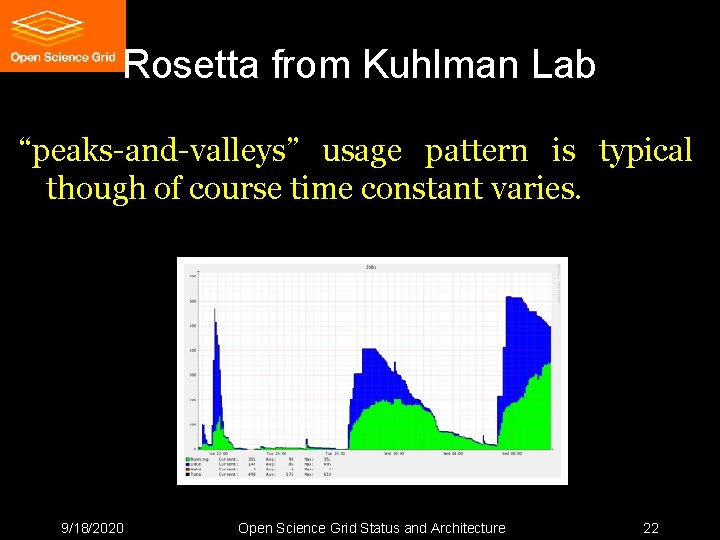
Rosetta from Kuhlman Lab “peaks-and-valleys” usage pattern is typical though of course time constant varies. 9/18/2020 Open Science Grid Status and Architecture 22
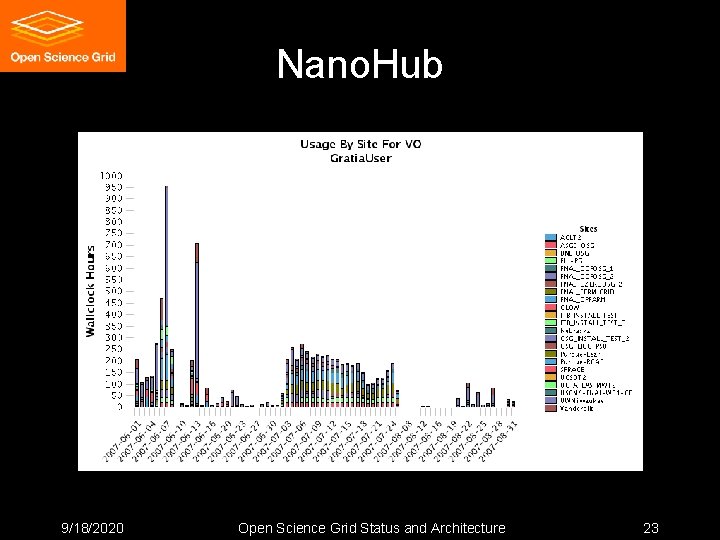
Nano. Hub 9/18/2020 Open Science Grid Status and Architecture 23
OSG Architecture: Campus Infrastructure: gateway to national grid The OSG software stack aims to support: Sharing of resources across multi-organization University Campus. (In the US this also involves a cultural change and model of trust, which OSG can help facilitate). Single bi-directional points of entry between campus and national infrastructure allowing centralized local management, monitoring and support. Gateways that enable protocol translation while maintaining performant end-to-end transport of data and jobs between infrastructures. 9/18/2020 Open Science Grid Status and Architecture 24
OSG is on the road working with many colleagues! Significant % of ATLAS and CMS data and job throughput supported by the infrastructure. US ATLAS and US CMS make significant contributions in terms of resources and effort. STAR, CDF, D 0, LIGO, Mini. Boone all acknowledge contributions and themselves contribute. Many talks and posters refer to work on and contributions to the Consortium. 9/18/2020 Open Science Grid Status and Architecture 25