
The ontology development process 1 Each modeller has
- Slides: 2
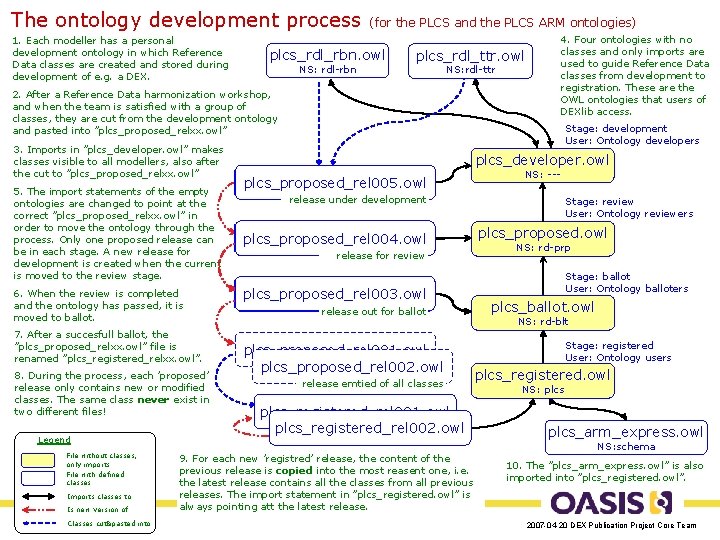
The ontology development process 1. Each modeller has a personal development ontology in which Reference Data classes are created and stored during development of e. g. a DEX. (for the PLCS and the PLCS ARM ontologies) plcs_rdl_rbn. owl NS: rdl-rbn plcs_rdl_ttr. owl NS: rdl-ttr 2. After a Reference Data harmonization workshop, and when the team is satisfied with a group of classes, they are cut from the development ontology and pasted into ”plcs_proposed_relxx. owl” 3. Imports in ”plcs_developer. owl” makes classes visible to all modellers, also after the cut to ”plcs_proposed_relxx. owl” 5. The import statements of the empty ontologies are changed to point at the correct ”plcs_proposed_relxx. owl” in order to move the ontology through the process. Only one proposed release can be in each stage. A new release for development is created when the current is moved to the review stage. 6. When the review is completed and the ontology has passed, it is moved to ballot. 7. After a succesfull ballot, the ”plcs_proposed_relxx. owl” file is renamed ”plcs_registered_relxx. owl”. 8. During the process, each ’proposed’ release only contains new or modified classes. The same class never exist in two different files! Legend File without classes, only imports File with defined classes Imports classes to Is new version of Classes cut&pasted into 4. Four ontologies with no classes and only imports are used to guide Reference Data classes from development to registration. These are the OWL ontologies that users of DEXlib access. Stage: development User: Ontology developers plcs_developer. owl plcs_proposed_rel 004. owl plcs_proposed_rel 005. owl plcs_proposed_rel 003. owl plcs_proposed_rel 001. owl plcs_proposed_rel 002. owl NS: --- release under development plcs_proposed_rel 003. owl plcs_proposed_rel 004. owl plcs_proposed_rel 002. owl plcs_proposed_rel 001. owl release for review plcs_proposed_rel 002. owl plcs_proposed_rel 003. owl plcs_proposed_rel 001. owl release out for ballot plcs_proposed_rel 001. owl release emtied of all classes plcs_proposed_rel 002. owl release emtied of all classes plcs_registered_rel 001. owl plcs_registered_rel 002. owl 9. For each new ’registred’ release, the content of the previous release is copied into the most reasent one, i. e. the latest release contains all the classes from all previous releases. The import statement in ”plcs_registered. owl” is always pointing att the latest release. Stage: review User: Ontology reviewers plcs_proposed. owl NS: rd-prp Stage: ballot User: Ontology balloters plcs_ballot. owl NS: rd-blt Stage: registered User: Ontology users plcs_registered. owl NS: plcs_arm_express. owl NS: schema 10. The ”plcs_arm_express. owl” is also imported into ”plcs_registered. owl”. 2007 -04 -20 DEX Publication Project Core Team
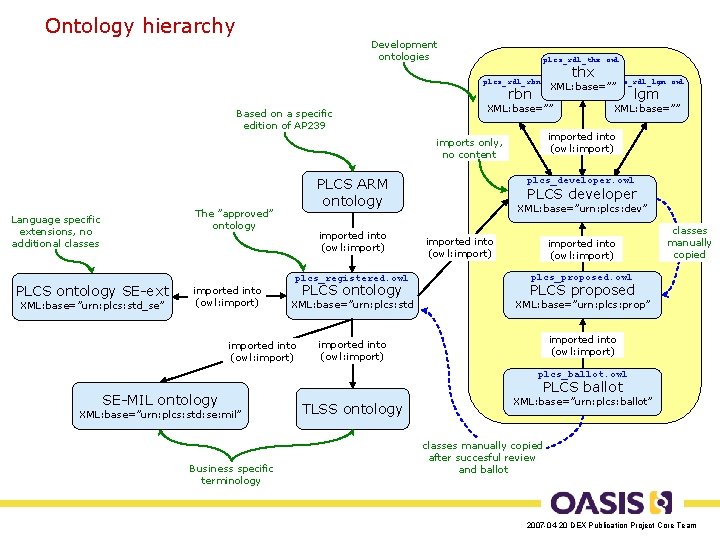
Ontology hierarchy Development ontologies plcs_rdl_thx. owl plcs_rdl_rbn. owl rbn Based on a specific edition of AP 239 XML: base=”” The ”approved” ontology Language specific extensions, no additional classes PLCS ontology SE-ext XML: base=”urn: plcs: std_se” imported into (owl: import) plcs_registered. owl imported into (owl: import) PLCS ontology XML: base=”urn: plcs: std imported into (owl: import) plcs_rdl_lgm. owl lgm XML: base=”” imported into (owl: import) imports only, no content PLCS ARM ontology thx XML: base=”” plcs_developer. owl PLCS developer XML: base=”urn: plcs: dev” imported into (owl: import) classes manually copied plcs_proposed. owl PLCS proposed XML: base=”urn: plcs: prop” imported into (owl: import) plcs_ballot. owl SE-MIL ontology XML: base=”urn: plcs: std: se: mil” Business specific terminology PLCS ballot TLSS ontology XML: base=”urn: plcs: ballot” classes manually copied after succesful review and ballot 2007 -04 -20 DEX Publication Project Core Team