
The Online Disinhibition Effect and its Impact on
The Online Disinhibition Effect and its Impact on the ELearning Environment Summer 2009 Dr. Monica Brooks brooks@marshall. edu
Who said it? It wz d best of tmz, it wz d worst of tmz, it wz d age of wzdm, it wz d age of fulishnss. Amrcnz. . . stil Bl. Ev n an America whr NEthingz poseb. L - dey jst dun tink th. R lead. Rz do. A biz dat maks Ø bt $ isa poor biz.

The Disinhibition Effect Coined by psychology professor, Dr. John Suler, the Disinhibition Effect is a psychological term that describes how people often exhibit less restraint on the internet. People tend to “loosen up, feel more uninhibited, express themselves more openly” online. Some will show more sensitivity to others in the online format, share very personal information readily, or show unusual acts of kindness to virtual strangers.
The Disinhibition Effect Likewise, the effect can also have a dark side. Some people may allow rudeness or rage to take over their emotions when communicating with others online. Others may explore places they would not dare to visit in the real world such as violent sites, pornography, or perform illegal activities such as online stalking or bullying.
Contributing factors: You Don't Know Me (anonymity) - A person is likely to act out and/or speak ones mind when there is no fear that the reader will discover his or her identity. You Can't See Me (invisibility) - In the online environment, you usually can’t see or hear the person on the other end, so the impact of anonymity is enhanced by the invisibility factor. See You Later (asynchronicity) – Usually internet communication is not in real time; so the delayed response can add to the “hit and run” feeling of a hostile posting or email.

Contributing factors: It's All in My Head (solipsistic introjection)- The reader may conflate imagination and fact as he reads a posting from an online posting and “hears” the author’s voice within and/or continues a conversation. Within the imagination, it’s ok to say almost anything…. and that often gets confused. It's Just a Game (dissociative imagination) – If a user creates a persona and interacts with others in a way that is very different from his true self, it’s possible an identity becomes associated with the online communication.

Contributing factors: We're Equals (minimizing authority) – Nobody knows who anyone really is online: a CEO in a Manhattan office and a homeless person at the local public library could have the same online identity. Class, race, body type, attractiveness level, socioeconomic status, etc. aren’t “seen” unless the user discloses. With the appearances of "authority" minimized, people are much more willing to speak out or misbehave. Students who don’t know me will address me as “Monica” in emails…. . I reply with “Ms. or Mr. ” Aspects of the Disinhibition Effect creep into online communication in the education environment.
REdn, Rytn, n Rithmetik Remember when …we had to learn how to write a business letter? …we had to deliver a speech on a topic? …we had to write research papers in a format other than vernacular speech or first person? Proper written and oral communication requires attention to detail; gives the author credibility; aids in relaying skills or abilities; and conveys a message in a professional manner appropriate for the situation. What happened?
Research According to Nielson research data published in August 2009, teens are now sending an average of 2, 272 texts each month on their phones—about 80 messages a day but may only write one research paper in an entire college career. Text messages sacrifice grammar, syntax, and punctuation for slang and brevity. In the recent edutopia newsletter, Sarah Ring suggests “as more and more students immerse themselves in Textspeak over their cell phones and computers, educators worry that their writing skills are suffering. ”
Hey TEchr! Familiar speech, outward hostility, sexual innuendo, the over-sharing of personal information, and other products of the Disinhibition Effect can impact students. It may manifest itself in many ways: Poor language skills: writing and oral communication Inappropriate online communication with teachers and classmates Online cheating and plagiarism Bad online judgment
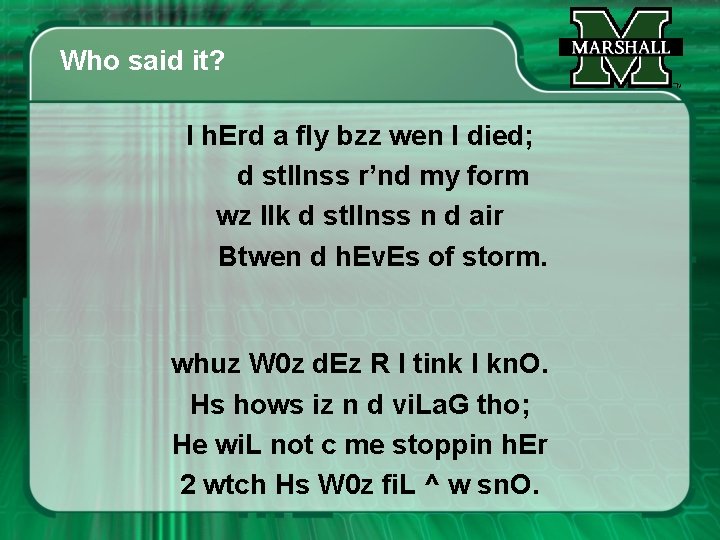
Who said it? I h. Erd a fly bzz wen I died; d stllnss r’nd my form wz l. Ik d stllnss n d air Btwen d h. Ev. Es of storm. whuz W 0 z d. Ez R I tink I kn. O. Hs hows iz n d vi. La. G tho; He wi. L not c me stoppin h. Er 2 wtch Hs W 0 z fi. L ^ w sn. O.
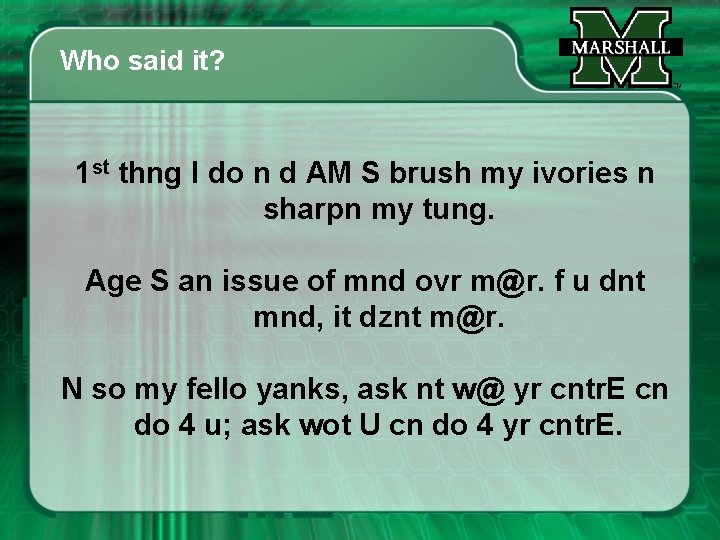
Who said it? 1 st thng I do n d AM S brush my ivories n sharpn my tung. Age S an issue of mnd ovr m@r. f u dnt mnd, it dznt m@r. N so my fello yanks, ask nt w@ yr cntr. E cn do 4 u; ask wot U cn do 4 yr cntr. E.
Poor Language Skills In 2008, the Pew Internet & American Life Project issued a report entitled Writing, technology and teens (2008). http: //www. pewinternet. org/PPF/r/247/report_display. asp In this report, Lenhart, Arafeh, Smith and Rankin Macgill (2008) suggest “many educators and observers have expressed concern that the abbreviated language styles of text messaging, email and wall posts are filtering inappropriately into formal school writing. ”
Poor Language Skills In another article from the Univ. of Illinois newsletter, Mary Trachsel, the head of the UI rhetoric department said when grading student papers, she has noticed a lack of understanding of basic grammar. "They have a hard time telling what is a complete sentence, " she said. "They write with run-ons, sentence fragments, often not following standard writing rules. “ Punctuation also seems to be completely optional when students email professors.
Inappropriate Communication Articles show numerous cases of online threats, cyber stalking, bullying, and examples of postings slanderous remarks about faculty and students on Facebook or Rate My Professor at various universities and colleges. Students have used school networks to perform illegal commercial activity and illegal downloading of copyrighted music or movies cited in several articles. MU’s use policy and systems monitoring aid in identifying activity without violating privacy.
Cheating and Plagiarism Some schools are cracking down on text messaging during class or exams due to cheating. Lack of concern for the writing process and easilyaccessible full text materials have also resulted in widespread plagiarism. Some college-aged students have actually said they didn’t know it was wrong to cut and paste entire portions of books or articles into term papers.
Bad Online Judgment There have been numerous cases in which students have violated the campus code of conduct or state/federal laws and were expelled or prosecuted when officials obtained photos or blog postings of these activities on Facebook or other sites. The Disinhibition Effect allows for self disclosure beyond what is considered appropriate on wall postings and micro blogs (such as Twitter). Religious schools and the military have used social networking sites to expel people they consider deviant.
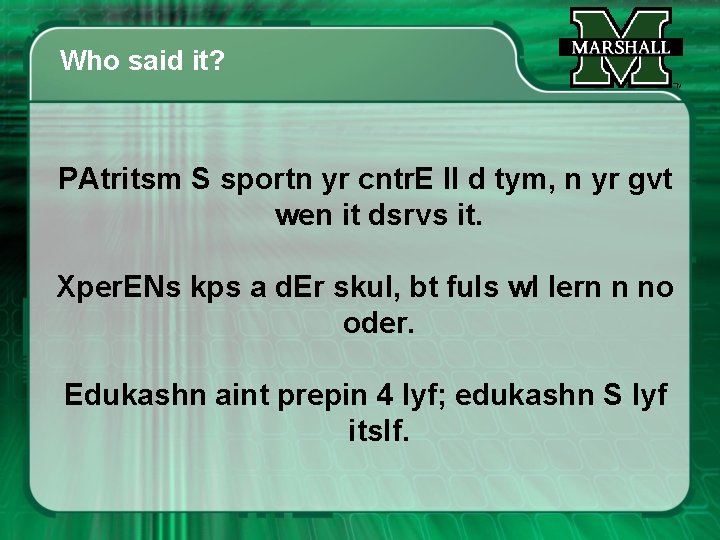
Who said it? PAtritsm S sportn yr cntr. E ll d tym, n yr gvt wen it dsrvs it. Xper. ENs kps a d. Er skul, bt fuls wl lern n no oder. Edukashn aint prepin 4 lyf; edukashn S lyf itslf.
Impact on E-Learning We feel the pain! In a typical semester, I spend hours grading essays, short answer exams, and discussion postings for grammatical and spelling errors instead of content. When students correspond with me, I am surprised at their poor writing skills on email. I am not surprised when I receive chat messages from students with errors or lack of punctuation. I don’t correct these but try to model good skills when I reply.
Impact on E-Learning More and more, online faculty are starting to discuss the impact poor writing skills have on their ability to convey critical content. The professor who may not be confident in his/her ability to grade grammatical or spelling errors may shy away from teaching online altogether. Today’s students can also be demanding; college is no longer a privilege; students are consumers who demand a product. Children trained to write at a rapid-fire pace are failing to think analytically about test answers. They instead answer quickly, with little thinking and few words.
Is there a solution? INFORMATION LITERACY education may help mitigate poor communication habits before they become ingrained. IL skills can provide a foundation for ethical and appropriate use of information while teaching students critical thinking skills. Research is required, but when students learn to think critically, they should be able to weigh the consequences of their online actions. Perhaps this is one way to neutralize the Disinhibition Effect in the classroom!
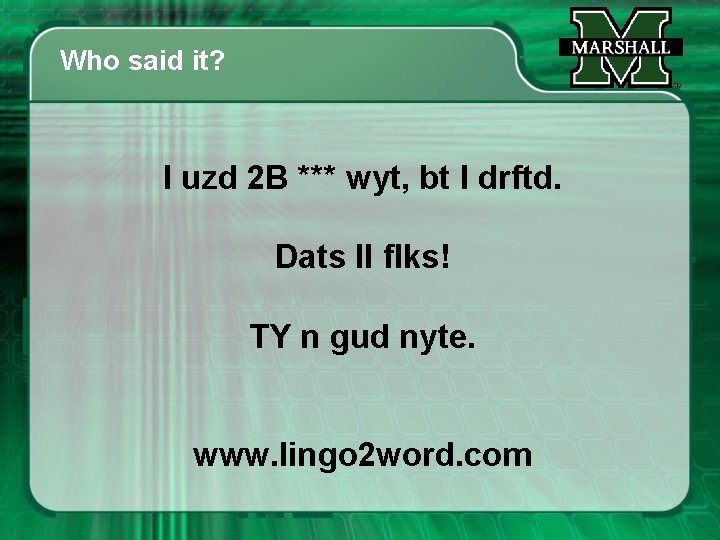
Who said it? I uzd 2 B *** wyt, bt I drftd. Dats ll flks! TY n gud nyte. www. lingo 2 word. com
Resources • Suler, J. (2004). The Online Disinhibition Effect. Cyber. Psychology and Behavior, 7, 321 -326 • Text messaging Tips: Texas State Univ: – http: //www. writingcenter. txstate. edu/Englishes/Text-Messaging. html • Does Text Messaging hurt Student Writing Skills? – http: //www. vantagelearning. com/docs/articles/myaccess. ut. american. t eacher. 20071101. pdf • Web rage and the disinhibition effect: – http: //urbansemiotic. com/2007/06/15/impulsive-web-rage-and-theonline-disinhibition-effect/ • Switched: Text Messaging Stunts Writing Skills: – http: //www. switched. com/2007/05/01/text-messaging-stunts-writingskills
Resources • Dangers and delights of internet disinhibition: – http: //www. pickthebrain. com/blog/the-dangers-and-delights-ofinternet-disinhibition/ • Instant Messaging: Friend or Foe to Student Writing? – http: //www. newhorizons. org/strategies/literacy/oconnor. htm • Text Messaging may be Harming Writing Abilities: – http: //www. dailyvidette. com/home/index. cfm? event=display. Article Printer. Friendly&u. Story_id=03 e 97 cee-1414 -40 be-99 fb-fa 24 de 3 eeb 83 • Do Text messages Count as Writing? Should They? – http: //community. greatschools. net/q-and-a/290911/Do-textmessages-count-as-writing-Should-they • When is poor punctuation ok? – http: //www. education. com/magazine/article/Punctuation/
- Slides: 24