
The One Minute Learner An Innovative Tool to
- Slides: 20
The One Minute Learner An Innovative Tool to Promote Student-Faculty Discussion of Goals and Expectations Miriam Hoffman-Kleiner, MD Molly Cohen-Osher, MD Medical Student Education Division Department of Family Medicine Boston University School of Medicine
Think back to when you were a third-year student… • What did you want to know when you started a new rotation? • How did you feel when you started? • How empowered did you feel? • What was hard about it? • What was helpful to you?
Why is Setting Expectations Important? • For the learner • • • For the educator • • • Clarifies role Gives a sense of structure Decreases anxiety Sets groundwork for feedback and assessment Helps student to “ hit the ground running” Student is more effective in the office Sets groundwork for feedback and assessment Improves efficiency Puts educator and learner on “the same page”
Why is Setting Learning Goals Important? • For the learner • • • Facilitates self-directed learning behavior Improves learner-educator relationship Increased motivation to learn and deeper learning Learner’s needs/goals are valued For the educator • Gives a framework for clinical teaching • Identifies student’s level and needs • Facilitates a learning experience that is “learner-directed” • Puts educator and learner on “the same page” Bullock et al. , 2007, Chien et al. , 2002, Challis, 2000, Jones-Boggs Rye, 2008, Knowles, 1986
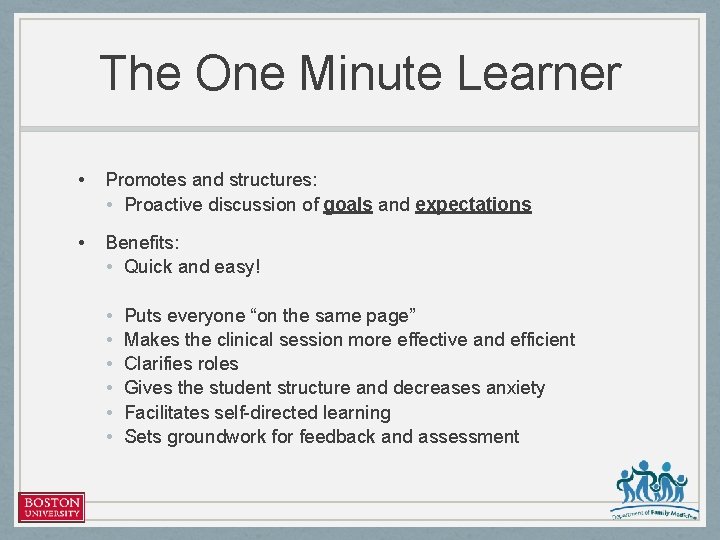
The One Minute Learner • Promotes and structures: • Proactive discussion of goals and expectations • Benefits: • Quick and easy! • • • Puts everyone “on the same page” Makes the clinical session more effective and efficient Clarifies roles Gives the student structure and decreases anxiety Facilitates self-directed learning Sets groundwork for feedback and assessment
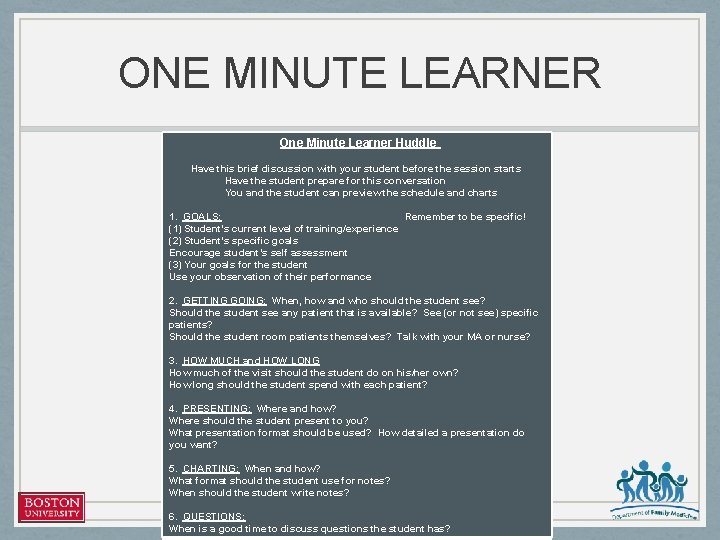
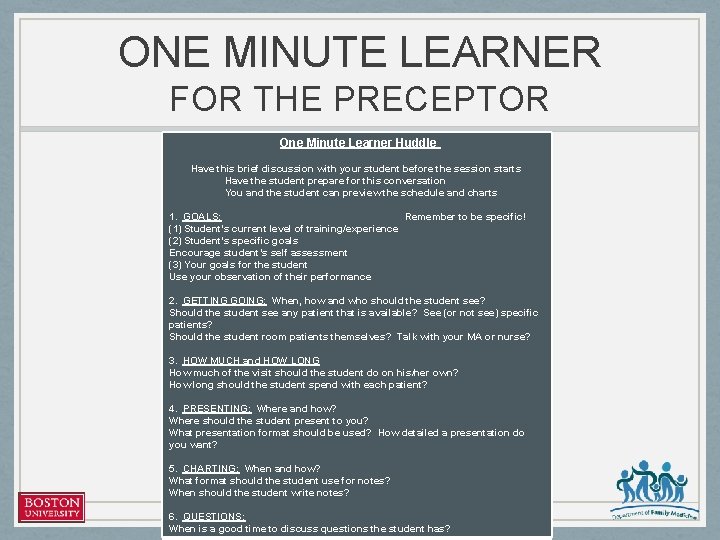
ONE MINUTE LEARNER One Minute Learner Huddle Have this brief discussion with your student before the session starts Have the student prepare for this conversation You and the student can preview the schedule and charts 1. GOALS: Remember to be specific! (1) Student’s current level of training/experience (2) Student’s specific goals Encourage student’s self assessment (3) Your goals for the student Use your observation of their performance 2. GETTING GOING: When, how and who should the student see? Should the student see any patient that is available? See (or not see) specific patients? Should the student room patients themselves? Talk with your MA or nurse? 3. HOW MUCH and HOW LONG How much of the visit should the student do on his/her own? How long should the student spend with each patient? 4. PRESENTING: Where and how? Where should the student present to you? What presentation format should be used? How detailed a presentation do you want? 5. CHARTING: When and how? What format should the student use for notes? When should the student write notes? 6. QUESTIONS: When is a good time to discuss questions the student has?
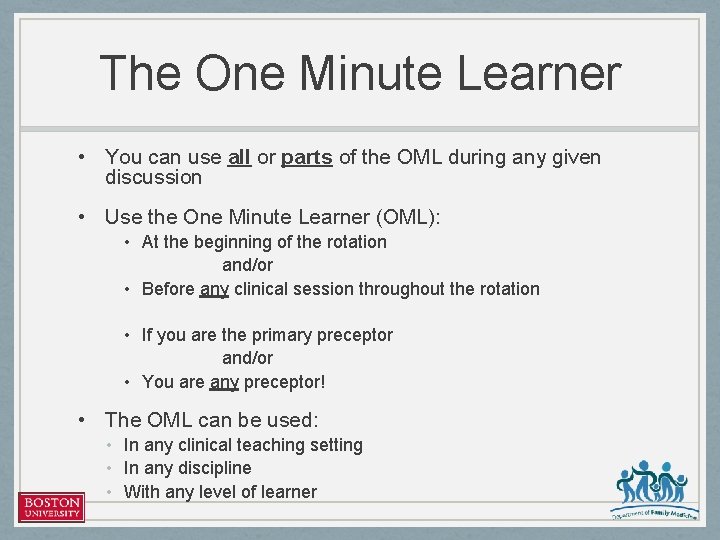
The One Minute Learner • You can use all or parts of the OML during any given discussion • Use the One Minute Learner (OML): • At the beginning of the rotation and/or • Before any clinical session throughout the rotation • If you are the primary preceptor and/or • You are any preceptor! • The OML can be used: • In any clinical teaching setting • In any discipline • With any level of learner
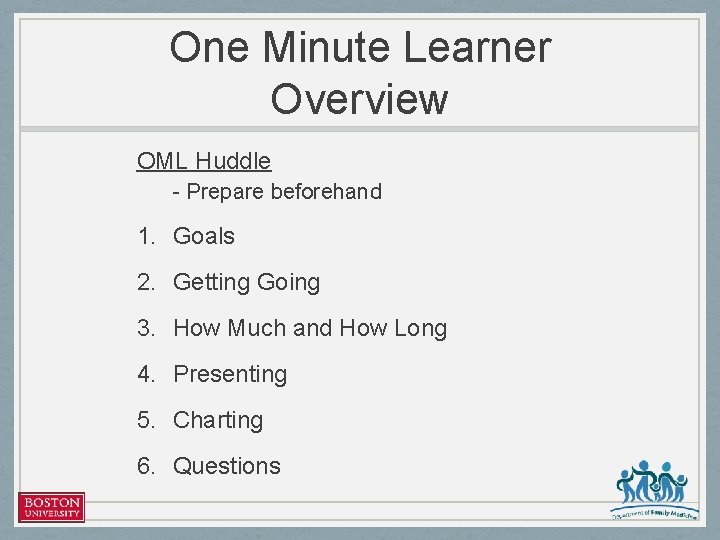
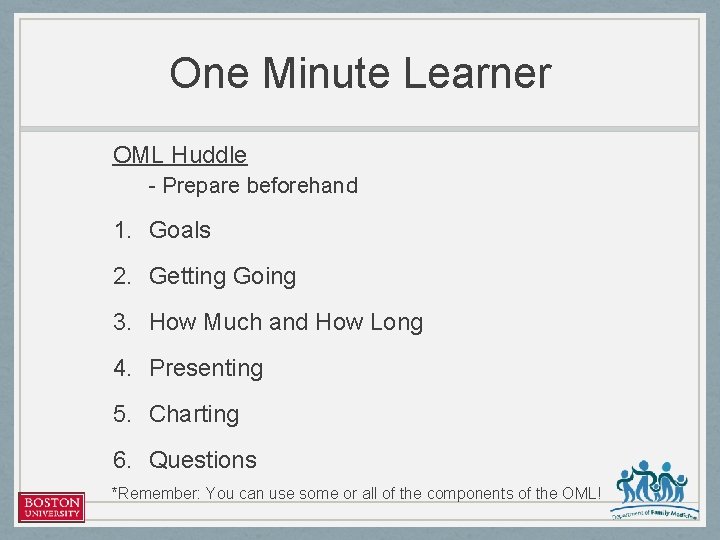
One Minute Learner Overview OML Huddle - Prepare beforehand 1. Goals 2. Getting Going 3. How Much and How Long 4. Presenting 5. Charting 6. Questions
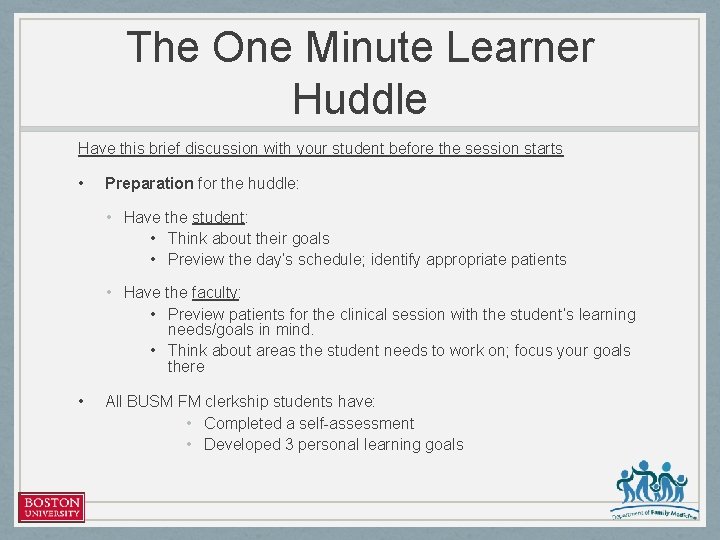
The One Minute Learner Huddle Have this brief discussion with your student before the session starts • Preparation for the huddle: • Have the student: • Think about their goals • Preview the day’s schedule; identify appropriate patients • Have the faculty: • Preview patients for the clinical session with the student’s learning needs/goals in mind. • Think about areas the student needs to work on; focus your goals there • All BUSM FM clerkship students have: • Completed a self-assessment • Developed 3 personal learning goals
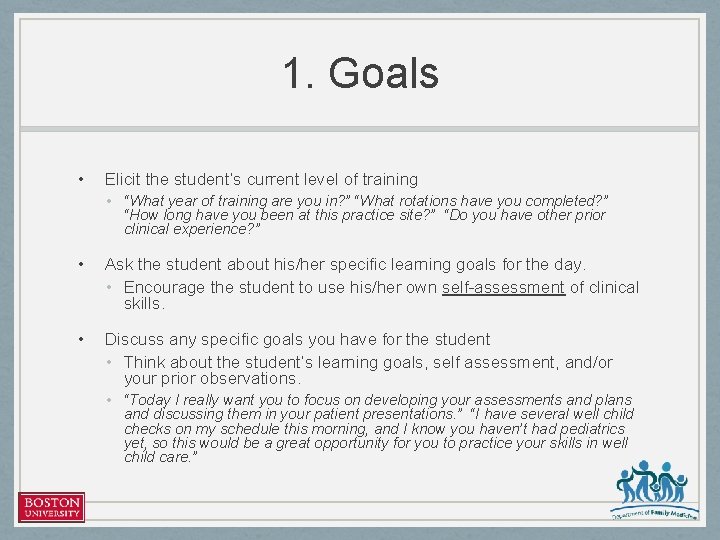
1. Goals • Elicit the student’s current level of training • “What year of training are you in? ” “What rotations have you completed? ” “How long have you been at this practice site? ” “Do you have other prior clinical experience? ” • Ask the student about his/her specific learning goals for the day. • Encourage the student to use his/her own self-assessment of clinical skills. • Discuss any specific goals you have for the student • Think about the student’s learning goals, self assessment, and/or your prior observations. • “Today I really want you to focus on developing your assessments and plans and discussing them in your patient presentations. ” “I have several well child checks on my schedule this morning, and I know you haven’t had pediatrics yet, so this would be a great opportunity for you to practice your skills in well child care. ”
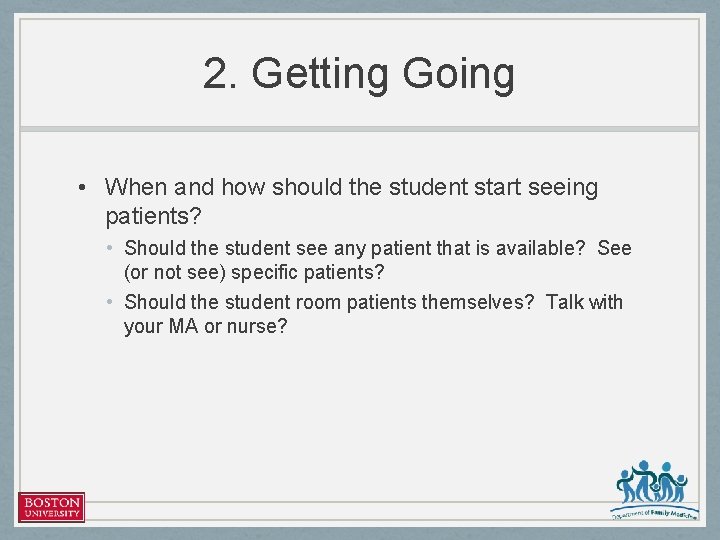
2. Getting Going • When and how should the student start seeing patients? • Should the student see any patient that is available? See (or not see) specific patients? • Should the student room patients themselves? Talk with your MA or nurse?
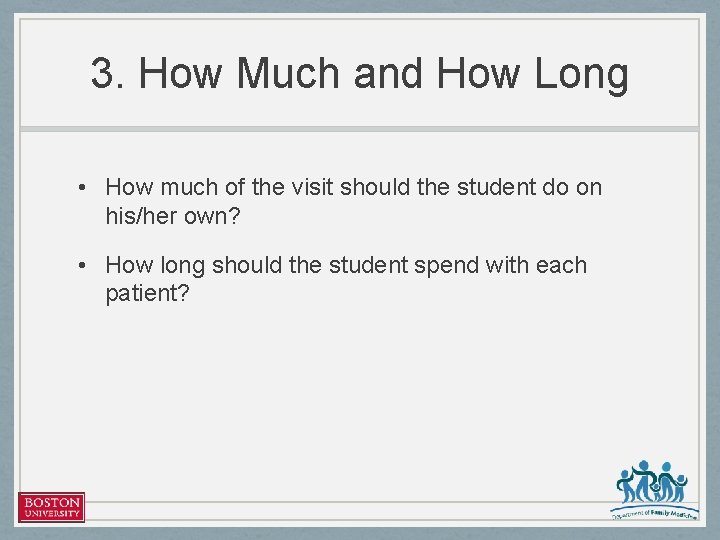
3. How Much and How Long • How much of the visit should the student do on his/her own? • How long should the student spend with each patient?
4. Presenting • Where should the student present to you? • What presentation format should be used? How detailed a presentation do you want?
5. Charting • What format should the student use for notes? • When should the student write notes?
6. Questions • When is a good time to discuss questions the student has?
ONE MINUTE LEARNER FOR THE PRECEPTOR One Minute Learner Huddle Have this brief discussion with your student before the session starts Have the student prepare for this conversation You and the student can preview the schedule and charts 1. GOALS: Remember to be specific! (1) Student’s current level of training/experience (2) Student’s specific goals Encourage student’s self assessment (3) Your goals for the student Use your observation of their performance 2. GETTING GOING: When, how and who should the student see? Should the student see any patient that is available? See (or not see) specific patients? Should the student room patients themselves? Talk with your MA or nurse? 3. HOW MUCH and HOW LONG How much of the visit should the student do on his/her own? How long should the student spend with each patient? 4. PRESENTING: Where and how? Where should the student present to you? What presentation format should be used? How detailed a presentation do you want? 5. CHARTING: When and how? What format should the student use for notes? When should the student write notes? 6. QUESTIONS: When is a good time to discuss questions the student has?
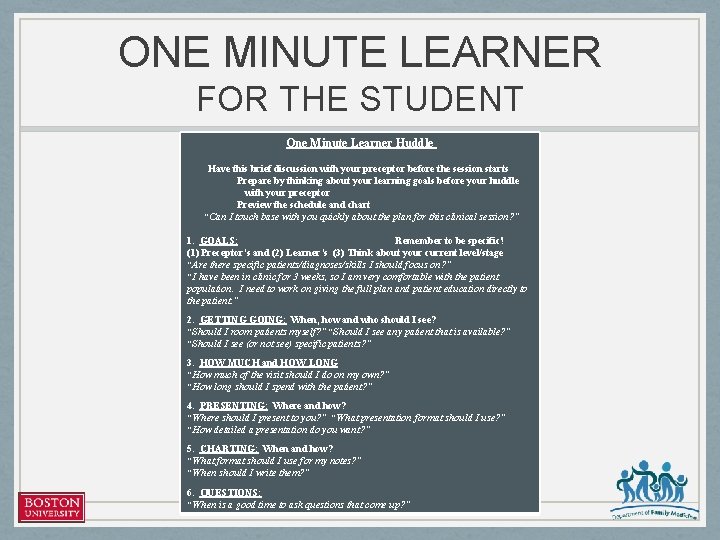
ONE MINUTE LEARNER FOR THE STUDENT One Minute Learner Huddle Have this brief discussion with your preceptor before the session starts Prepare by thinking about your learning goals before your huddle with your preceptor Preview the schedule and chart “Can I touch base with you quickly about the plan for this clinical session? ” 1. GOALS: Remember to be specific! (1) Preceptor’s and (2) Learner’s (3) Think about your current level/stage “Are there specific patients/diagnoses/skills I should focus on? ” “I have been in clinic for 3 weeks, so I am very comfortable with the patient population. I need to work on giving the full plan and patient education directly to the patient. ” 2. GETTING GOING: When, how and who should I see? “Should I room patients myself? ” “Should I see any patient that is available? ” “Should I see (or not see) specific patients? ” 3. HOW MUCH and HOW LONG “How much of the visit should I do on my own? ” “How long should I spend with the patient? ” 4. PRESENTING: Where and how? “Where should I present to you? ” “What presentation format should I use? ” “How detailed a presentation do you want? ” 5. CHARTING: When and how? “What format should I use for my notes? ” “When should I write them? ” 6. QUESTIONS: “When is a good time to ask questions that come up? ”
One Minute Learner OML Huddle - Prepare beforehand 1. Goals 2. Getting Going 3. How Much and How Long 4. Presenting 5. Charting 6. Questions *Remember: You can use some or all of the components of the OML!
Case Debrief
Questions • What are your pearls and best practices for discussing goals and expectations with learners? • How could you use the One Minute Learner in your practice?