
The Ombudsman Complaint Management Health Service Complaints Emer

The Ombudsman Complaint Management Health Service Complaints Emer Doyle Investigator

Complaint Management • Ombudsman’s role and processes • Complaint Management – the life cycle of a complaint • Learning to Get Better • Redress and Apology
The Role of the Ombudsman • To examine complaints about public service providers: • Independently • Impartially • Evidence based • To influence improvements
Role of the Ombudsman • Main focus of Ombudsman is resolution of individual complaints but also role in improving services • Generally process is quite informal • Ombudsman sets own procedures • Ombudsman is not an advocate -must be fair to all parties
Status of the Office • Independent – does not report to Minister • Over 50 full-time staff / budget of € 5. 975 million (2016) • Recruitment of health and social care specialists
Legislation • The Ombudsman Act 1980 describes the powers of the Ombudsman as regards the examination and investigation of complaints – exclusion in respect of clinical judgment. • Most significant amendment to this Act contained in the Ombudsman (Amendment) Act 2012 – over 180 bodies brought within remit • Most recent amendment - S. I. 300 of 2015 brought private nursing homes within remit for actions which occurred on or after 24 August 2015
Section 4 : Outlines the functions of the Ombudsman • The Ombudsman may investigate any action taken by or on behalf of a reviewable agency in the performance of administrative functions if that action has or may have resulted in an adverse affect • Reviewable agencies cannot complain about other reviewable agencies • Staff of a reviewable agency can only complain to the Ombudsman in their ‘private capacity’
Maladministration checklist • taken without proper authority • taken on irrelevant grounds • the result of negligence or carelessness • based on incorrect or incomplete information • improperly discriminatory • based on an undesirable administrative practice • a failure to provide reasonable assistance • otherwise contrary to fair or sound administration
Ombudsman’s Powers • Set out in the Ombudsman Acts (1980, amended in 2012) • We can get all relevant records and interview anyone connected to complaints • We can make non-binding recommendations and report to the Oireachtas if they are not implemented.
What we can’t examine • • Private Hospitals Matters before the courts (discretionary) Actions more than 12 months ago (discretionary) Clinical judgement (in the Ombudsman’s opinion)
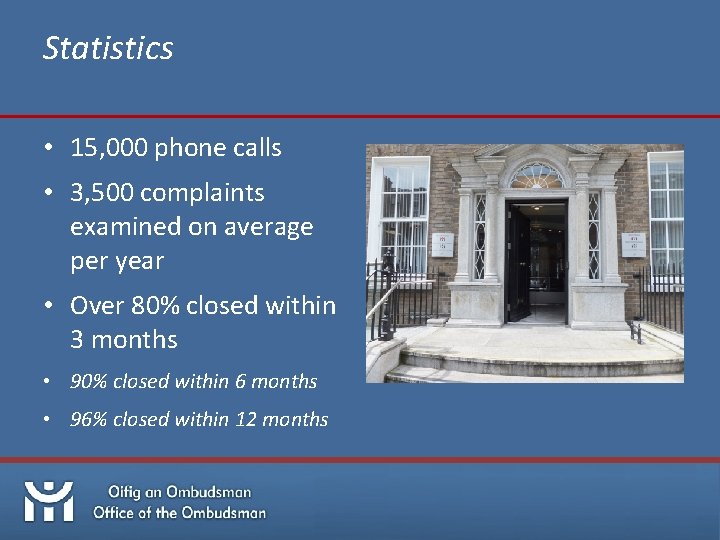
Statistics • 15, 000 phone calls • 3, 500 complaints examined on average per year • Over 80% closed within 3 months • 90% closed within 6 months • 96% closed within 12 months

Complaint Closure Categories Upheld Partially Upheld Assistance Provided Not Upheld • Complaint substantiated • Some aspects of complaint substantiated • Better explanation/other benefit as result of complaint • Complaint not substantiated
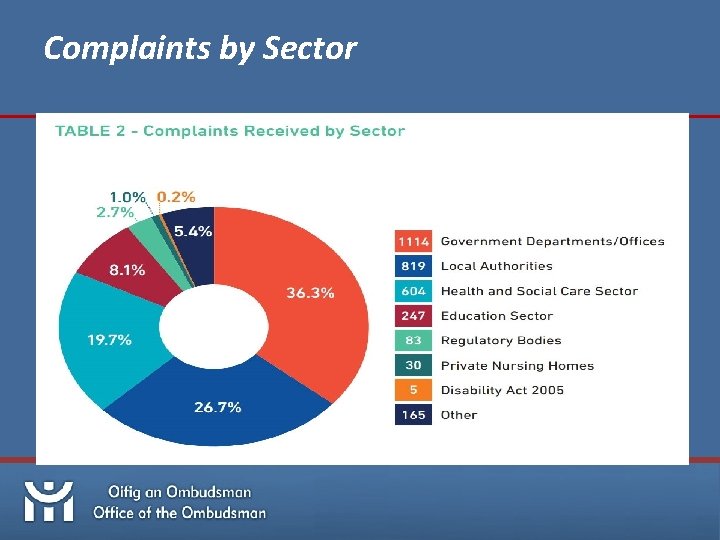
Complaints by Sector
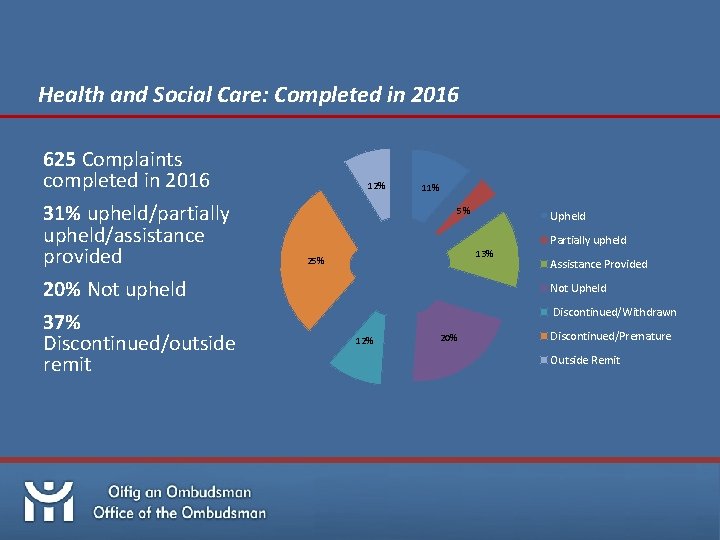
Health and Social Care: Completed in 2016 625 Complaints completed in 2016 31% upheld/partially upheld/assistance provided 12% 11% 5% Upheld Partially upheld 13% 25% Assistance Provided 20% Not upheld Not Upheld 37% Discontinued/outside remit Discontinued/Withdrawn 12% 20% Discontinued/Premature Outside Remit
Why are complaints important? ‘ A health Service that does not listen to complaints is unlikely to reflect it’s patients’ needs. One that does will be more likely to detect the early warning signs that something requires correction, to address such issues and protect others from harmful treatment. ’ Sir Robert Francis QC –Mid Staffordshire Trust hospital scandal
Why Do People Complain? • They feel hurt and let down • They want a full explanation • Lessons learned to avoid the problem occurring again • To receive feedback • They want to know what happens next • To receive a meaningful apology

The Complaint Examination Process 4 Stages Healthcare complaints Phone Personal Caller Post CICs Email Website

The life cycle of a complaint (and what you can expect) • Complaint received in Enquiries – initial assessment to check that complaint is valid (with 12 months, evidence of adverse affect, etc. ) and within remit (concerns a reviewable agency) • Deals with all “non-reply to correspondence” • Otherwise complaints are sent to Assessment Unit (or Examination Unit in respect of some health and social care complaints)

The life cycle of a complaint (and what you can expect) • Complaint received in Assessment (or Examination) Unit • Acknowledgement sent to complainant with investigator or caseworker details – will often ring complainant also to clarify complaint and redress sought.
The life cycle of a complaint (and what you can expect) • Will request report from reviewable agency – usually 3 weeks deadline set • In health and social care cases, will send request to Liaison Officers in first instance (with exception of section 38 and 39 bodies) • May also request medical files (consent) and complaint files
The life cycle of a complaint (and what you can expect) • Section 7 – power to require any person to furnish information or document • Must be complied with – otherwise possibility of Circuit Court proceedings • If any delay anticipated – phone or email!
The life cycle of a complaint (and what you can expect) • Once report is received, it will be examined • May seek further information and/or speak to members of staff before reaching a decision on a complaint • But remember – focus is on systems not individuals.
Learning to Get Better An investigation by the Ombudsman into how public hospitals handle complaints
This investigation looked at • How well the HSE and public hospitals listen to feedback and concerns • Whether the HSE and public hospitals are learning from complaints to improve services
Made a number of recommendations… • HSE and hospitals must publicise the information and supports available in order to encourage and assist people to share their experiences. • A “no wrong door” policy should be developed
How should the process work? • A standardised structure for collecting and documenting a complaint should be developed - the nature of the complaint - the preferred method of communication - the desired outcome • There is a need for proportionate, objective and thorough investigations
The outcome of any investigation should be conveyed in writing to the complainant • Each issue should be responded to • Details of any proposed changes to hospital practices and procedures should be included in the response
But learning from complaints is as important as the process • There needs to be a new focus on learning and sharing the learning • Should sit alongside learning from other sources such as adverse events or “near misses”.
When things go wrong… The service should • Be open and honest with the patient / service user • Put things right where possible for the patient / user • Learn from the mistake • Introduce procedures and practices to prevent recurrence • Make sure the lessons learnt from the investigation of complaints feed back into the system to benefit the users and service providers alike.
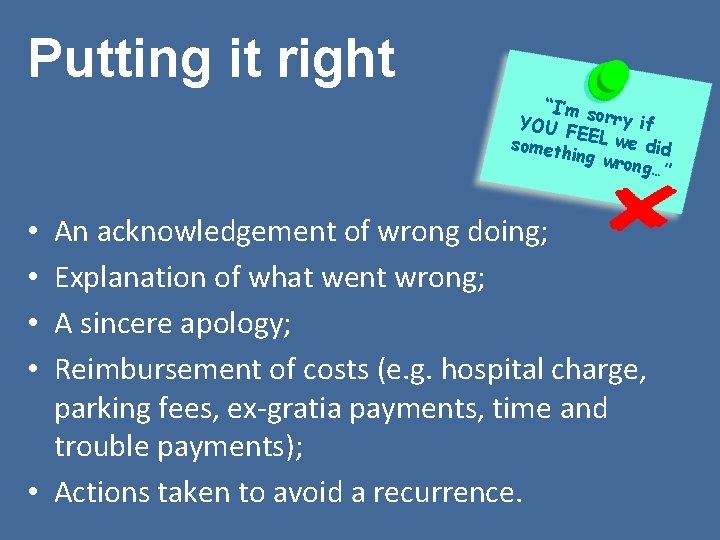
Putting it right “I’m s YOU F orry if E someth EL we did ing wr ong…” An acknowledgement of wrong doing; Explanation of what went wrong; A sincere apology; Reimbursement of costs (e. g. hospital charge, parking fees, ex-gratia payments, time and trouble payments); • Actions taken to avoid a recurrence. • •
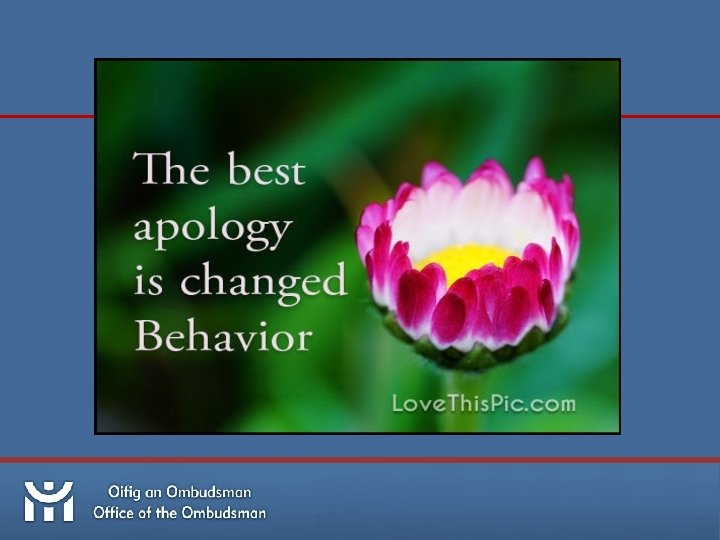
Why Apologise? • An apology shows an individual or agency taking responsibility for its actions and the research shows that this is what many people are looking for. • Restored relationship for on-going care • Systemic benefits- learning from an event • Financial benefits
‘ never ruin an apology with an excuse’ - Benjamin Franklin
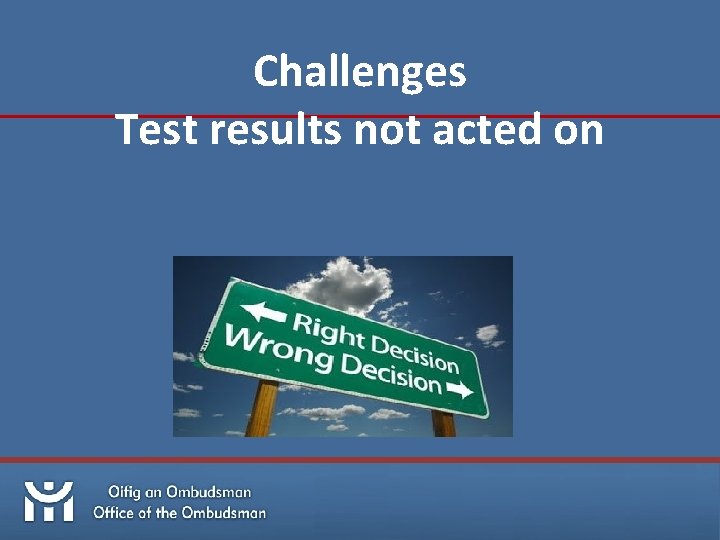
Challenges Test results not acted on
Complaint Outcome • A sincere written apology to the complainant for the distress caused • The hospital outlined what happened, • Acknowledged the delay in dealing with the complaint • Explained the steps taken since to avoid recurrence • The Consultant undertook to ensure a discharge summary was completed and sent to the GP.
Remember. . • Follow complaints policy • Apologise if necessary • Look after staff • Advise complainants of their right to complain to the Ombudsman • You can’t win them all…
- Slides: 36