
The Old Testament A Very Brief Overview Whats

The Old Testament: A Very Brief Overview
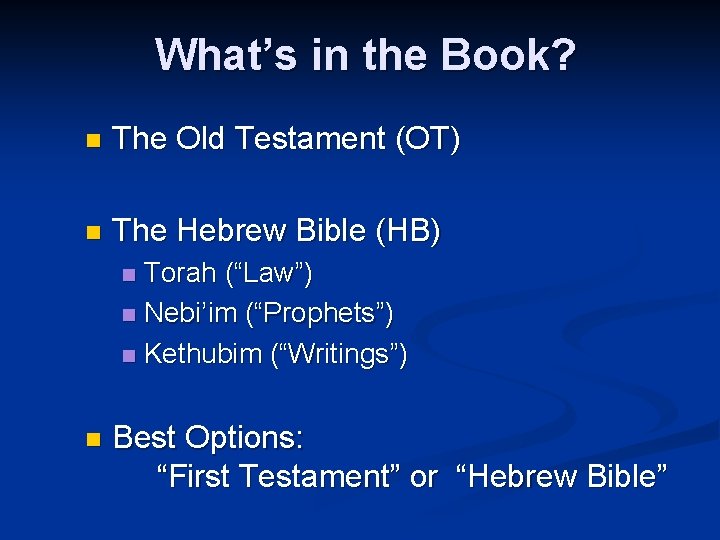
What’s in the Book? n The Old Testament (OT) n The Hebrew Bible (HB) Torah (“Law”) n Nebi’im (“Prophets”) n Kethubim (“Writings”) n n Best Options: “First Testament” or “Hebrew Bible”

“If Christians continue to use ‘Old Testament’ (and in my judgment that is preferable), they must make clear that the term is not pejorative, but descriptive, serving the purpose of distinguishing the books so designated from the New Testament. In traditional Christian thought the Old Testament is Scripture, just as sacred and enduringly valid as the New Testament. ” n Raymond E. Brown, An Introduction to the New Testament, p. xxxiv.
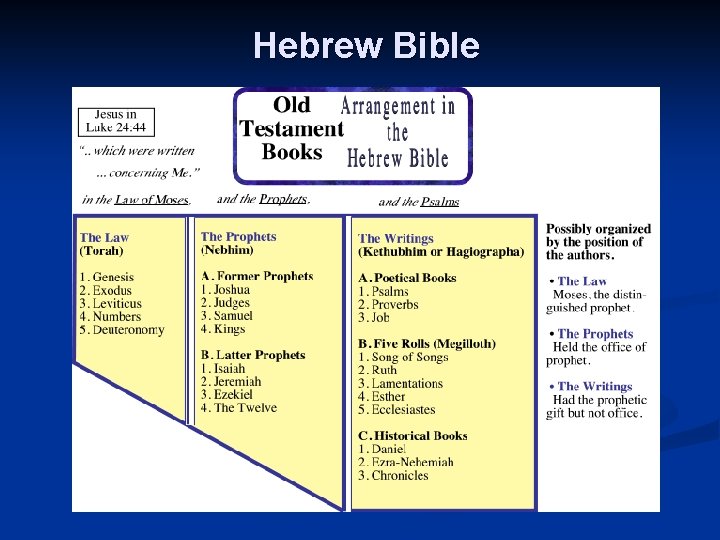
Hebrew Bible


English Bible The Structure of the English Old Testament (English 39 = Books) Pentateuch (5) n Historical Books (12) n Poetry and Wisdom (5) n Major Prophets (5) n Minor Prophets (12) n
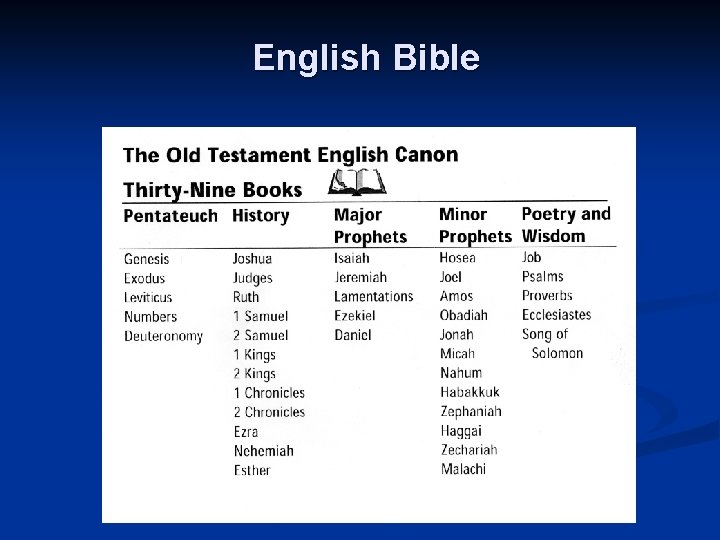
English Bible
Historical Context The Biblical Times
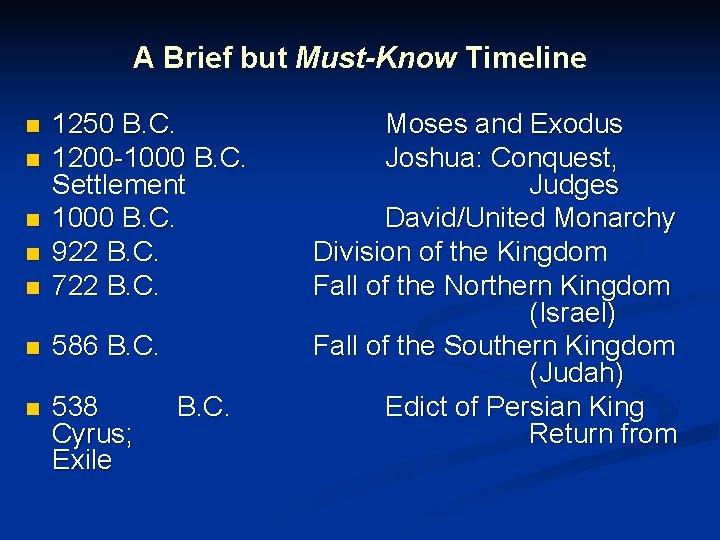
A Brief but Must-Know Timeline n 1250 B. C. 1200 -1000 B. C. Settlement 1000 B. C. 922 B. C. 722 B. C. n 586 B. C. n 538 Cyrus; Exile n n B. C. Moses and Exodus Joshua: Conquest, Judges David/United Monarchy Division of the Kingdom Fall of the Northern Kingdom (Israel) Fall of the Southern Kingdom (Judah) Edict of Persian King Return from

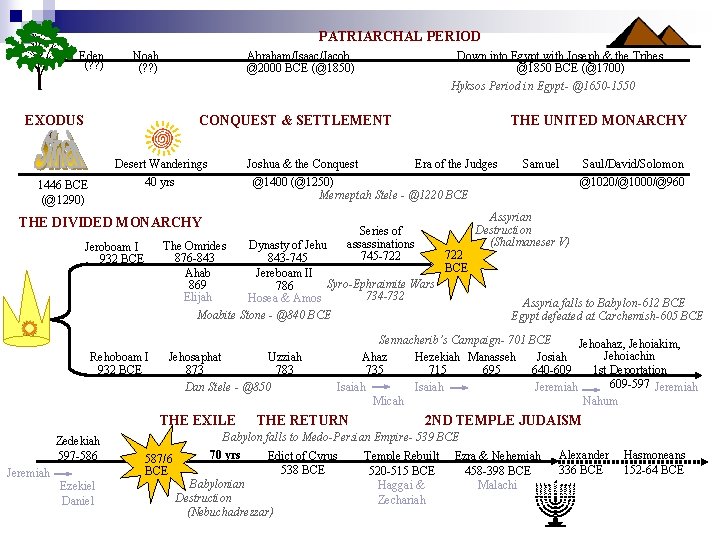
PATRIARCHAL PERIOD Eden (? ? ) Noah (? ? ) EXODUS Abraham/Isaac/Jacob @2000 BCE (@1850) CONQUEST & SETTLEMENT Desert Wanderings 40 yrs 1446 BCE (@1290) Dynasty of Jehu 722 843 -745 BCE Jereboam II Syro-Ephraimite Wars 786 734 -732 Hosea & Amos Moabite Stone - @840 BCE Rehoboam I 932 BCE Jehosaphat Uzziah 873 783 Dan Stele - @850 THE EXILE Ezekiel Daniel Series of assassinations 745 -722 The Omrides 876 -843 Ahab 869 Elijah Jeroboam I 932 BCE Zedekiah 597 -586 THE UNITED MONARCHY Joshua & the Conquest Era of the Judges @1400 (@1250) Merneptah Stele - @1220 BCE THE DIVIDED MONARCHY Jeremiah Down into Egypt with Joseph & the Tribes @1850 BCE (@1700) Hyksos Period in Egypt- @1650 -1550 Samuel Saul/David/Solomon @1020/@1000/@960 Assyrian Destruction (Shalmaneser V) Assyria falls to Babylon-612 BCE Egypt defeated at Carchemish-605 BCE Sennacherib’s Campaign- 701 BCE Jehoahaz, Jehoiakim, Jehoiachin Ahaz Hezekiah Manasseh Josiah 735 715 695 640 -609 1 st Deportation 609 -597 Jeremiah Isaiah Jeremiah Micah Nahum THE RETURN 2 ND TEMPLE JUDAISM Babylon falls to Medo-Persian Empire- 539 BCE 70 yrs Edict of Cyrus Temple Rebuilt Ezra & Nehemiah 587/6 538 BCE 458 -398 BCE 520 -515 BCE Babylonian Malachi Haggai & Destruction Zechariah (Nebuchadrezzar) Alexander 336 BCE Hasmoneans 152 -64 BCE
Historical Context The Biblical Places
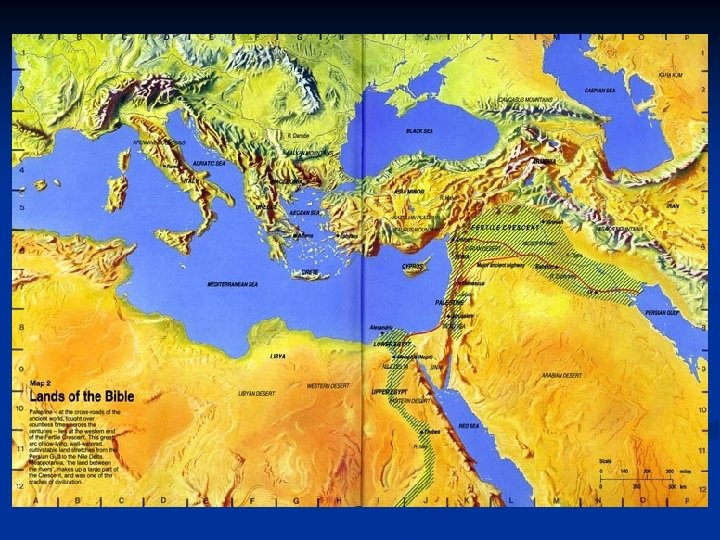
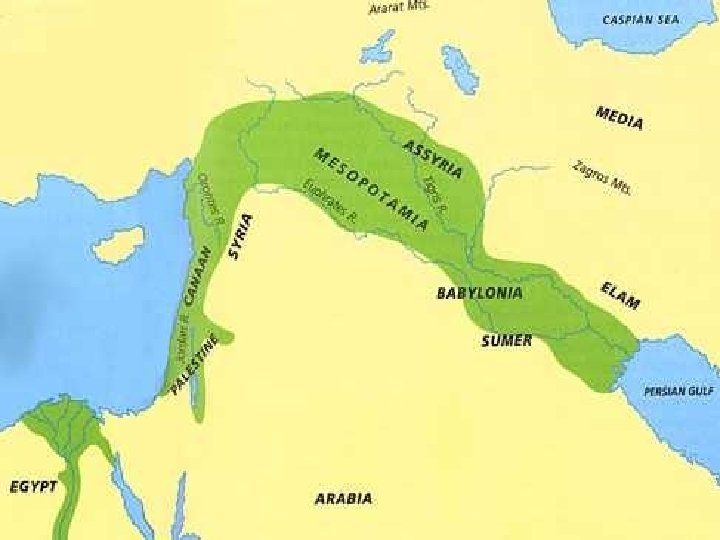
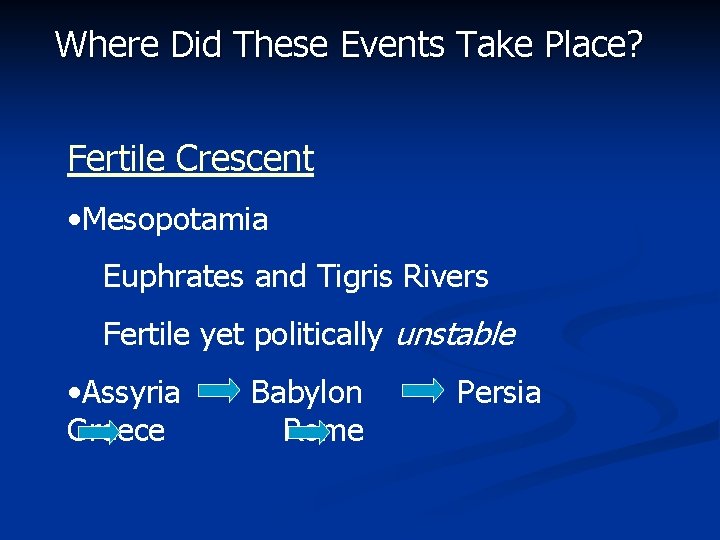
Where Did These Events Take Place? Fertile Crescent • Mesopotamia Euphrates and Tigris Rivers Fertile yet politically unstable • Assyria Greece Babylon Rome Persia
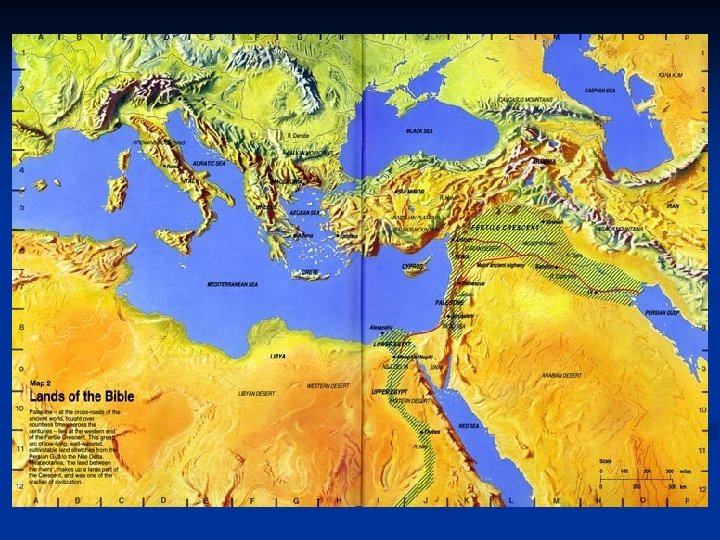
Where Did These Events Take Place? Egypt • Nile River Fertile and stable
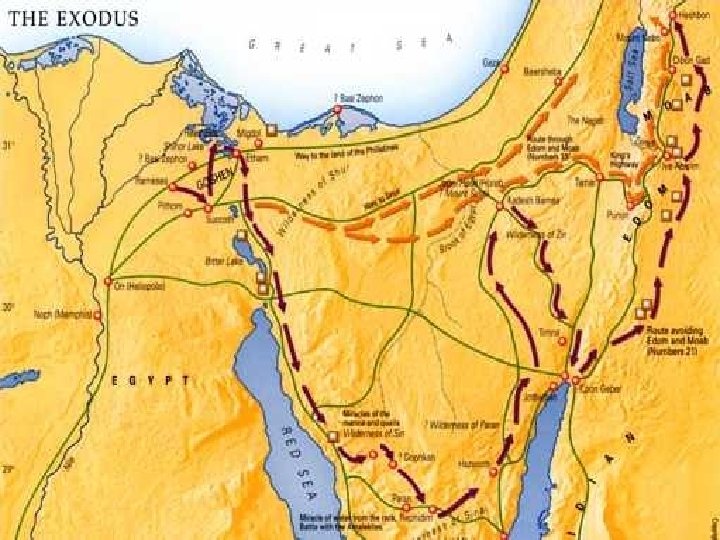
Where Did These Events Take Place? Palestine’s geographic features made isolation the norm
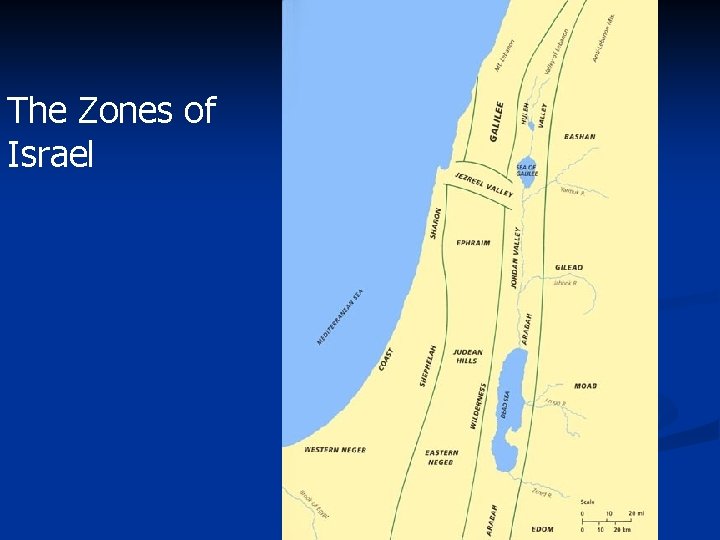
The Zones of Israel
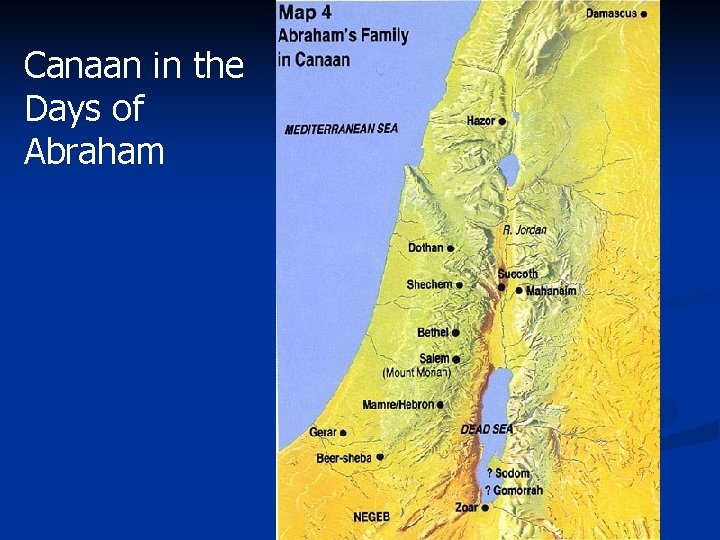
Canaan in the Days of Abraham
Cultural Context The Biblical Culture
Thinking Like an Ancient The ancient world of which Abraham, Moses, Jesus and Paul were a part was in various ways very unlike modern western culture. n
1. HONOR and SHAME n A primary value is honor, life is a secondary value in such a culture. Better to die than to be dishonored or shamed. ¨ Honor was a public and male value in this culture, shame a private, and often female value. n Society was structured such that one got ahead by means of Honor challenges-- in which there were always winners and losers.
2. Group vs. Individual Identity Ancient Mediterranean persons got their primary sense of identity not from their uniqueness but from the groups and locale of which they were a part-in particular, n their family group (OT tribe or father, Jeremiah, son of Hilkiah) n ethnic group (Ruth the Moabite) n homeland (e. g. Elijah the Tishbite 1 Kings 17: 1)
3. LIMITED GOOD n n n In antiquity, goods, services, honor, and the like were all in limited supply. If one person had them another did not. Thus one spent much of one's time trying to protect what one had. There was not a free market economy. Bartering, trading, stealing, or winning were the chief means of obtaining what one did not have. One could seldom earn improvement in life, it had to be bestowed and one had to know the right people.
4. PATRON-CLIENT Relationships n The chief means of succeeding in antiquity was through patronage. ¨ Favors ¨Once and payback were the order of the day. one entered a patron-client relationship, it was difficult if not impossible to get out. ¨In such a culture, “grace” was a foreign concept.
5. A PATRIARCHAL WORLD The ancient world was highly patriarchal and male-centered. n Not only was it a male dominated world, but the major values of the world were set up to keep it that way. n ¨ Ancient literature was almost all written from a male point of view. ¨ Higher Education was basically the provenance of males, and so most ancient literature was written by and for men. n In this world, we should see God’s attempt to modify patriarchy as much more revolutionary than they appear today.
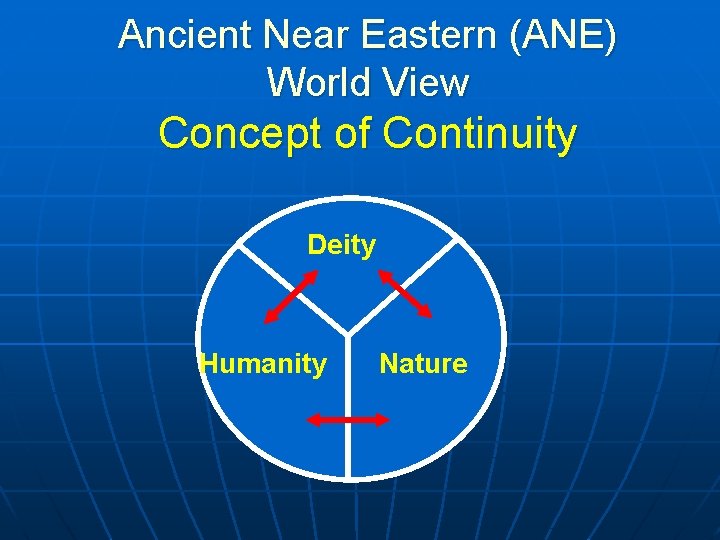
Ancient Near Eastern (ANE) World View Concept of Continuity Deity Humanity Natue Nature
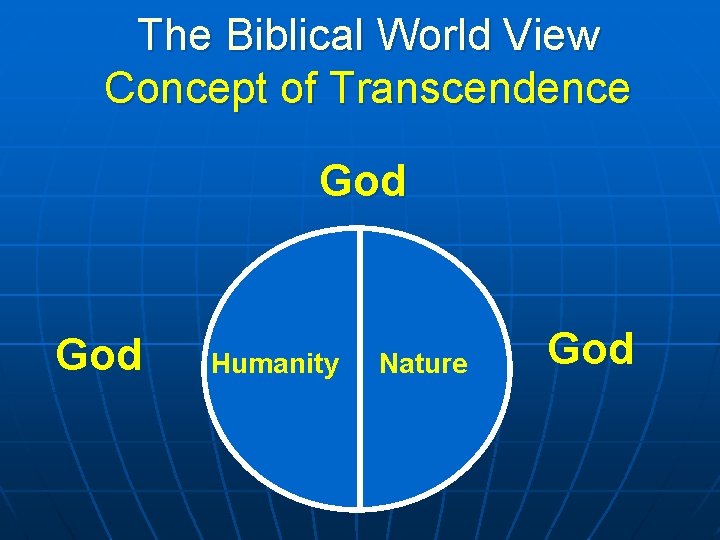
The Biblical World View Concept of Transcendence God Natue God Humanity Nature God
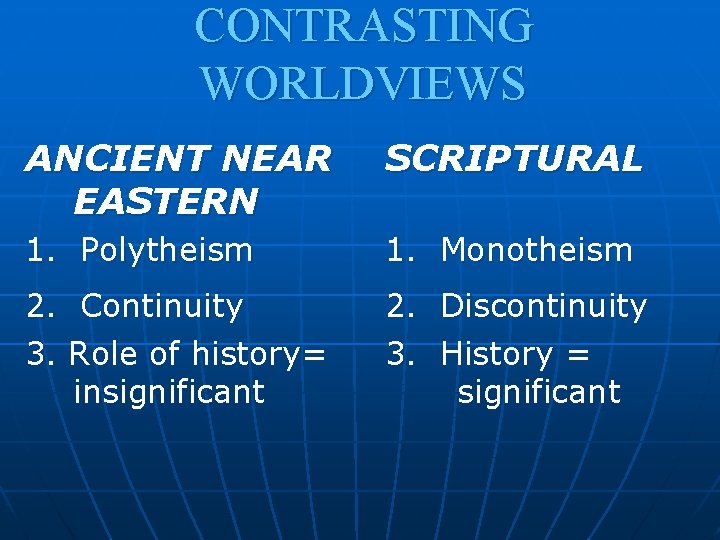
CONTRASTING WORLDVIEWS ANCIENT NEAR EASTERN SCRIPTURAL 1. Polytheism 1. Monotheism 2. Continuity 3. Role of history= insignificant 2. Discontinuity 3. History = significant
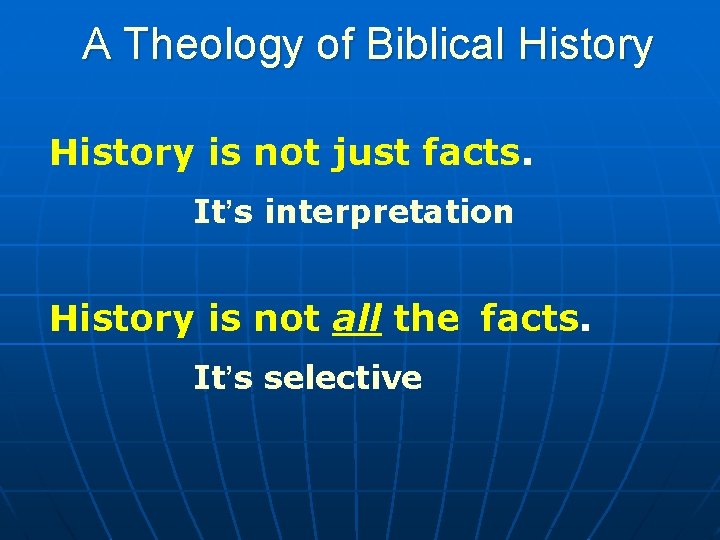
A Theology of Biblical History is not just facts. It’s interpretation History is not all the facts. It’s selective
A Theology of Biblical History is linear Beginning, middle, end (Exception: Judges 2: 6 -3: 6) History is purposeful Something (someone) stands behind history, pushing it to a climax
A Theology of Biblical History is Relational God acts not by determinism but in response to our relationship to Him History is Crisis-Oriented Leads to a decision for something or someone
- Slides: 35