
The old man saltbush By Chiara and Harguan

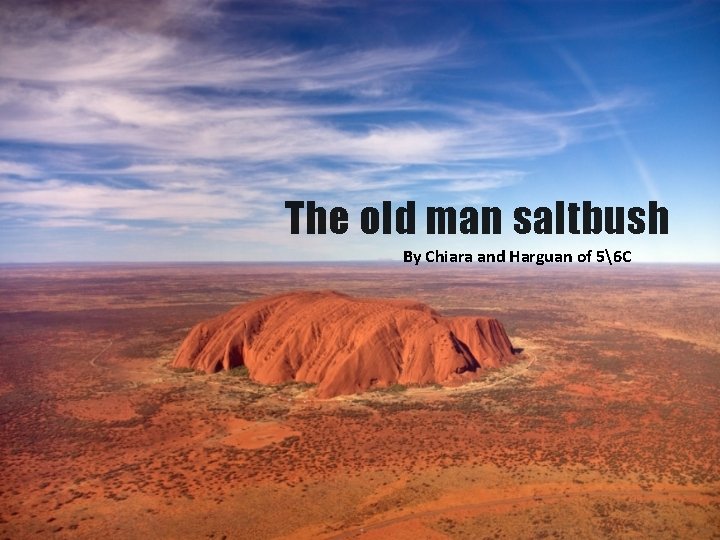
The old man saltbush By Chiara and Harguan of 56 C
Contents Slide Our Predictions----------------------------------------Slide 4 What is the old man salt bush? ------------------------------Slide 5 Adaptations of the old man salt bush--------------------------Slide 6 Structural Features-------------------------------------Slide 7 The Environment--------------------------------------Slide 8 Facts About The Old Man Saltbush---------------------------Slide 9 Annotated Diagram-------------------------------------Slide 10 The close up Annotated Diagram----------------------------Slide 11 Pictures-------------------------------------------- Slide 12 Diagrams and graphs------------------------------------Slide 13 Experiment Plan---------------------------------------Slide 14 Experiment Steps--------------------------------------Slide 15 Experiment Hypothesis----------------------------------Slide 16 Experiment Photos------------------------------------Slide 17 Experiment results------------------------------------Slide 18 Experiment graph-------------------------------------Slide 19 Experiment Conclusion---------------------------------Slide 20 Experiment Reflection----------------------------------Slide 21 Glossary------------------------------------------Slide 22 Bibliography----------------------------------
Our Predictions Harguan’s Prediction: I think one of the Old Man Saltbush adaptations are the ability to protect itself from it’s predators with it’s spikes. It also is really tall so it’s not many animals can jump that high. One more adaptation I think it has is the salt because I think animals don’t like to eat the salt. Chiara’s Prediction: I predict that the Old Man Saltbush is salty to stop as many animals eating it because the salt either tastes bad or is unhealthy for the animals like it’s unhealthy to people. I also think that it has spikes to protect it from predictors as well .
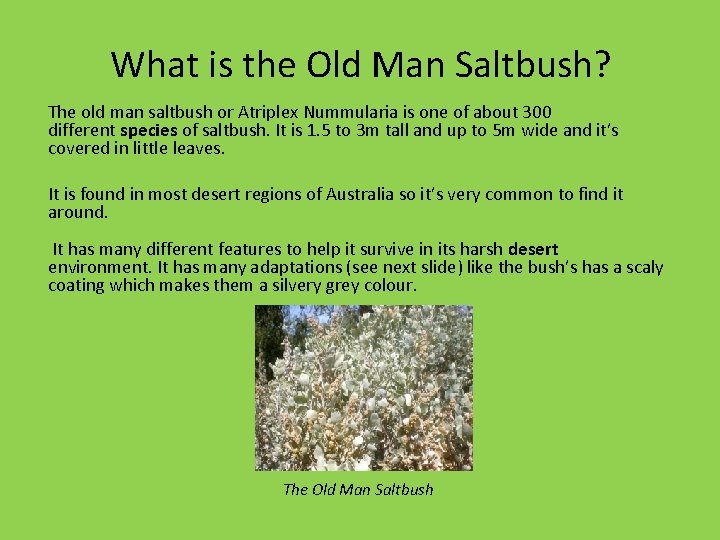
What is the Old Man Saltbush? The old man saltbush or Atriplex Nummularia is one of about 300 different species of saltbush. It is 1. 5 to 3 m tall and up to 5 m wide and it’s covered in little leaves. It is found in most desert regions of Australia so it’s very common to find it around. It has many different features to help it survive in its harsh desert environment. It has many adaptations (see next slide) like the bush’s has a scaly coating which makes them a silvery grey colour. The Old Man Saltbush
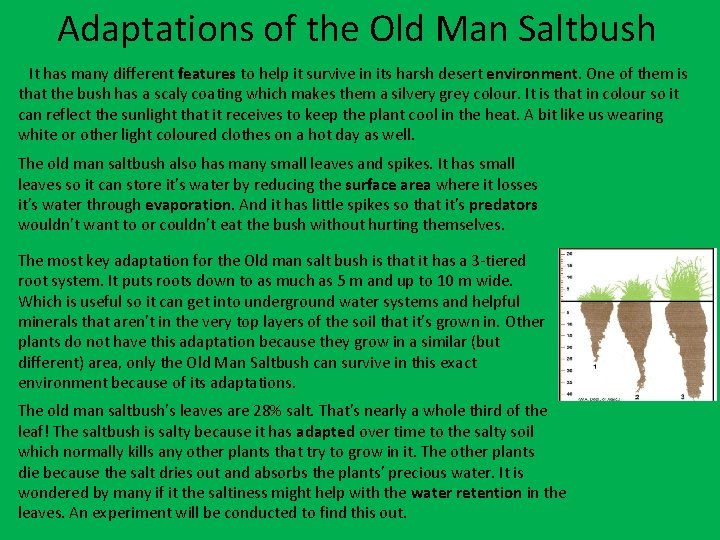
Adaptations of the Old Man Saltbush It has many different features to help it survive in its harsh desert environment. One of them is that the bush has a scaly coating which makes them a silvery grey colour. It is that in colour so it can reflect the sunlight that it receives to keep the plant cool in the heat. A bit like us wearing white or other light coloured clothes on a hot day as well. The old man saltbush also has many small leaves and spikes. It has small leaves so it can store it's water by reducing the surface area where it losses it's water through evaporation. And it has little spikes so that it's predators wouldn’t want to or couldn’t eat the bush without hurting themselves. The most key adaptation for the Old man salt bush is that it has a 3 -tiered root system. It puts roots down to as much as 5 m and up to 10 m wide. Which is useful so it can get into underground water systems and helpful minerals that aren't in the very top layers of the soil that it's grown in. Other plants do not have this adaptation because they grow in a similar (but different) area, only the Old Man Saltbush can survive in this exact environment because of its adaptations. The old man saltbush's leaves are 28% salt. That's nearly a whole third of the leaf! The saltbush is salty because it has adapted over time to the salty soil which normally kills any other plants that try to grow in it. The other plants die because the salt dries out and absorbs the plants' precious water. It is wondered by many if it the saltiness might help with the water retention in the leaves. An experiment will be conducted to find this out.
Structural Features First of all let’s define what structural features are, they are how something is made to suit where it is found. So they are quite similar to the adaptations that something has. Here is a list of some of the main structural features that the Old Man saltbush has: • Spikes to protect the plant • Roots to reach down for water in the ground as the surface is very dry • Female flowers to help make seeds • Male flowers to protect the female flowers • The ability to grow in salty places where other plants can’t
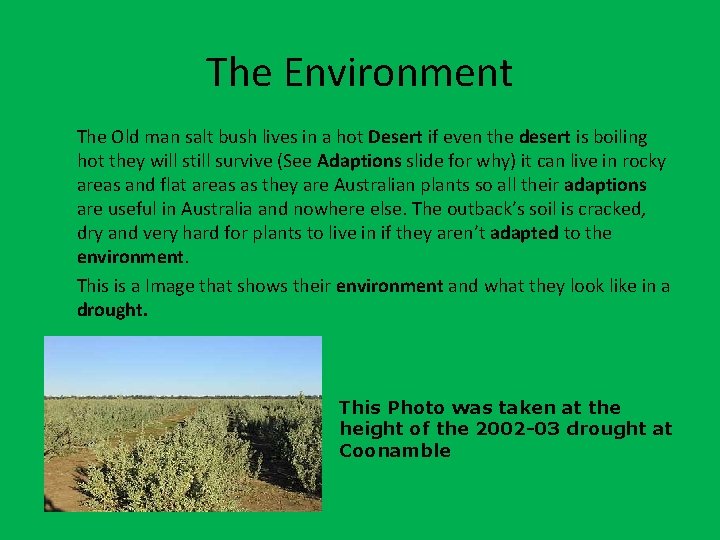
The Environment The Old man salt bush lives in a hot Desert if even the desert is boiling hot they will still survive (See Adaptions slide for why) it can live in rocky areas and flat areas as they are Australian plants so all their adaptions are useful in Australia and nowhere else. The outback’s soil is cracked, dry and very hard for plants to live in if they aren’t adapted to the environment. This is a Image that shows their environment and what they look like in a drought. This Photo was taken at the height of the 2002 -03 drought at Coonamble
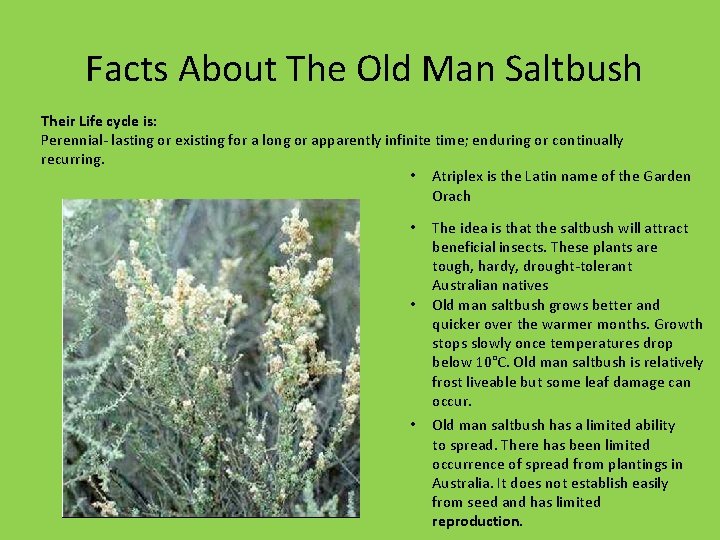
Facts About The Old Man Saltbush Their Life cycle is: Perennial- lasting or existing for a long or apparently infinite time; enduring or continually recurring. • Atriplex is the Latin name of the Garden Orach • • • The idea is that the saltbush will attract beneficial insects. These plants are tough, hardy, drought-tolerant Australian natives Old man saltbush grows better and quicker over the warmer months. Growth stops slowly once temperatures drop below 10°C. Old man saltbush is relatively frost liveable but some leaf damage can occur. Old man saltbush has a limited ability to spread. There has been limited occurrence of spread from plantings in Australia. It does not establish easily from seed and has limited reproduction.
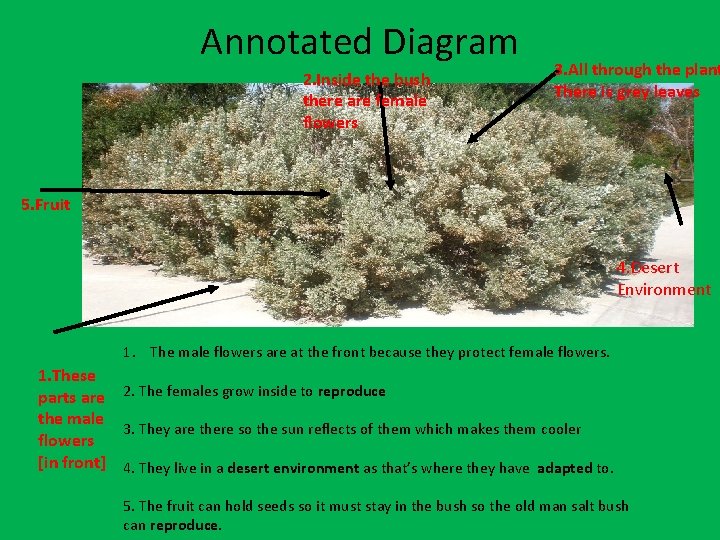
Annotated Diagram 2. Inside the bush there are female flowers 3. All through the plant There is grey leaves 5. Fruit 4. Desert Environment 1. The male flowers are at the front because they protect female flowers. 1. These parts are 2. The females grow inside to reproduce the male 3. They are there so the sun reflects of them which makes them cooler flowers [in front] 4. They live in a desert environment as that’s where they have adapted to. 5. The fruit can hold seeds so it must stay in the bush so the old man salt bush can reproduce.
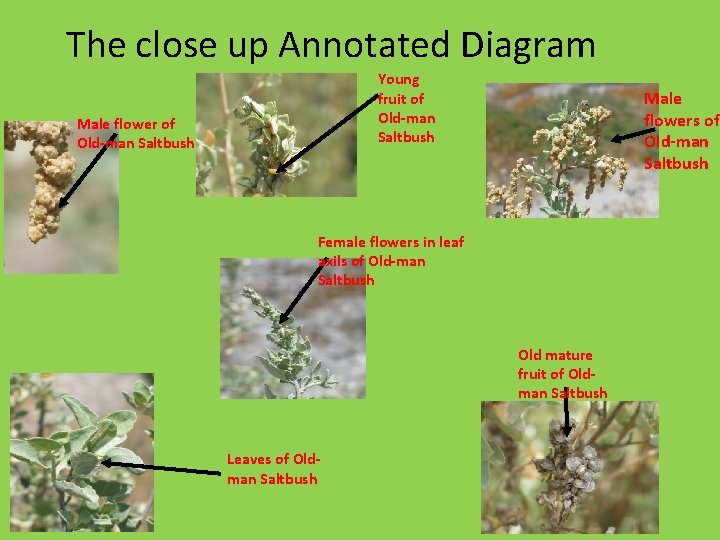
The close up Annotated Diagram Young fruit of Old-man Saltbush Male flowers of Old-man Saltbush Female flowers in leaf axils of Old-man Saltbush Old mature fruit of Oldman Saltbush Leaves of Oldman Saltbush
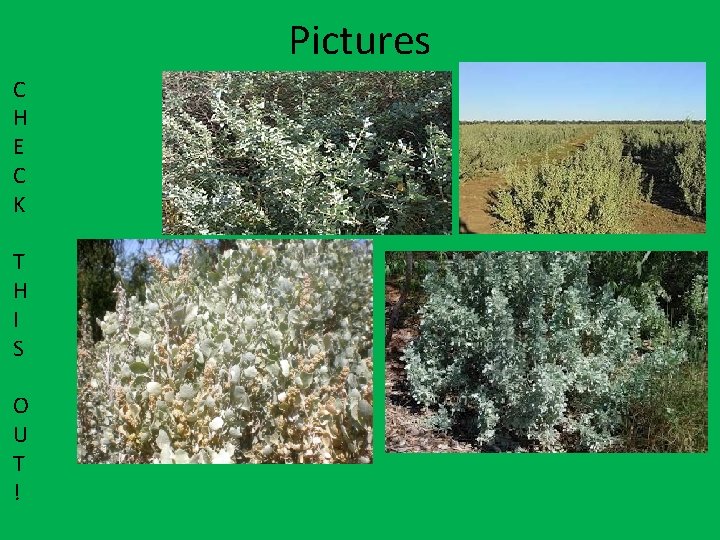
Pictures C H E C K T H I S O U T !
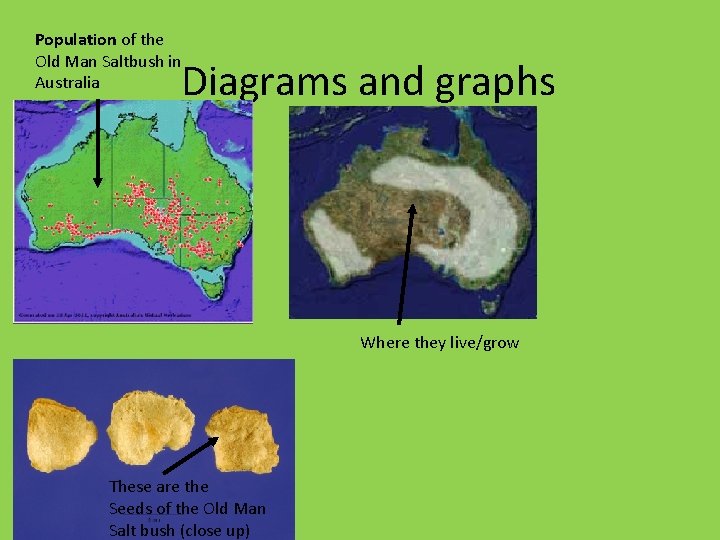
Population of the Old Man Saltbush in Australia Diagrams and graphs Where they live/grow These are the Seeds of the Old Man Salt bush (close up)
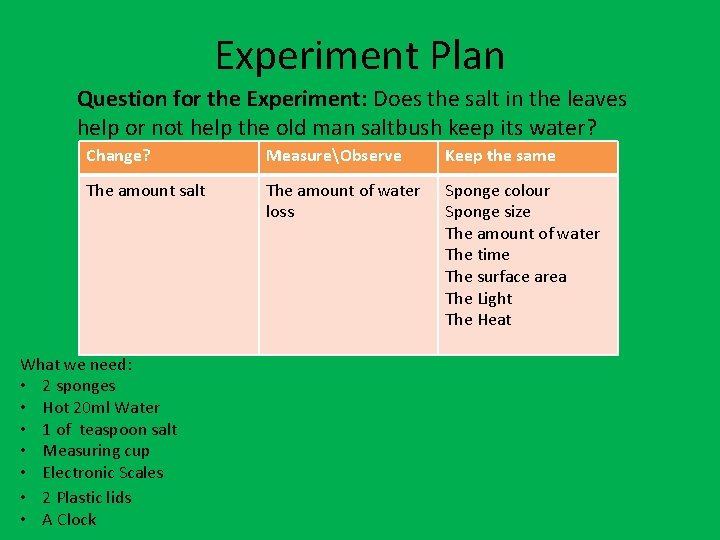
Experiment Plan Question for the Experiment: Does the salt in the leaves help or not help the old man saltbush keep its water? Change? MeasureObserve Keep the same The amount salt The amount of water loss Sponge colour Sponge size The amount of water The time The surface area The Light The Heat What we need: • 2 sponges • Hot 20 ml Water • 1 of teaspoon salt • Measuring cup • Electronic Scales • 2 Plastic lids • A Clock
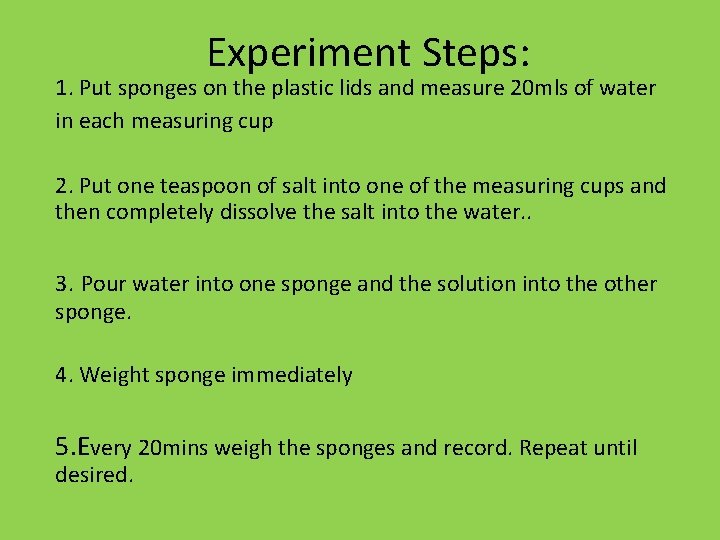
Experiment Steps: 1. Put sponges on the plastic lids and measure 20 mls of water in each measuring cup 2. Put one teaspoon of salt into one of the measuring cups and then completely dissolve the salt into the water. . 3. Pour water into one sponge and the solution into the other sponge. 4. Weight sponge immediately 5. Every 20 mins weigh the sponges and record. Repeat until desired.
Experiment Hypothesis Chiara’s Hypothesis: I predict that the sponge with the salt in it will loose it’s water though evaporation will be slower (more water efficient). I think this because the salt (Na Cl) is an ionic bond (meaning it’s bonded through the electric charge of the particles) which meaning it’s bond can be broken easily with a covalent bond. Molecules like water can make a solution which has a higher viscosity (meaning it’s thicker) and I think that it will slow down the process of losing it’s water. Harguan’s Hypothesis: I predict that the one with more salt will lose less water because the salt will be thick and stop the water from coming out.
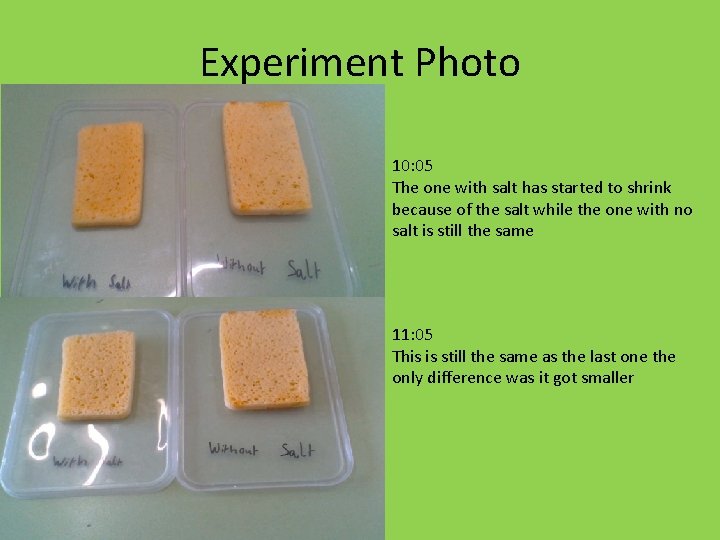
Experiment Photo 10: 05 The one with salt has started to shrink because of the salt while the one with no salt is still the same 11: 05 This is still the same as the last one the only difference was it got smaller
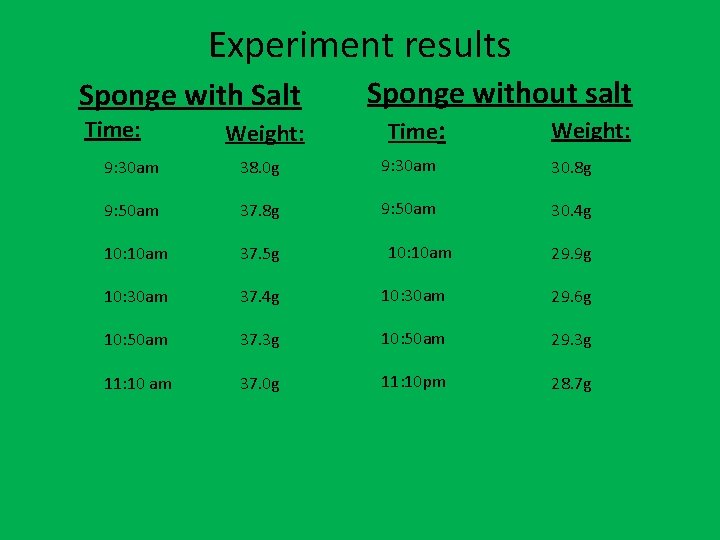
Experiment results Sponge with Salt Time: Weight: Sponge without salt Time: Weight: 9: 30 am 38. 0 g 9: 30 am 30. 8 g 9: 50 am 37. 8 g 9: 50 am 30. 4 g 10: 10 am 37. 5 g 10: 30 am 37. 4 g 10: 30 am 29. 6 g 10: 50 am 37. 3 g 10: 50 am 29. 3 g 11: 10 am 37. 0 g 11: 10 pm 28. 7 g 10: 10 am 29. 9 g
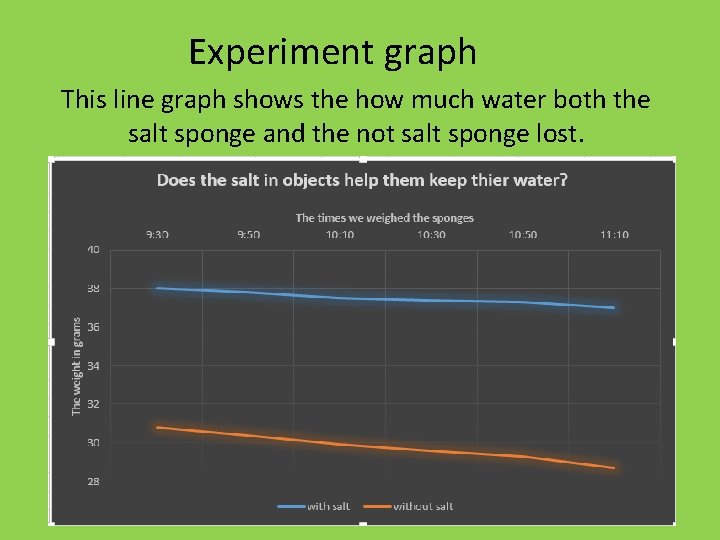
Experiment graph This line graph shows the how much water both the salt sponge and the not salt sponge lost.
Experiment Conclusion Harguan’s Conclusion: We found out that the one with salt loss less which means my prediction was correct, because it had less surface area because the salt made it shrink and things with less surface area keep more water as there is less space for the sun to evaporate but after the experiment the reason why it lost water was because the salt made a thick layer. Chiara’s Conclusion: Although the results were very close, the sponge with salt did keep its water for longer. This means that both of our predictions were correct. Something I noticed during the experiment was that the sponge that had one teaspoon of salt in it had shrunk quite significantly. We think that the salt must’ve somehow shrunk the sponge giving it less surface area therefore decreasing the water loss. This could be why the salty sponge kept its water but we don’t know for sure. Overall this experiment was successfully conducted and the outcome was as predicted. .
Experiment Reflection: To improve the experiment next time we think that we would make sure that we where 100% sure that the sponges were the exact same sponges because with the experiment that we did, one of the sponges behaved differently to the other one and we just assumed that it was the salt. If we were to carry another experiment testing the same question, we might have used real and small actual leaves instead of the sponges. This way we can get a better understanding of the beneficial (or unbeneficial) aspects of having salt in the leaves of the old man saltbush
Glossary Adaptations- the action or process of adapting to their environment. Predators- a living thing [plants, animals or fungi] that eats another living thing. Species- a type of living things for example a dog. Surface area- the amount of space a surface covers. Desert- a place with limited amount of water. Evaporation- the process of a liquid becoming a gas. Features- a distinct part of a living thing. Drought- were the water supply has gone down. Water Retention- when something keeps it water. Reproduce- When something makes more of its kind Population- the amount of something Ionic bond- is the bond between atoms that form because of the slight electrical attraction to each other. Particles- a little portion of matter. Covalent bond- is the bond of atoms when one atom has one less electron attracts to an atom that has one more atom in their outer orbital shell to balance them both with electrons. Molecules- a group of conjoined atoms. Higher viscosity- means the liquid thicker when you pour it. Reproduction. - is the act of reproducing

Wait and check out our model!

Bibliography: A special thanks to…. . http: //www. dpi. nsw. gov. au/agriculture/pastures-and-rangelands/species-varieties/pf/factsheets/old-mansaltbush http: //www. answers. com/Q/How_does_the_old_man_saltbush_survive_in_the_desert? #slide=1 Saltbushausthrutime. com http: //www. oldmansaltbush. com/salinity. cfm> https: //www. google. com. au/search? q=saltbush&oq=slat+bush&aqs=chrome. 1. 69 i 57 j 0 l 5. 5203 j 0 j 7&sourcei d=chrome&ie=UTF-8#q=old+man+saltbush+facts h: //www. florabank. org. au/lucid/key/species%20 navigator/media/html/Atriplex_nummularia. htm> http: //www. oldmansaltbush. com/advantage. cfm http: //keys. lucidcentral. org/keys/v 3/pastures/Html/Old_man_saltbush. htm http: //www. herbiguide. com. au/Descriptions/hg_d_Man_Saltbush. htm http: //www. abc. net. au/gardening/stories/s 3763232. htm> http: //www. outbackpride. com. au/species/saltbush https: //tuckerbush. com. au/old-man-saltbush-atriplex-nummularia/> http: //www. australiangeographic. com. au/topics/science-environment/2016/04/australias-10 deserts https: //www. anbg. gov. au/gnp/interns-2007/atriplex-nummularia. html http: //healthbrokers. com. au/2012/09/old-man-saltbush-a-native-tucker-treat / AND GOOGLE
Thank you for Watching Thanks for watching and we hope learnt something new about the adaptions of the old man salt bush!
- Slides: 25