
The Odyssey Homer Ancient Greece Background Information English
The Odyssey, Homer, & Ancient Greece Background Information English 9
Ancient Greece-Everyday Life �Most ancient Greeks made their living by farming lands outside of the city. �If they were not otherwise occupied with military training or politics, men would attend theater, most often watching comedies and tragedies. �Women’s lives were tied closely with domestic work such as cooking, cleaning, and raising children. � Women were not allowed to get involved in politics or work.
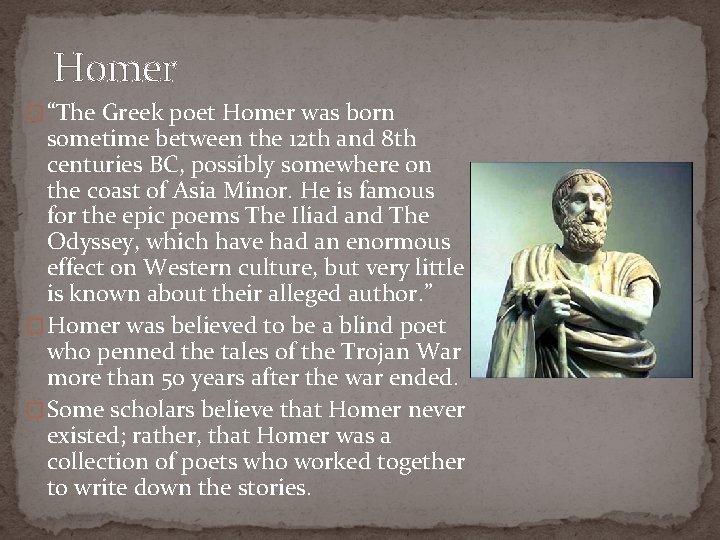
Homer � “The Greek poet Homer was born sometime between the 12 th and 8 th centuries BC, possibly somewhere on the coast of Asia Minor. He is famous for the epic poems The Iliad and The Odyssey, which have had an enormous effect on Western culture, but very little is known about their alleged author. ” � Homer was believed to be a blind poet who penned the tales of the Trojan War more than 50 years after the war ended. � Some scholars believe that Homer never existed; rather, that Homer was a collection of poets who worked together to write down the stories.
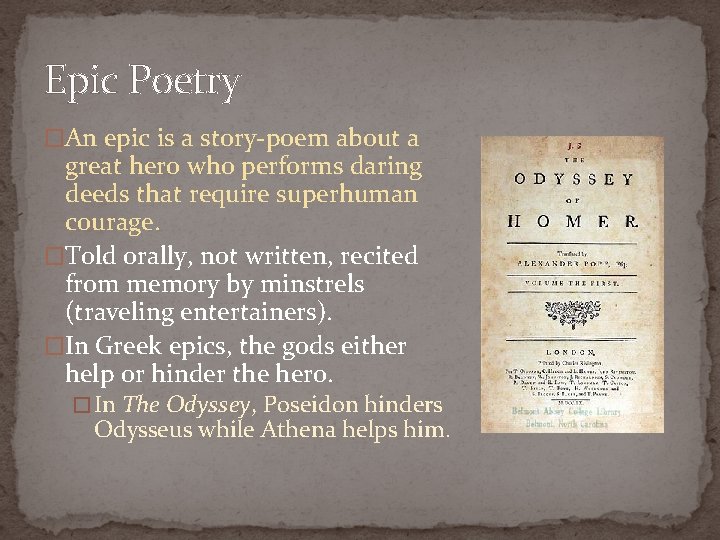
Epic Poetry �An epic is a story-poem about a great hero who performs daring deeds that require superhuman courage. �Told orally, not written, recited from memory by minstrels (traveling entertainers). �In Greek epics, the gods either help or hinder the hero. � In The Odyssey, Poseidon hinders Odysseus while Athena helps him.
Characteristics of an Epic � A long narrative poem about a hero's adventures � The hero can be from history or from legend and is of high social position (prince or king) � The hero is set against overwhelming odds and must be strong and brave � Gods and goddesses often play a part, either helping or hindering the hero � Address universal concerns (good vs. evil; life vs. death; etc. ) � The story is set over many locations (real or imaginary) across a wide area � An epic hero has a tragic flaw

Homeric Simile � � Definition: � -Simile developed over several lines of verse � - Usually takes the form of, "like a ____ when it ______. " � -Often compares something ordinary with something strange or unfamiliar � -Often used to intensify the heroic stature of the subject and to serve as decoration � � Example: “Its crackling roots blazed and hissed - as a blacksmith plunges a glowing ax or adze in an ice-cold bath and the metal screeches steam and its temper hardens - that's the iron's strength - so the eye of Cyclops sizzled round that stake. ”
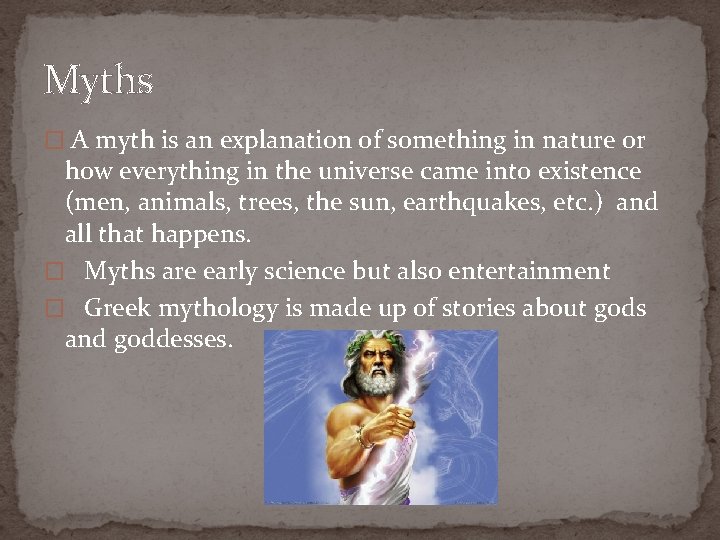
Myths � A myth is an explanation of something in nature or how everything in the universe came into existence (men, animals, trees, the sun, earthquakes, etc. ) and all that happens. � Myths are early science but also entertainment � Greek mythology is made up of stories about gods and goddesses.
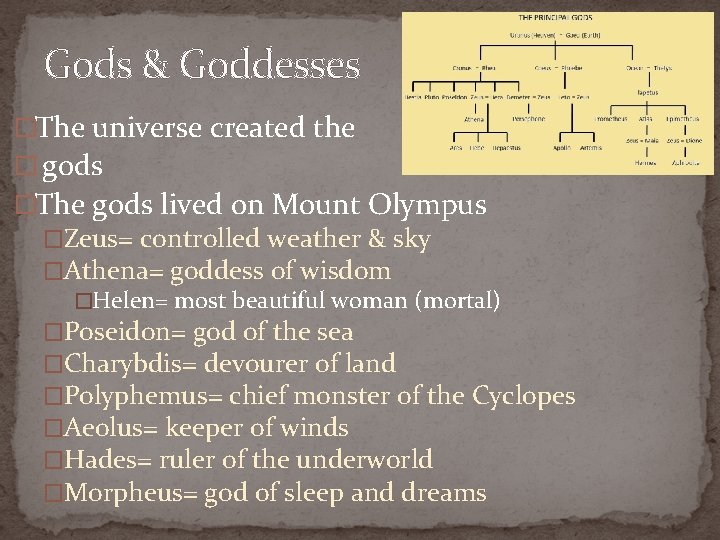
Gods & Goddesses �The universe created the � gods �The gods lived on Mount Olympus �Zeus= controlled weather & sky �Athena= goddess of wisdom �Helen= most beautiful woman (mortal) �Poseidon= god of the sea �Charybdis= devourer of land �Polyphemus= chief monster of the Cyclopes �Aeolus= keeper of winds �Hades= ruler of the underworld �Morpheus= god of sleep and dreams
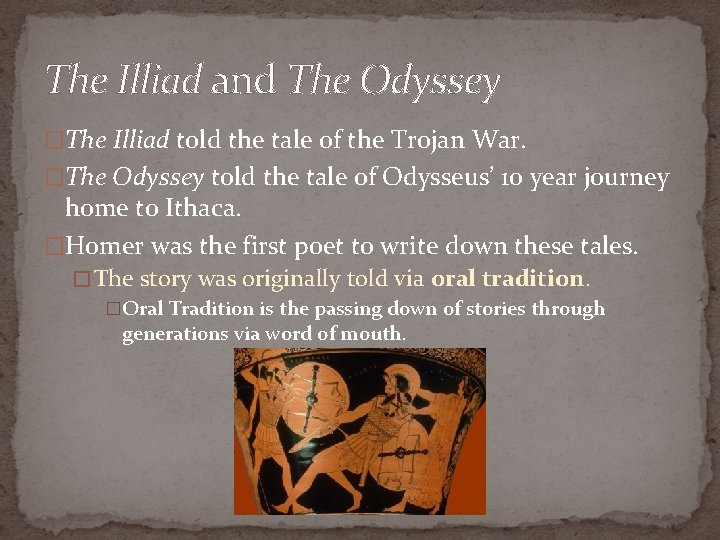
The Illiad and The Odyssey �The Illiad told the tale of the Trojan War. �The Odyssey told the tale of Odysseus’ 10 year journey home to Ithaca. �Homer was the first poet to write down these tales. � The story was originally told via oral tradition. �Oral Tradition is the passing down of stories through generations via word of mouth.
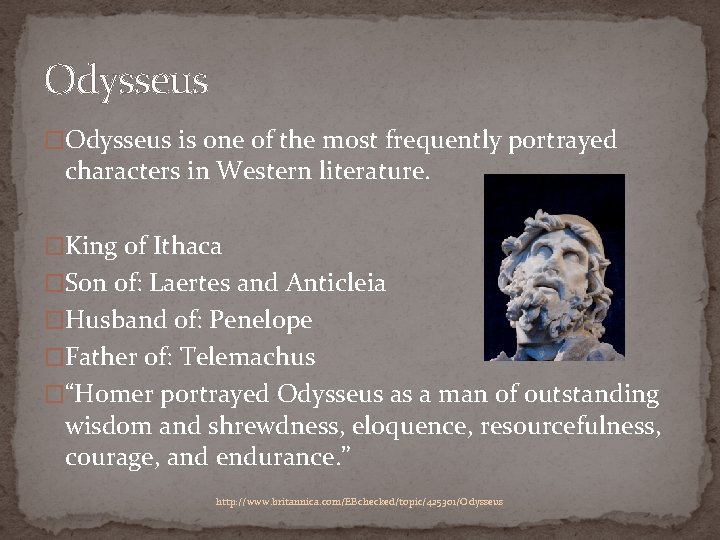
Odysseus �Odysseus is one of the most frequently portrayed characters in Western literature. �King of Ithaca �Son of: Laertes and Anticleia �Husband of: Penelope �Father of: Telemachus �“Homer portrayed Odysseus as a man of outstanding wisdom and shrewdness, eloquence, resourcefulness, courage, and endurance. ” http: //www. britannica. com/EBchecked/topic/425301/Odysseus
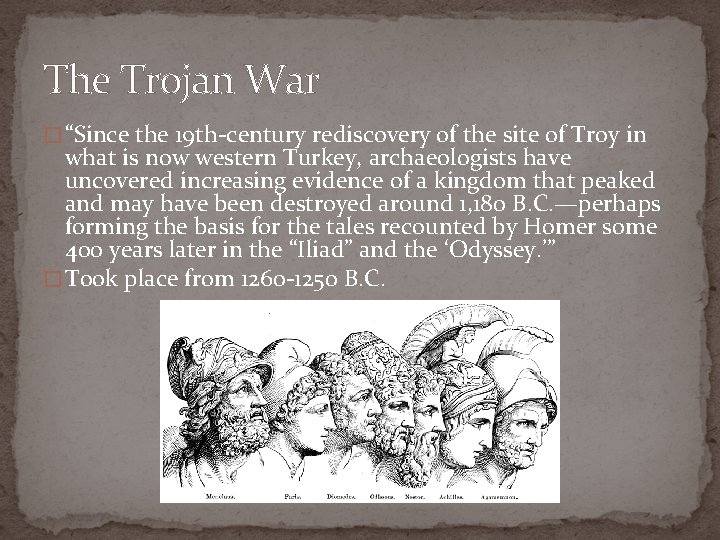
The Trojan War � “Since the 19 th-century rediscovery of the site of Troy in what is now western Turkey, archaeologists have uncovered increasing evidence of a kingdom that peaked and may have been destroyed around 1, 180 B. C. —perhaps forming the basis for the tales recounted by Homer some 400 years later in the “Iliad” and the ‘Odyssey. ’” � Took place from 1260 -1250 B. C.
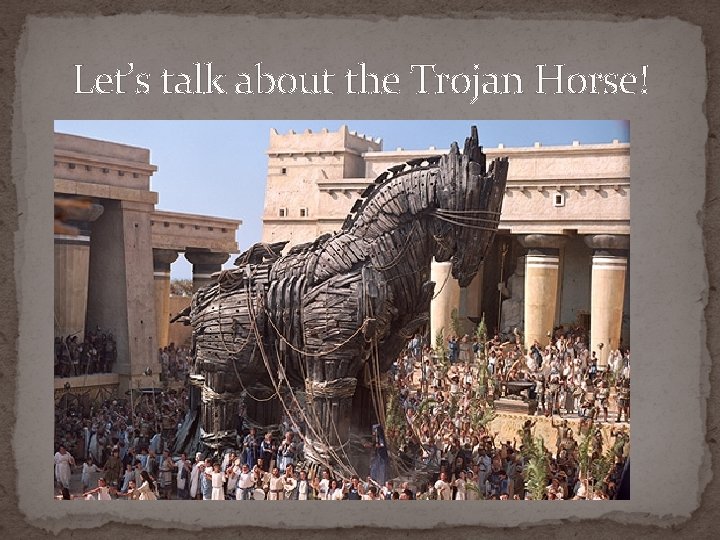
Let’s talk about the Trojan Horse!
- Slides: 12