
The Odyssey Book 9 New Coasts and Poseidons
The Odyssey Book 9: New Coasts and Poseidon’s Son Pgs. 372 - 385
Pitiless (adjective) (pg. 372) Without mercy. Cruel. The root word of the adjective pitiless is pity. If someone lacks all sympathy or tenderness, you can describe them as pitiless. People who are annoyed that they have to step out of the way of homeless people who huddle against buildings in winter are probably pitiless — they just don't care about the plights of others. How can you tell if your friends are pitiless? They seem bored or annoyed when you are upset about something.
Pitiless (adjective) Synonyms: brutal, callous, cold hearted, mean, cruel Antonyms: charitable, kind, merciful, sympathetic Forms: pity (noun) , pitiful (adj), pitilessness (noun), pitilessly (adverb) Example: The pitiless winter resulted in the deaths of many.
Formidable (adjective) (pg. 372) Extremely impressive in strength or excellence. Inspiring fear. What's interesting about formidable is that we often tend to use it about things that, while they may scare us, we can't help being pretty impressed by all the same. A formidable opponent is almost by definition a worthy one; a formidable challenge almost by definition one worth rising to. Synonyms: dangerous, imposing, intimidating, fearful, shocking Antonyms: unimportant, harmless, unthreatening Forms: formidability (noun), formidably (adverb) Example: Odysseus was a formidable opponent, but the gods always win.
Guile (noun) (pg. 372) Shrewdness as demonstrated by being skilled in deception. Use the noun guile for cunning, craftiness, and artful duplicity. The noun guile has quite negative connotations, as it refers to the kind of knowledge and skill that can be used by comic book villains for evil and not good! People who have guile are also thought of as being wily (which is also a related word), sneaky, and deceitful. Synonyms: trickery, cunning, deceit, deception Antonyms: honesty, sincerity, trustworthiness Forms: Guileless (adjective) Guilelessly (adverb) Guilelessness (noun) Example: The defendant showed no hatred or guile, and so the jury found him not guilty.
The Epic Hero Epics are often characterized by long speeches made by the hero and other major characters. These speeches reveal important ideas about the hero’s culture as well as his own character. Book 9: Comprehension Questions: 7. Read lines 1 -6 on page 372. How will Odysseus repay the hospitality shown by Alcinous? Why is this vow important? 8. What do the details in lines 17 -25 reveal about Odysseus’ feelings?
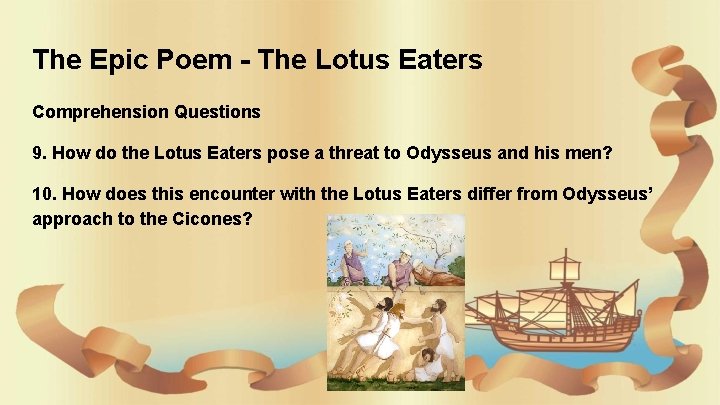
The Epic Poem - The Lotus Eaters Comprehension Questions 9. How do the Lotus Eaters pose a threat to Odysseus and his men? 10. How does this encounter with the Lotus Eaters differ from Odysseus’ approach to the Cicones?
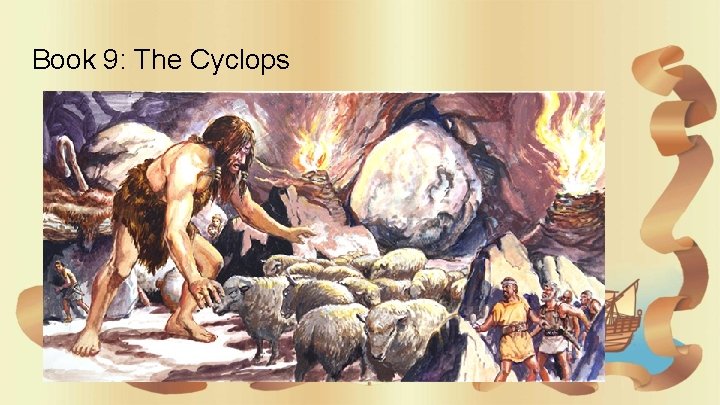
Book 9: The Cyclops
Lout (noun) (page 374) An awkward stupid person. Lout originally meant a bumbling, awkward fellow, both annoying and pitiful. But if you call someone a lout today, you're also implying that he's not only stupid and clumsy, but that he's no good. Lout is almost never used for women, because the word has an implication of being bad to women — not abusive so much as selfish. If everyone thinks your boyfriend is a lowdown, disgusting lout, you might want to try dating someone else. Synonyms: Brute, buffon, barbarian, oaf, slob Antonyms: prince, gentleman Forms: NONE Example: Her ex-husband was rude, filthy and uneducated. What did she ever see in that lout?
Till (noun & verb) (pg. 374) When used as a noun, it means “cash register. ” When used as a verb, it means to work the land, to get it ready for harvesting. Synonyms: (noun) cash box, cash drawer; (verb) plough, dig, tend Antonyms: (noun) NONE; (verb) reap, neglect, ignore Forms: tilled (past, verb) Example: You mind the till while I go to the garden and till the soil.
Savage (noun, adjective, verb, adverb) (pg. 374) Noun: A member of an uncivilized people Adjective: Wild and menacing; marked by extreme violence. Verb: To attack brutally and harshly. Synonym: (noun) barbarian, brute, beast (adjective) barbaric, ferocious, crude, brutal Antonym: (adjective) civilized, calm, humane, compassionate Forms: savagery (noun), savages (pl. noun), savagely (adverb) savaged (past tense verb) savages (present tense verb) Example: The savages savagely savaged the school.
Prodigious (adjective) (pg. 375) Far beyond what is usual in magnitude or degree. Something exceptional, substantial, or great is prodigious. Prodigious is a word for things that are impressive. If you have prodigious strength, you're very strong. If your cat had a prodigious litter of kittens, then you've got a houseful of kittens. This is a strong word that's also kind of formal. Save it for things that really blow you away because of their quality or quantity.
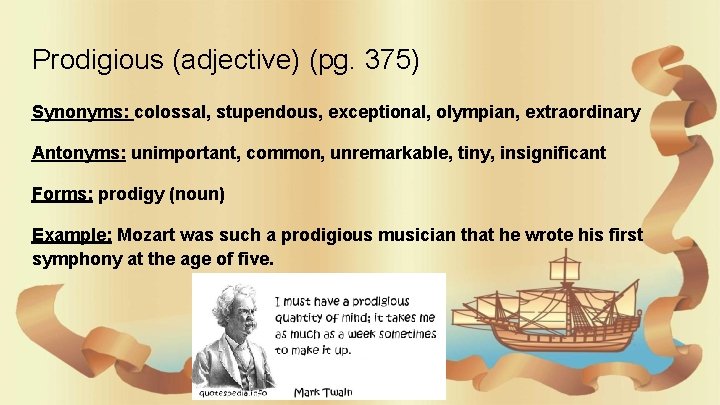
Prodigious (adjective) (pg. 375) Synonyms: colossal, stupendous, exceptional, olympian, extraordinary Antonyms: unimportant, common, unremarkable, tiny, insignificant Forms: prodigy (noun) Example: Mozart was such a prodigious musician that he wrote his first symphony at the age of five.
Appalled (adjective) pg. 378 Struck with fear, dread or consternation. Appalled is an adjective that describes feeling shocked and disappointed. When you are appalled, you don't just disapprove of what you are seeing; you are emotionally disturbed by it, like being appalled by the wasted food at a cafeteria or restaurant. Synonyms: aghast, shocked, dismayed, unnerved Antonyms: comforted, satisfied, reassured Forms: appalling (adjective) Example: She was appalled by the grammar of her students at the begining of the school year and impressed with their improvement by the end.
The Cyclops: Comprehension Questions 11. The epic hero has some very human traits as well as those that define him as extraordinary. Note how the characteristics of Odysseus are seen through his decisions and actions. Why do you think Odysseus wants to visit the land of the Cyclops? What does this action reveal about his character? (pg. 374, Lines 71 - 75) 12. One narrative device used often in the poem is foreshadowing (giving clues to what will happen in the future) to keep the audience interested. What might be foreshadowed by the description of the Cyclops? (pg. 375, Lines 85 - 92) BE SURE TO ANSWER ALL PARTS OF EACH QUESTION!!!
The Cyclops: Comprehension Questions 13. You can make inferences (educated guesses based on prior knowledge) about Odysseus’ motives and even the wisdom of his actions from the details he presents. Why do you think Odysseus takes the wine and his twelve best fighting men? Use these details to draw conclusions. Is this expedition is good idea? Why or why not? (pg. 375, Lines 93 - 111) 14. Dialogue advances plot and reveals character. What can you learn from the dialogue between Odysseus and his crew? What is foreshadowed by the line “no pretty sight, it turned out, for my friends. ” (pg. 376, Lines 125 - 132) BE SURE TO ANSWER ALL PARTS OF EACH QUESTION!!!
The Cyclops: Comprehension Questions 15. Often in narratives the setting has an impact on the action. Look carefully at the details the poet includes about the Cyclops’s cave. In lines 140 -153 what impression does this description provide of the Cyclops and his cave? What potential conflict is foreshadowed by these details? (pg. 376) 16. Describe the Cyclops’s attitude toward his guests. What does this attitude suggest about the possible conflict between the Cyclops and Odysseus? (pg. 377 Lines 176 - 184) 17. A character’s reaction to conflict may reveal important qualities. Why does Odysseus lie to the Cyclops about the ship? What traits does Odysseus show in this exchange with the Cyclops? (pg. 377, Lines 185 -190
The Cyclops: Comprehension Questions 18. To make the epic exciting and suspenseful, events occur that complicate the hero’s attempt to resolve the conflict. Note that Odysseus does not kill the giant. Why not? What does this mean for the resolution of the conflict? (pg. 378, Lines 198 - 210) 19. Some cultures admired courage and strength above all other qualities. Odysseus’ traits reveal that the Greeks also admired the ability to reason. Explain the good luck that Odysseus has. How does he take advantage of this good luck and what does this reveal about him? (p. 379, Lines 238 - 275)
The Cyclops: Comprehension Questions 20. Recall that earlier Odysseus requested that the Cyclops give him the gift due a guest according to the Greek laws of hospitality. What is the irony in the “gift” the Cyclops says he will give to Odysseus? (Pg. 380, Lines 276 - 277) 21. Remember that Odysseus was the mastermind behind the plan that brought the ten-year Trojan War to an end- The Trojan Horse. Reread lines 322 - 346 and explain how Odysseus’ plan to escape the Cyclops is similar to his plan to win the Trijan War.
The Cyclops: Comprehension Questions 22. Consider why Odysseus includes his taunting of the Cyclops and its consequences in his story. How does Odysseus view his own actions? (pg. 383 Lines 390 -405) 23. Often in Greek literature, a prophecy, or prediction about the future, is fulfilled but not in the way anticipated by the person receiving it. Why is Polyphemus surprised by the fulfillment of the prophecy? What does the Cyclops’ characterization of Odysseus as “small, pitiful and twiggy” suggest about the value of “brawn vs brain” in a conflict? (pg. 384, Lines 420 -436) 24. The consequences of a person’s actions often help reveal an important theme or message, about life. What theme is conveyed by Odysseus’ behavior in this part of the poem? (pg. 384, Lines 437 -446)
- Slides: 20