
The Oceans in Motion Surface Currents Ocean Currents

- Slides: 18
The Oceans in Motion Surface Currents
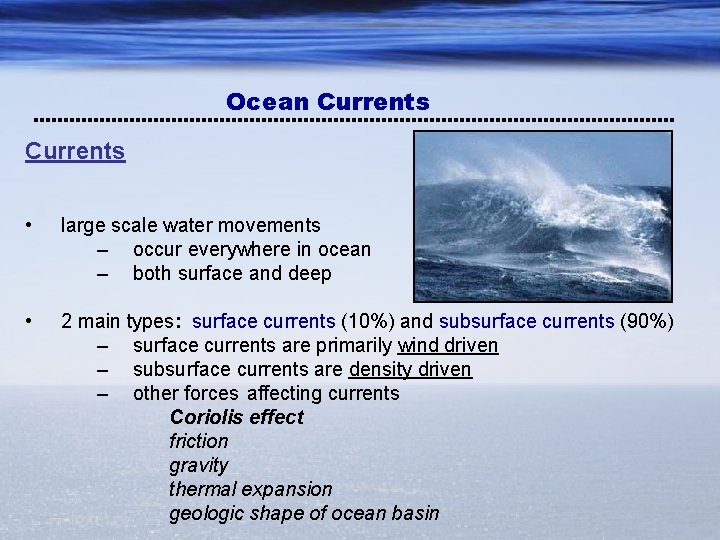
Ocean Currents • large scale water movements – occur everywhere in ocean – both surface and deep • 2 main types: surface currents (10%) and subsurface currents (90%) – surface currents are primarily wind driven – subsurface currents are density driven – other forces affecting currents Coriolis effect friction gravity thermal expansion geologic shape of ocean basin
Formation of Surface Currents surface currents =horizontal movement of the oceans surface waters • • driven by: a) thermal expansion & gravity, b) winds and c) combination extend to approximately 100 -150 m depth (depending on strength of winds) a) thermal expansion and gravity – – equatorial surface waters receive more solar radiation than polar surface waters warmer equatorial waters expand (thermal expansion) – higher elevation colder polar waters contract – lower elevation gravity ‘pulls’ the waters from area of higher elevation (equator) to areas of lower elevation (poles), water moves downhill
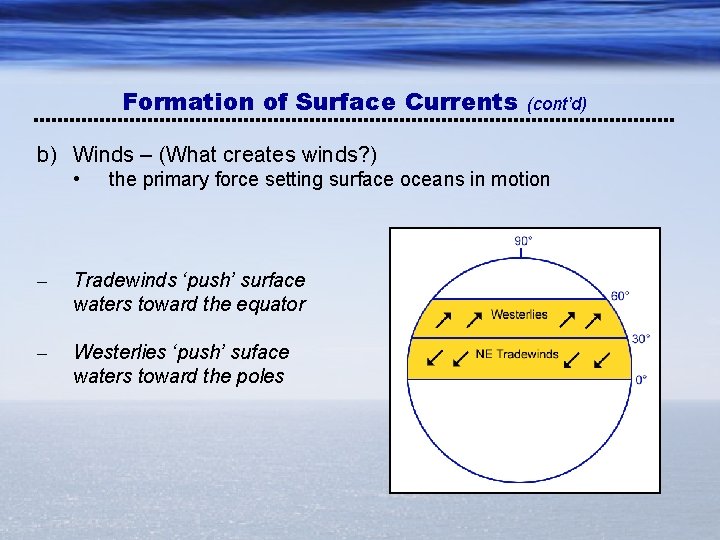
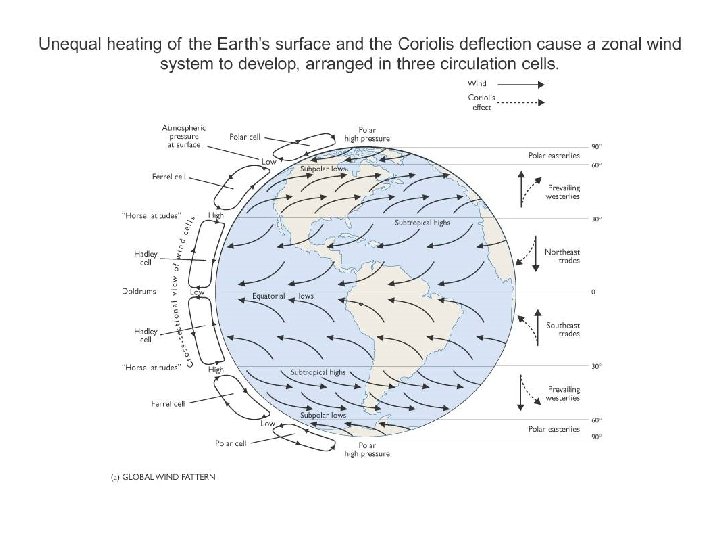
Formation of Surface Currents (cont’d) b) Winds – (What creates winds? ) • the primary force setting surface oceans in motion – Tradewinds ‘push’ surface waters toward the equator – Westerlies ‘push’ suface waters toward the poles
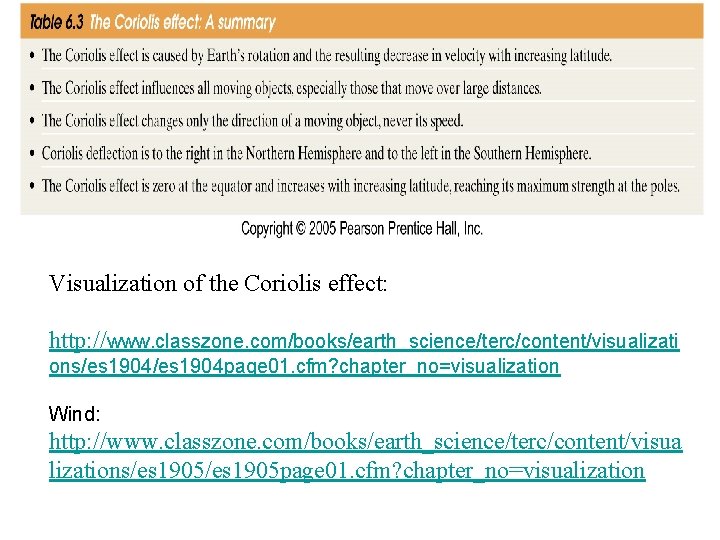
Visualization of the Coriolis effect: http: //www. classzone. com/books/earth_science/terc/content/visualizati ons/es 1904 page 01. cfm? chapter_no=visualization Wind: http: //www. classzone. com/books/earth_science/terc/content/visua lizations/es 1905 page 01. cfm? chapter_no=visualization
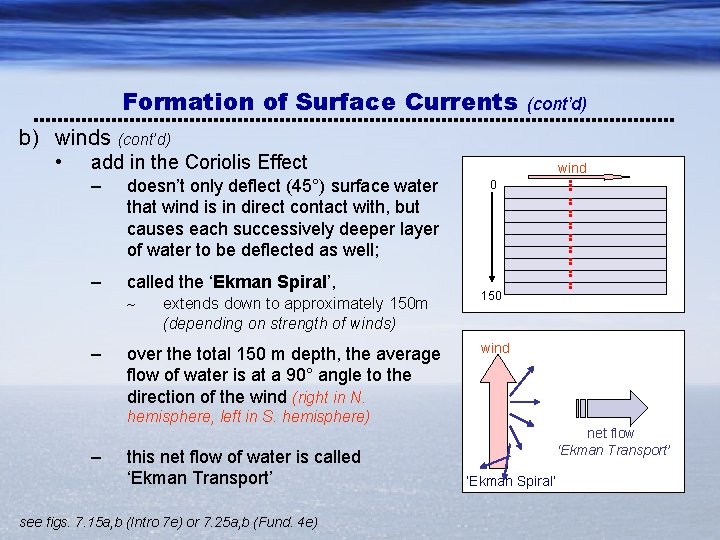
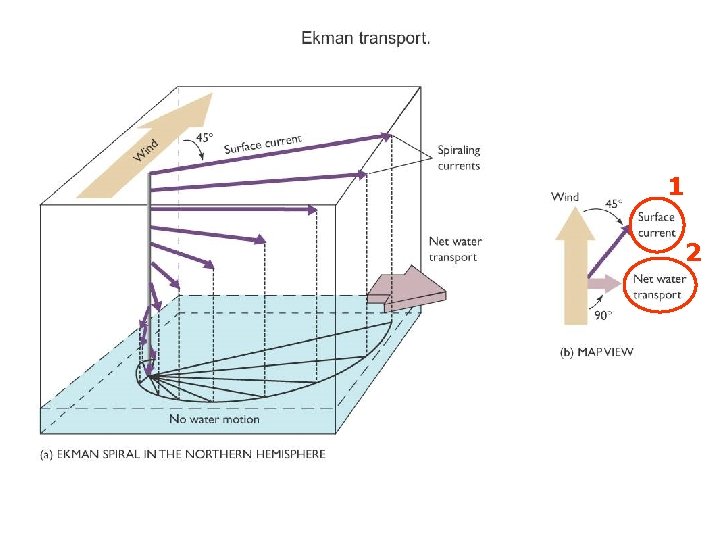
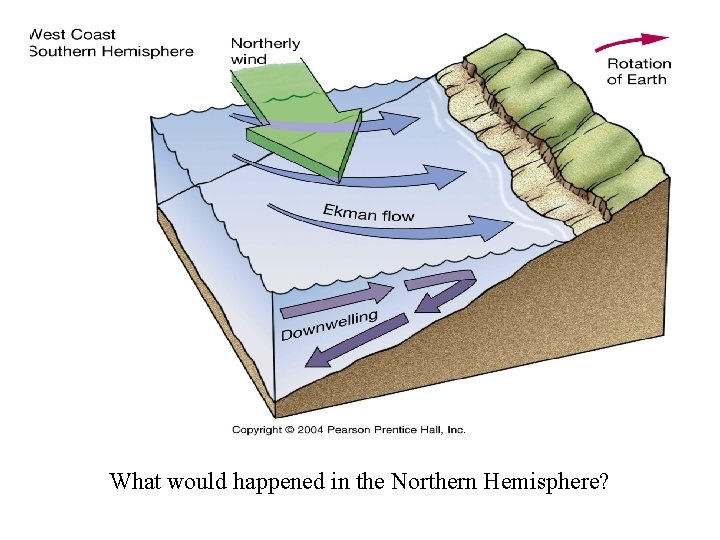
Formation of Surface Currents (cont’d) b) winds (cont’d) • add in the Coriolis Effect – doesn’t only deflect (45°) surface water that wind is in direct contact with, but causes each successively deeper layer of water to be deflected as well; – called the ‘Ekman Spiral’, ~ – extends down to approximately 150 m (depending on strength of winds) over the total 150 m depth, the average flow of water is at a 90° angle to the direction of the wind (right in N. wind 0 150 wind hemisphere, left in S. hemisphere) – this net flow of water is called ‘Ekman Transport’ see figs. 7. 15 a, b (Intro 7 e) or 7. 25 a, b (Fund. 4 e) net flow ‘Ekman Transport’ ‘Ekman Spiral’
1 2
What would happened in the Northern Hemisphere?
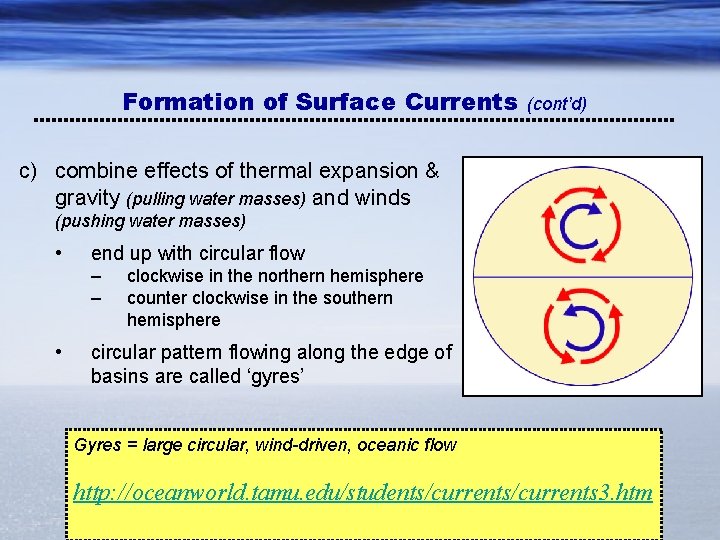
Formation of Surface Currents (cont’d) c) combine effects of thermal expansion & gravity (pulling water masses) and winds (pushing water masses) • end up with circular flow – – • clockwise in the northern hemisphere counter clockwise in the southern hemisphere circular pattern flowing along the edge of basins are called ‘gyres’ Gyres = large circular, wind-driven, oceanic flow http: //oceanworld. tamu. edu/students/currents 3. htm
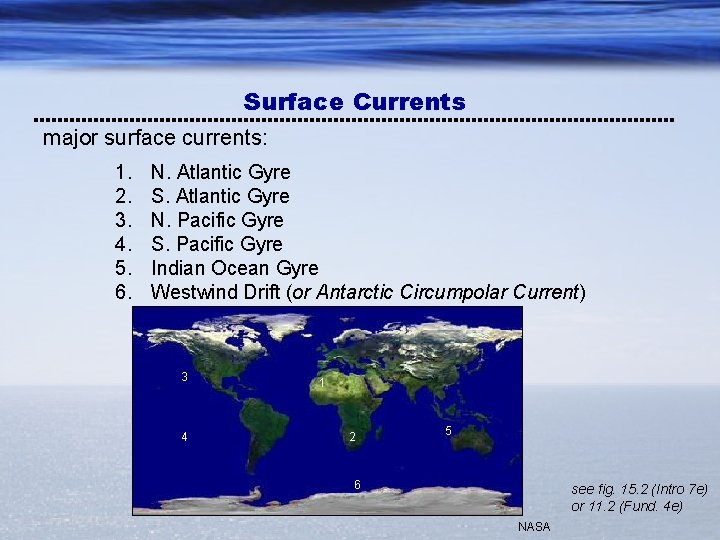
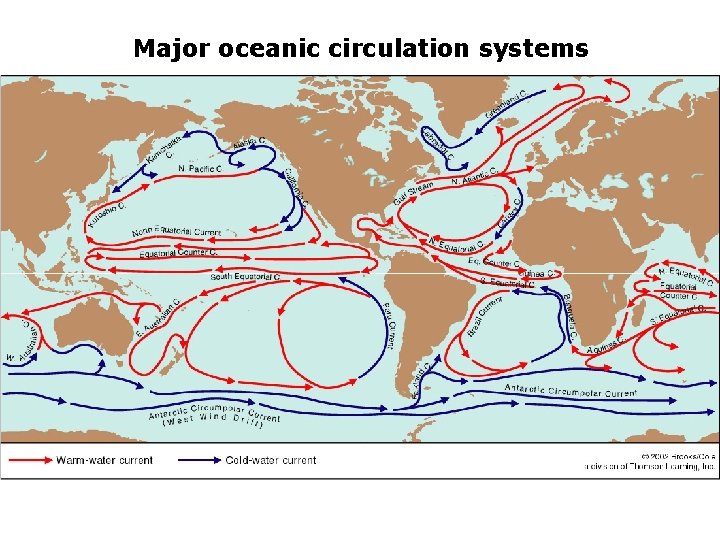
Surface Currents major surface currents: 1. 2. 3. 4. 5. 6. N. Atlantic Gyre S. Atlantic Gyre N. Pacific Gyre S. Pacific Gyre Indian Ocean Gyre Westwind Drift (or Antarctic Circumpolar Current) 3 4 1 2 5 6 see fig. 15. 2 (Intro 7 e) or 11. 2 (Fund. 4 e) NASA
Major oceanic circulation systems
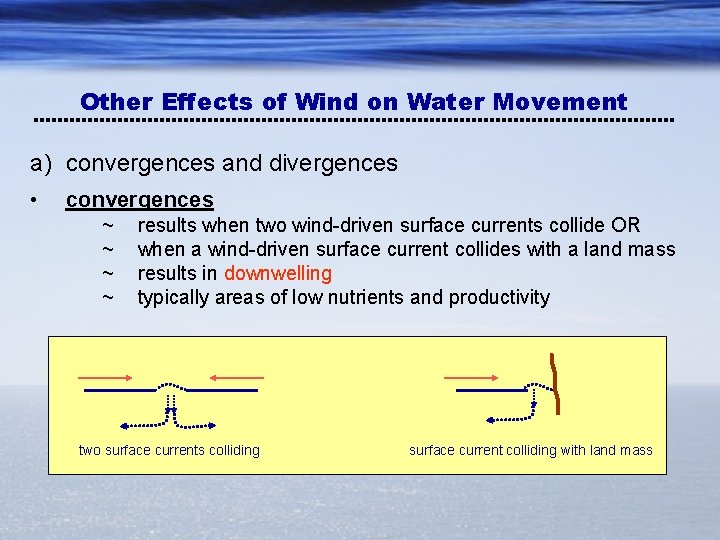
Other Effects of Wind on Water Movement a) convergences and divergences • convergences ~ ~ results when two wind-driven surface currents collide OR when a wind-driven surface current collides with a land mass results in downwelling typically areas of low nutrients and productivity two surface currents colliding surface current colliding with land mass
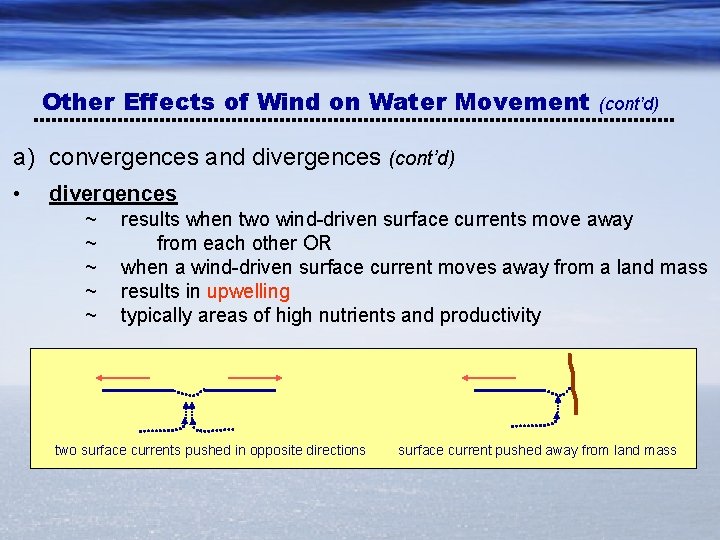
Other Effects of Wind on Water Movement (cont’d) a) convergences and divergences (cont’d) • divergences ~ ~ ~ results when two wind-driven surface currents move away from each other OR when a wind-driven surface current moves away from a land mass results in upwelling typically areas of high nutrients and productivity two surface currents pushed in opposite directions surface current pushed away from land mass
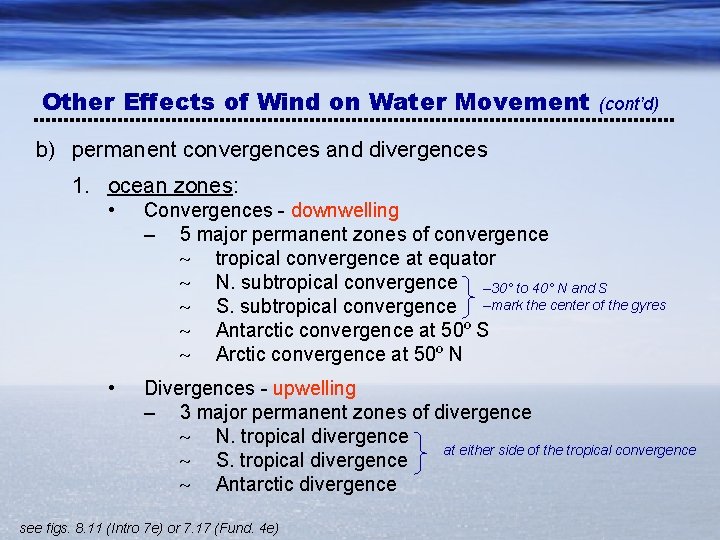
Other Effects of Wind on Water Movement (cont’d) b) permanent convergences and divergences 1. ocean zones: • Convergences - downwelling – 5 major permanent zones of convergence ~ tropical convergence at equator ~ N. subtropical convergence – 30° to 40° N and S ~ S. subtropical convergence –mark the center of the gyres ~ Antarctic convergence at 50º S ~ Arctic convergence at 50º N • Divergences - upwelling – 3 major permanent zones of divergence ~ N. tropical divergence at either side of the tropical convergence ~ S. tropical divergence ~ Antarctic divergence see figs. 8. 11 (Intro 7 e) or 7. 17 (Fund. 4 e)
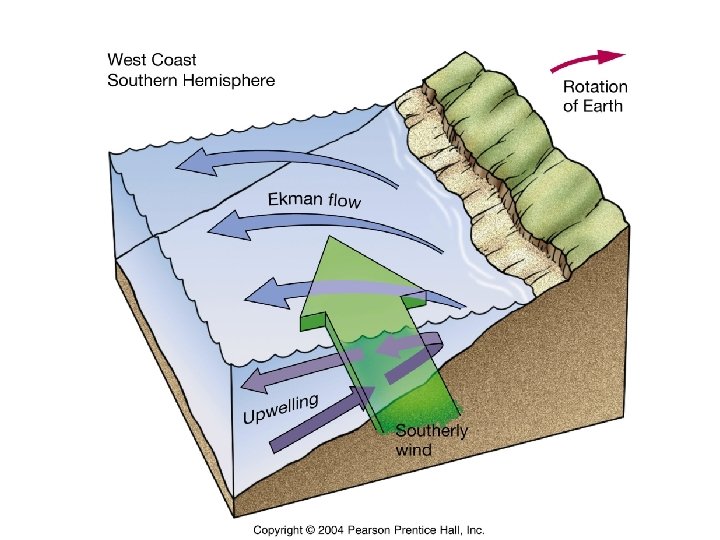
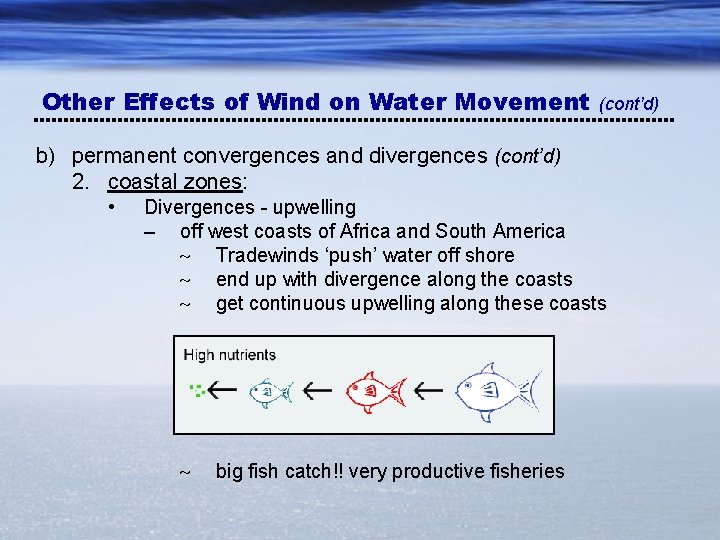
Other Effects of Wind on Water Movement (cont’d) b) permanent convergences and divergences (cont’d) 2. coastal zones: • Divergences - upwelling – off west coasts of Africa and South America ~ Tradewinds ‘push’ water off shore ~ end up with divergence along the coasts ~ get continuous upwelling along these coasts ~ big fish catch!! very productive fisheries
Other Effects of Wind on Water Movement c) seasonal convergences and divergences coastal • off west coast of North America – winter convergence ~ coastal wind blows from the south ~ net water transport onshore (convergence) ~ get downwelling – summer divergence ~ coastal wind blows from the north ~ net water transport offshore (divergence) ~ get upwelling ~ i. e. San Francisco fisheries and fog (cont’d)