
The Occupational Alliance for Risk Science OARS Organizing
- Slides: 17
The Occupational Alliance for Risk Science (OARS) Organizing Initiative for the Workplace Environmental Exposure Levels (WEELs) February 25, 2020 Andy Maier (andrew. maier@cardno. com)
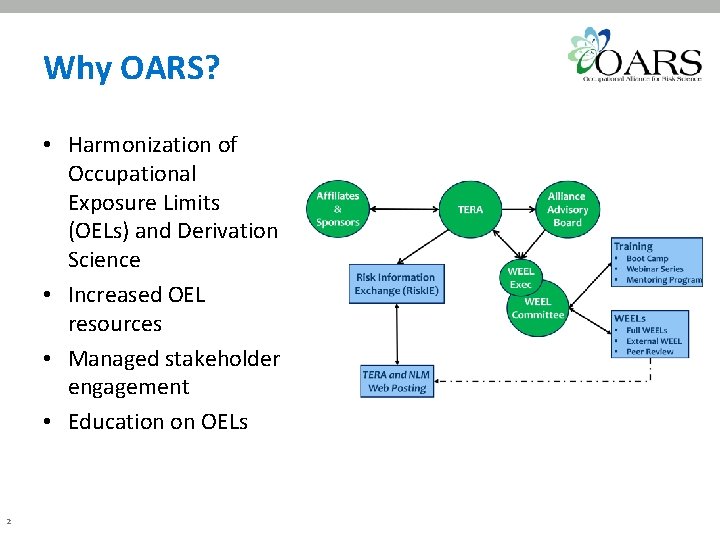
Why OARS? • Harmonization of Occupational Exposure Limits (OELs) and Derivation Science • Increased OEL resources • Managed stakeholder engagement • Education on OELs 2
Do We Need OEL Coordination? • Workers recognized a potential population at increased risk due to exposure potential. • OELs are central for worker health protection. • Many chemicals and not enough OELs. • Use of different sources of information complex. 3
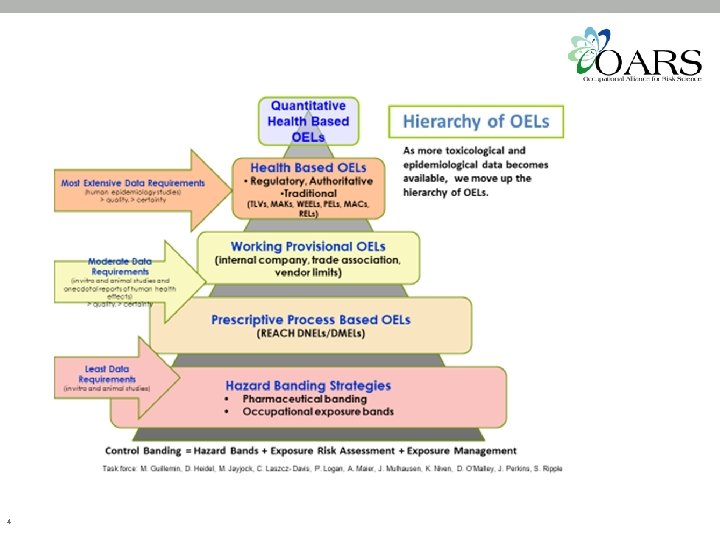
4
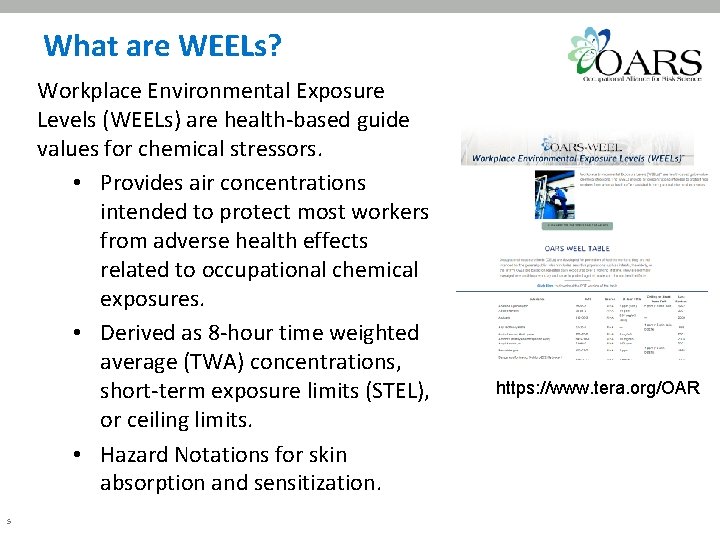
What are WEELs? Workplace Environmental Exposure Levels (WEELs) are health-based guide values for chemical stressors. • Provides air concentrations intended to protect most workers from adverse health effects related to occupational chemical exposures. • Derived as 8 -hour time weighted average (TWA) concentrations, short-term exposure limits (STEL), or ceiling limits. • Hazard Notations for skin absorption and sensitization. 5 https: //www. tera. org/OAR
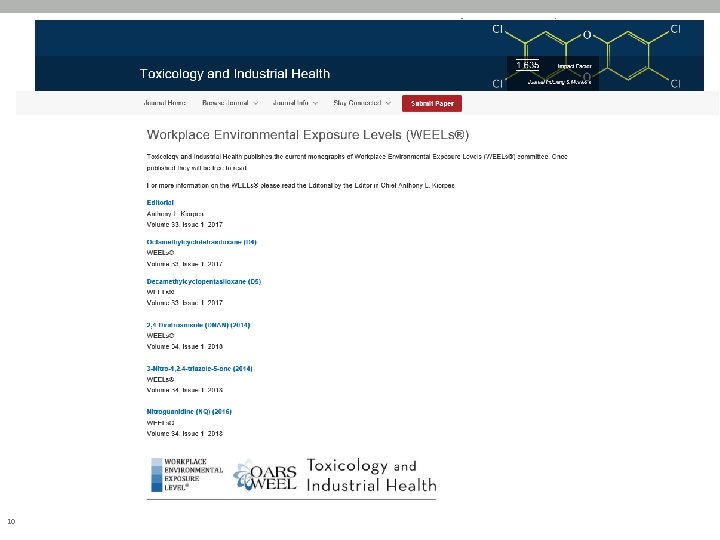
History of the WEELs • WEEL Committee was established in 1976 by the American Industrial Hygiene Association (AIHA) Guideline Foundation. • WEELs available for purchase in booklet form and full documentation sets from AIHA. • AIHA board votes to discontinue new WEEL development in August 2011. • AIHA Board votes to transfer WEELs to TERA in January 2012. • The Occupational Alliance for Risk Science (OARS) is established in January 2012. • January 2017 began publishing full dossiers in Toxicology and Industrial Health. • As of 2020 WEELs established for 176 substances. 6
WEEL Committee A volunteer technical expert committee. Approximately 30 members. Diverse organizational affiliations. Occupational health professions • • § § § • 7 toxicologists, industrial hygienists, risk assessors. Operates as an expert panel with substance author team drafts approved by full committee review and external comment.
Impact Assessment • Cited in EPA (TSCA) and FDA (PMTA) guidance. • Cited in OSHA guidance on chemicals with no PELs. • WEELs used in emergency response applications (Do. E PACs). • WEELs used as part of NIOSH OEB validation effort. • Accepted as peer reviewed values in ASHRAE/ISO-817. • Accepted as authoritative OELs by Safe. Work Australia. • NASA Standard 1800. 1 D Chapter 4. • Cited on many SDSs. 8
WEELs – What is Different? • Same health-based expert committee approach as other organizations, but effort to…. § § 9 Increase access to full OEL documentation for free, Address under-served chemistries, Provide education via professional societies, Enable managed stakeholder engagement.
10
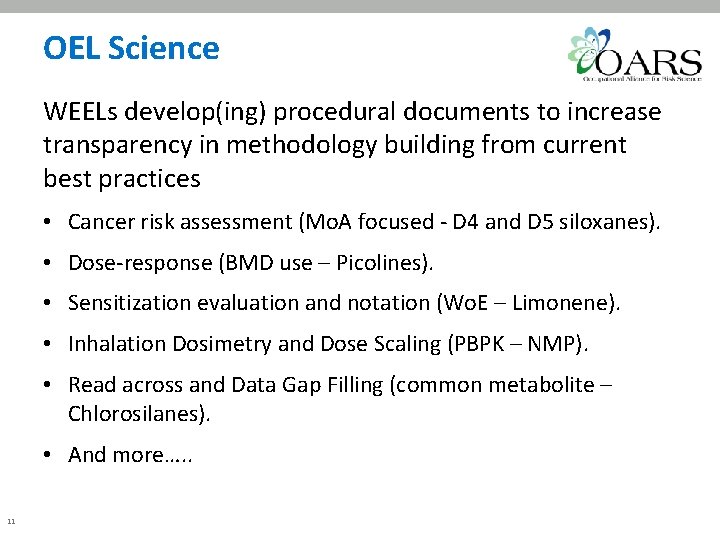
OEL Science WEELs develop(ing) procedural documents to increase transparency in methodology building from current best practices • Cancer risk assessment (Mo. A focused - D 4 and D 5 siloxanes). • Dose-response (BMD use – Picolines). • Sensitization evaluation and notation (Wo. E – Limonene). • Inhalation Dosimetry and Dose Scaling (PBPK – NMP). • Read across and Data Gap Filling (common metabolite – Chlorosilanes). • And more…. . 11
Key Reference • Journal of Occupational and Environmental Hygiene Volume 12, 2015 – Issue Supplement 1: State of the Science of Occupational Exposure Limit Methods and Guidance. • Review of current methods and resources • Point of departure estimation • Uncertainty factor application • Dosimetry adjustments • Use of new high throughput data and biomarkers • Aggregate and cumulative risks • Setting OELs for allergens • OEL selection 12
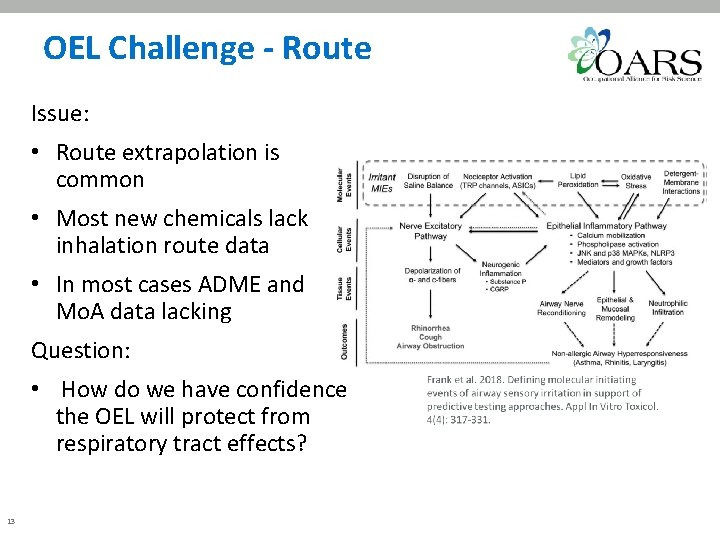
OEL Challenge - Route Issue: • Route extrapolation is common • Most new chemicals lack inhalation route data • In most cases ADME and Mo. A data lacking Question: • How do we have confidence the OEL will protect from respiratory tract effects? 13
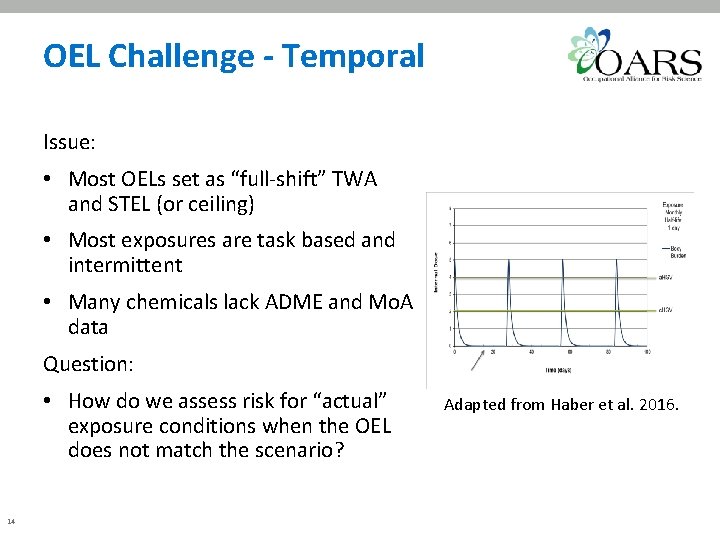
OEL Challenge - Temporal Issue: • Most OELs set as “full-shift” TWA and STEL (or ceiling) • Most exposures are task based and intermittent • Many chemicals lack ADME and Mo. A data Question: • How do we assess risk for “actual” exposure conditions when the OEL does not match the scenario? 14 Adapted from Haber et al. 2016.
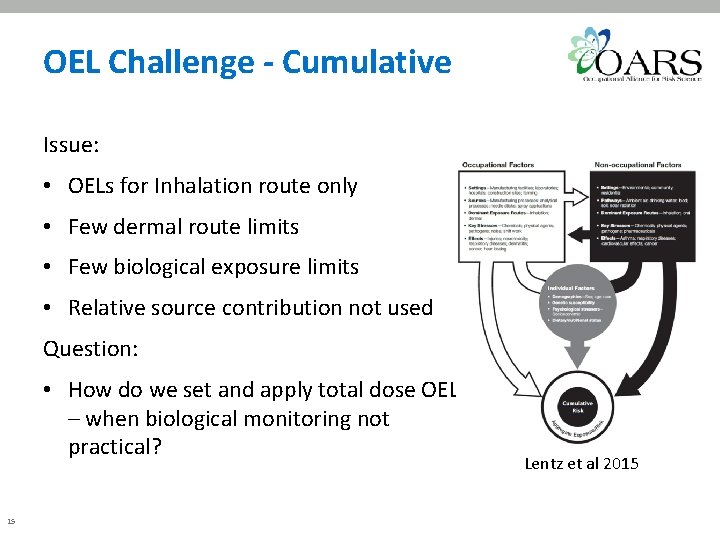
OEL Challenge - Cumulative Issue: • OELs for Inhalation route only • Few dermal route limits • Few biological exposure limits • Relative source contribution not used Question: • How do we set and apply total dose OELs – when biological monitoring not practical? 15 Lentz et al 2015
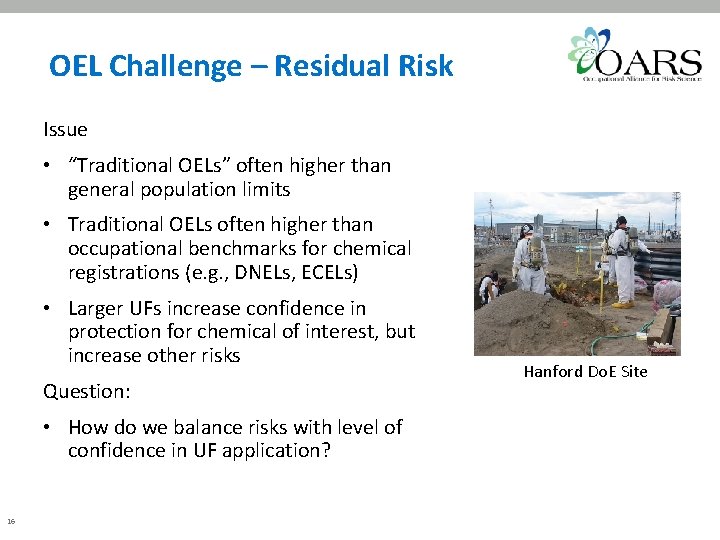
OEL Challenge – Residual Risk Issue • “Traditional OELs” often higher than general population limits • Traditional OELs often higher than occupational benchmarks for chemical registrations (e. g. , DNELs, ECELs) • Larger UFs increase confidence in protection for chemical of interest, but increase other risks Question: • How do we balance risks with level of confidence in UF application? 16 Hanford Do. E Site
Summary • Ongoing needs for harmonization in occupational risk sciences. • WEELs are important and unique resource. • WEELs are embracing evolving risk methods. • There are many challenges in both derivation AND application of OELs. 17