
The Obstetric Anal Sphincter Injury OASI Care Bundle
The Obstetric Anal Sphincter Injury (OASI) Care Bundle A quality improvement programme to reduce the incidence of third- and fourth-degree perineal tears
Current issues in OASI prevention in the UK • • Our Care Bundle aims to address these issues Inconsistencies in approaches to preventing OASIs Inconsistencies in training and skills Lack of awareness of risk factors and long-term impact of OASIs Variation in practice between midwives and doctors Trochez R, Waterfield M, Freeman RM. Hands on or hands off the perineum: a survey of care of the perineum in labour (HOOP). Int Urogynecol J 2011; 22: 1279– 85 2 Ismail KM, Paschetta E, Papoutsis D, Freeman RM. Perineal support and risk of obstetric anal sphincter injuries: a Delphi survey. Acta Obstet Gynecol Scand. 2015 Feb; 94(2): 165 -74. 3 Andrews V, Sultan AH, Thakar R, Jones PW. Risk factors for obstetric anal sphincter injury: a prospective study. Birth. 2006 Jun; 33(2): 117 -22. 4 Naidu M, Kapoor DS, Evans S, Vinayakarao L, Thakar R, Sultan AH. Cutting an episiotomy at 60 degrees: how good are we? Int Urogynecol J. 2015 Jun; 26(6): 813 -6. Groom KM, Paterson-Brown S. Can we improve on the diagnosis of third degree tears? Eur J Obstet Gynecol Reprod Biol. 2002 Feb 10; 101(1): 19 -21. 1
What is a Care Bundle? A care bundle is a small set of evidence-based interventions for a defined patient segment or population and care setting that, when implemented together, will result in significantly better outcomes than when implemented individually. Institute for Healthcare Improvement
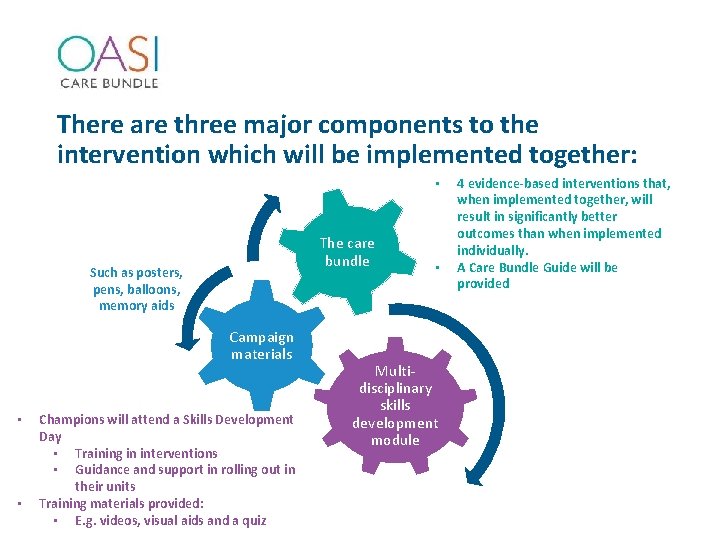
There are three major components to the intervention which will be implemented together: • The care bundle Such as posters, pens, balloons, memory aids Campaign materials • • Champions will attend a Skills Development Day • Training in interventions • Guidance and support in rolling out in their units Training materials provided: • E. g. videos, visual aids and a quiz • Multidisciplinary skills development module 4 evidence-based interventions that, when implemented together, will result in significantly better outcomes than when implemented individually. A Care Bundle Guide will be provided
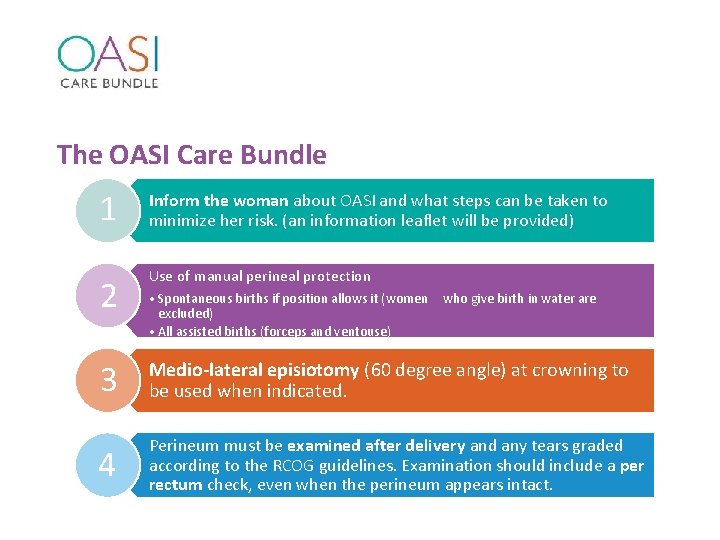
The OASI Care Bundle 1 Inform the woman about OASI and what steps can be taken to minimize her risk. (an information leaflet will be provided) 2 Use of manual perineal protection 3 Medio-lateral episiotomy (60 degree angle) at crowning to be used when indicated. 4 Perineum must be examined after delivery and any tears graded according to the RCOG guidelines. Examination should include a per rectum check, even when the perineum appears intact. • Spontaneous births if position allows it (women who give birth in water are excluded) • All assisted births (forceps and ventouse)
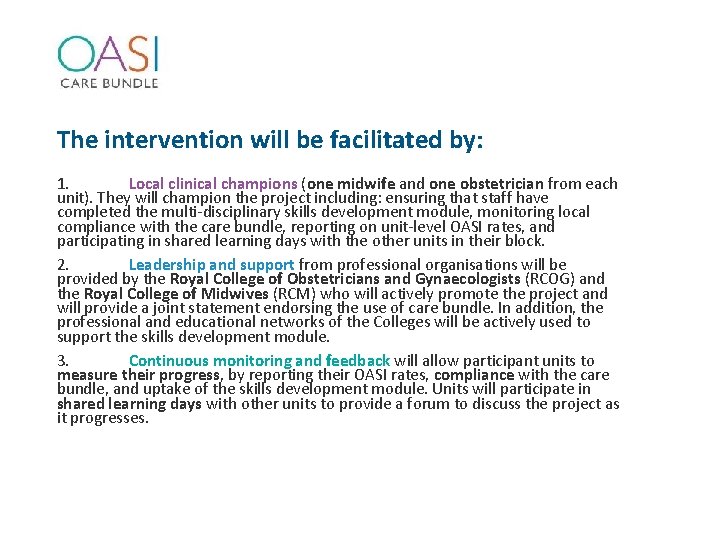
The intervention will be facilitated by: 1. Local clinical champions (one midwife and one obstetrician from each unit). They will champion the project including: ensuring that staff have completed the multi-disciplinary skills development module, monitoring local compliance with the care bundle, reporting on unit-level OASI rates, and participating in shared learning days with the other units in their block. 2. Leadership and support from professional organisations will be provided by the Royal College of Obstetricians and Gynaecologists (RCOG) and the Royal College of Midwives (RCM) who will actively promote the project and will provide a joint statement endorsing the use of care bundle. In addition, the professional and educational networks of the Colleges will be actively used to support the skills development module. 3. Continuous monitoring and feedback will allow participant units to measure their progress, by reporting their OASI rates, compliance with the care bundle, and uptake of the skills development module. Units will participate in shared learning days with other units to provide a forum to discuss the project as it progresses.
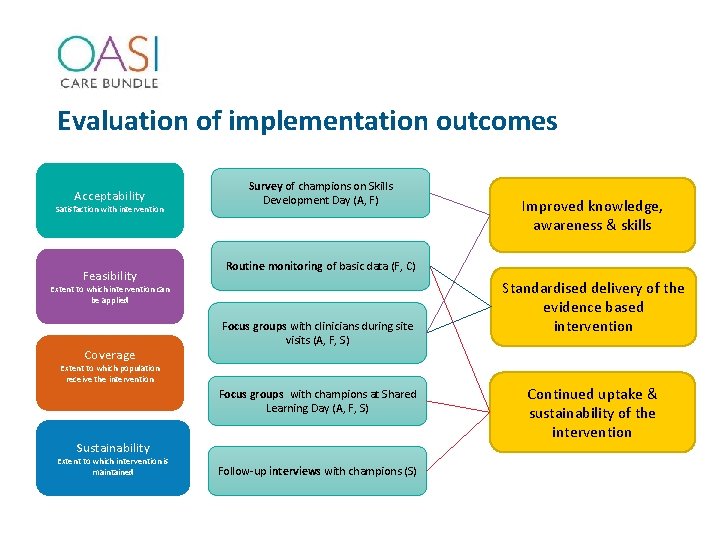
Evaluation of implementation outcomes Acceptability Satisfaction with intervention Feasibility Survey of champions on Skills Development Day (A, F) Routine monitoring of basic data (F, C) Extent to which intervention can be applied Coverage Focus groups with clinicians during site visits (A, F, S) Extent to which population receive the intervention Focus groups with champions at Shared Learning Day (A, F, S) Sustainability Extent to which intervention is maintained Improved knowledge, awareness & skills Follow-up interviews with champions (S) Standardised delivery of the evidence based intervention Continued uptake & sustainability of the intervention
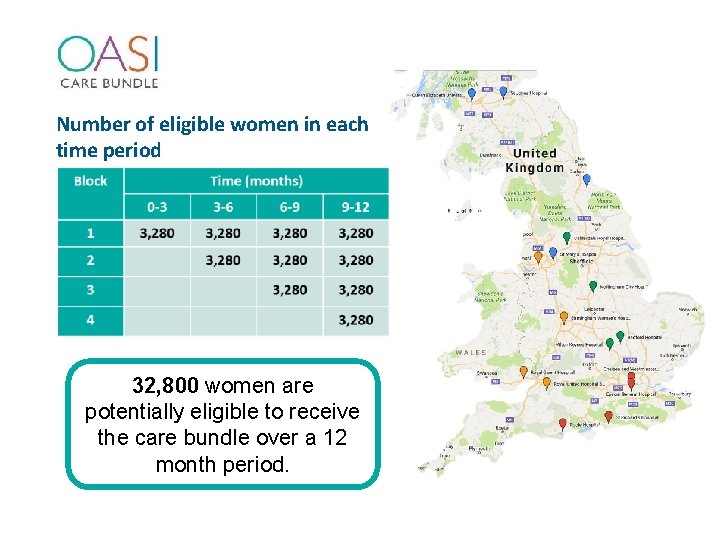
Number of eligible women in each time period 32, 800 women are potentially eligible to receive the care bundle over a 12 month period.
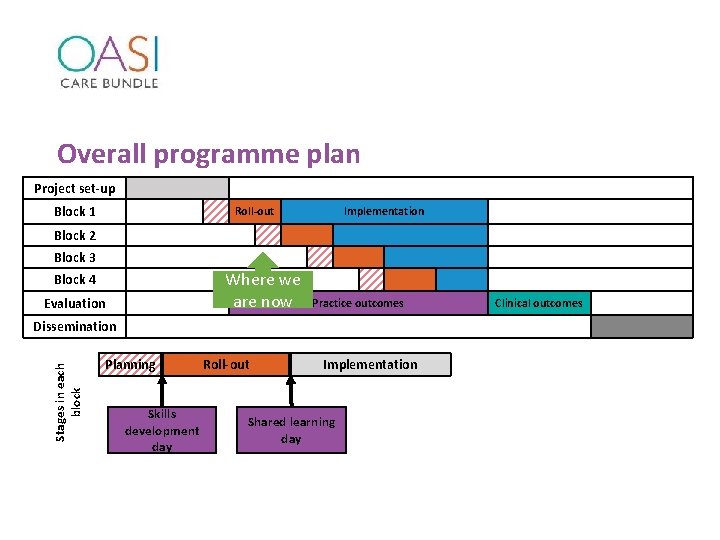
Overall programme plan Project set-up Block 1 Roll-out Implementation Block 2 Block 3 Where we are now Block 4 Evaluation Practice outcomes Stages in each block Dissemination Planning Skills development day Roll-out Implementation Shared learning day Clinical outcomes
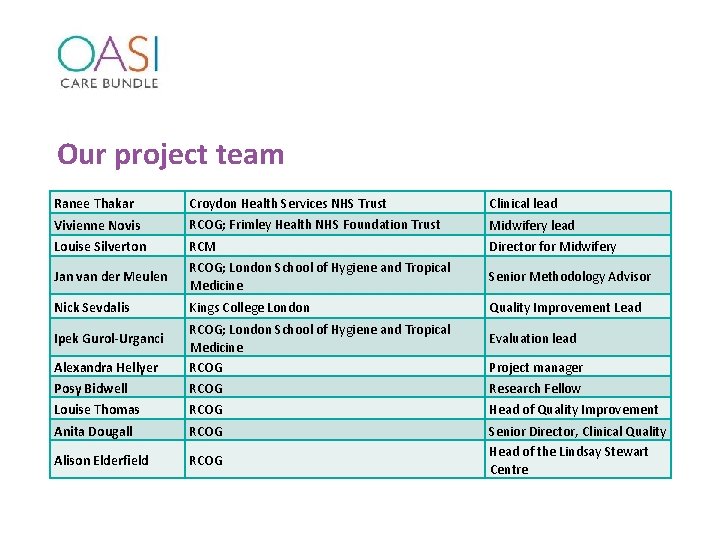
Our project team Ranee Thakar Vivienne Novis Louise Silverton Anita Dougall Jan van der Meulen Nick Sevdalis Croydon Health Services NHS Trust RCOG; Frimley Health NHS Foundation Trust Clinical lead RCM RCOG; London School of Hygiene and Tropical Medicine Director Midwifery Director, for Clinical Quality Kings College London Quality Improvement Lead Midwifery lead Senior Methodology Advisor Alexandra Hellyer Posy Bidwell RCOG; London School of Hygiene and Tropical Medicine RCOG Louise Thomas RCOG Head of Quality Improvement Anita Dougall RCOG Alison Elderfield RCOG Senior Director, Clinical Quality Head of the Lindsay Stewart Centre Ipek Gurol-Urganci Evaluation lead Project manager Research Fellow

Any questions?
- Slides: 11