
The Observation Feedback Cycle Getting to Practice SCS

The Observation & Feedback Cycle: Getting to Practice SCS Leader Institute June 2017
Objectives Articulate & rehearse the steps of the observation cycle Explain the importance of practice and describe elements of effective practice during the observation feedback debrief Observe a model practice step in a coaching conversation with a teacher
Agenda Observe & Plan Principles of Practice a Model Practice Conversation Planning Ahead: What do your teachers need to practice the most? Which teachers do you want to focus on?
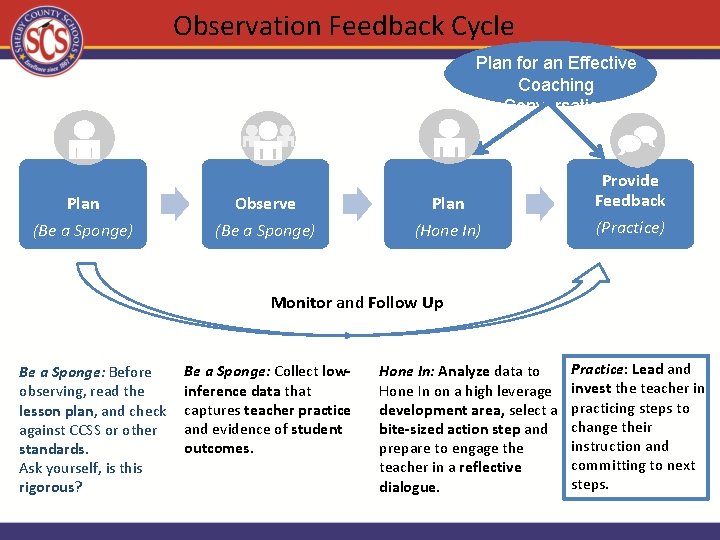
Observation Feedback Cycle Plan for an Effective Coaching Conversation Plan Observe Plan Provide Feedback (Be a Sponge) (Hone In) (Practice) Monitor and Follow Up Be a Sponge: Before observing, read the lesson plan, and check against CCSS or other standards. Ask yourself, is this rigorous? Be a Sponge: Collect lowinference data that captures teacher practice and evidence of student outcomes. Hone In: Analyze data to Hone In on a high leverage development area, select a bite-sized action step and prepare to engage the teacher in a reflective dialogue. Practice: Lead and invest the teacher in practicing steps to change their instruction and committing to next steps.
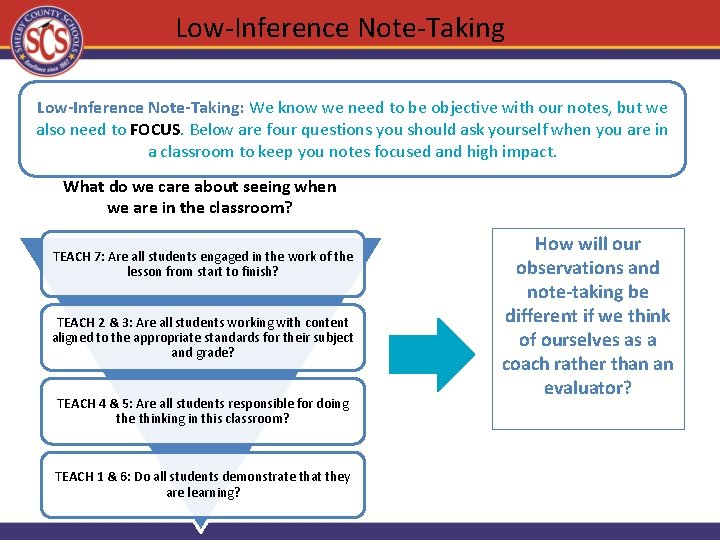
Low-Inference Note-Taking: We know we need to be objective with our notes, but we also need to FOCUS. Below are four questions you should ask yourself when you are in a classroom to keep you notes focused and high impact. What do we care about seeing when we are in the classroom? TEACH 7: Are all students engaged in the work of the lesson from start to finish? TEACH 2 & 3: Are all students working with content aligned to the appropriate standards for their subject and grade? TEACH 4 & 5: Are all students responsible for doing the thinking in this classroom? TEACH 1 & 6: Do all students demonstrate that they are learning? How will our observations and note-taking be different if we think of ourselves as a coach rather than an evaluator?
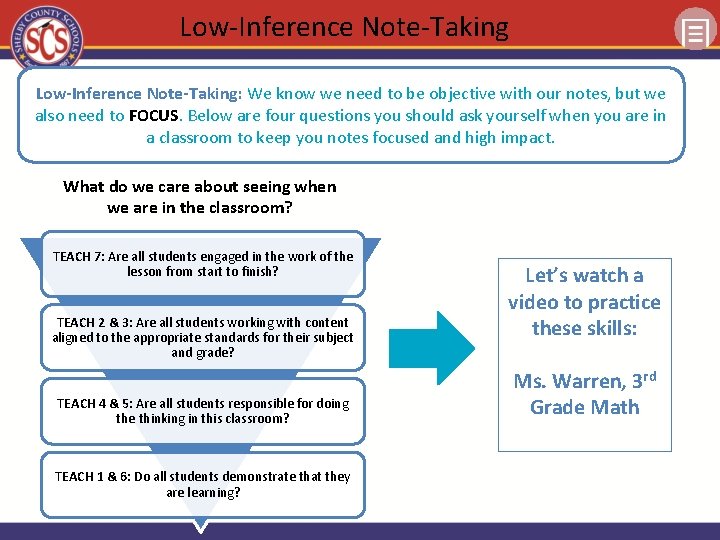
Low-Inference Note-Taking: We know we need to be objective with our notes, but we also need to FOCUS. Below are four questions you should ask yourself when you are in a classroom to keep you notes focused and high impact. What do we care about seeing when we are in the classroom? TEACH 7: Are all students engaged in the work of the lesson from start to finish? TEACH 2 & 3: Are all students working with content aligned to the appropriate standards for their subject and grade? TEACH 4 & 5: Are all students responsible for doing the thinking in this classroom? TEACH 1 & 6: Do all students demonstrate that they are learning? Let’s watch a video to practice these skills: Ms. Warren, 3 rd Grade Math
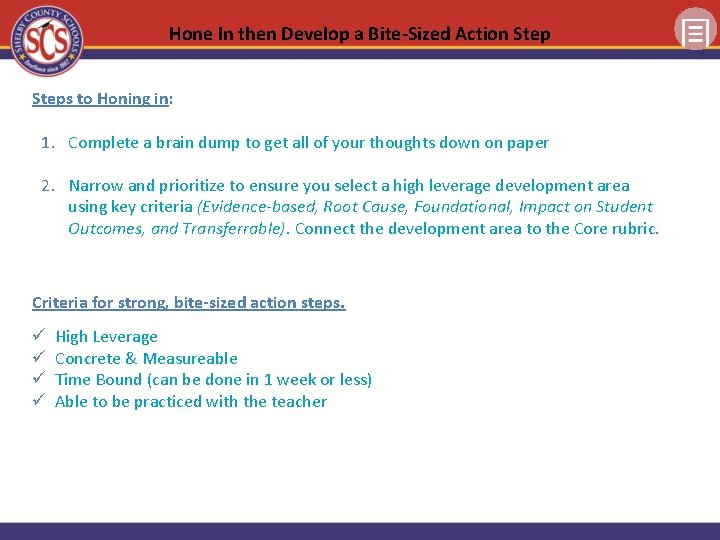
Hone In then Develop a Bite-Sized Action Steps to Honing in: 1. Complete a brain dump to get all of your thoughts down on paper 2. Narrow and prioritize to ensure you select a high leverage development area using key criteria (Evidence-based, Root Cause, Foundational, Impact on Student Outcomes, and Transferrable). Connect the development area to the Core rubric. Criteria for strong, bite-sized action steps. ü ü High Leverage Concrete & Measureable Time Bound (can be done in 1 week or less) Able to be practiced with the teacher
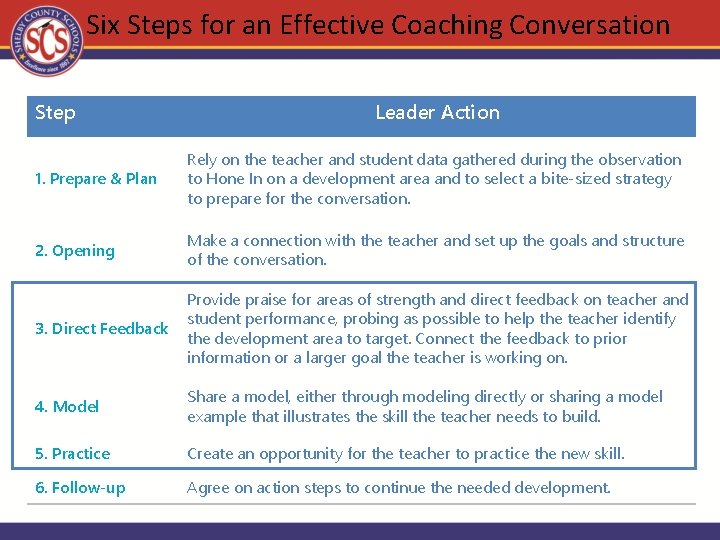
Six Steps for an Effective Coaching Conversation Step Leader Action 1. Prepare & Plan Rely on the teacher and student data gathered during the observation to Hone In on a development area and to select a bite-sized strategy to prepare for the conversation. 2. Opening Make a connection with the teacher and set up the goals and structure of the conversation. 3. Direct Feedback Provide praise for areas of strength and direct feedback on teacher and student performance, probing as possible to help the teacher identify the development area to target. Connect the feedback to prior information or a larger goal the teacher is working on. 4. Model Share a model, either through modeling directly or sharing a model example that illustrates the skill the teacher needs to build. 5. Practice Create an opportunity for the teacher to practice the new skill. 6. Follow-up Agree on action steps to continue the needed development.
Agenda Observe & Plan Principles of Practice a Model Practice Conversation Planning Ahead: What do your teachers need to practice the most? Which teachers do you want to focus on?
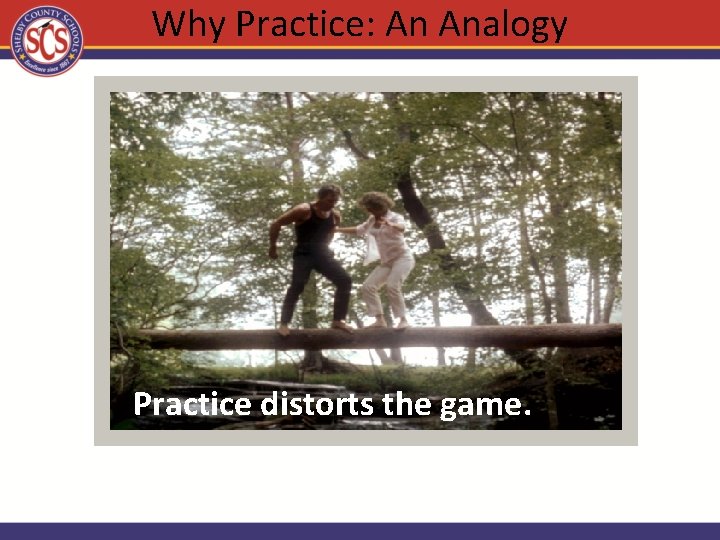
Why Practice: An Analogy Practice distorts the game.
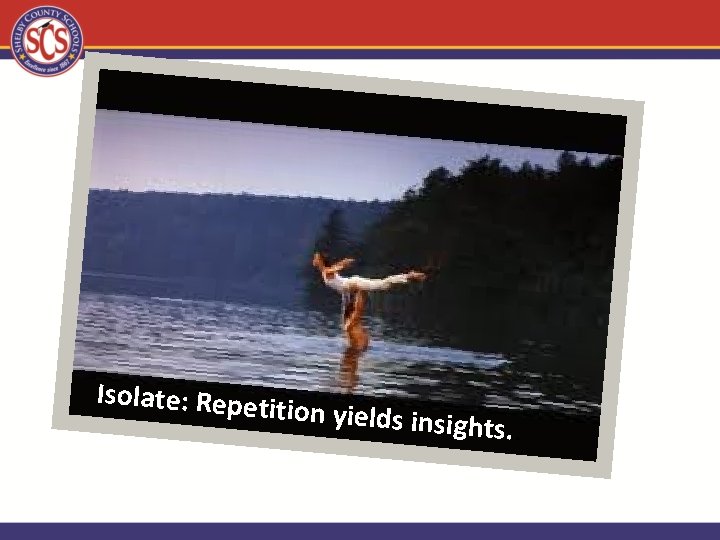
Isolate: Repet ition yields ins ights. .
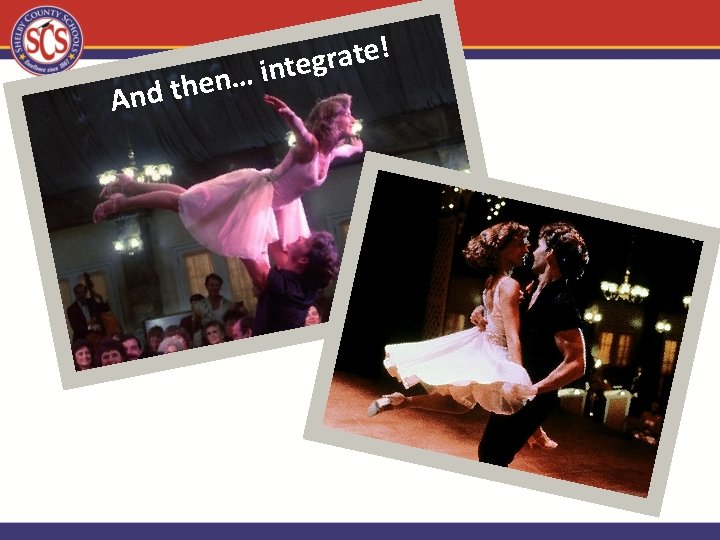
n e h t And ! e t a r g … inte
… ce i t c a r p , s Ye s e m i t e m o s d r a w k can be aw
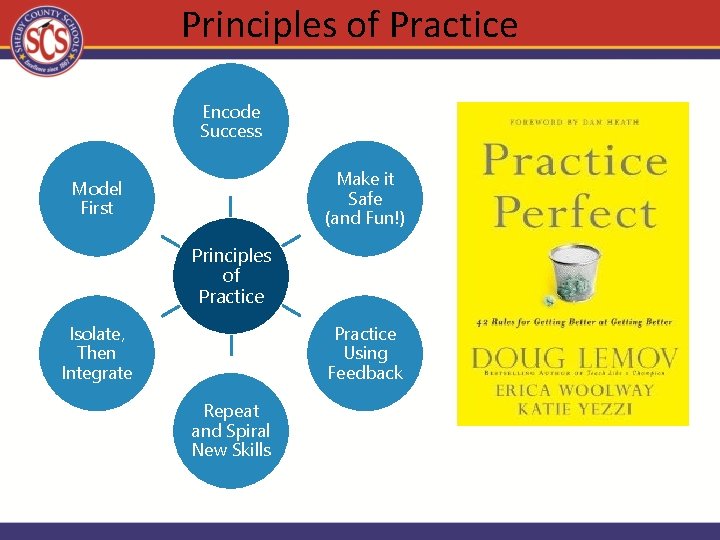
Principles of Practice Encode Success Make it Safe (and Fun!) Model First Principles of Practice Isolate, Then Integrate Practice Using Feedback Repeat and Spiral New Skills
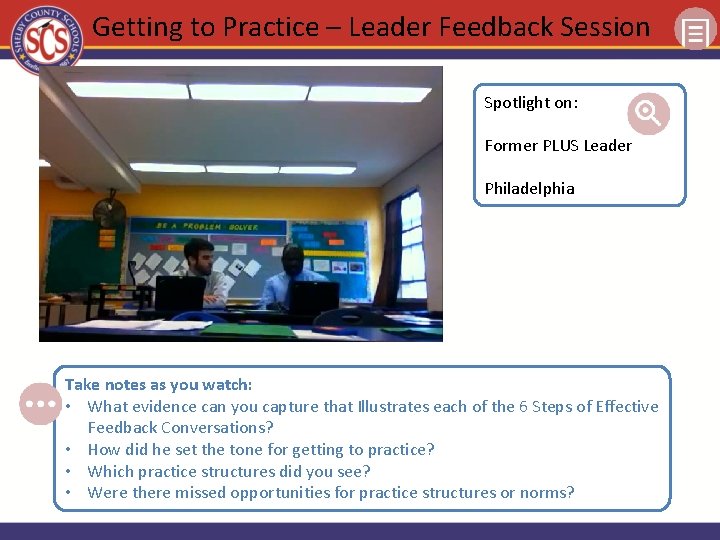
Getting to Practice – Leader Feedback Session Spotlight on: Former PLUS Leader Philadelphia Take notes as you watch: • What evidence can you capture that Illustrates each of the 6 Steps of Effective Feedback Conversations? • How did he set the tone for getting to practice? • Which practice structures did you see? • Were there missed opportunities for practice structures or norms?
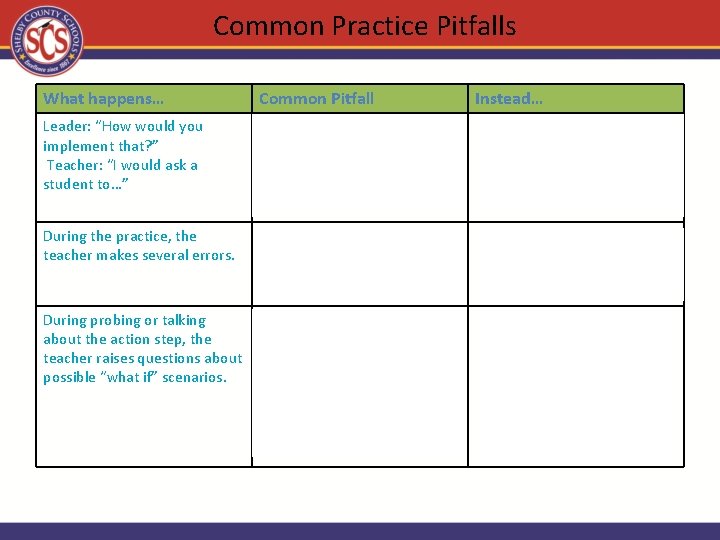
Common Practice Pitfalls What happens… Common Pitfall Instead… Leader: “How would you implement that? ” Teacher: “I would ask a student to…” Leader and teacher are talking about the action step. The teacher should stand up and practice as if it were her classroom. Talking about the action step isn’t practice. During the practice, the teacher makes several errors. Leader gives feedback and the teacher talks about how she will do it differently. Practice AGAIN until the teacher implements the action step with accuracy. During probing or talking about the action step, the teacher raises questions about possible “what if” scenarios. Leader and teacher spend the bulk of their time talking about the “what ifs” and run out of time to practice. Pause the conversation and say “I love that you’re already thinking through possible student responses and scenarios. Let’s practice the action step to see how it would play out in that case. ” Get to the practice!
TAKE A BREAK! Let’s take a short break! Please be back in your seat and ready to learn again in 10 minutes.
Agenda Observe & Plan Principles of Practice a Model Practice Conversation Planning Ahead: What do your teachers need to practice the most? Which teachers do you want to focus on?
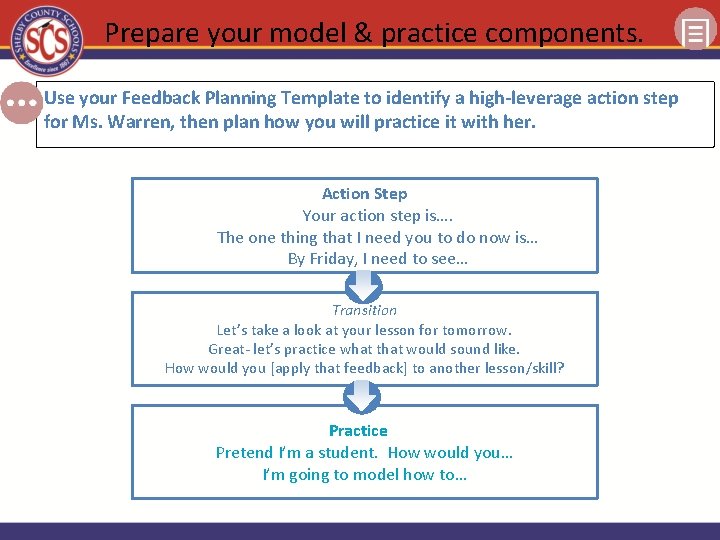
Prepare your model & practice components. Use your Feedback Planning Template to identify a high-leverage action step for Ms. Warren, then plan how you will practice it with her. Action Step Your action step is…. The one thing that I need you to do now is… By Friday, I need to see… Transition Let’s take a look at your lesson for tomorrow. Great- let’s practice what that would sound like. How would you [apply that feedback] to another lesson/skill? Practice Pretend I’m a student. How would you… I’m going to model how to… 19
Agenda Observe & Plan Principles of Practice a Model Practice Conversation Planning Ahead: What do your teachers need to practice the most? Which teachers do you want to focus on?
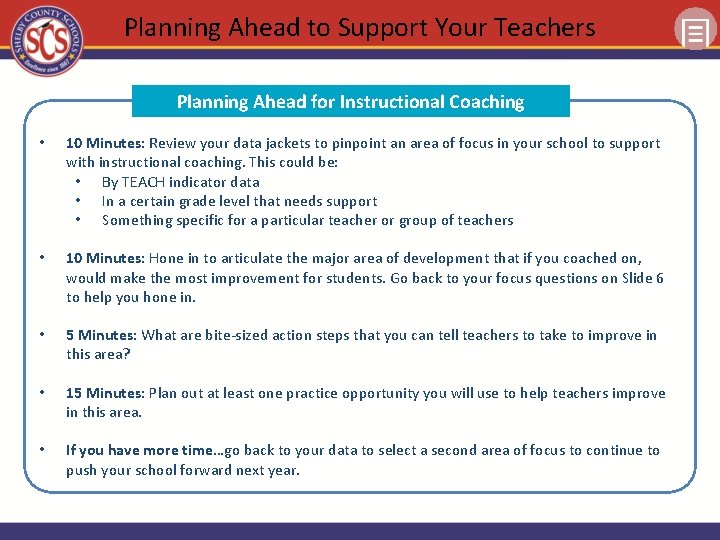
Planning Ahead to Support Your Teachers Planning Ahead for Instructional Coaching • 10 Minutes: Review your data jackets to pinpoint an area of focus in your school to support with instructional coaching. This could be: • By TEACH indicator data • In a certain grade level that needs support • Something specific for a particular teacher or group of teachers • 10 Minutes: Hone in to articulate the major area of development that if you coached on, would make the most improvement for students. Go back to your focus questions on Slide 6 to help you hone in. • 5 Minutes: What are bite-sized action steps that you can tell teachers to take to improve in this area? • 15 Minutes: Plan out at least one practice opportunity you will use to help teachers improve in this area. • If you have more time…go back to your data to select a second area of focus to continue to push your school forward next year.
- Slides: 21