
The objectives of this lesson are Learn about
The objectives of this lesson are: Learn about a legend which is from another country. Reflect about their own legends. Make connections between legend and history in their country. Understand written texts and visual material. Look for general and specific information in the different texts. Compare, share ideas with the classmates. Explain a story/legend that is familiar to them.
From legend to history
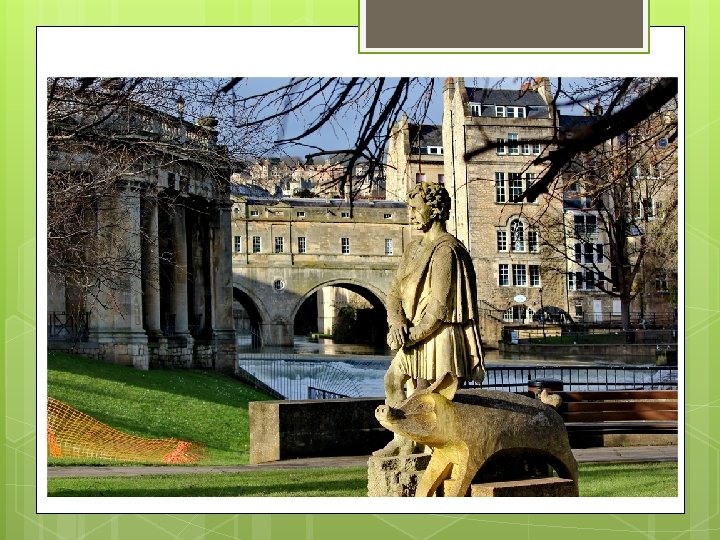
Who is that ?
Answer these questions 1. Who do you think that man is: . a warrior. a farmer. a prince. a shepherd 2. What animal is next to the person? 3. In pairs, imagine what the relationship between them is. Can you guess their story? 4. Explain what you imagined to the whole group.

Reading activity Bladud was the legendary founder of Bath and the sacred temple of Aqua Sullis. He is mentioned in Geoffrey of Monmouth's History of the Kings of Britain and The Life of Merlin, written in the twelfth century. The source of the original legend is obscure. Lud Hubibras (Bladud), was a British Prince in Celtic times. While at court the Prince contracted the dreaded Leprosy, and was banished and disowned by his father. Before he made his way out of the kingdom his mother took him aside and gave him a golden ring. This was to be the key to his return if he could ever cure himself of the disease. Everywhere the Prince went he was shunned, he made a living as a swineherd until some of the herd also caught the disease. To hide this from his employer, he fled across the river Avon (at a place now called Swineford), and into the land where the city of Bath now stands. He wandered the area until one day one of the pigs seemed to go crazy and rushed headlong into a black bog in the marshy ground. Bladud struggled to pull the pig from the bog and became covered in the foul smelling mud. When he had finally freed himself and the pig, he found that the pigs skin lesions had disappeared, and where the mud had touched his bare skin he was also cured. He immersed himself fully in the warm mud and became fully cured of the disease. Finally Bladud returned to Court, where he was welcomed with open arms by his mother, who recognised the ring she had given him so many years before. Bladud ruled wisely as King for twenty years. He founded the city of Bath, and created the temple of Aqua Sullis dedicated to Minerva. He was said to have been a man of great learning, he studied in Athens and brought much Greek wisdom into Britain. He was killed when a magical experiment wrong; he built himself some wings, and was flying over New Troy when they gave way and he crashed to the ground. Please, check all words in bold, explain their meaning or give synonyms. Alternatively, vocabulary matching activity in case of weaker students. (Students match the list of words in bold with their definitions) http: //www. mysteriousbritain. co. uk/england/avon/legends/the-legend-of-bladud. html
Answer the following questions in pairs. Who was Bladud? When was he mentioned the first time? What illness did he contract? What did his mother give him before he left? Why did he have to escape from his employer? What happened to one of his pigs one day? What were the consequences of them immersing into the mud? What is the end of the story? Did you like the story? Why?
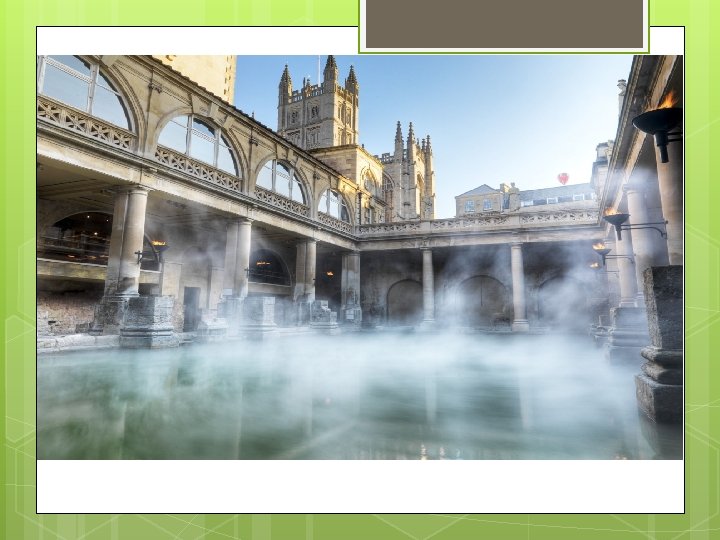
The Roman Baths
Watch this video https: //youtu. be/c. DLgo. Lh 5 hi. Y True or False? Correct the false statements. . Bath was originally called Aquae Fulis. There is a museum around the Roman Baths. . The hot water has been bubbling for 1000 years. . The goddess of the hot springs is Minerva. . The water has 34 minerals. . The hot water cures leprosy. . River Thames flows through Bath. . The canal was built to transport coal. T F (For stronger groups, some open questions about the video. E. g. What was the original name of Bath? )
Speaking Do you know some legends in your region or country? Talk about it with your classmate(s) and explain them to the group.
Follow up writing activity Write a legend (real or invented) of 120 -150 words. (Revise the structure of a narrative )
- Slides: 10