
The Nuts and Bolts of FirstPrinciples Simulation 3
The Nuts and Bolts of First-Principles Simulation 3: Density Functional Theory CASTEP Developers’ Group with support from the ESF k Network CASTEP Workshop, Durham University, 6 – 13 December 2001
Density functional theory Mike Gillan, University College London • Ground-state energetics of electrons in condensed matter • Energy as functional of density: the two fundamental theorems • Equivalence of the interacting electron system to a noninteracting system in an effective external potential • Kohn-sham equation • Local-density approximation for exchange-correlation energy CASTEP Workshop, Durham University, 6 – 13 December 2001
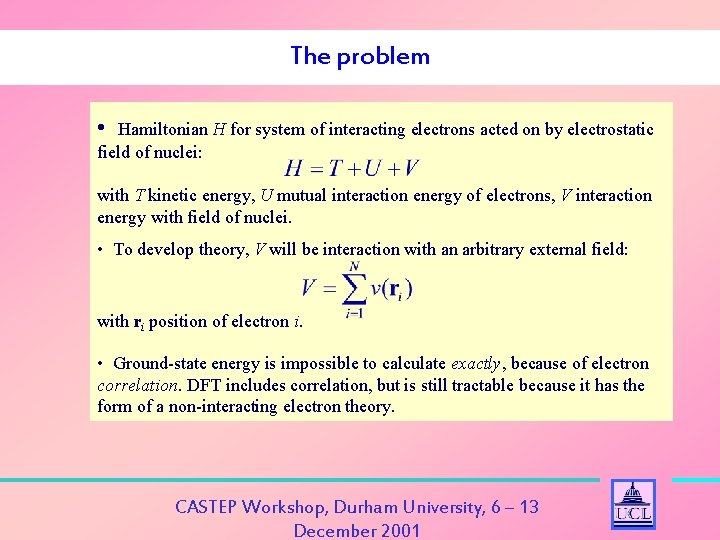
The problem • Hamiltonian H for system of interacting electrons acted on by electrostatic field of nuclei: with T kinetic energy, U mutual interaction energy of electrons, V interaction energy with field of nuclei. • To develop theory, V will be interaction with an arbitrary external field: with ri position of electron i. • Ground-state energy is impossible to calculate exactly, because of electron correlation. DFT includes correlation, but is still tractable because it has the form of a non-interacting electron theory. CASTEP Workshop, Durham University, 6 – 13 December 2001
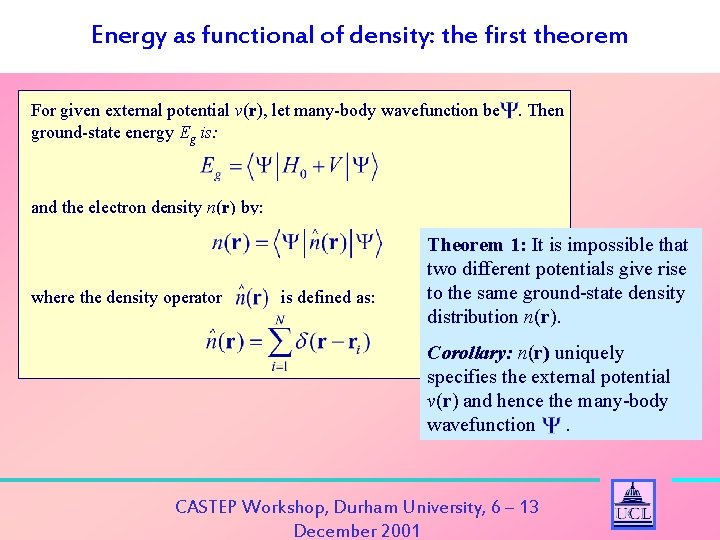
Energy as functional of density: the first theorem For given external potential v(r), let many-body wavefunction be ground-state energy Eg is: . Then and the electron density n(r) by: where the density operator is defined as: Theorem 1: It is impossible that two different potentials give rise to the same ground-state density distribution n(r). Corollary: n(r) uniquely specifies the external potential v(r) and hence the many-body wavefunction. CASTEP Workshop, Durham University, 6 – 13 December 2001
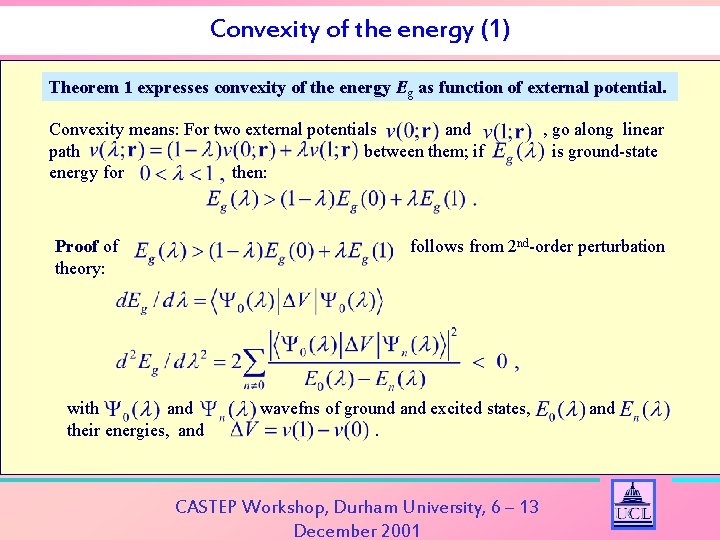
Convexity of the energy (1) Theorem 1 expresses convexity of the energy Eg as function of external potential. Convexity means: For two external potentials and path between them; if energy for then: Proof of theory: , go along linear is ground-state follows from 2 nd-order perturbation with and their energies, and wavefns of ground and excited states, . CASTEP Workshop, Durham University, 6 – 13 December 2001 and
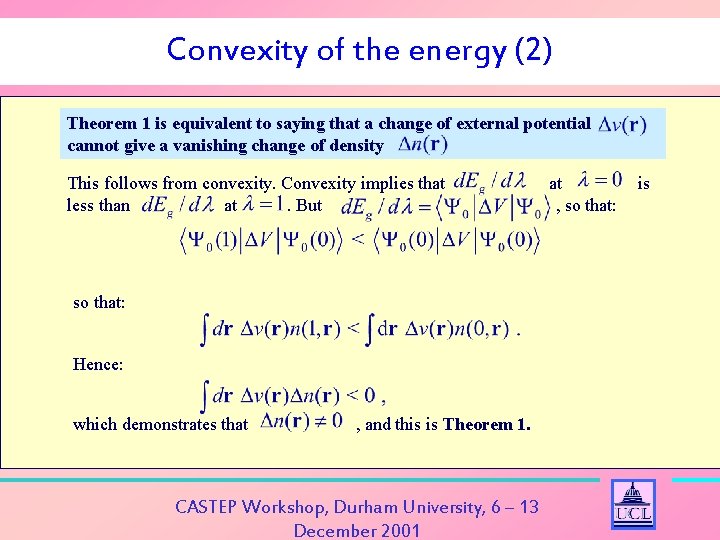
Convexity of the energy (2) Theorem 1 is equivalent to saying that a change of external potential cannot give a vanishing change of density This follows from convexity. Convexity implies that less than at. But so that: Hence: which demonstrates that , and this is Theorem 1. CASTEP Workshop, Durham University, 6 – 13 December 2001 at , so that: is
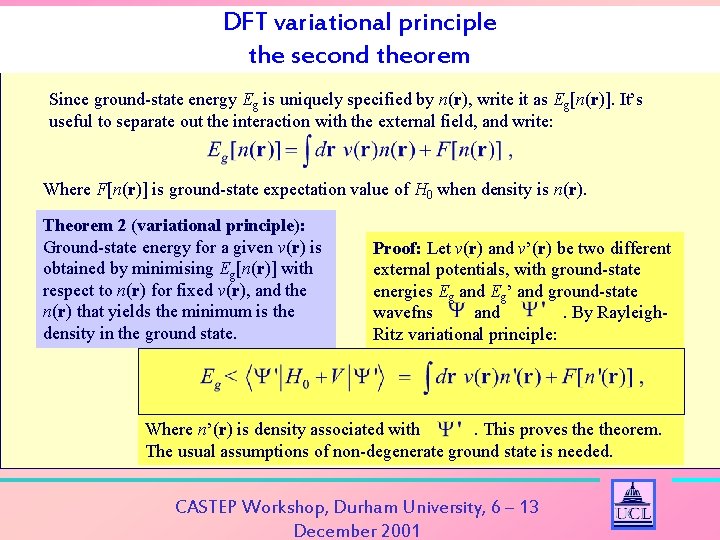
DFT variational principle the second theorem Since ground-state energy Eg is uniquely specified by n(r), write it as Eg[n(r)]. It’s useful to separate out the interaction with the external field, and write: Where F[n(r)] is ground-state expectation value of H 0 when density is n(r). Theorem 2 (variational principle): Ground-state energy for a given v(r) is obtained by minimising Eg[n(r)] with respect to n(r) for fixed v(r), and the n(r) that yields the minimum is the density in the ground state. Proof: Let v(r) and v’(r) be two different external potentials, with ground-state energies Eg and Eg’ and ground-state wavefns and. By Rayleigh. Ritz variational principle: Where n’(r) is density associated with. This proves theorem. The usual assumptions of non-degenerate ground state is needed. CASTEP Workshop, Durham University, 6 – 13 December 2001
![The Euler equation Write F[n(r)] as: where T[n] is kinetic energy of a system](http://slidetodoc.com/presentation_image_h/ae2f8ddd7dbac233cd57bcf42dc8220a/image-8.jpg "The Euler equation Write F[n(r)] as: where T[n] is kinetic energy of a system")
The Euler equation Write F[n(r)] as: where T[n] is kinetic energy of a system of non-interacting electrons whose density distribution is n(r). Then: Variational principle: subject to constraint: Handle the constant-number constraint by Lagrange undetermined multiplier, and get: with undetermined multiplier the chemical potential. CASTEP Workshop, Durham University, 6 – 13 December 2001
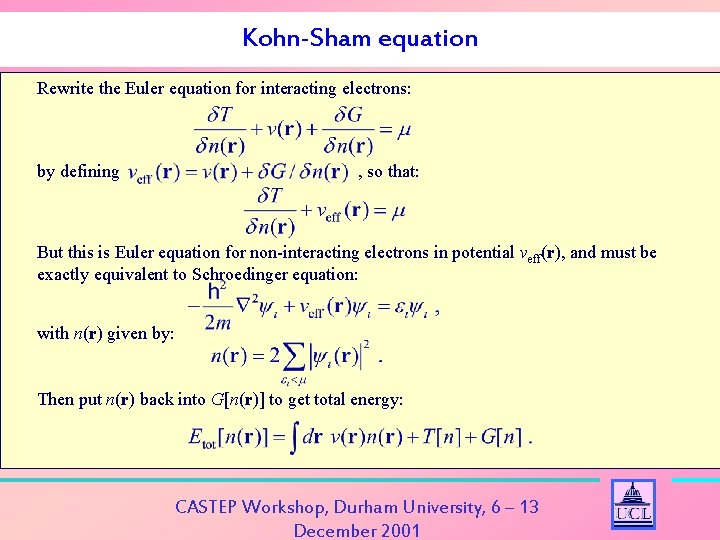
Kohn-Sham equation Rewrite the Euler equation for interacting electrons: by defining , so that: But this is Euler equation for non-interacting electrons in potential veff(r), and must be exactly equivalent to Schroedinger equation: with n(r) given by: Then put n(r) back into G[n(r)] to get total energy: CASTEP Workshop, Durham University, 6 – 13 December 2001
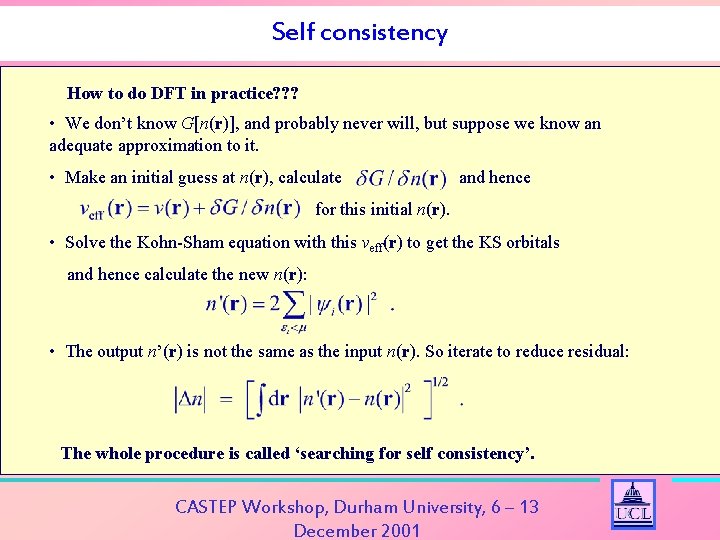
Self consistency How to do DFT in practice? ? ? • We don’t know G[n(r)], and probably never will, but suppose we know an adequate approximation to it. • Make an initial guess at n(r), calculate and hence for this initial n(r). • Solve the Kohn-Sham equation with this veff(r) to get the KS orbitals and hence calculate the new n(r): • The output n’(r) is not the same as the input n(r). So iterate to reduce residual: The whole procedure is called ‘searching for self consistency’. CASTEP Workshop, Durham University, 6 – 13 December 2001
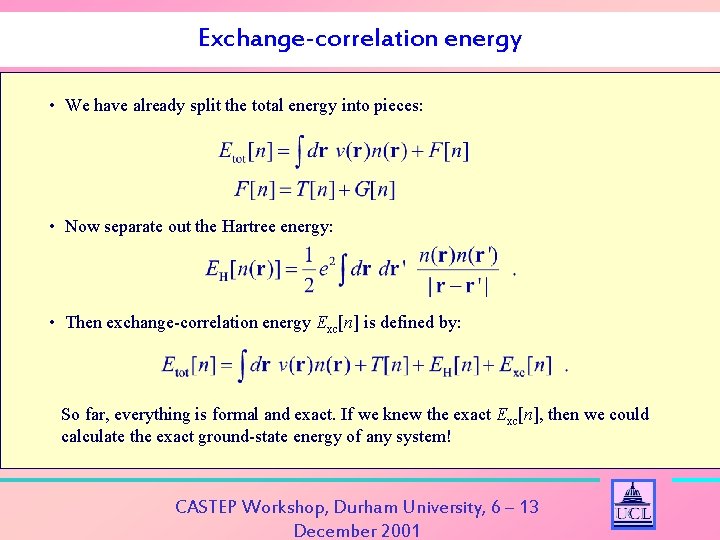
Exchange-correlation energy • We have already split the total energy into pieces: • Now separate out the Hartree energy: • Then exchange-correlation energy Exc[n] is defined by: So far, everything is formal and exact. If we knew the exact Exc[n], then we could calculate the exact ground-state energy of any system! CASTEP Workshop, Durham University, 6 – 13 December 2001
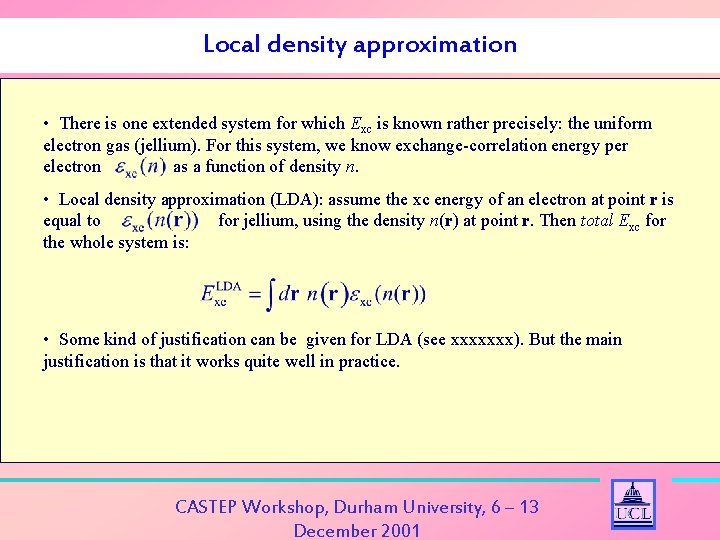
Local density approximation • There is one extended system for which Exc is known rather precisely: the uniform electron gas (jellium). For this system, we know exchange-correlation energy per electron as a function of density n. • Local density approximation (LDA): assume the xc energy of an electron at point r is equal to for jellium, using the density n(r) at point r. Then total Exc for the whole system is: • Some kind of justification can be given for LDA (see xxxxxxx). But the main justification is that it works quite well in practice. CASTEP Workshop, Durham University, 6 – 13 December 2001
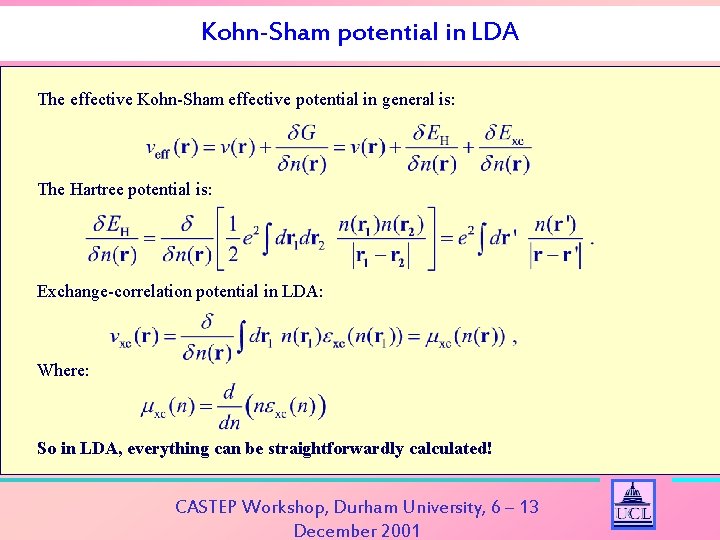
Kohn-Sham potential in LDA The effective Kohn-Sham effective potential in general is: The Hartree potential is: Exchange-correlation potential in LDA: Where: So in LDA, everything can be straightforwardly calculated! CASTEP Workshop, Durham University, 6 – 13 December 2001
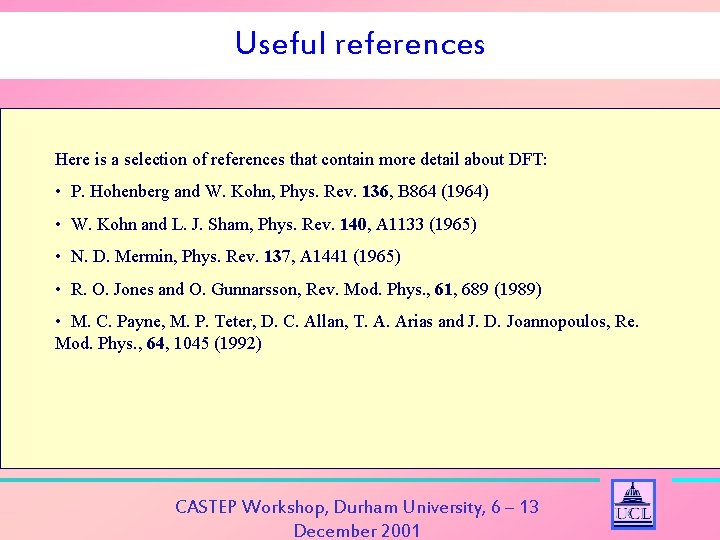
Useful references Here is a selection of references that contain more detail about DFT: • P. Hohenberg and W. Kohn, Phys. Rev. 136, B 864 (1964) • W. Kohn and L. J. Sham, Phys. Rev. 140, A 1133 (1965) • N. D. Mermin, Phys. Rev. 137, A 1441 (1965) • R. O. Jones and O. Gunnarsson, Rev. Mod. Phys. , 61, 689 (1989) • M. C. Payne, M. P. Teter, D. C. Allan, T. A. Arias and J. D. Joannopoulos, Re. Mod. Phys. , 64, 1045 (1992) CASTEP Workshop, Durham University, 6 – 13 December 2001
- Slides: 14