
The Nursing Process Stacie Pigues MSN RN NWCC
- Slides: 41
The Nursing Process Stacie Pigues, MSN, RN NWCC NUR 1117 Foundations of Nursing
Problem Solving Process • Method for organizing and delivering nursing care • Focus is identification and treatment of responses of individuals or groups to actual or potential health alterations • Allows nurses in all settings to identify and meet changing client needs • Process is sequential and interrelated
Problem Solving Process • Each step depends on the previous step • Joint effort between the nurse and the client • Two critical functions are mastered for the nursing process to be effective 1. Communication 2. Documentation
Nursing Process • You must complete this process in order to write your nursing care plan • The Nursing Care Plan (NCP) is the written version of the nursing process • It is the basis for nursing implementation
Nursing Process • Assessment and nursing diagnosis are essential for problem identification and planning • Implementation and evaluation are essential for problem solving
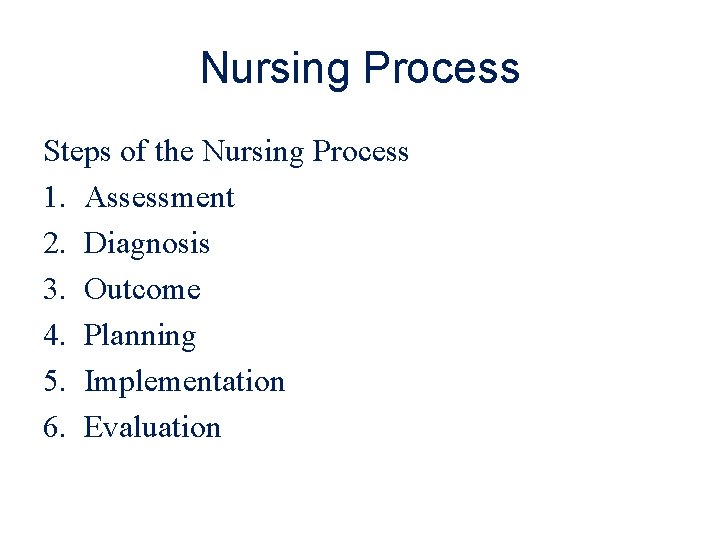
Nursing Process Steps of the Nursing Process 1. Assessment 2. Diagnosis 3. Outcome 4. Planning 5. Implementation 6. Evaluation
Nursing Process (Assessment) • Collecting and organizing information about the client’s health status • Establishes a data base • Data collection is the process of gathering information about a client’s health status • Involves the collection of nursing health history
Nursing Process (Assessment) Types of data collection A. Subjective Data B. Objective Data
Nursing Process (Assessment) Subjective Data • Only apparent to and verified by the client • Are the symptoms as related to the “signs and symptoms of a disease” • Can only be obtained by asking questions, unless the information is voluntarily given • Subjective= what the client “says”
Nursing Process (Assessment) Objective Data • Observation and measurements made by the data collector, such as the nurse • Are the signs as related to the “signs and symptoms of a disease” • Objective= what the nurse “observes”
Nursing Process (Assessment) Sources of Data • Primary or direct • Secondary or indirect
Nursing Diagnosis • Statement describing client’s response to a situation/condition • Results in an actual or high risk health problem/need • Consist of decision-making steps, used to develop a diagnostic statement
Nursing Diagnosis Medical vs. Nursing Ø Medical diagnosis→Disease or pathology of organs or body system. Provides information about signs and symptoms of disease process. Ø Nursing diagnosis→Actual, risk, or wellness human response to a health problem. Nurses can treat independently.
Nursing Diagnosis • During the diagnostic process: 1. Analyze collected data from assessment 2. Validate findings with diagnostic categories 3. Choose category that best fits the data
Nursing Diagnosis • Two types of nursing diagnosis 1. Actual 2. High Risk (potential)
Nursing Diagnosis Actual Problem • 3 part statement • These (3) parts are connected by the phrases “related to” (R/T) and “as manifested by” (AMB) or “as evidenced by” (AEB)
Nursing Diagnosis Actual Problem • Contains a Problem (Diagnostic Category) • R/T Cause/Etiology (Contributing or Risk Factors) • AMB Signs/Symptoms (Defining Characteristics)
Nursing Diagnosis Actual Problem Altered Comfort: Acute Pain R/T accident AMB facial mask of pain, crying, and moaning
Nursing Diagnosis High Risk • 2 part statement • Contains a Problem (Diagnostic Category) • R/T Cause/Etiology (Contributing or Risk Factors) • No accompanying signs or symptoms, only the presence of risk factors
Nursing Diagnosis Potential Problem High Risk for Injury R/T faulty judgment
Nursing Diagnosis Examples: • Impaired physical mobility R/T musculoskeletal impairment AMB contracture of the RUE • Impaired skin integrity R/T immobility AMB L hip decubitus (2. 5 cm X 3. 5 cm X 1. 5 cm)
Planning • • Set priorities Determine client centered goals Develop expected outcomes Formulate NCP
Planning Prioritize nursing diagnoses a. High b. Intermediate c. Low
Planning • Set goals with outcome criteria a. Provide direction for planning nursing actions b. Evaluate the effectiveness of nursing actions c. Client centered d. Goal must be determined for every nursing diagnosis
Planning What is a goal? A goal or expected outcome is a statement about the expected or desired changes in the client’s status as a result of nursing care.
Planning • A complete goal statement must contain five parts 1. Subject – Client 2. Verb – Action 3. Condition – Under what circumstances 4. Criteria – How well 5. Specific time – Target date v. Goals should be realistic, mutually agreed upon by the nurse and client, client centered, measurable, specific, and timed (must be reasonable)
Planning • Goals must have a specific time frame, and are connected with expected outcomes with the phrase “as manifested by” or AMB or “as evidenced by” (AEB) • Short term goals • Long term goals
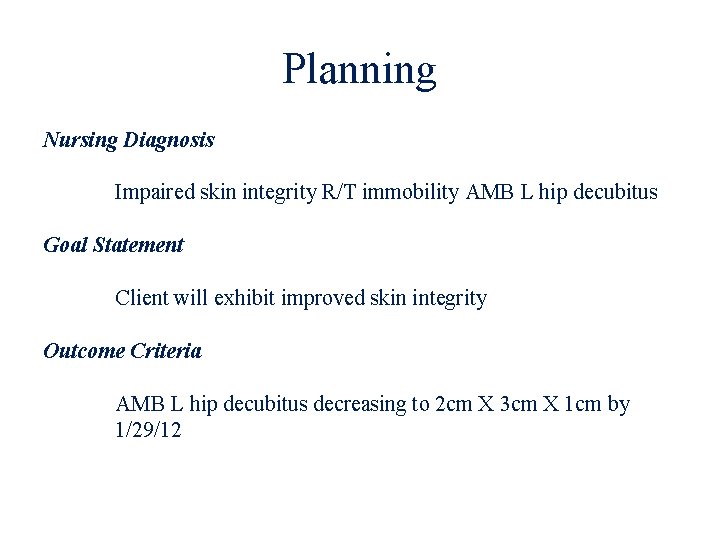
Planning Nursing Diagnosis Impaired skin integrity R/T immobility AMB L hip decubitus Goal Statement Client will exhibit improved skin integrity Outcome Criteria AMB L hip decubitus decreasing to 2 cm X 3 cm X 1 cm by 1/29/12
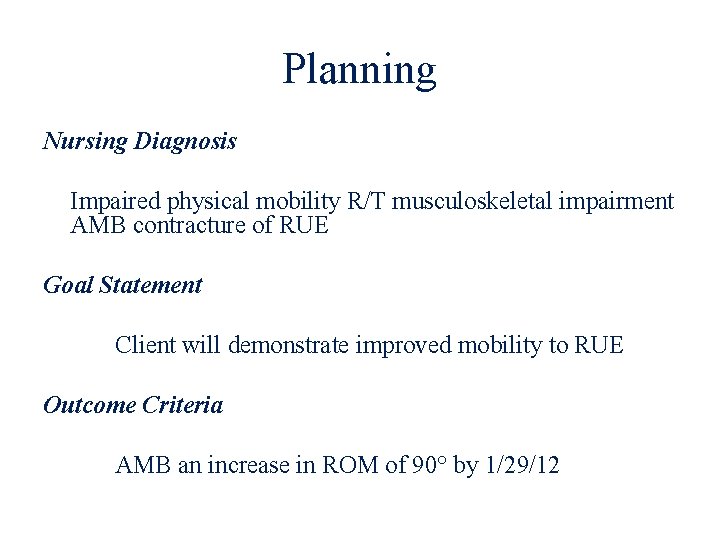
Planning Nursing Diagnosis Impaired physical mobility R/T musculoskeletal impairment AMB contracture of RUE Goal Statement Client will demonstrate improved mobility to RUE Outcome Criteria AMB an increase in ROM of 90° by 1/29/12
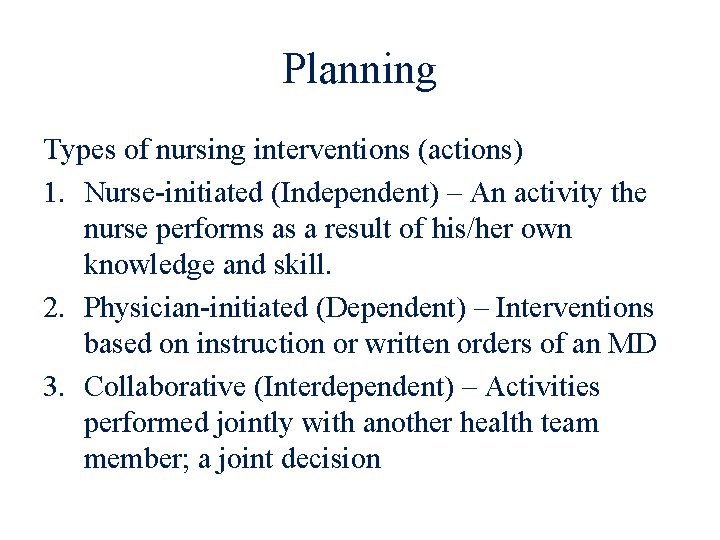
Planning Types of nursing interventions (actions) 1. Nurse-initiated (Independent) – An activity the nurse performs as a result of his/her own knowledge and skill. 2. Physician-initiated (Dependent) – Interventions based on instruction or written orders of an MD 3. Collaborative (Interdependent) – Activities performed jointly with another health team member; a joint decision
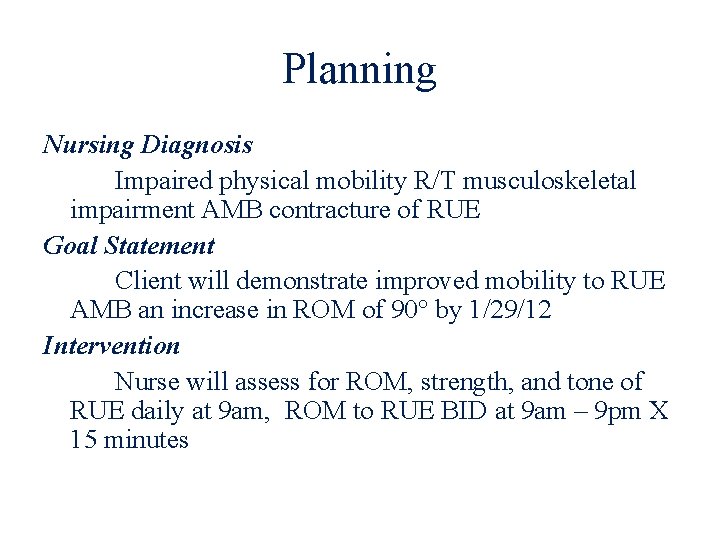
Planning Nursing Diagnosis Impaired physical mobility R/T musculoskeletal impairment AMB contracture of RUE Goal Statement Client will demonstrate improved mobility to RUE AMB an increase in ROM of 90° by 1/29/12 Intervention Nurse will assess for ROM, strength, and tone of RUE daily at 9 am, ROM to RUE BID at 9 am – 9 pm X 15 minutes
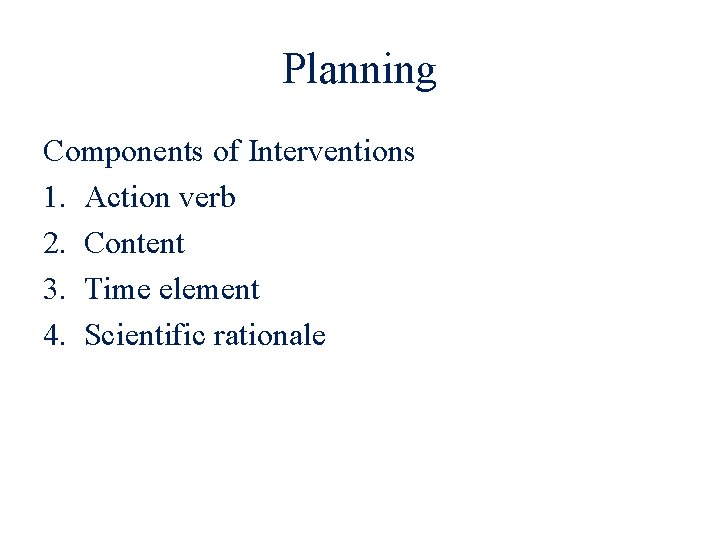
Planning Components of Interventions 1. Action verb 2. Content 3. Time element 4. Scientific rationale
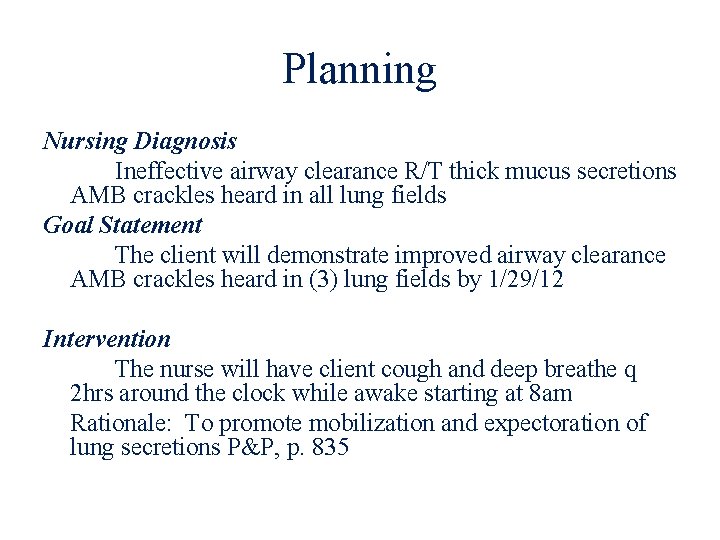
Planning Nursing Diagnosis Ineffective airway clearance R/T thick mucus secretions AMB crackles heard in all lung fields Goal Statement The client will demonstrate improved airway clearance AMB crackles heard in (3) lung fields by 1/29/12 Intervention The nurse will have client cough and deep breathe q 2 hrs around the clock while awake starting at 8 am Rationale: To promote mobilization and expectoration of lung secretions P&P, p. 835
Planning Types of Care Plans • Kardex NCP’S/Client Care Summary – Makes readily accessible nursing information needed for the daily care of a client. It allows quick reference to information about diet, allergies, self-care/activity level, treatments, IV, etc.
Planning Types of Care Plans • Standardized/Computerized NCP’s – Preprinted, established guidelines used to care for clients having a specific medical condition
Planning Types of Care Plans • Individualized NCP’S (Student Care Plans) – Prepared specifically to meet the needs of a client; should communicate a client’s unique needs rather than standard routine information.
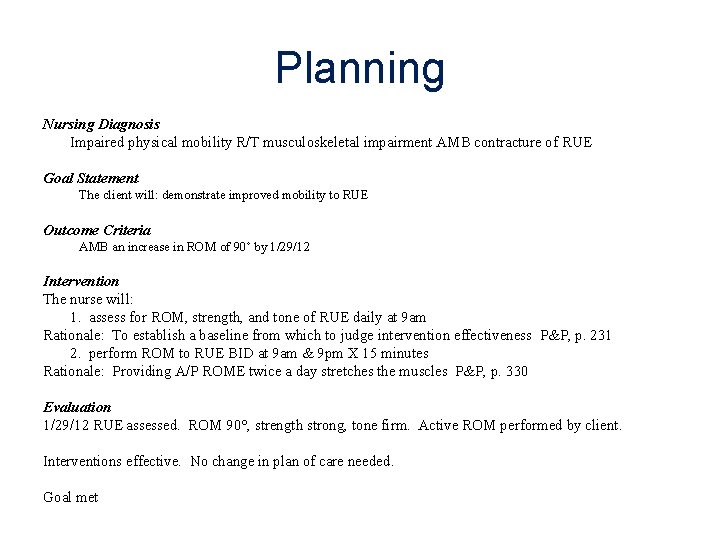
Planning Nursing Diagnosis Impaired physical mobility R/T musculoskeletal impairment AMB contracture of RUE Goal Statement The client will: demonstrate improved mobility to RUE Outcome Criteria AMB an increase in ROM of 90˚ by 1/29/12 Intervention The nurse will: 1. assess for ROM, strength, and tone of RUE daily at 9 am Rationale: To establish a baseline from which to judge intervention effectiveness P&P, p. 231 2. perform ROM to RUE BID at 9 am & 9 pm X 15 minutes Rationale: Providing A/P ROME twice a day stretches the muscles P&P, p. 330 Evaluation 1/29/12 RUE assessed. ROM 90°, strength strong, tone firm. Active ROM performed by client. Interventions effective. No change in plan of care needed. Goal met
Implementation • The actual carrying out of the plan of care. • Adequate and thorough preparation before implementing the NCP ensures efficient and effective nursing care
Evaluation • Determines to what extent goals have been met and how effective interventions were. • Each goal and intervention should be evaluated specifically.
Evaluation • Components of evaluation: a. Review the outcome criteria (OC) b. Collect subjective and objective data R/T outcome criteria c. Evaluate if goal is met, unmet, or partially met
Evaluation • • Were goals realistic? Were actions effective? May need to identify new nursing diagnoses Revisions or modifications may need to be made to reflect patient’s current status