
THE NUCLEOLUS The nucleolus nucleoli nonmembrane bound structure
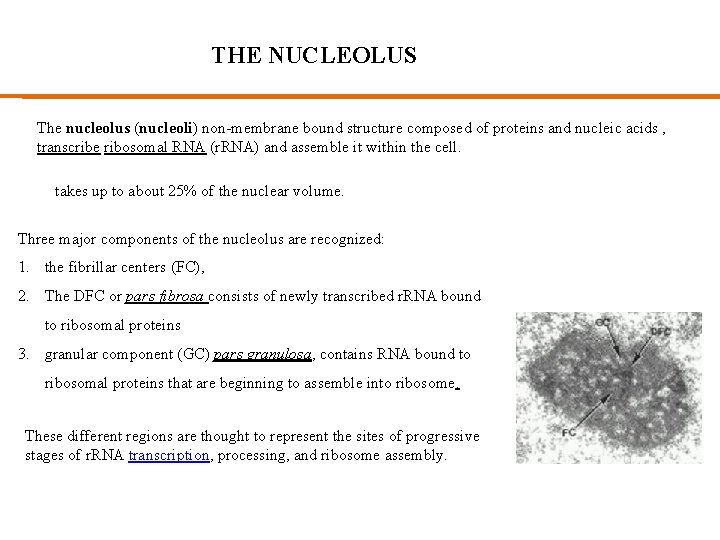
THE NUCLEOLUS The nucleolus (nucleoli) non-membrane bound structure composed of proteins and nucleic acids , transcribe ribosomal RNA (r. RNA) and assemble it within the cell. takes up to about 25% of the nuclear volume. Three major components of the nucleolus are recognized: 1. the fibrillar centers (FC), 2. The DFC or pars fibrosa consists of newly transcribed r. RNA bound to ribosomal proteins 3. granular component (GC) pars granulosa, contains RNA bound to ribosomal proteins that are beginning to assemble into ribosome. These different regions are thought to represent the sites of progressive stages of r. RNA transcription, processing, and ribosome assembly.
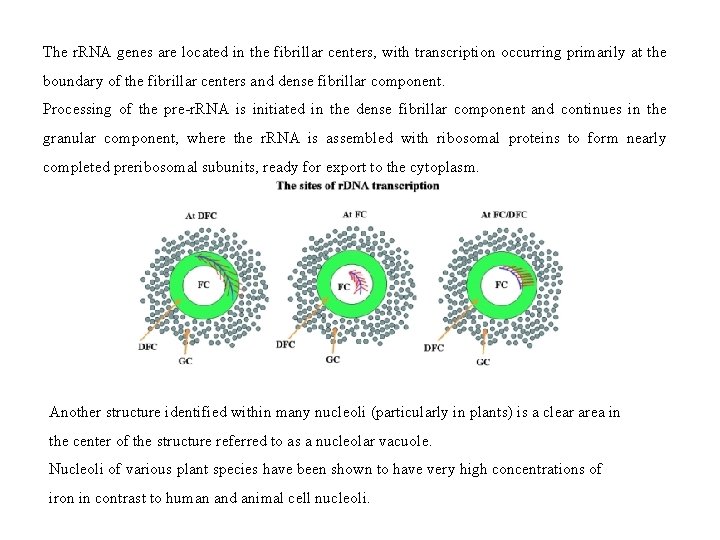
The r. RNA genes are located in the fibrillar centers, with transcription occurring primarily at the boundary of the fibrillar centers and dense fibrillar component. Processing of the pre-r. RNA is initiated in the dense fibrillar component and continues in the granular component, where the r. RNA is assembled with ribosomal proteins to form nearly completed preribosomal subunits, ready for export to the cytoplasm. Another structure identified within many nucleoli (particularly in plants) is a clear area in the center of the structure referred to as a nucleolar vacuole. Nucleoli of various plant species have been shown to have very high concentrations of iron in contrast to human and animal cell nucleoli.

ORGANIZATION Nucleoli are formed around specific genetic loci called nucleolar organizing regions (NORs), NOR is composed of tandem repeats of r. RNA genes. The human genome contains more than 200 clustered copies of the r. RNA genes on five different chromosomes (13, 14, 15, 21, 22). • In ribosome biogenesis, two of the three eukaryotic RNA polymerases (pol I and III) are required, and these function in a coordinated manner.

RIBOSOMAL BIOGENESIS 1. cleavage within the external transcribed spacer near the 5′ end of the (45 S) pre-r. RNA, which takes place during the early stages of transcription. requires the U 3 small nucleolar RNP 2. Once transcription is complete, the external transcribed spacer at the 3′ end of the molecule is removed. 3. cleavage at the 5′ end of the 5. 8 S region, yielding separate precursors to the 18 S and 5. 8 S + 28 S r. RNAs. Additional cleavages then result in formation of the mature r. RNAs. 4. Processing follows a similar pattern in other species, although there are differences in the order of some of the cleavages. U 3, nucleolar RNP
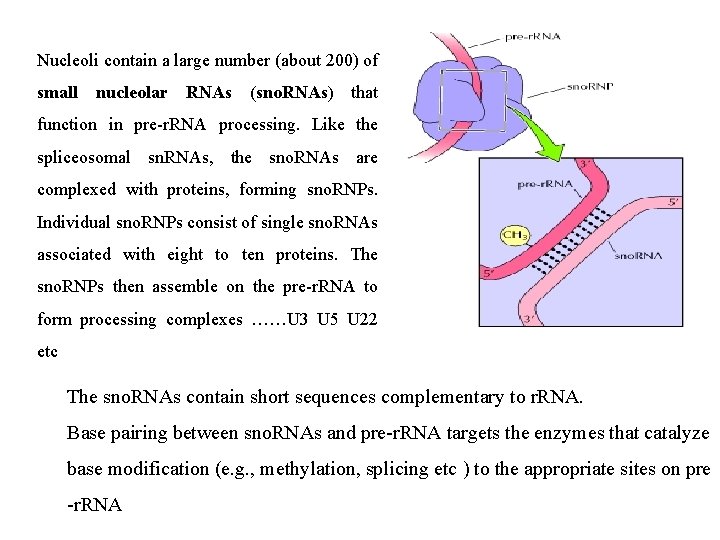
Nucleoli contain a large number (about 200) of small nucleolar RNAs (sno. RNAs) that function in pre-r. RNA processing. Like the spliceosomal sn. RNAs, the sno. RNAs are complexed with proteins, forming sno. RNPs. Individual sno. RNPs consist of single sno. RNAs associated with eight to ten proteins. The sno. RNPs then assemble on the pre-r. RNA to form processing complexes ……U 3 U 5 U 22 etc The sno. RNAs contain short sequences complementary to r. RNA. Base pairing between sno. RNAs and pre-r. RNA targets the enzymes that catalyze base modification (e. g. , methylation, splicing etc ) to the appropriate sites on pre -r. RNA
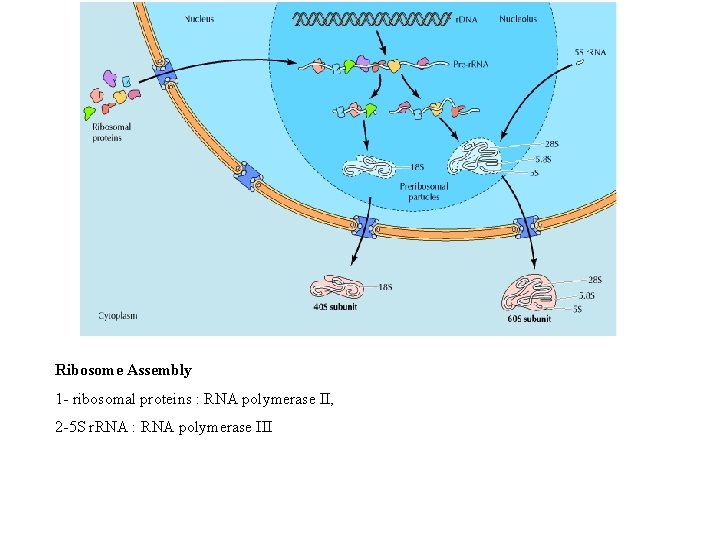
Ribosome Assembly 1 - ribosomal proteins : RNA polymerase II, 2 -5 S r. RNA : RNA polymerase III
NUCLEOLAR SEQUESTRATION The nucleolus is known to capture and immobilize proteins, then are unable to diffuse and to interact with their binding partners. Targets of this post-translational regulatory mechanism include h. TERT. It is now known that noncoding RNAs originating from intergenic regions of the nucleolus are responsible for this phenomenon.

SUB NUCLEAR BODIES 1. Cajal bodies, 2. Gemini of coiled bodies, Structure name Diameter Cajal bodies 0. 2– 2. 0 µm PIKA 5 µm PML bodies 0. 2– 1. 0 µm Paraspeckles 0. 2– 1. 0 µm Speckles 20– 25 nm 3. Polymorphic interphase karyosomal association (pika) 4. Promyelocytic leukaemia (PML) bodies, 5. Paraspeckles, 6. Splicing speckles. as part of abnormal disease processes. NEMALINE MYOPATHY: the presence of small intranuclear rods has been reported , mutations in actin, and the rods themselves consist of mutant actin as well as other cytoskeletal proteins.

- Slides: 9