
The NSW Higher School Certificate Information for Year
- Slides: 29
The NSW Higher School Certificate Information for Year 10 Students and Parents
The NSW HSC • The Higher School Certificate (HSC) is the highest educational award you can gain in New South Wales schools. • The HSC: • is an internationally recognised credential • provides a strong foundation for the future • is standards-based. Students receive HSC marks that indicate the standard they have achieved.
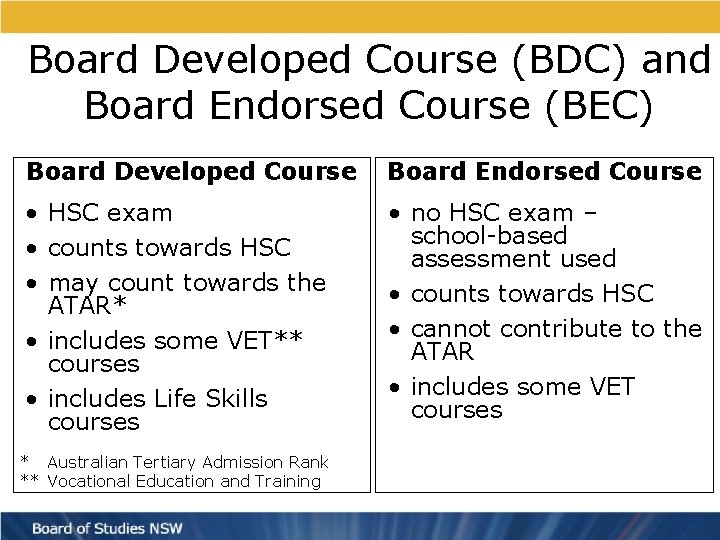
Board Developed Course (BDC) and Board Endorsed Course (BEC) Board Developed Course Board Endorsed Course • HSC exam • counts towards HSC • may count towards the ATAR* • includes some VET** courses • includes Life Skills courses • no HSC exam – school-based assessment used • counts towards HSC • cannot contribute to the ATAR • includes some VET courses * Australian Tertiary Admission Rank ** Vocational Education and Training
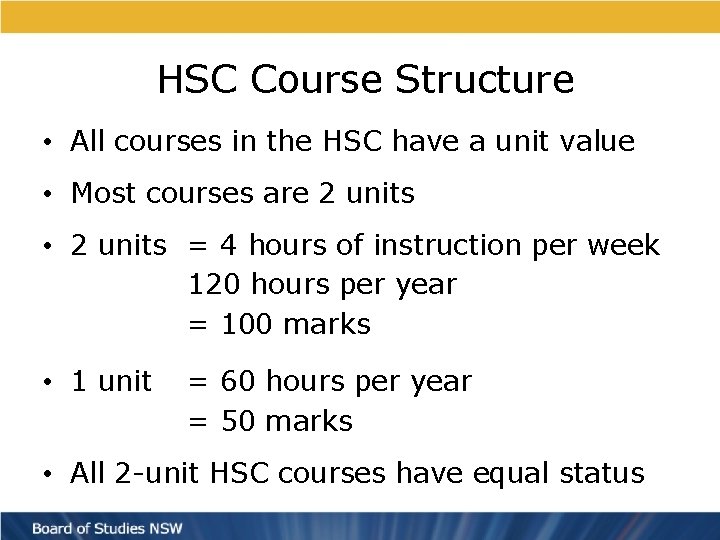
HSC Course Structure • All courses in the HSC have a unit value • Most courses are 2 units • 2 units = 4 hours of instruction per week 120 hours per year = 100 marks • 1 unit = 60 hours per year = 50 marks • All 2 -unit HSC courses have equal status
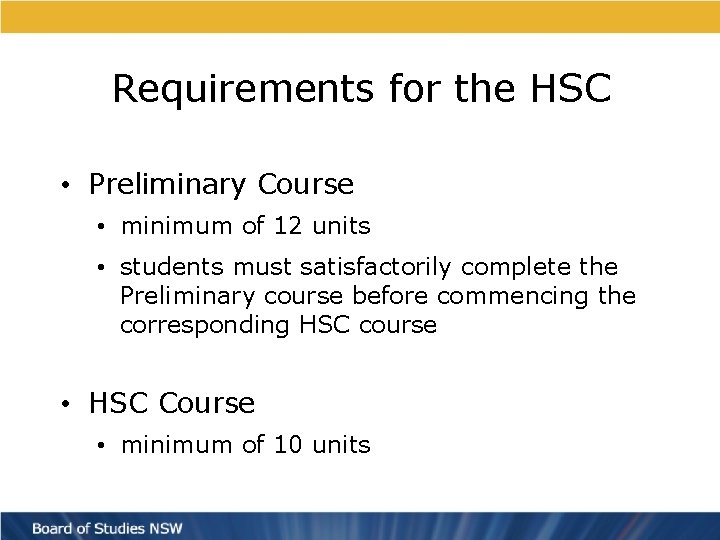
Requirements for the HSC • Preliminary Course • minimum of 12 units • students must satisfactorily complete the Preliminary course before commencing the corresponding HSC course • HSC Course • minimum of 10 units
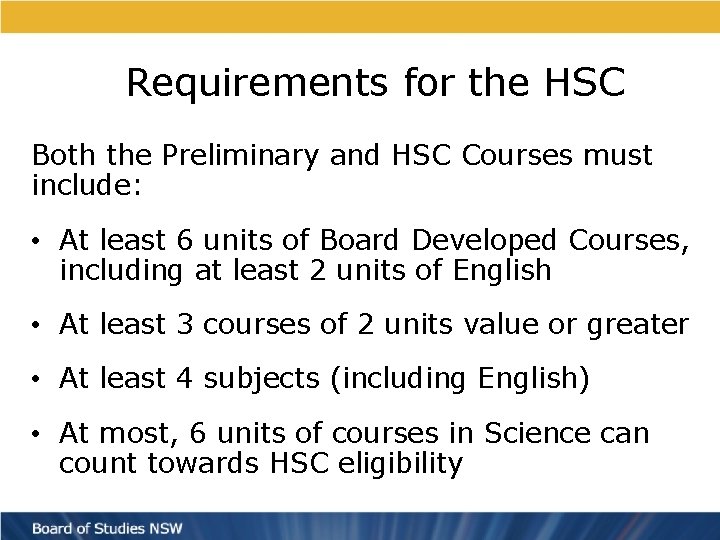
Requirements for the HSC Both the Preliminary and HSC Courses must include: • At least 6 units of Board Developed Courses, including at least 2 units of English • At least 3 courses of 2 units value or greater • At least 4 subjects (including English) • At most, 6 units of courses in Science can count towards HSC eligibility
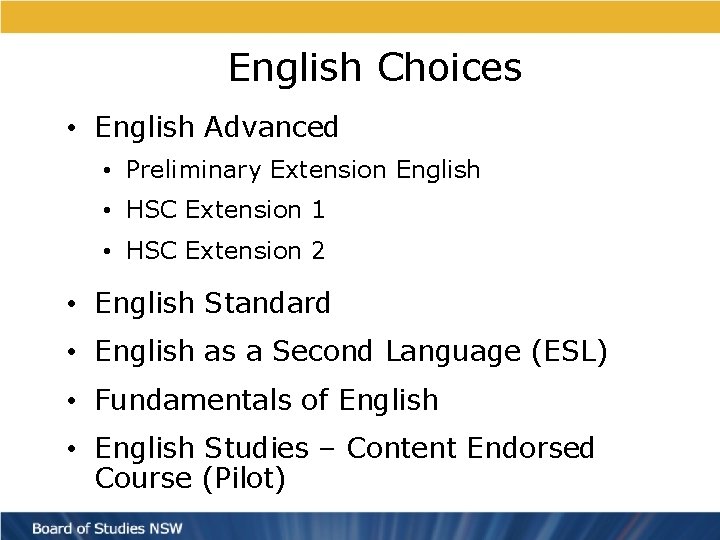
English Choices • English Advanced • Preliminary Extension English • HSC Extension 1 • HSC Extension 2 • English Standard • English as a Second Language (ESL) • Fundamentals of English • English Studies – Content Endorsed Course (Pilot)
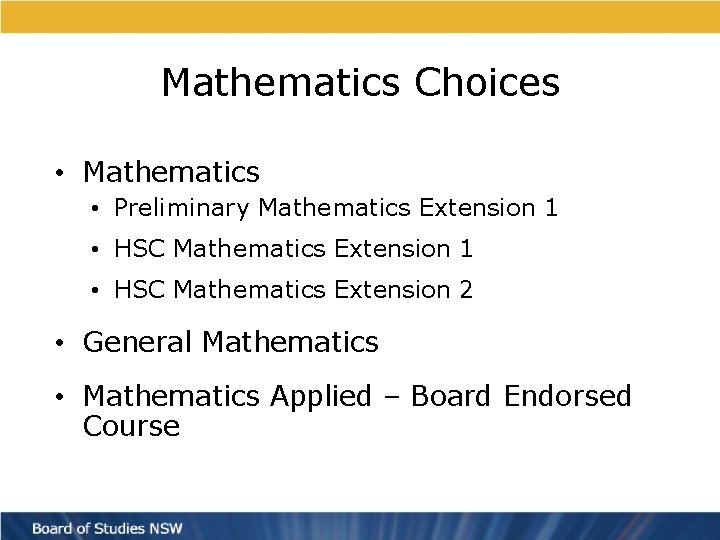
Mathematics Choices • Mathematics • Preliminary Mathematics Extension 1 • HSC Mathematics Extension 2 • General Mathematics • Mathematics Applied – Board Endorsed Course
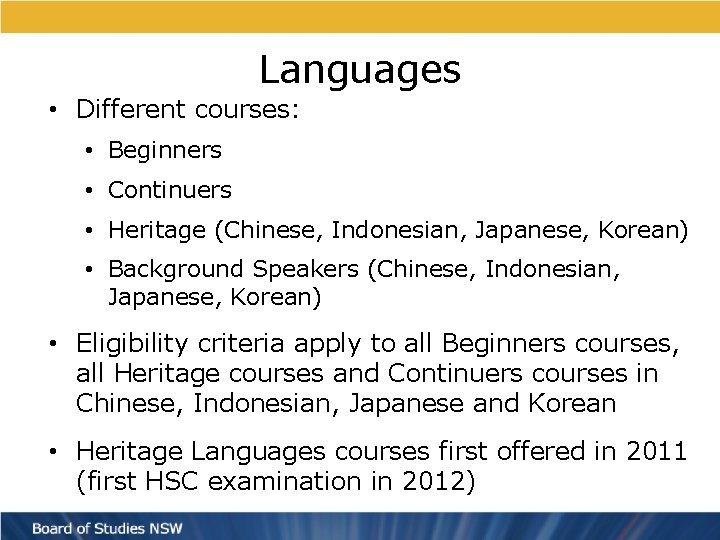
Languages • Different courses: • Beginners • Continuers • Heritage (Chinese, Indonesian, Japanese, Korean) • Background Speakers (Chinese, Indonesian, Japanese, Korean) • Eligibility criteria apply to all Beginners courses, all Heritage courses and Continuers courses in Chinese, Indonesian, Japanese and Korean • Heritage Languages courses first offered in 2011 (first HSC examination in 2012)
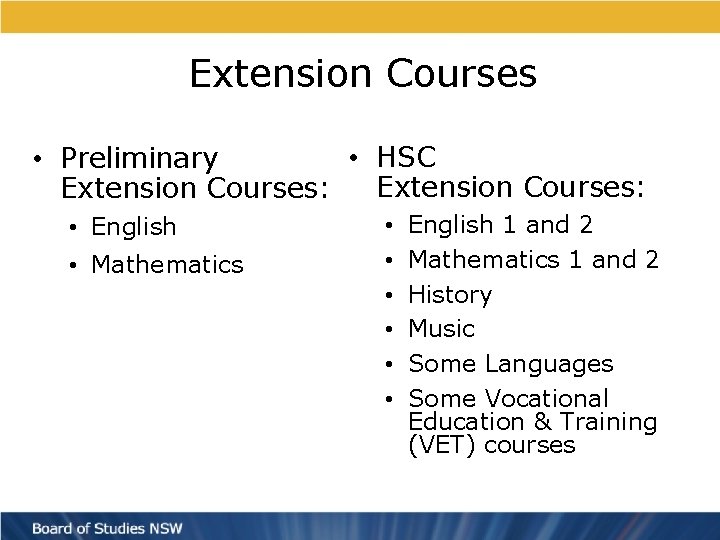
Extension Courses • HSC • Preliminary Extension Courses: • English • Mathematics • • • English 1 and 2 Mathematics 1 and 2 History Music Some Languages Some Vocational Education & Training (VET) courses
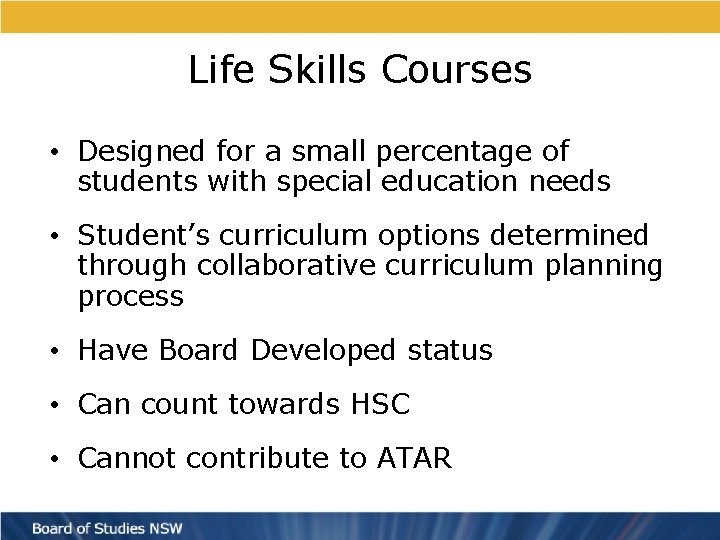
Life Skills Courses • Designed for a small percentage of students with special education needs • Student’s curriculum options determined through collaborative curriculum planning process • Have Board Developed status • Can count towards HSC • Cannot contribute to ATAR
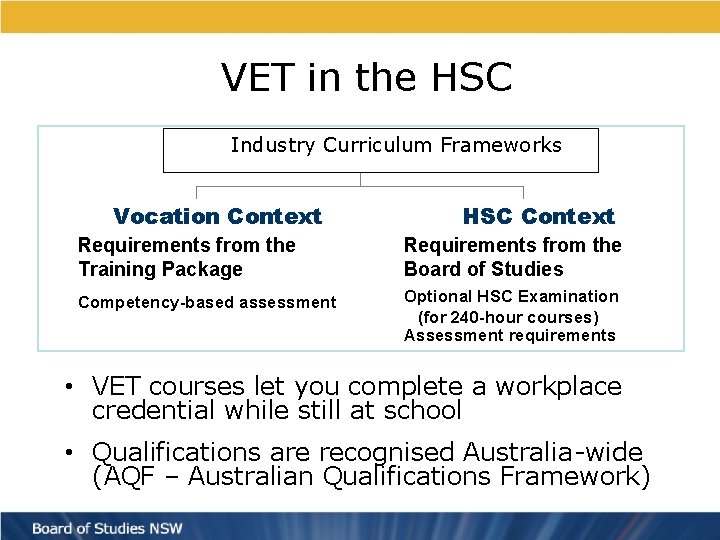
VET in the HSC Industry Curriculum Frameworks Vocation Context HSC Context Requirements from the Training Package Requirements from the Board of Studies Competency-based assessment Optional HSC Examination (for 240 -hour courses) Assessment requirements • VET courses let you complete a workplace credential while still at school • Qualifications are recognised Australia-wide (AQF – Australian Qualifications Framework)
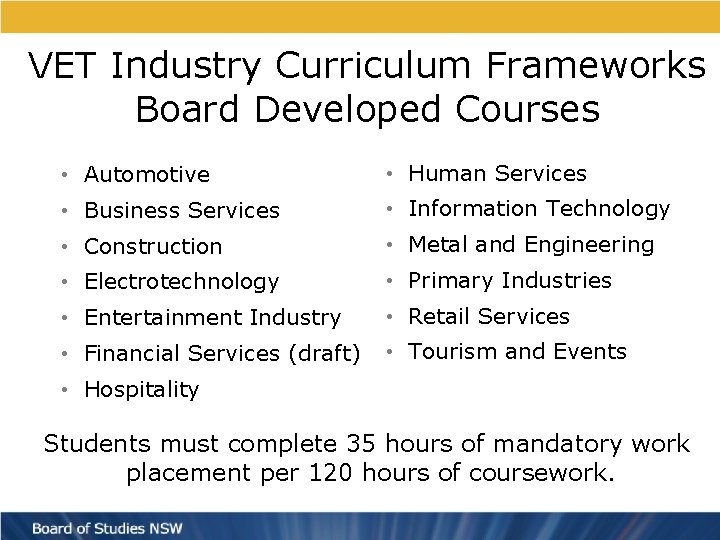
VET Industry Curriculum Frameworks Board Developed Courses • Automotive • Human Services • Business Services • Information Technology • Construction • Metal and Engineering • Electrotechnology • Primary Industries • Entertainment Industry • Retail Services • Financial Services (draft) • Tourism and Events • Hospitality Students must complete 35 hours of mandatory work placement per 120 hours of coursework.
HSC: All My Own Work • is a program designed to help HSC students follow the principles and practices of good scholarship • includes understanding and valuing of ethical practices when locating and using information as part of HSC studies Students must complete HSC: All My Own Work or its equivalent before they can be entered for any Preliminary or HSC course.
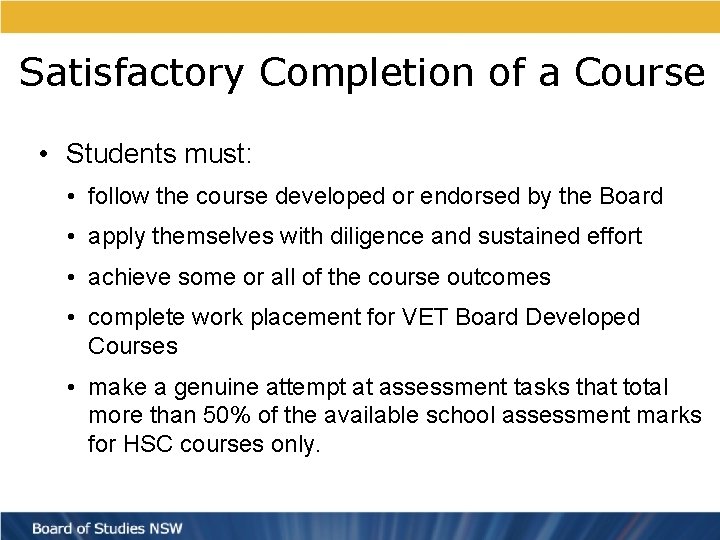
Satisfactory Completion of a Course • Students must: • follow the course developed or endorsed by the Board • apply themselves with diligence and sustained effort • achieve some or all of the course outcomes • complete work placement for VET Board Developed Courses • make a genuine attempt at assessment tasks that total more than 50% of the available school assessment marks for HSC courses only.
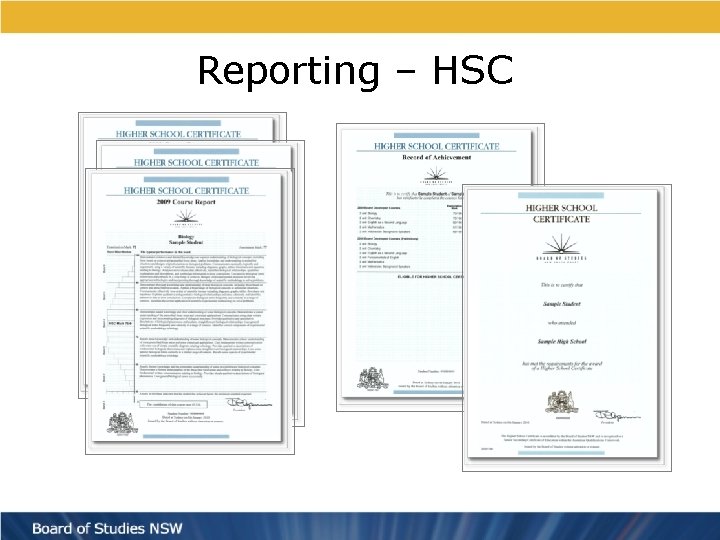
Reporting – HSC
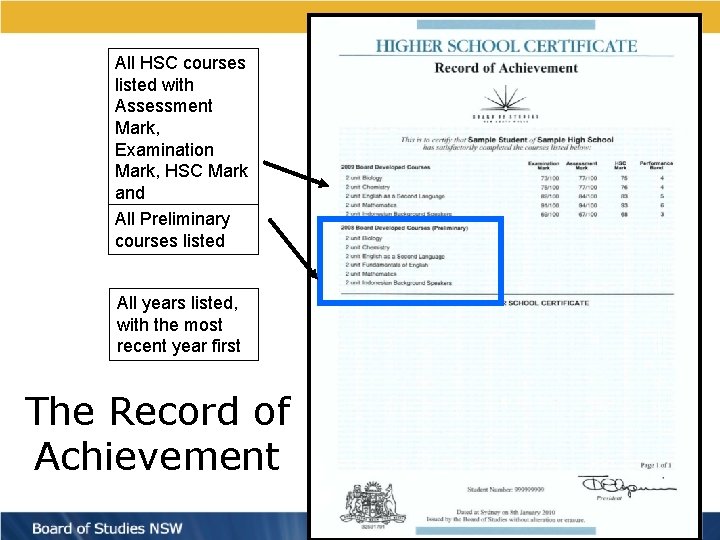
All HSC courses listed with Assessment Mark, Examination Mark, HSC Mark and Performance All Preliminary Band courses listed All years listed, with the most recent year first The Record of Achievement
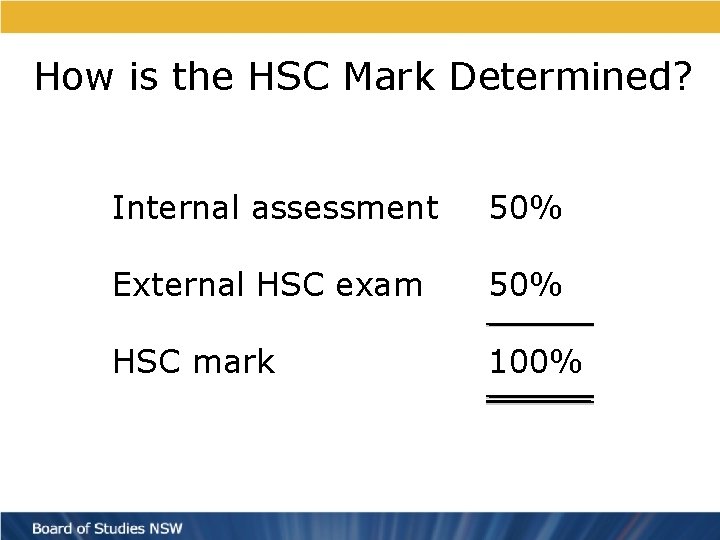
How is the HSC Mark Determined? Internal assessment 50% External HSC exam 50% HSC mark 100%
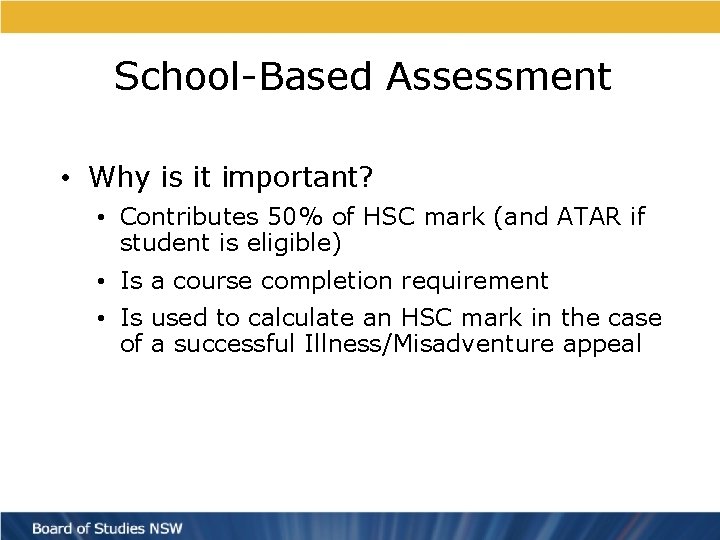
School-Based Assessment • Why is it important? • Contributes 50% of HSC mark (and ATAR if student is eligible) • Is a course completion requirement • Is used to calculate an HSC mark in the case of a successful Illness/Misadventure appeal
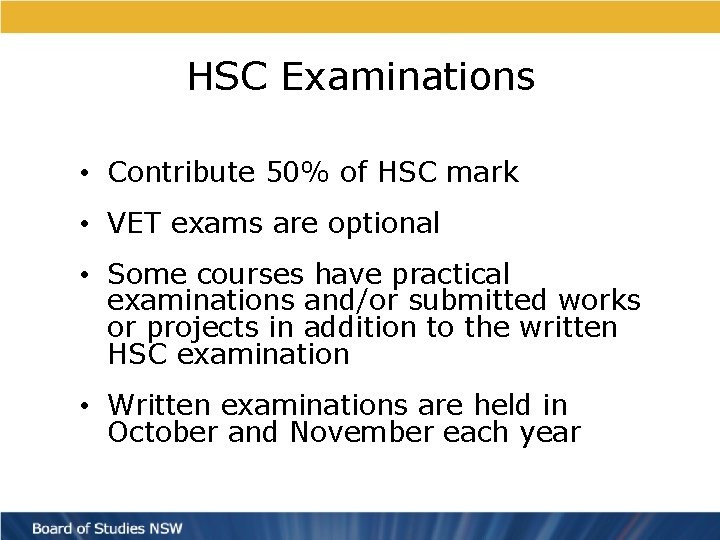
HSC Examinations • Contribute 50% of HSC mark • VET exams are optional • Some courses have practical examinations and/or submitted works or projects in addition to the written HSC examination • Written examinations are held in October and November each year
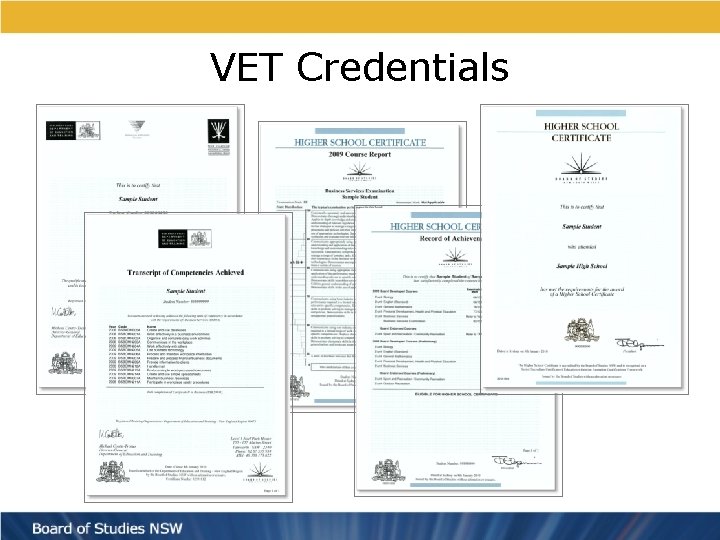
VET Credentials
VET Assessment • Assessment is competency based • Assessment of relevant tasks counts towards AQF VET qualification component
What is the difference between the HSC and the ATAR?
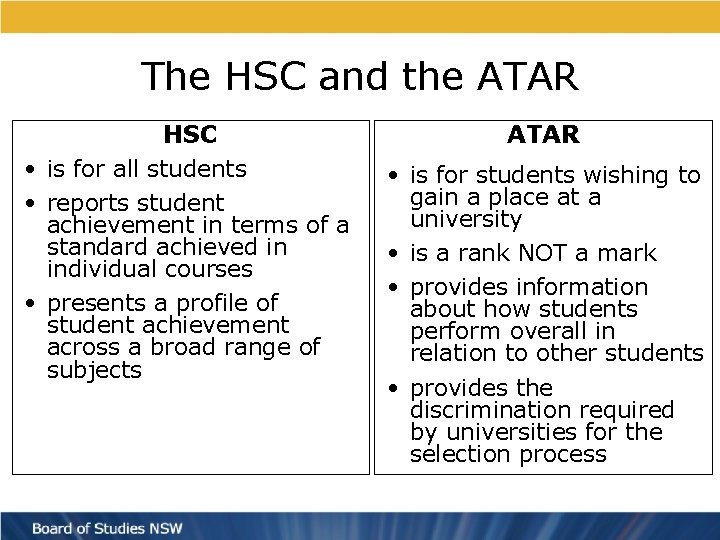
The HSC and the ATAR HSC • is for all students • reports student achievement in terms of a standard achieved in individual courses • presents a profile of student achievement across a broad range of subjects ATAR • is for students wishing to gain a place at a university • is a rank NOT a mark • provides information about how students perform overall in relation to other students • provides the discrimination required by universities for the selection process
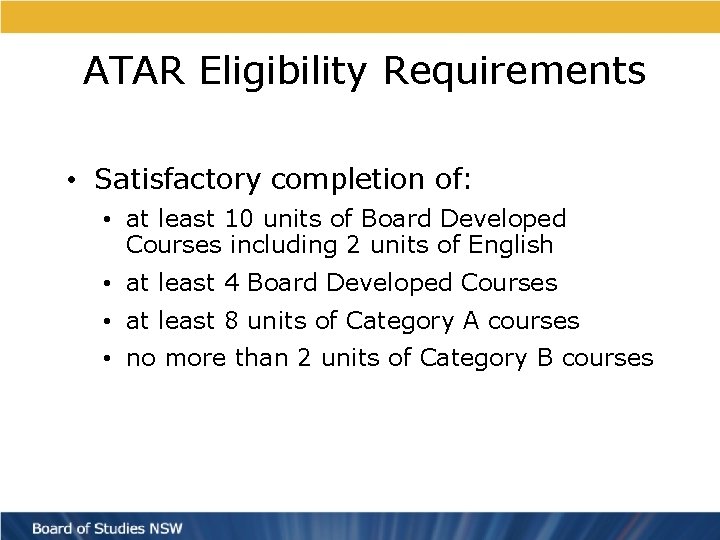
ATAR Eligibility Requirements • Satisfactory completion of: • at least 10 units of Board Developed Courses including 2 units of English • at least 4 Board Developed Courses • at least 8 units of Category A courses • no more than 2 units of Category B courses
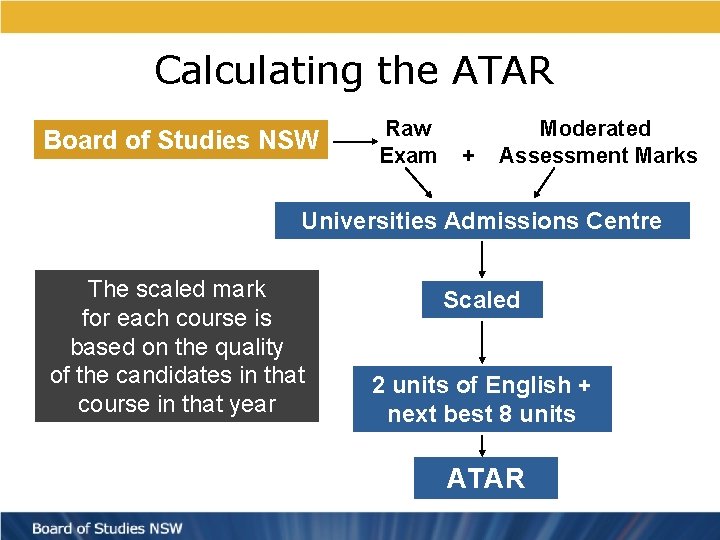
Calculating the ATAR Board of Studies NSW Raw Exam + Moderated Assessment Marks Universities Admissions Centre The scaled mark for each course is based on the quality of the candidates in that course in that year Scaled 2 units of English + next best 8 units ATAR
Key Considerations for Course Selection • Abilities • Interests/Motivation • Career aspirations and needs
Practical Considerations • Syllabus requirements • Practical/Major work components • Subject combinations
Consider: • What do I want for my future? • What ‘pathway’ best suits me? • Ask for advice from: • • • teachers parents year adviser careers adviser students in Years 11 and 12 publications + website Note: Universities, TAFE, employer groups, School, Board of Studies, UAC