
THE NOTION OF CONTEXT PART 1 The words

- Slides: 9
THE NOTION OF CONTEXT (PART 1)
The words of a text are surrounded by their linguistic environment, called co-text. The text takes place in a broader environment, called context. Analyze the co-text of the word “order” and context of the following sentences: Your order will be processed within 3/4 days after your request is submitted. Excuse me, can we order, please? I was given an order by a senior officer and I have to fulfill it. Can you place the books in alphabetic order to make the search easier? When analyzing context one has to analyze co-text of central words, define the event (topic), the participants, medium (oral or written; formal or informal). Task: use words society, environment, bottom, feet, trunk, club, paper which have different meanings in different sentences. Other students will define the context of your sentences and co-text of the word that helped them define the correct context and meaning.
The topic, the participants and the medium of an event constitute what has been called by Halliday context of situation. Context of situation is the totality of extra linguistic features having relevance to a communicative act. Introduce your child to books when she is a baby She shouldn’t have a baby because she is a baby herself Give your examples of the same word (phrase) being used in a different context of situation (e. g. the first step)
THEORETICAL OVERVIEW OF CONTEXT IN LINGUISTICS A theory of context was first developed by the anthropologist Bronislaw Malinowski. The influence of Malinowski is visible in theories of many scholars, particularly in those of J. R. Firth, one of his colleagues at London University and of Halliday who follows both Malinowski’s and Firth’s ideas in the development of his theory on the context of situation. Bronislaw Malinowski carried out an ethnographic field work in the Trobriand Islands. The inhabitants of those islands lived by fishing and gardening and spoke the Kiriwininan language. The first problem he had to face was how to translate the texts in Kiriwinian he had taken down in discussion with the Tobrianders, in order to make them accessible to the British culture. These texts were the product of a culture which was extremely different from the Western culture, for this reason a free translation would have not helped Western people to understand them. He argues “…instead of translating, of inserting simply an English word for a native one, we are faced by a long and not altogether simple process of describing wide fields of custom, of special psychology and of tribal organisation which correspond to one term or another. We see that linguistic analysis inevitably leads us into the study of all subjects covered by Ethnographic fieldwork. ” For this reason, he decided to add an extended commentary to the translated text, which “placed the text in its living environment”. Malinowski coined a new term which identifies the total environment, including the verbal environment and the situation in which the text was produced: the context of situation.
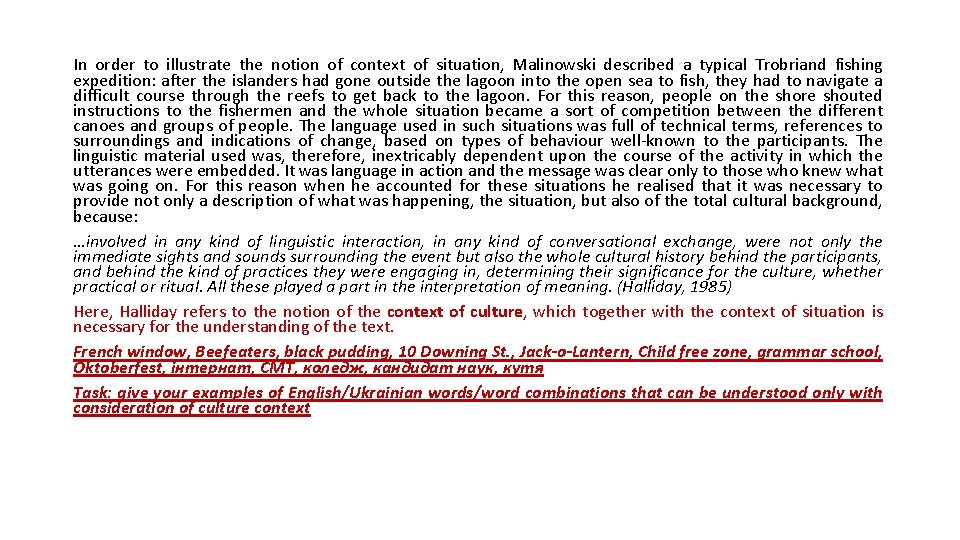
In order to illustrate the notion of context of situation, Malinowski described a typical Trobriand fishing expedition: after the islanders had gone outside the lagoon into the open sea to fish, they had to navigate a difficult course through the reefs to get back to the lagoon. For this reason, people on the shore shouted instructions to the fishermen and the whole situation became a sort of competition between the different canoes and groups of people. The language used in such situations was full of technical terms, references to surroundings and indications of change, based on types of behaviour well-known to the participants. The linguistic material used was, therefore, inextricably dependent upon the course of the activity in which the utterances were embedded. It was language in action and the message was clear only to those who knew what was going on. For this reason when he accounted for these situations he realised that it was necessary to provide not only a description of what was happening, the situation, but also of the total cultural background, because: …involved in any kind of linguistic interaction, in any kind of conversational exchange, were not only the immediate sights and sounds surrounding the event but also the whole cultural history behind the participants, and behind the kind of practices they were engaging in, determining their significance for the culture, whether practical or ritual. All these played a part in the interpretation of meaning. (Halliday, 1985) Here, Halliday refers to the notion of the context of culture, which together with the context of situation is necessary for the understanding of the text. French window, Beefeaters, black pudding, 10 Downing St. , Jack-o-Lantern, Child free zone, grammar school, Oktoberfest, інтернат, СМТ, коледж, кандидат наук, кутя Task: give your examples of English/Ukrainian words/word combinations that can be understood only with consideration of culture context
THE ROARING 20 s The ten years between 1920 and 1930 were filled with great political, economic and social changes in the United States. The nation's wealth about doubled. Many Americans were becoming very rich. More Americans now lived in cities instead of on farms. Many products were becoming 'national' products. They could be bought all over the United States. People in New York and San Francisco danced and sang to the same music. Society in the United States was really 'roaring. ' However, many saw real problems in the changes in the culture. They thought of the changes as a lessening of moral values. Young people, though, enjoyed their new freedoms. ‘Flappers' wore shorter dresses, and smoked and drank. Some young women began to lead a lifestyle which was not in line with previous values. Not all women made all of these changes. However, most women experienced more freedom. Women had the right to vote, granted in 1919. They could work in more professional jobs outside of the home. Modern appliances, like the washing machine, gave women more free time. Young people especially loved their new freedom of music. Phonograph records sold in the millions. Jazz bands performed all over the country. People danced to the Charleston, the black bottom, the flea hop and others. Volstead Act came into action on January 16, 1920. All taverns and bars closed. However, people started making and selling alcohol secretly. People could go to 'speakeasies' and buy alcoholic drinks. Al Capone paid many Chicago Policemen to look the other way. He hired 1000 tough men to work for him and control the operation of his business. Other problems in the 1920's involved the movement of many African-Americans from the South to the northern cities. Many people in the North didn't like the jazz and blues music and the different kind of literature they brought with them. National Origins Act of 1924 came into action. Some countries were favored over others. Conflict between many different people in America existed during the 1920's, involving differences of religion, skin color and moral values. Scott Fitzgerald like no one else managed to depict a perfect reflection of life in America of Roaring 20 s in his masterpiece.