
The Norwegian support and subsidy policy of electric
The Norwegian support and subsidy policy of electric cars. Should it be adopted by other countries? Anders Skonhoft Economic Department NTNU (Environmental Science & Policy 42, 2014) Athen October 2014
1. Introduction • As a result of generous policies to increase the use of electric vehicles (EVs), the sales of EVs in Norway are rapidly increasing • This in sharp contrast to most other rich countries without such generous policies • Due to the subsidies, driving an EV implies very low costs to the owner on the margin. Probably leading to more driving at the expense of public transport and cycling • Because most EVs’ driving range is low, the policy also gives households incentives to purchase a second car, again stimulating the use of private cars instead of public transport and cycling • These effects are analysed in light of possible greenhouse gas (GHG) emission effects as well as other possible benefits of utilizing EVs versus conventional cars • We discuss and analyze whether the EV policy can be justified, as well as whether this policy should be implemented by other countries Trondheim september 2014
Plan for the presentation: • Electrical vehicle(EV) sale growth • Details of the Norwegian subsidy policy • GHG emission related to EVs’ demand for energy • Cost per tonne CO 2 – a numerical example • The EV policy and houshold’s use of transport • On lock-ins, network and technology • Summing up and conclusions…. – – The Norwegian subsidy policy should be ended asap!! It should not be adopted by other countries!! Trondheim september 2014
2. EV sale • Road traffic gives rise to various healthdamaging pollutants, noise and accidents. Therefore often heavily taxed through fuel taxes, road taxes and turnpike taxes. Norway no exception… • But EVs treated much more leniently in Norway…. And the result… Trondheim september 2014
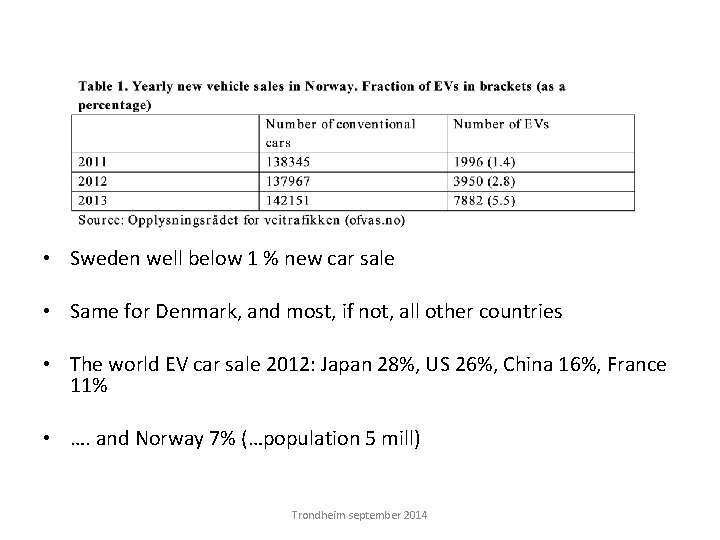
• Sweden well below 1 % new car sale • Same for Denmark, and most, if not, all other countries • The world EV car sale 2012: Japan 28%, US 26%, China 16%, France 11% • …. and Norway 7% (…population 5 mill) Trondheim september 2014
3. Norwegian subsidy policy and the arguments • The subsidy policy has been gradually implemented during the last 10 years, and is now an integrated part of the so-called Climate agreement among (all!) parties in the Norwegian Parliament • Rooted in laws and regulations (Ministry of Finance, and Ministry of Transportation), together with policy measures implemented at the local level • Main elements: – EVs are exempt from VAT and other taxes on car purchases and sales – Parking in public parking spaces is free – EVs can use most toll roads and several ferry connections free of charge – EVs are allowed to use bus and collective traffic lanes – The company car tax is 50 per cent lower on EVs, and the annual motor vehicle tax/road tax is also lower – Battery charging is free at a rapidly growing number of publicly funded charging stations • . . Trondheim september 2014
• The Norwegian EV policy is founded on the widespread notion (among politicians, and so-called environmental organizations) that EVs are far more environmentally friendly than conventional vehicles using gasoline and diesel fuel • The arguments are partly related to the possible short-term benefits, and partly related to what may happen in the long term • The reduction of local emissions and the reduction of GHGs to fulfil the Norwegian emission reduction goals are an important part of the shortterm story • Technological changes and possible battery technology improvements stimulated through demand effects form part of the long-term picture • We discuss these arguments in turn and start with the long—term arguments Trondheim september 2014
• The basic long term argument is: – Stimulating demand drives research and development of new battery technologies – Many, many examples history of technology where policy interventions and subsidies (and also state owned/driven labs) have encouraged new and groundbreaking technology • But…. there already strong incentives for research and development to improve battery technology as new battery technology is an essential part of laptops, tablets, mobile phones, etc. • And don’t forget: Two-thirds of the world’s electricity, feeding the EV batteries, is currently generated from fossil sources (coal etc. ). Come back to this… • So if EVs are to contribute significantly to solving the world’s CO 2 problem, there needs to be a fundamental revision of electricity production Trondheim september 2014
• The short term arguments is first: • Reduce local emission problems, particularly in comparison with diesel vehicles – But if the purpose of the EV subsidy policy is to mitigate local environmental problems, promoting a switch from diesel vehicles to gasoline models is possibly both a simpler and a cheaper expedient But…. the Norwegian car tax policy favors diesel cars while sacrificing gasoline, meaning that the current (spring 2014) pumping price of gasoline is about 1 NOK/litre above that of diesel – the use of spike tyres during the winter … – Car noise is also often a local environmental problem. The tyres, not the engines, represent the most serious problem here Trondheim september 2014
• The main short term argument: – The global environmental question and curbing greenhouse gases (GHGs) is possible the main argument behind the Norwegian EV policy • Several issues here: – The ‘driving effect’; GHG per km EVs vs. conventional cars – The total life cycle analysis; GHG embodied in the car construction and the driving over the whole life time of the cars – But also the ‘replacement effect’ (or ‘rebound effect’) ; that is, whether EVs replace, or come as an addition to conventional cars • . – Possible changes in the energy mix related to electricity production have also to be considered Trondheim september 2014
4. CO 2 emissions related to EVs’ use of energy • Important background for the whole discussion: What type of energy is feeding the electricity production, and therefore what type of energy may feed the EVs? – Globally, coal accounts for approximately 40 per cent of the electricity generated today (IEA 2013) – The use of gas and oil is significant as well – In total; fossil energy accounts today for roughly 67 per cent of the world’s production of electricity – Renewable sources account for about 19 per cent – The rest comes from nuclear energy Trondheim september 2014
• Projections International Energy Agency IEA (2013): • • IEA expects a significant efficiency improvement in fossil power stations • But CCS plays not a significant role in the coming decades in IEA’s ‘current policy scenario’ • Additionally; numerous new coal fired power stations are under construction and many more are supposed to be build the coming years without CCS technology (IEA 2013) • IEA’s projection 2035 ‘current policies scenario’ indicates that still 65 % electrical energy still will come from fossil energy, and 25 % from renewables This together with Capture and Storage technology (CCS) may modify the modest prospect of reduced GHG emission related to world’s future electricity production Trondheim september 2014
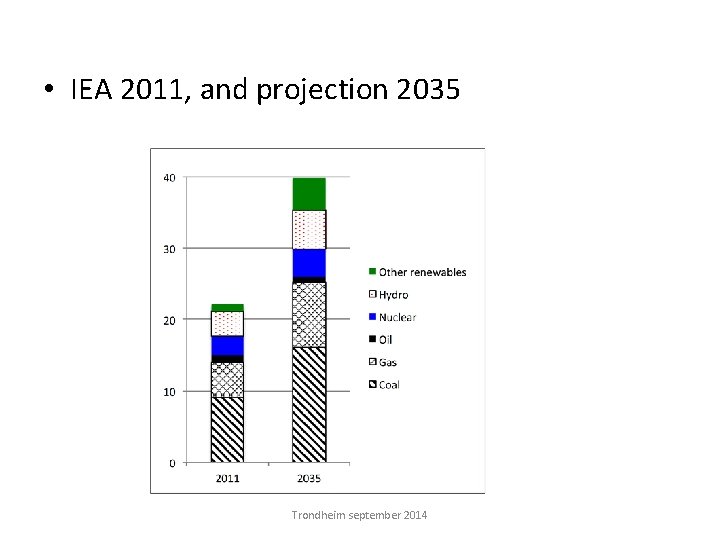
• IEA 2011, and projection 2035 Trondheim september 2014
• The ‘driving effect’; GHG per km EVs vs. conventional cars: • CO 2 properties of the conventional car technology versus EV technology by comparing the use and driving-related emissions of gasoline- and dieselpowered vehicles with the fossil fuel mix and the related emissions in power stations producing electricity utilized for EV driving • Calculations on fuel use and range are based on tests performed by the US Department of Energy (DOE). Comparing: – The gasoline-driven hybrids Toyota Prius and Lexus ES 300 h – The EVs Nissan Leaf and Tesla Model S, the latter both having the 60 k. Wh and 85 k. Wh battery pack • The vehicles’ use of energy is crucial • The composition of fossil fuel in the electricity production crucial (above) • And the results are… Trondheim september 2014
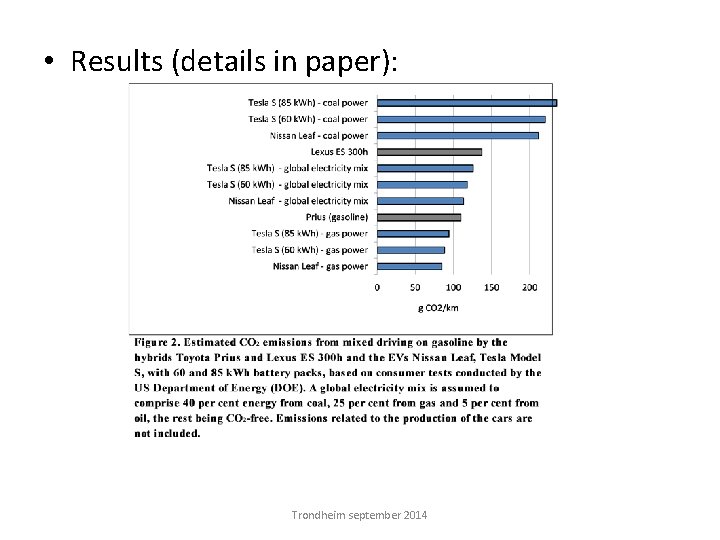
• Results (details in paper): Trondheim september 2014
• Sum: • In a world in which energy come largely from fossil sources, EVs do not necessarily achieve lower CO 2 emission than conventional cars running on gasoline or diesel • Greatly depends on source of electricity, electricity mix and production efficiency Trondheim september 2014
• Complete comparison… • The total life cycle analysis; GHG embodied in the car construction and the driving over the whole life time of the cars • Hawkins et al. 2012, Hawkins et al. 2013: Under certain assumptions on life time of the cars, total driving (km) over the lifetime, and electricity mix, they found that a switch from conventional car to EVs may give a 10 – 24 % reductions in the total lifetime GHG emissions for cars of comparable size • An exemption is possible Tesla S (large battery pack, production of battery is energy intensive and the lifetime of the battery…) • NOTE zero ‘replacement effect’: These life cycle analysis are based on assumption that any EV replaces a conventional car, and a trip with EV replaces a trip with a conventional car; Trondheim september 2014
5. Cost per tonne CO 2 – a numerical example • The power-producing sector in Europe is part of the European Union’s emissions trading system (EU ETS), which also includes Norway • Cap on emissions from the sectors and producers participating in this system, also including energy producers. Therefore, increased demand for electricity in Europe does not increase the total GHG emission, but ceteris paribus instead leads to higher CO 2 permit price • If we consider the cap of the EU ETS to be fixed, and a trip with a conventional car to be replaced with an EV, the emission reduction is equal to the CO 2 emissions that would have been caused by the conventional car • This is the assumption. And we ask whether the size of this emission reduction is reasonable in light of the costs Trondheim september 2014
• The emission saving (the benefit side): • Consider, as an example, a Nissan Leaf owner living in Sandvika, a commuting suburb slightly more than 10 km from the city center of Oslo, where his/her workplace is assumed to be located. The car owner has a 5 -day working week. Altogether, this workload and travelling distance add up to about 5, 000 km driving per year. • If we also assume some additional driving (errands, etc. ), we end up with a yearly mileage of about 7, 500 km with this Nissan Leaf. We also assume that 75 % of these journeys replace trips with a Toyota Prius, which emits 110 g/km. • Then we find that the EV driving saves about 0. 6 tonne of CO 2 (t. CO 2) emission yearly because the Prius is left in the garage under the binding EU ETS cap assumption. Trondheim september 2014
• The cost side: • We assume that our Leaf owner from Sandvika saves the following taxes and charges – Tax on the purchase of this car (mainly VAT) estimated at nearly 10, 000 USD, based on its current cost (spring 2014) of about 230, 000 NOK. With a discount rent of 5 per cent and a lifetime of 10 years, this converts into a yearly cost (annuity) of 1, 300 USD; – Toll road charges in Oslo and Bærum (the municipality where Sandvika is located), estimated annually at 1, 400 USD; – Parking fees in the city center of Oslo, estimated at about 5, 000 USD per year; – Road use charges (fuel charges) and VAT on fuel, assumed to be about 400 USD per year. Trondheim september 2014
• Sum: We end up with an annual amount of subsidies and support adding up to about 8, 100 USD when ignoring the benefit of recharging the battery for free at public charging stations and the time-saving benefit of using bus lanes (which also involves certain social costs) • In light of the above-calculated yearly fossil CO 2 emission reduction of about 0. 6 t. CO 2, the gain for the EV owner comes at a cost of roughly 13, 500 USD/t. CO 2 • In comparison, the price of CO 2 on the European permit market is currently (spring 2014) around 5 USD/t. CO 2. Consequently, the cost of supporting the Leaf owner in Sandvika is 2, 700 times higher than the current CO 2 emission price • In other words, the yearly cost of subsidizing this single EV driver equals the value of 2, 700 t. CO 2 permits, and subsidizing 20, 000 EVs, which is somewhat below the number of EV vehicles running on Norwegian roads today, under similar assumptions, adds up to the value of more than 50 million permits (about the GHG emission in Norway today) Trondheim september 2014
6. The ‘replacement effect’ (‘rebound effect’) and related issues • The Norwegian EV policy in an example of subsidizing the use of an alternative rather than taxing the problem; the GHG emission. • Another example; the so called green certificate market in Sweden and Norway (today about 20 øre/k. Wh, and large negative external effects) • Usually economists favor the more directly policy instrument: making emission more costly (taxation, or cap). More predictable • The EV policy is certainly a success as a large number of EVs on the road: • . – More car driving – Incentives to by an additional car to reap the privileges of using bus lanes, and free parking in the big cities. Remember: EVs certain restrictions long-distance driving – But also replacing journeys otherwise taken by train, bus or bicycle. Trondheim september 2014
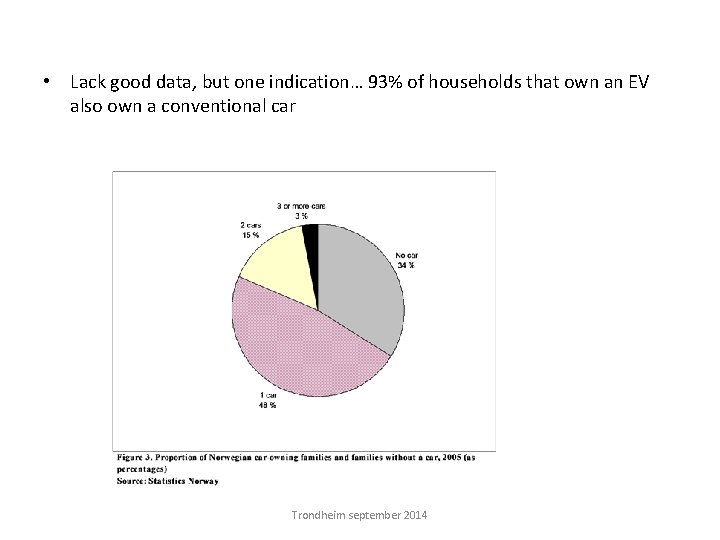
• Lack good data, but one indication… 93% of households that own an EV also own a conventional car Trondheim september 2014
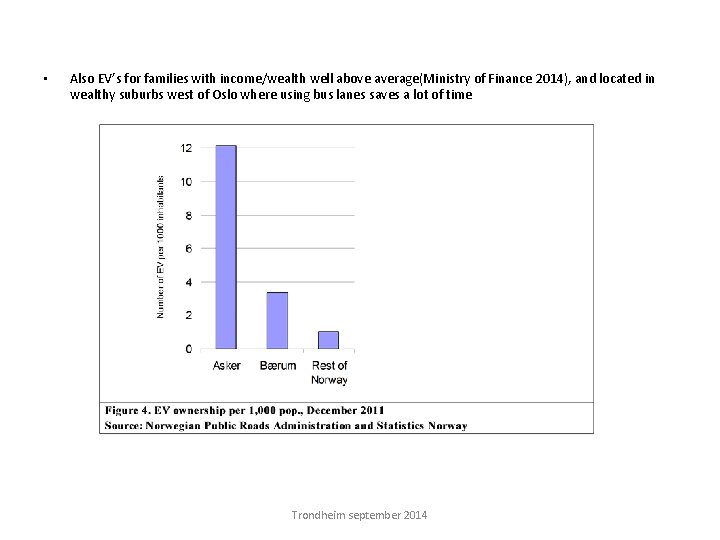
• Also EV’s for families with income/wealth well above average(Ministry of Finance 2014), and located in wealthy suburbs west of Oslo where using bus lanes saves a lot of time Trondheim september 2014
7. Conclusion • Gone through the arguments for EVs. The merits of the short-term arguments are far from convincing • This policy is extremely costly • Also some flavor of ‘privatizing the benefits and socializing the costs’ • Our reasoning is in line with some few others (Thomas 2012, Proud’homme and Koning 2012, Bosetti and Longden 2013) • The Norwegian EV subsidy policy should be ended asap, and certainly should not be implemented by other countries • And more: It should be food for the Policy Science Departments to find out how this EV policy really was realized Trondheim september 2014
- Slides: 25