
The North Carolina Council on Developmental Disabilities Introduction

The North Carolina Council on Developmental Disabilities Introduction to the NCCDD A Presentation for Bidders’ Workshop May 30, 2018 1

The North Carolina Council on Developmental Disabilities (NCCDD) is part of a national network of 56 organizations that assist people with intellectual developmental disabilities (I/DD) and their families. Funded by the US Administration on Intellectual and Developmental Disabilities (AIDD) 2
About DD Councils The US Congress Created Councils on Developmental Disabilities The Developmental Disabilities Bill of Rights and Assistance Act (DD Act); PL 106 -402 3
Mission is in the DD Act Ensure that people with I/DD and their families participate in the design of and have access to individualized services and supports that promote: • Self-determination • Productivity • Integration, and • Inclusion In all aspects of community life 4
Funding and Accountability The Administration on Intellectual and Developmental Disabilities (AIDD) is the federal government organization that oversees the implementation of the Developmental Disabilities Assistance and Bill of Rights Act of 2000. 5
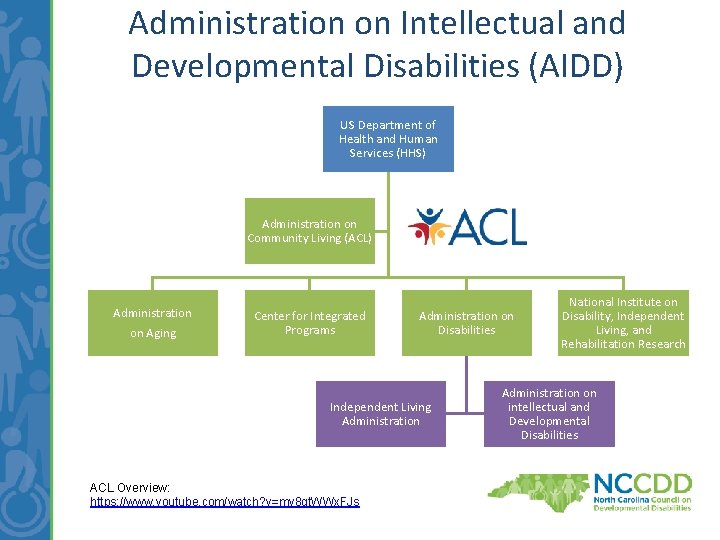
Administration on Intellectual and Developmental Disabilities (AIDD) US Department of Health and Human Services (HHS) Administration on Community Living (ACL) Administration on Aging Center for Integrated Programs Administration on Disabilities Independent Living Administration ACL Overview: https: //www. youtube. com/watch? v=my 8 gt. WWx. FJs National Institute on Disability, Independent Living, and Rehabilitation Research Administration on intellectual and Developmental Disabilities
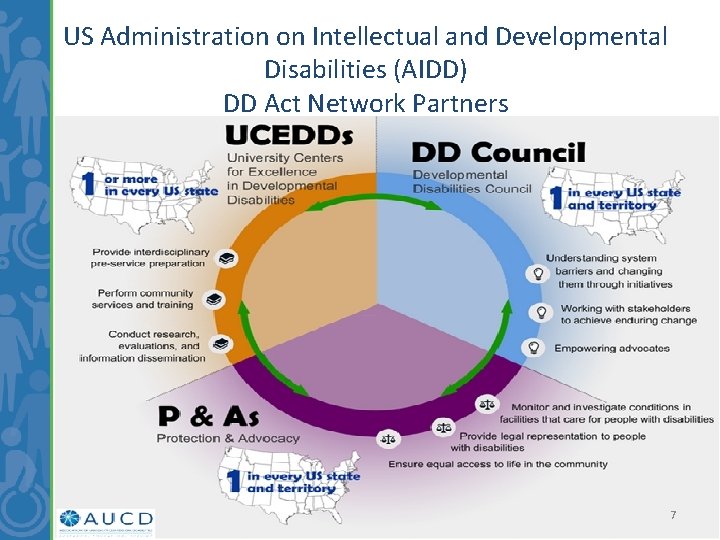
US Administration on Intellectual and Developmental Disabilities (AIDD) DD Act Network Partners 7
AIDD/NC Network is also part of NCCDD University Center on Excellence in Developmental Disabilities Carolina Institute on Developmental Disabilities (Joe Piven/Deb Zuver) Protection and Advocacy Disability Rights North Carolina (Vicki Smith) 8
Federal Law, N. C. G. S. , and NCCDD Designated State agency q The Office of the Secretary, NC Department of Health and Human Services (DHHS) is our organizational “home” q The Council makes decisions independently of DHHS q The Council supervises its executive director q DHHS has an important, but limited role o Ensure the NCCDD staff are hired and managed consistent with state law and o receive, o account for, o and disburse Council funds. 9
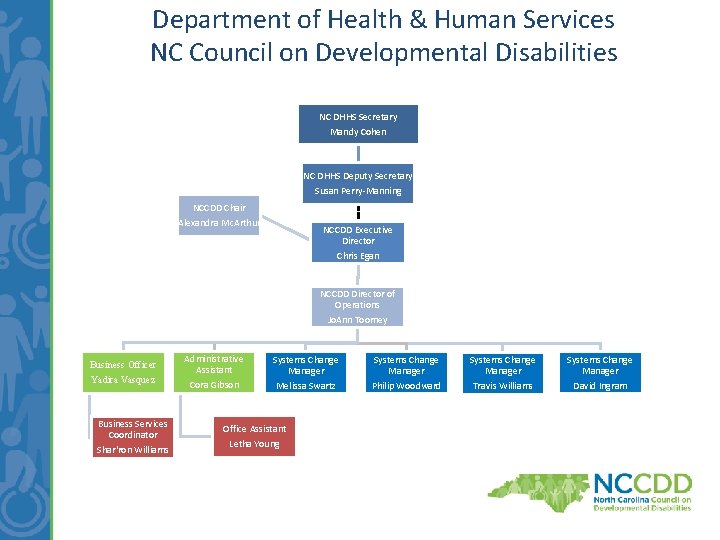
Department of Health & Human Services NC Council on Developmental Disabilities NC DHHS Secretary Mandy Cohen NC DHHS Deputy Secretary Susan Perry-Manning NCCDD Chair Alexandra Mc. Arthur NCCDD Executive Director Chris Egan NCCDD Director of Operations Jo. Ann Toomey Business Officer Yadira Vasquez Business Services Coordinator Shar'ron Williams Administrative Assistant Cora Gibson Systems Change Manager Melissa Swartz Office Assistant Letha Young Systems Change Manager Philip Woodward Systems Change Manager Travis Williams Systems Change Manager David Ingram
Who We Are Council Members • Appointed by the Governor, with input from the Council • Geographic, racial/ethnic diversity of state • Not less than 60% people with I/DD, parents or guardians of children or adults with I/DD 11
The North Carolina Council on Developmental Disabilities NCCDD is made of many experts: people with I/DD (“selfadvocates”); families; representatives from Local Management Entities/Managed Care Organizations; providers; advocates; policymakers from three departments and the University of NC; and legislators. 12
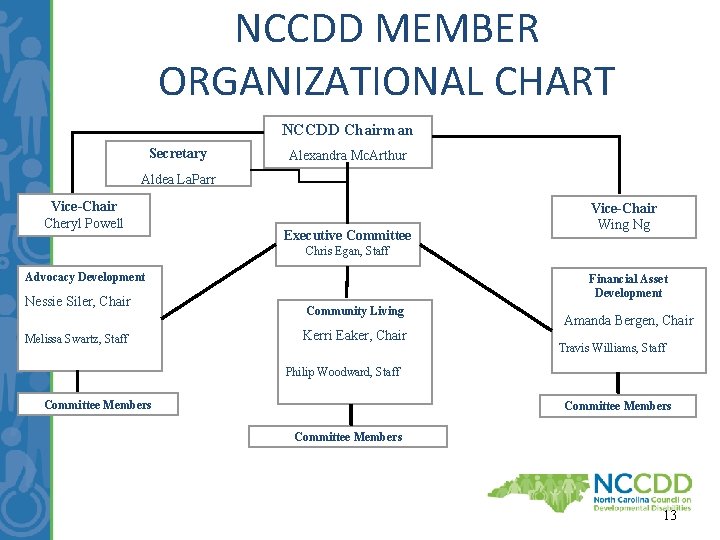
NCCDD MEMBER ORGANIZATIONAL CHART NCCDD Chairman Secretary Alexandra Mc. Arthur Aldea La. Parr Vice-Chair Cheryl Powell Executive Committee Vice-Chair Wing Ng Chris Egan, Staff Advocacy Development Nessie Siler, Chair Melissa Swartz, Staff Financial Asset Development Community Living Kerri Eaker, Chair Amanda Bergen, Chair Travis Williams, Staff Philip Woodward, Staff Committee Members 13
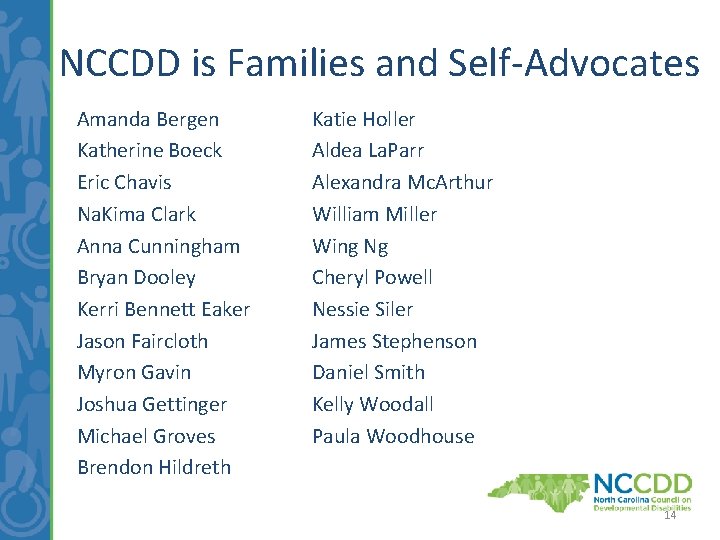
NCCDD is Families and Self-Advocates Amanda Bergen Katherine Boeck Eric Chavis Na. Kima Clark Anna Cunningham Bryan Dooley Kerri Bennett Eaker Jason Faircloth Myron Gavin Joshua Gettinger Michael Groves Brendon Hildreth Katie Holler Aldea La. Parr Alexandra Mc. Arthur William Miller Wing Ng Cheryl Powell Nessie Siler James Stephenson Daniel Smith Kelly Woodall Paula Woodhouse 14
The NCCDD is also People from Agencies NC General Assembly (Sen. Valerie Foushee and Rep. Verla Insko) Department of Health & Human Services – Office of the Secretary, DHHS (Dave Richard, Deputy Secretary) – Division of Vocational Rehabilitation (Tara Myers/Jim Swain) – Division of Medical Assistance (Sandy Terrell/Deb Goda) – Division of MH/DD/SAS (Kody Kinsley/Mya Lewis) – Division of Public Health (Kelly Kimple/Danielle Matula) – Division of Social Services (Wayne Black/Teresa Strom) – Division of Aging and Adult Services (Mary Edwards/Joseph Breen) Dept. of Public Safety, Division of Prisons (Gary Junker, Director) Department of Public Instruction (William Hussey/Dreama Mc. Coy) Local, non-governmental agencies (Peggy Terhune) Non-profits concerned with people with developmental disabilities (Christina Carter/Andrea Misenheimer) Member of the General Public (Karen Armstrong) 15
Council Member Responsibilities • Carry out the provisions of the Developmental Disabilities Assistance and Bill of Rights Act (PL 106402; DD Act) • Gain support for the Council and its positions from people with I/DD, families, policy makers, other stakeholder organizations, and the general public • Make sure that the Council is a member-driven, effective, efficient, accountable organization 16
Five-Year State Plan Based on the NCCDD’s Five-Year State Plan, our 40 members decide how $2 million in federal funds will be used. 17
What we do with Funds • With member approval, release funds through competitive Requests for Applications (RFAs) and contracts • These funds go to initiatives, across NC, that advance the Council’s goals and objectives in the Five-Year Plan • Conduct advocacy and policy activities • Fund staff to manage initiatives and Council funds • Collaborate with our NC AIDD Network Partners (Disability Rights NC, Carolina Institute on Developmental Disabilities)
Areas of Emphasis in the DD Act • Formal and informal community supports • Child care • Education • Employment • • • Health Housing Quality assurance Recreation Transportation Advancing the following activities… 19
Funding and Resource Distribution for: v. Outreach v. Training v. Technical Assistance v. Supporting and Educating Communities v. Interagency Collaboration and Coordination v. Coordination with Related Councils, Committees, and Programs v Barrier Elimination, Systems Design and Redesign v Coalition Development and Citizen Participation v Informing Policymakers v Demonstration of New Approaches to Services and Support v Other Activities Consistent with DD Act 20
Contact Information North Carolina Council On Developmental Disabilities 3125 Poplarwood Court, Suite 200 Raleigh, NC 27604 www. nccdd. org 800 -357 -6916 or 919 -850 -2901 21
- Slides: 21