
The North American Land Data Assimilation System NLDAS
![Forcing Validation: ARM/CART Monthly Averaged Hourly All-Sky SW [Wm-2] Winter (NDJF) UMD/SRB Summer (MJJA)](https://slidetodoc.com/presentation_image_h2/70bf678c695d99f0f0cdf1e3b74b15af/image-7.jpg "Forcing Validation: ARM/CART Monthly Averaged Hourly All-Sky SW [Wm-2] Winter (NDJF) UMD/SRB Summer (MJJA)")
- Slides: 16
The North American Land Data Assimilation System (N-LDAS) Project: Validation of the Energy Budget Components Eric F. Wood 1, Lifeng Luo 2, Jesse Meng 3, Fenghua Wen 1, Rachel Pinker 4, Dan Tarpley 5, Alan Robock 2, Justin Sheffield 1, Kenneth Mitchell 3, Paul R. Houser 6, John Schaake 7, Dennis Lettenmaier 8, Brian Cosgrove 6, Qingyun Duan 7, Dag Lohmann 3, Wayne Higgins 9 1 Department of Civil Engineering, Princeton University of Environmental Sciences, Rutgers University 3 NOAA/NWS/NCEP/EMC 4 Department of Meteorology, University of Maryland 5 NOAA/NESDIS/ORA 6 Hydrological Sciences Branch, NASA/GSFC 7 NOAA/NWS/OHD 8 Department of Civil and Environmental Engineering, University of Washington 9 NOAA/NWS/NCEP/CPC 2 Department GCIP/GAPP Investigator Meeting New Orleans, May 2002
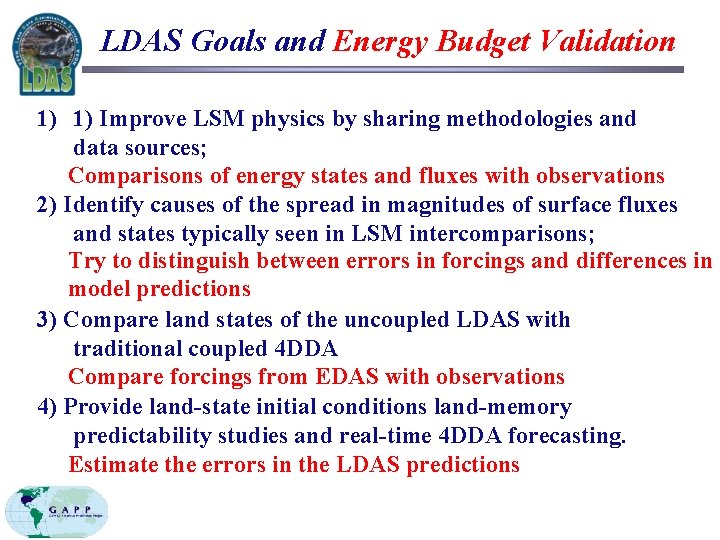
LDAS Goals and Energy Budget Validation 1) 1) Improve LSM physics by sharing methodologies and data sources; Comparisons of energy states and fluxes with observations 2) Identify causes of the spread in magnitudes of surface fluxes and states typically seen in LSM intercomparisons; Try to distinguish between errors in forcings and differences in model predictions 3) Compare land states of the uncoupled LDAS with traditional coupled 4 DDA Compare forcings from EDAS with observations 4) Provide land-state initial conditions land-memory predictability studies and real-time 4 DDA forecasting. Estimate the errors in the LDAS predictions
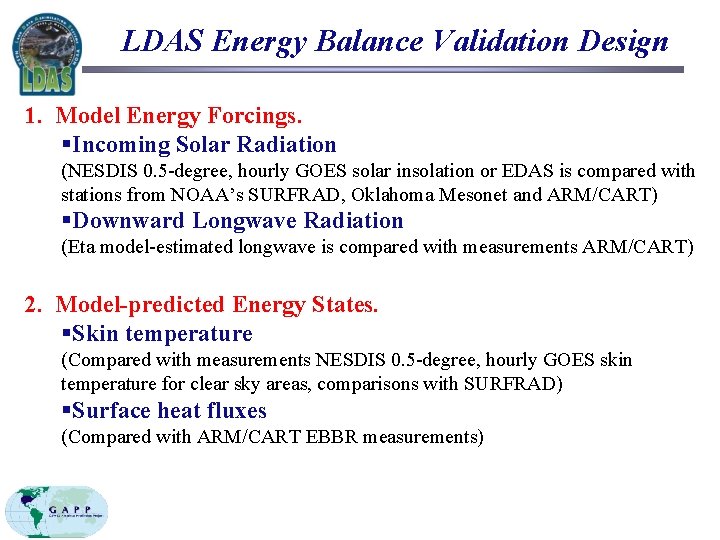
LDAS Energy Balance Validation Design 1. Model Energy Forcings. §Incoming Solar Radiation (NESDIS 0. 5 -degree, hourly GOES solar insolation or EDAS is compared with stations from NOAA’s SURFRAD, Oklahoma Mesonet and ARM/CART) §Downward Longwave Radiation (Eta model-estimated longwave is compared with measurements ARM/CART) 2. Model-predicted Energy States. §Skin temperature (Compared with measurements NESDIS 0. 5 -degree, hourly GOES skin temperature for clear sky areas, comparisons with SURFRAD) §Surface heat fluxes (Compared with ARM/CART EBBR measurements)
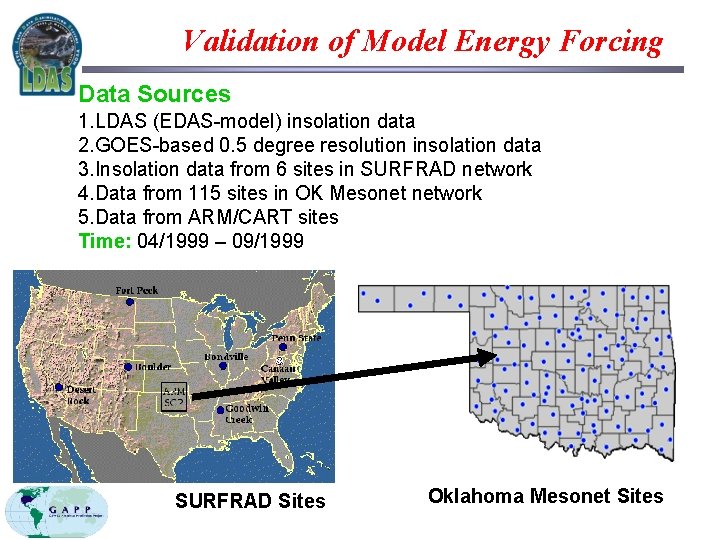
Validation of Model Energy Forcing Data Sources 1. LDAS (EDAS-model) insolation data 2. GOES-based 0. 5 degree resolution insolation data 3. Insolation data from 6 sites in SURFRAD network 4. Data from 115 sites in OK Mesonet network 5. Data from ARM/CART sites Time: 04/1999 – 09/1999 SURFRAD Sites Oklahoma Mesonet Sites
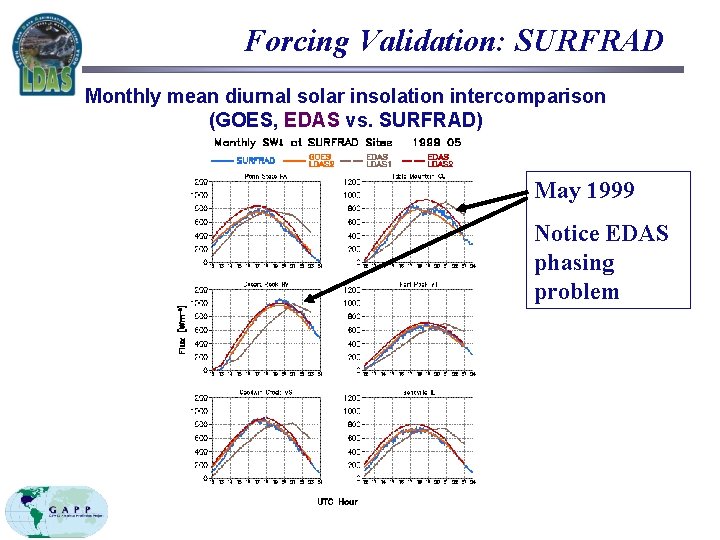
Forcing Validation: SURFRAD Monthly mean diurnal solar insolation intercomparison (GOES, EDAS vs. SURFRAD) May 1999 Notice EDAS phasing problem
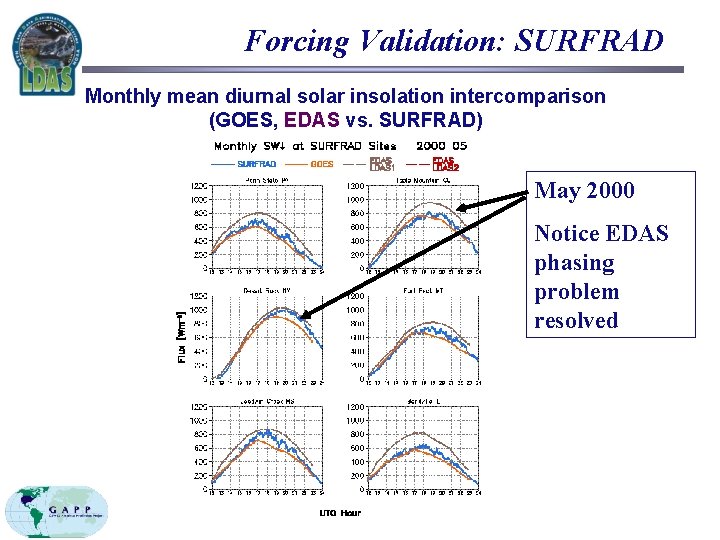
Forcing Validation: SURFRAD Monthly mean diurnal solar insolation intercomparison (GOES, EDAS vs. SURFRAD) May 2000 Notice EDAS phasing problem resolved
Forcing Validation: ARM/CART Monthly Averaged Hourly All-Sky SW [Wm-2] Winter (NDJF) UMD/SRB Summer (MJJA) RMS BIAS n 40 27 46 ARM/SGP RMS BIAS n 24 11 30 ARM/SGP
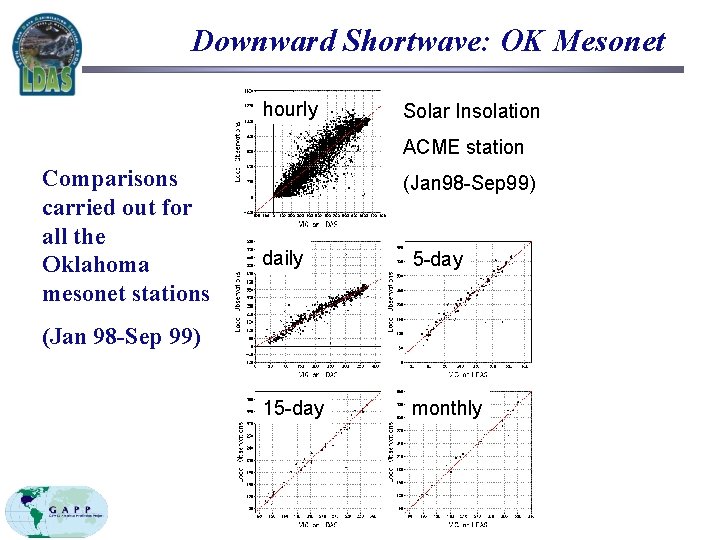
Downward Shortwave: OK Mesonet hourly Solar Insolation ACME station Comparisons carried out for all the Oklahoma mesonet stations (Jan 98 -Sep 99) daily 5 -day 15 -day monthly (Jan 98 -Sep 99)
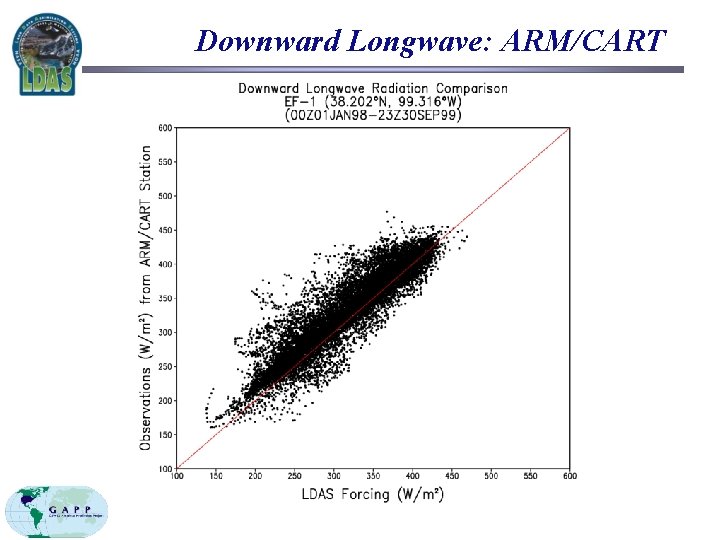
Downward Longwave: ARM/CART
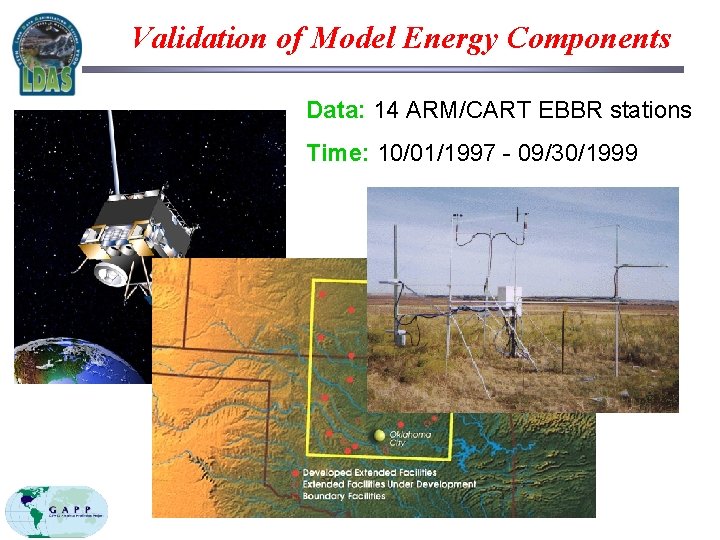
Validation of Model Energy Components Data: 14 ARM/CART EBBR stations Time: 10/01/1997 - 09/30/1999
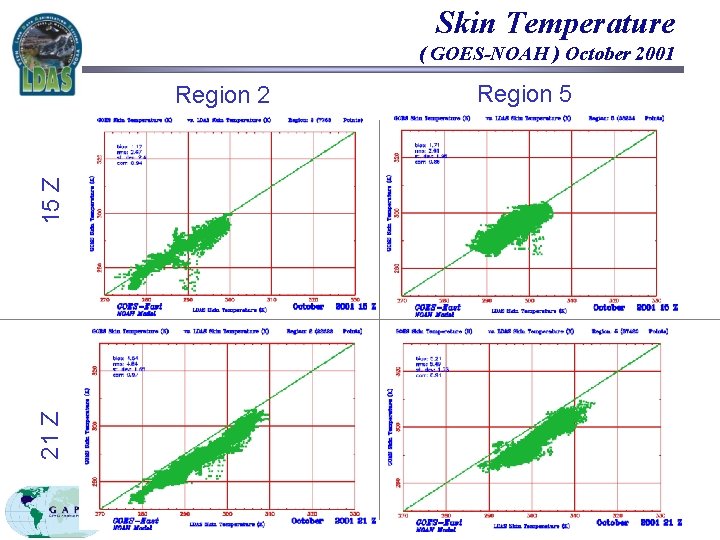
Skin Temperature ( GOES-NOAH ) October 2001 21 Z 15 Z Region 2 Region 5
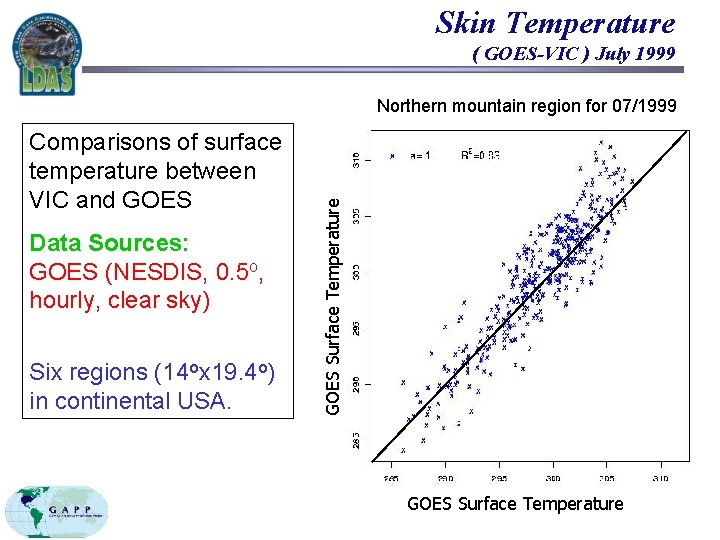
Skin Temperature ( GOES-VIC ) July 1999 Comparisons of surface temperature between VIC and GOES Data Sources: GOES (NESDIS, 0. 5 o, hourly, clear sky) Six regions (14 ox 19. 4 o) in continental USA. GOES Surface Temperature Northern mountain region for 07/1999 GOES Surface Temperature
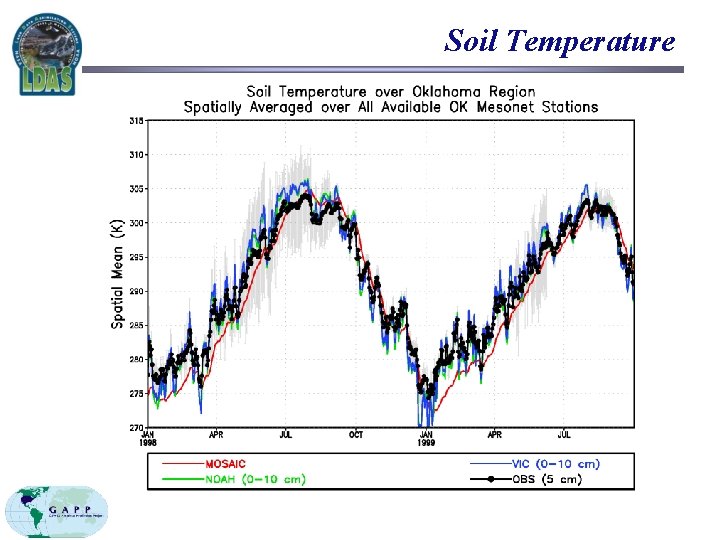
Soil Temperature
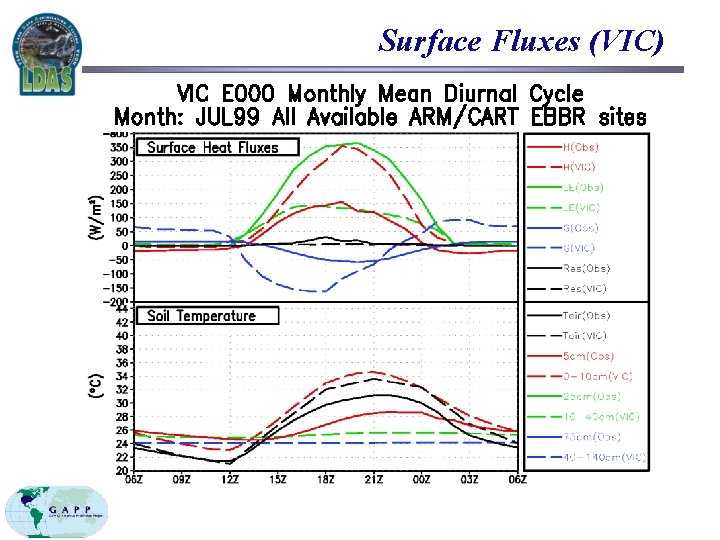
Surface Fluxes (VIC)
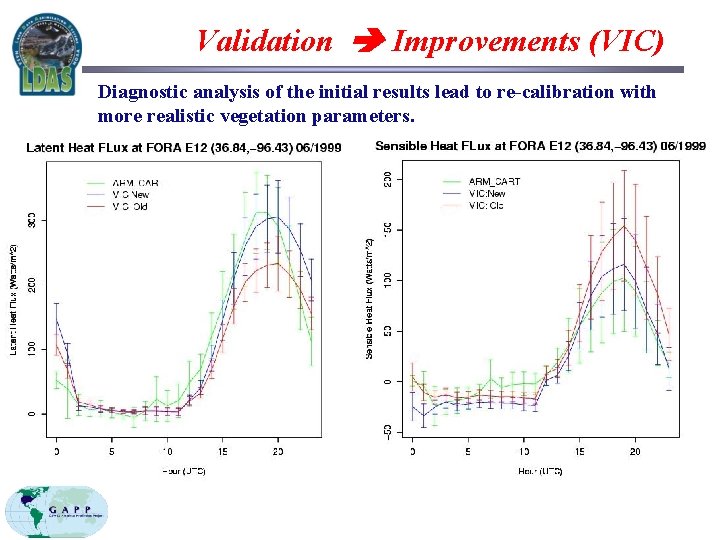
Validation Improvements (VIC) Diagnostic analysis of the initial results lead to re-calibration with more realistic vegetation parameters.
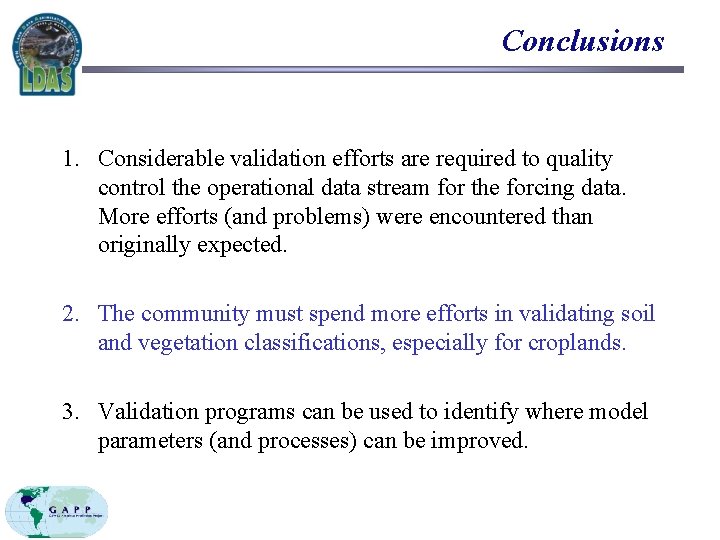
Conclusions 1. Considerable validation efforts are required to quality control the operational data stream for the forcing data. More efforts (and problems) were encountered than originally expected. 2. The community must spend more efforts in validating soil and vegetation classifications, especially for croplands. 3. Validation programs can be used to identify where model parameters (and processes) can be improved.