
The Normal Distribution LO To know the properties
The Normal Distribution LO: To know the properties of the normal distribution. www. mathssupport. org

The Normal Distribution Is the most important distribution for a continuous random variable. Many naturally occurring phenomena have a distribution that is normal, or approximately normal. Examples of variables that have a Normal distribution v Physical attributes of a population such as: Ø Height Ø Weight Ø Arm length v Crop yields. v Scores for tests taken by a large population. Once a normal model has been stablished, we can use it to calculate probabilities and make predictions. www. mathssupport. org
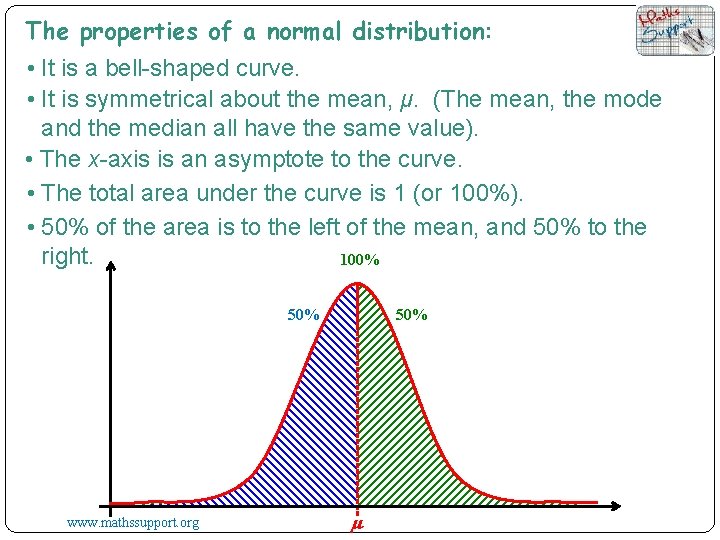
The properties of a normal distribution: • It is a bell-shaped curve. • It is symmetrical about the mean, μ. (The mean, the mode and the median all have the same value). • The x-axis is an asymptote to the curve. • The total area under the curve is 1 (or 100%). • 50% of the area is to the left of the mean, and 50% to the right. 100% 50% www. mathssupport. org 50% μ
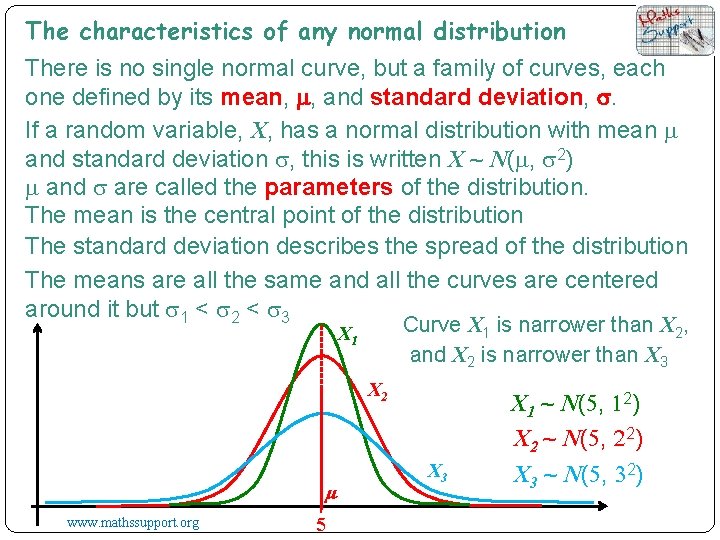
The characteristics of any normal distribution There is no single normal curve, but a family of curves, each one defined by its mean, m, and standard deviation, s. If a random variable, X, has a normal distribution with mean m and standard deviation s, this is written X ~ N(m, s 2) m and s are called the parameters of the distribution. The mean is the central point of the distribution The standard deviation describes the spread of the distribution The means are all the same and all the curves are centered around it but s 1 < s 2 < s 3 Curve X 1 is narrower than X 2, and X 2 is narrower than X 3 X 1 X 2 μ www. mathssupport. org 5 X 1 ~ N(5, 12) X 2 ~ N(5, 22) X 3 ~ N(5, 32)
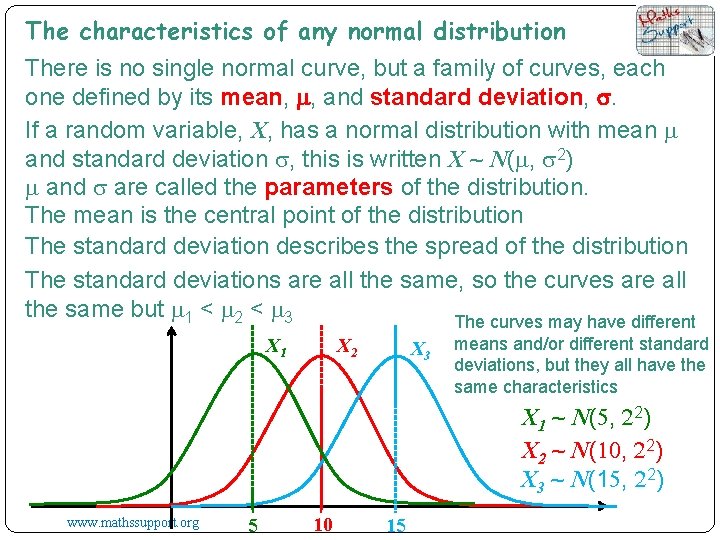
The characteristics of any normal distribution There is no single normal curve, but a family of curves, each one defined by its mean, m, and standard deviation, s. If a random variable, X, has a normal distribution with mean m and standard deviation s, this is written X ~ N(m, s 2) m and s are called the parameters of the distribution. The mean is the central point of the distribution The standard deviation describes the spread of the distribution The standard deviations are all the same, so the curves are all the same but m 1 < m 2 < m 3 The curves may have different X 1 X 2 X 3 means and/or different standard deviations, but they all have the same characteristics X 1 ~ N(5, 22) X 2 ~ N(10, 22) X 3 ~ N(15, 22) www. mathssupport. org 5 10 15
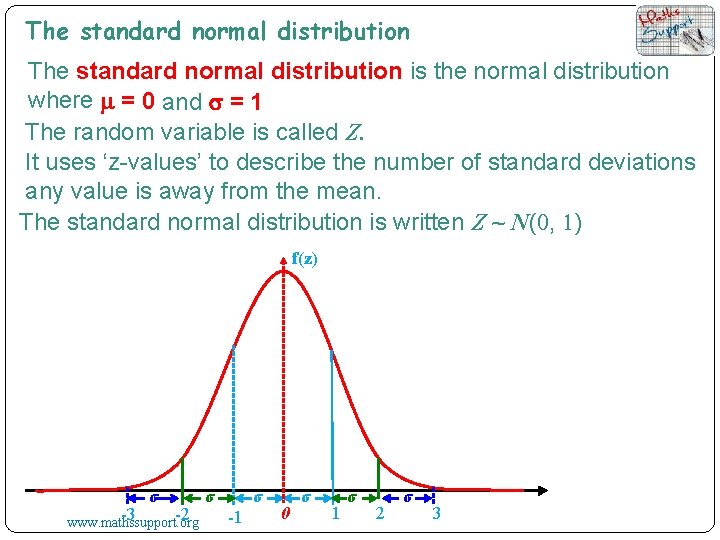
The standard normal distribution is the normal distribution where m = 0 and s = 1 The random variable is called Z. It uses ‘z-values’ to describe the number of standard deviations any value is away from the mean. The standard normal distribution is written Z ~ N(0, 1) f(z) -3 σ -2 www. mathssupport. org σ σ -1 0 σ 1 σ 2 σ 3
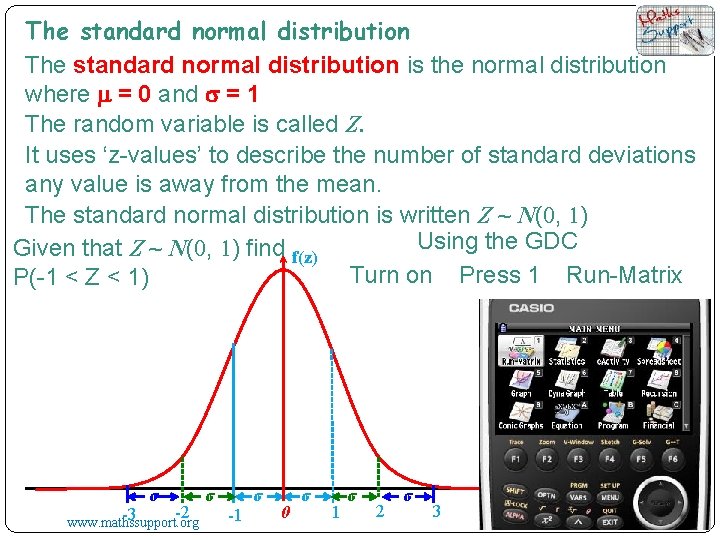
The standard normal distribution is the normal distribution where m = 0 and s = 1 The random variable is called Z. It uses ‘z-values’ to describe the number of standard deviations any value is away from the mean. The standard normal distribution is written Z ~ N(0, 1) Using the GDC Given that Z ~ N(0, 1) find f(z) Turn on Press 1 Run-Matrix P(-1 < Z < 1) -3 σ -2 www. mathssupport. org σ σ -1 0 σ 1 σ 2 σ 3
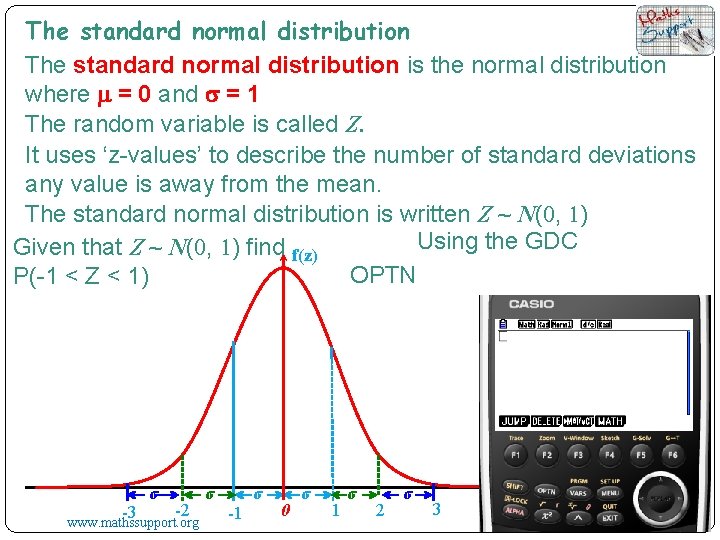
The standard normal distribution is the normal distribution where m = 0 and s = 1 The random variable is called Z. It uses ‘z-values’ to describe the number of standard deviations any value is away from the mean. The standard normal distribution is written Z ~ N(0, 1) Using the GDC Given that Z ~ N(0, 1) find f(z) OPTN P(-1 < Z < 1) -3 σ -2 www. mathssupport. org σ σ -1 0 σ 1 σ 2 σ 3
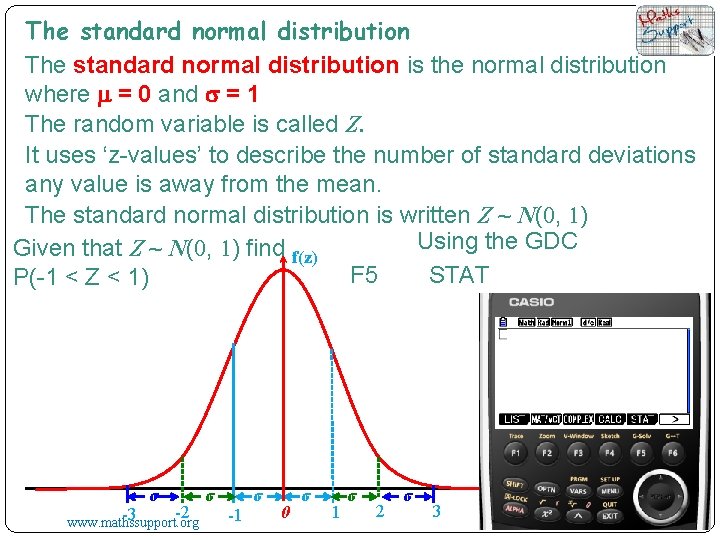
The standard normal distribution is the normal distribution where m = 0 and s = 1 The random variable is called Z. It uses ‘z-values’ to describe the number of standard deviations any value is away from the mean. The standard normal distribution is written Z ~ N(0, 1) Using the GDC Given that Z ~ N(0, 1) find f(z) F 5 STAT P(-1 < Z < 1) -3 σ -2 www. mathssupport. org σ σ -1 0 σ 1 σ 2 σ 3

The standard normal distribution is the normal distribution where m = 0 and s = 1 The random variable is called Z. It uses ‘z-values’ to describe the number of standard deviations any value is away from the mean. The standard normal distribution is written Z ~ N(0, 1) Using the GDC Given that Z ~ N(0, 1) find f(z) F 3 DIST P(-1 < Z < 1) -3 σ -2 www. mathssupport. org σ σ -1 0 σ 1 σ 2 σ 3
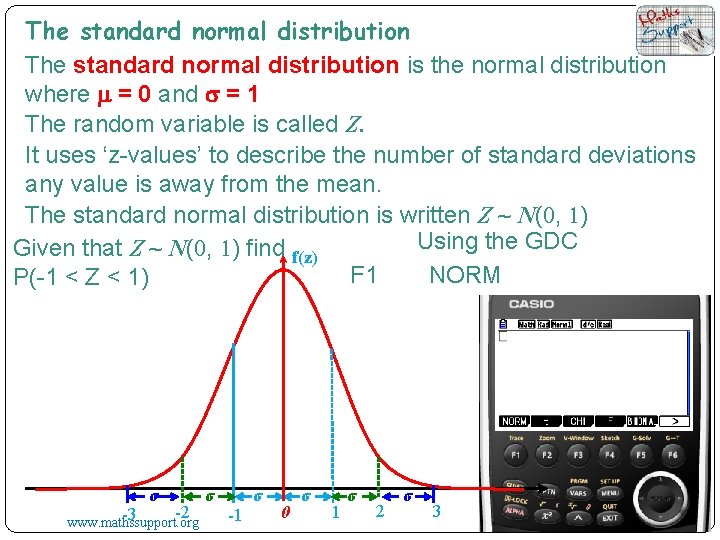
The standard normal distribution is the normal distribution where m = 0 and s = 1 The random variable is called Z. It uses ‘z-values’ to describe the number of standard deviations any value is away from the mean. The standard normal distribution is written Z ~ N(0, 1) Using the GDC Given that Z ~ N(0, 1) find f(z) F 1 NORM P(-1 < Z < 1) -3 σ -2 www. mathssupport. org σ σ -1 0 σ 1 σ 2 σ 3
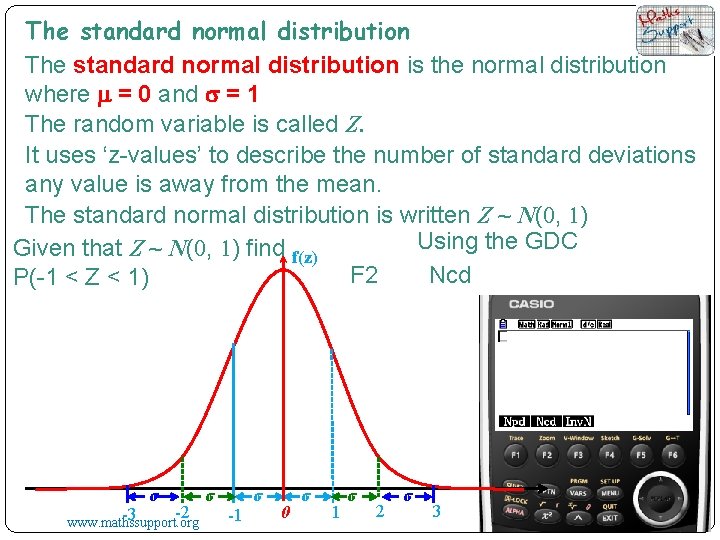
The standard normal distribution is the normal distribution where m = 0 and s = 1 The random variable is called Z. It uses ‘z-values’ to describe the number of standard deviations any value is away from the mean. The standard normal distribution is written Z ~ N(0, 1) Using the GDC Given that Z ~ N(0, 1) find f(z) F 2 Ncd P(-1 < Z < 1) -3 σ -2 www. mathssupport. org σ σ -1 0 σ 1 σ 2 σ 3
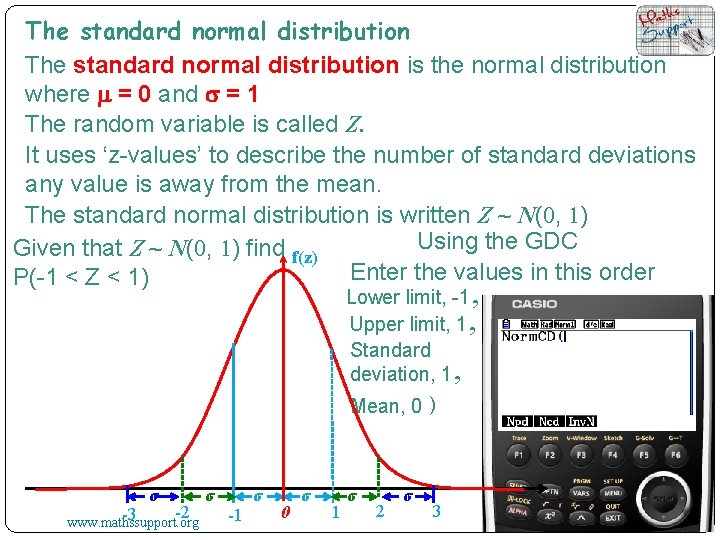
The standard normal distribution is the normal distribution where m = 0 and s = 1 The random variable is called Z. It uses ‘z-values’ to describe the number of standard deviations any value is away from the mean. The standard normal distribution is written Z ~ N(0, 1) Using the GDC Given that Z ~ N(0, 1) find f(z) Enter the values in this order P(-1 < Z < 1) , , Lower limit, -1 Upper limit, 1 Standard deviation, 1 Mean, 0 ) , -3 σ -2 www. mathssupport. org σ σ -1 0 σ 1 σ 2 σ 3
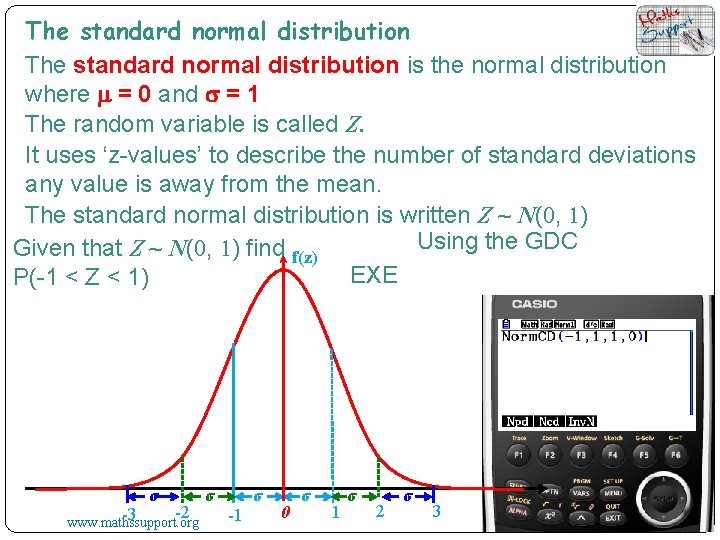
The standard normal distribution is the normal distribution where m = 0 and s = 1 The random variable is called Z. It uses ‘z-values’ to describe the number of standard deviations any value is away from the mean. The standard normal distribution is written Z ~ N(0, 1) Using the GDC Given that Z ~ N(0, 1) find f(z) EXE P(-1 < Z < 1) -3 σ -2 www. mathssupport. org σ σ -1 0 σ 1 σ 2 σ 3
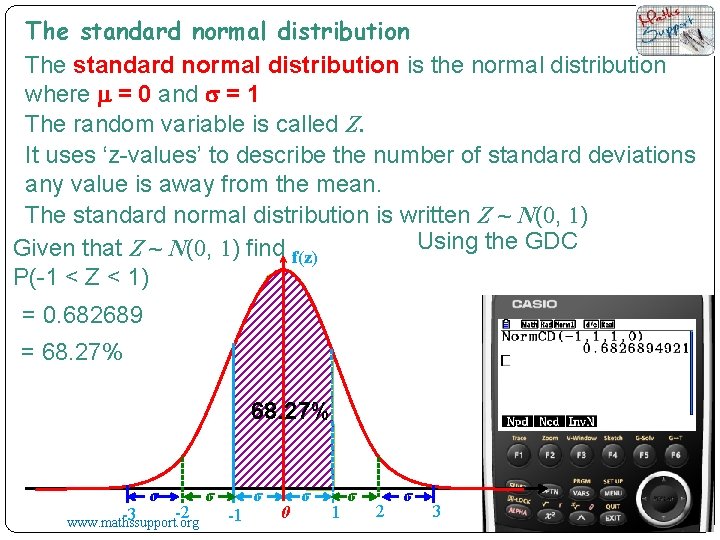
The standard normal distribution is the normal distribution where m = 0 and s = 1 The random variable is called Z. It uses ‘z-values’ to describe the number of standard deviations any value is away from the mean. The standard normal distribution is written Z ~ N(0, 1) Using the GDC Given that Z ~ N(0, 1) find f(z) P(-1 < Z < 1) = 0. 682689 = 68. 27% -3 σ -2 www. mathssupport. org σ σ -1 0 σ 1 σ 2 σ 3
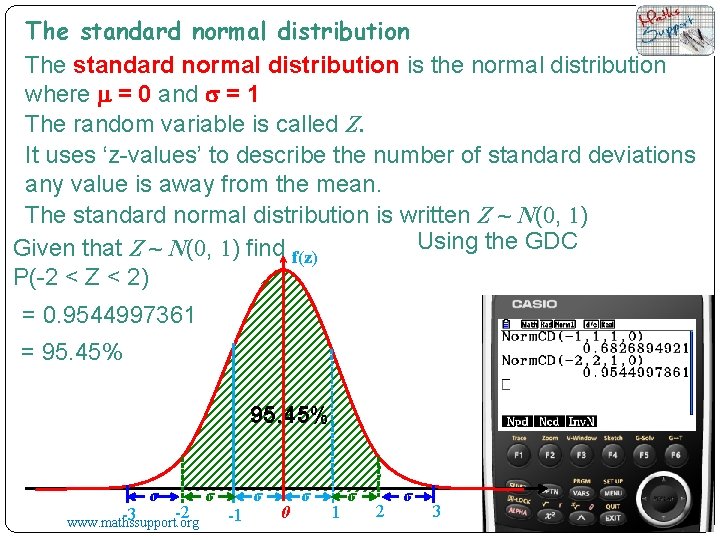
The standard normal distribution is the normal distribution where m = 0 and s = 1 The random variable is called Z. It uses ‘z-values’ to describe the number of standard deviations any value is away from the mean. The standard normal distribution is written Z ~ N(0, 1) Using the GDC Given that Z ~ N(0, 1) find f(z) P(-2 < Z < 2) = 0. 9544997361 = 95. 45% -3 σ -2 www. mathssupport. org σ σ -1 0 σ 1 σ 2 σ 3
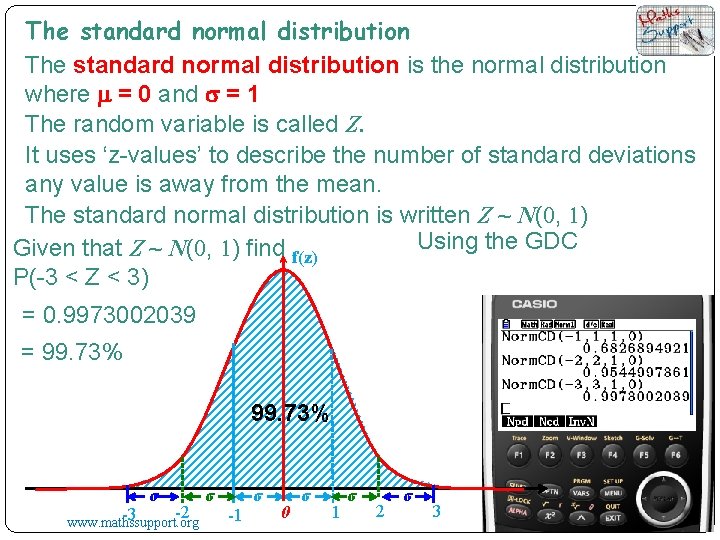
The standard normal distribution is the normal distribution where m = 0 and s = 1 The random variable is called Z. It uses ‘z-values’ to describe the number of standard deviations any value is away from the mean. The standard normal distribution is written Z ~ N(0, 1) Using the GDC Given that Z ~ N(0, 1) find f(z) P(-3 < Z < 3) = 0. 9973002039 = 99. 73% -3 σ -2 www. mathssupport. org σ σ -1 0 σ 1 σ 2 σ 3
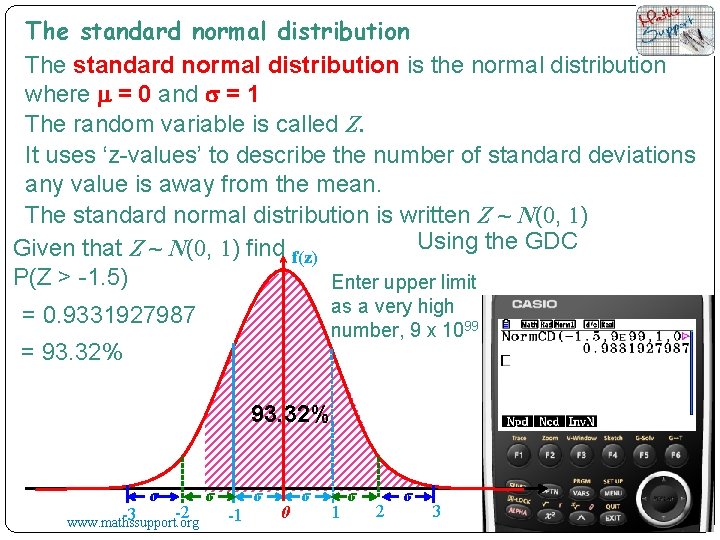
The standard normal distribution is the normal distribution where m = 0 and s = 1 The random variable is called Z. It uses ‘z-values’ to describe the number of standard deviations any value is away from the mean. The standard normal distribution is written Z ~ N(0, 1) Using the GDC Given that Z ~ N(0, 1) find f(z) P(Z > -1. 5) Enter upper limit as a very high number, 9 x 1099 = 0. 9331927987 = 93. 32% -3 σ -2 www. mathssupport. org σ σ -1 0 σ 1 σ 2 σ 3
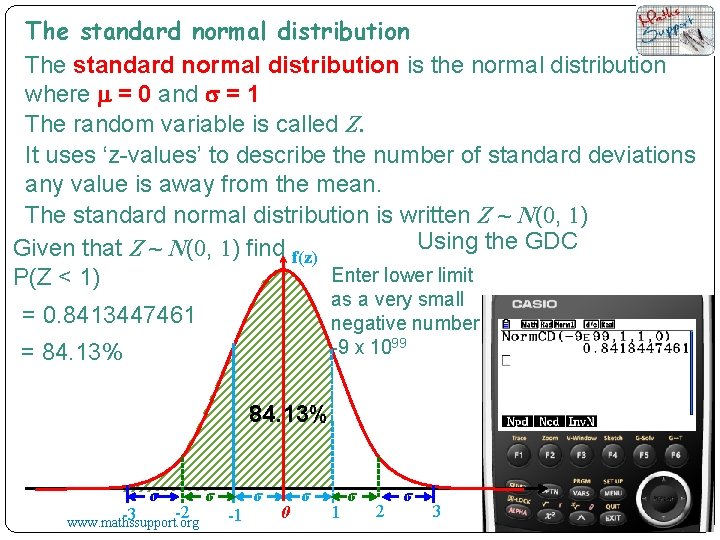
The standard normal distribution is the normal distribution where m = 0 and s = 1 The random variable is called Z. It uses ‘z-values’ to describe the number of standard deviations any value is away from the mean. The standard normal distribution is written Z ~ N(0, 1) Using the GDC Given that Z ~ N(0, 1) find f(z) Enter lower limit P(Z < 1) as a very small negative number, -9 x 1099 = 0. 8413447461 = 84. 13% -3 σ -2 www. mathssupport. org σ σ -1 0 σ 1 σ 2 σ 3
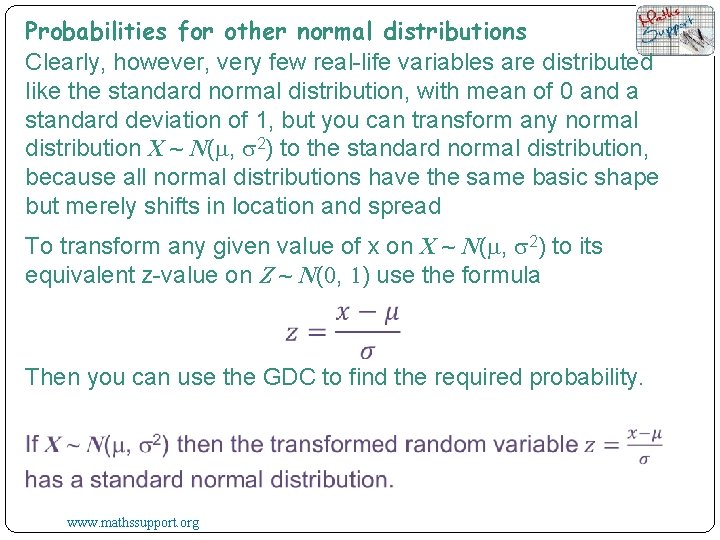
Probabilities for other normal distributions Clearly, however, very few real-life variables are distributed like the standard normal distribution, with mean of 0 and a standard deviation of 1, but you can transform any normal distribution X ~ N(m, s 2) to the standard normal distribution, because all normal distributions have the same basic shape but merely shifts in location and spread To transform any given value of x on X ~ N(m, s 2) to its equivalent z-value on Z ~ N(0, 1) use the formula Then you can use the GDC to find the required probability. www. mathssupport. org
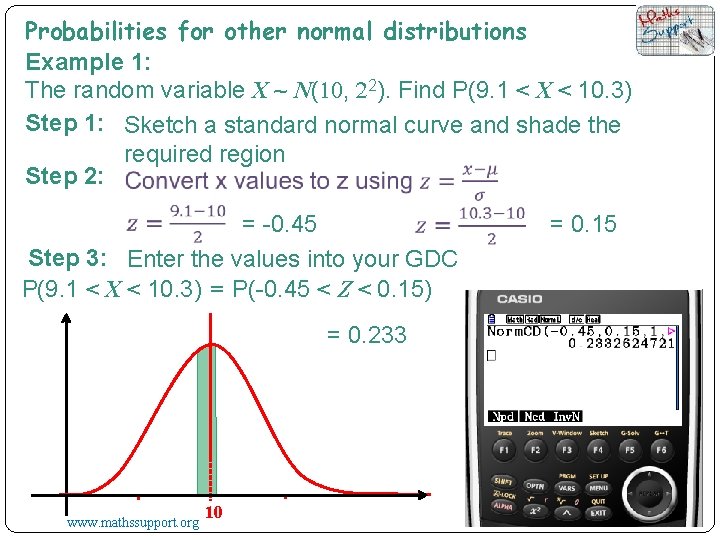
Probabilities for other normal distributions Example 1: The random variable X ~ N(10, 22). Find P(9. 1 < X < 10. 3) Step 1: Sketch a standard normal curve and shade the required region Step 2: = -0. 45 Step 3: Enter the values into your GDC P(9. 1 < X < 10. 3) = P(-0. 45 < Z < 0. 15) = 0. 233 www. mathssupport. org 10 = 0. 15
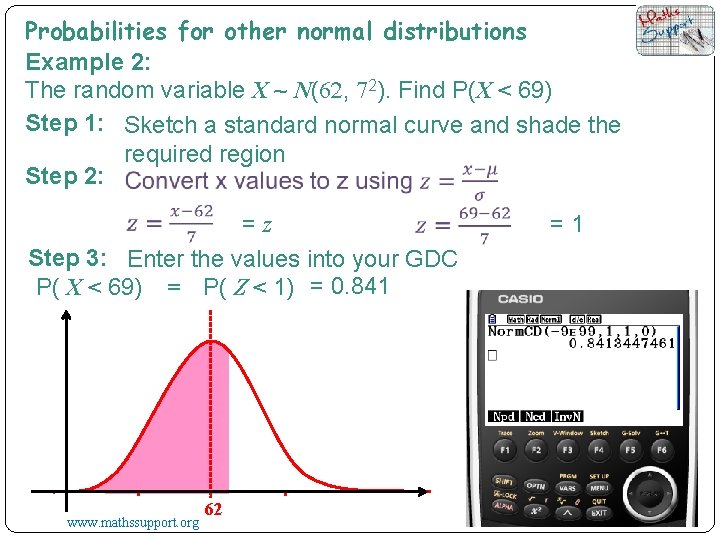
Probabilities for other normal distributions Example 2: The random variable X ~ N(62, 72). Find P(X < 69) Step 1: Sketch a standard normal curve and shade the required region Step 2: =z Step 3: Enter the values into your GDC P( X < 69) = P( Z < 1) = 0. 841 www. mathssupport. org 62 =1
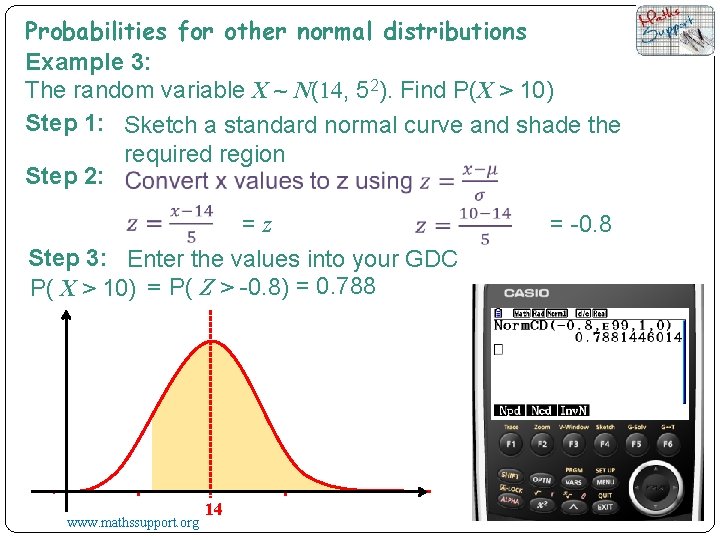
Probabilities for other normal distributions Example 3: The random variable X ~ N(14, 52). Find P(X > 10) Step 1: Sketch a standard normal curve and shade the required region Step 2: =z Step 3: Enter the values into your GDC P( X > 10) = P( Z > -0. 8) = 0. 788 www. mathssupport. org 14 = -0. 8
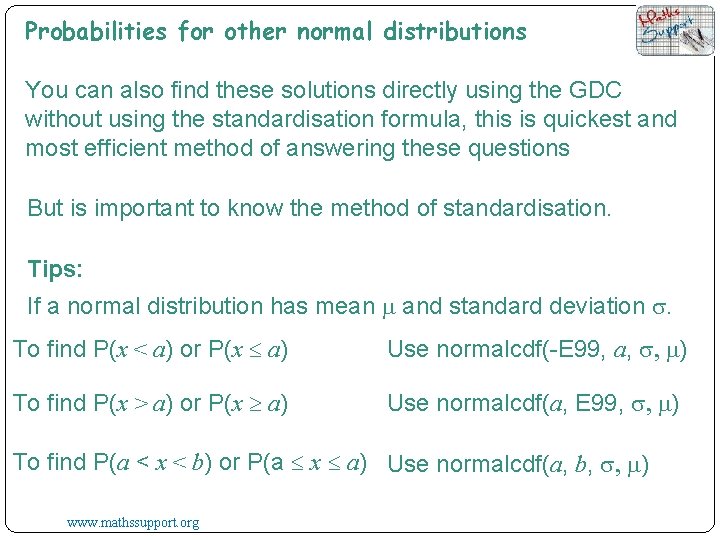
Probabilities for other normal distributions You can also find these solutions directly using the GDC without using the standardisation formula, this is quickest and most efficient method of answering these questions But is important to know the method of standardisation. Tips: If a normal distribution has mean m and standard deviation s. To find P(x < a) or P(x a) Use normalcdf(-E 99, a, s, m) To find P(x > a) or P(x a) Use normalcdf(a, E 99, s, m) To find P(a < x < b) or P(a x a) Use normalcdf(a, b, s, m) www. mathssupport. org
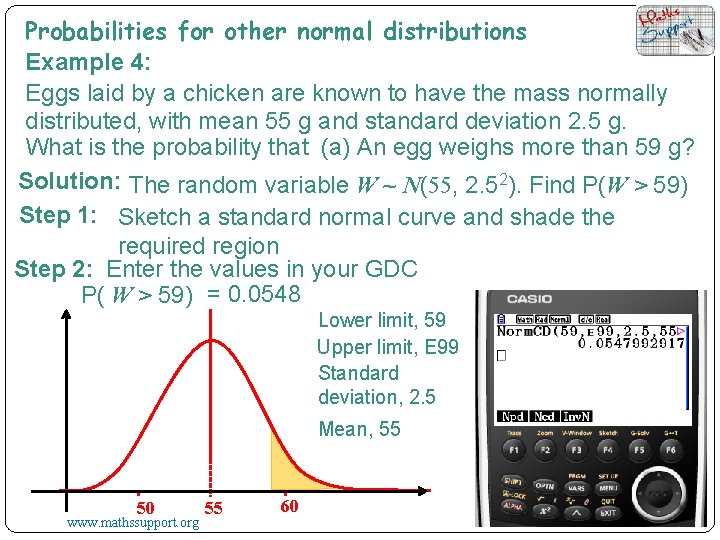
Probabilities for other normal distributions Example 4: Eggs laid by a chicken are known to have the mass normally distributed, with mean 55 g and standard deviation 2. 5 g. What is the probability that (a) An egg weighs more than 59 g? Solution: The random variable W ~ N(55, 2. 52). Find P(W > 59) Step 1: Sketch a standard normal curve and shade the required region Step 2: Enter the values in your GDC P( W > 59) = 0. 0548 Lower limit, 59 Upper limit, E 99 Standard deviation, 2. 5 Mean, 55 50 www. mathssupport. org 55 60
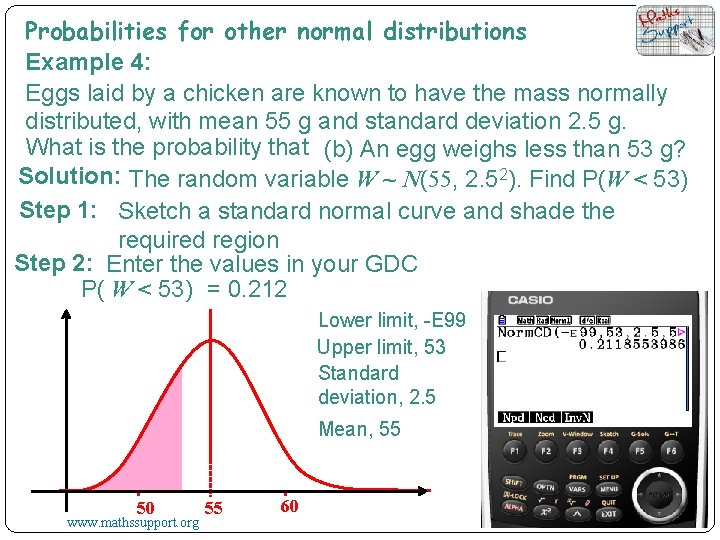
Probabilities for other normal distributions Example 4: Eggs laid by a chicken are known to have the mass normally distributed, with mean 55 g and standard deviation 2. 5 g. What is the probability that (b) An egg weighs less than 53 g? Solution: The random variable W ~ N(55, 2. 52). Find P(W < 53) Step 1: Sketch a standard normal curve and shade the required region Step 2: Enter the values in your GDC P( W < 53) = 0. 212 Lower limit, -E 99 Upper limit, 53 Standard deviation, 2. 5 Mean, 55 50 www. mathssupport. org 55 60
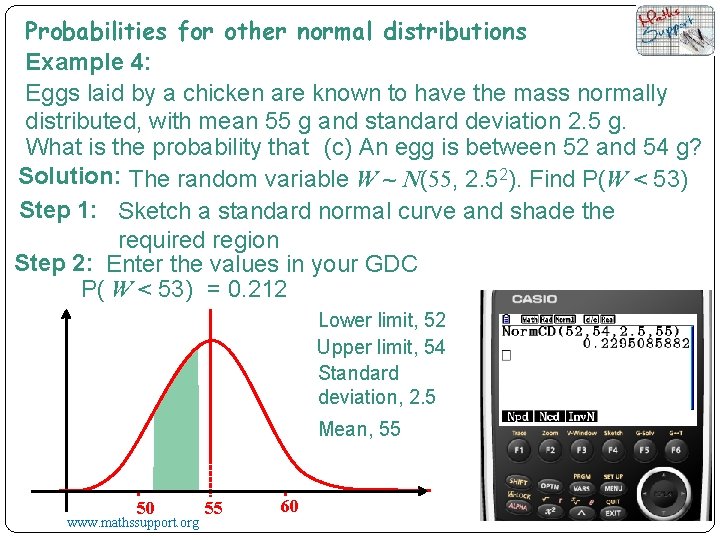
Probabilities for other normal distributions Example 4: Eggs laid by a chicken are known to have the mass normally distributed, with mean 55 g and standard deviation 2. 5 g. What is the probability that (c) An egg is between 52 and 54 g? Solution: The random variable W ~ N(55, 2. 52). Find P(W < 53) Step 1: Sketch a standard normal curve and shade the required region Step 2: Enter the values in your GDC P( W < 53) = 0. 212 Lower limit, 52 Upper limit, 54 Standard deviation, 2. 5 Mean, 55 50 www. mathssupport. org 55 60

Thank you for using resources from For more resources visit our website https: //www. mathssupport. org If you have a special request, drop us an email info@mathssupport. org www. mathssupport. org
- Slides: 28