
The Normal Distribution Lecture 20 Section 6 3
The Normal Distribution Lecture 20 Section 6. 3. 1 Wed, Feb 20, 2008
The “ 68 -95 -99. 7 Rule” n For any normal distribution, ¨ Approximately 68% of the values lie within one standard deviation of the mean. ¨ Approximately 95% of the values lie within two standard deviations of the mean. ¨ Approximately 99. 7% of the values lie within three standard deviations of the mean.
The Empirical Rule n n The well-known Empirical Rule is similar, but more general. If a distribution has a “mound shape”, then ¨ Approximately 68% lie within one standard deviation of the mean. ¨ Approximately 95% lie within two standard deviations of the mean. ¨ Nearly all lie within three standard deviations of the mean.
The Standard Normal Distribution The standard normal distribution n It is denoted by the letter Z. n That is, Z is N(0, 1). n
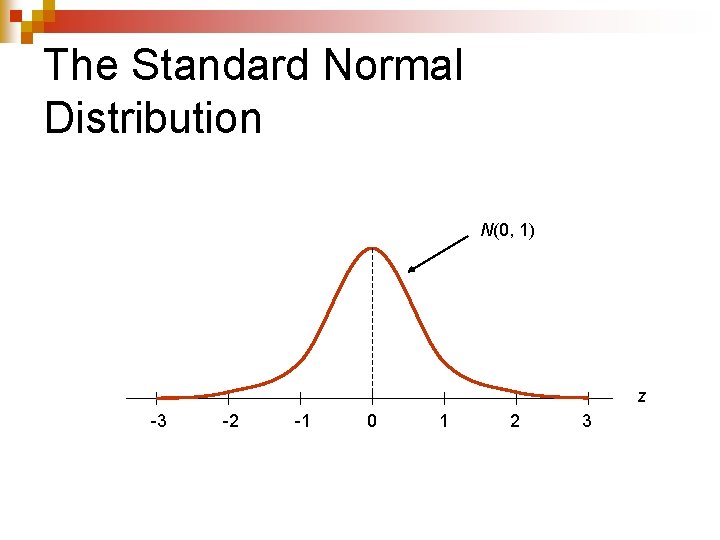
The Standard Normal Distribution N(0, 1) z -3 -2 -1 0 1 2 3
Areas Under the Standard Normal Curve n Easy questions: ¨ What is the total area under the curve? ¨ What proportion of values of Z will fall below 0? ¨ What proportion of values of Z will fall above 0?
Areas Under the Standard Normal Curve n Harder question: ¨ What proportion of values will fall below +1?
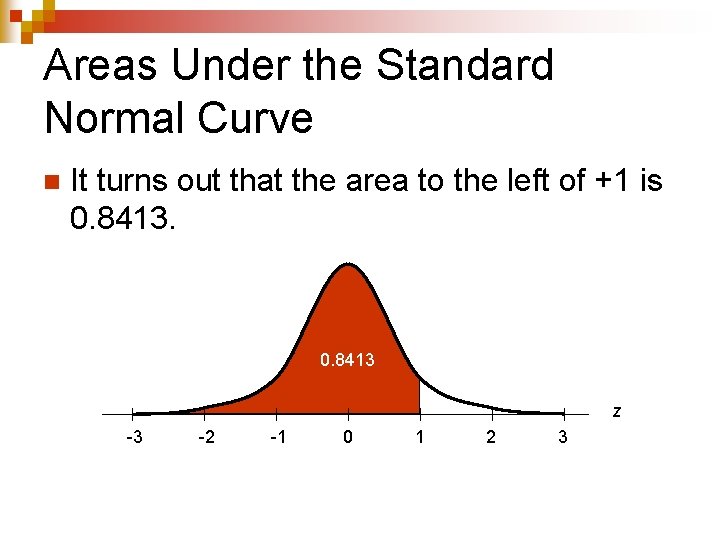
Areas Under the Standard Normal Curve n It turns out that the area to the left of +1 is 0. 8413 z -3 -2 -1 0 1 2 3
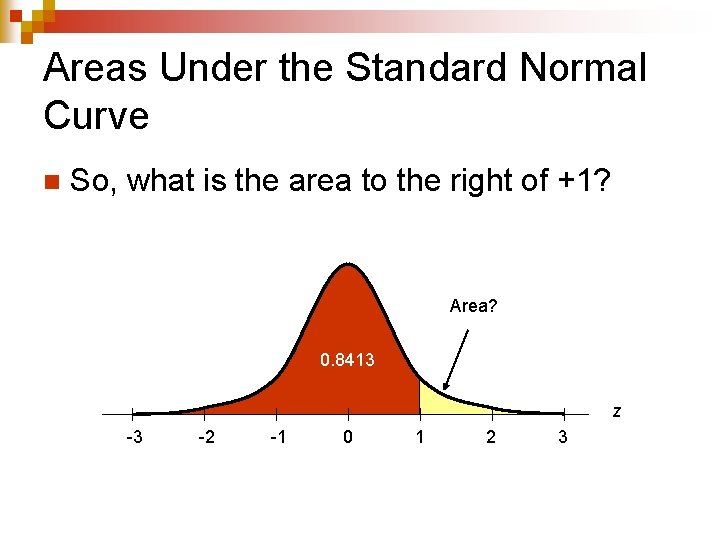
Areas Under the Standard Normal Curve n So, what is the area to the right of +1? Area? 0. 8413 z -3 -2 -1 0 1 2 3
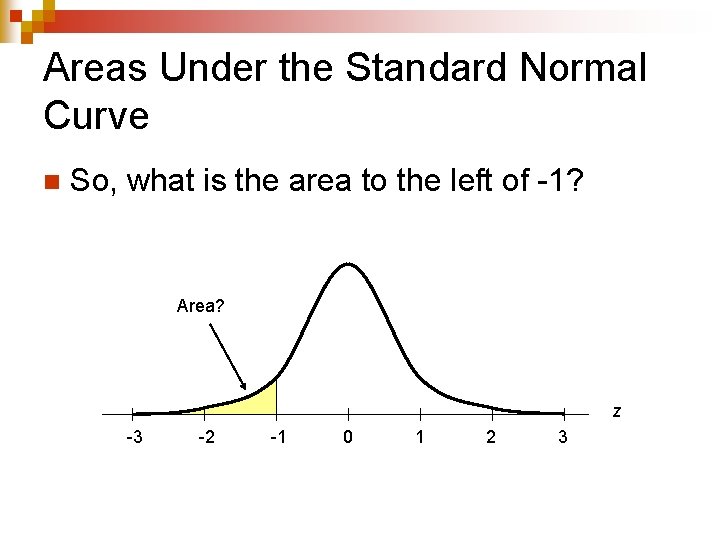
Areas Under the Standard Normal Curve n So, what is the area to the left of -1? Area? z -3 -2 -1 0 1 2 3
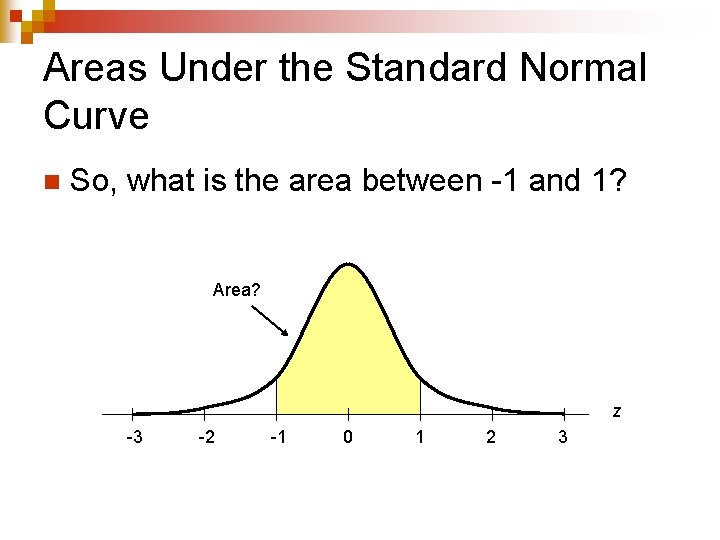
Areas Under the Standard Normal Curve n So, what is the area between -1 and 1? Area? 0. 8413 z -3 -2 -1 0 1 2 3
Areas Under the Standard Normal Curve n There are two methods to finding standard normal areas: ¨ The TI-83 function normalcdf. ¨ Standard normal table. n We will use the TI-83 (unless you want to use the table).
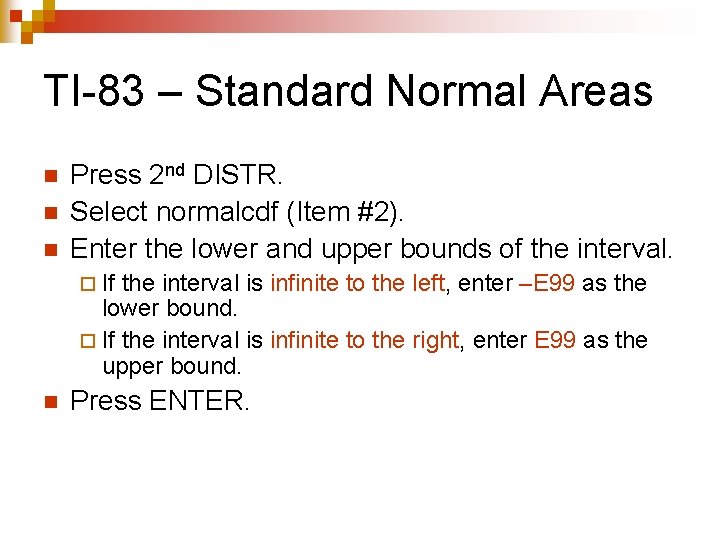
TI-83 – Standard Normal Areas n n n Press 2 nd DISTR. Select normalcdf (Item #2). Enter the lower and upper bounds of the interval. ¨ If the interval is infinite to the left, enter –E 99 as the lower bound. ¨ If the interval is infinite to the right, enter E 99 as the upper bound. n Press ENTER.
Standard Normal Areas n Use the TI-83 to find the following. ¨ The area between -1 and +1. ¨ The area to the left of +1. ¨ The area to the right of +1.

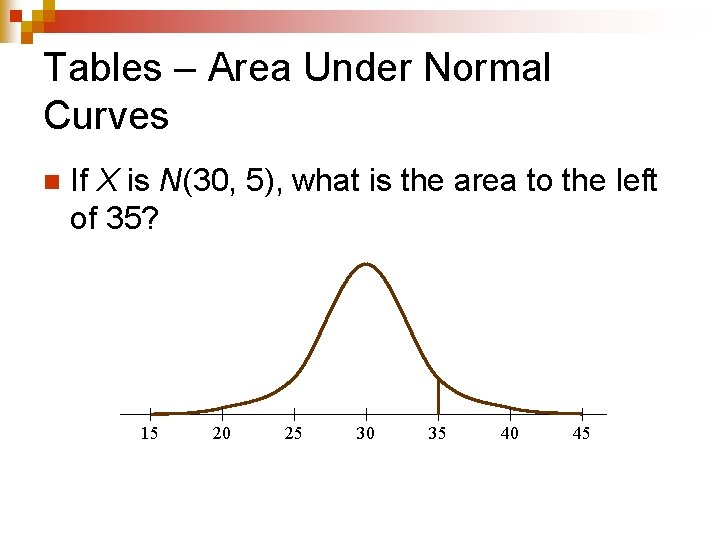
Other Normal Curves n If we are working with a different normal distribution, say N(30, 5), then how can we find areas under the curve?
TI-83 – Area Under Normal Curves Use the same procedure as before, except enter the mean and standard deviation as the 3 rd and 4 th parameters of the normalcdf function. n Find area between 25 and 38 in the distribution N(30, 5). n
IQ Scores Intelligence Quotient. n Understanding and Interpreting IQ. n IQ scores are standardized to have a mean of 100 and a standard deviation of 15. n Psychologists often assume a normal distribution of IQ scores as well. n
IQ Scores What percentage of the population has an IQ above 120? above 140? n What percentage of the population has an IQ between 75 and 125? n
Bag A vs. Bag B Suppose we have two bags, Bag A and Bag B. n Each bag contains millions of vouchers. n In Bag A, the values of the vouchers have distribution N(50, 10). In Bag B, the values of the vouchers have distribution N(80, 15). n
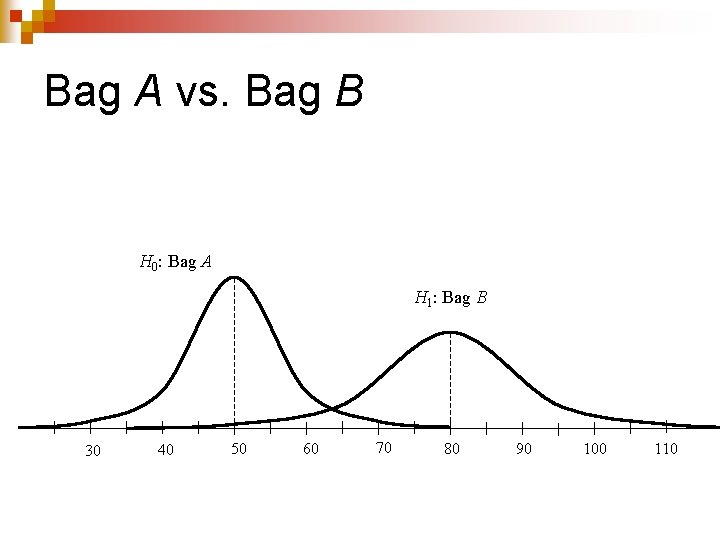
Bag A vs. Bag B H 0: Bag A H 1: Bag B 30 40 50 60 70 80 90 100 110
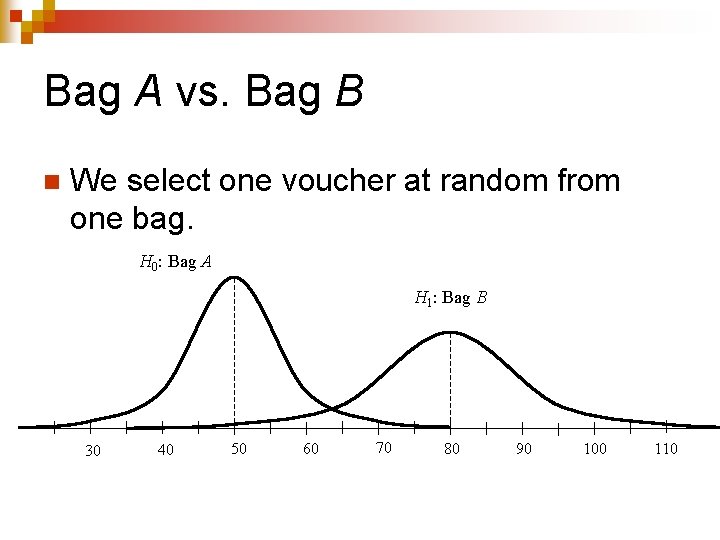
Bag A vs. Bag B n We select one voucher at random from one bag. H 0: Bag A H 1: Bag B 30 40 50 60 70 80 90 100 110
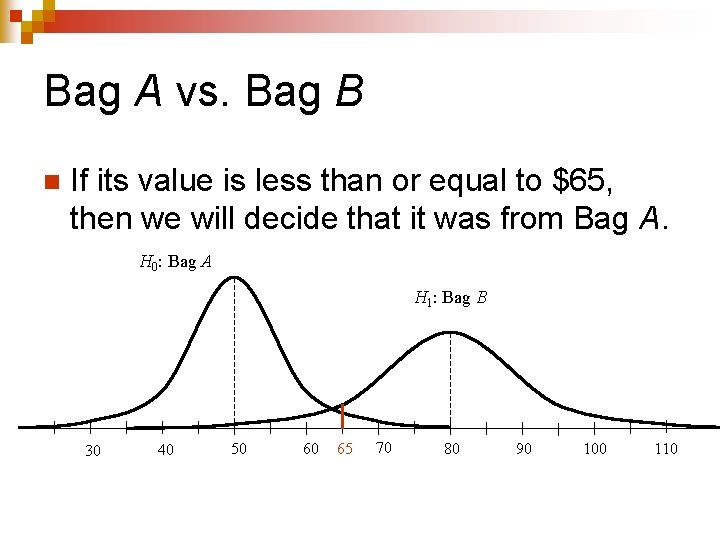
Bag A vs. Bag B n If its value is less than or equal to $65, then we will decide that it was from Bag A. H 0: Bag A H 1: Bag B 30 40 50 60 65 70 80 90 100 110
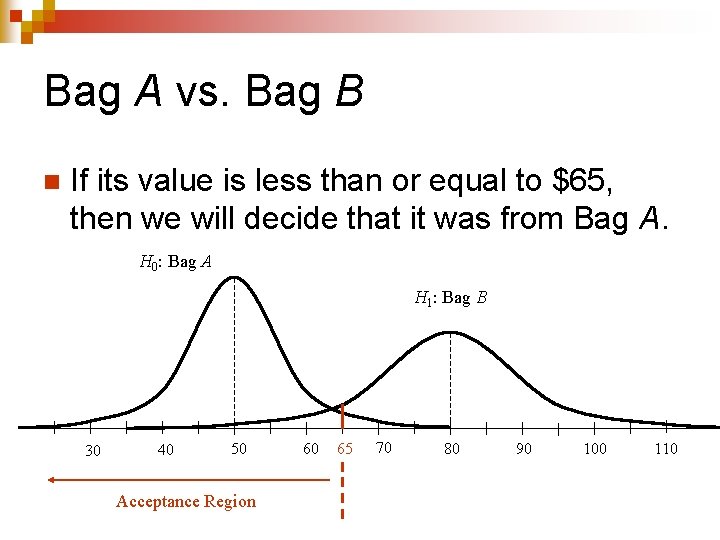
Bag A vs. Bag B n If its value is less than or equal to $65, then we will decide that it was from Bag A. H 0: Bag A H 1: Bag B 30 40 50 Acceptance Region 60 65 70 80 90 100 110
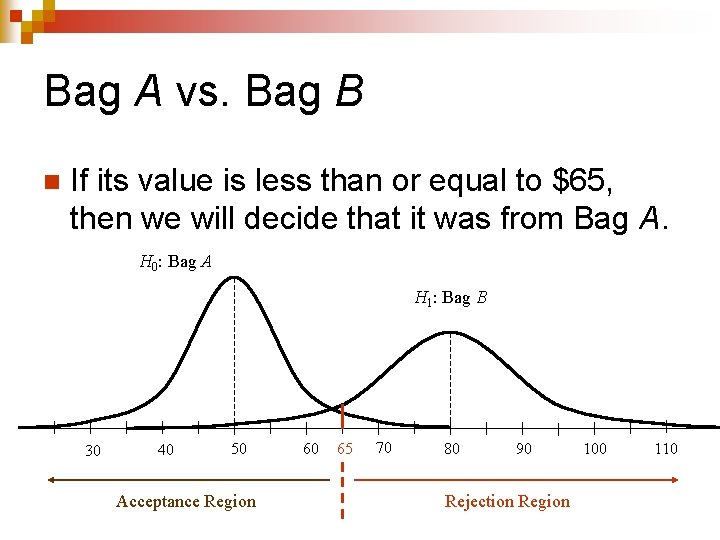
Bag A vs. Bag B n If its value is less than or equal to $65, then we will decide that it was from Bag A. H 0: Bag A H 1: Bag B 30 40 50 Acceptance Region 60 65 70 80 90 Rejection Region 100 110
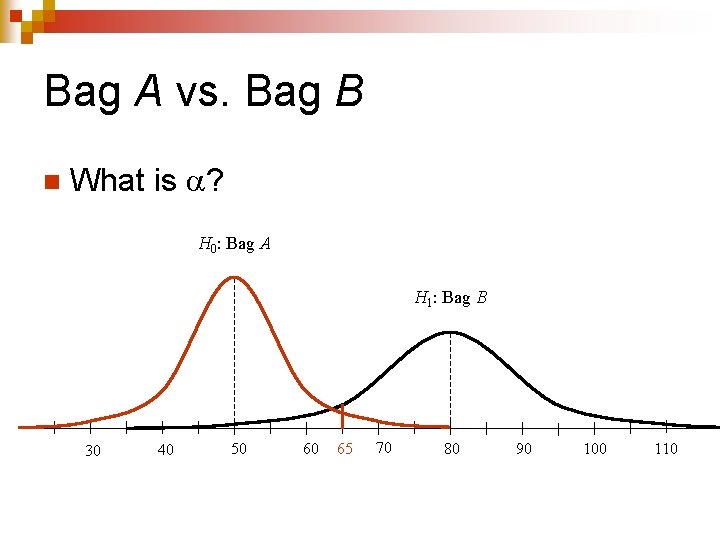
Bag A vs. Bag B n What is ? H 0: Bag A H 1: Bag B 30 40 50 60 65 70 80 90 100 110
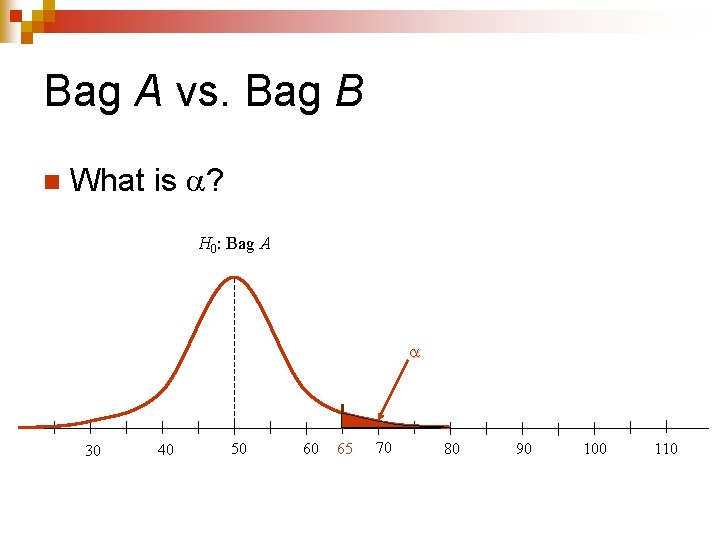
Bag A vs. Bag B n What is ? H 0: Bag A 30 40 50 60 65 70 80 90 100 110
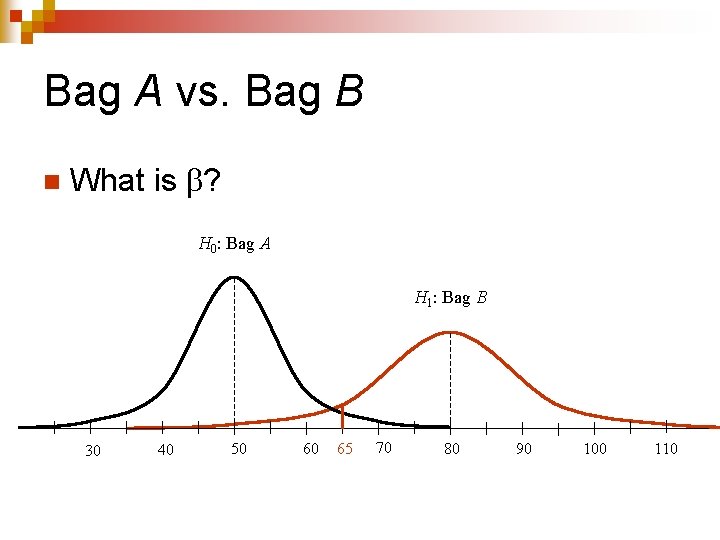
Bag A vs. Bag B n What is ? H 0: Bag A H 1: Bag B 30 40 50 60 65 70 80 90 100 110
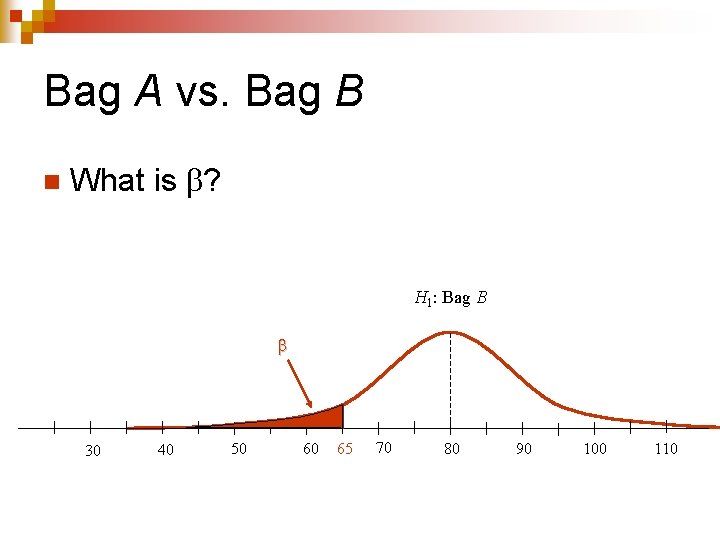
Bag A vs. Bag B n What is ? H 1: Bag B 30 40 50 60 65 70 80 90 100 110
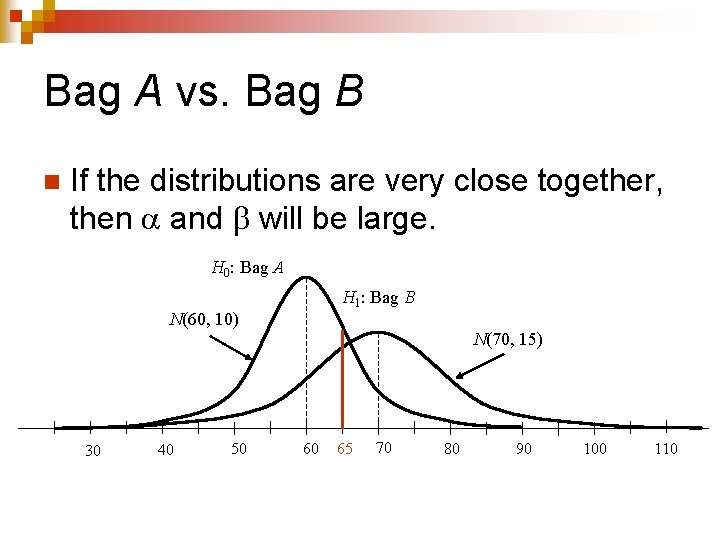
Bag A vs. Bag B n If the distributions are very close together, then and will be large. H 0: Bag A H 1: Bag B N(60, 10) N(70, 15) 30 40 50 60 65 70 80 90 100 110
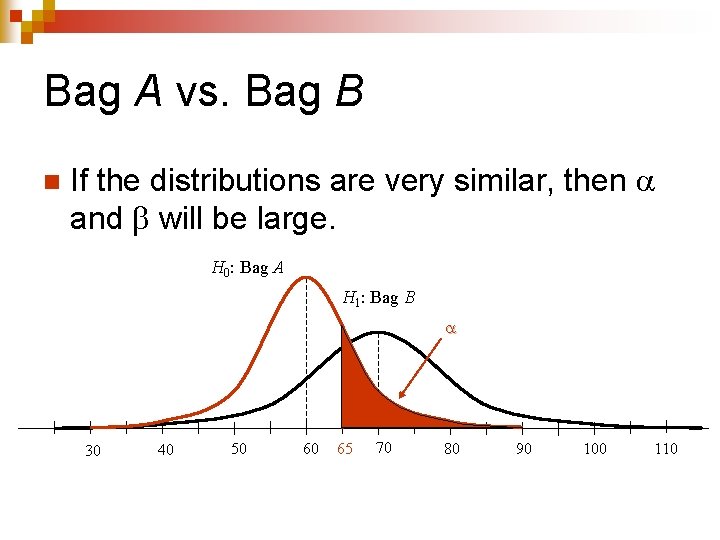
Bag A vs. Bag B n If the distributions are very similar, then and will be large. H 0: Bag A H 1: Bag B 30 40 50 60 65 70 80 90 100 110
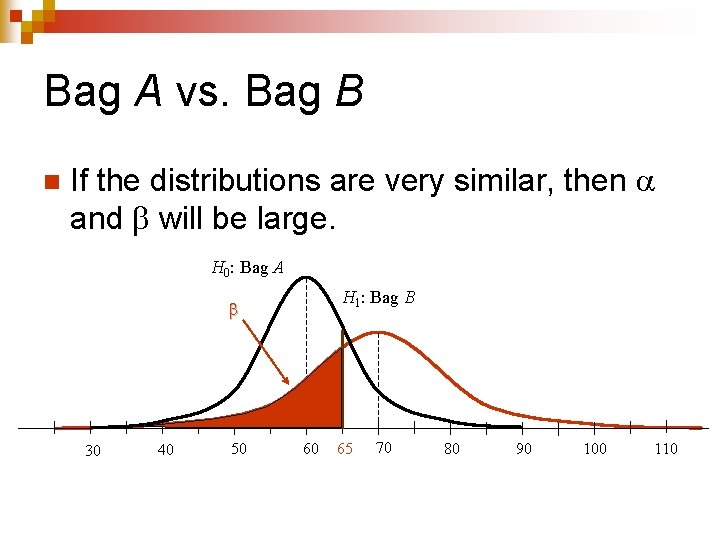
Bag A vs. Bag B n If the distributions are very similar, then and will be large. H 0: Bag A H 1: Bag B 30 40 50 60 65 70 80 90 100 110
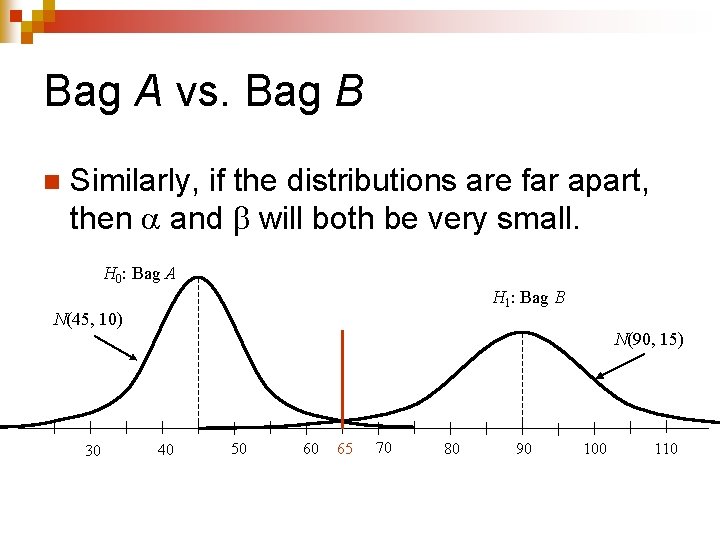
Bag A vs. Bag B n Similarly, if the distributions are far apart, then and will both be very small. H 0: Bag A H 1: Bag B N(45, 10) N(90, 15) 30 40 50 60 65 70 80 90 100 110
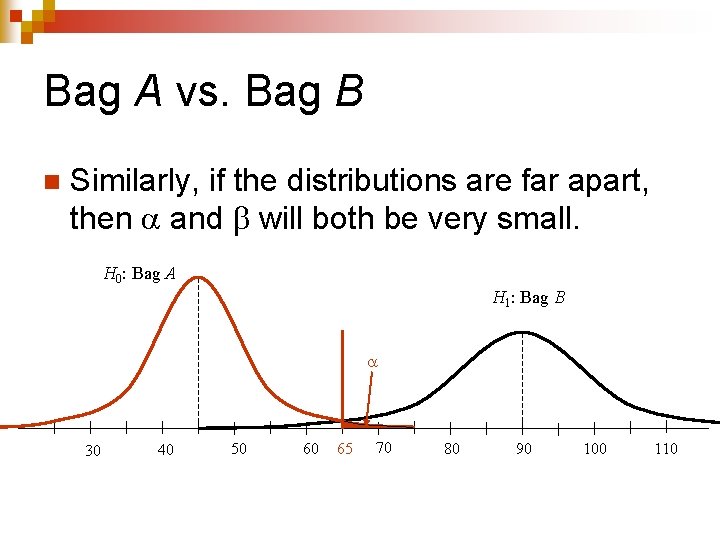
Bag A vs. Bag B n Similarly, if the distributions are far apart, then and will both be very small. H 0: Bag A H 1: Bag B 30 40 50 60 65 70 80 90 100 110
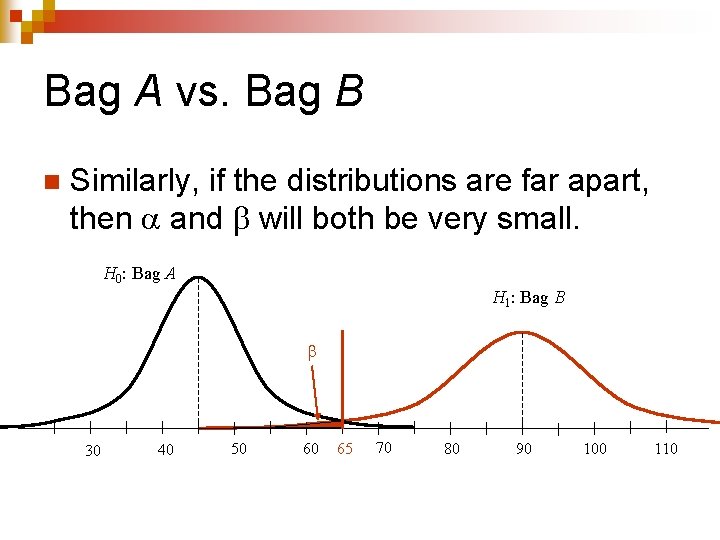
Bag A vs. Bag B n Similarly, if the distributions are far apart, then and will both be very small. H 0: Bag A H 1: Bag B 30 40 50 60 65 70 80 90 100 110
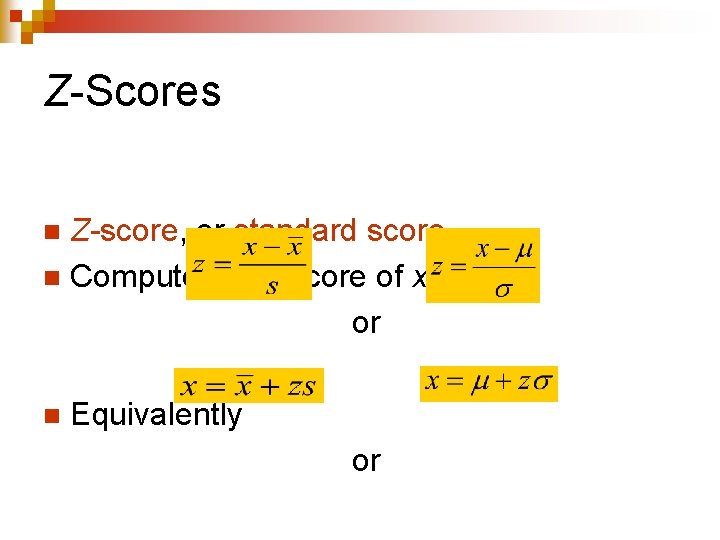
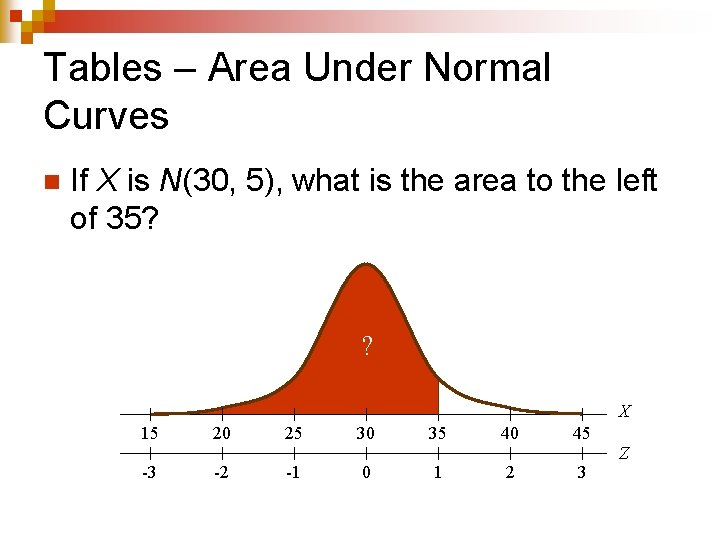
Z-Scores Z-score, or standard score n Compute the z-score of x as or n n Equivalently or
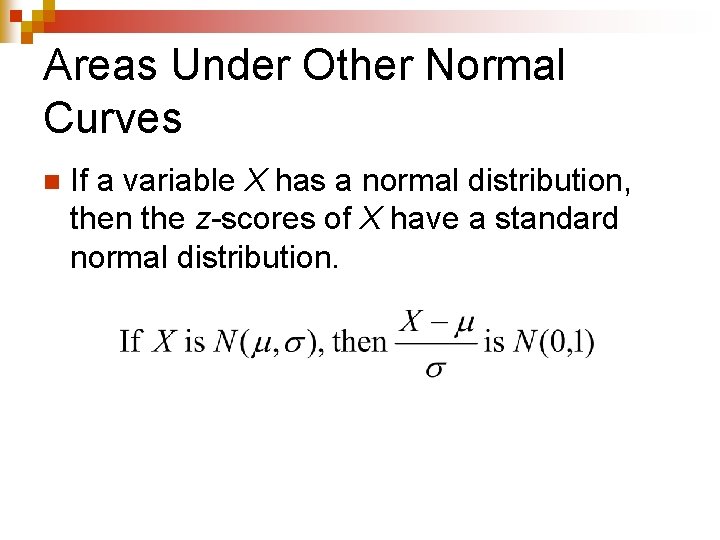
Areas Under Other Normal Curves n If a variable X has a normal distribution, then the z-scores of X have a standard normal distribution.
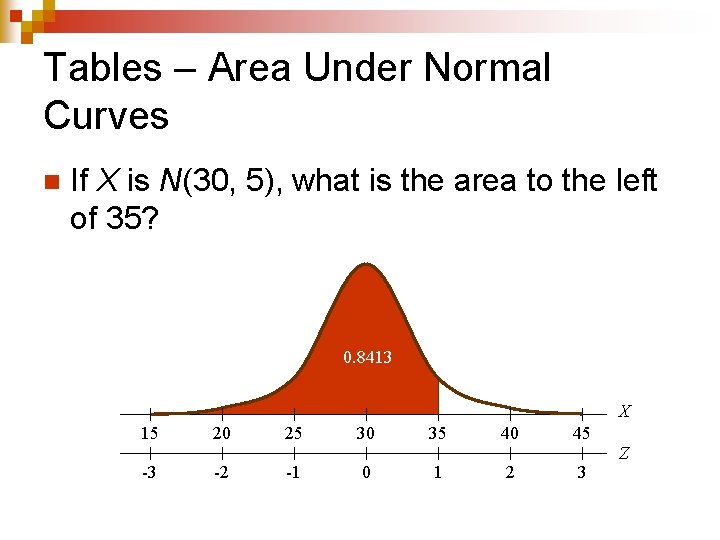
Example n n Let X be N(30, 5). What proportion of values of X are below 38? ¨ Compute z = (38 – 30)/5 = 8/5 = 1. 6. ¨ Find the area to the left of 1. 6 under the standard normal curve. ¨ Answer: 0. 9452. n Therefore, 94. 52% of the values of X are below 38.
Appendix – Using the Standard Normal Table
The Standard Normal Table See pages 406 – 407 or pages A-4 and A 5 in Appendix A. n The table is designed for the standard normal distribution. n The entries in the table are the areas to the left of the z-value. n
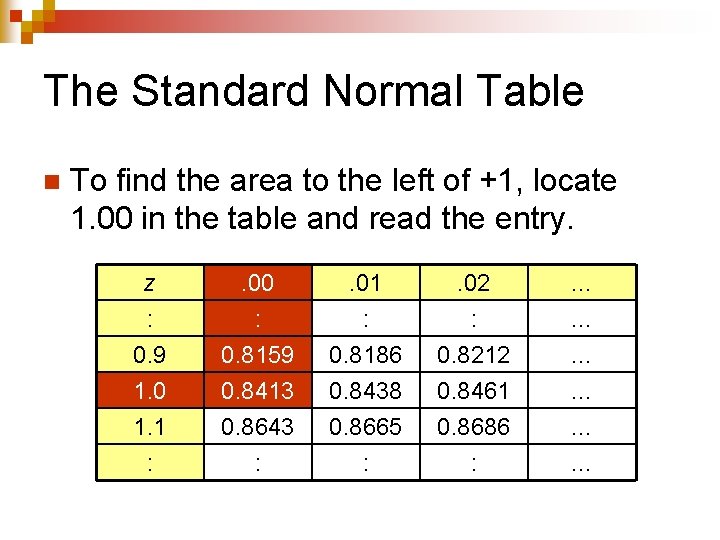
The Standard Normal Table n To find the area to the left of +1, locate 1. 00 in the table and read the entry. z : 0. 9 1. 0 . 00 : 0. 8159 0. 8413 . 01 : 0. 8186 0. 8438 . 02 : 0. 8212 0. 8461 … … 1. 1 : 0. 8643 : 0. 8665 : 0. 8686 : … …
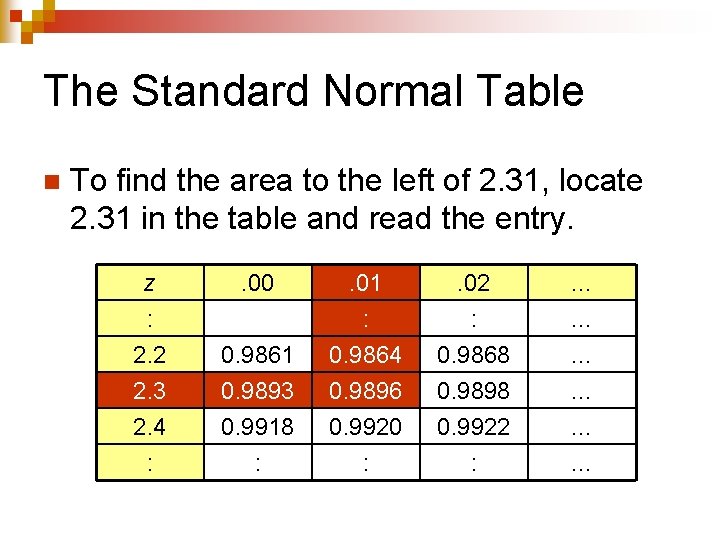
The Standard Normal Table n To find the area to the left of 2. 31, locate 2. 31 in the table and read the entry. z : 2. 2 2. 3 . 00 : 0. 9861 0. 9893 . 01 : 0. 9864 0. 9896 . 02 : 0. 9868 0. 9898 … … 2. 4 : 0. 9918 : 0. 9920 : 0. 9922 : … …
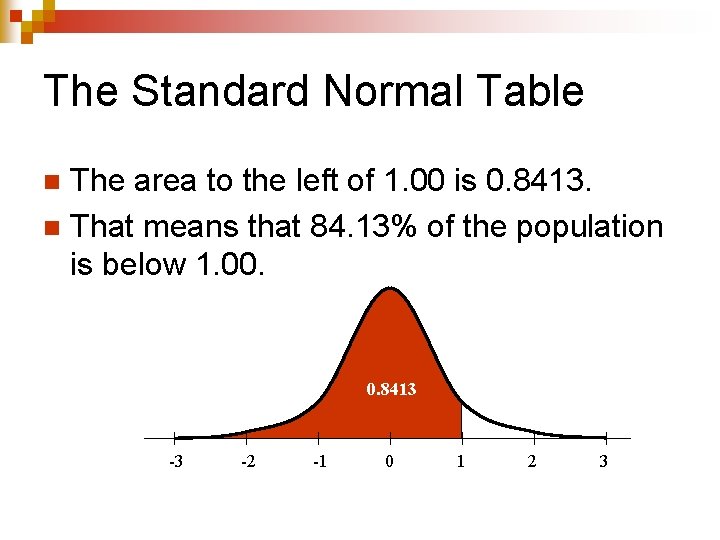
The Standard Normal Table The area to the left of 1. 00 is 0. 8413. n That means that 84. 13% of the population is below 1. 00. n 0. 8413 -3 -2 -1 0 1 2 3
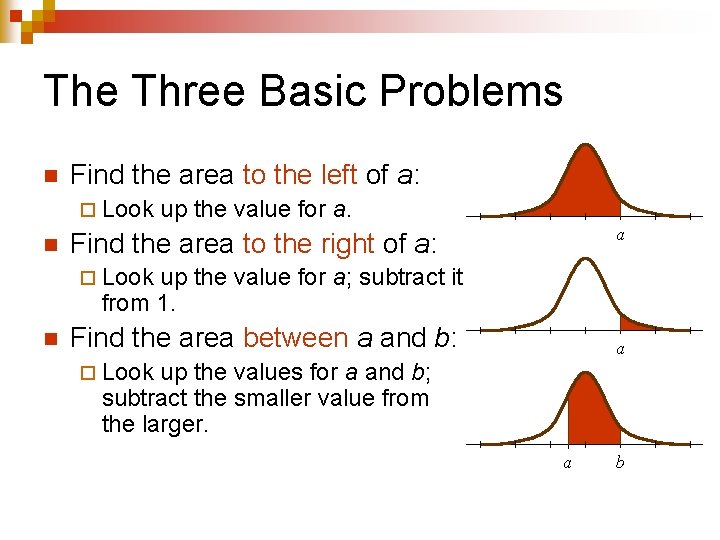
The Three Basic Problems n Find the area to the left of a: ¨ Look n up the value for a. a Find the area to the right of a: ¨ Look up the value for a; subtract it from 1. n Find the area between a and b: a ¨ Look up the values for a and b; subtract the smaller value from the larger. a b
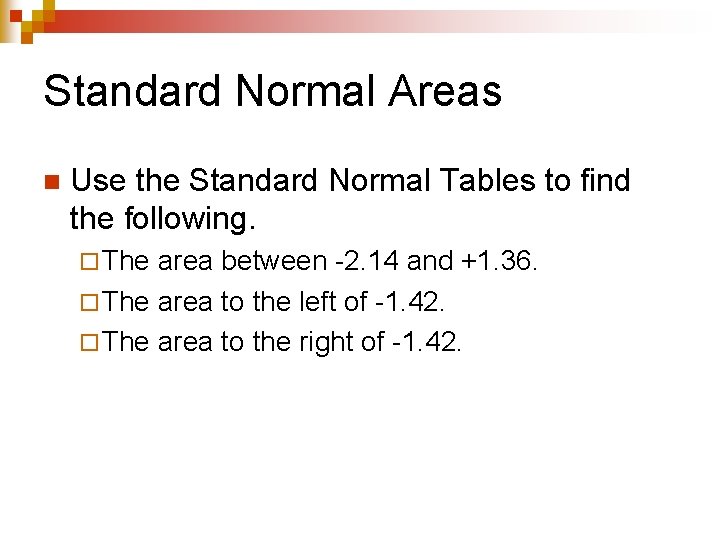
Standard Normal Areas n Use the Standard Normal Tables to find the following. ¨ The area between -2. 14 and +1. 36. ¨ The area to the left of -1. 42. ¨ The area to the right of -1. 42.
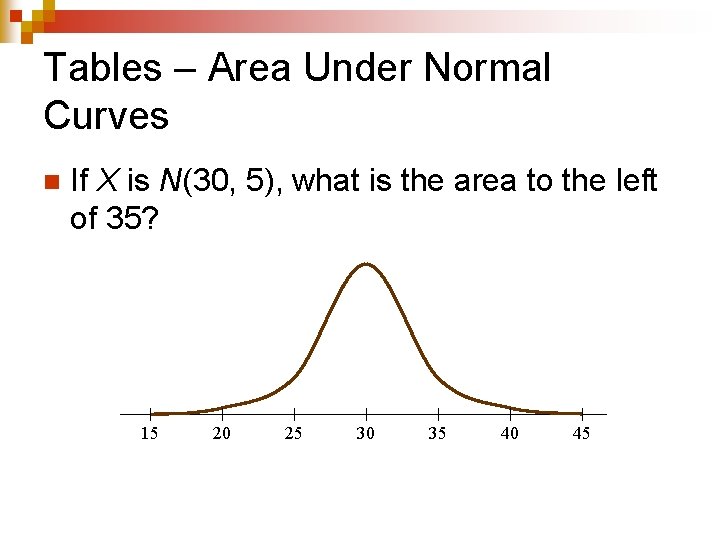
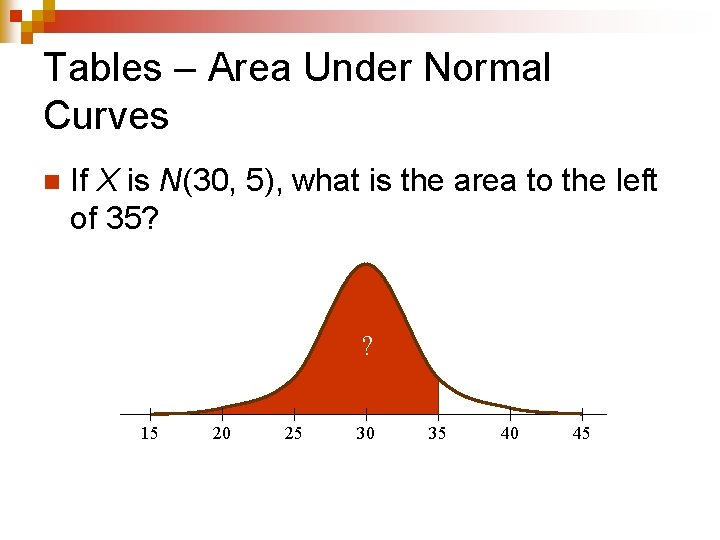
Tables – Area Under Normal Curves n If X is N(30, 5), what is the area to the left of 35? 15 20 25 30 35 40 45
Tables – Area Under Normal Curves n If X is N(30, 5), what is the area to the left of 35? 15 20 25 30 35 40 45
Tables – Area Under Normal Curves n If X is N(30, 5), what is the area to the left of 35? ? 15 20 25 30 35 40 45
Tables – Area Under Normal Curves n If X is N(30, 5), what is the area to the left of 35? ? X 15 -3 20 -2 25 -1 30 0 35 1 40 2 45 3 Z
Tables – Area Under Normal Curves n If X is N(30, 5), what is the area to the left of 35? 0. 8413 X 15 -3 20 -2 25 -1 30 0 35 1 40 2 45 3 Z
- Slides: 49