
The Normal Curve Z Scores Example Comparing 2




- Slides: 25
The Normal Curve & Z Scores
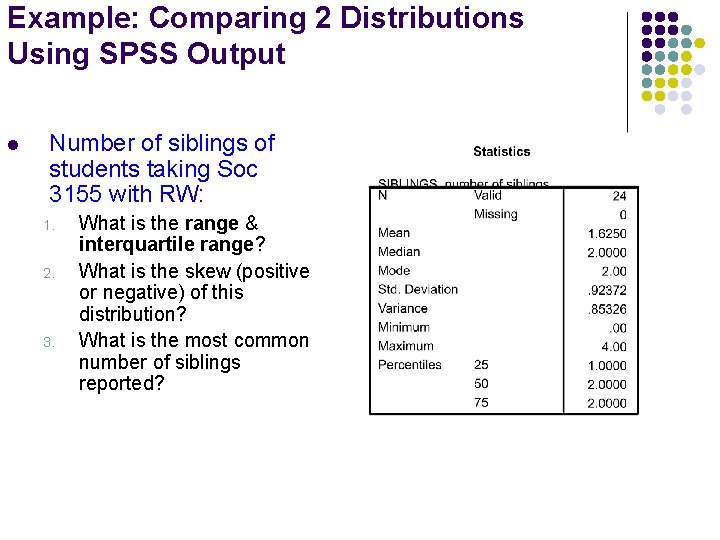
Example: Comparing 2 Distributions Using SPSS Output l Number of siblings of students taking Soc 3155 with RW: 1. 2. 3. What is the range & interquartile range? What is the skew (positive or negative) of this distribution? What is the most common number of siblings reported?
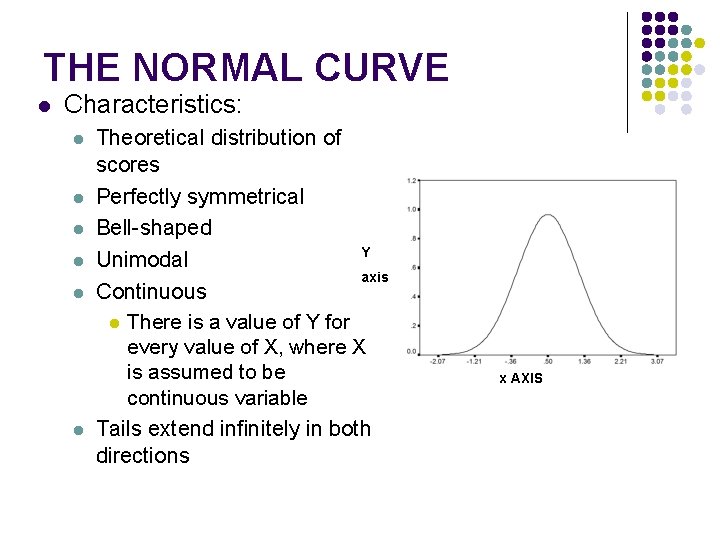
THE NORMAL CURVE l Characteristics: l l l Theoretical distribution of scores Perfectly symmetrical Bell-shaped Y Unimodal axis Continuous l There is a value of Y for every value of X, where X is assumed to be continuous variable Tails extend infinitely in both directions x AXIS
THE NORMAL CURVE l Assumption of normality of a given empirical distribution makes it possible to describe this “real-world” distribution based on what we know about the (theoretical) normal curve
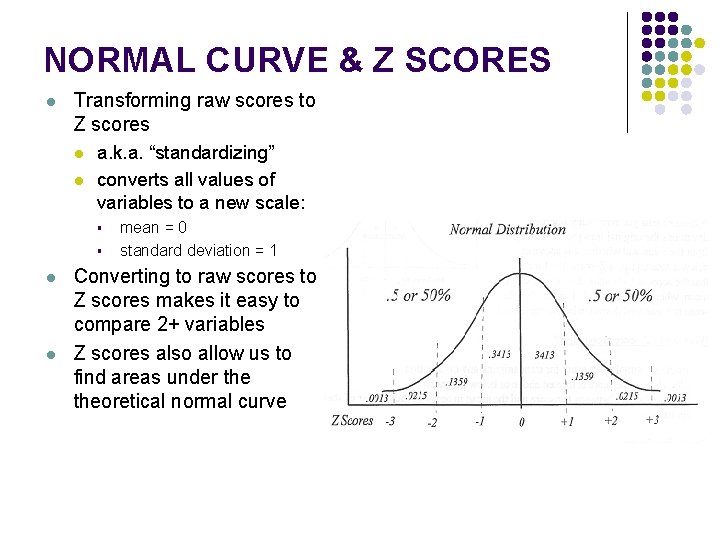
THE NORMAL CURVE l Properties: l 68% of area under the curve (and thus cases) fall within 1 standard deviation (s) of the mean l 95% of cases fall within 2 s’s l 99% of cases fall within 3 s’s
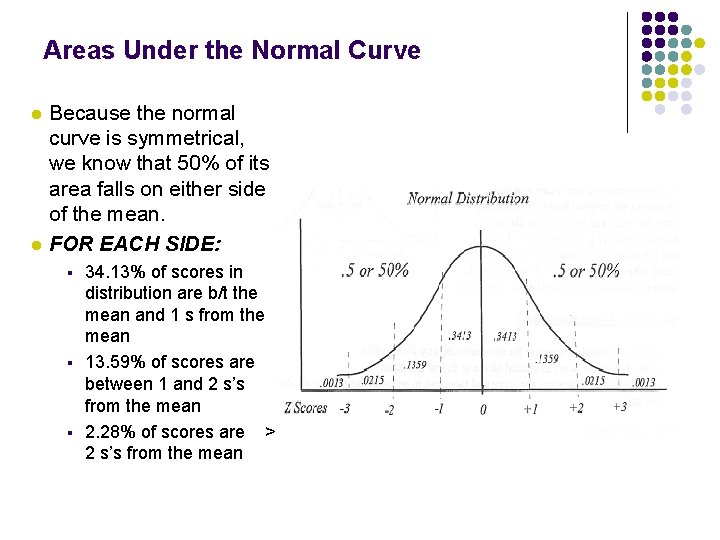
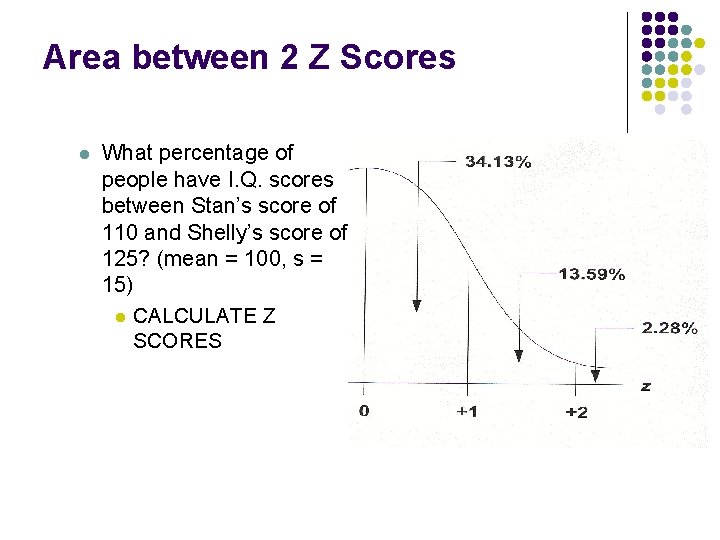
Areas Under the Normal Curve l l Because the normal curve is symmetrical, we know that 50% of its area falls on either side of the mean. FOR EACH SIDE: § § § 34. 13% of scores in distribution are b/t the mean and 1 s from the mean 13. 59% of scores are between 1 and 2 s’s from the mean 2. 28% of scores are > 2 s’s from the mean
THE NORMAL CURVE l Example: l Male height = normally distributed, mean = 70 inches, s = 4 inches l What is the range of heights that encompasses 99% of the population? § l l Hint: that’s +/- 3 standard deviations Answer: 70 +/- (3)(4) = 70 +/- 12 Range = 58 to 82
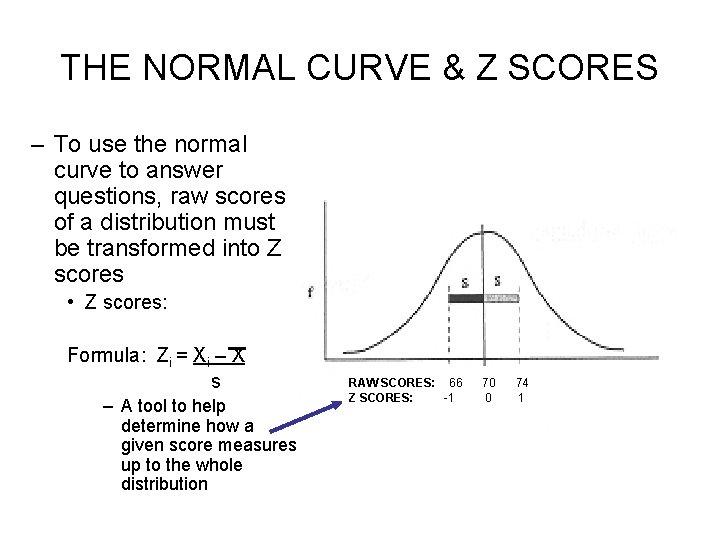
THE NORMAL CURVE & Z SCORES – To use the normal curve to answer questions, raw scores of a distribution must be transformed into Z scores • Z scores: Formula: Zi = Xi – X s – A tool to help determine how a given score measures up to the whole distribution RAW SCORES: 66 Z SCORES: -1 70 0 74 1
NORMAL CURVE & Z SCORES l Transforming raw scores to Z scores l l a. k. a. “standardizing” converts all values of variables to a new scale: § § l l mean = 0 standard deviation = 1 Converting to raw scores to Z scores makes it easy to compare 2+ variables Z scores also allow us to find areas under theoretical normal curve
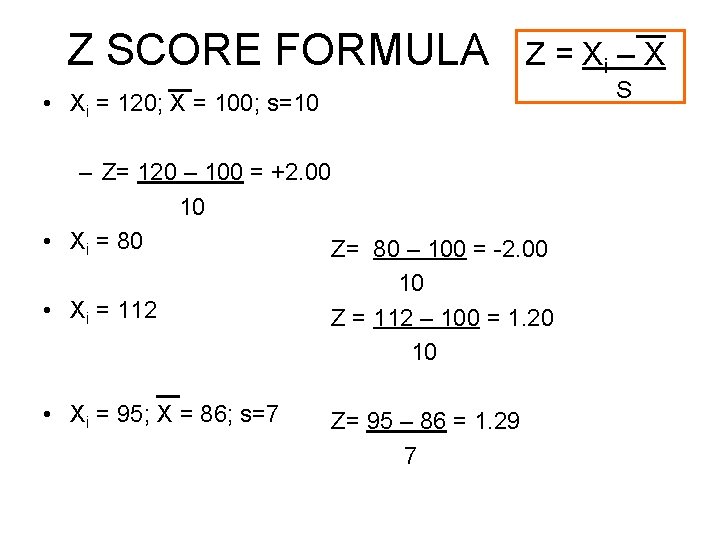
Z SCORE FORMULA Z = Xi – X S • Xi = 120; X = 100; s=10 – Z= 120 – 100 = +2. 00 10 • Xi = 80 Z= 80 – 100 = -2. 00 10 • Xi = 112 Z = 112 – 100 = 1. 20 10 • Xi = 95; X = 86; s=7 Z= 95 – 86 = 1. 29 7
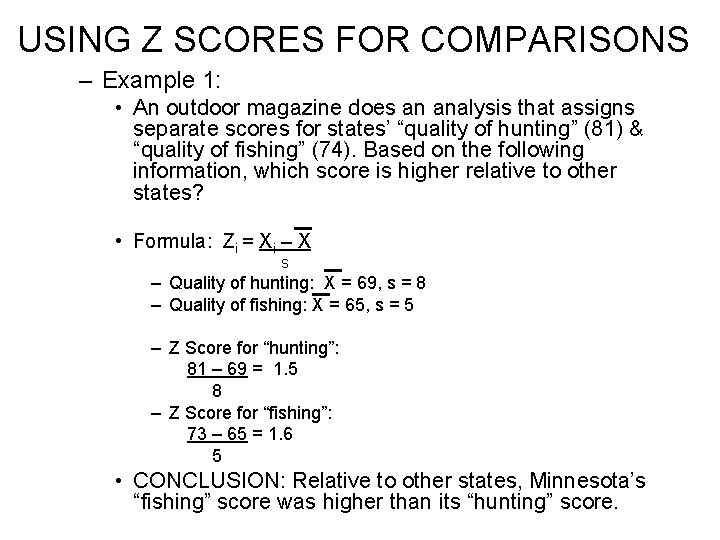
USING Z SCORES FOR COMPARISONS – Example 1: • An outdoor magazine does an analysis that assigns separate scores for states’ “quality of hunting” (81) & “quality of fishing” (74). Based on the following information, which score is higher relative to other states? • Formula: Zi = Xi – X s – Quality of hunting: X = 69, s = 8 – Quality of fishing: X = 65, s = 5 – Z Score for “hunting”: 81 – 69 = 1. 5 8 – Z Score for “fishing”: 73 – 65 = 1. 6 5 • CONCLUSION: Relative to other states, Minnesota’s “fishing” score was higher than its “hunting” score.
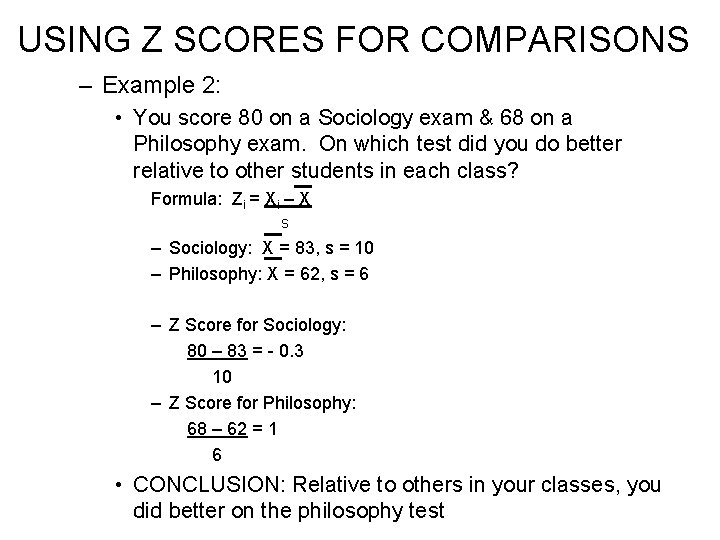
USING Z SCORES FOR COMPARISONS – Example 2: • You score 80 on a Sociology exam & 68 on a Philosophy exam. On which test did you do better relative to other students in each class? Formula: Zi = Xi – X s – Sociology: X = 83, s = 10 – Philosophy: X = 62, s = 6 – Z Score for Sociology: 80 – 83 = - 0. 3 10 – Z Score for Philosophy: 68 – 62 = 1 6 • CONCLUSION: Relative to others in your classes, you did better on the philosophy test
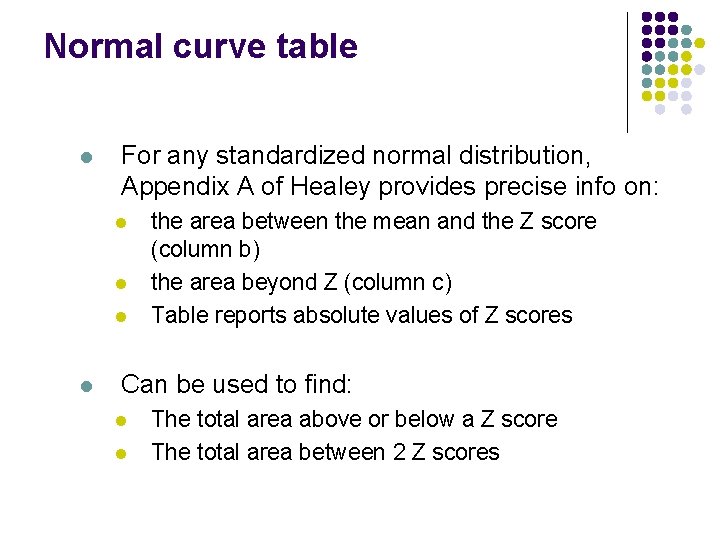
Normal curve table l For any standardized normal distribution, Appendix A of Healey provides precise info on: l l the area between the mean and the Z score (column b) the area beyond Z (column c) Table reports absolute values of Z scores Can be used to find: l l The total area above or below a Z score The total area between 2 Z scores
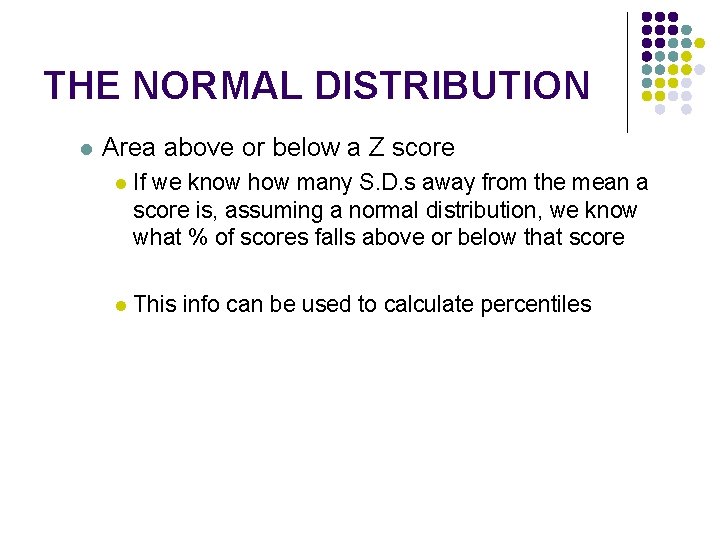
THE NORMAL DISTRIBUTION l Area above or below a Z score l If we know how many S. D. s away from the mean a score is, assuming a normal distribution, we know what % of scores falls above or below that score l This info can be used to calculate percentiles
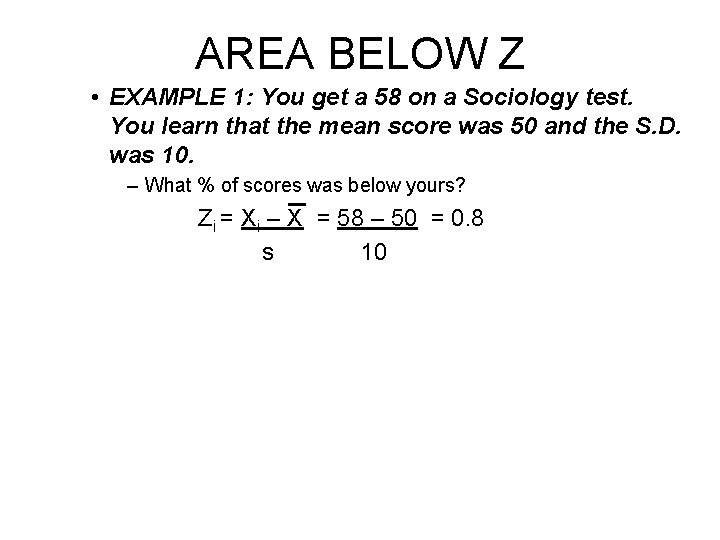
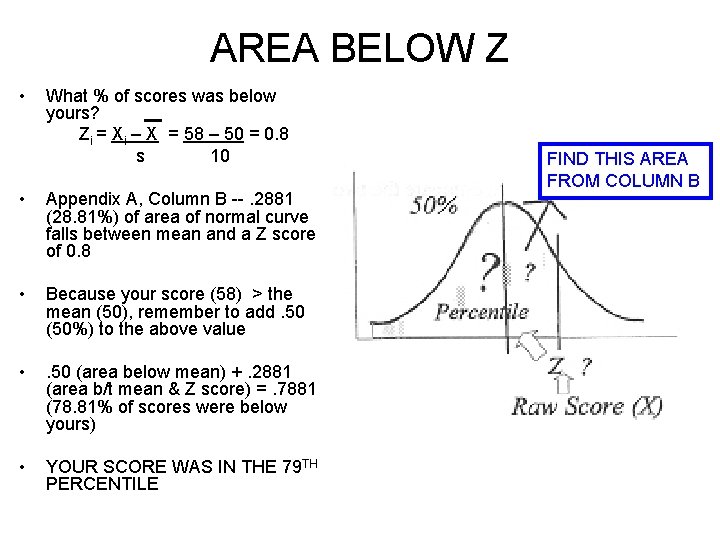
AREA BELOW Z • EXAMPLE 1: You get a 58 on a Sociology test. You learn that the mean score was 50 and the S. D. was 10. – What % of scores was below yours? Zi = Xi – X = 58 – 50 = 0. 8 s 10
AREA BELOW Z • What % of scores was below yours? Zi = Xi – X = 58 – 50 = 0. 8 s 10 • Appendix A, Column B --. 2881 (28. 81%) of area of normal curve falls between mean and a Z score of 0. 8 • Because your score (58) > the mean (50), remember to add. 50 (50%) to the above value • . 50 (area below mean) +. 2881 (area b/t mean & Z score) =. 7881 (78. 81% of scores were below yours) • YOUR SCORE WAS IN THE 79 TH PERCENTILE FIND THIS AREA FROM COLUMN B
AREA BELOW Z – Example 2: – Your friend gets a 44 (mean = 50 & s=10) on the same test – What % of scores was below his? Zi = Xi – X = 44 – 50 = - 0. 6 s 10
AREA BELOW Z • What % of scores was below his? Z = Xi – X = 44 – 50= -0. 6 s 10 • Appendix A, Column C -. 2743 (27. 43%) of area of normal curve is under a Z score of -0. 6 • . 2743 (area beyond [below] his Z score) 27. 43% of scores were below his • YOUR FRIEND’S SCORE WAS IN THE 27 TH PERCENTILE FIND THIS AREA FROM COLUMN C
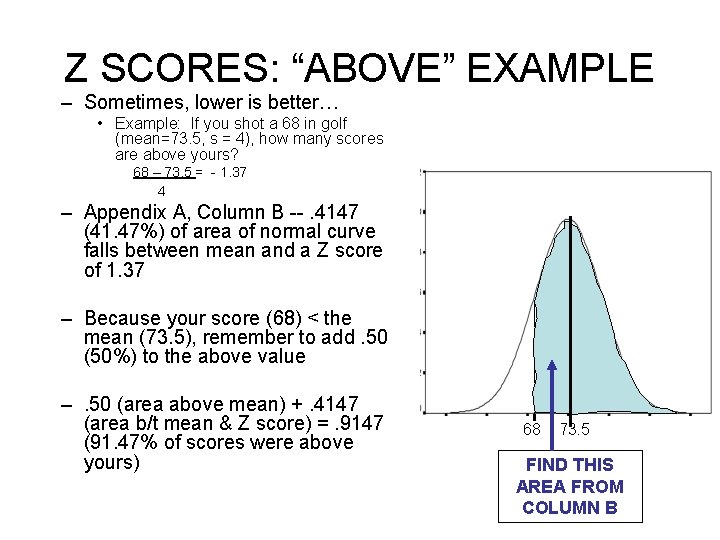
Z SCORES: “ABOVE” EXAMPLE – Sometimes, lower is better… • Example: If you shot a 68 in golf (mean=73. 5, s = 4), how many scores are above yours? 68 – 73. 5 = - 1. 37 4 – Appendix A, Column B --. 4147 (41. 47%) of area of normal curve falls between mean and a Z score of 1. 37 – Because your score (68) < the mean (73. 5), remember to add. 50 (50%) to the above value –. 50 (area above mean) +. 4147 (area b/t mean & Z score) =. 9147 (91. 47% of scores were above yours) 68 73. 5 FIND THIS AREA FROM COLUMN B
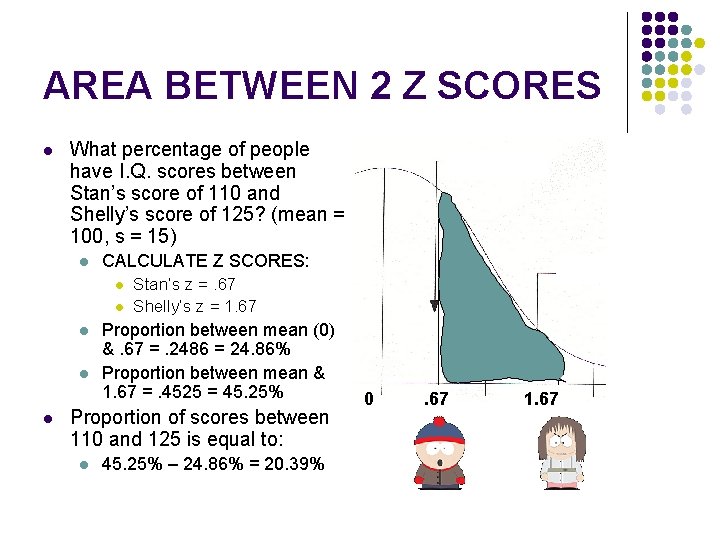
Area between 2 Z Scores l What percentage of people have I. Q. scores between Stan’s score of 110 and Shelly’s score of 125? (mean = 100, s = 15) l CALCULATE Z SCORES
AREA BETWEEN 2 Z SCORES l What percentage of people have I. Q. scores between Stan’s score of 110 and Shelly’s score of 125? (mean = 100, s = 15) l CALCULATE Z SCORES: l l l Stan’s z =. 67 Shelly’s z = 1. 67 Proportion between mean (0) &. 67 =. 2486 = 24. 86% Proportion between mean & 1. 67 =. 4525 = 45. 25% Proportion of scores between 110 and 125 is equal to: l 45. 25% – 24. 86% = 20. 39% 0 . 67 1. 67
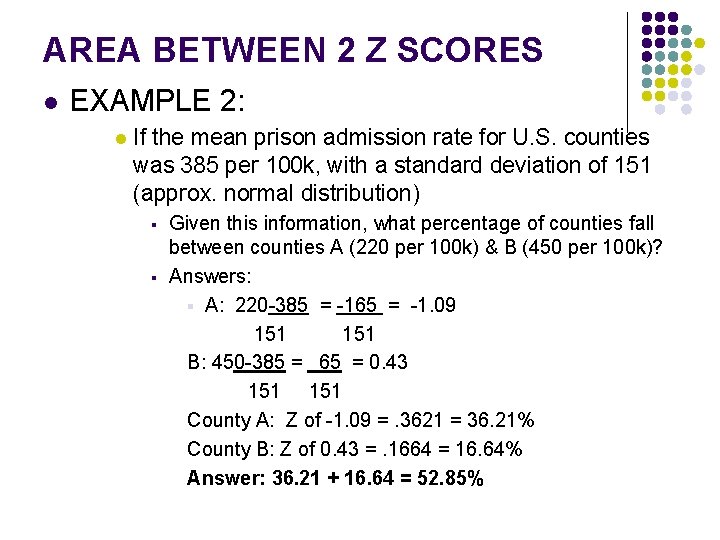
AREA BETWEEN 2 Z SCORES l EXAMPLE 2: l If the mean prison admission rate for U. S. counties was 385 per 100 k, with a standard deviation of 151 (approx. normal distribution) § § Given this information, what percentage of counties fall between counties A (220 per 100 k) & B (450 per 100 k)? Answers: § A: 220 -385 = -165 = -1. 09 151 B: 450 -385 = 65 = 0. 43 151 County A: Z of -1. 09 =. 3621 = 36. 21% County B: Z of 0. 43 =. 1664 = 16. 64% Answer: 36. 21 + 16. 64 = 52. 85%
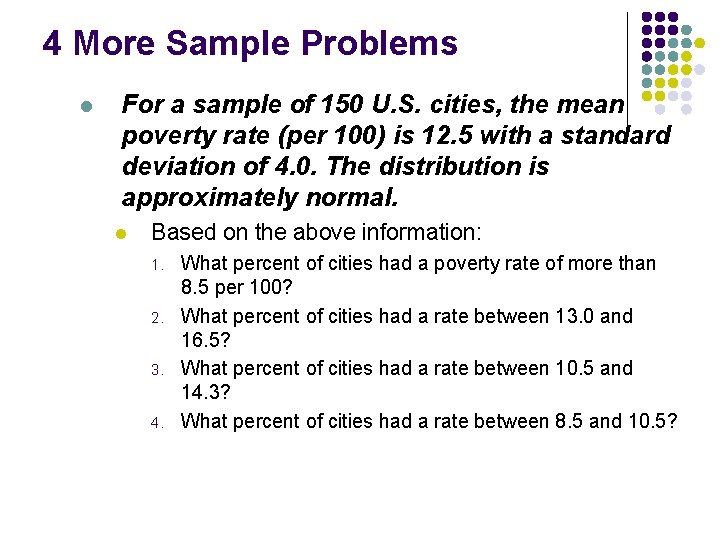
4 More Sample Problems l For a sample of 150 U. S. cities, the mean poverty rate (per 100) is 12. 5 with a standard deviation of 4. 0. The distribution is approximately normal. l Based on the above information: 1. 2. 3. 4. What percent of cities had a poverty rate of more than 8. 5 per 100? What percent of cities had a rate between 13. 0 and 16. 5? What percent of cities had a rate between 10. 5 and 14. 3? What percent of cities had a rate between 8. 5 and 10. 5?
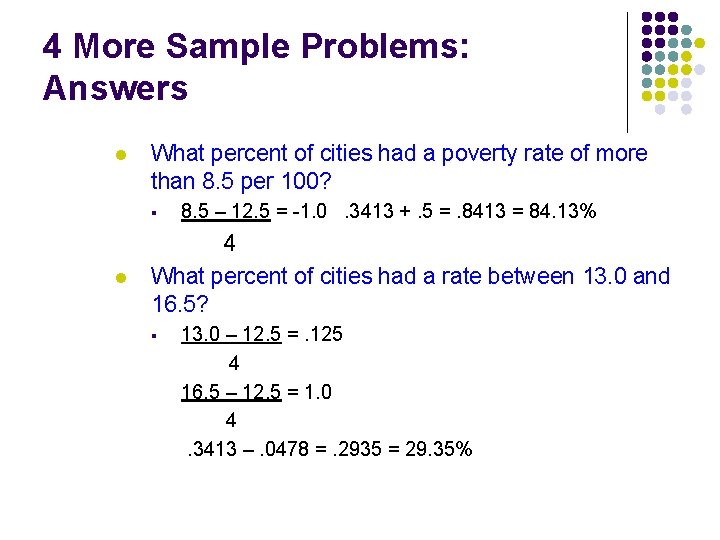
4 More Sample Problems: Answers l What percent of cities had a poverty rate of more than 8. 5 per 100? § l 8. 5 – 12. 5 = -1. 0. 3413 +. 5 =. 8413 = 84. 13% 4 What percent of cities had a rate between 13. 0 and 16. 5? § 13. 0 – 12. 5 =. 125 4 16. 5 – 12. 5 = 1. 0 4. 3413 –. 0478 =. 2935 = 29. 35%
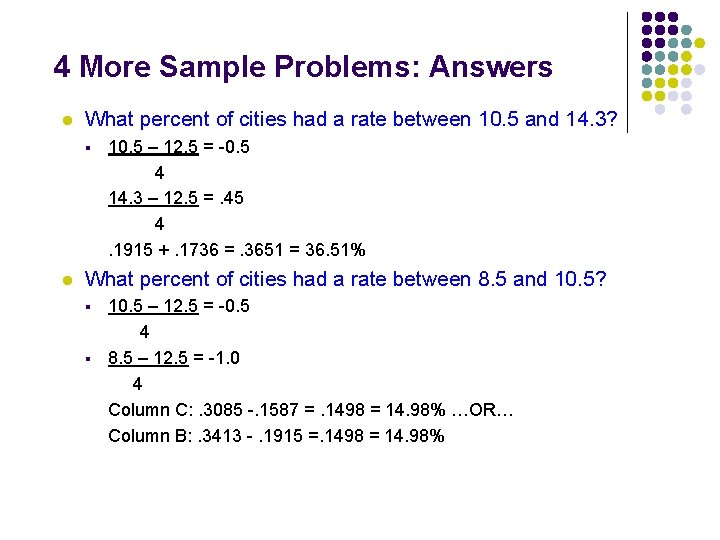
4 More Sample Problems: Answers l What percent of cities had a rate between 10. 5 and 14. 3? § l 10. 5 – 12. 5 = -0. 5 4 14. 3 – 12. 5 =. 45 4. 1915 +. 1736 =. 3651 = 36. 51% What percent of cities had a rate between 8. 5 and 10. 5? § § 10. 5 – 12. 5 = -0. 5 4 8. 5 – 12. 5 = -1. 0 4 Column C: . 3085 -. 1587 =. 1498 = 14. 98% …OR… Column B: . 3413 -. 1915 =. 1498 = 14. 98%