
The Nine Criteria for Developing a Compensation Plan
- Slides: 15
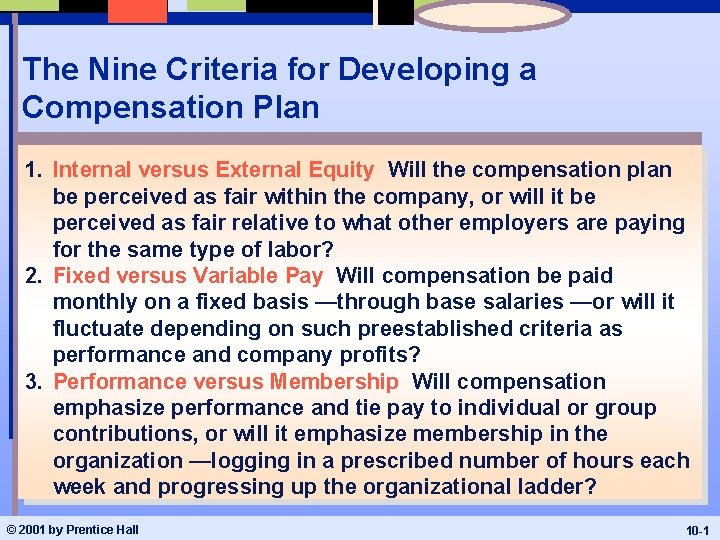
The Nine Criteria for Developing a Compensation Plan 1. Internal versus External Equity Will the compensation plan be perceived as fair within the company, or will it be perceived as fair relative to what other employers are paying for the same type of labor? 2. Fixed versus Variable Pay Will compensation be paid monthly on a fixed basis —through base salaries —or will it fluctuate depending on such preestablished criteria as performance and company profits? 3. Performance versus Membership Will compensation emphasize performance and tie pay to individual or group contributions, or will it emphasize membership in the organization —logging in a prescribed number of hours each week and progressing up the organizational ladder? © 2001 by Prentice Hall 10 -1
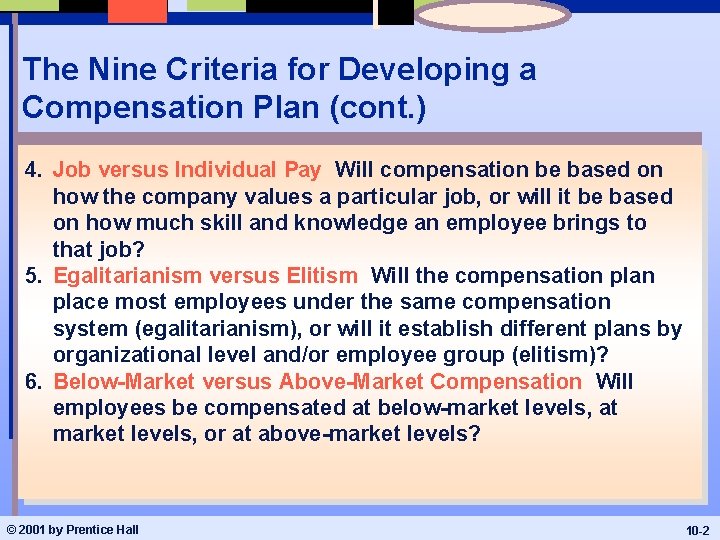
The Nine Criteria for Developing a Compensation Plan (cont. ) 4. Job versus Individual Pay Will compensation be based on how the company values a particular job, or will it be based on how much skill and knowledge an employee brings to that job? 5. Egalitarianism versus Elitism Will the compensation place most employees under the same compensation system (egalitarianism), or will it establish different plans by organizational level and/or employee group (elitism)? 6. Below-Market versus Above-Market Compensation Will employees be compensated at below-market levels, at market levels, or at above-market levels? © 2001 by Prentice Hall 10 -2
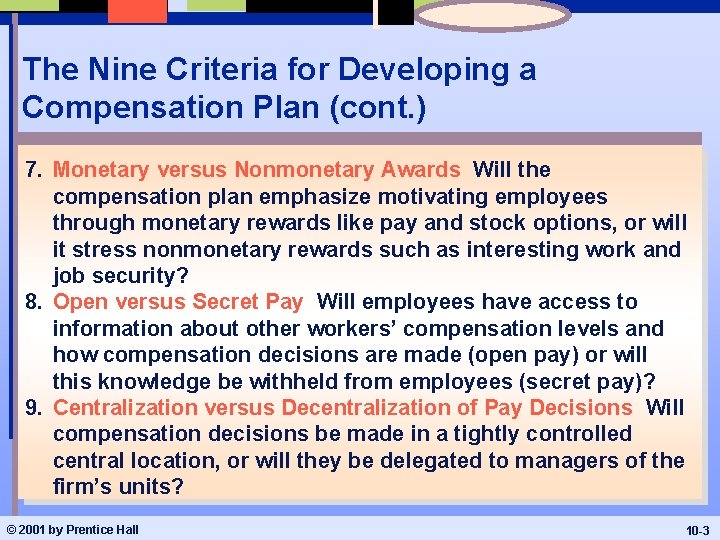
The Nine Criteria for Developing a Compensation Plan (cont. ) 7. Monetary versus Nonmonetary Awards Will the compensation plan emphasize motivating employees through monetary rewards like pay and stock options, or will it stress nonmonetary rewards such as interesting work and job security? 8. Open versus Secret Pay Will employees have access to information about other workers’ compensation levels and how compensation decisions are made (open pay) or will this knowledge be withheld from employees (secret pay)? 9. Centralization versus Decentralization of Pay Decisions Will compensation decisions be made in a tightly controlled central location, or will they be delegated to managers of the firm’s units? © 2001 by Prentice Hall 10 -3
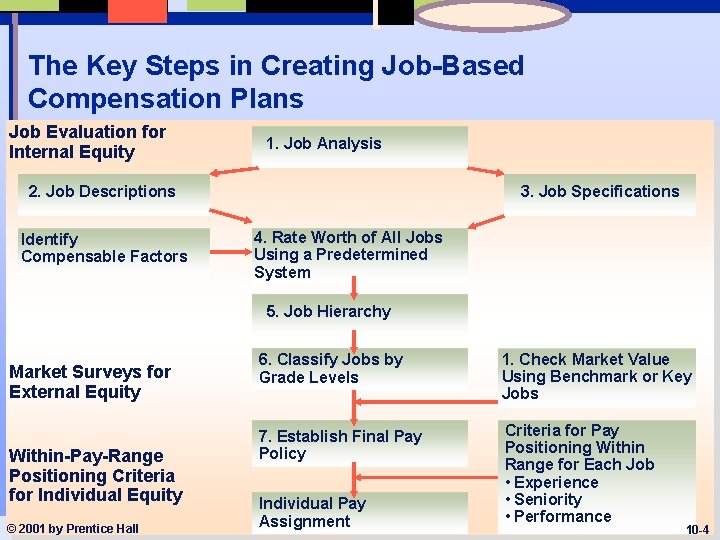
The Key Steps in Creating Job-Based Compensation Plans Job Evaluation for Internal Equity 1. Job Analysis 2. Job Descriptions Identify Compensable Factors 3. Job Specifications 4. Rate Worth of All Jobs Using a Predetermined System 5. Job Hierarchy Market Surveys for External Equity Within-Pay-Range Positioning Criteria for Individual Equity © 2001 by Prentice Hall 6. Classify Jobs by Grade Levels 1. Check Market Value Using Benchmark or Key Jobs 7. Establish Final Pay Policy Criteria for Pay Positioning Within Range for Each Job • Experience • Seniority • Performance © 1998 by Prentice Hall Individual Pay Assignment 10 -4
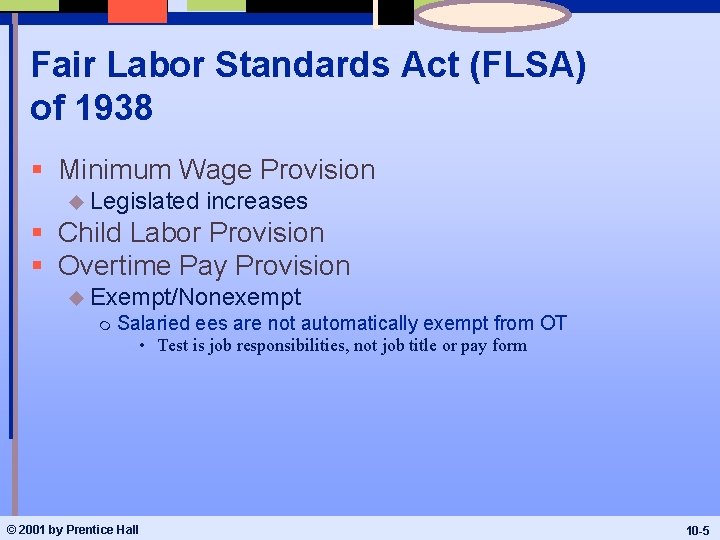
Fair Labor Standards Act (FLSA) of 1938 § Minimum Wage Provision u Legislated increases § Child Labor Provision § Overtime Pay Provision u Exempt/Nonexempt m Salaried ees are not automatically exempt from OT • Test is job responsibilities, not job title or pay form © 2001 by Prentice Hall 10 -5
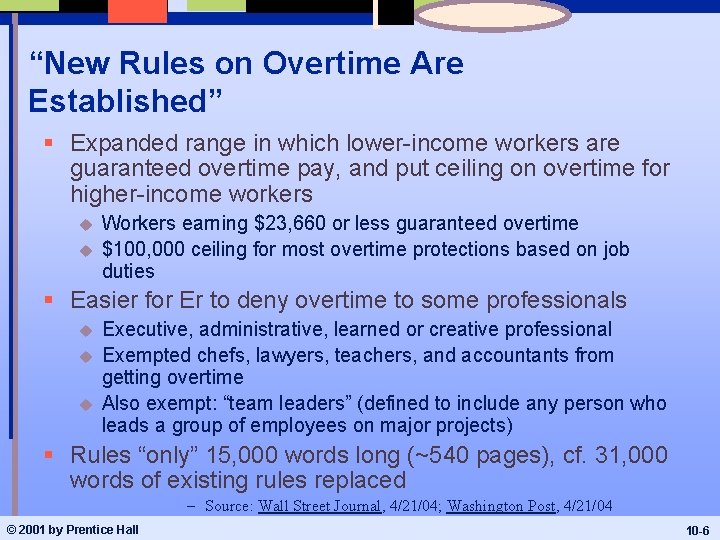
“New Rules on Overtime Are Established” § Expanded range in which lower-income workers are guaranteed overtime pay, and put ceiling on overtime for higher-income workers u u Workers earning $23, 660 or less guaranteed overtime $100, 000 ceiling for most overtime protections based on job duties § Easier for Er to deny overtime to some professionals u u u Executive, administrative, learned or creative professional Exempted chefs, lawyers, teachers, and accountants from getting overtime Also exempt: “team leaders” (defined to include any person who leads a group of employees on major projects) § Rules “only” 15, 000 words long (~540 pages), cf. 31, 000 words of existing rules replaced – Source: Wall Street Journal, 4/21/04; Washington Post, 4/21/04 © 2001 by Prentice Hall 10 -6
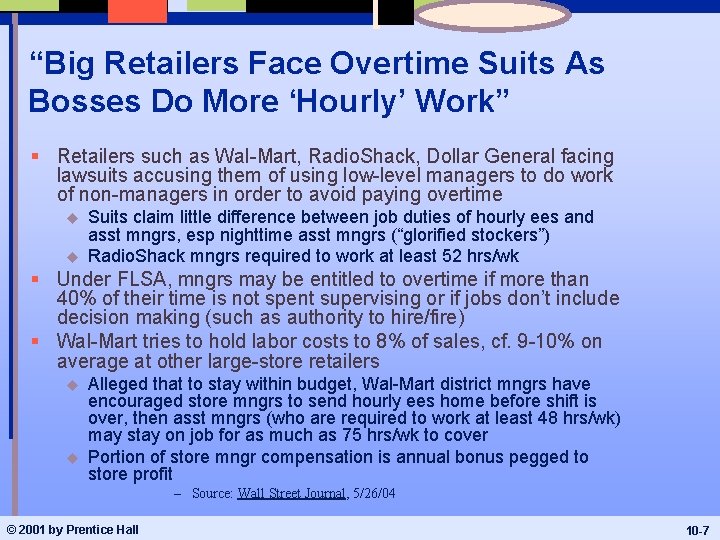
“Big Retailers Face Overtime Suits As Bosses Do More ‘Hourly’ Work” § Retailers such as Wal-Mart, Radio. Shack, Dollar General facing lawsuits accusing them of using low-level managers to do work of non-managers in order to avoid paying overtime u u Suits claim little difference between job duties of hourly ees and asst mngrs, esp nighttime asst mngrs (“glorified stockers”) Radio. Shack mngrs required to work at least 52 hrs/wk § Under FLSA, mngrs may be entitled to overtime if more than 40% of their time is not spent supervising or if jobs don’t include decision making (such as authority to hire/fire) § Wal-Mart tries to hold labor costs to 8% of sales, cf. 9 -10% on average at other large-store retailers u u Alleged that to stay within budget, Wal-Mart district mngrs have encouraged store mngrs to send hourly ees home before shift is over, then asst mngrs (who are required to work at least 48 hrs/wk) may stay on job for as much as 75 hrs/wk to cover Portion of store mngr compensation is annual bonus pegged to store profit – Source: Wall Street Journal, 5/26/04 © 2001 by Prentice Hall 10 -7
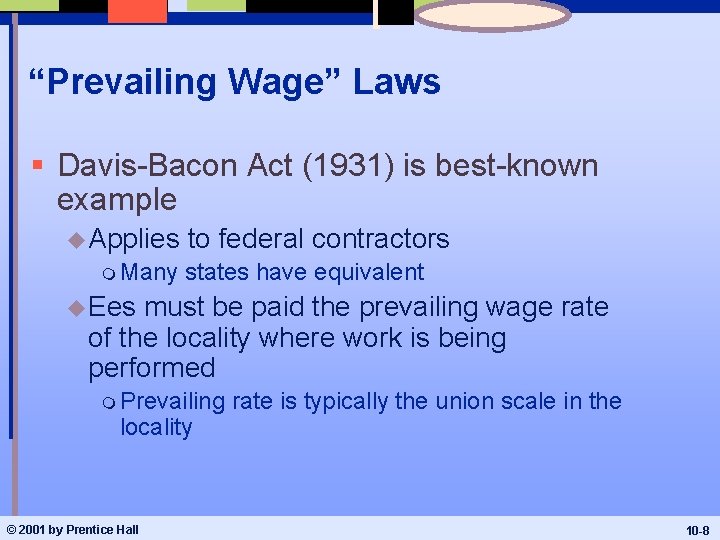
“Prevailing Wage” Laws § Davis-Bacon Act (1931) is best-known example u Applies m Many to federal contractors states have equivalent u Ees must be paid the prevailing wage rate of the locality where work is being performed m Prevailing locality © 2001 by Prentice Hall rate is typically the union scale in the 10 -8
Equal Pay Act of 1963 § Men and women in “substantially equal” jobs must receive equal pay § Allows pay differences based on u Seniority u Merit u Productivity u Any © 2001 by Prentice Hall factor other than gender 10 -9
Civil Rights Act of 1964, Title VII § Prohibits discrimination based on race, color, gender, religion, national origin u Market rates are defense to paying dissimilar jobs differently (unlike Equal Pay Act, and equal work) u Comparable worth Advocates that women performing jobs judged to be equal on some measure of worth should be paid the same as men m Not mandated by federal law m Some states, for public employees; Ontario, public and private m § Age Discrimination in Employment Act (1967) adds age as prohibited basis (40+) © 2001 by Prentice Hall 10 -10
The Earnings Gap § In 1960 FT-employed women earned 61% of pay of FT-employed men; in 2004, 76% u Differences m in Occupational Attainment Discrimination and gender stereotyping or choice? u Differences in Personal Work-Related Characteristics m Experience, seniority, education • The less education an ee has, the greater the gap – HS: male median $31. 2 k, female $19. 8 k u Differences in Industries and Firms u Differences in Union Membership © 2001 by Prentice Hall – Source: Milkovich and Newman (2005); Evansville Courier & Press, 9/5/05 10 -11
Assertiveness Gap? § Study of MBAs entering job market, interviewing for position paying $61 K u u 71% of male candidates believed they were better than other candidates, told hiring managers so, asked for more money 70% of female candidates believed themselves to be equal to other candidates, willing to accept offered salary § Men and women have different attitudes about competing and winning u u In research study involving computer maze, men performed 50% better when competing against others in group rather than when paid piece-rate In research study involving runners, boys ran faster if they ran against other boys, even faster if they ran against girls; girls ran at same speed either running alone or w/ competitor § Social risks: “Consistent assertiveness in a woman rankles people” § Men may be more comfortable with selling themselves than women – Source: Washington Post, 7/8/03 © 2001 by Prentice Hall 10 -12
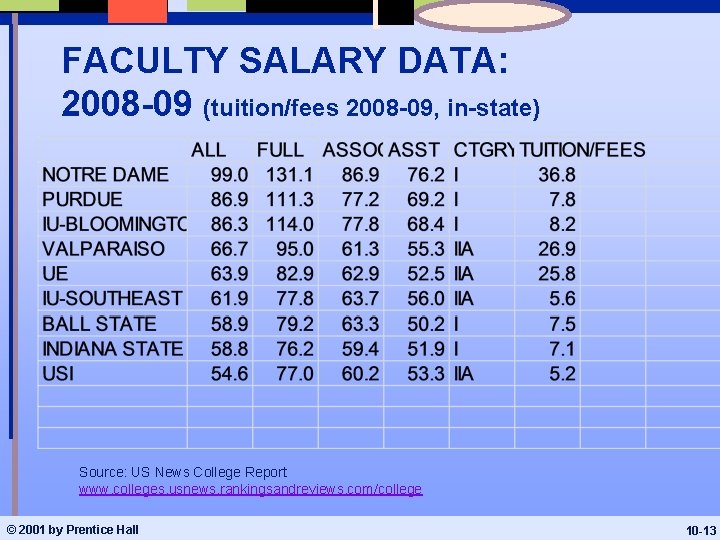
FACULTY SALARY DATA: 2008 -09 (tuition/fees 2008 -09, in-state) Source: US News College Report www. colleges. usnews. rankingsandreviews. com/college © 2001 by Prentice Hall 10 -13
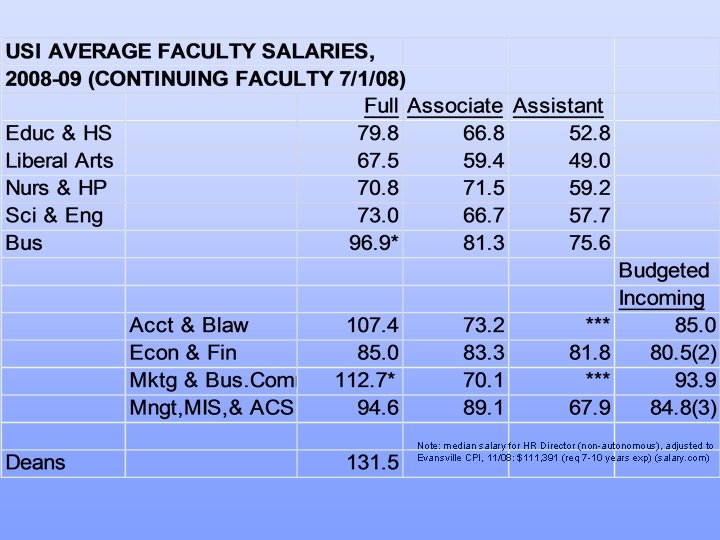
Note: median salary for HR Director (non-autonomous), adjusted to Evansville CPI, 11/08: $111, 391 (req 7 -10 years exp) (salary. com)
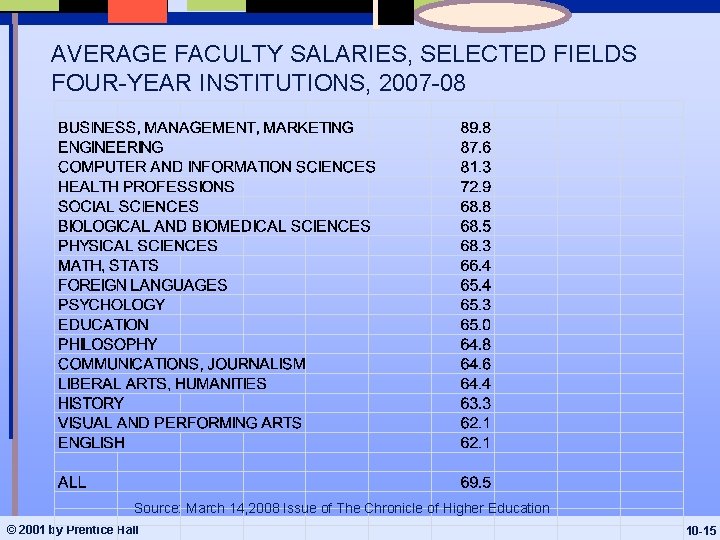
AVERAGE FACULTY SALARIES, SELECTED FIELDS FOUR-YEAR INSTITUTIONS, 2007 -08 Source: March 14, 2008 Issue of The Chronicle of Higher Education © 2001 by Prentice Hall 10 -15