
The NIDDK Central Repositories Beena Akolkar National Institute
The NIDDK Central Repositories Beena Akolkar National Institute of Diabetes, Digestive and Kidney Diseases, NIH
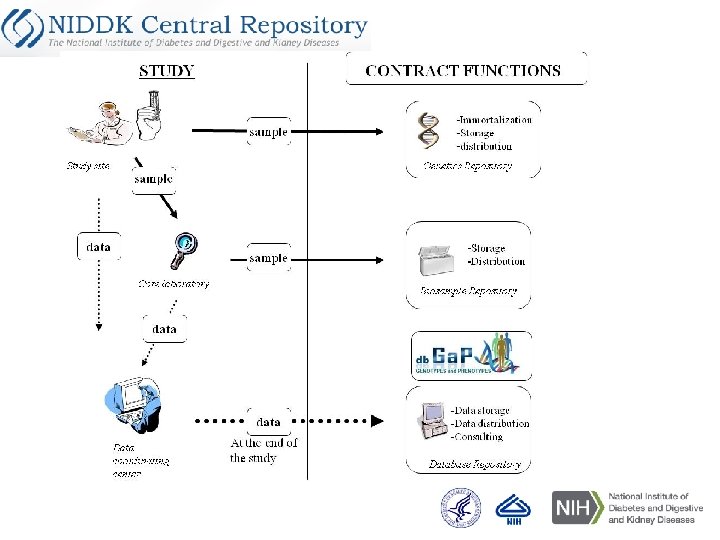
Central Repository Components Contract funded since 2003 Biosample repository (Fisher): Processing and archival storage of biological specimens Heather Higgins, Director Sandra Ke, Associate Director Database repository (IMS): Maintain archival datasets, Respond to queries about data and stored samples Carol Giffen, Director Leslie Carroll, Associate Director Genetics repository (Rutgers Univ. ): Create immortalized cell lines, extract DNA from certain samples, distribute cell lines and DNA Andy Brooks, Director Brad Scherer Dana Witt-Garbolino Jennifer Liu

Advantages of a Central Repository § Allow additional studies on characterized samples, enhancing the value of each study § Ensure uniform storage conditions § Simplify access by other scientists to samples § Cost effective, economy of scale in processing pediatric genetic samples to create cell lines § Maintain databases after the study ends or investigator leaves the institution § Curate databases to assure their integrity and validity § Facilitate data sharing and reproducibility studies
The NIDDK Central Repositories’ Holdings § >100 studies are storing samples and, eventually, data in the NIDDK repository § 60 studies have data available for sharing, some with multiple datasets § 44 studies have samples and data available § 45 GWAS datasets available for sharing through db. GAP
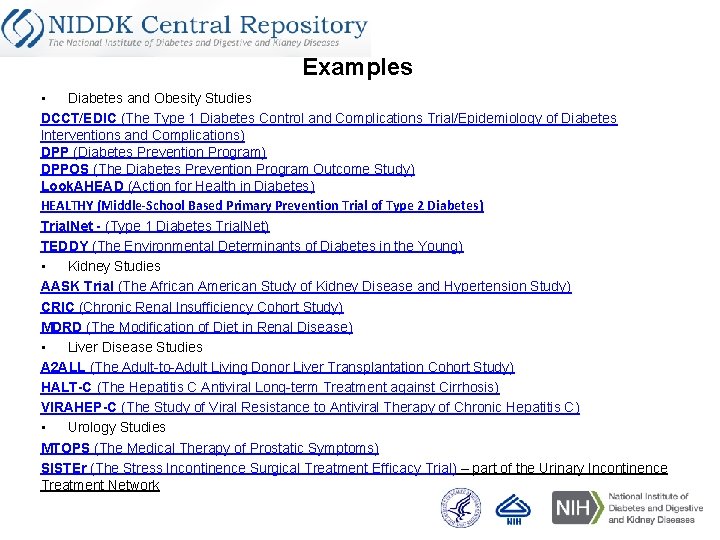
Examples • Diabetes and Obesity Studies DCCT/EDIC (The Type 1 Diabetes Control and Complications Trial/Epidemiology of Diabetes Interventions and Complications) DPP (Diabetes Prevention Program) DPPOS (The Diabetes Prevention Program Outcome Study) Look. AHEAD (Action for Health in Diabetes) HEALTHY (Middle-School Based Primary Prevention Trial of Type 2 Diabetes) Trial. Net - (Type 1 Diabetes Trial. Net) TEDDY (The Environmental Determinants of Diabetes in the Young) • Kidney Studies AASK Trial (The African American Study of Kidney Disease and Hypertension Study) CRIC (Chronic Renal Insufficiency Cohort Study) MDRD (The Modification of Diet in Renal Disease) • Liver Disease Studies A 2 ALL (The Adult-to-Adult Living Donor Liver Transplantation Cohort Study) HALT-C (The Hepatitis C Antiviral Long-term Treatment against Cirrhosis) VIRAHEP-C (The Study of Viral Resistance to Antiviral Therapy of Chronic Hepatitis C) • Urology Studies MTOPS (The Medical Therapy of Prostatic Symptoms) SISTEr (The Stress Incontinence Surgical Treatment Efficacy Trial) – part of the Urinary Incontinence Treatment Network
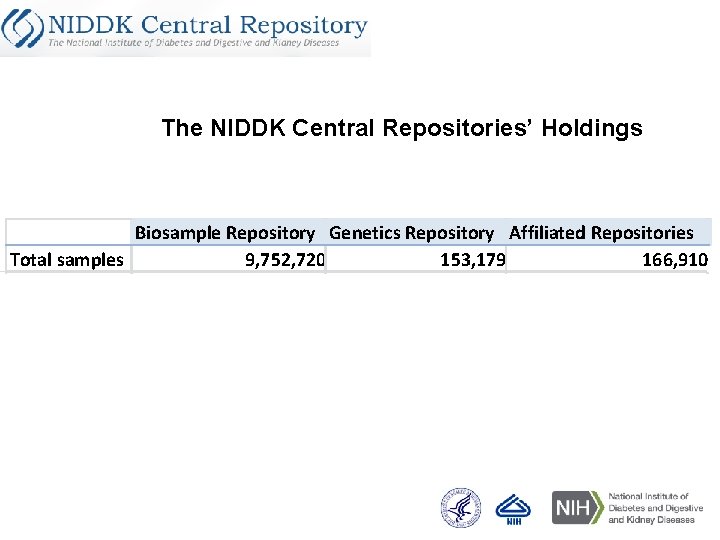
The NIDDK Central Repositories’ Holdings Biosample Repository Genetics Repository Affiliated Repositories Total samples 9, 752, 720 153, 179 166, 910
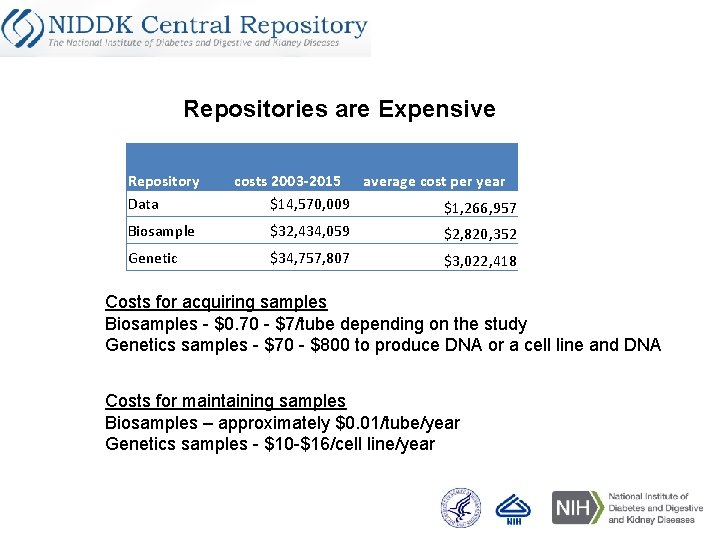
Repositories are Expensive Repository Data costs 2003 -2015 average cost per year $14, 570, 009 $1, 266, 957 Biosample $32, 434, 059 $2, 820, 352 Genetic $34, 757, 807 $3, 022, 418 Costs for acquiring samples Biosamples - $0. 70 - $7/tube depending on the study Genetics samples - $70 - $800 to produce DNA or a cell line and DNA Costs for maintaining samples Biosamples – approximately $0. 01/tube/year Genetics samples - $10 -$16/cell line/year
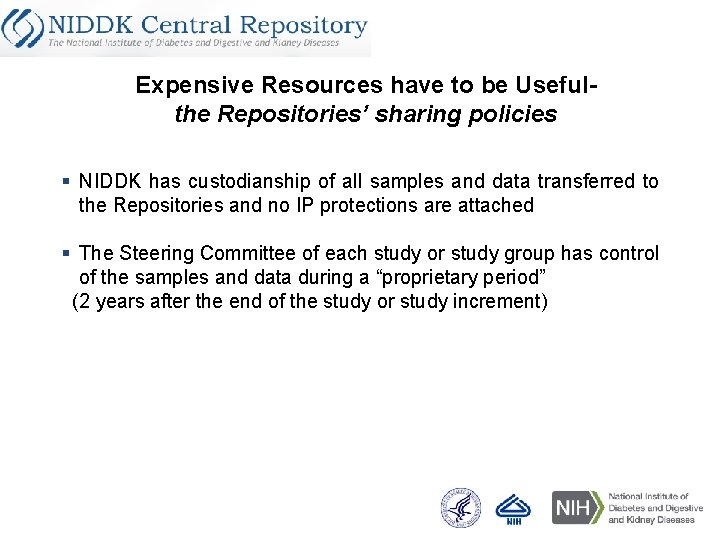
Expensive Resources have to be Usefulthe Repositories’ sharing policies § NIDDK has custodianship of all samples and data transferred to the Repositories and no IP protections are attached § The Steering Committee of each study or study group has control of the samples and data during a “proprietary period” (2 years after the end of the study or study increment)
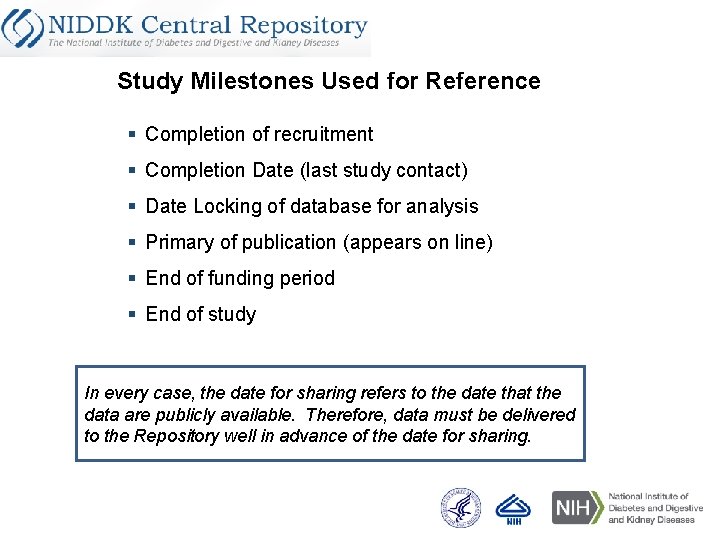
Study Milestones Used for Reference § Completion of recruitment § Completion Date (last study contact) § Date Locking of database for analysis § Primary of publication (appears on line) § End of funding period § End of study In every case, the date for sharing refers to the date that the data are publicly available. Therefore, data must be delivered to the Repository well in advance of the date for sharing.
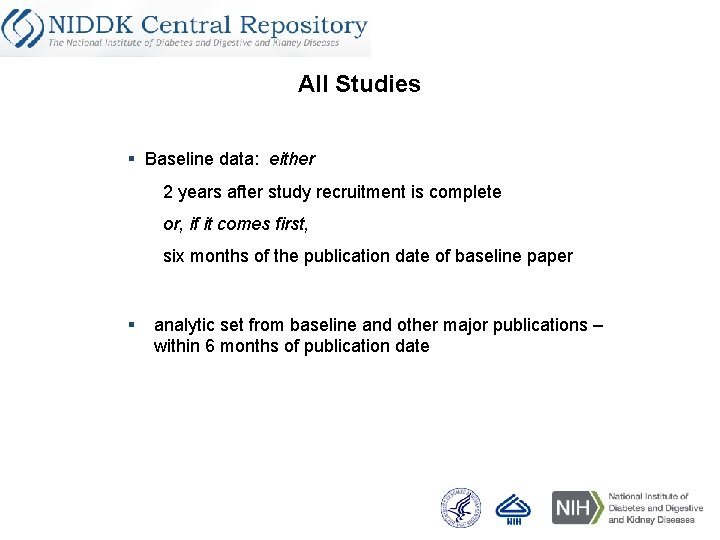
All Studies § Baseline data: either 2 years after study recruitment is complete or, if it comes first, six months of the publication date of baseline paper § analytic set from baseline and other major publications – within 6 months of publication date
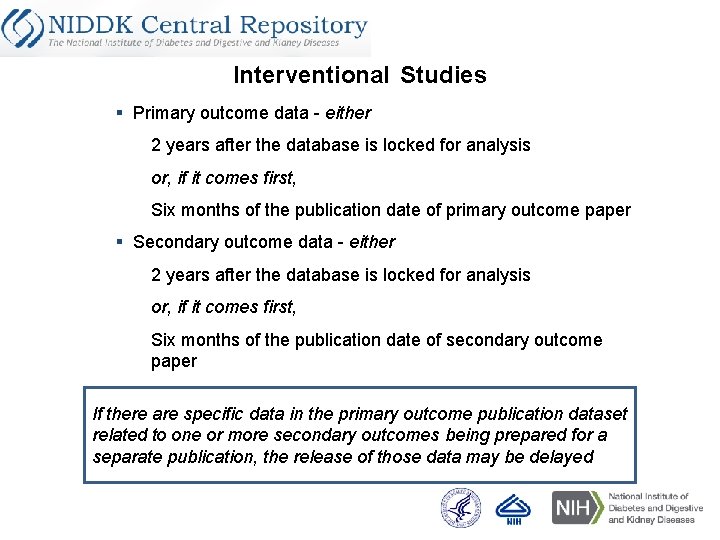
Interventional Studies § Primary outcome data - either 2 years after the database is locked for analysis or, if it comes first, Six months of the publication date of primary outcome paper § Secondary outcome data - either 2 years after the database is locked for analysis or, if it comes first, Six months of the publication date of secondary outcome paper If there are specific data in the primary outcome publication dataset related to one or more secondary outcomes being prepared for a separate publication, the release of those data may be delayed
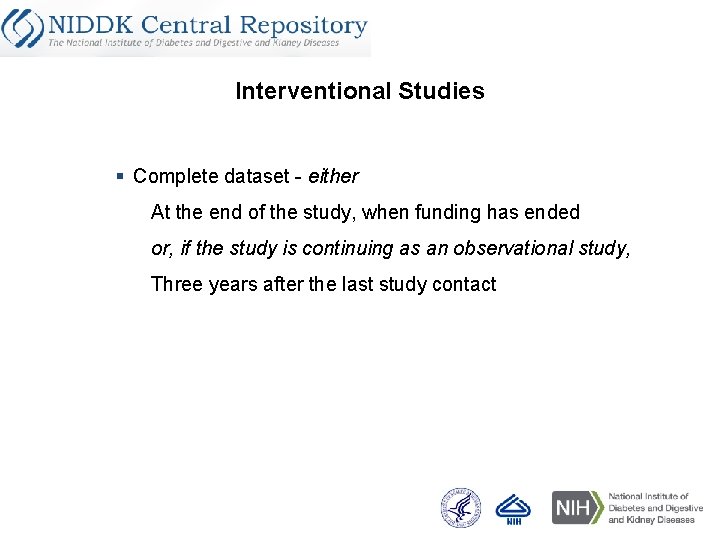
Interventional Studies § Complete dataset - either At the end of the study, when funding has ended or, if the study is continuing as an observational study, Three years after the last study contact
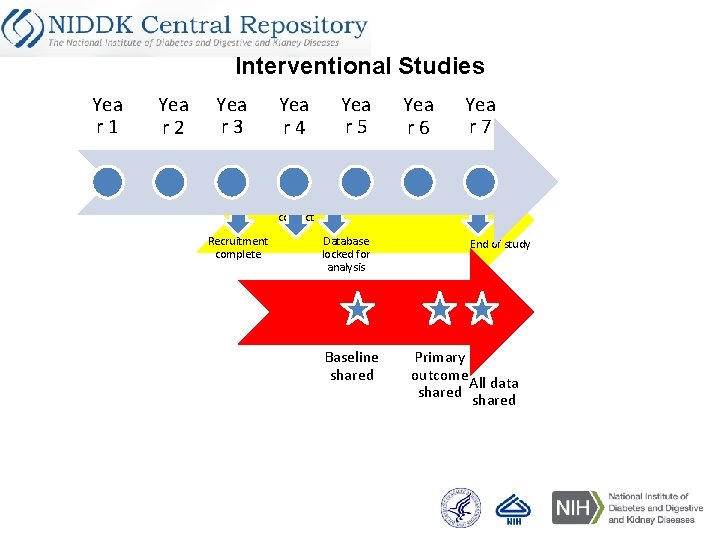
Interventional Studies Yea r 1 Yea r 2 Yea r 3 Yea r 4 Yea r 5 Yea r 6 Yea r 7 Last patient contact Recruitment complete Database locked for analysis Baseline shared End of study Primary outcome All data shared
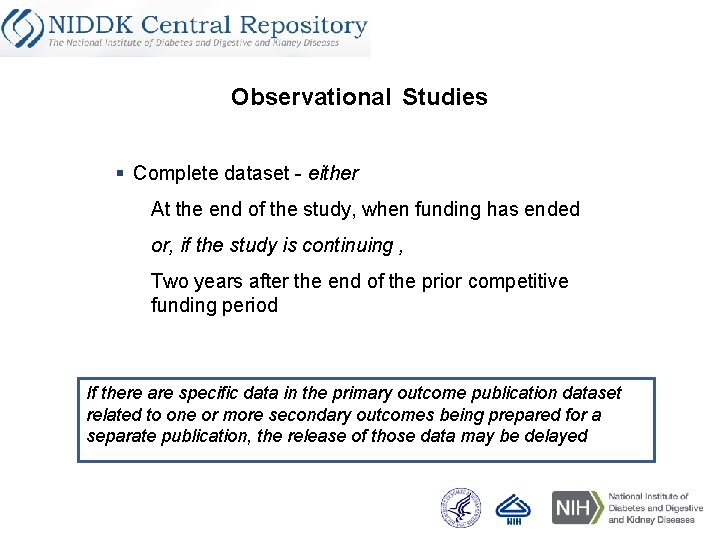
Observational Studies § Complete dataset - either At the end of the study, when funding has ended or, if the study is continuing , Two years after the end of the prior competitive funding period If there are specific data in the primary outcome publication dataset related to one or more secondary outcomes being prepared for a separate publication, the release of those data may be delayed
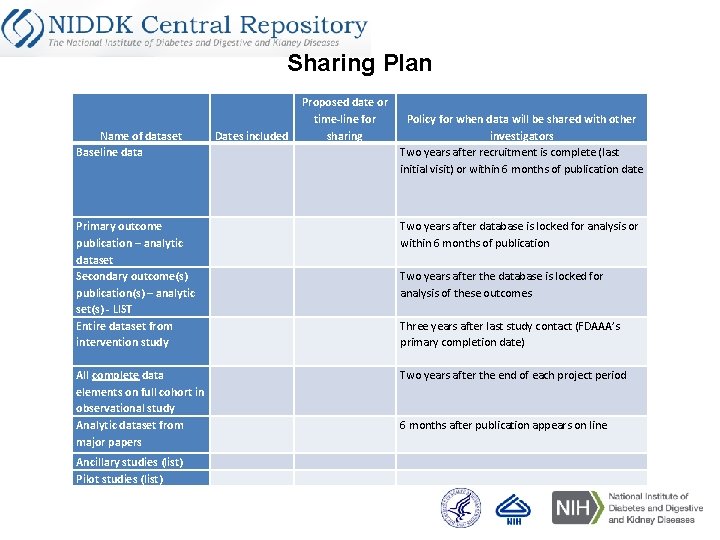
Sharing Plan Name of dataset Baseline data Dates included Proposed date or time-line for sharing Policy for when data will be shared with other investigators Two years after recruitment is complete (last initial visit) or within 6 months of publication date Primary outcome publication – analytic dataset Secondary outcome(s) publication(s) – analytic set(s) - LIST Entire dataset from intervention study Two years after database is locked for analysis or within 6 months of publication All complete data elements on full cohort in observational study Analytic dataset from major papers Two years after the end of each project period Ancillary studies (list) Pilot studies (list) Two years after the database is locked for analysis of these outcomes Three years after last study contact (FDAAA’s primary completion date) 6 months after publication appears on line
Benefits of Data Sharing § Enables data generated from one study to be used to explore a wide range of additional research questions § Increases statistical power and scientific value by enabling data from multiple studies to be combined § Facilitates validation of research results § Facilitates innovation of methods and tools for research
Expensive Resources have to be Useful – Make Data and Samples Available The request process is Web-based § Data requests – reviewed administratively § DNA from cell lines - reviewed administratively § Ancillary requests – no scientific review § External sample requests – peer-reviewed requests: – Apply for samples only: X 01 http: //grants. nih. gov/grants/guide/pa-files/PAR-14 -301. html – Apply for samples and money: R 01 http: //grants. nih. gov/grants/guide/pa-files/PAR-13 -228. html
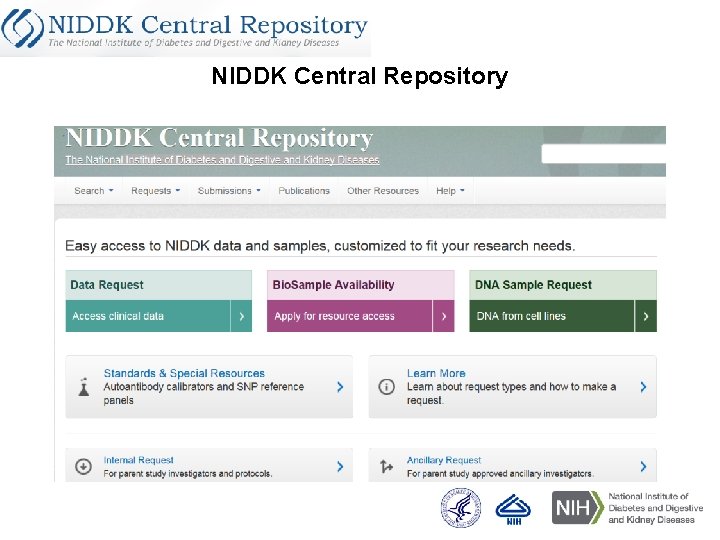
NIDDK Central Repository
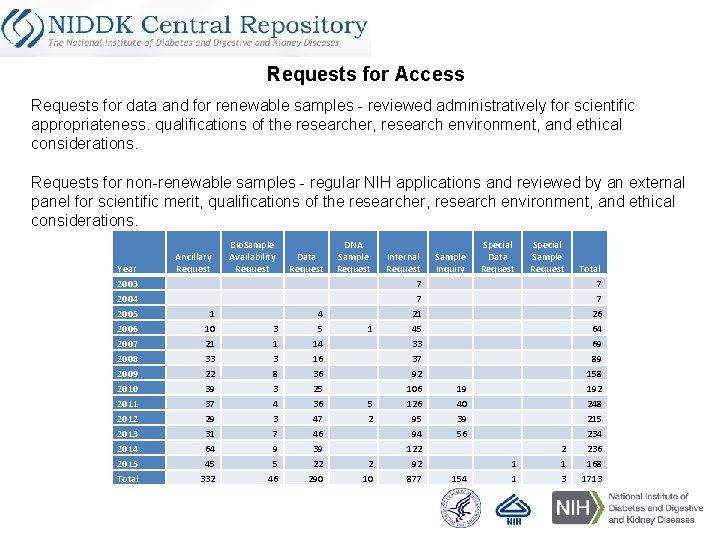
Requests for Access Requests for data and for renewable samples - reviewed administratively for scientific appropriateness. qualifications of the researcher, research environment, and ethical considerations. Requests for non-renewable samples - regular NIH applications and reviewed by an external panel for scientific merit, qualifications of the researcher, research environment, and ethical considerations. Year 2003 2004 2005 2006 2007 2008 2009 2010 2011 2012 2013 2014 2015 Total Ancillary Request 1 10 21 33 22 39 37 29 31 64 45 332 Bio. Sample Availability Request Data Request 3 1 3 8 3 4 3 7 9 5 46 4 5 14 16 36 25 36 47 46 39 22 290 DNA Sample Request 1 5 2 2 10 Internal Request 7 7 21 45 33 37 92 106 126 95 94 122 92 877 Sample Inquiry Special Data Request Special Sample Request 1 1 2 1 3 19 40 39 56 154 Total 7 7 26 64 69 89 158 192 248 215 234 236 168 1713
Using the Data and Samples >150 publications by researchers who gained access to data and samples through the NIDDK Repository and db. GAP including: § Papers based on the GWAS data sets in db. GAP § Publications on novel analytic methods or markers in NIDDK Repository-supplied samples
NIDDK Repository Staff Project Officers Rebekah Rasooly Beena Akolkar Bob Karp Lisa Spain Contracting Specialist Rich Bailey Technology Transfer Agnes Rooke Repository Specialists Kris Moen Kay Mobley
- Slides: 22