
THE NHS MODERNISATION AGENCY The Application of Complexity
- Slides: 12
THE NHS MODERNISATION AGENCY The Application of Complexity in a National Healthcare Improvement Organisation
Outline of Session 1. 2. 3. 4. 5. 6. Context - Who we are and why ICo. SS Methodology Interim Findings What Next What are we Learning Q&A
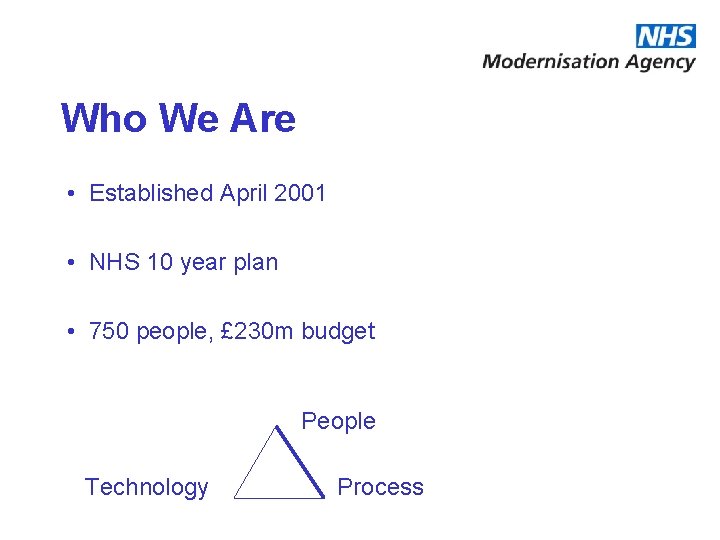
Who We Are • Established April 2001 • NHS 10 year plan • 750 people, £ 230 m budget People Technology Process
Examples of our work • Supported 42 zero star Trusts • Helped by the Agency’s Emergency Services Collaborative, all 24 -hour A&E Departments have ensured that 94% of patients are seen, treated or discharged within 4 hours • Over 40% of diagnosed cancer patients are benefiting from redesigned services through the Agency’s Cancer Services Collaborative • The Changing Workforce Programme helps the NHS and health and social care organisations to test, implement and spread the redesign of staff roles. It spreads learning from a range of projects throughout the NHS
Why ICo. SS • Senior Management Team (SMT), consisting of top 70 managers, created in September 2003 • ICo. SS process commissioned to enable us to reflect on development needs
Sept 2003 - May 2004 • Decision taken to localise the MA in 1 year • Successor organisation • Change direction of ICo. SS project
Methodology • Semi structured 1: 1 and team interviews • Landscape of the mind (Lo. M) questionnaire • Netmap
Feedback/Validation • Reflect back workshop • Core group • Complexity seminar • Lo. M 1: 1
Interim Findings • Caveat on findings, as majority of study undertaken prior to March 2004 announcement • Emphasis on relationships - borne out by the large number of senior staff in the Lo. M ‘Warm Gold’ category • Not good at demonstrating the value and impact of the work in terms of measurement and targets • Need for effective cost model to justify the MA’s activities
Findings 2 • Need for better management systems and processes • Need for clarity of the role of the MA - Do. H / NHS • Need to improve the identification, capture and dissemination of learning • Need to improve meetings and be more respectful of each other’s time • Future role of new organisation will be leading edge helping others to meet their targets is to be localised
What Next? • Using the findings to inform the new organisation and the improvement system within the NHS • Consideration of Lo. M one-to-one feedback for all SMT members who want it, to help them to consider their future direction • Using Lo. M elements to consider the capabilities required in the new organisation
What are we Learning? • Power of language • Impact of theoretical framework • Translation to business impact • Opportunities for whole system