
The NH Conservation and Heritage License Plate Program




- Slides: 30
The NH Conservation and Heritage License Plate Program
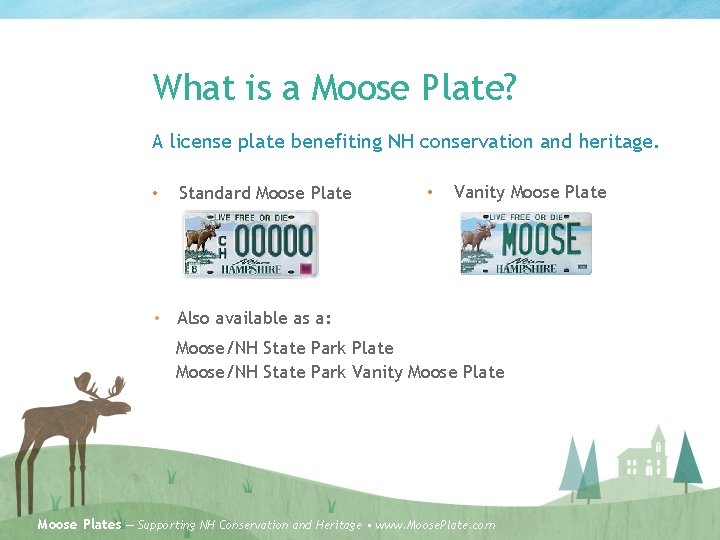
What is a Moose Plate? A license plate benefiting NH conservation and heritage. • Standard Moose Plate • Vanity Moose Plate • Also available as a: Moose/NH State Park Plate Moose/NH State Park Vanity Moose Plates — Supporting NH Conservation and Heritage • www. Moose. Plate. com
Wear it Proudly! Moose Plate funds are distributed to six NH agencies. • Used for conservation and heritage projects throughout NH How can you get one? • NH citizen buys Moose Plate when registering vehicle How it began… • • • 1993: Holderness 4 th grade presented idea to NH state legislature 1998: Moose Plate program created 1999: Resident Jim Collins designed Moose Plates — Supporting NH Conservation and Heritage • www. Moose. Plate. com
How do Moose Plates Benefit NH? The agencies use Moose Plate fees to: • Provide conservation/heritage grants • Restore/preserve public historic properties and artifacts • Protect threatened wildlife/habitats • Conserve rare/native plants • Maintain/administer NH historical sites • Enhance NH roadsides • Administer Land & Community Heritage Investment Program • Educate the public about unique NH resources Moose Plates — Supporting NH Conservation and Heritage • www. Moose. Plate. com
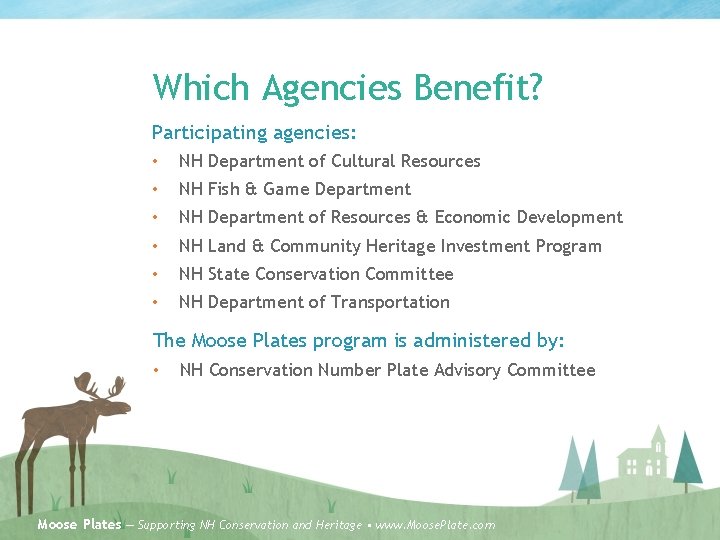
Which Agencies Benefit? Participating agencies: • NH Department of Cultural Resources • NH Fish & Game Department • NH Department of Resources & Economic Development • NH Land & Community Heritage Investment Program • NH State Conservation Committee • NH Department of Transportation The Moose Plates program is administered by: • NH Conservation Number Plate Advisory Committee Moose Plates — Supporting NH Conservation and Heritage • www. Moose. Plate. com
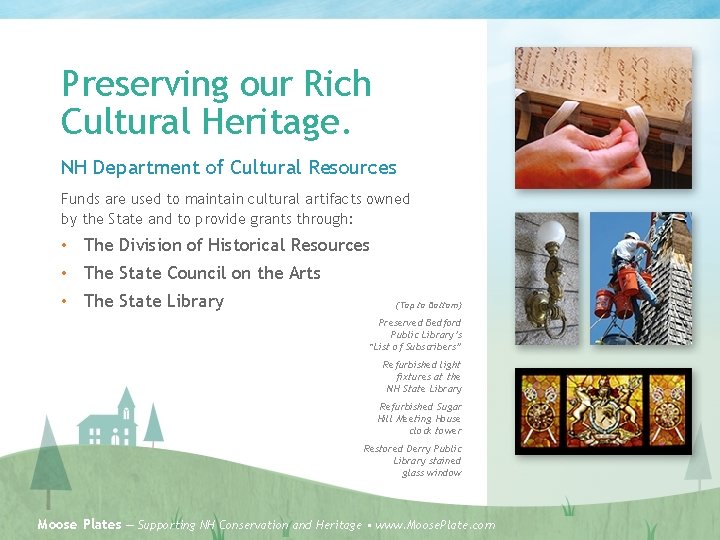
Preserving our Rich Cultural Heritage. NH Department of Cultural Resources Funds are used to maintain cultural artifacts owned by the State and to provide grants through: • The Division of Historical Resources • The State Council on the Arts • The State Library (Top to Bottom) Preserved Bedford Public Library’s “List of Subscribers” Refurbished light fixtures at the NH State Library Refurbished Sugar Hill Meeting House clock tower Restored Derry Public Library stained glass window Moose Plates — Supporting NH Conservation and Heritage • www. Moose. Plate. com
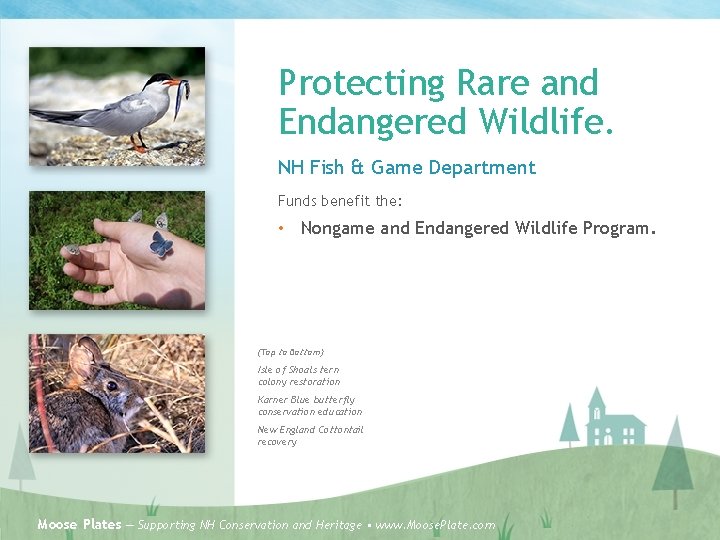
Protecting Rare and Endangered Wildlife. NH Fish & Game Department Funds benefit the: • Nongame and Endangered Wildlife Program. (Top to Bottom) Isle of Shoals tern colony restoration Karner Blue butterfly conservation education New England Cottontail recovery Moose Plates — Supporting NH Conservation and Heritage • www. Moose. Plate. com
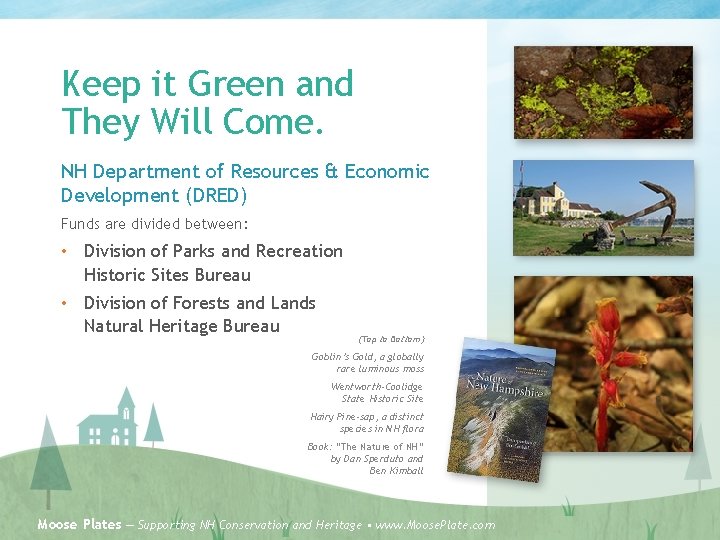
Keep it Green and They Will Come. NH Department of Resources & Economic Development (DRED) Funds are divided between: • Division of Parks and Recreation Historic Sites Bureau • Division of Forests and Lands Natural Heritage Bureau (Top to Bottom) Goblin’s Gold, a globally rare luminous moss Wentworth-Coolidge State Historic Site Hairy Pine-sap, a distinct species in NH flora Book: “The Nature of NH” by Dan Sperduto and Ben Kimball Moose Plates — Supporting NH Conservation and Heritage • www. Moose. Plate. com
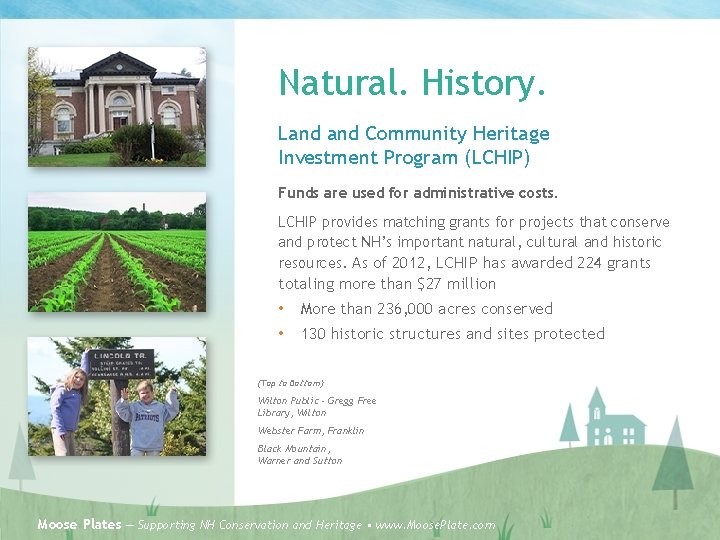
Natural. History. Land Community Heritage Investment Program (LCHIP) Funds are used for administrative costs. LCHIP provides matching grants for projects that conserve and protect NH’s important natural, cultural and historic resources. As of 2012, LCHIP has awarded 224 grants totaling more than $27 million • More than 236, 000 acres conserved • 130 historic structures and sites protected (Top to Bottom) Wilton Public - Gregg Free Library, Wilton Webster Farm, Franklin Black Mountain, Warner and Sutton Moose Plates — Supporting NH Conservation and Heritage • www. Moose. Plate. com
Boots on the Ground Conservation Work. NH State Conservation Committee (SCC) Funds are used to award competitive conservation grants to: • County Conservation Districts • Cooperative Extensions • Municipalities • Schools • Nonprofits (Top to Bottom) Hazelton Farm conservation project (Photo: Martha Twombly) Cheshire County No-Till Farming Initiative (Photo: Amanda Littleton) Lake friendly landscaping to protect Clough Pond (Photo: Andrea La. Moreaux) Moose Plates — Supporting NH Conservation and Heritage • www. Moose. Plate. com
Beautifying New Hampshire’s Highways. NH Department of Transportation Funds benefit: • Bureau of Highway Design, specifically the Statewide Native Wildflowers and Lilac Planting Program. (Top to Bottom) Lilacs at former site of Nashua Rest Area Wildflower site in Hopkinton on I-89 Wildflower site at Rt. 25 Plymouth Circle Moose Plates — Supporting NH Conservation and Heritage • www. Moose. Plate. com
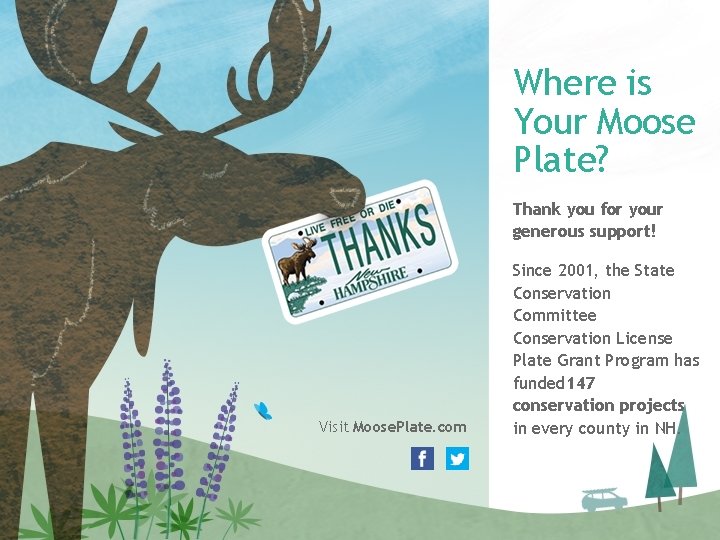
Where is Your Moose Plate? Thank you for your generous support! Visit Moose. Plate. com Since 2001, the State Conservation Committee Conservation License Plate Grant Program has funded 147 conservation projects in every county in NH.
The State Conservation Committee Conservation Grant Program Ø Purpose SCC Conservation Grant Program: To support and promote programs and partnerships throughout the state that protect, restore, and enhance the state’s valuable natural resources. (RSA 261: 97 -c section III) Ø Grants shall be used for physical and tangible environmental projects that foster stewardship and the sustainability of New Hampshire's natural environment. (Chapter 20: 1, III Laws of 1998) Ø The SCC (1946) - affiliate of the State NH Department of Agriculture. Grants awarded by SCC are administered through the Depart. of Agriculture. Ø SCC Board: 12 members representing the county conservation districts, municipal conservation commissions, and agencies responsible for natural resources conservation. Ø SCC Grant Review Committee: comprised of SCC Board members. Review grant proposals and make recommendations to the SCC Board. Ø SCC Grant Administrator: Supports SCC conservation grant program.
SCC Grant Eligibility Eligible Applicants 1. County Conservation Grants: Ø County Conservation Districts Ø County Cooperative Extension Natural Resource Programs 2. Municipal and Nongovernmental Entity Conservation Grants: Ø Municipal conservation agencies engaged in conservation programs; Ø Nonprofit entities engaged in conservation programs Ø Public and private schools, K through grade 12; Scout groups Eligible Sites Ø Projects on public and private land are eligible with the signed consent and approval of the appropriate governing body or landowner(s).
Project Categories Enhance NH’s environment by promoting the sustainability of the state’s natural resources. ² Preserve, protect & conserve water quality & water quantity. ² Restore, enhance or conserve wildlife habitat. ² Reduce, prevent and/or manage soil erosion and/or flooding. ² Planning, implementing and using Best Management Practices for agriculture, forestry or storm water management. ² Conservation planning that accomplishes a conservation project or outcome. ² Permanent land protection through conservation easement or fee purchase.
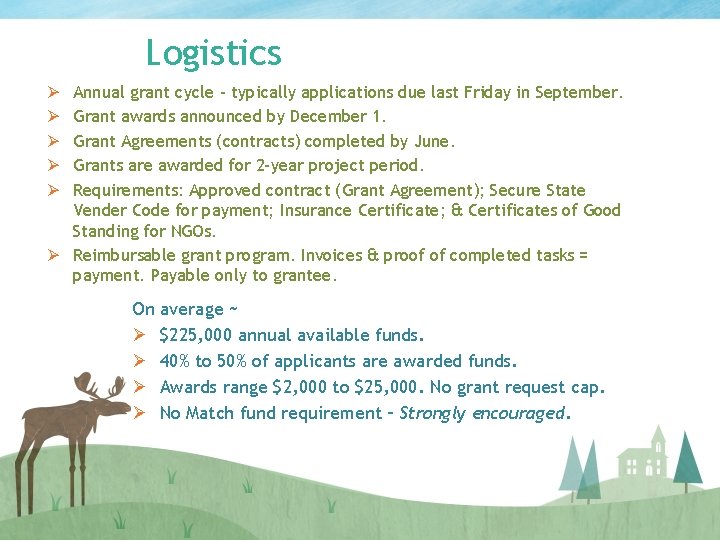
Logistics Annual grant cycle – typically applications due last Friday in September. Grant awards announced by December 1. Grant Agreements (contracts) completed by June. Grants are awarded for 2 -year project period. Requirements: Approved contract (Grant Agreement); Secure State Vender Code for payment; Insurance Certificate; & Certificates of Good Standing for NGOs. Ø Reimbursable grant program. Invoices & proof of completed tasks = payment. Payable only to grantee. Ø Ø Ø On average ~ Ø $225, 000 annual available funds. Ø 40% to 50% of applicants are awarded funds. Ø Awards range $2, 000 to $25, 000. No grant request cap. Ø No Match fund requirement – Strongly encouraged.
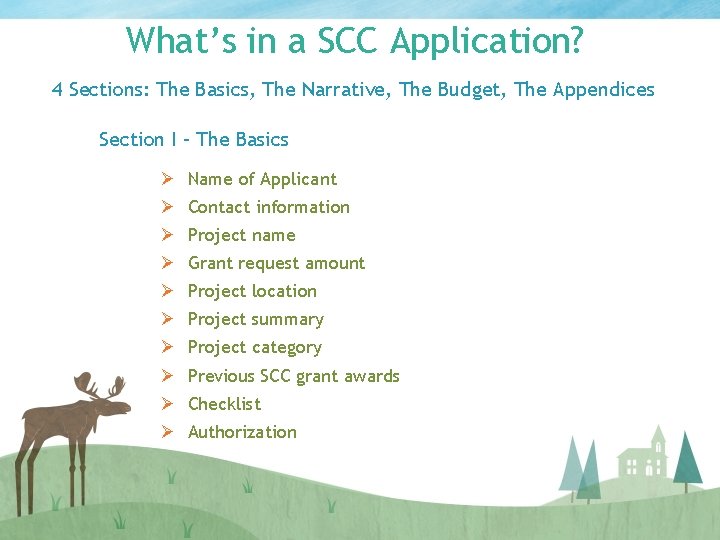
What’s in a SCC Application? 4 Sections: The Basics, The Narrative, The Budget, The Appendices Section I – The Basics Ø Name of Applicant Ø Contact information Ø Project name Ø Grant request amount Ø Project location Ø Project summary Ø Project category Ø Previous SCC grant awards Ø Checklist Ø Authorization
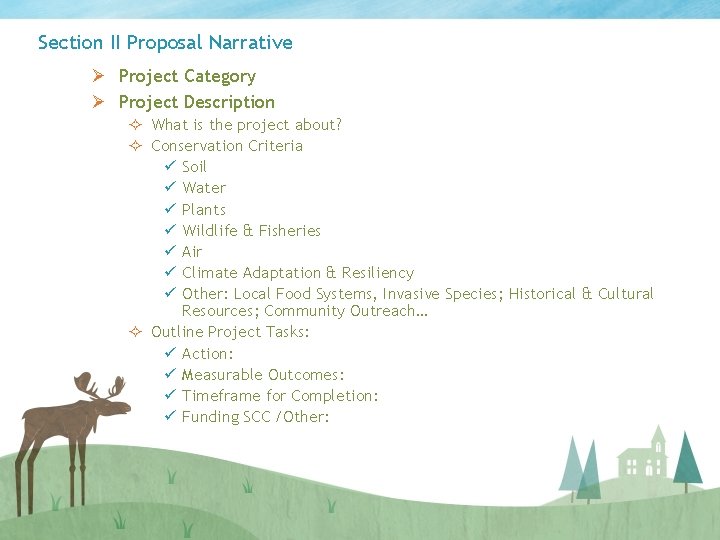
Section II Proposal Narrative Ø Project Category Ø Project Description ² What is the project about? ² Conservation Criteria ü Soil ü Water ü Plants ü Wildlife & Fisheries ü Air ü Climate Adaptation & Resiliency ü Other: Local Food Systems, Invasive Species; Historical & Cultural Resources; Community Outreach… ² Outline Project Tasks: ü Action: ü Measurable Outcomes: ü Timeframe for Completion: ü Funding SCC /Other:
Section II Proposal Narrative continued Ø Long-term Project Management and Stewardship Ø Moose Plate Program Public Awareness Ø Landowner Consent Ø Applicant Institutional Capacity and Project Partners
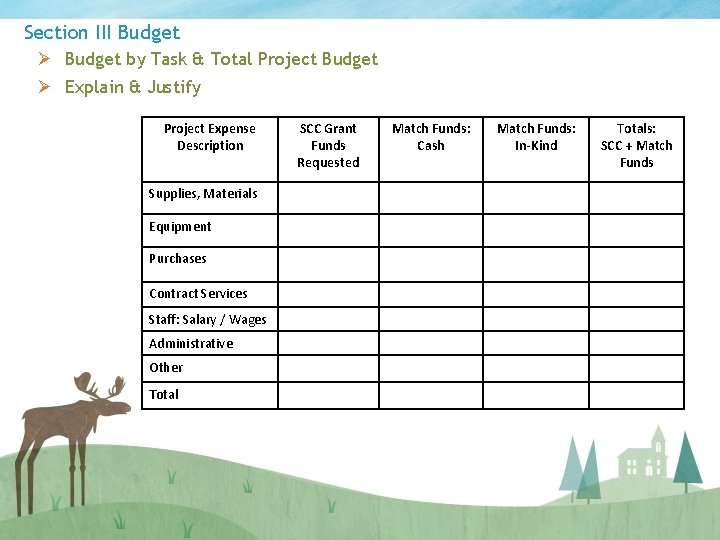
Section III Budget Ø Budget by Task & Total Project Budget Ø Explain & Justify Project Expense Description Supplies, Materials Equipment Purchases Contract Services Staff: Salary / Wages Administrative Other Total SCC Grant Funds Requested Match Funds: Cash Match Funds: In-Kind Totals: SCC + Match Funds
Section IV Appendices Ø Maps Ø Photos Ø Site Plans Ø Permits Ø Landowner Consent Ø Letters support Ø Match Funds Documentation Ø Other Supporting Documentation
What makes a good SCC application Ø Project fits the funding source Ø Project concept is developed to the point of implementation Ø Project outcome(s) are clear Ø Total project funding strategy has been developed Ø Budget & SCC request is realistic Ø Match funds – always help Ø Institutional capacity to accomplish demonstrated Ø Project Tasks ~ Measurable Outcomes ~ Timeframe for Completion are reasonable & will achieve project goal Ø Conservation Benefits are clearly described
Writing a Grant Application… suggestions Ø Answer the question in the format provided Ø Provide all the information requested, even the appendices. If a section does not apply to your project, state “NA” Ø Be succinct Ø Honor word counts, sentence length limits Ø Communicate with the funder if you have questions about the application or funding program Ø Pretend you are the reviewer
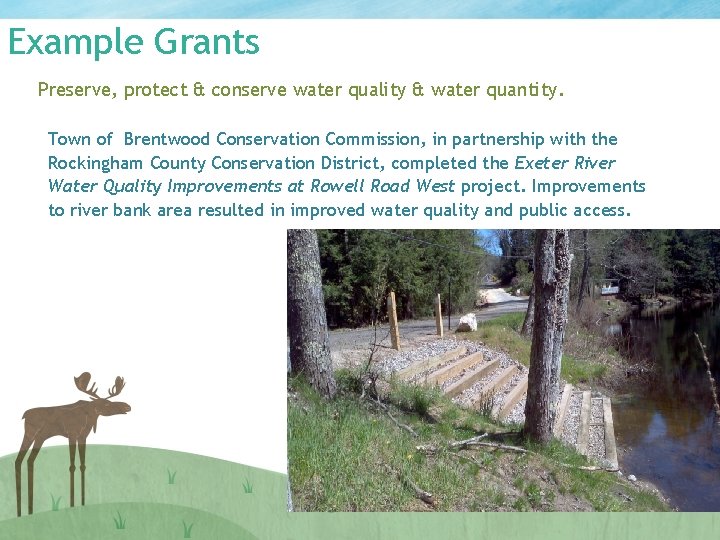
Example Grants Preserve, protect & conserve water quality & water quantity. Town of Brentwood Conservation Commission, in partnership with the Rockingham County Conservation District, completed the Exeter River Water Quality Improvements at Rowell Road West project. Improvements to river bank area resulted in improved water quality and public access.
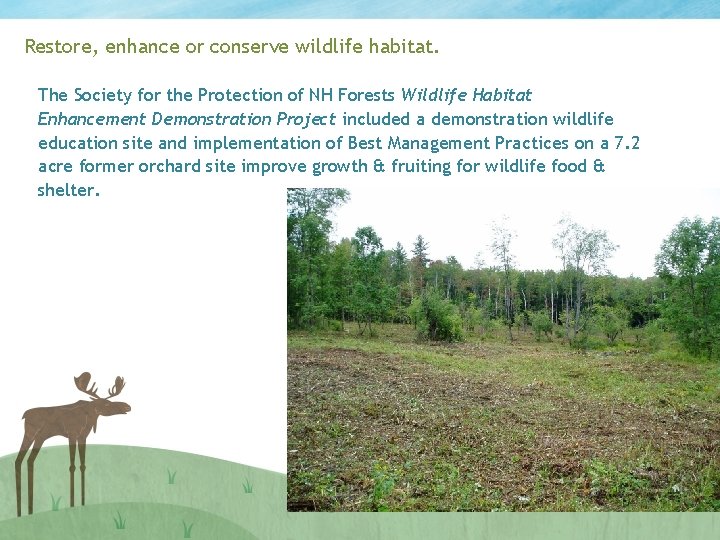
Restore, enhance or conserve wildlife habitat. The Society for the Protection of NH Forests Wildlife Habitat Enhancement Demonstration Project included a demonstration wildlife education site and implementation of Best Management Practices on a 7. 2 acre former orchard site improve growth & fruiting for wildlife food & shelter.
Reduce, prevent and/or manage soil erosion and/or flooding. Cheshire County Conservation District’s No-Till Farming Initiative to improve soil and protect water quality. The CCCD purchased the no-till drill and provided it to farmers in the county through a lease program. Partnering with other natural resource agencies, four educational workshops were held to demonstrate how to adopt no-till practices and properly use the equipment for the best results. In the first two years of the start-up program, 17 farms rented the equipment and used it on a total of 238 acres.
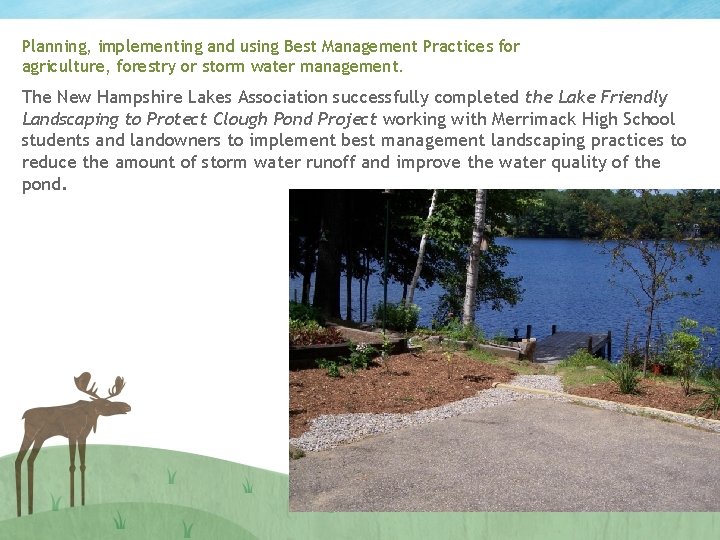
Planning, implementing and using Best Management Practices for agriculture, forestry or storm water management. The New Hampshire Lakes Association successfully completed the Lake Friendly Landscaping to Protect Clough Pond Project working with Merrimack High School students and landowners to implement best management landscaping practices to reduce the amount of storm water runoff and improve the water quality of the pond.
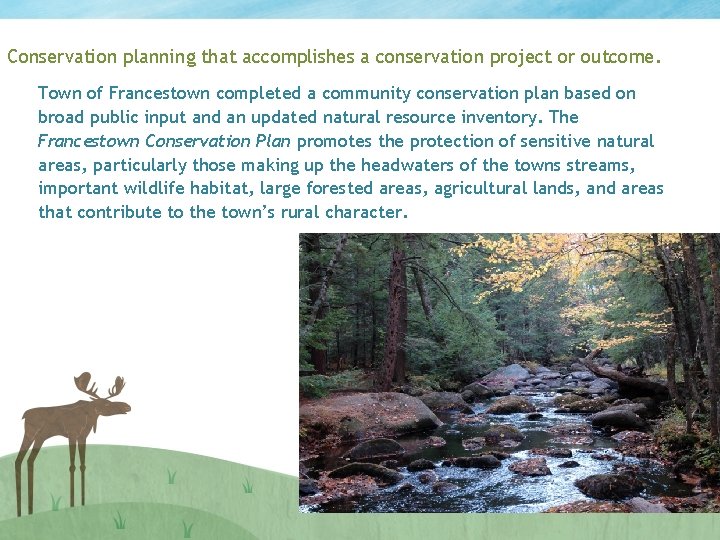
Conservation planning that accomplishes a conservation project or outcome. Town of Francestown completed a community conservation plan based on broad public input and an updated natural resource inventory. The Francestown Conservation Plan promotes the protection of sensitive natural areas, particularly those making up the headwaters of the towns streams, important wildlife habitat, large forested areas, agricultural lands, and areas that contribute to the town’s rural character.
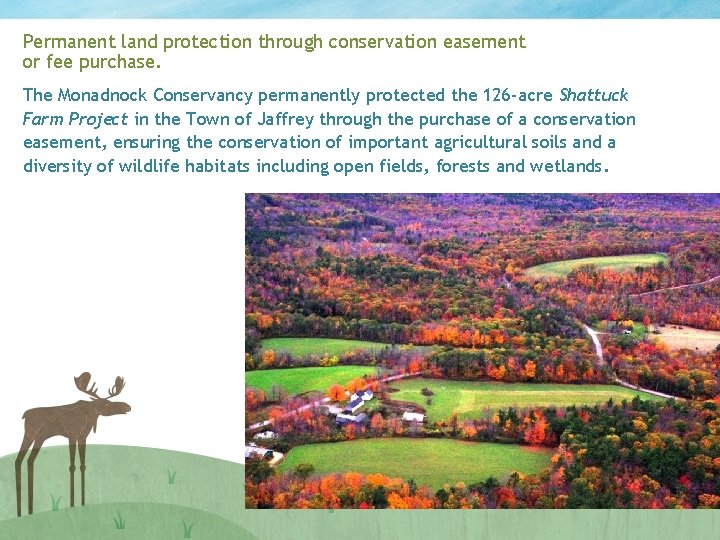
Permanent land protection through conservation easement or fee purchase. The Monadnock Conservancy permanently protected the 126 -acre Shattuck Farm Project in the Town of Jaffrey through the purchase of a conservation easement, ensuring the conservation of important agricultural soils and a diversity of wildlife habitats including open fields, forests and wetlands.
Thanks State Conservation Committee: http: //www. nh. gov/scc/gra nts/ Dea Brickner-Wood Administrator SCC Conservation Grant Program bluesky 24@comcast. net 603 -868 -6112