
The next question was what makes planets go



- Slides: 83
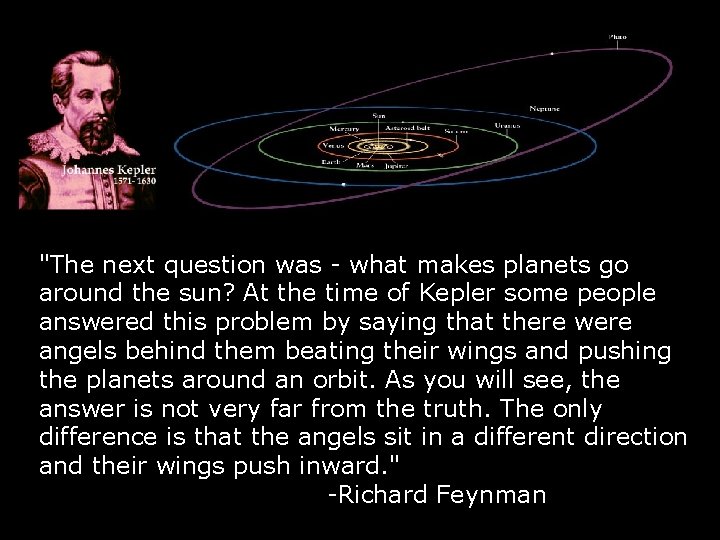
"The next question was - what makes planets go around the sun? At the time of Kepler some people answered this problem by saying that there were angels behind them beating their wings and pushing the planets around an orbit. As you will see, the answer is not very far from the truth. The only difference is that the angels sit in a different direction and their wings push inward. " -Richard Feynman
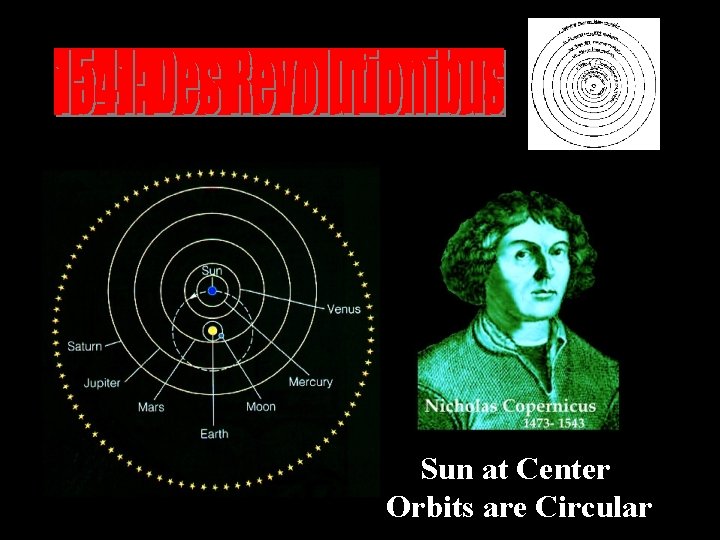
Sun at Center Orbits are Circular
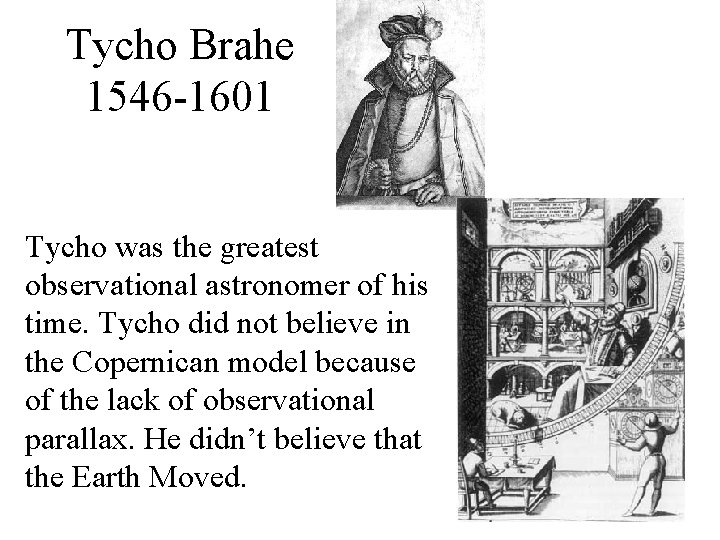
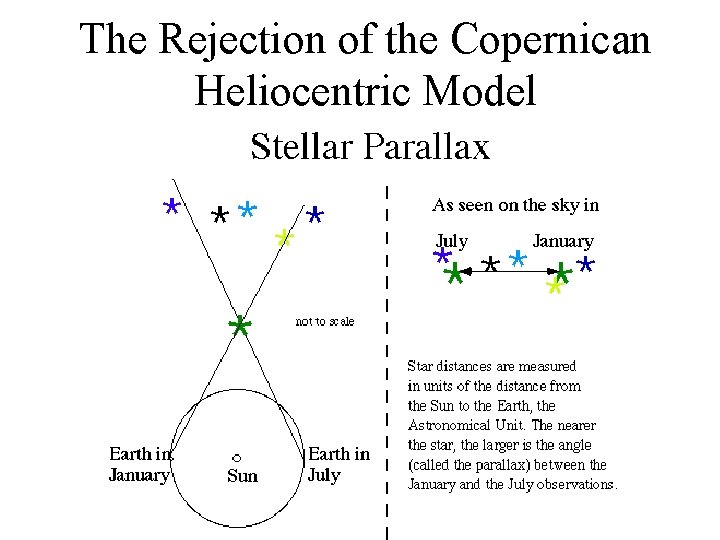
Tycho Brahe 1546 -1601 Tycho was the greatest observational astronomer of his time. Tycho did not believe in the Copernican model because of the lack of observational parallax. He didn’t believe that the Earth Moved.
The Rejection of the Copernican Heliocentric Model
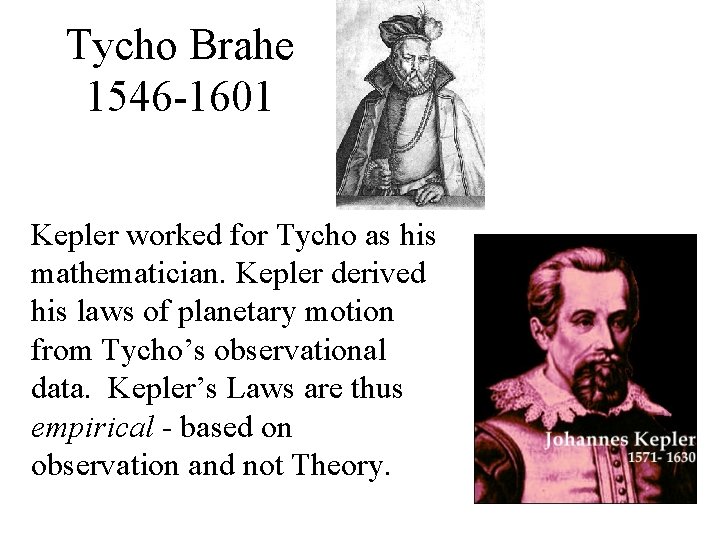
Tycho Brahe 1546 -1601 Kepler worked for Tycho as his mathematician. Kepler derived his laws of planetary motion from Tycho’s observational data. Kepler’s Laws are thus empirical - based on observation and not Theory.
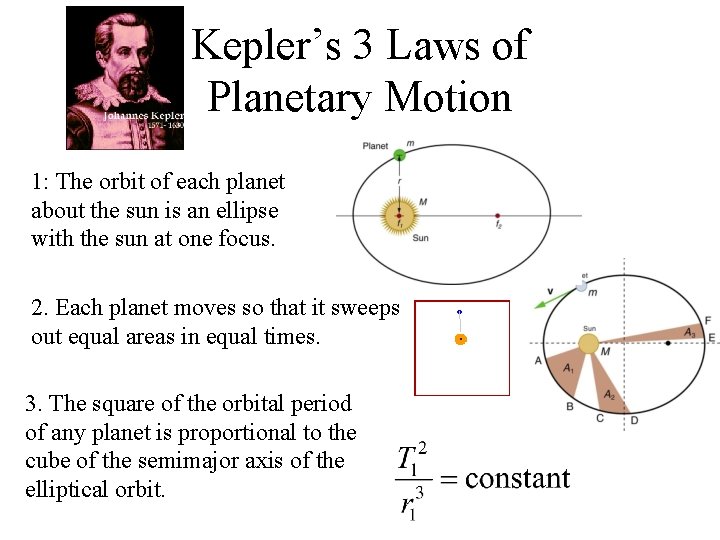
Kepler’s 3 Laws of Planetary Motion 1: The orbit of each planet about the sun is an ellipse with the sun at one focus. 2. Each planet moves so that it sweeps out equal areas in equal times. 3. The square of the orbital period of any planet is proportional to the cube of the semimajor axis of the elliptical orbit.
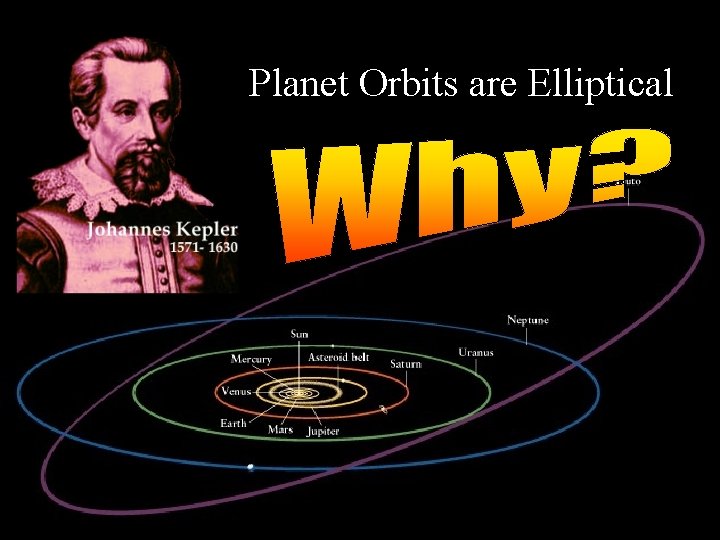
Planet Orbits are Elliptical
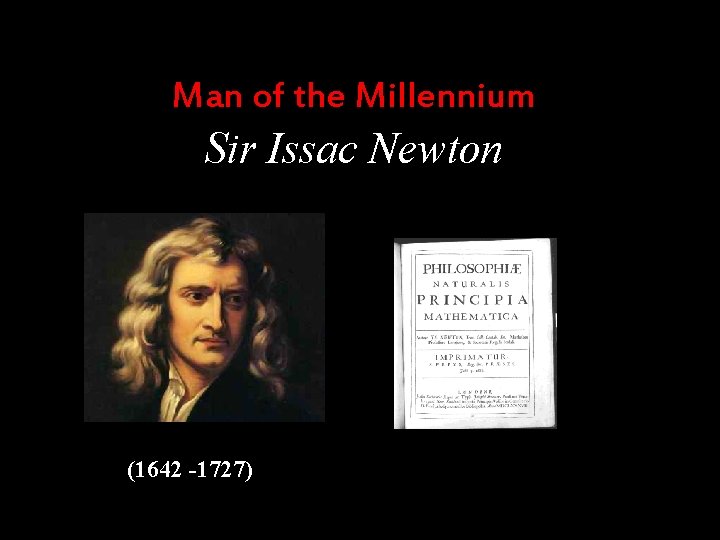
Man of the Millennium Sir Issac Newton (1642 -1727)
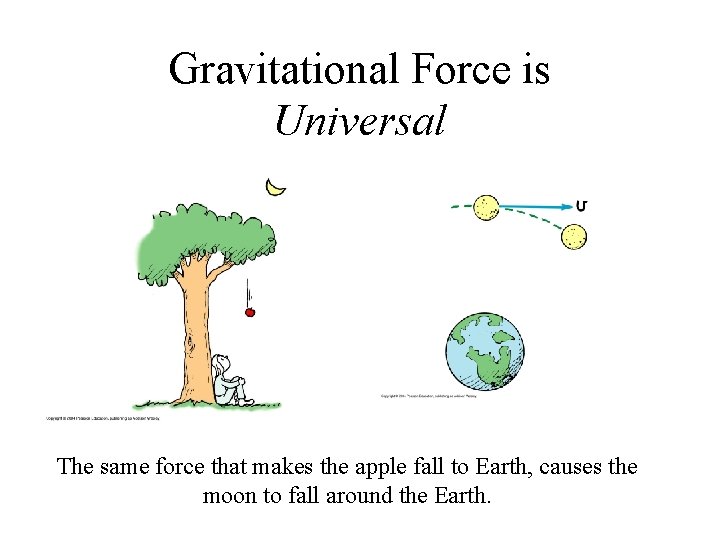
Gravitational Force is Universal The same force that makes the apple fall to Earth, causes the moon to fall around the Earth.
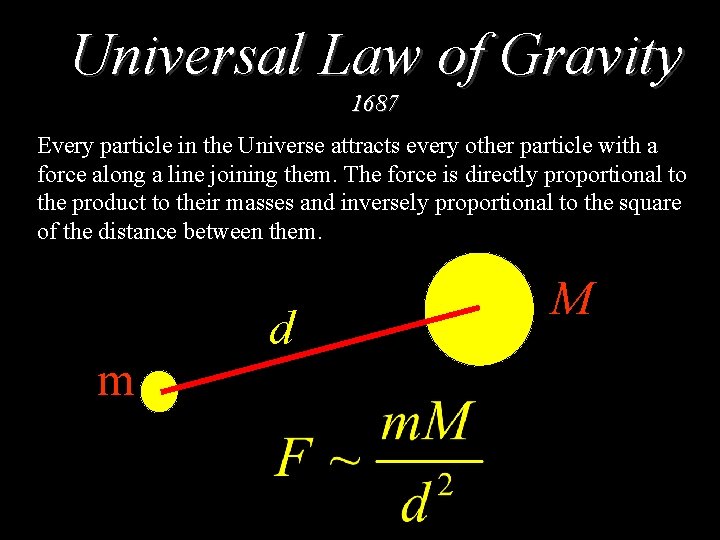
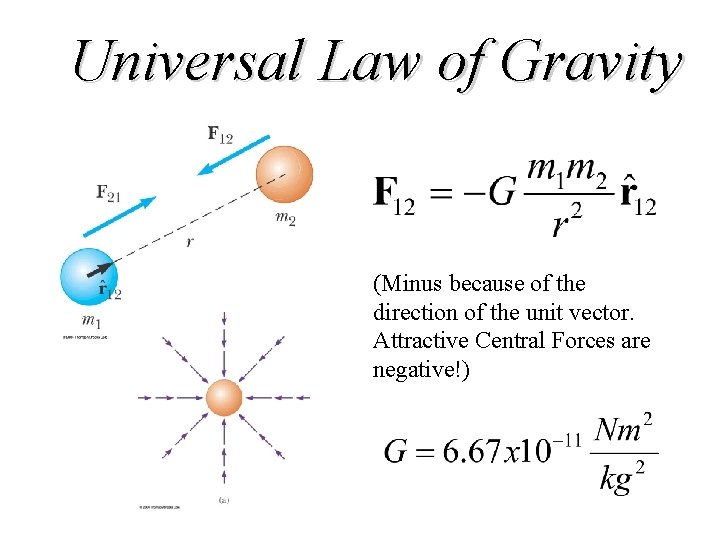
Universal Law of Gravity 1687 Every particle in the Universe attracts every other particle with a force along a line joining them. The force is directly proportional to the product to their masses and inversely proportional to the square of the distance between them. m d M
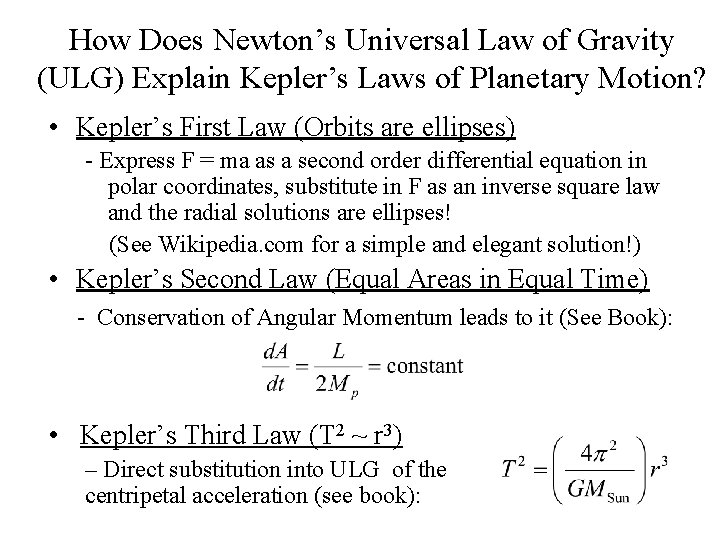
How Does Newton’s Universal Law of Gravity (ULG) Explain Kepler’s Laws of Planetary Motion? • Kepler’s First Law (Orbits are ellipses) - Express F = ma as a second order differential equation in polar coordinates, substitute in F as an inverse square law and the radial solutions are ellipses! (See Wikipedia. com for a simple and elegant solution!) • Kepler’s Second Law (Equal Areas in Equal Time) - Conservation of Angular Momentum leads to it (See Book): • Kepler’s Third Law (T 2 ~ r 3) – Direct substitution into ULG of the centripetal acceleration (see book):
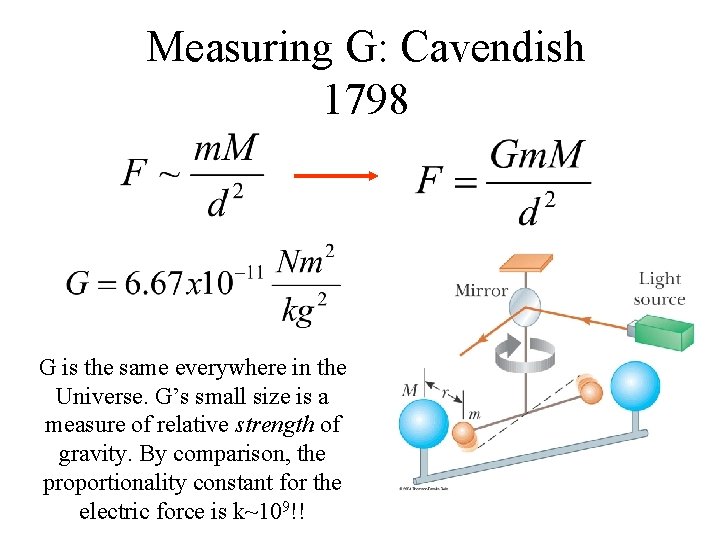
Measuring G: Cavendish 1798 G is the same everywhere in the Universe. G’s small size is a measure of relative strength of gravity. By comparison, the proportionality constant for the electric force is k~109!!
Universal Law of Gravity (Minus because of the direction of the unit vector. Attractive Central Forces are negative!)
Gravity: Inverse Square Law
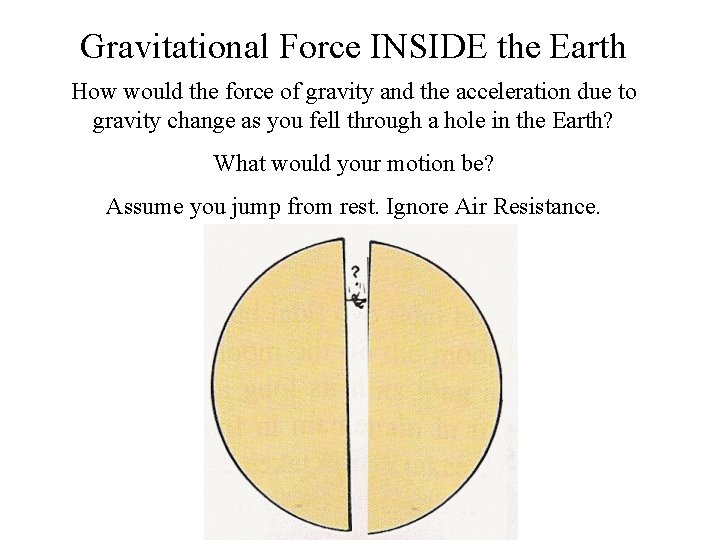
Gravitational Force INSIDE the Earth How would the force of gravity and the acceleration due to gravity change as you fell through a hole in the Earth? What would your motion be? Assume you jump from rest. Ignore Air Resistance.
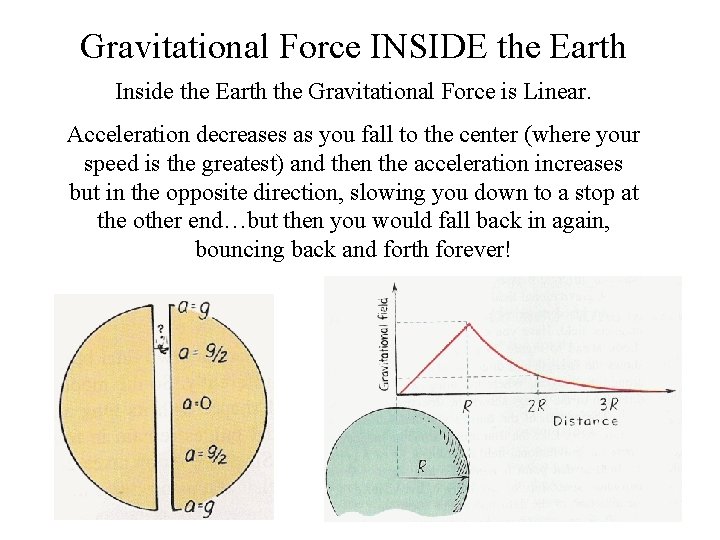
Gravitational Force INSIDE the Earth Inside the Earth the Gravitational Force is Linear. Acceleration decreases as you fall to the center (where your speed is the greatest) and then the acceleration increases but in the opposite direction, slowing you down to a stop at the other end…but then you would fall back in again, bouncing back and forth forever!
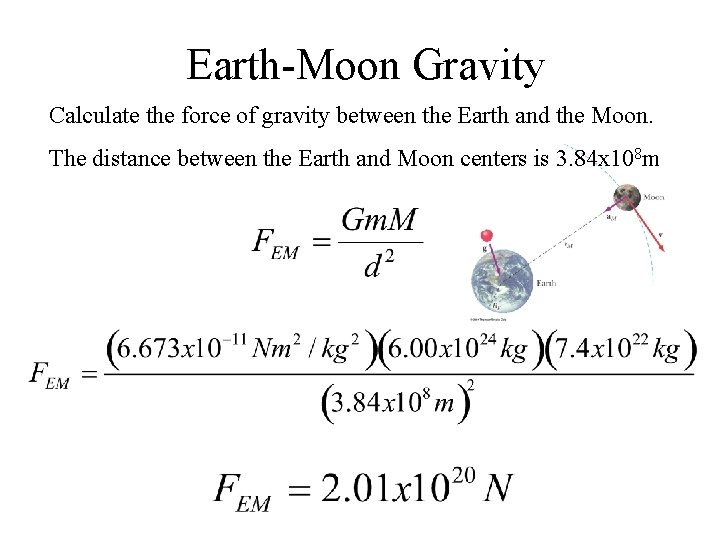
Earth-Moon Gravity Calculate the force of gravity between the Earth and the Moon. The distance between the Earth and Moon centers is 3. 84 x 108 m
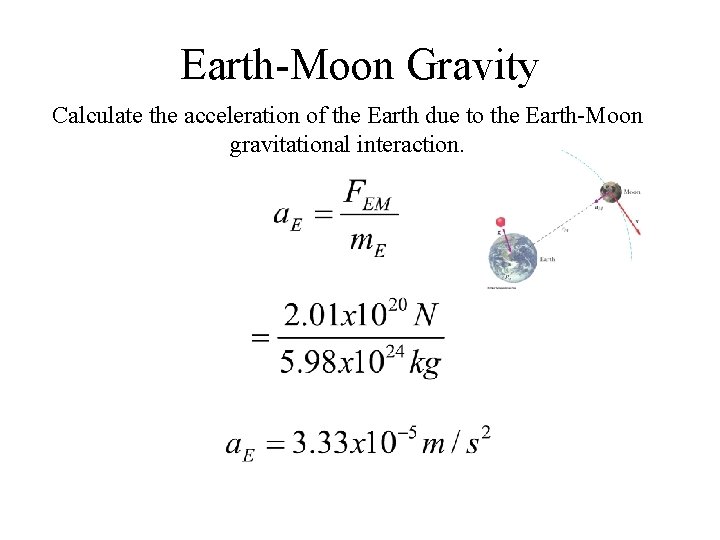
Earth-Moon Gravity Calculate the acceleration of the Earth due to the Earth-Moon gravitational interaction.
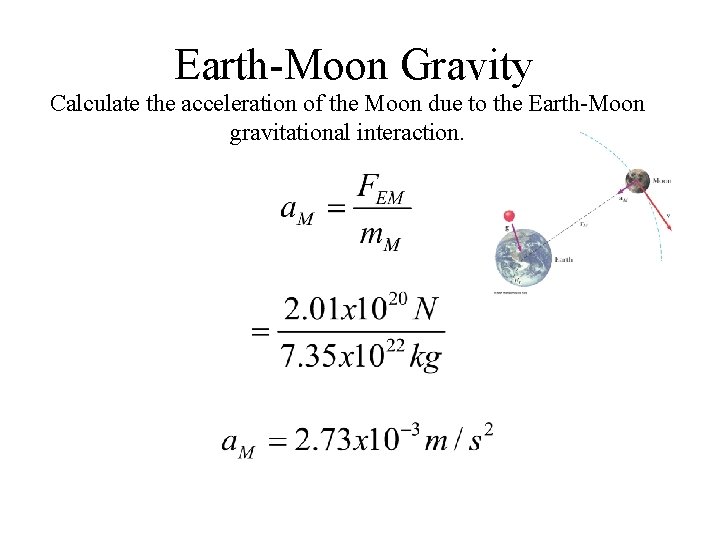
Earth-Moon Gravity Calculate the acceleration of the Moon due to the Earth-Moon gravitational interaction.
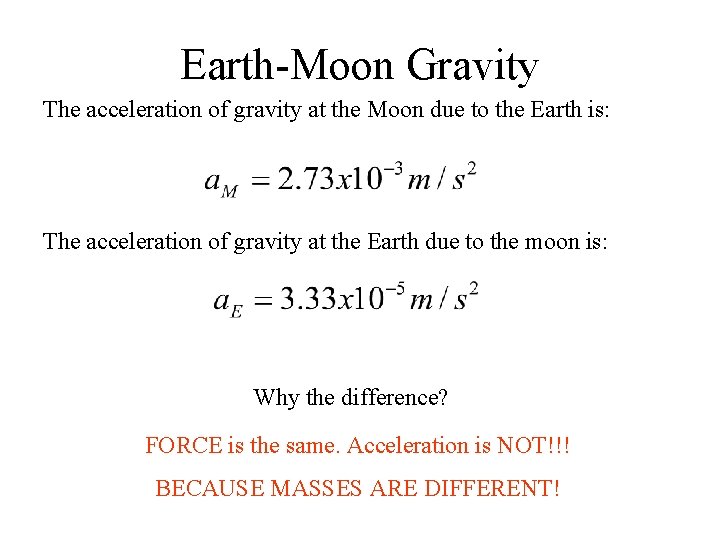
Earth-Moon Gravity The acceleration of gravity at the Moon due to the Earth is: The acceleration of gravity at the Earth due to the moon is: Why the difference? FORCE is the same. Acceleration is NOT!!! BECAUSE MASSES ARE DIFFERENT!
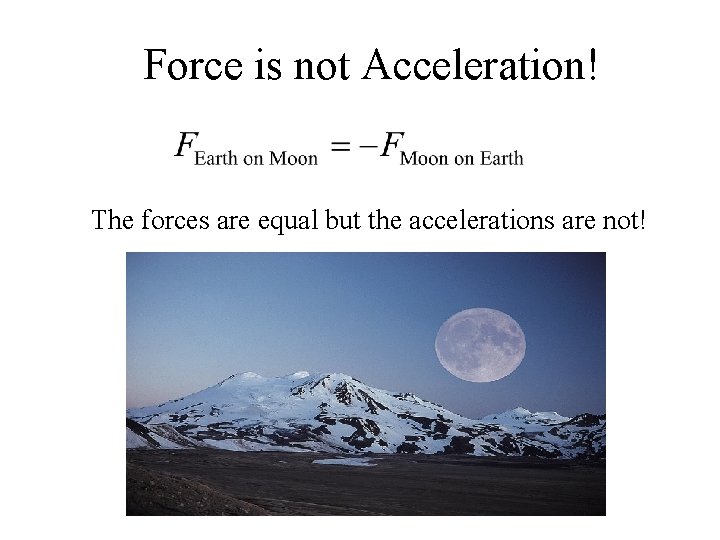
Force is not Acceleration! The forces are equal but the accelerations are not!
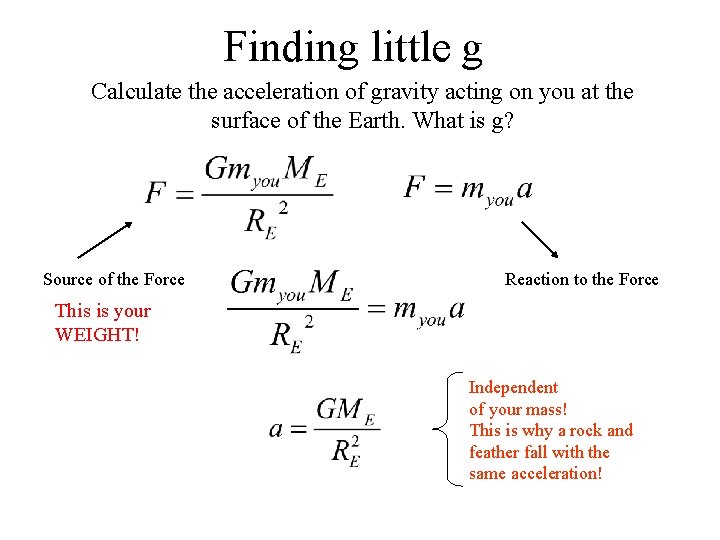
Finding little g Calculate the acceleration of gravity acting on you at the surface of the Earth. What is g? Source of the Force Reaction to the Force This is your WEIGHT! Independent of your mass! This is why a rock and feather fall with the same acceleration!
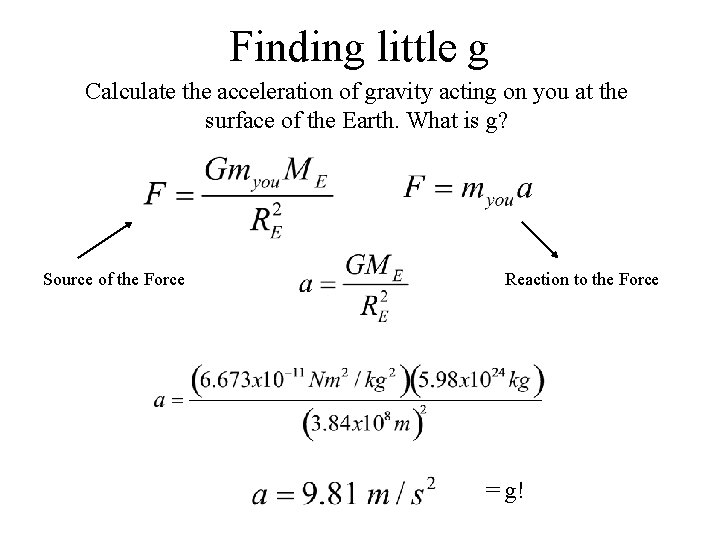
Finding little g Calculate the acceleration of gravity acting on you at the surface of the Earth. What is g? Source of the Force Reaction to the Force = g!
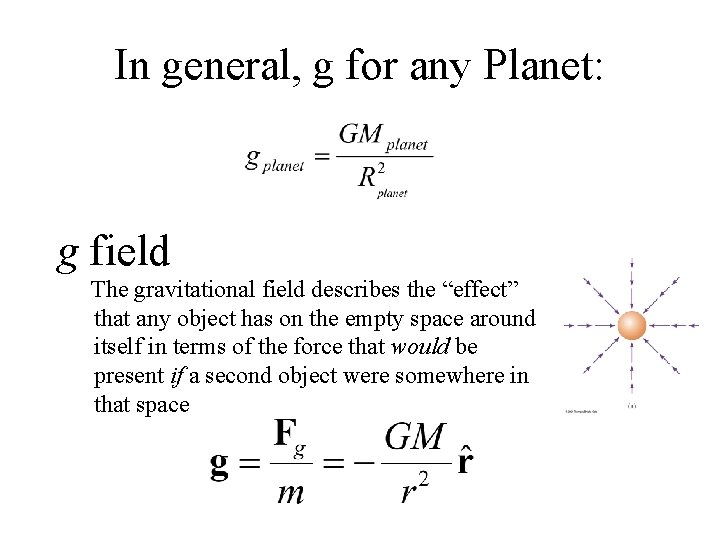
In general, g for any Planet: g field The gravitational field describes the “effect” that any object has on the empty space around itself in terms of the force that would be present if a second object were somewhere in that space
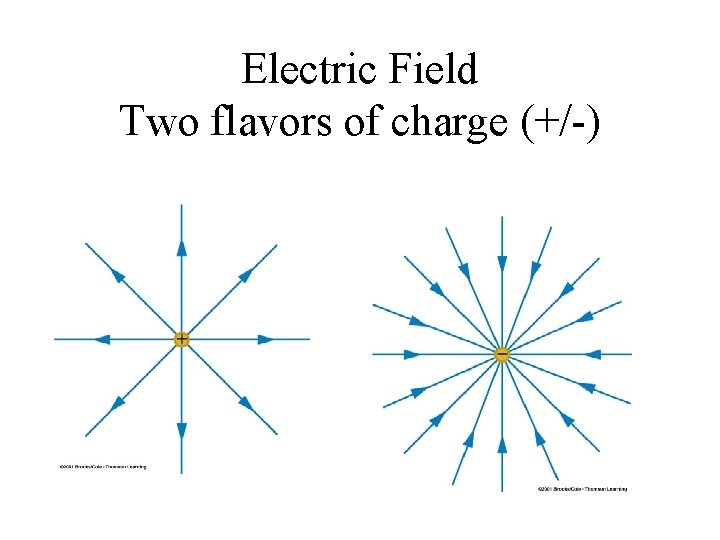
Electric Field Two flavors of charge (+/-)
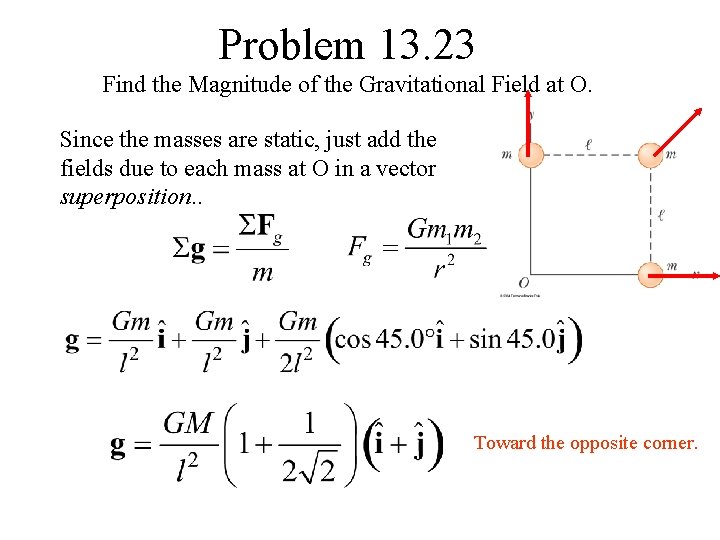
Problem 13. 23 Find the Magnitude of the Gravitational Field at O. Since the masses are static, just add the fields due to each mass at O in a vector superposition. . Toward the opposite corner.
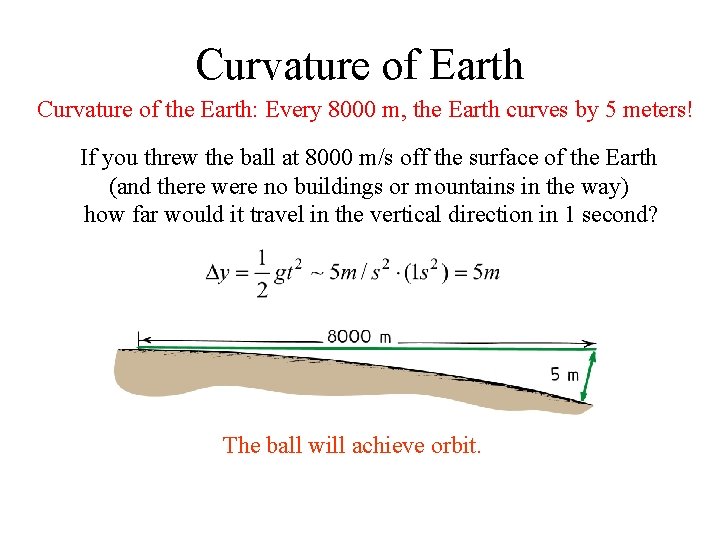
Curvature of Earth Curvature of the Earth: Every 8000 m, the Earth curves by 5 meters! If you threw the ball at 8000 m/s off the surface of the Earth (and there were no buildings or mountains in the way) how far would it travel in the vertical direction in 1 second? The ball will achieve orbit.
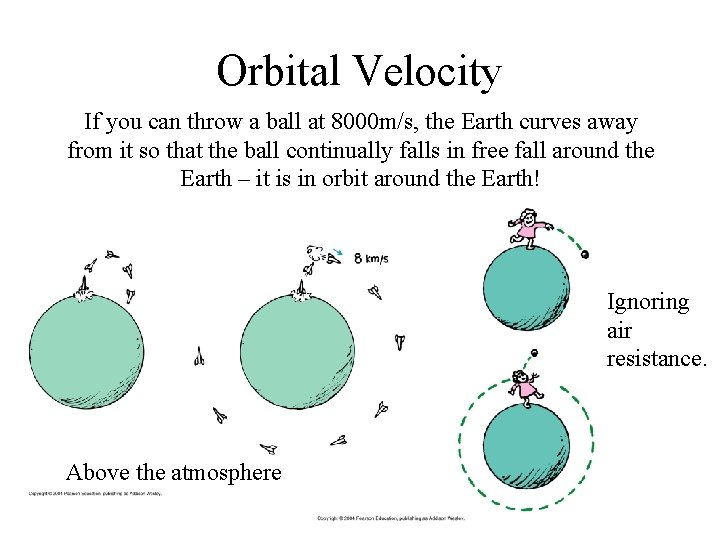
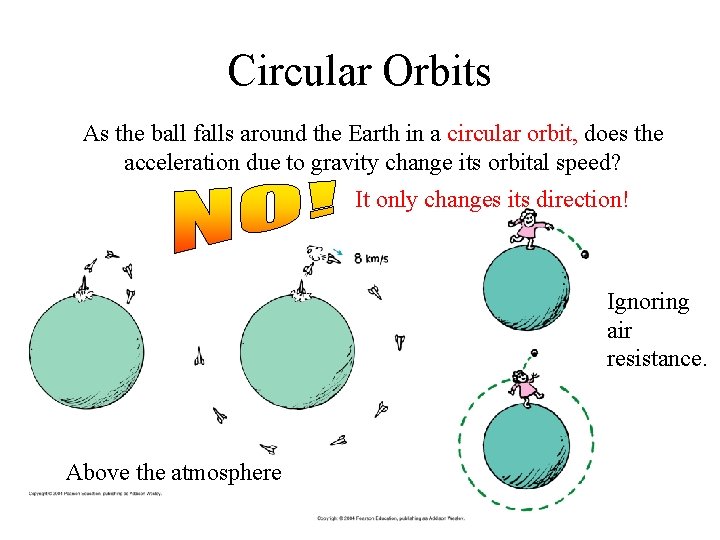
Orbital Velocity If you can throw a ball at 8000 m/s, the Earth curves away from it so that the ball continually falls in free fall around the Earth – it is in orbit around the Earth! Ignoring air resistance. Above the atmosphere
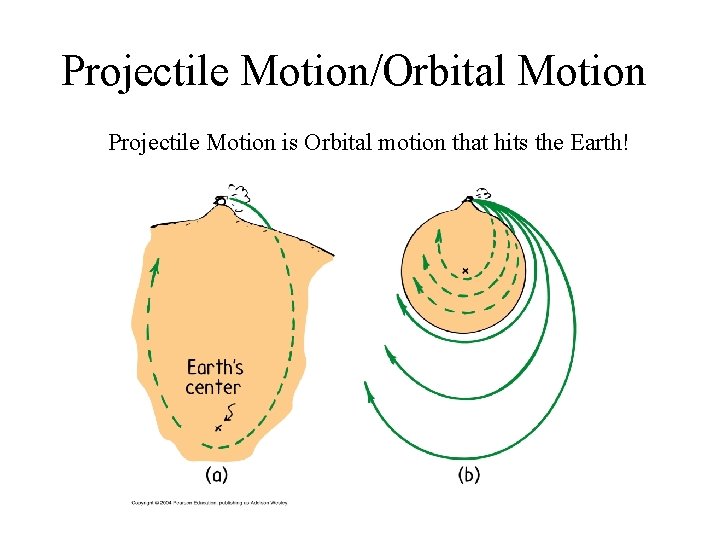
Projectile Motion/Orbital Motion Projectile Motion is Orbital motion that hits the Earth!
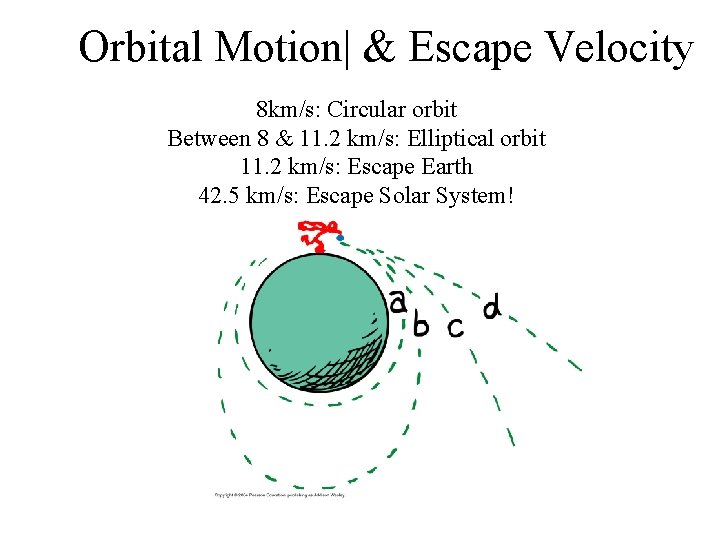
Orbital Motion| & Escape Velocity 8 km/s: Circular orbit Between 8 & 11. 2 km/s: Elliptical orbit 11. 2 km/s: Escape Earth 42. 5 km/s: Escape Solar System!
Circular Orbits As the ball falls around the Earth in a circular orbit, does the acceleration due to gravity change its orbital speed? It only changes its direction! Ignoring air resistance. Above the atmosphere
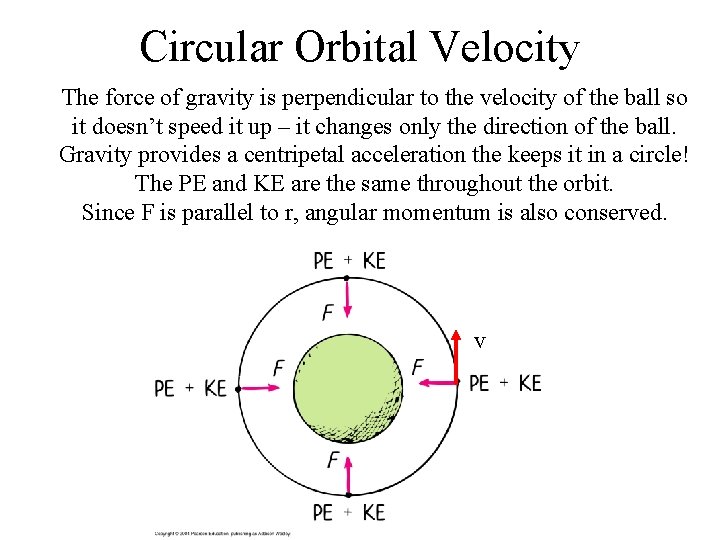
Circular Orbital Velocity The force of gravity is perpendicular to the velocity of the ball so it doesn’t speed it up – it changes only the direction of the ball. Gravity provides a centripetal acceleration the keeps it in a circle! The PE and KE are the same throughout the orbit. Since F is parallel to r, angular momentum is also conserved. v
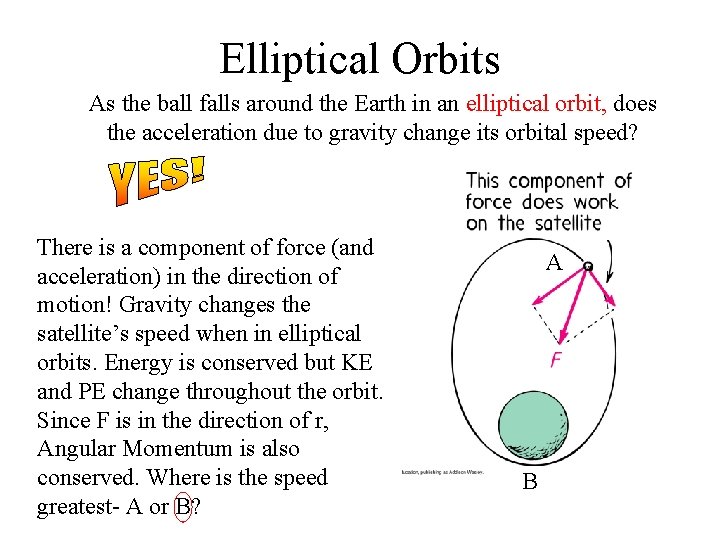
Elliptical Orbits As the ball falls around the Earth in an elliptical orbit, does the acceleration due to gravity change its orbital speed? There is a component of force (and acceleration) in the direction of motion! Gravity changes the satellite’s speed when in elliptical orbits. Energy is conserved but KE and PE change throughout the orbit. Since F is in the direction of r, Angular Momentum is also conserved. Where is the speed greatest- A or B? A B
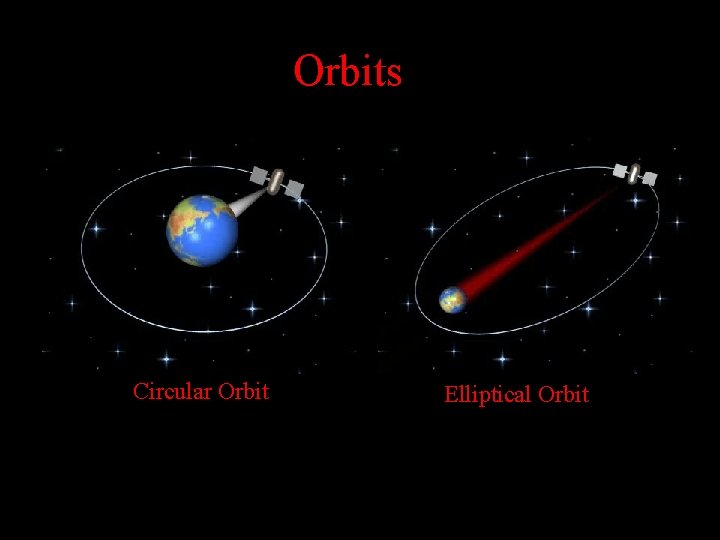
Orbits Circular Orbit Elliptical Orbit
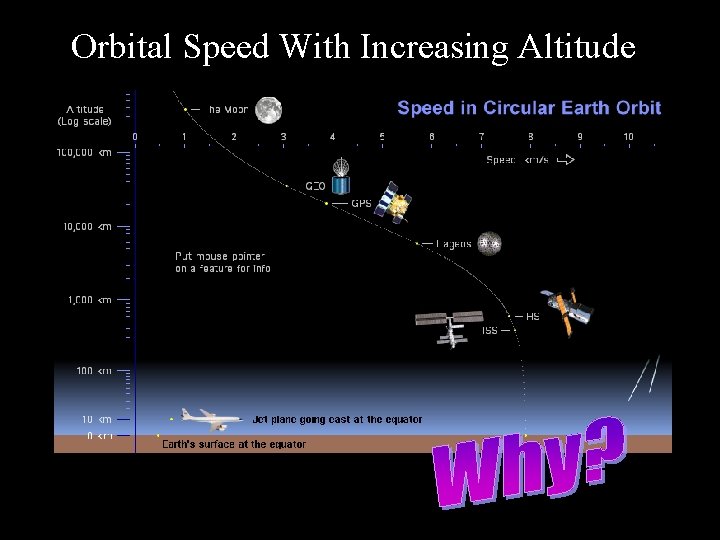
Orbital Speed With Increasing Altitude
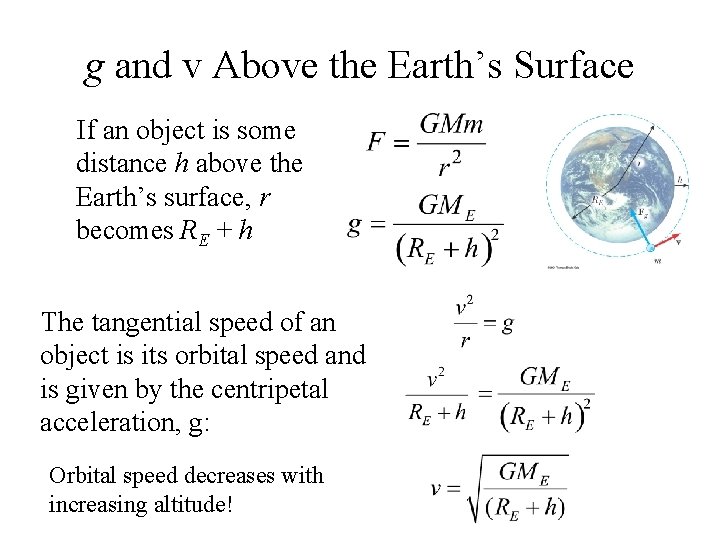
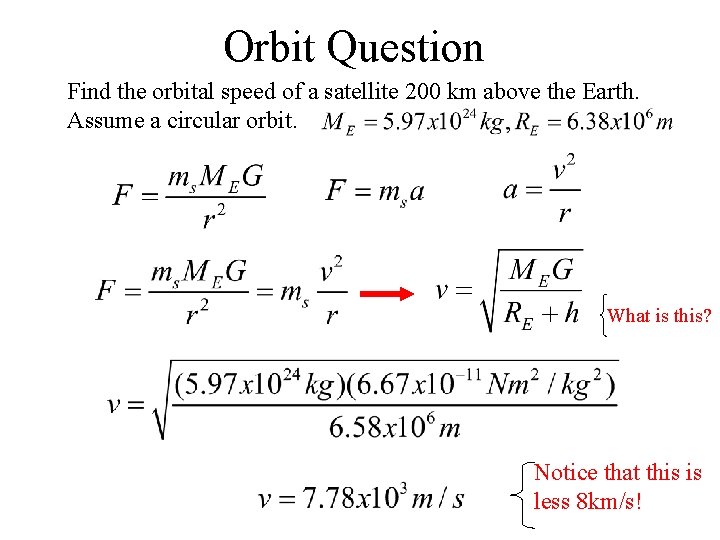
g and v Above the Earth’s Surface If an object is some distance h above the Earth’s surface, r becomes RE + h The tangential speed of an object is its orbital speed and is given by the centripetal acceleration, g: Orbital speed decreases with increasing altitude!
Orbit Question Find the orbital speed of a satellite 200 km above the Earth. Assume a circular orbit. What is this? Notice that this is less 8 km/s!
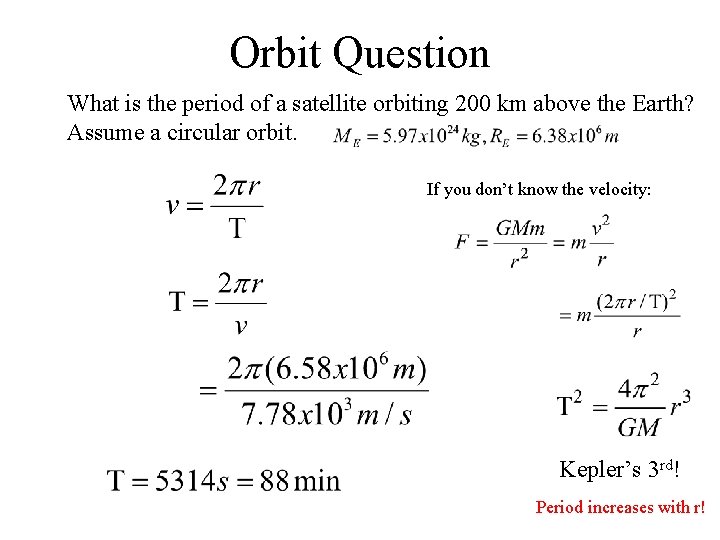
Orbit Question What is the period of a satellite orbiting 200 km above the Earth? Assume a circular orbit. If you don’t know the velocity: Kepler’s 3 rd! Period increases with r!
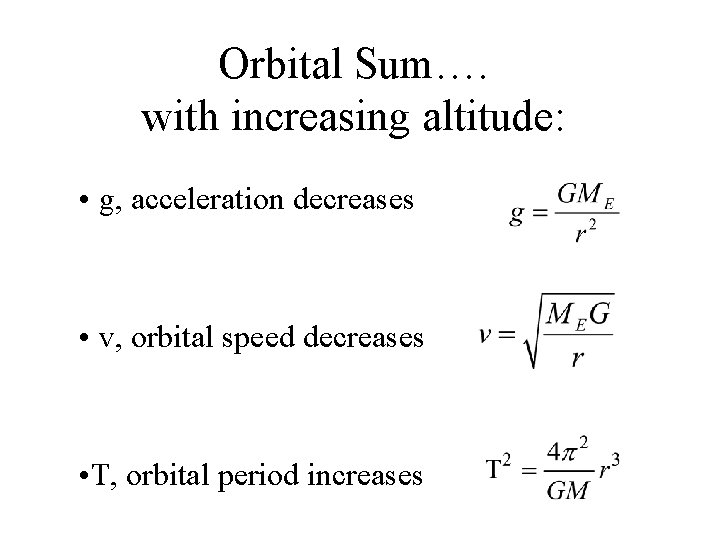
Orbital Sum…. with increasing altitude: • g, acceleration decreases • v, orbital speed decreases • T, orbital period increases
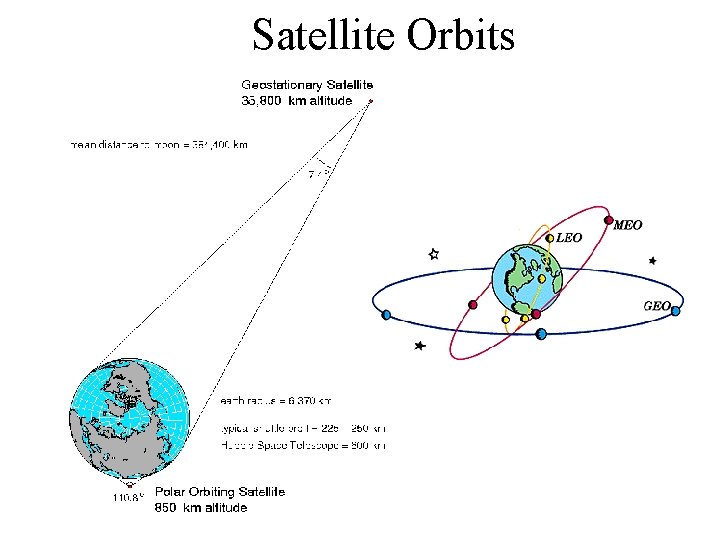
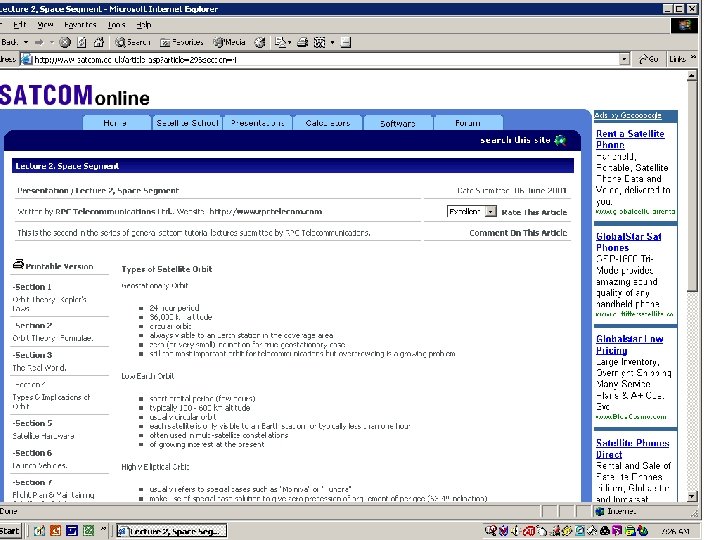
Satellite Orbits
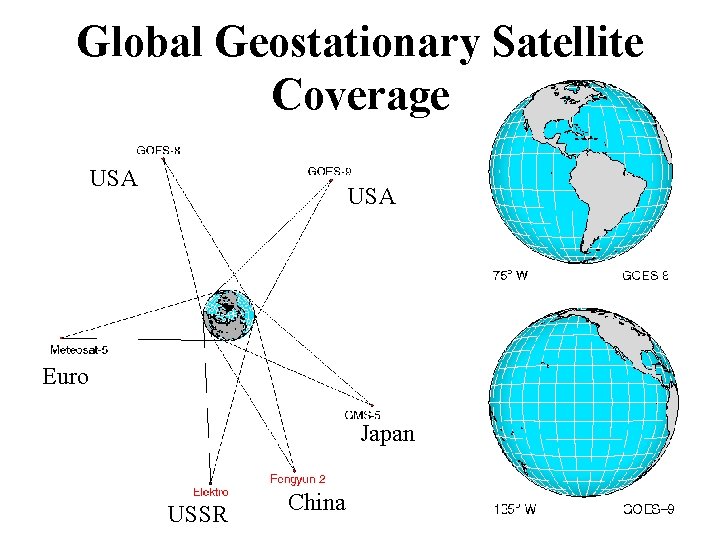
Global Geostationary Satellite Coverage USA Euro Japan USSR China
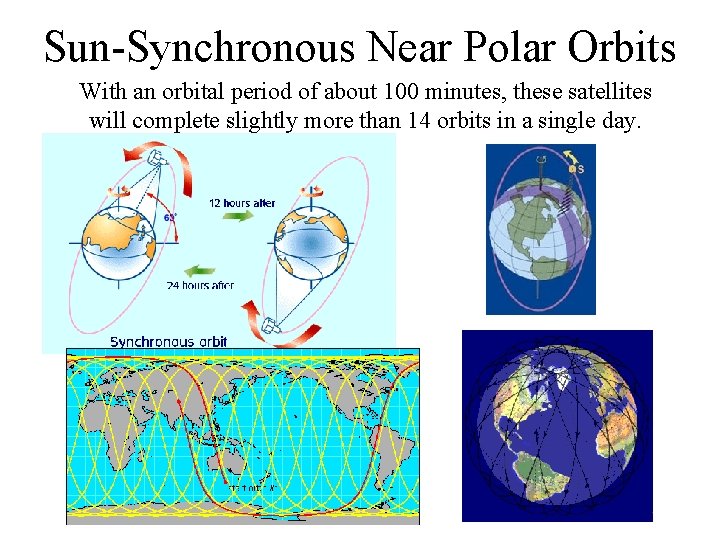
Sun-Synchronous Near Polar Orbits With an orbital period of about 100 minutes, these satellites will complete slightly more than 14 orbits in a single day.
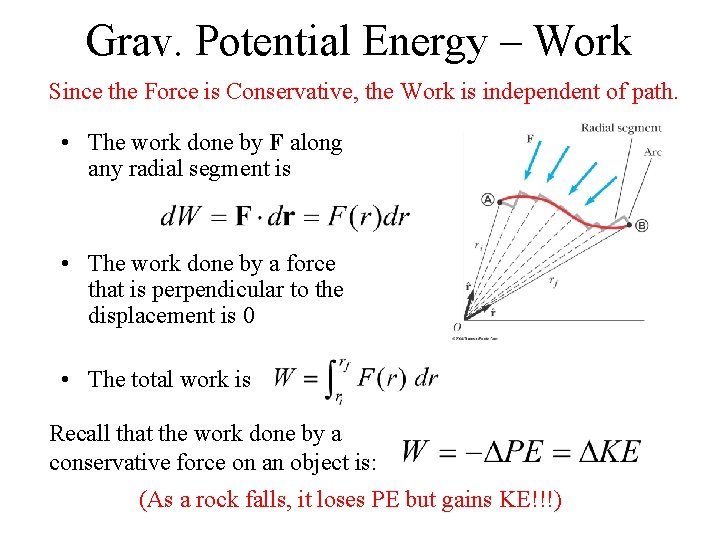
Grav. Potential Energy – Work Since the Force is Conservative, the Work is independent of path. • The work done by F along any radial segment is • The work done by a force that is perpendicular to the displacement is 0 • The total work is Recall that the work done by a conservative force on an object is: (As a rock falls, it loses PE but gains KE!!!)
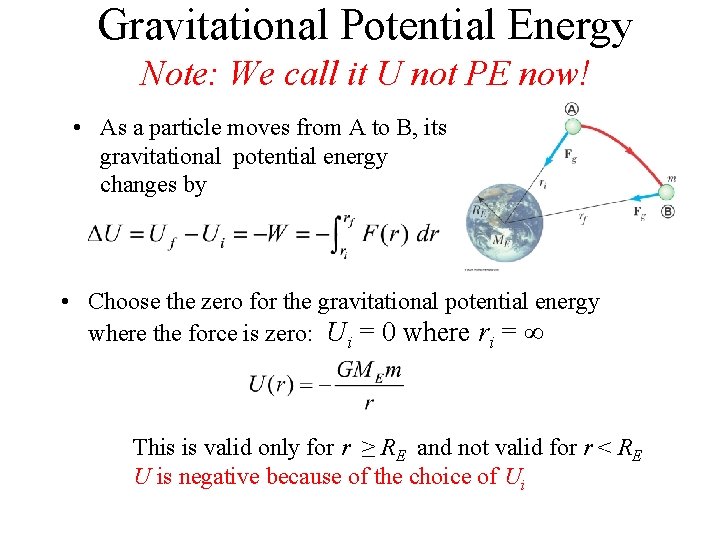
Gravitational Potential Energy Note: We call it U not PE now! • As a particle moves from A to B, its gravitational potential energy changes by • Choose the zero for the gravitational potential energy where the force is zero: Ui = 0 where ri = ∞ This is valid only for r ≥ RE and not valid for r < RE U is negative because of the choice of Ui
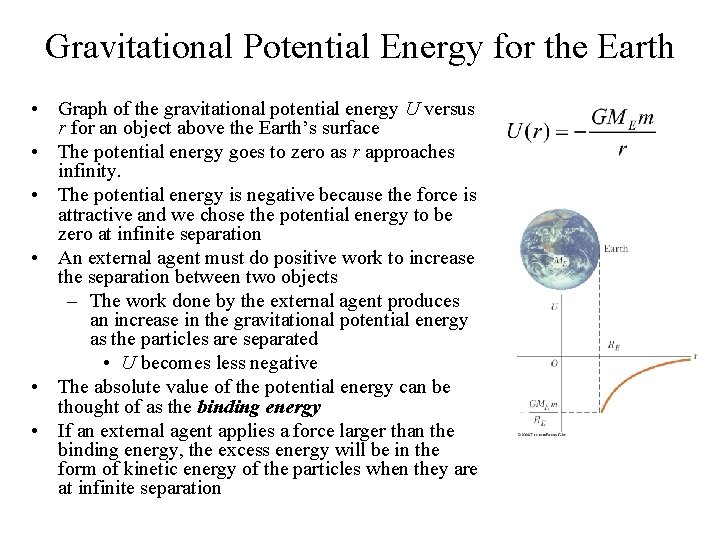
Gravitational Potential Energy for the Earth • Graph of the gravitational potential energy U versus r for an object above the Earth’s surface • The potential energy goes to zero as r approaches infinity. • The potential energy is negative because the force is attractive and we chose the potential energy to be zero at infinite separation • An external agent must do positive work to increase the separation between two objects – The work done by the external agent produces an increase in the gravitational potential energy as the particles are separated • U becomes less negative • The absolute value of the potential energy can be thought of as the binding energy • If an external agent applies a force larger than the binding energy, the excess energy will be in the form of kinetic energy of the particles when they are at infinite separation
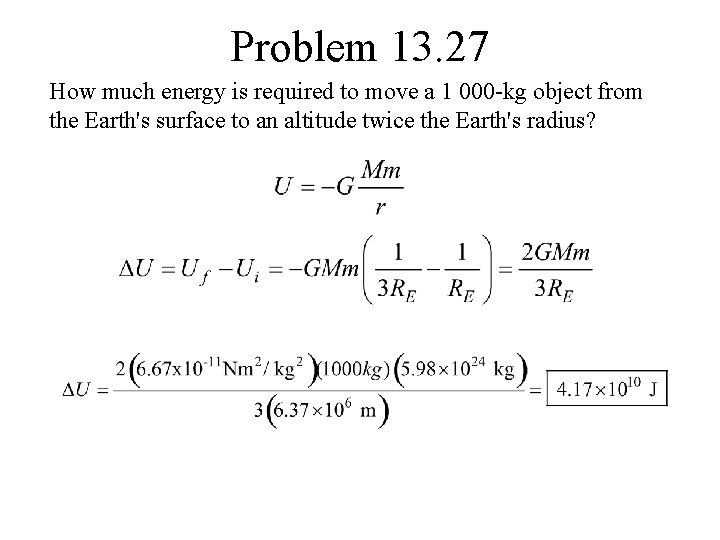
Problem 13. 27 How much energy is required to move a 1 000 -kg object from the Earth's surface to an altitude twice the Earth's radius?
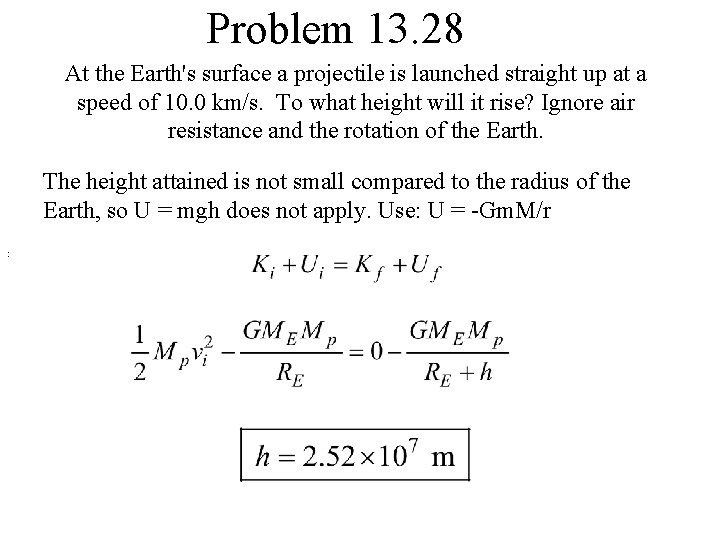
Problem 13. 28 At the Earth's surface a projectile is launched straight up at a speed of 10. 0 km/s. To what height will it rise? Ignore air resistance and the rotation of the Earth. The height attained is not small compared to the radius of the Earth, so U = mgh does not apply. Use: U = -Gm. M/r :
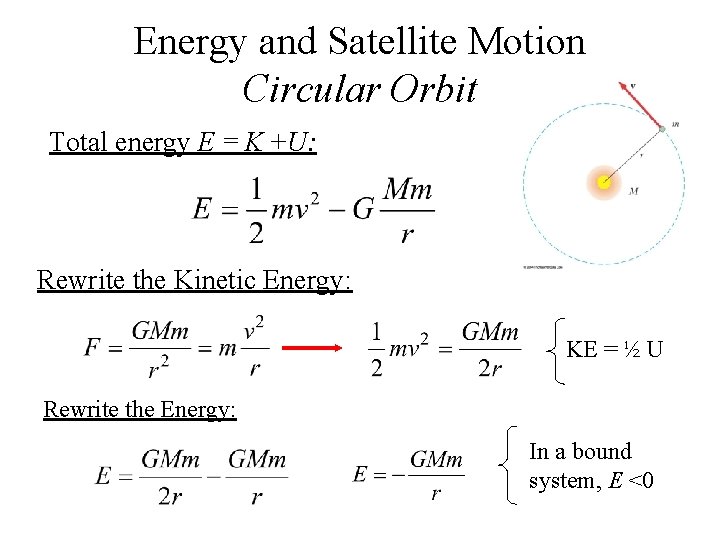
Energy and Satellite Motion Circular Orbit Total energy E = K +U: Rewrite the Kinetic Energy: KE = ½ U Rewrite the Energy: In a bound system, E <0
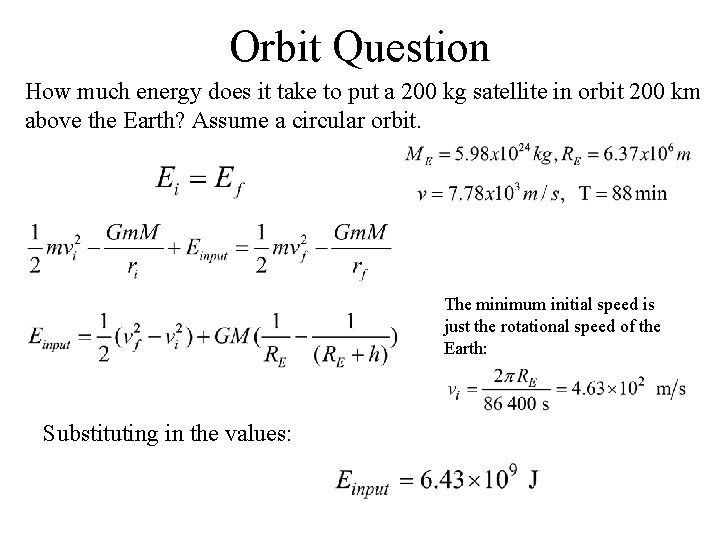
Orbit Question How much energy does it take to put a 200 kg satellite in orbit 200 km above the Earth? Assume a circular orbit. The minimum initial speed is just the rotational speed of the Earth: Substituting in the values:
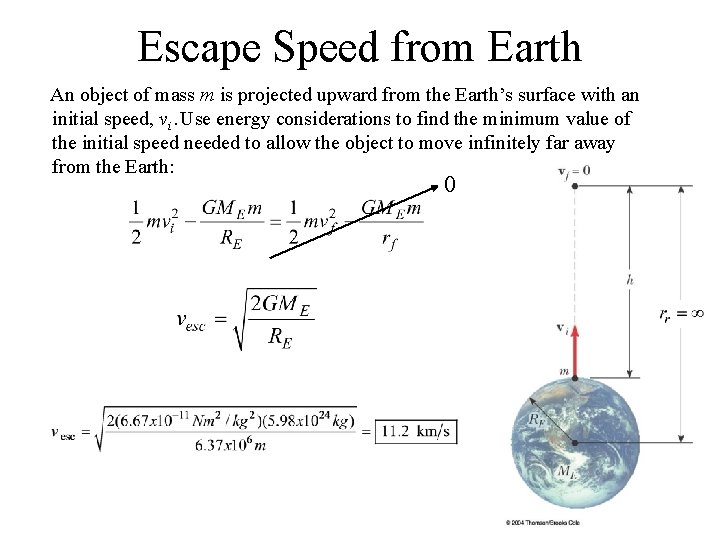
Escape Speed from Earth An object of mass m is projected upward from the Earth’s surface with an initial speed, vi. Use energy considerations to find the minimum value of the initial speed needed to allow the object to move infinitely far away from the Earth: 0
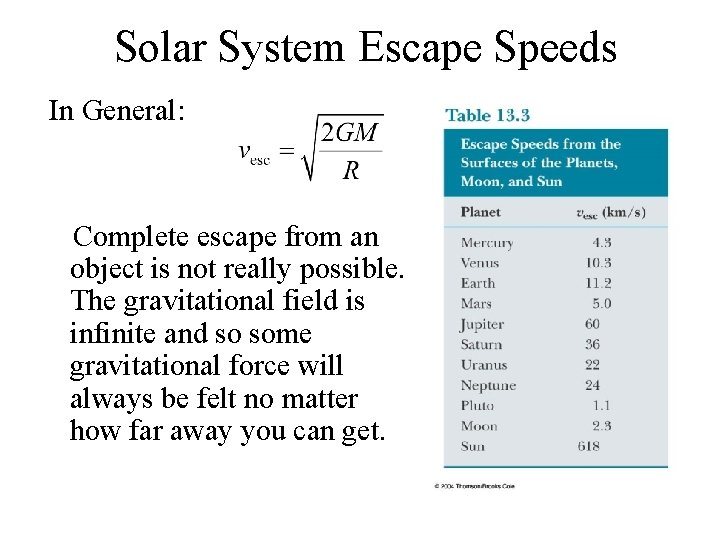
Solar System Escape Speeds In General: Complete escape from an object is not really possible. The gravitational field is infinite and so some gravitational force will always be felt no matter how far away you can get.
Systems with Three or More Particles STATIC • The total gravitational potential energy of the system is the sum over all pairs of particles • Gravitational potential energy obeys the superposition principle • The absolute value of Utotal represents the work needed to separate the particles by an infinite distance
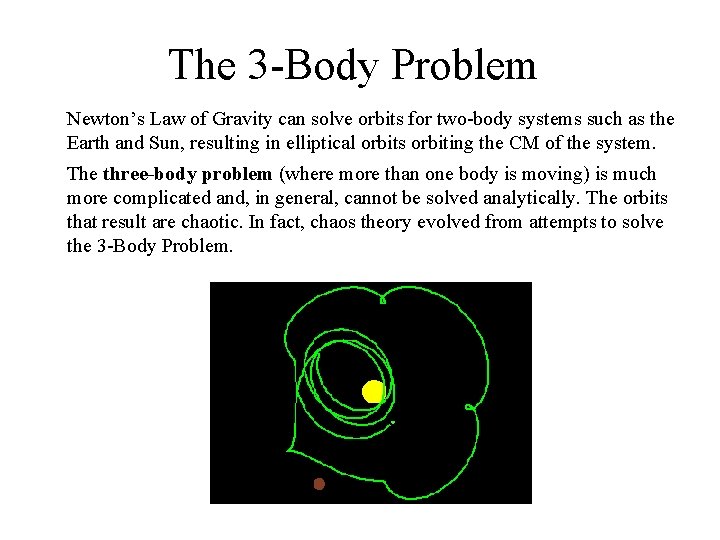
The 3 -Body Problem Newton’s Law of Gravity can solve orbits for two-body systems such as the Earth and Sun, resulting in elliptical orbits orbiting the CM of the system. The three-body problem (where more than one body is moving) is much more complicated and, in general, cannot be solved analytically. The orbits that result are chaotic. In fact, chaos theory evolved from attempts to solve the 3 -Body Problem.
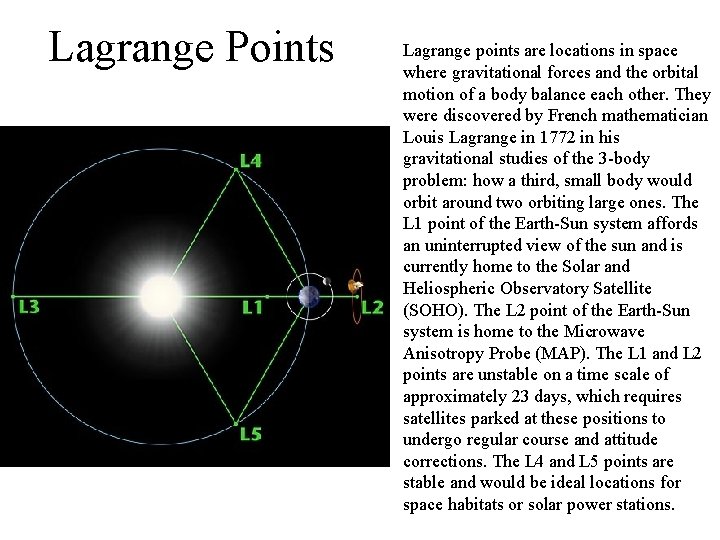
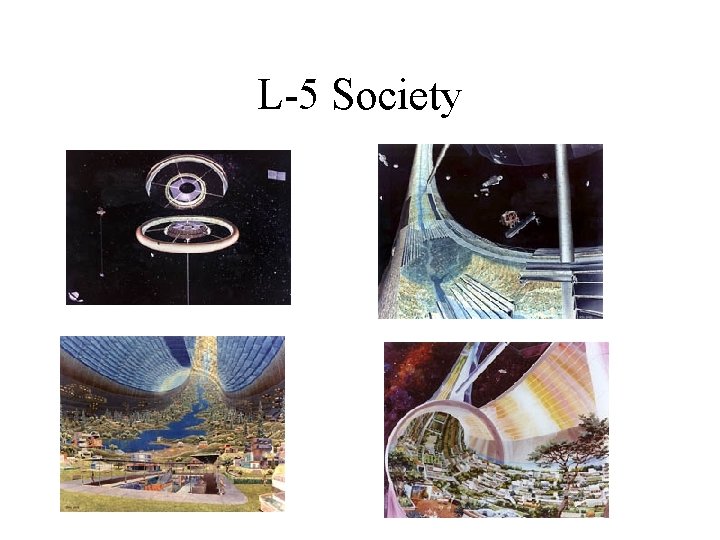
Lagrange Points Lagrange points are locations in space where gravitational forces and the orbital motion of a body balance each other. They were discovered by French mathematician Louis Lagrange in 1772 in his gravitational studies of the 3 -body problem: how a third, small body would orbit around two orbiting large ones. The L 1 point of the Earth-Sun system affords an uninterrupted view of the sun and is currently home to the Solar and Heliospheric Observatory Satellite (SOHO). The L 2 point of the Earth-Sun system is home to the Microwave Anisotropy Probe (MAP). The L 1 and L 2 points are unstable on a time scale of approximately 23 days, which requires satellites parked at these positions to undergo regular course and attitude corrections. The L 4 and L 5 points are stable and would be ideal locations for space habitats or solar power stations.
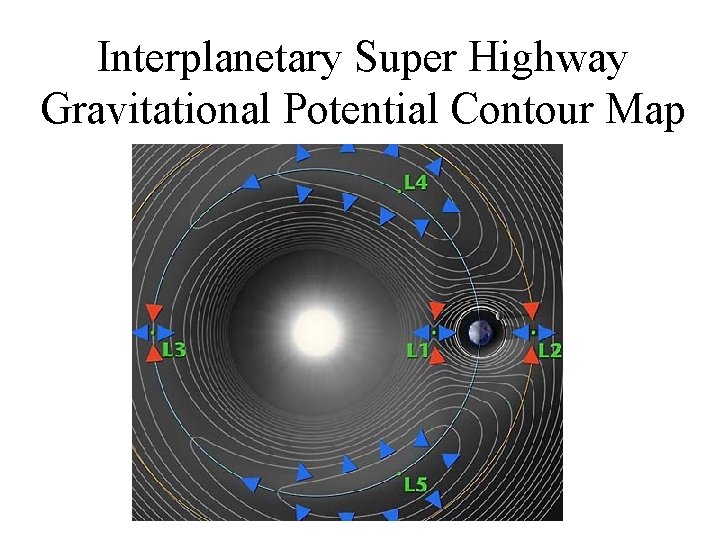
Interplanetary Super Highway Gravitational Potential Contour Map
L-5 Society
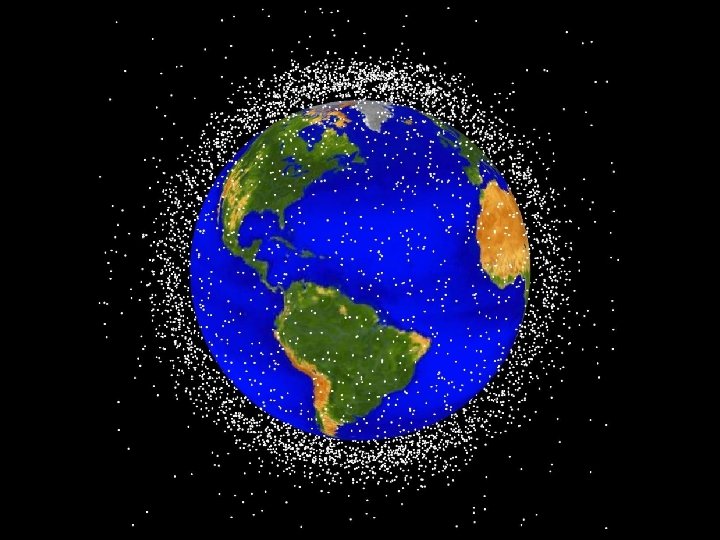
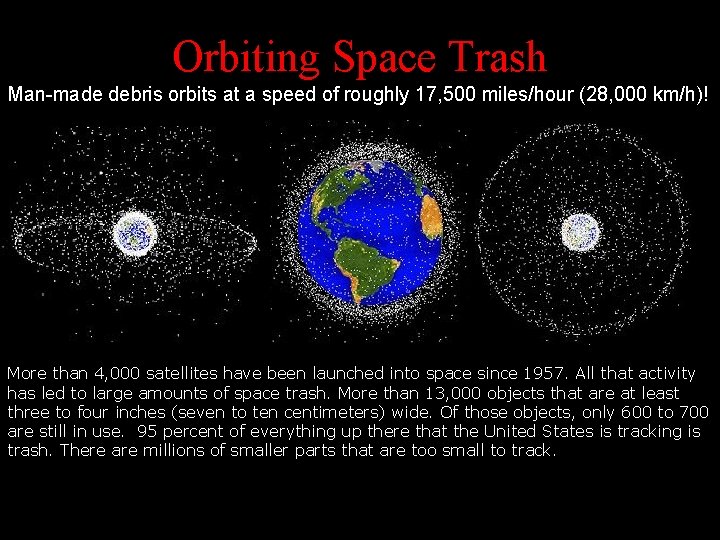
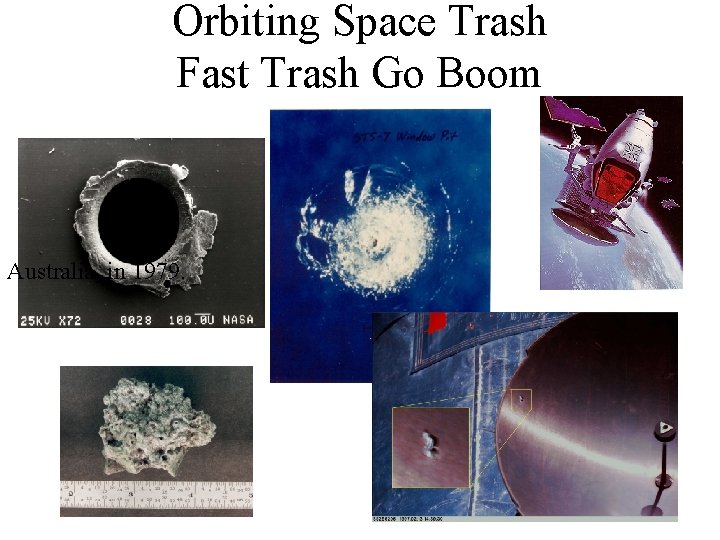
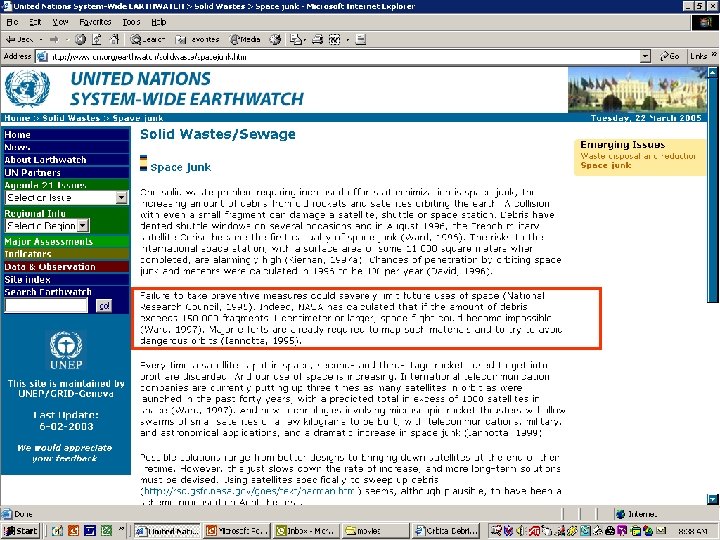
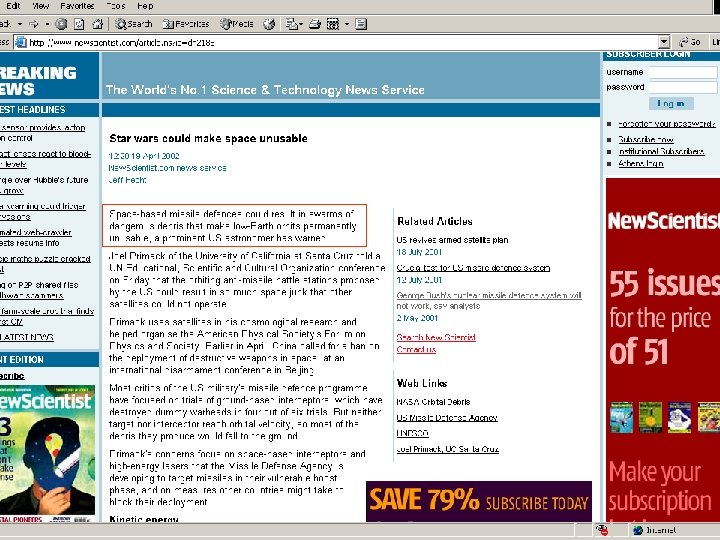
Orbiting Space Trash Man-made debris orbits at a speed of roughly 17, 500 miles/hour (28, 000 km/h)! More than 4, 000 satellites have been launched into space since 1957. All that activity has led to large amounts of space trash. More than 13, 000 objects that are at least three to four inches (seven to ten centimeters) wide. Of those objects, only 600 to 700 are still in use. 95 percent of everything up there that the United States is tracking is trash. There are millions of smaller parts that are too small to track.
Orbiting Space Trash Fast Trash Go Boom Australia, in 1979.
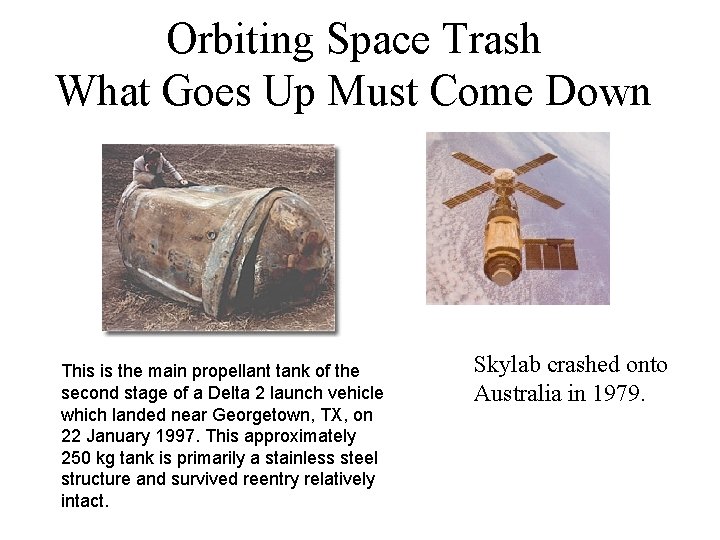
Orbiting Space Trash What Goes Up Must Come Down This is the main propellant tank of the second stage of a Delta 2 launch vehicle which landed near Georgetown, TX, on 22 January 1997. This approximately 250 kg tank is primarily a stainless steel structure and survived reentry relatively intact. Skylab crashed onto Australia in 1979.
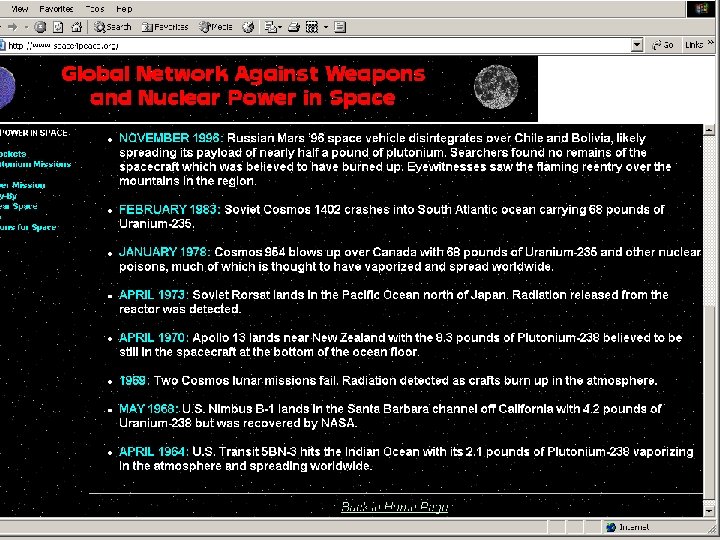
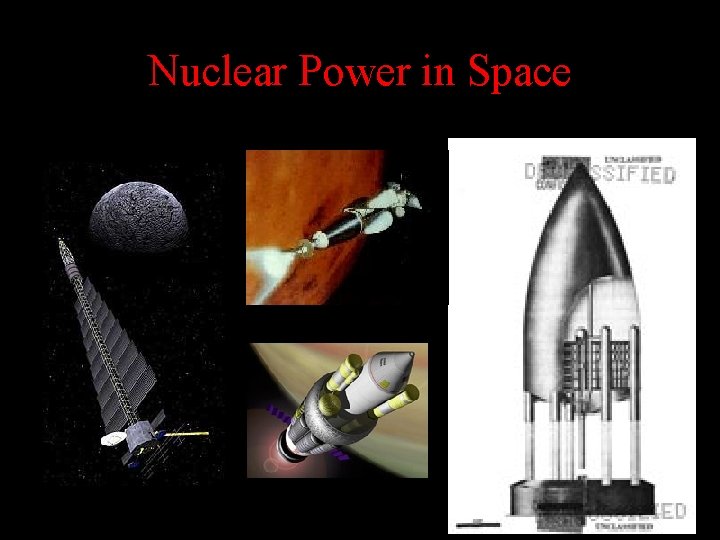
Nuclear Power in Space
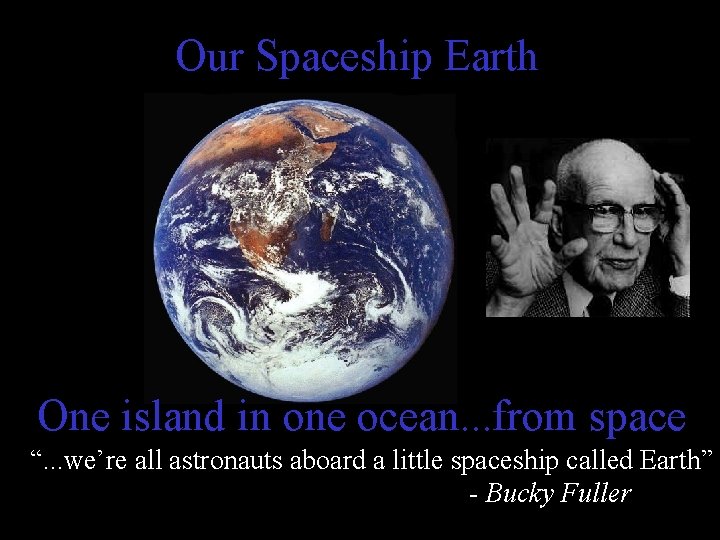
Our Spaceship Earth One island in one ocean. . . from space “. . . we’re all astronauts aboard a little spaceship called Earth” - Bucky Fuller
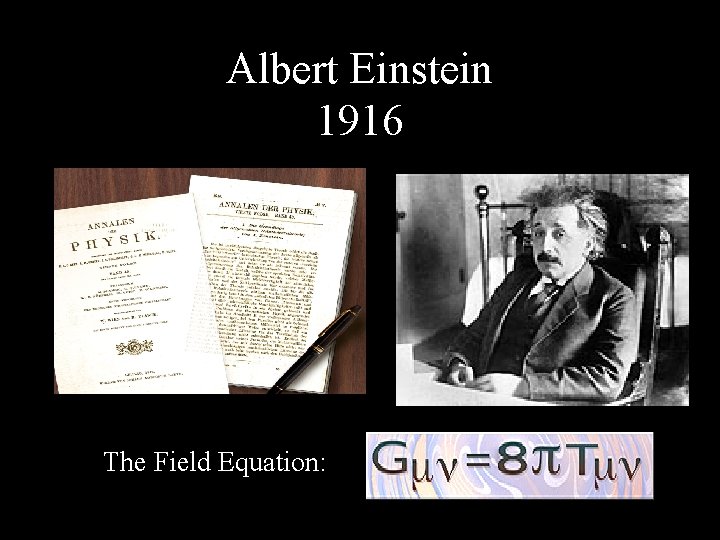
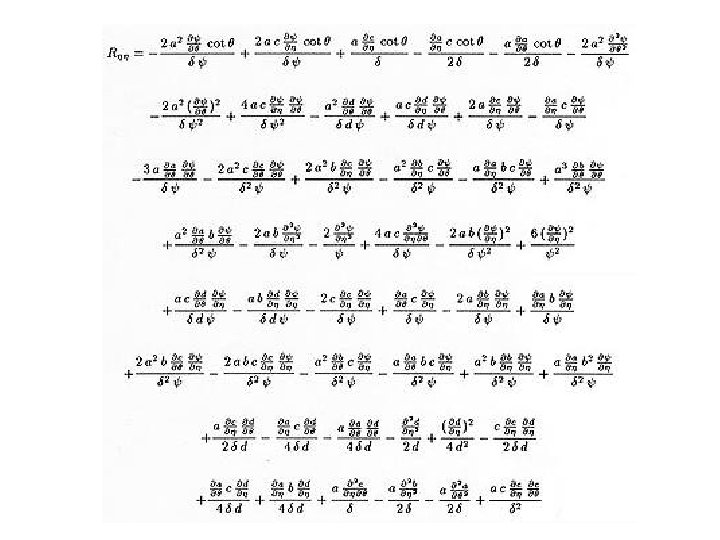
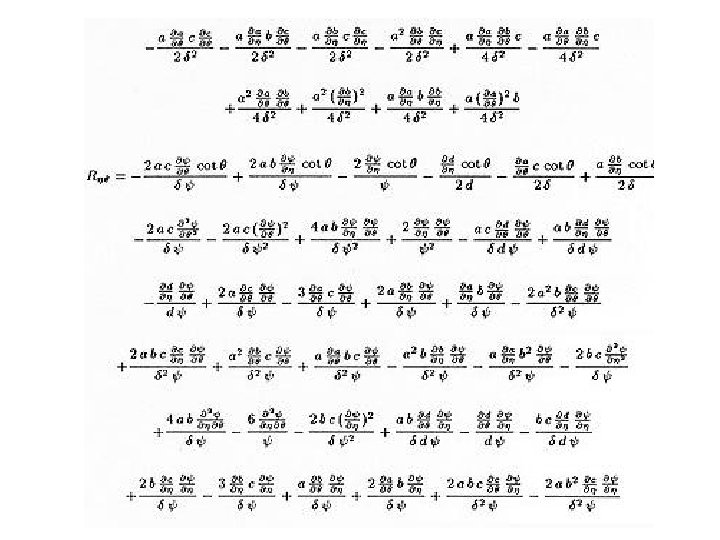
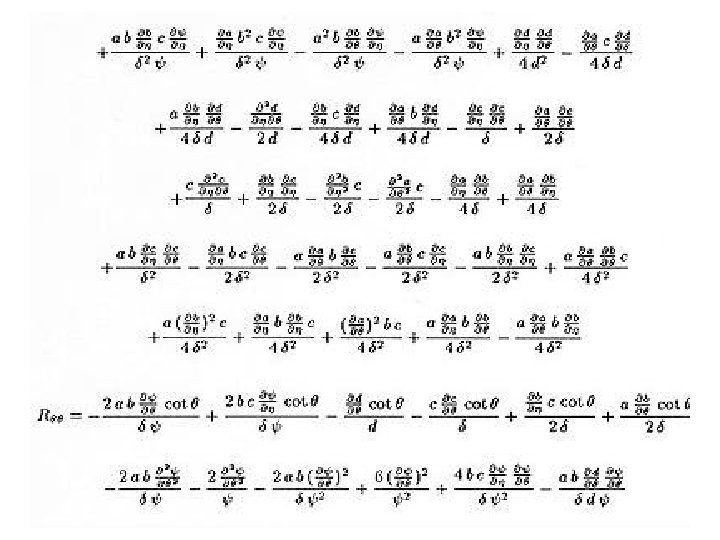
Albert Einstein 1916 The Field Equation:
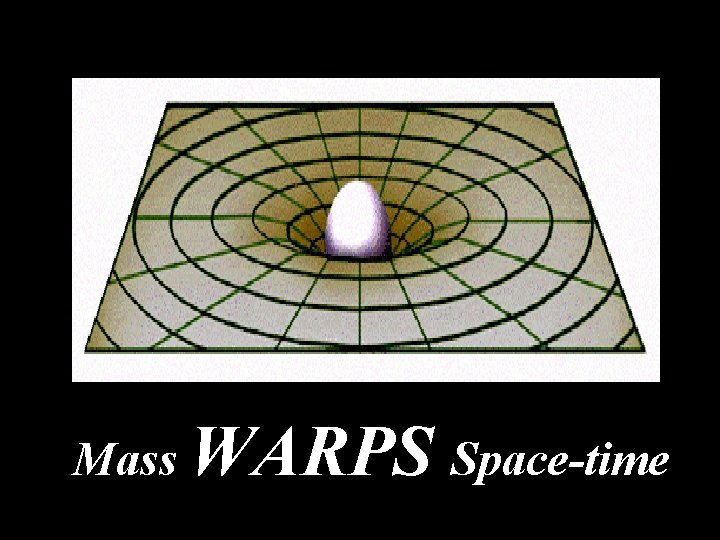
Mass WARPS Space-time
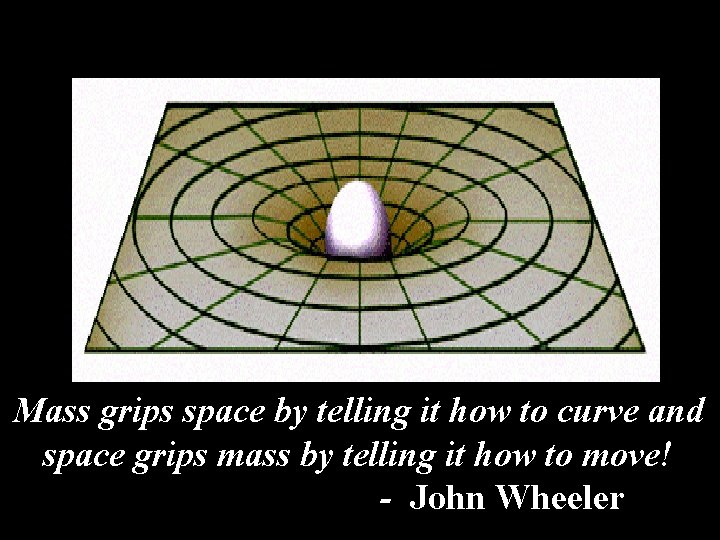
Mass grips space by telling it how to curve and space grips mass by telling it how to move! - John Wheeler
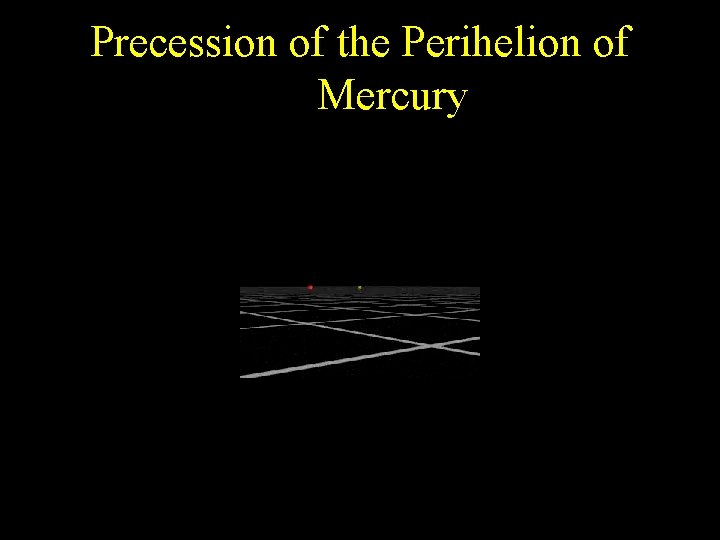
Precession of the Perihelion of Mercury
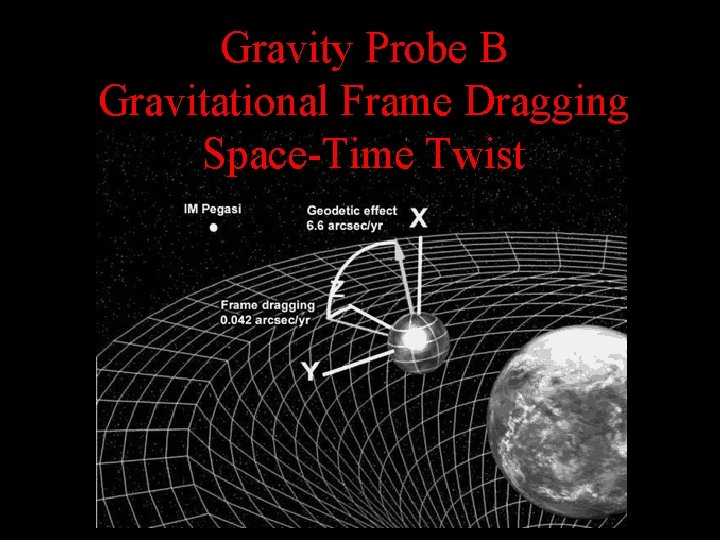
Gravity Probe B Gravitational Frame Dragging Space-Time Twist
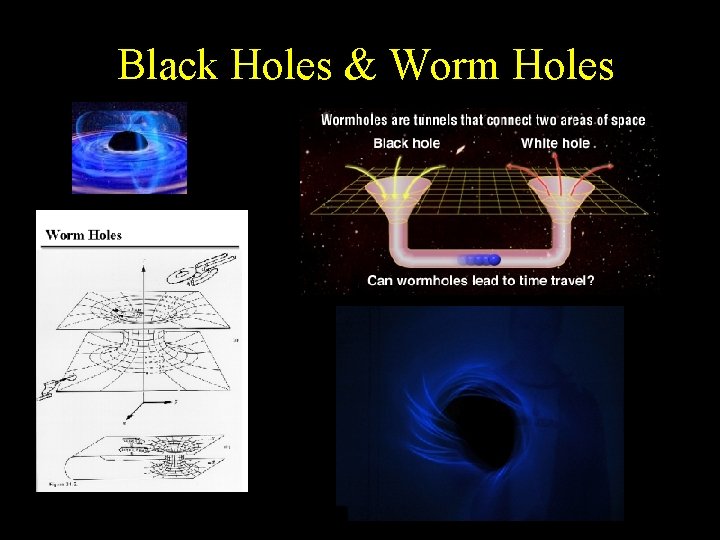
Black Holes & Worm Holes
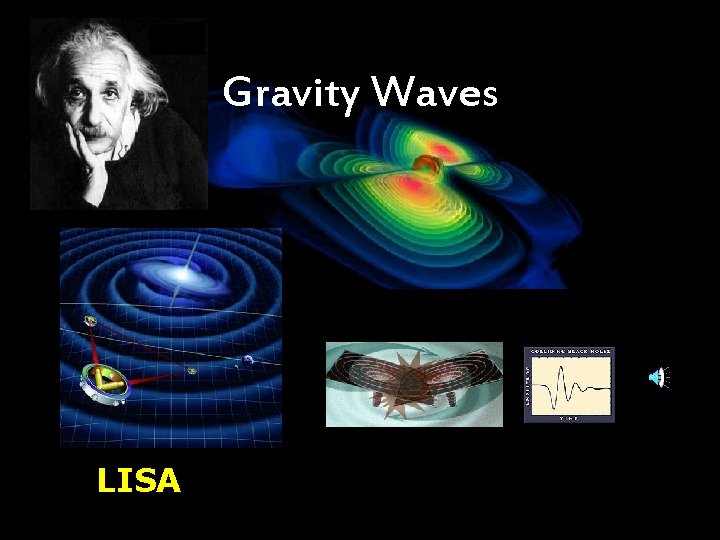
Gravity Waves LISA
Einstein for Everyone! Now Available in the SRJC Library!!!