
The Next Generation Science Standards A crash course

- Slides: 40
The Next Generation Science Standards A crash course in understanding and using NGSS in your classroom
Next Generation Science Standards Key Innovations • The NGSS are not curriculum, they are endpoints of instruction. • To reach endpoints, students use the science and engineering practices, disciplinary core ideas, and crosscutting concepts to explain phenomena and/or design solutions. • For instructional materials to be aligned to the NGSS, lessons must meet the criteria of three-dimensional learning
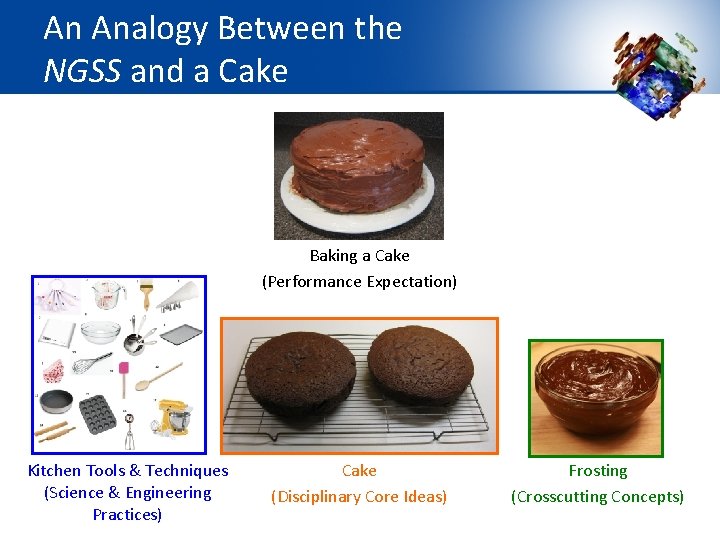
An Analogy Between the NGSS and a Cake Baking a Cake (Performance Expectation) Kitchen Tools & Techniques (Science & Engineering Practices) Cake (Disciplinary Core Ideas) Frosting (Crosscutting Concepts)
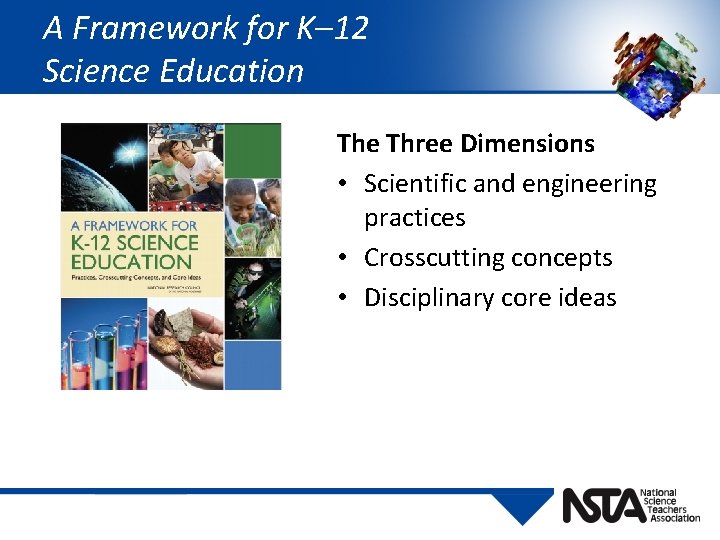
A Framework for K– 12 Science Education The Three Dimensions • Scientific and engineering practices • Crosscutting concepts • Disciplinary core ideas
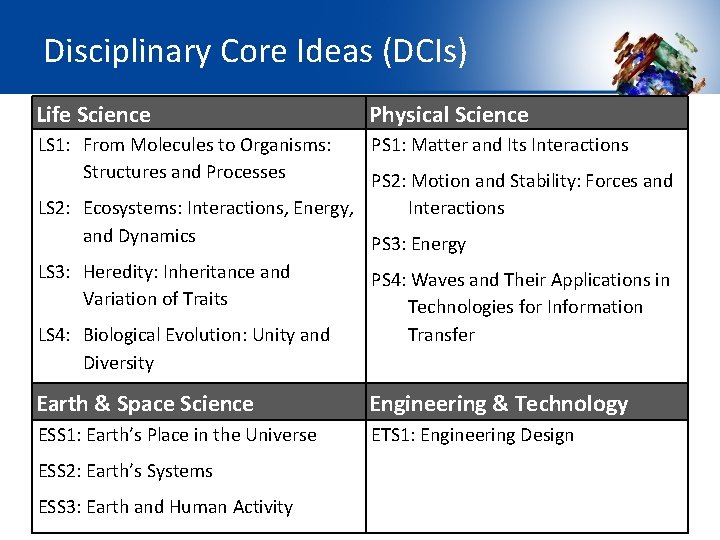
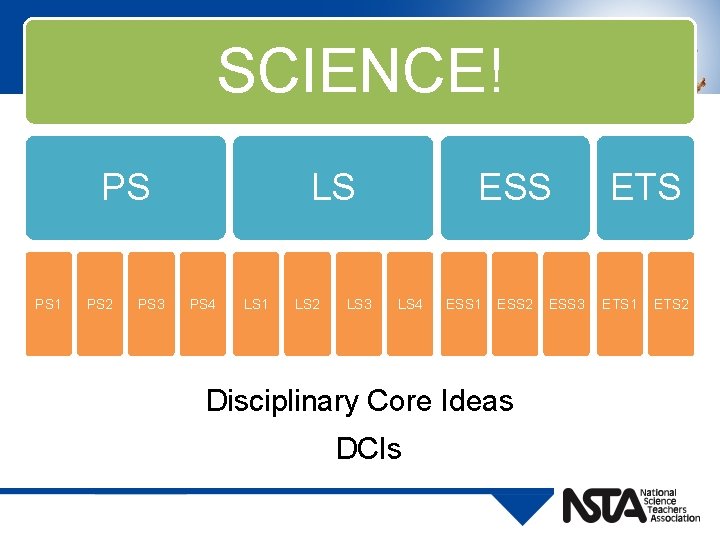
Disciplinary Core Ideas (DCIs) Life Science Physical Science LS 1: From Molecules to Organisms: Structures and Processes PS 1: Matter and Its Interactions LS 3: Heredity: Inheritance and Variation of Traits PS 4: Waves and Their Applications in Technologies for Information Transfer PS 2: Motion and Stability: Forces and LS 2: Ecosystems: Interactions, Energy, Interactions and Dynamics PS 3: Energy LS 4: Biological Evolution: Unity and Diversity Earth & Space Science Engineering & Technology ESS 1: Earth’s Place in the Universe ETS 1: Engineering Design ESS 2: Earth’s Systems ESS 3: Earth and Human Activity
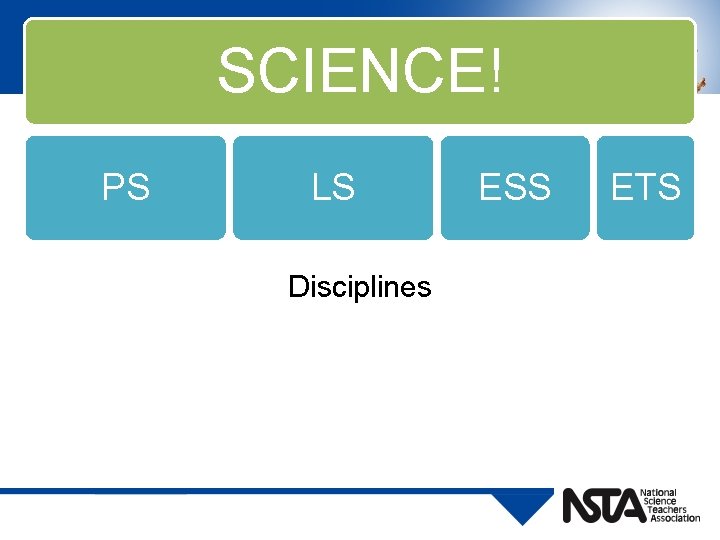
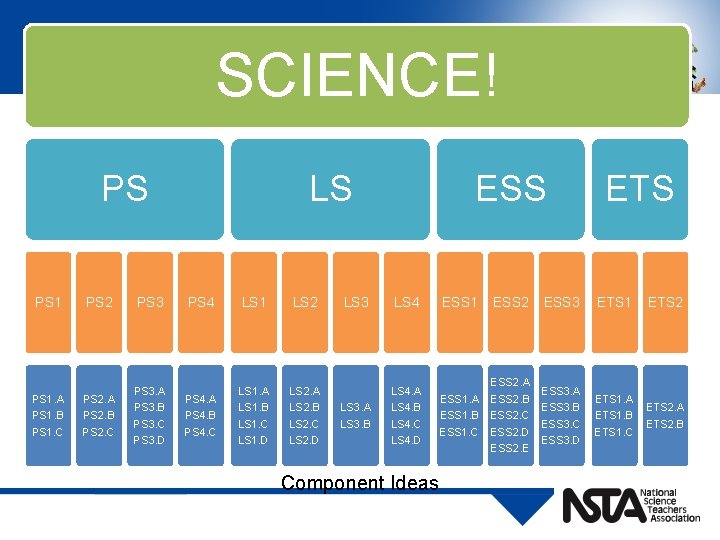
SCIENCE! PS PS 1 PS 2 PS 1. A PS 1. B PS 2. A PS 2. B PS 1. C PS 2. C PS 3. A PS 3. B PS 3. C PS 3. D LS PS 4. A PS 4. B PS 4. C LS 1 LS 2 LS 1. A LS 2. A LS 1. B LS 1. C LS 1. D LS 2. B LS 2. C LS 2. D LS 3 ESS LS 4. A LS 3. B LS 4. C LS 4. D ESS 1. A ESS 1. B ESS 1. C ESS 2. A ESS 2. B ESS 2. C ESS 2. D ESS 2. E ESS 3. A ESS 3. B ESS 3. C ESS 3. D ETS 1. A ETS 1. B ETS 1. C ETS 2. A ETS 2. B
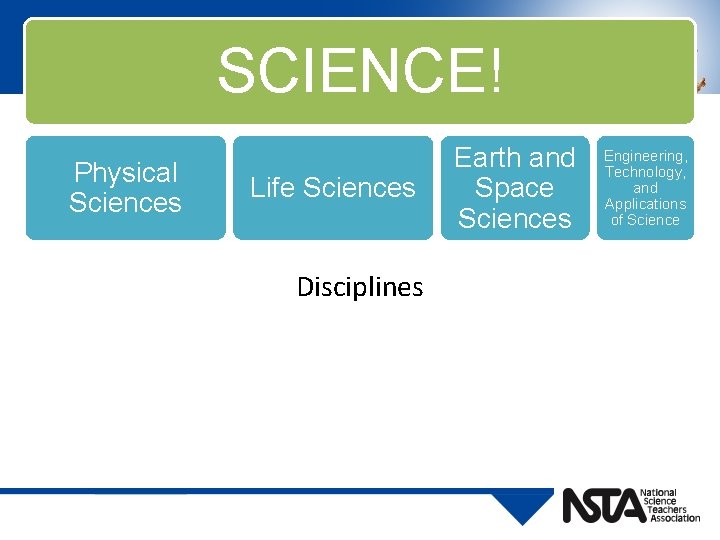
SCIENCE! Physical Sciences PS 1 PS 2 PS 1. A PS 1. B PS 2. A PS 2. B PS 1. C PS 2. C PS 3. A PS 3. B PS 3. C PS 3. D Life Sciences PS 4. A PS 4. B PS 4. C LS 1 Disciplines LS 2 LS 3 LS 4 LS 1. A LS 2. A LS 1. B LS 1. C LS 1. D LS 2. B LS 2. C LS 2. D LS 4. A LS 3. B LS 4. C LS 4. D Earth and Space Sciences ESS 1. A ESS 1. B ESS 1. C ESS 2. A ESS 2. B ESS 2. C ESS 2. D ESS 2. E ESS 3. A ESS 3. B ESS 3. C ESS 3. D Engineering, Technology, and Applications of Science ETS 1. A ETS 1. B ETS 1. C ETS 2. A ETS 2. B
SCIENCE! PS PS 1 PS 2 PS 1. A PS 1. B PS 2. A PS 2. B PS 1. C PS 2. C PS 3. A PS 3. B PS 3. C PS 3. D LS PS 4. A PS 4. B PS 4. C LS 1 ESS Disciplines LS 2 LS 3 LS 4 LS 1. A LS 2. A LS 1. B LS 1. C LS 1. D LS 2. B LS 2. C LS 2. D LS 4. A LS 3. B LS 4. C LS 4. D ESS 1. A ESS 1. B ESS 1. C ESS 2. A ESS 2. B ESS 2. C ESS 2. D ESS 2. E ESS 3. A ESS 3. B ESS 3. C ESS 3. D ETS 1. A ETS 1. B ETS 1. C ETS 2. A ETS 2. B
SCIENCE! PS PS 1 PS 2 PS 1. A PS 1. B PS 2. A PS 2. B PS 1. C PS 2. C PS 3. A PS 3. B PS 3. C PS 3. D LS PS 4 LS 1 LS 2 LS 3 ESS LS 4 ESS 1 ESS 2. A ESS 2. B ESS 2. C ESS 2. D ESS 2. E Disciplinary Core Ideas PS 4. A PS 4. B PS 4. C LS 1. A LS 2. A LS 1. B LS 1. C LS 1. D LS 2. B LS 2. C LS 2. D LS 4. A LS 3. B LS 4. C LS 4. D DCIs ESS 1. A ESS 1. B ESS 1. C ESS 3. A ESS 3. B ESS 3. C ESS 3. D ETS 1. A ETS 1. B ETS 1. C ETS 2. A ETS 2. B
SCIENCE! PS PS 1. A PS 1. B PS 1. C PS 2 PS 3 PS 2. A PS 2. B PS 2. C PS 3. A PS 3. B PS 3. C PS 3. D LS PS 4 LS 1 LS 2 PS 4. A PS 4. B PS 4. C LS 1. A LS 1. B LS 1. C LS 1. D LS 2. A LS 2. B LS 2. C LS 2. D ESS LS 3 LS 4 LS 3. A LS 3. B LS 4. A LS 4. B LS 4. C LS 4. D Component Ideas ETS ESS 1 ESS 2 ESS 3 ETS 1 ETS 2 ESS 1. A ESS 1. B ESS 1. C ESS 2. A ESS 2. B ESS 2. C ESS 2. D ESS 2. E ESS 3. A ESS 3. B ESS 3. C ESS 3. D ETS 1. A ETS 1. B ETS 1. C ETS 2. A ETS 2. B
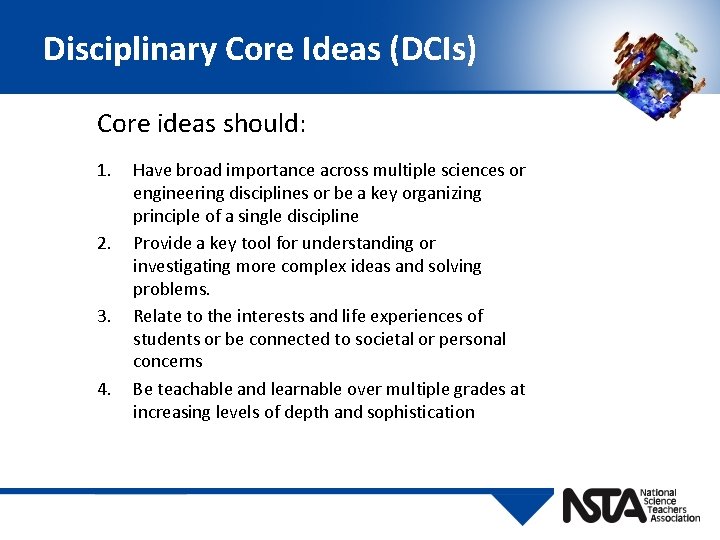
Disciplinary Core Ideas (DCIs) Core ideas should: 1. 2. 3. 4. Have broad importance across multiple sciences or engineering disciplines or be a key organizing principle of a single discipline Provide a key tool for understanding or investigating more complex ideas and solving problems. Relate to the interests and life experiences of students or be connected to societal or personal concerns Be teachable and learnable over multiple grades at increasing levels of depth and sophistication National Research Council (2012). A framework for K-12 science education: Practices, crosscutting concepts, and core ideas. Washington DC: The National Academies Press
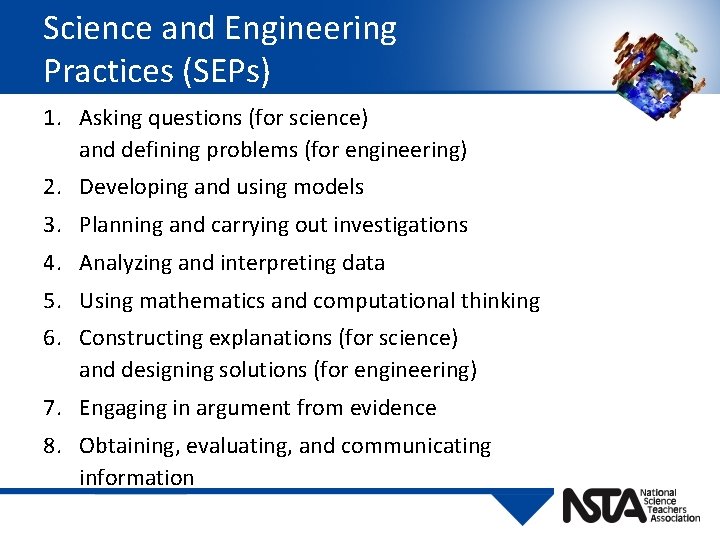
Science and Engineering Practices (SEPs) 1. Asking questions (for science) and defining problems (for engineering) 2. Developing and using models 3. Planning and carrying out investigations 4. Analyzing and interpreting data 5. Using mathematics and computational thinking 6. Constructing explanations (for science) and designing solutions (for engineering) 7. Engaging in argument from evidence 8. Obtaining, evaluating, and communicating information
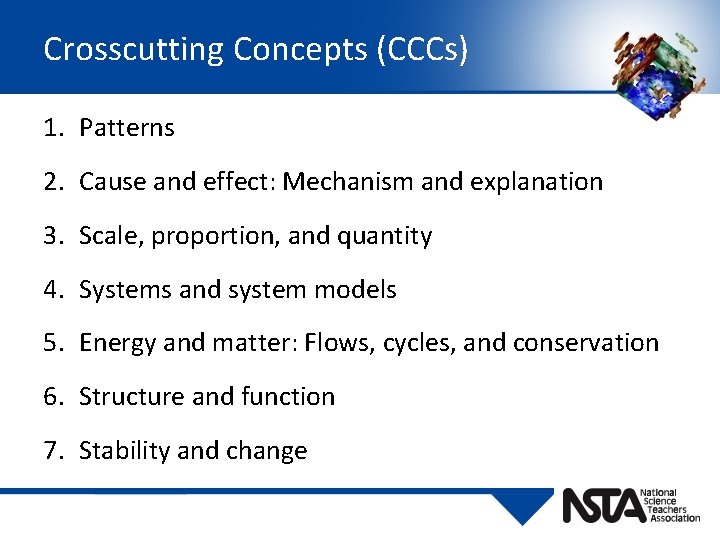
Crosscutting Concepts (CCCs) 1. Patterns 2. Cause and effect: Mechanism and explanation 3. Scale, proportion, and quantity 4. Systems and system models 5. Energy and matter: Flows, cycles, and conservation 6. Structure and function 7. Stability and change
The Elements of the Three Dimensions
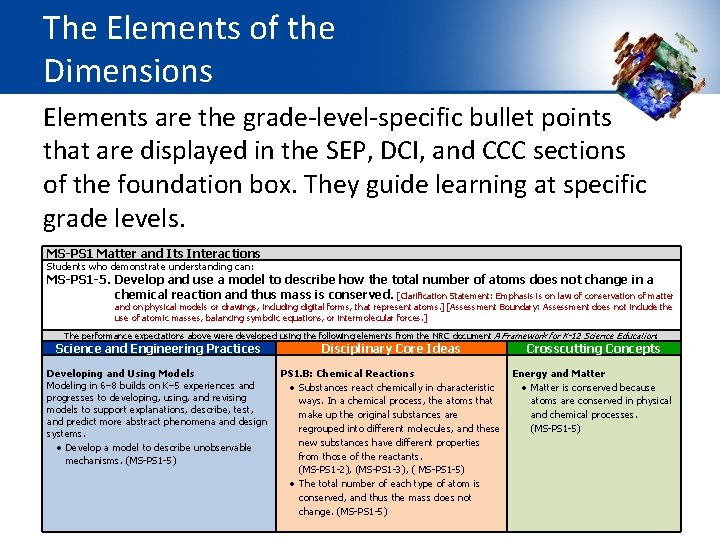
The Elements of the Dimensions Elements are the grade-level-specific bullet points that are displayed in the SEP, DCI, and CCC sections of the foundation box. They guide learning at specific grade levels. MS-PS 1 Matter and Its Interactions Students who demonstrate understanding can: MS-PS 1 -5. Develop and use a model to describe how the total number of atoms does not change in a chemical reaction and thus mass is conserved. [Clarification Statement: Emphasis is on law of conservation of matter and on physical models or drawings, including digital forms, that represent atoms. ] [Assessment Boundary: Assessment does not include the use of atomic masses, balancing symbolic equations, or intermolecular forces. ] The performance expectations above were developed using the following elements from the NRC document A Framework for K-12 Science Education: Science and Engineering Practices Developing and Using Models Modeling in 6– 8 builds on K– 5 experiences and progresses to developing, using, and revising models to support explanations, describe, test, and predict more abstract phenomena and design systems. Develop a model to describe unobservable mechanisms. (MS-PS 1 -5) Disciplinary Core Ideas Crosscutting Concepts PS 1. B: Chemical Reactions Energy and Matter Substances react chemically in characteristic Matter is conserved because ways. In a chemical process, the atoms that atoms are conserved in physical make up the original substances are and chemical processes. regrouped into different molecules, and these (MS-PS 1 -5) new substances have different properties from those of the reactants. (MS-PS 1 -2), (MS-PS 1 -3), ( MS-PS 1 -5) The total number of each type of atom is conserved, and thus the mass does not change. (MS-PS 1 -5)
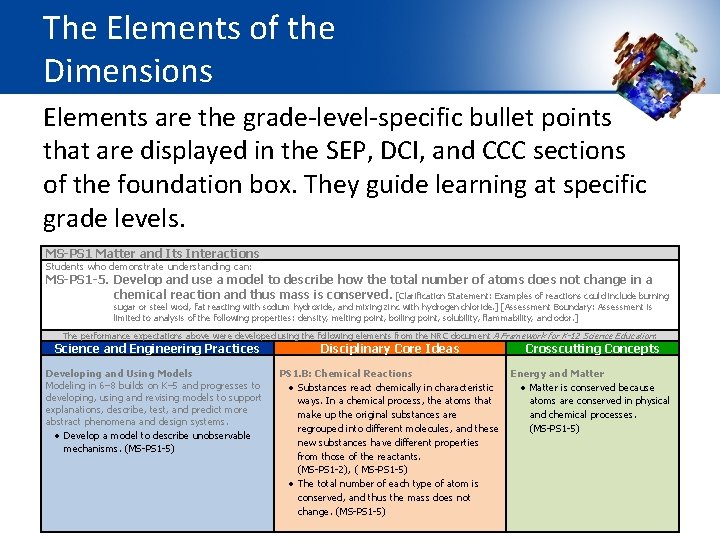
The Elements of the Dimensions Elements are the grade-level-specific bullet points that are displayed in the SEP, DCI, and CCC sections of the foundation box. They guide learning at specific grade levels. MS-PS 1 Matter and Its Interactions Students who demonstrate understanding can: MS-PS 1 -5. Develop and use a model to describe how the total number of atoms does not change in a chemical reaction and thus mass is conserved. [Clarification Statement: Examples of reactions could include burning sugar or steel wool, fat reacting with sodium hydroxide, and mixing zinc with hydrogen chloride. ] [Assessment Boundary: Assessment is limited to analysis of the following properties: density, melting point, boiling point, solubility, flammability, and odor. ] The performance expectations above were developed using the following elements from the NRC document A Framework for K-12 Science Education: Science and Engineering Practices Developing and Using Models Modeling in 6– 8 builds on K– 5 and progresses to developing, using and revising models to support explanations, describe, test, and predict more abstract phenomena and design systems. Develop a model to describe unobservable mechanisms. (MS-PS 1 -5) Disciplinary Core Ideas Crosscutting Concepts PS 1. B: Chemical Reactions Energy and Matter Substances react chemically in characteristic Matter is conserved because ways. In a chemical process, the atoms that atoms are conserved in physical make up the original substances are and chemical processes. regrouped into different molecules, and these (MS-PS 1 -5) new substances have different properties from those of the reactants. (MS-PS 1 -2), ( MS-PS 1 -5) The total number of each type of atom is conserved, and thus the mass does not change. (MS-PS 1 -5)
Why Use the Elements of the Three Dimensions • The NGSS identify the capabilities students should demonstrate when using each dimension by the end of each grade band in the elements of that dimension. • The elements should be used when gathering evidence of students using the dimensions to make sense of phenomena or develop solutions to problems.
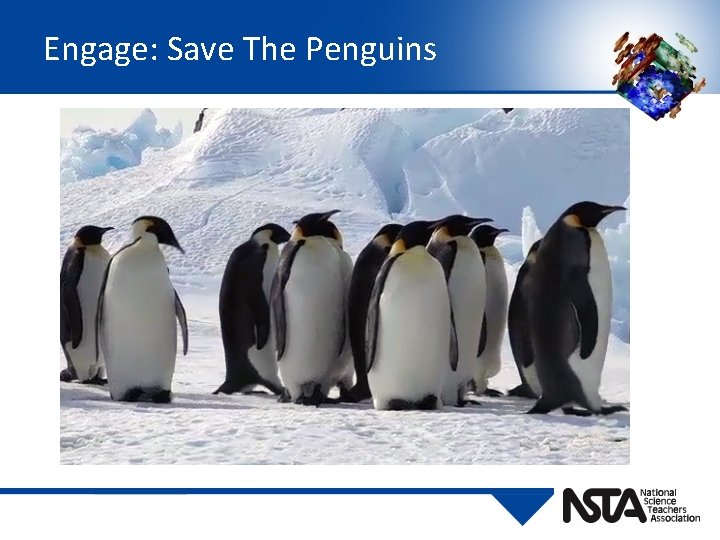
Save the Penguins
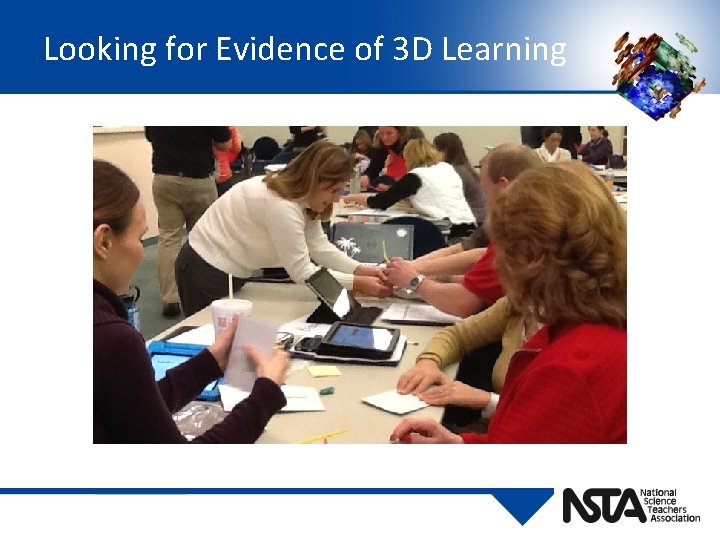
Looking for Evidence of 3 D Learning
Engage: Save The Penguins
Save the Penguins Part 1: • Task: You are a team of engineers assigned to collaboratively develop a penguin habitat that will keep them cool. o What solution do you propose? o How do you justify your solution?
Reading the Standards
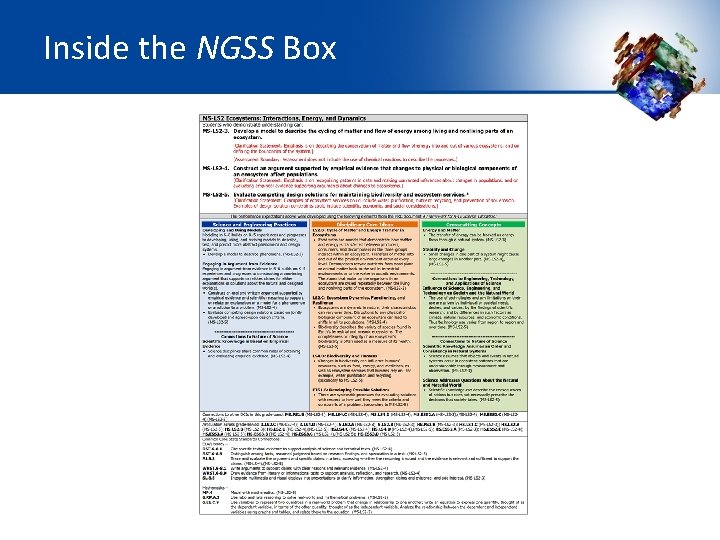
Inside the NGSS Box
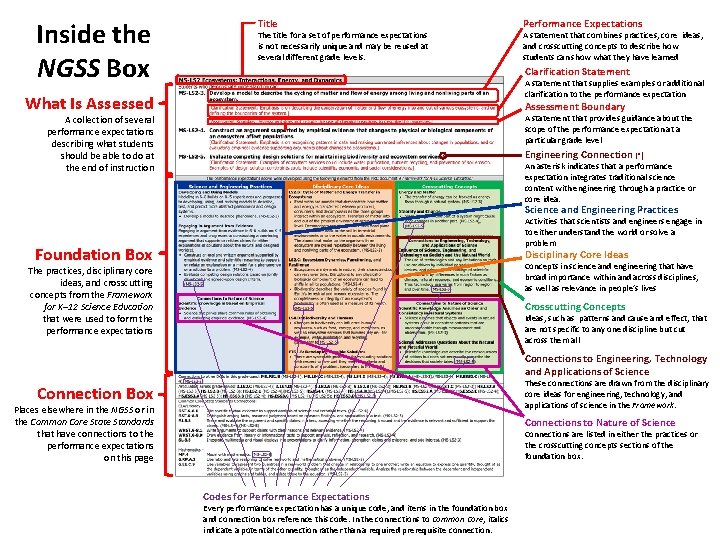
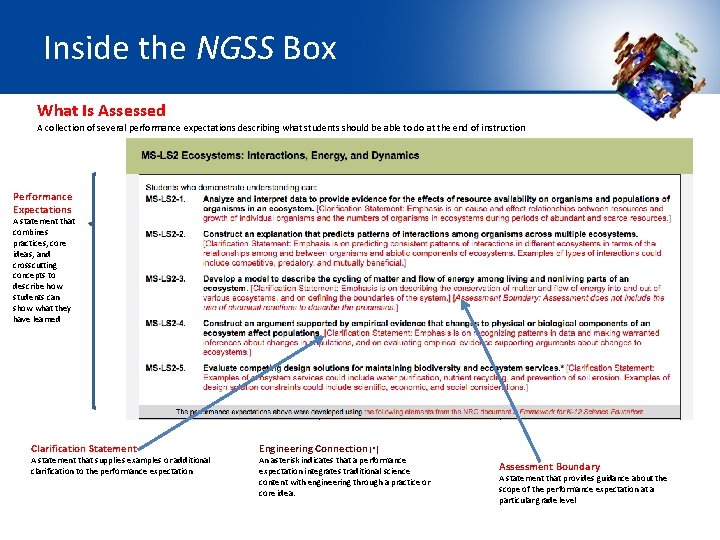
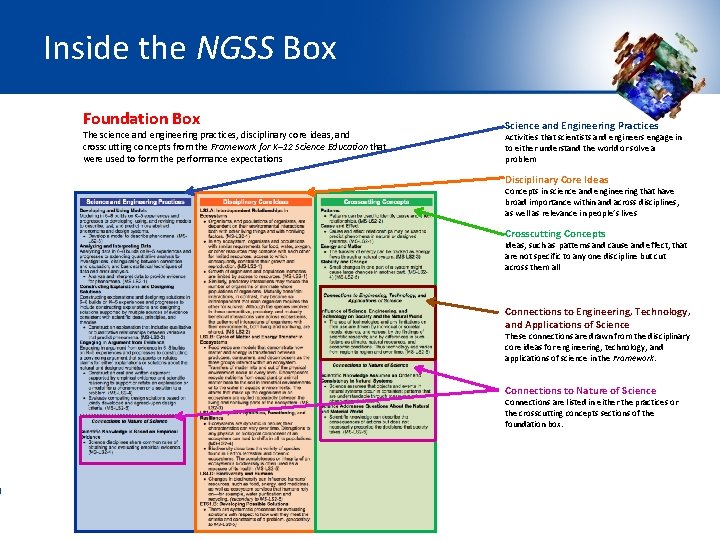
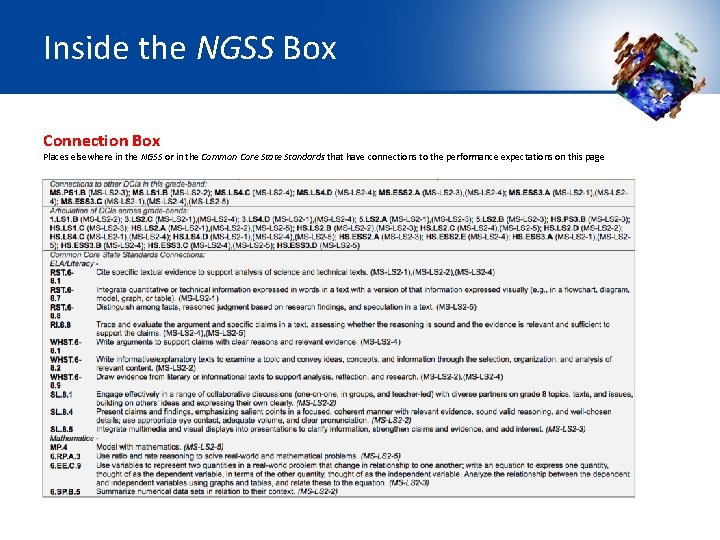
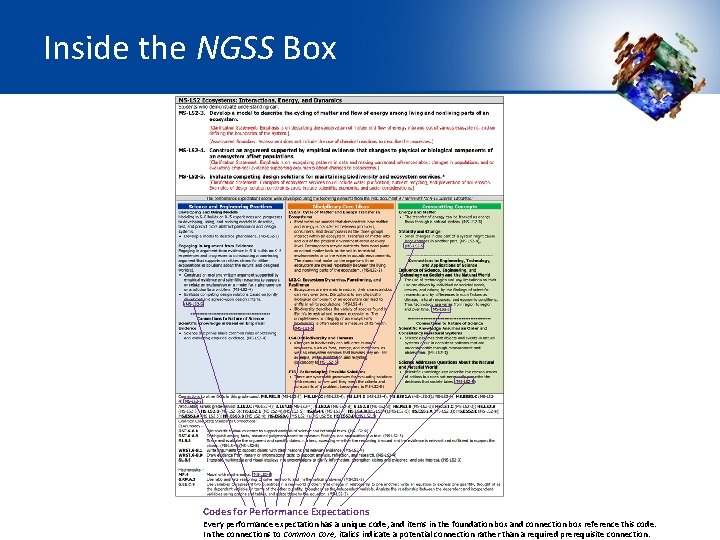
Inside the NGSS Box Title The title for a set of performance expectations is not necessarily unique and may be reused at several different grade levels. Performance Expectations A statement that combines practices, core ideas, and crosscutting concepts to describe how students can show what they have learned Clarification Statement A statement that supplies examples or additional clarification to the performance expectation What Is Assessed Assessment Boundary A statement that provides guidance about the scope of the performance expectation at a particular grade level A collection of several performance expectations describing what students should be able to do at the end of instruction Engineering Connection (*) An asterisk indicates that a performance expectation integrates traditional science content with engineering through a practice or core idea. Science and Engineering Practices Activities that scientists and engineers engage in to either understand the world or solve a problem Foundation Box Disciplinary Core Ideas Concepts in science and engineering that have broad importance within and across disciplines, as well as relevance in people’s lives The practices, disciplinary core ideas, and crosscutting concepts from the Framework for K– 12 Science Education that were used to form the performance expectations Crosscutting Concepts Ideas, such as patterns and cause and effect, that are not specific to any one discipline but cut across them all Connections to Engineering, Technology and Applications of Science These connections are drawn from the disciplinary core ideas for engineering, technology, and applications of science in the Framework. Connection Box Places elsewhere in the NGSS or in the Common Core State Standards that have connections to the performance expectations on this page Connections to Nature of Science Connections are listed in either the practices or the crosscutting concepts sections of the foundation box. Codes for Performance Expectations Every performance expectation has a unique code, and items in the foundation box and connection box reference this code. In the connections to Common Core, italics indicate a potential connection rather than a required prerequisite connection.
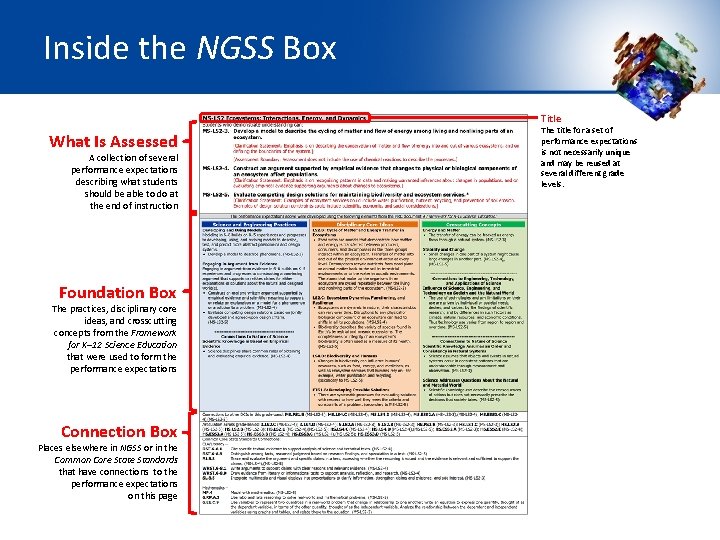
Inside the NGSS Box Title What Is Assessed A collection of several performance expectations describing what students should be able to do at the end of instruction Foundation Box The practices, disciplinary core ideas, and crosscutting concepts from the Framework for K– 12 Science Education that were used to form the performance expectations Connection Box Places elsewhere in NGSS or in the Common Core State Standards that have connections to the performance expectations on this page The title for a set of performance expectations is not necessarily unique and may be reused at several different grade levels.
Inside the NGSS Box What Is Assessed A collection of several performance expectations describing what students should be able to do at the end of instruction Performance Expectations A statement that combines practices, core ideas, and crosscutting concepts to describe how students can show what they have learned Clarification Statement A statement that supplies examples or additional clarification to the performance expectation Engineering Connection (*) An asterisk indicates that a performance expectation integrates traditional science content with engineering through a practice or core idea. Assessment Boundary A statement that provides guidance about the scope of the performance expectation at a particular grade level
Inside the NGSS Box Foundation Box The science and engineering practices, disciplinary core ideas, and crosscutting concepts from the Framework for K– 12 Science Education that were used to form the performance expectations Science and Engineering Practices Activities that scientists and engineers engage in to either understand the world or solve a problem Disciplinary Core Ideas Concepts in science and engineering that have broad importance within and across disciplines, as well as relevance in people’s lives Crosscutting Concepts Ideas, such as patterns and cause and effect, that are not specific to any one discipline but cut across them all Connections to Engineering, Technology, and Applications of Science These connections are drawn from the disciplinary core ideas for engineering, technology, and applications of science in the Framework. Connections to Nature of Science Connections are listed in either the practices or the crosscutting concepts sections of the foundation box.
Inside the NGSS Box Connection Box Places elsewhere in the NGSS or in the Common Core State Standards that have connections to the performance expectations on this page
Inside the NGSS Box Codes for Performance Expectations Every performance expectation has a unique code, and items in the foundation box and connection box reference this code. In the connections to Common Core, italics indicate a potential connection rather than a required prerequisite connection.
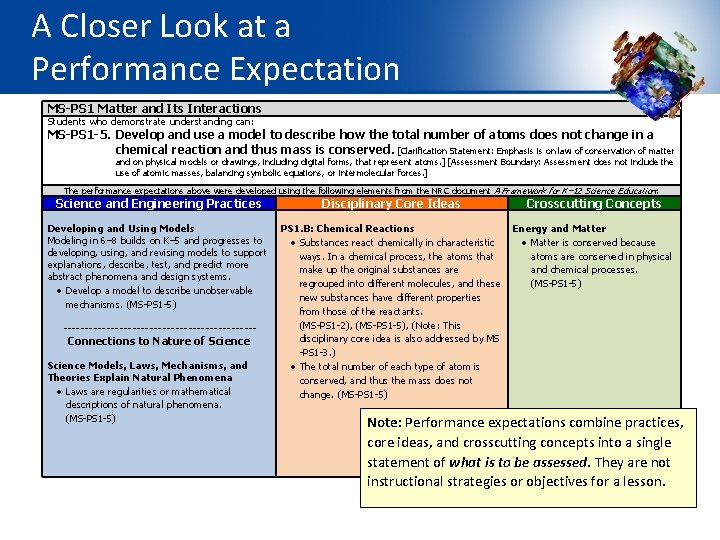
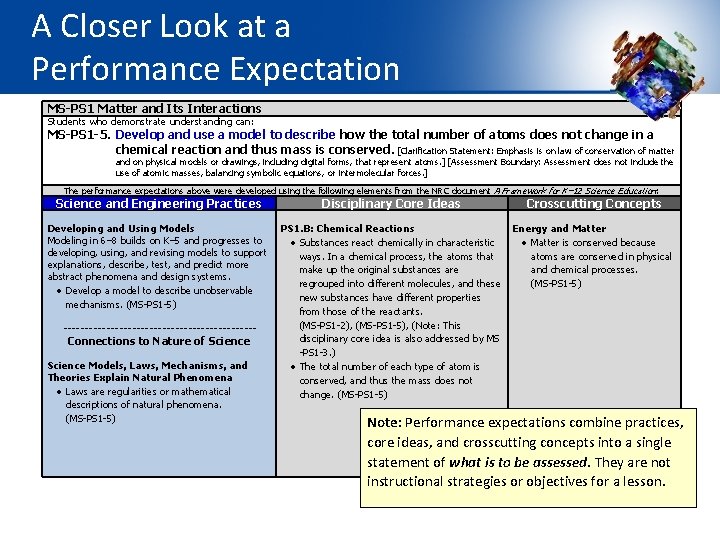
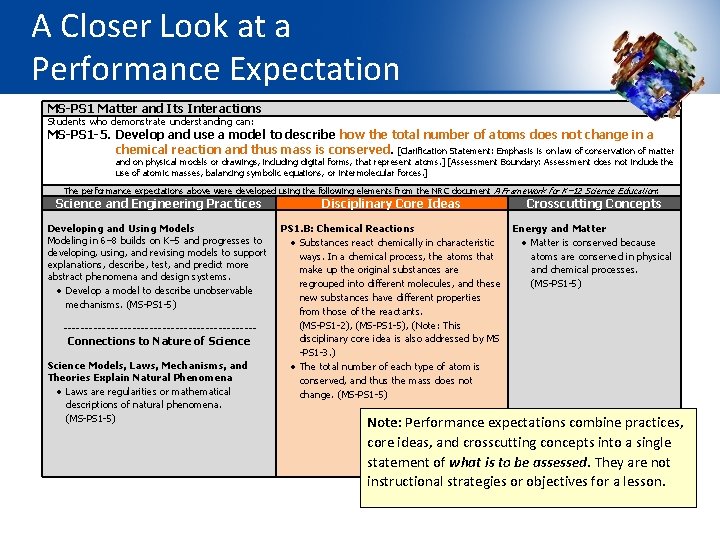
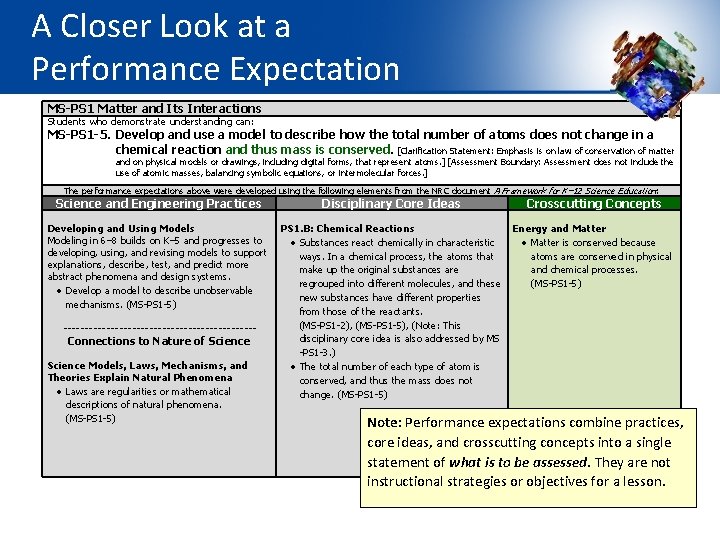
A Closer Look at a Performance Expectation MS-PS 1 Matter and Its Interactions Students who demonstrate understanding can: MS-PS 1 -5. Develop and use a model to describe how the total number of atoms does not change in a chemical reaction and thus mass is conserved. [Clarification Statement: Emphasis is on law of conservation of matter and on physical models or drawings, including digital forms, that represent atoms. ] [Assessment Boundary: Assessment does not include the use of atomic masses, balancing symbolic equations, or intermolecular forces. ] The performance expectations above were developed using the following elements from the NRC document A Framework for K– 12 Science Education: Science and Engineering Practices Developing and Using Models Modeling in 6– 8 builds on K– 5 and progresses to developing, using, and revising models to support explanations, describe, test, and predict more abstract phenomena and design systems. Develop a model to describe unobservable mechanisms. (MS-PS 1 -5) ----------------------- Connections to Nature of Science Models, Laws, Mechanisms, and Theories Explain Natural Phenomena Laws are regularities or mathematical descriptions of natural phenomena. (MS-PS 1 -5) Disciplinary Core Ideas Crosscutting Concepts PS 1. B: Chemical Reactions Energy and Matter Substances react chemically in characteristic Matter is conserved because ways. In a chemical process, the atoms that atoms are conserved in physical make up the original substances are and chemical processes. regrouped into different molecules, and these (MS-PS 1 -5) new substances have different properties from those of the reactants. (MS-PS 1 -2), (MS-PS 1 -5), (Note: This disciplinary core idea is also addressed by MS -PS 1 -3. ) The total number of each type of atom is conserved, and thus the mass does not change. (MS-PS 1 -5) Note: Performance expectations combine practices, core ideas, and crosscutting concepts into a single statement of what is to be assessed. They are not instructional strategies or objectives for a lesson.
A Closer Look at a Performance Expectation MS-PS 1 Matter and Its Interactions Students who demonstrate understanding can: MS-PS 1 -5. Develop and use a model to describe how the total number of atoms does not change in a chemical reaction and thus mass is conserved. [Clarification Statement: Emphasis is on law of conservation of matter and on physical models or drawings, including digital forms, that represent atoms. ] [Assessment Boundary: Assessment does not include the use of atomic masses, balancing symbolic equations, or intermolecular forces. ] The performance expectations above were developed using the following elements from the NRC document A Framework for K– 12 Science Education: Science and Engineering Practices Developing and Using Models Modeling in 6– 8 builds on K– 5 and progresses to developing, using, and revising models to support explanations, describe, test, and predict more abstract phenomena and design systems. Develop a model to describe unobservable mechanisms. (MS-PS 1 -5) ----------------------- Connections to Nature of Science Models, Laws, Mechanisms, and Theories Explain Natural Phenomena Laws are regularities or mathematical descriptions of natural phenomena. (MS-PS 1 -5) Disciplinary Core Ideas Crosscutting Concepts PS 1. B: Chemical Reactions Energy and Matter Substances react chemically in characteristic Matter is conserved because ways. In a chemical process, the atoms that atoms are conserved in physical make up the original substances are and chemical processes. regrouped into different molecules, and these (MS-PS 1 -5) new substances have different properties from those of the reactants. (MS-PS 1 -2), (MS-PS 1 -5), (Note: This disciplinary core idea is also addressed by MS -PS 1 -3. ) The total number of each type of atom is conserved, and thus the mass does not change. (MS-PS 1 -5) Note: Performance expectations combine practices, core ideas, and crosscutting concepts into a single statement of what is to be assessed. They are not instructional strategies or objectives for a lesson.
A Closer Look at a Performance Expectation MS-PS 1 Matter and Its Interactions Students who demonstrate understanding can: MS-PS 1 -5. Develop and use a model to describe how the total number of atoms does not change in a chemical reaction and thus mass is conserved. [Clarification Statement: Emphasis is on law of conservation of matter and on physical models or drawings, including digital forms, that represent atoms. ] [Assessment Boundary: Assessment does not include the use of atomic masses, balancing symbolic equations, or intermolecular forces. ] The performance expectations above were developed using the following elements from the NRC document A Framework for K– 12 Science Education: Science and Engineering Practices Developing and Using Models Modeling in 6– 8 builds on K– 5 and progresses to developing, using, and revising models to support explanations, describe, test, and predict more abstract phenomena and design systems. Develop a model to describe unobservable mechanisms. (MS-PS 1 -5) ----------------------- Connections to Nature of Science Models, Laws, Mechanisms, and Theories Explain Natural Phenomena Laws are regularities or mathematical descriptions of natural phenomena. (MS-PS 1 -5) Disciplinary Core Ideas Crosscutting Concepts PS 1. B: Chemical Reactions Energy and Matter Substances react chemically in characteristic Matter is conserved because ways. In a chemical process, the atoms that atoms are conserved in physical make up the original substances are and chemical processes. regrouped into different molecules, and these (MS-PS 1 -5) new substances have different properties from those of the reactants. (MS-PS 1 -2), (MS-PS 1 -5), (Note: This disciplinary core idea is also addressed by MS -PS 1 -3. ) The total number of each type of atom is conserved, and thus the mass does not change. (MS-PS 1 -5) Note: Performance expectations combine practices, core ideas, and crosscutting concepts into a single statement of what is to be assessed. They are not instructional strategies or objectives for a lesson.
A Closer Look at a Performance Expectation MS-PS 1 Matter and Its Interactions Students who demonstrate understanding can: MS-PS 1 -5. Develop and use a model to describe how the total number of atoms does not change in a chemical reaction and thus mass is conserved. [Clarification Statement: Emphasis is on law of conservation of matter and on physical models or drawings, including digital forms, that represent atoms. ] [Assessment Boundary: Assessment does not include the use of atomic masses, balancing symbolic equations, or intermolecular forces. ] The performance expectations above were developed using the following elements from the NRC document A Framework for K– 12 Science Education: Science and Engineering Practices Developing and Using Models Modeling in 6– 8 builds on K– 5 and progresses to developing, using, and revising models to support explanations, describe, test, and predict more abstract phenomena and design systems. Develop a model to describe unobservable mechanisms. (MS-PS 1 -5) ----------------------- Connections to Nature of Science Models, Laws, Mechanisms, and Theories Explain Natural Phenomena Laws are regularities or mathematical descriptions of natural phenomena. (MS-PS 1 -5) Disciplinary Core Ideas Crosscutting Concepts PS 1. B: Chemical Reactions Energy and Matter Substances react chemically in characteristic Matter is conserved because ways. In a chemical process, the atoms that atoms are conserved in physical make up the original substances are and chemical processes. regrouped into different molecules, and these (MS-PS 1 -5) new substances have different properties from those of the reactants. (MS-PS 1 -2), (MS-PS 1 -5), (Note: This disciplinary core idea is also addressed by MS -PS 1 -3. ) The total number of each type of atom is conserved, and thus the mass does not change. (MS-PS 1 -5) Note: Performance expectations combine practices, core ideas, and crosscutting concepts into a single statement of what is to be assessed. They are not instructional strategies or objectives for a lesson.
Save the Penguins Part 2: Looking for Evidence of the Three Dimensions Did students have opportunities to engage in three-dimensional learning to explain phenomena or design solutions?
Evidence From the Immersion Experience Evidence I can see it, point to it in a lesson or unit, highlight it, or quote it directly from what is written.
Save The Penguins Table Discussion • As a group, discuss each dimension. Share whether or not you found evidence of the elements of each dimension in the immersion experience. o Connect evidence from the activity to the elements of the dimensions in your discussion. o Remember: The evidence shared is focused only on STUDENTS using the three dimensions to make sense of phenomena or design solutions to problems.
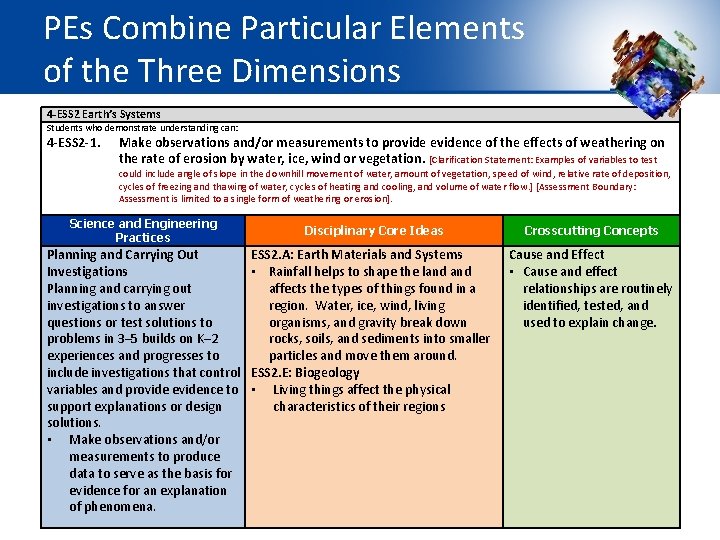
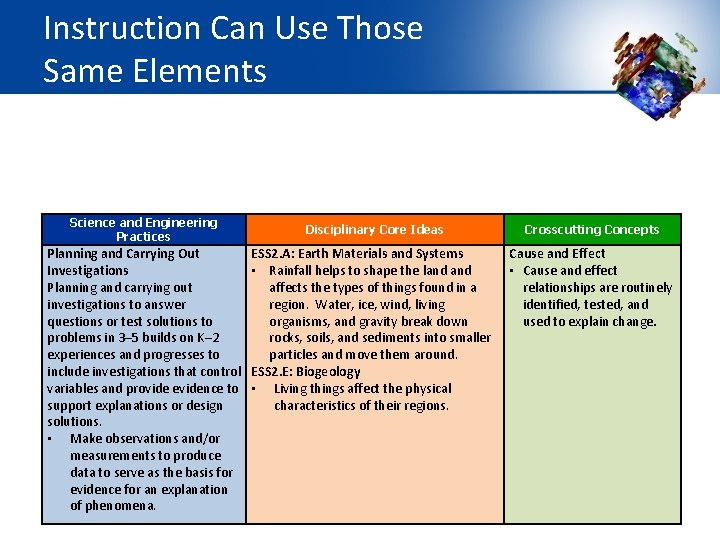
PEs Combine Particular Elements of the Three Dimensions 4 -ESS 2 Earth’s Systems Students who demonstrate understanding can: 4 -ESS 2 -1. Make observations and/or measurements to provide evidence of the effects of weathering on the rate of erosion by water, ice, wind or vegetation. [Clarification Statement: Examples of variables to test could include angle of slope in the downhill movement of water, amount of vegetation, speed of wind, relative rate of deposition, cycles of freezing and thawing of water, cycles of heating and cooling, and volume of water flow. ] [Assessment Boundary: Assessment is limited to a single form of weathering or erosion]. Science and Engineering Practices Planning and Carrying Out Investigations Planning and carrying out investigations to answer questions or test solutions to problems in 3– 5 builds on K– 2 experiences and progresses to include investigations that control variables and provide evidence to support explanations or design solutions. • Make observations and/or measurements to produce data to serve as the basis for evidence for an explanation of phenomena. Disciplinary Core Ideas Crosscutting Concepts ESS 2. A: Earth Materials and Systems • Rainfall helps to shape the land affects the types of things found in a region. Water, ice, wind, living organisms, and gravity break down rocks, soils, and sediments into smaller particles and move them around. ESS 2. E: Biogeology • Living things affect the physical characteristics of their regions Cause and Effect • Cause and effect relationships are routinely identified, tested, and used to explain change.
Instruction Can Use Those Same Elements MS-PS 1 Matter and Its Interactions Students who demonstrate understanding can: MS-PS 1 -1. Develop a model to describe that matter is made of particles too small to be seen. [Clarification Statement: Examples of evidence could include adding air to expand a basketball, compressing air in a syringe, dissolving sugar in water, and evaporating salt water. ] [Assessment Boundary: Assessment does not include the atomic-scale mechanism of evaporation and condensation or defining the unseen particles. ] Science and Engineering Practices Planning and Carrying Out Investigations Planning and carrying out investigations to answer questions or test solutions to problems in 3– 5 builds on K– 2 experiences and progresses to include investigations that control variables and provide evidence to support explanations or design solutions. • Make observations and/or measurements to produce data to serve as the basis for evidence for an explanation of phenomena. Disciplinary Core Ideas Crosscutting Concepts ESS 2. A: Earth Materials and Systems • Rainfall helps to shape the land affects the types of things found in a region. Water, ice, wind, living organisms, and gravity break down rocks, soils, and sediments into smaller particles and move them around. ESS 2. E: Biogeology • Living things affect the physical characteristics of their regions. Cause and Effect • Cause and effect relationships are routinely identified, tested, and used to explain change.
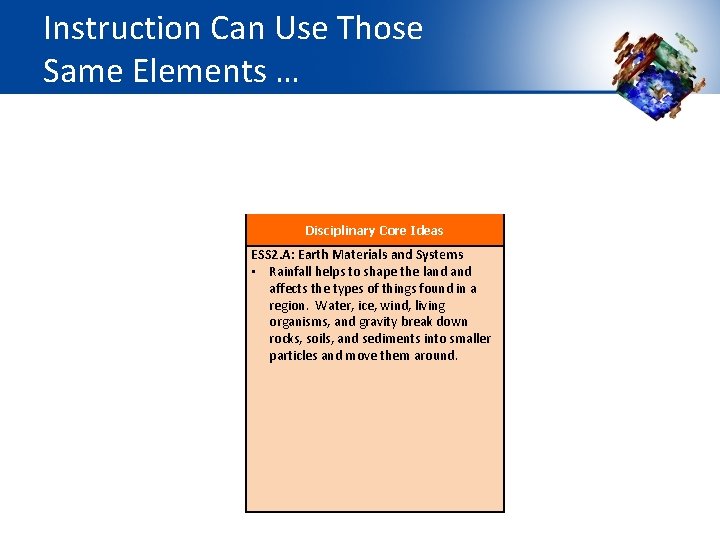
Instruction Can Use Those Same Elements … MS-PS 1 Matter and Its Interactions Students who demonstrate understanding can: MS-PS 1 -1. Develop a model to describe that matter is made of particles too small to be seen. [Clarification Statement: Examples of evidence could include adding air to expand a basketball, compressing air in a syringe, dissolving sugar in water, and evaporating salt water. ] [Assessment Boundary: Assessment does not include the atomic-scale mechanism of evaporation and condensation or defining the unseen particles. ] Disciplinary Core Ideas ESS 2. A: Earth Materials and Systems • Rainfall helps to shape the land affects the types of things found in a region. Water, ice, wind, living organisms, and gravity break down rocks, soils, and sediments into smaller particles and move them around.
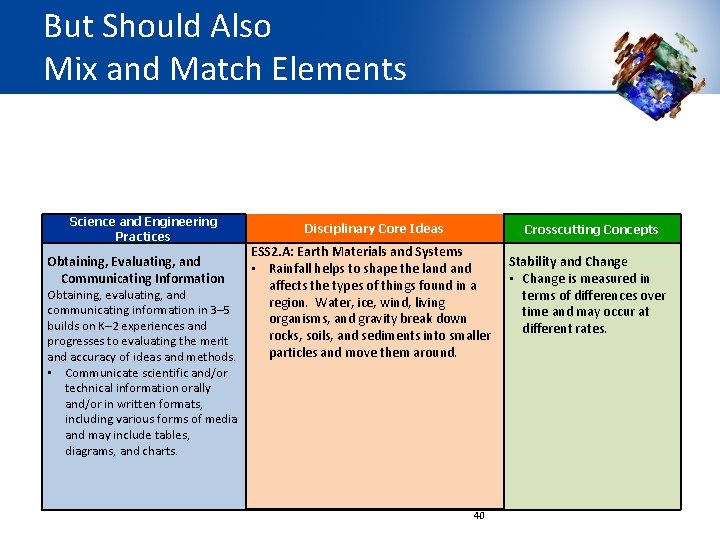
But Should Also Mix and Match Elements MS-PS 1 Matter and Its Interactions Students who demonstrate understanding can: MS-PS 1 -1. Develop a model to describe that matter is made of particles too small to be seen. [Clarification Statement: Examples of evidence could include adding air to expand a basketball, compressing air in a syringe, dissolving sugar in water, and evaporating salt water. ] [Assessment Boundary: Assessment does not include the atomic-scale mechanism of evaporation and condensation or defining the unseen particles. ] Science and Engineering Practices Disciplinary Core Ideas Crosscutting Concepts ESS 2. A: Earth Materials and Systems Obtaining, Developing Planning Using Constructing Engaging and inand Evaluating, and Argument Explanations Carrying Using and Models Out from and Stability Patterns Cause Scale, Systems Energy Proportion, and and Effect: Matter: Change System Function and Flows, Models Structure and Properties of Matter Structure Asking. Mathematics Analyzing Questions Interpreting and Defining Data • PS 1. A: Rainfall helps to shape the land Analyzing data in 3– 5 builds on K– 2 Modeling in 3– 5 builds on K– 2 Investigations Computational Designing Evidence Communicating Thinking Information • Cycles, Mechanism Quantity Different materials have Patterns of change can be A system can be described Change is measured in and Conservation and Prediction • affects the types of things found in a Matter of any type can be subdivided Problems Solutions experiences and progresses to Planning and carrying out Mathematical and computational Constructing explanations and Engaging in argument from Obtaining, evaluating, and experiences and progresses to used to make predictions. Cause and effect Natural objects and/or in terms of its components Matter is made of particles. terms of differences over into particles that are too small to see, • different substructures, Asking questions and defining region. Water, ice, wind, living introducing quantitative approaches investigations to answer questions thinking in 3– 5 builds on K– 2 designing solutions in 3– 5 builds on evidence in 3– 5 builds on K– 2 communicating information in 3– 5 building and revising simple which can sometimes be relationships are routinely observable phenomena and their interactions. time and may occur at but even the matter still exists and problems in 3– 5 builds on K– 2 organisms, and gravity break down to collecting data and conducting or test solutions to problems in 3– 5 K– 2 experiences and progresses to builds on K– 2 experiences and models and using models to observed. identified, tested, and exist from the very small different rates. can be detected by other means. A experiences and progresses to rocks, soils, and sediments into smaller multiple trials of qualitative builds on K– 2 experiences and extending quantitative the use of evidence in constructing critiquing the scientific explanations progresses to evaluating the merit represent events and design used to explain change. to the immensely large or model showing that gases are made specifying qualitative particles and move them around. observations. When possible and progresses to include investigations measurements to a variety of explanations that specify variables or solutions proposed by peers by and accuracy of ideas and methods. solutions. from very short to very from matter particles that are too small relationships. feasible, digital tools should be used. • Communicate scientific and/or that control variables and provide physical properties and using that describe and predict citing relevant evidence about the • Use models to describe long time periods. to see and are moving freely around in Ask questions that can be • natural and designed world(s). Analyze and interpret data to evidence to support explanations or computation and mathematics to phenomena and in designing technical information orally phenomena. space can explain many observations, investigated and predict make sense of phenomena, • and/or in written formats, design solutions. analyze data and compare multiple solutions to design Compare and refine arguments including the inflation and shape of a using logical reasoning, • reasonable outcomes based alternative design solutions. problems. Make observations and/or based on an evaluation of the including various forms of media balloon and the effects of air on larger mathematics, and/or • on patterns such as cause and measurements to produce data Organize simple data sets to Identify the evidence that evidence presented. and may include tables, particles or objects. effect relationships. computation. to serve as the basis for reveal patterns that suggest supports particular points in an diagrams, and charts. explanation. evidence for an explanation of a relationships. phenomenon or test a design solution. 40