
The Newtonian equivalence principle It states that gravity

- Slides: 8
The Newtonian equivalence principle • It states that gravity is indistinguishable from any other form of acceleration.
Roland Eötvös 1848 -1919 • Hungarian physicist. • He studied the Earth’s gravitational field. • He invented the torsion balance and showed that, to a high degree of accuracy, gravitational mass and inertial mass are equivalent. • His work became a major principle of Albert Einstein’s general theory of relativity.
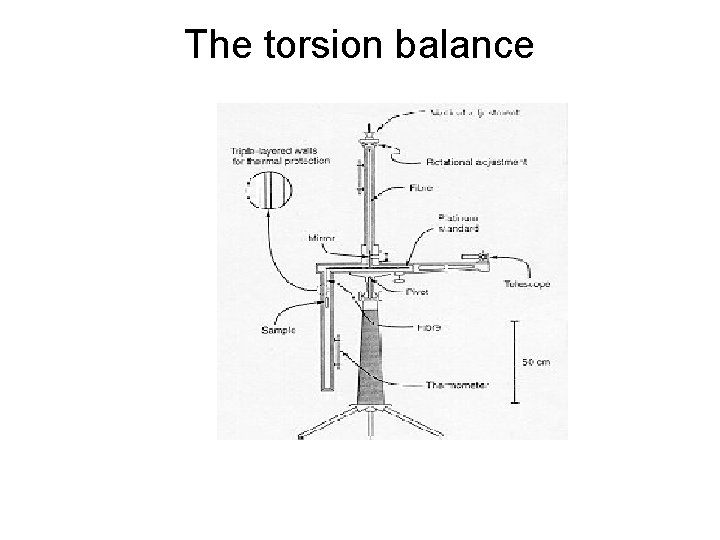
The torsion balance • The torsion balance consists of two balls attached onto an insulating rod suspended from the middle by a thin wire. Eotvos used two spheres of identical mass but of different substances; one of wood one of platinum. • For Eotvos, any deviation from the proportionality of gravitating and inertial masses could be checked by detecting differences in the direction of the acceleration of different substances, and that those differences might be detected by rotations of a horizontal rod.
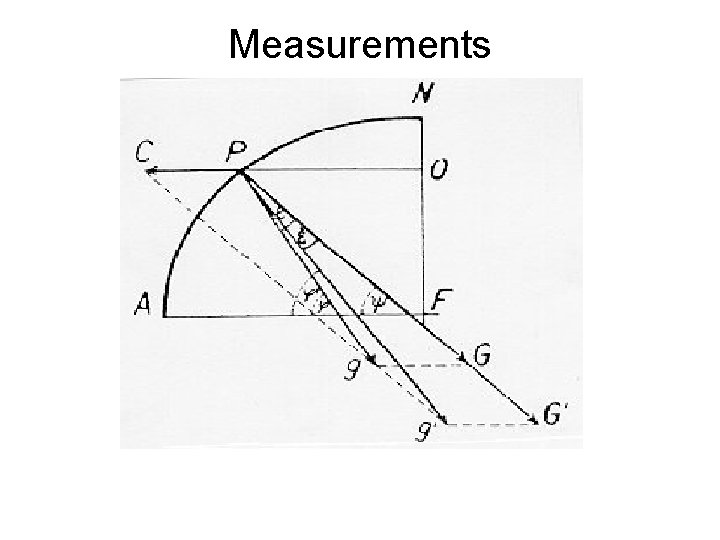
• Therefore, if the magnitude of the Coriolis force (centrifugal force due to the Earth rotation) and gravity had been different for the two bodies due to their different compositions, Eotvos would have detected a twisting of the wire. None was seen. • His experiment, performed in 1889, proved that the gravitational mass is proportional to the inertial mass up to 8 decimal figures ( not just 4 decimals as was known before): accuracy of 1/200 000.
The torsion balance
Measurements
Robert Dicke 1916 -1997 • American experimental physicist. • Dicke carried out a new experiment, using modern technology, and achieved an accuracy of 1/100 00 000. • He was able to increase the sensitivity, compared to Eötvös, in part by measuring the accelerations of their test masses to the Sun, rather than to the Earth. Any signal arising from the difference between gravitational an inertial mass would have the same 24 hour periodicity as the Earth’s rotation. • It allows the signal to be discriminated from background perturbations, without disturbing the torsion fibre.
• Works used • www. kfki. hu/eotvos/onehund. html • www. norskfysikk. no/nfn/epsbiografer/EOT VOS. PDF • www. kfki. hu/eotvos/stepcikk. html