
The new version of RDA structure key concepts
- Slides: 19
The new version of RDA: structure, key concepts and content Gordon Dunsire, RDA Technical Team Liaison Officer Presented at IFLA Satellite meeting on RDA, Aristotle University of Thessaloniki, 21 August, 2019 1 New version of RDA, IFLA 2019 January 24, 2019
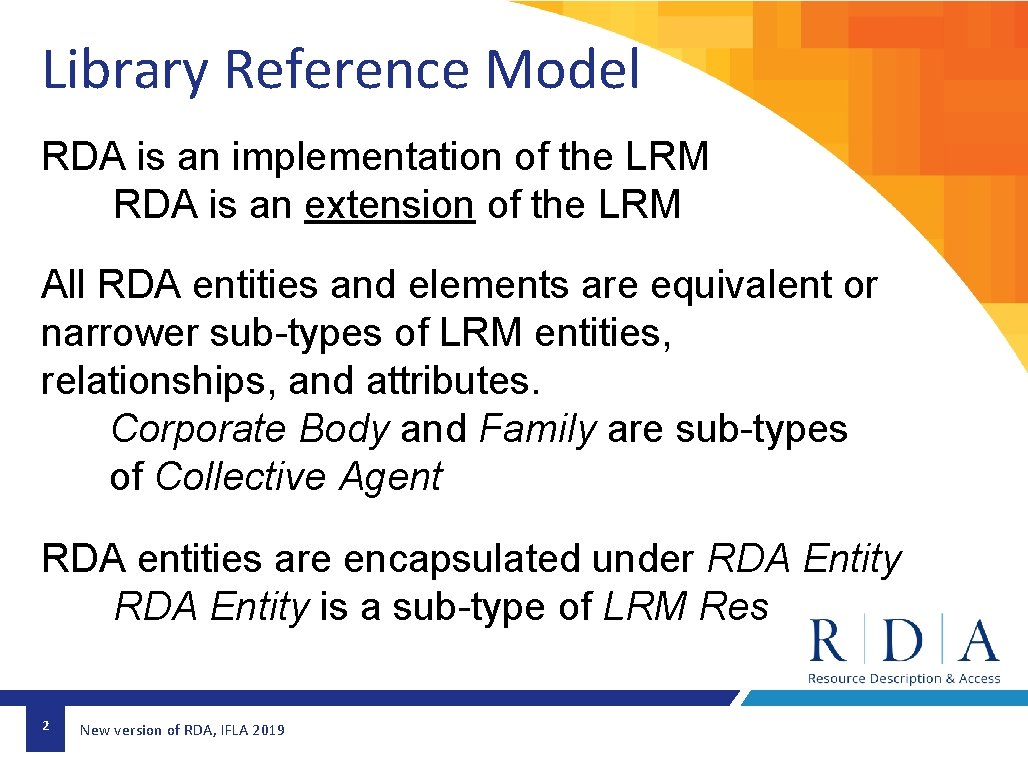
Library Reference Model RDA is an implementation of the LRM RDA is an extension of the LRM All RDA entities and elements are equivalent or narrower sub-types of LRM entities, relationships, and attributes. Corporate Body and Family are sub-types of Collective Agent RDA entities are encapsulated under RDA Entity is a sub-type of LRM Res 2 New version of RDA, IFLA 2019
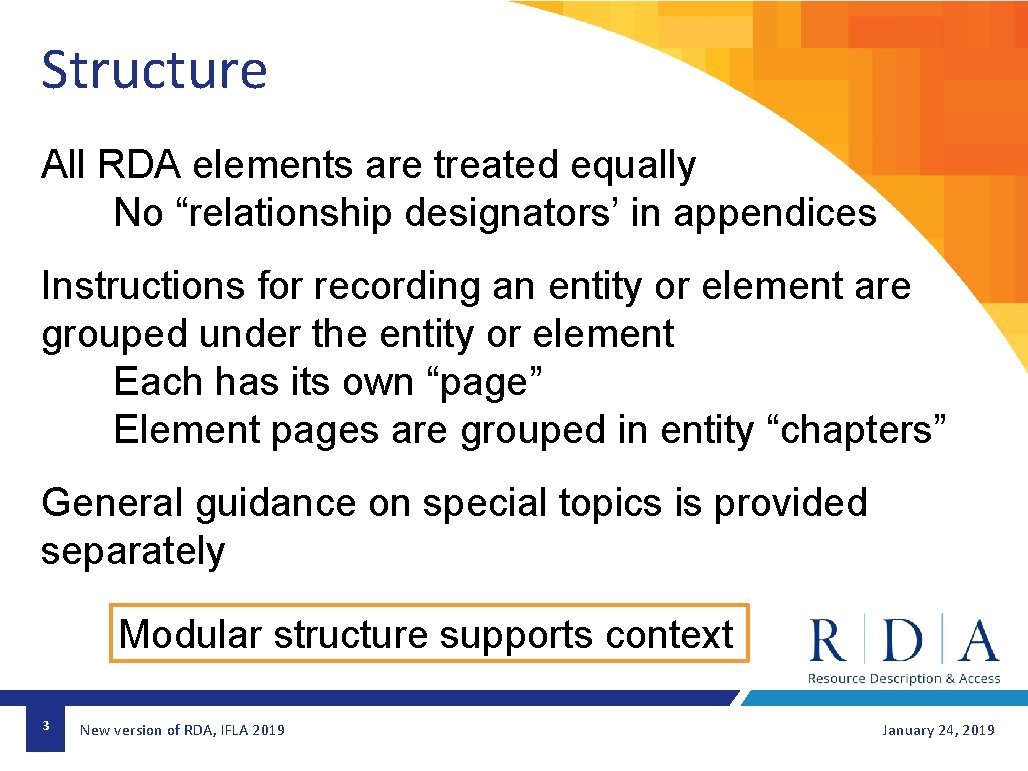
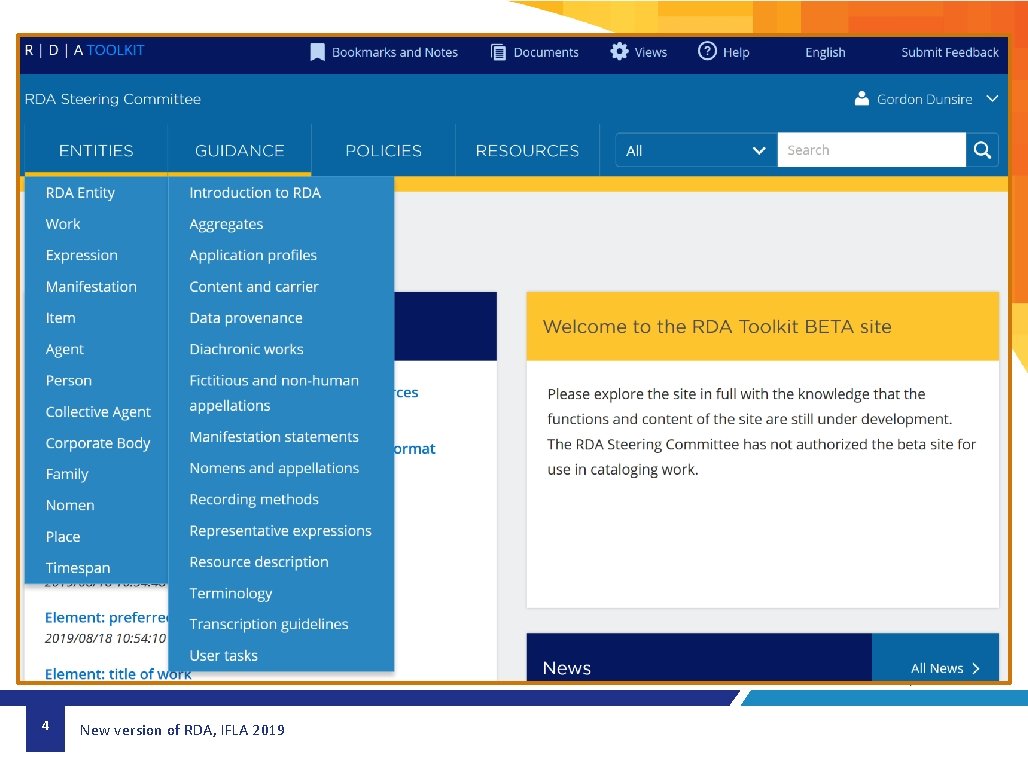
Structure All RDA elements are treated equally No “relationship designators’ in appendices Instructions for recording an entity or element are grouped under the entity or element Each has its own “page” Element pages are grouped in entity “chapters” General guidance on special topics is provided separately Modular structure supports context 3 New version of RDA, IFLA 2019 January 24, 2019
4 New version of RDA, IFLA 2019
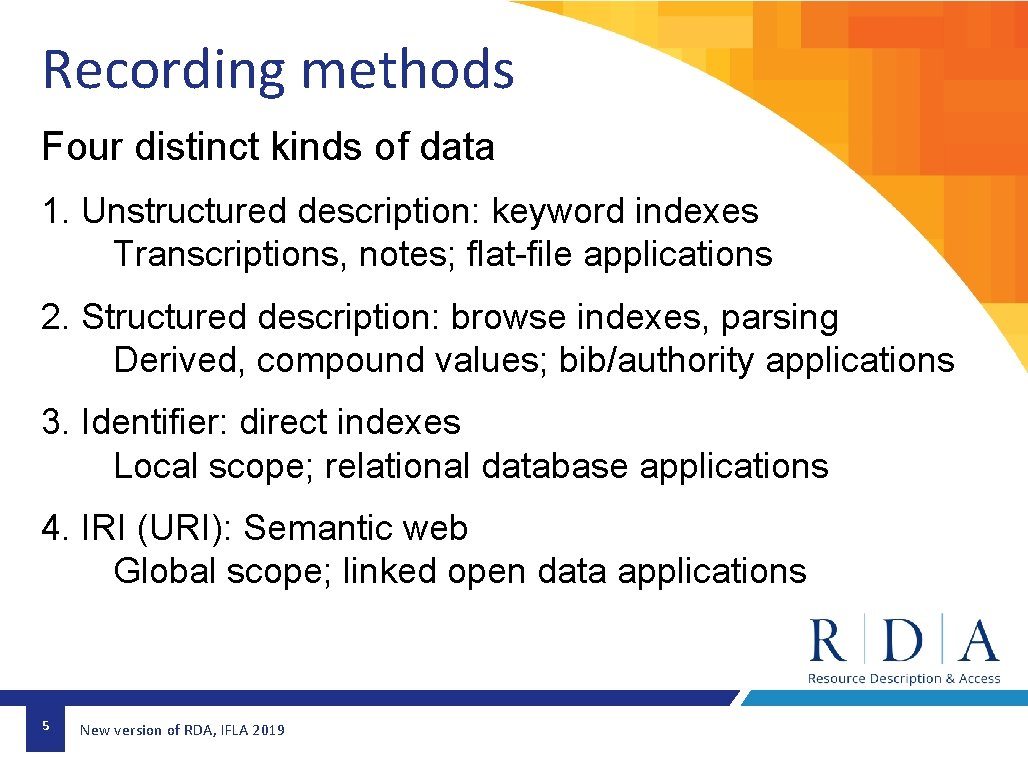
Recording methods Four distinct kinds of data 1. Unstructured description: keyword indexes Transcriptions, notes; flat-file applications 2. Structured description: browse indexes, parsing Derived, compound values; bib/authority applications 3. Identifier: direct indexes Local scope; relational database applications 4. IRI (URI): Semantic web Global scope; linked open data applications 5 New version of RDA, IFLA 2019
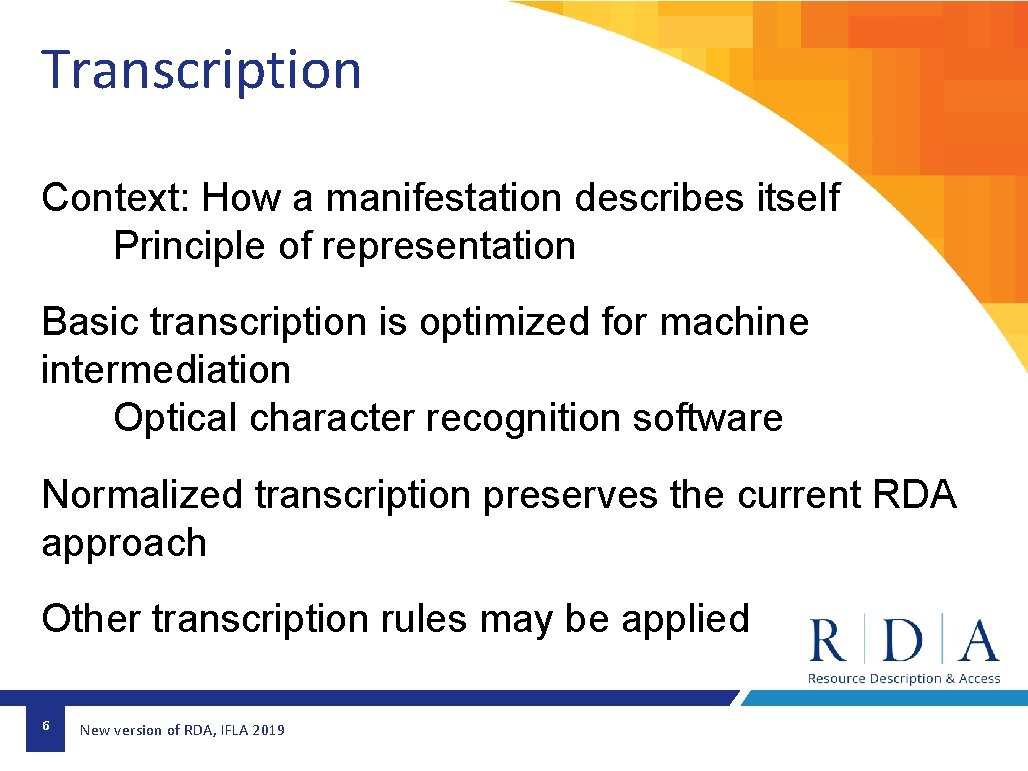
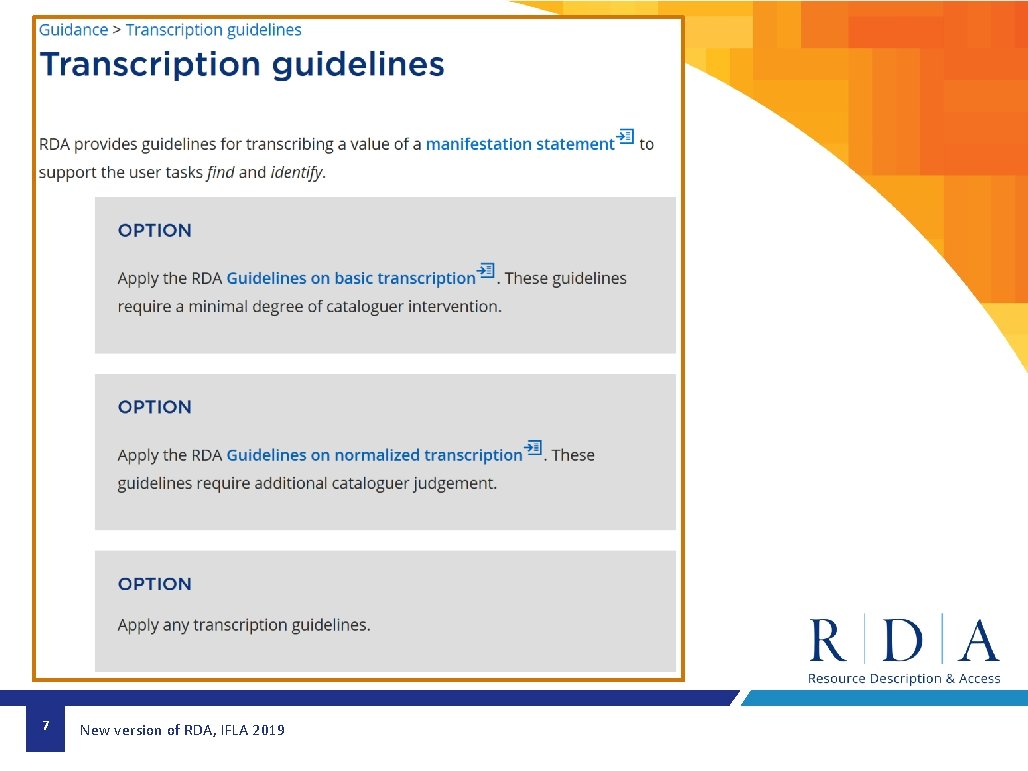
Transcription Context: How a manifestation describes itself Principle of representation Basic transcription is optimized for machine intermediation Optical character recognition software Normalized transcription preserves the current RDA approach Other transcription rules may be applied 6 New version of RDA, IFLA 2019
7 New version of RDA, IFLA 2019
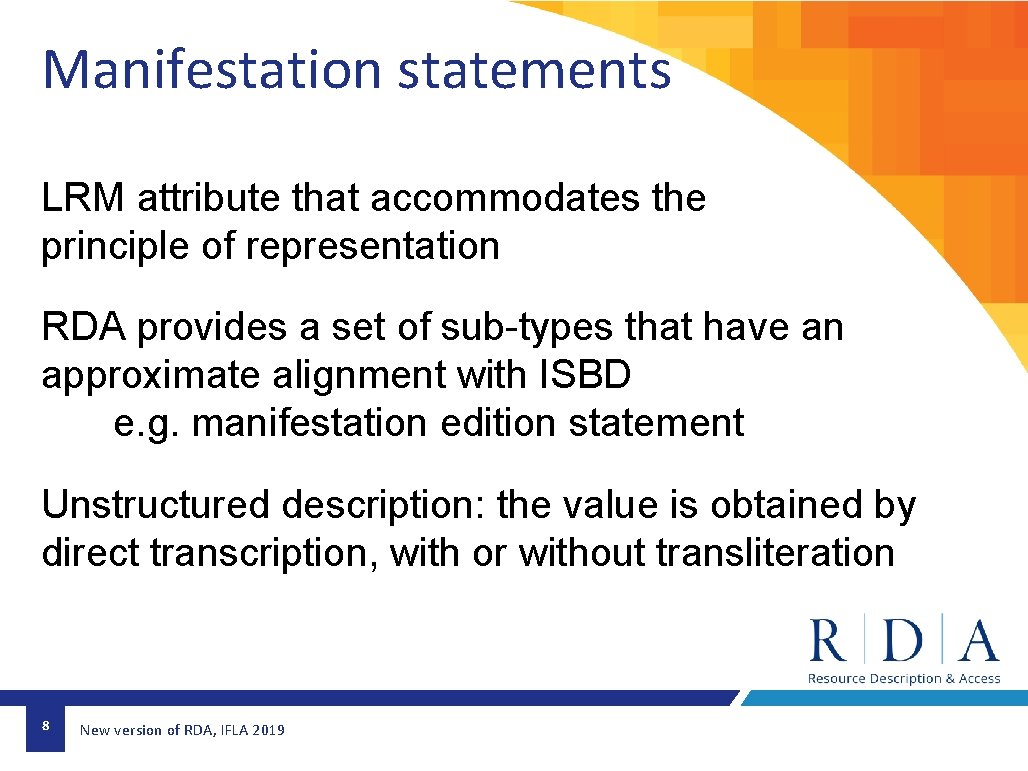
Manifestation statements LRM attribute that accommodates the principle of representation RDA provides a set of sub-types that have an approximate alignment with ISBD e. g. manifestation edition statement Unstructured description: the value is obtained by direct transcription, with or without transliteration 8 New version of RDA, IFLA 2019
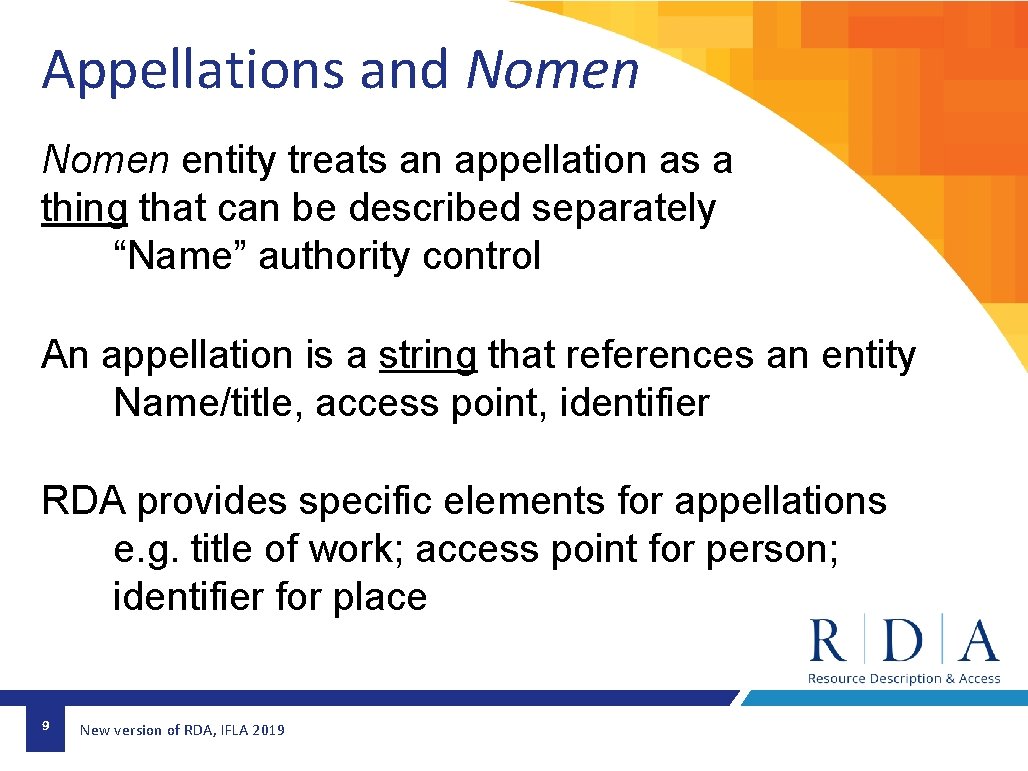
Appellations and Nomen entity treats an appellation as a thing that can be described separately “Name” authority control An appellation is a string that references an entity Name/title, access point, identifier RDA provides specific elements for appellations e. g. title of work; access point for person; identifier for place 9 New version of RDA, IFLA 2019
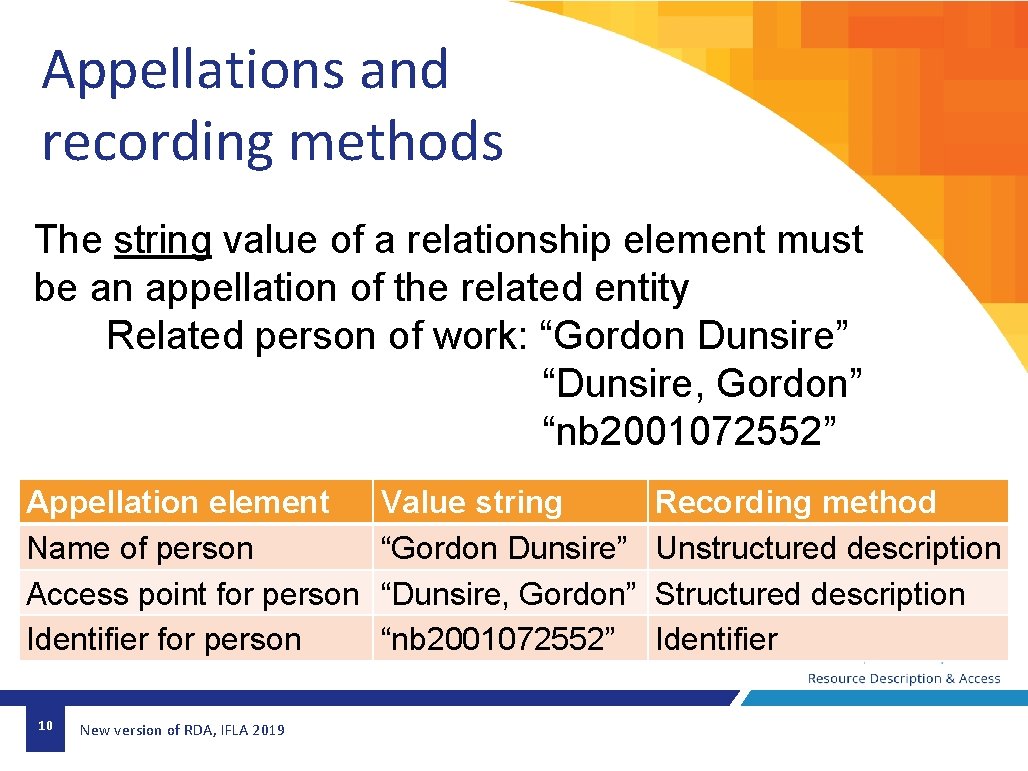
Appellations and recording methods The string value of a relationship element must be an appellation of the related entity Related person of work: “Gordon Dunsire” “Dunsire, Gordon” “nb 2001072552” Appellation element Name of person Access point for person Identifier for person 10 New version of RDA, IFLA 2019 Value string “Gordon Dunsire” “Dunsire, Gordon” “nb 2001072552” Recording method Unstructured description Structured description Identifier
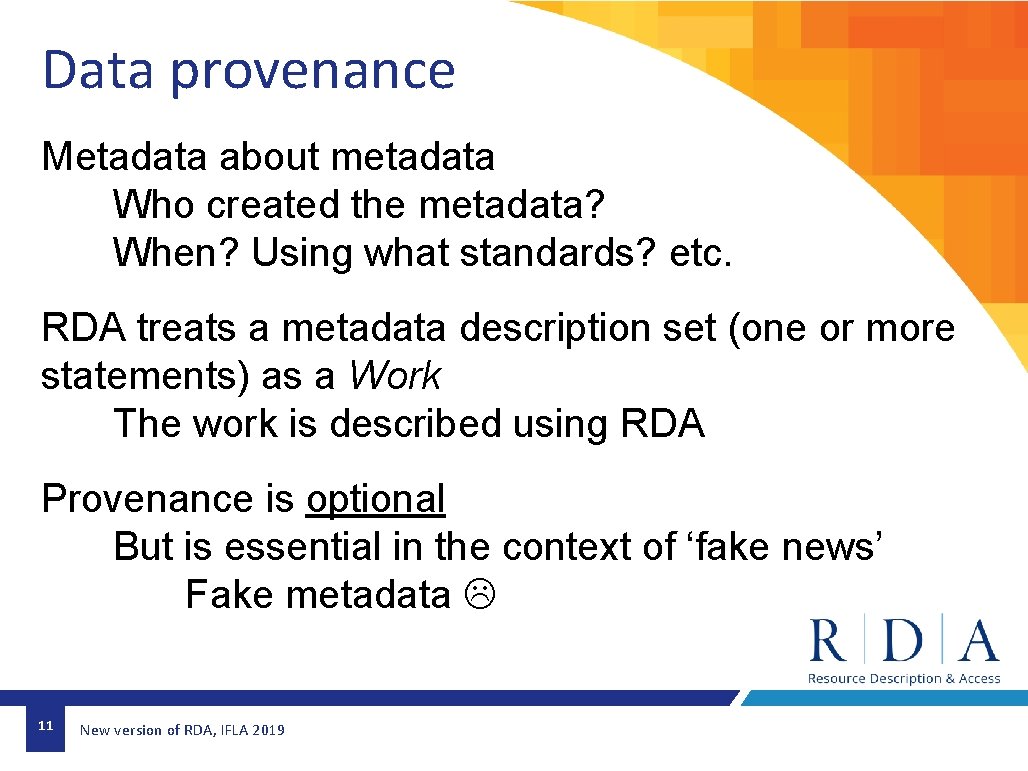
Data provenance Metadata about metadata Who created the metadata? When? Using what standards? etc. RDA treats a metadata description set (one or more statements) as a Work The work is described using RDA Provenance is optional But is essential in the context of ‘fake news’ Fake metadata 11 New version of RDA, IFLA 2019
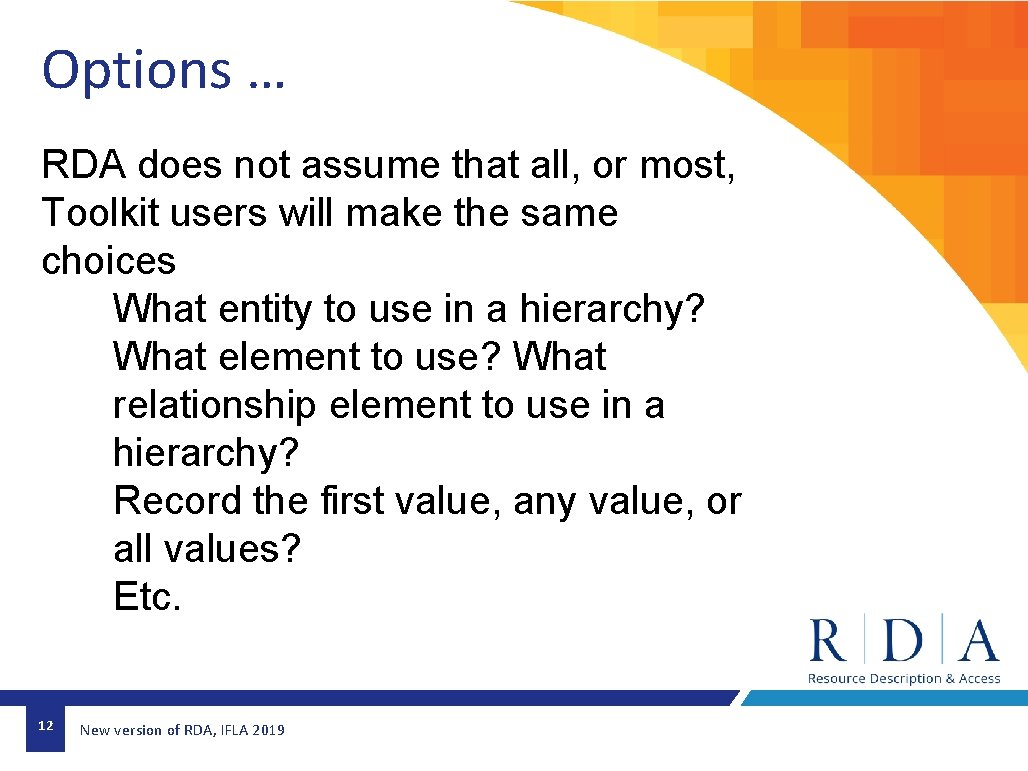
Options … RDA does not assume that all, or most, Toolkit users will make the same choices What entity to use in a hierarchy? What element to use? What relationship element to use in a hierarchy? Record the first value, any value, or all values? Etc. 12 New version of RDA, IFLA 2019
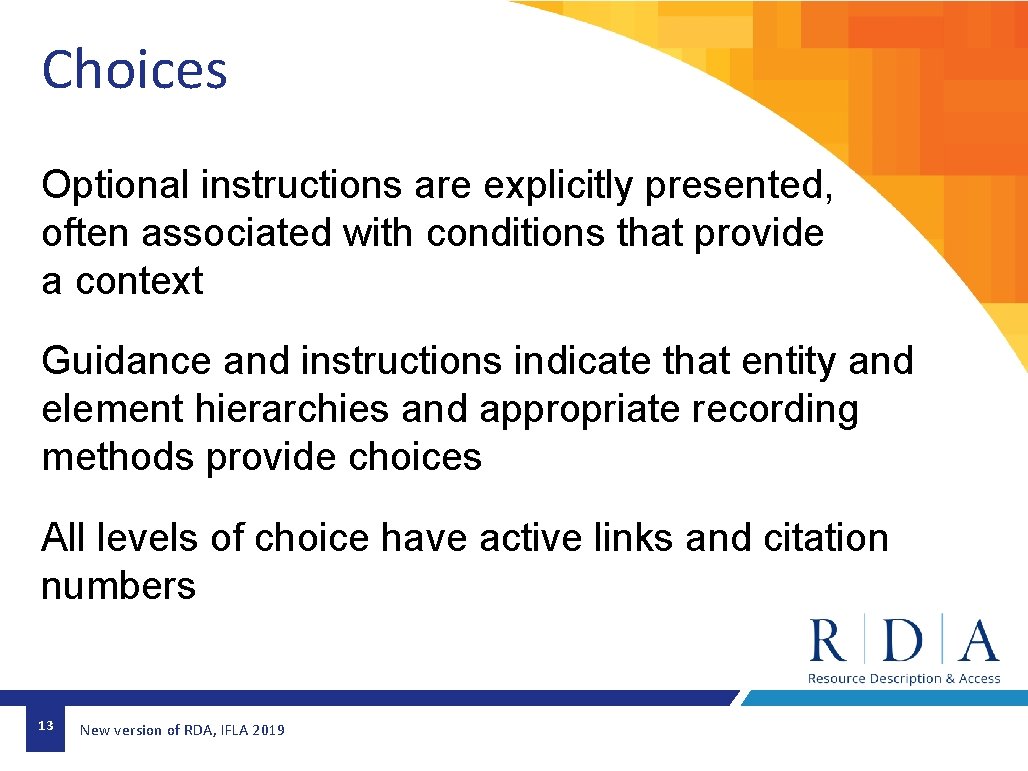
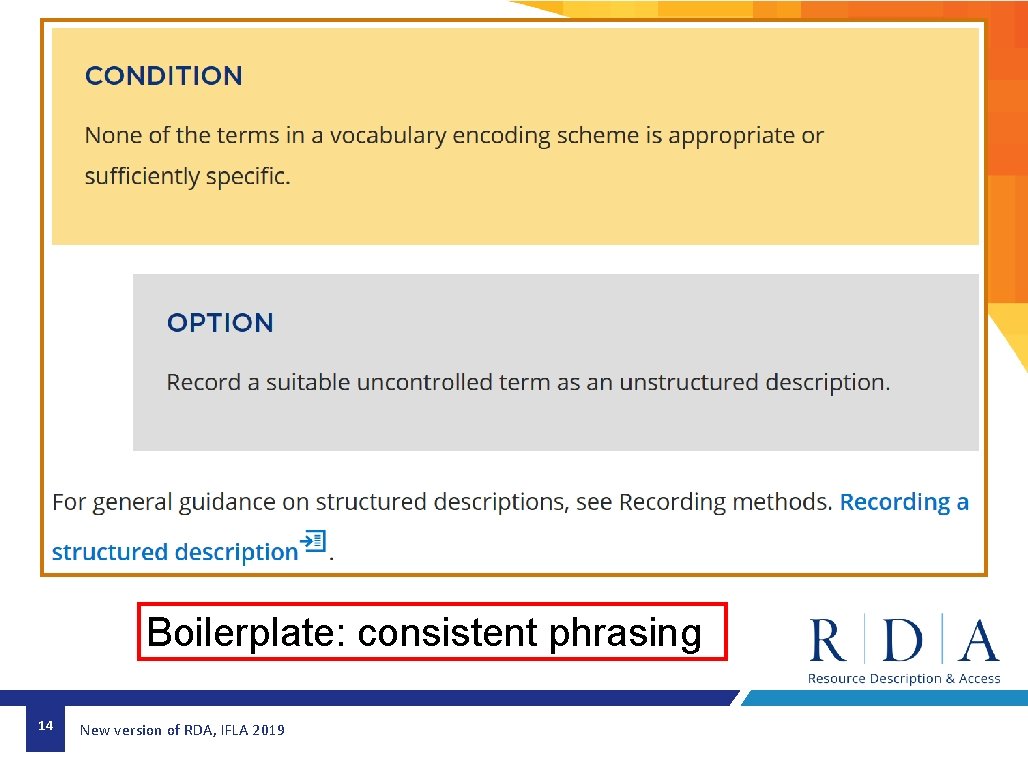
Choices Optional instructions are explicitly presented, often associated with conditions that provide a context Guidance and instructions indicate that entity and element hierarchies and appropriate recording methods provide choices All levels of choice have active links and citation numbers 13 New version of RDA, IFLA 2019
Boilerplate: consistent phrasing 14 New version of RDA, IFLA 2019
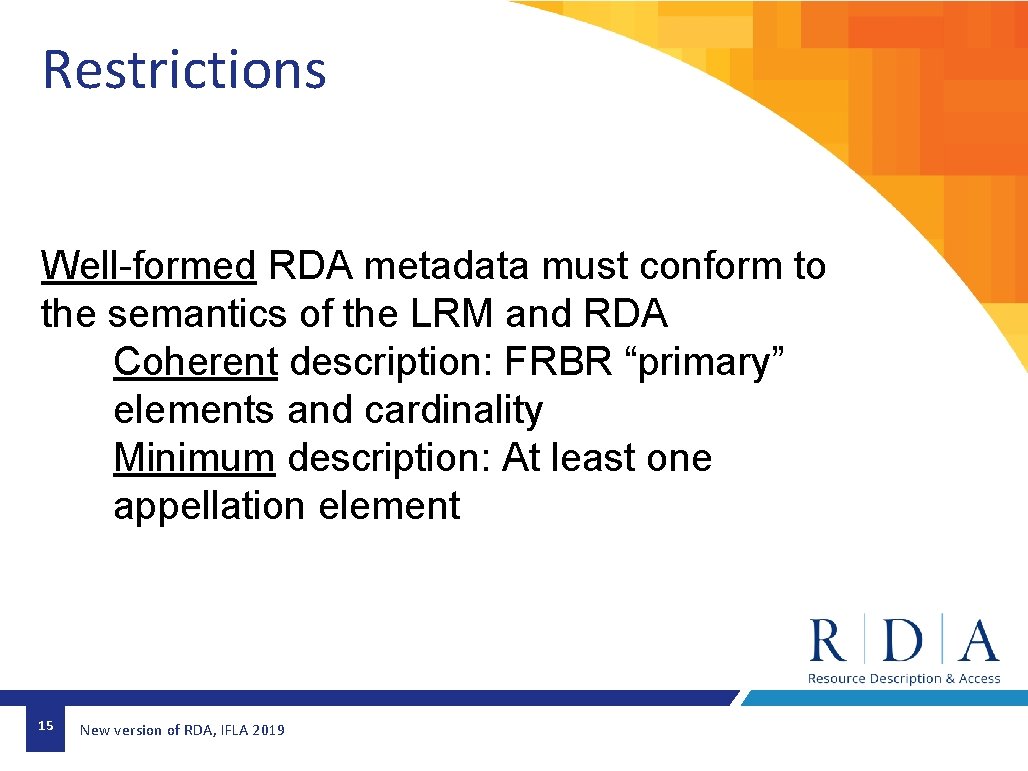
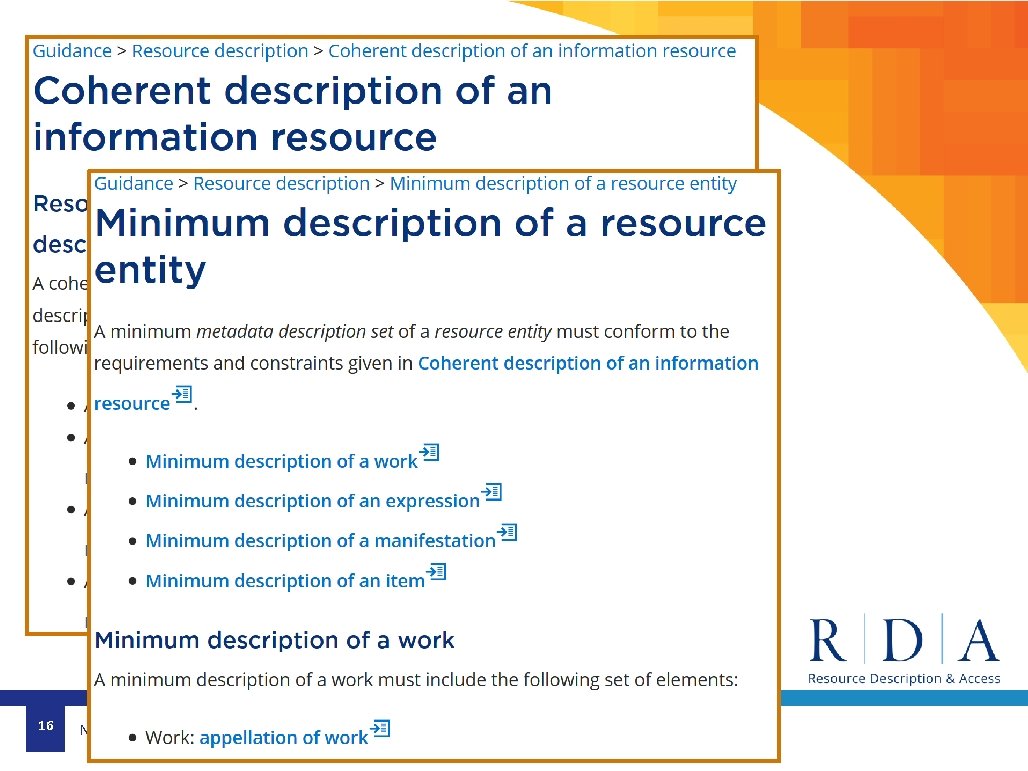
Restrictions Well-formed RDA metadata must conform to the semantics of the LRM and RDA Coherent description: FRBR “primary” elements and cardinality Minimum description: At least one appellation element 15 New version of RDA, IFLA 2019
16 New version of RDA, IFLA 2019
Consistency Semantic conformance allows RDA metadata to interoperate at ‘lowest common denominator” global level Via entity and element hierarchies Interoperability of metadata values requires conformance with local choices for strings Via “authority” processes 17 New version of RDA, IFLA 2019
Application The new RDA Toolkit is ready for: The cloud of metadata processing Smart metadata Slightly dumber metadata Multilingual metadata Local applications in a global network Individual, institutional, national, and international choice 18 New version of RDA, IFLA 2019
Thank you! techo@rdatoolkit. org 19 New version of RDA, IFLA 2019