
The New Time philosophy 1 General characteristic Stages


- Slides: 35
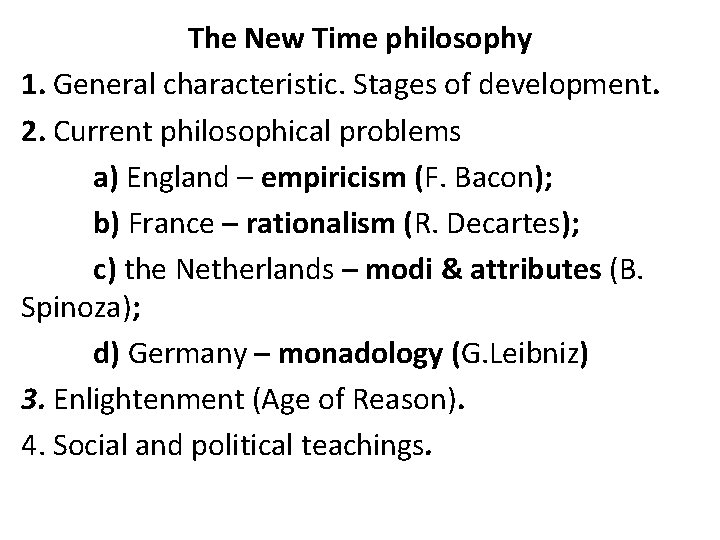
The New Time philosophy 1. General characteristic. Stages of development. 2. Current philosophical problems a) England – empiricism (F. Bacon); b) France – rationalism (R. Decartes); c) the Netherlands – modi & attributes (B. Spinoza); d) Germany – monadology (G. Leibniz) 3. Enlightenment (Age of Reason). 4. Social and political teachings.
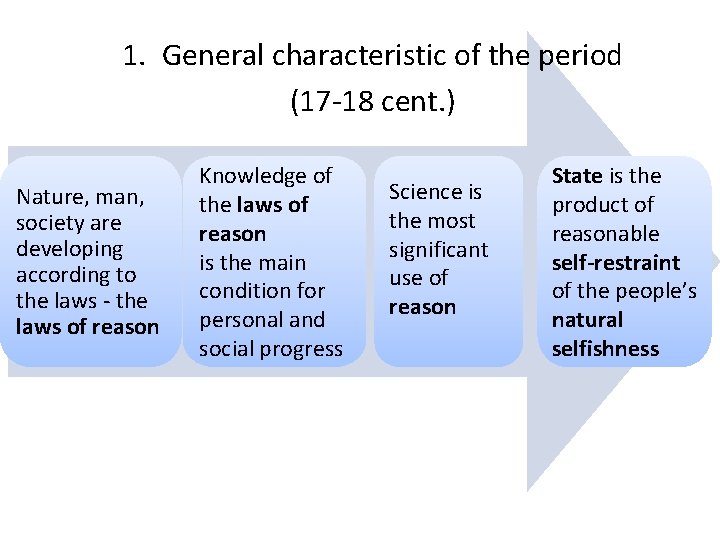
1. General characteristic of the period (17 -18 cent. ) Nature, man, society are developing according to the laws - the laws of reason Knowledge of the laws of reason is the main condition for personal and social progress Science is the most significant use of reason State is the product of reasonable self-restraint of the people’s natural selfishness
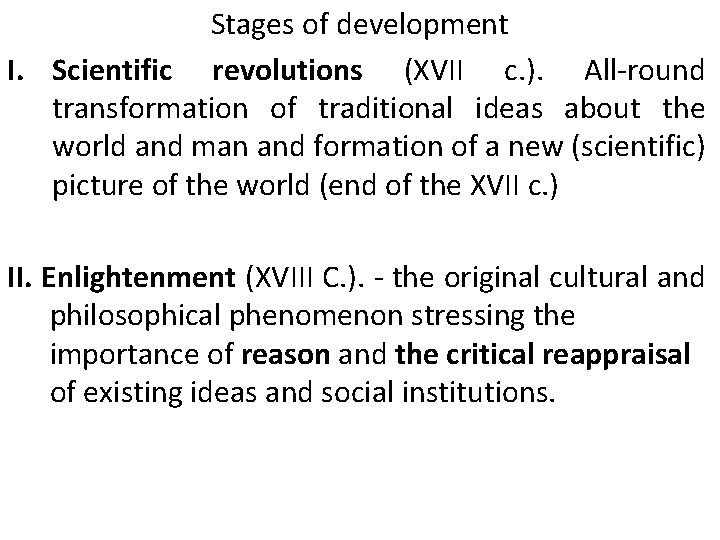
Stages of development I. Scientific revolutions (XVII c. ). All-round transformation of traditional ideas about the world and man and formation of a new (scientific) picture of the world (end of the XVII c. ) II. Enlightenment (XVIII C. ). - the original cultural and philosophical phenomenon stressing the importance of reason and the critical reappraisal of existing ideas and social institutions.
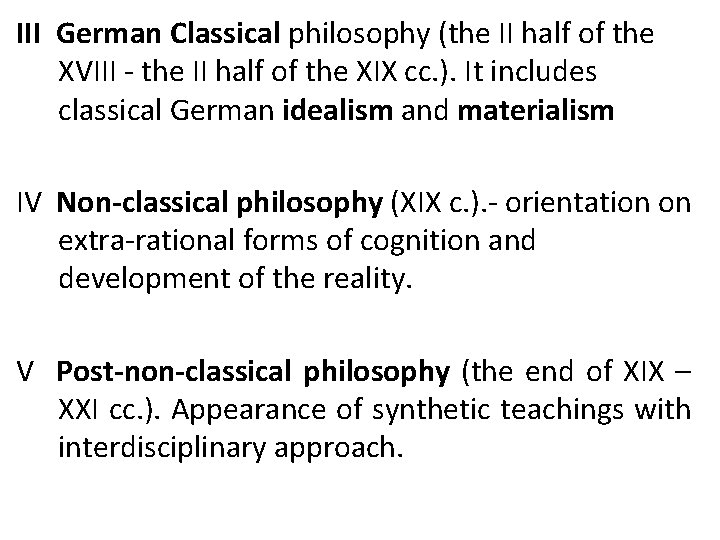
III German Classical philosophy (the II half of the XVIII - the II half of the XIX cc. ). It includes classical German idealism and materialism IV Non-classical philosophy (XIX c. ). - orientation on extra-rational forms of cognition and development of the reality. V Post-non-classical philosophy (the end of XIX – XXI cc. ). Appearance of synthetic teachings with interdisciplinary approach.
The philosophy is characterized by three main approaches 1. Rationalism – is the methodological approach based on arguments of the reason (lat. ‘ratio’ is ‘reason’). 2. Irrationalism - is an approach giving priority to intuition, insight, inner sense, direct experience of life and so on before the arguments of reason. 3. Empiricism - is the methodological approach based on empirical data (data of observance and experiment).
5. 1 The empiricism of F. Bacon The survey of the New Time philosophy is convenient to start from the empiricism because of namely it being a novelty invented in the New Time epoch. The ancient Greeks had the rational and irrational approaches of philosophizing but the systematic empiric investigation was in general something strange for them. The systematic empiric observances began only in the New Time and were that provided emergence of the proper science.
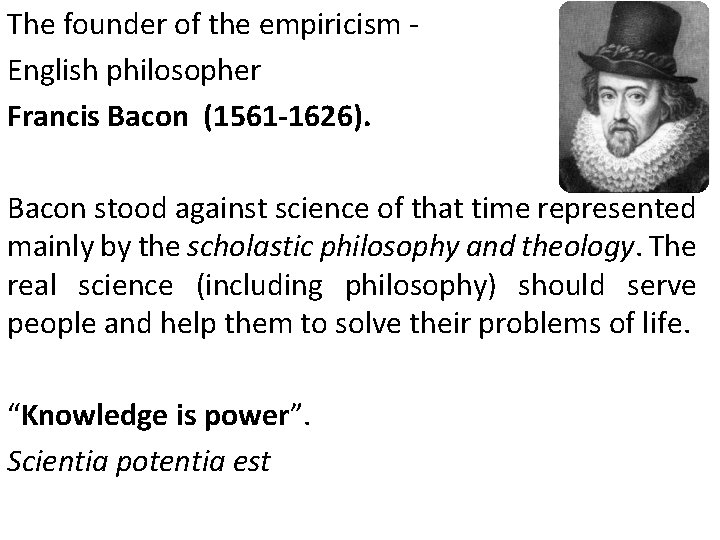
The founder of the empiricism English philosopher Francis Bacon (1561 -1626). Bacon stood against science of that time represented mainly by the scholastic philosophy and theology. The real science (including philosophy) should serve people and help them to solve their problems of life. “Knowledge is power”. Scientia potentia est
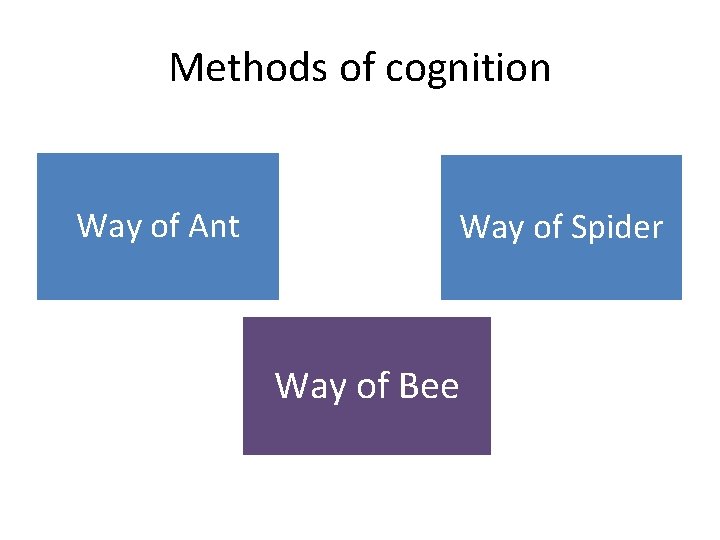
Methods of cognition Way of Ant Way of Spider Way of Bee
The use of theology is limited by its ability of proving the existence of God and no more. But the new philosophy he stood for couldn’t allow itself the luxury of long and fruitless abstract reasoning with its deductive approaches. The new philosophy should be grounded not on the deduction but on induction (such way of reasoning that supposes extracting general regularities from particular cases)
There exist two kinds of induction: 1) the induction through the complete enumeration (strong induction) - it provides reliable results which however contain nothing new 2) that through the incomplete enumeration (weak induction) – it gives out new results which are not reliable.
It’s like in the story about a clerk who wrote up the population in a village. There were 100 houses in this village. The clerk went up 98 houses and in every one the surname of its inhabitants was Johnson. It was an evening already and two houses else standing little aloof were remaining. The clerk was tied and decided there was no sense to go to these houses also because there for sure some Johnsons lived. He didn’t go and wrote up accordingly. But it turned out he had made a mistake because in one of these two houses Williamses lived.
Bacon’s teaching of idols The idols - mental habits leading to errors: • idols of cave or individual errors, originated from one’s individual nature, where one sojourns like in a cave, unable to get out; • idols of market, the erroneous habits set up by the ‘tyranny’ of words or by incorrect understanding their sense (human exchange with words like with coins and wares at a market); • idols of theater, ready schemes of thinking (similar to theater roles); • idols of school or faith in someone’s authority (that it can replace an own research).
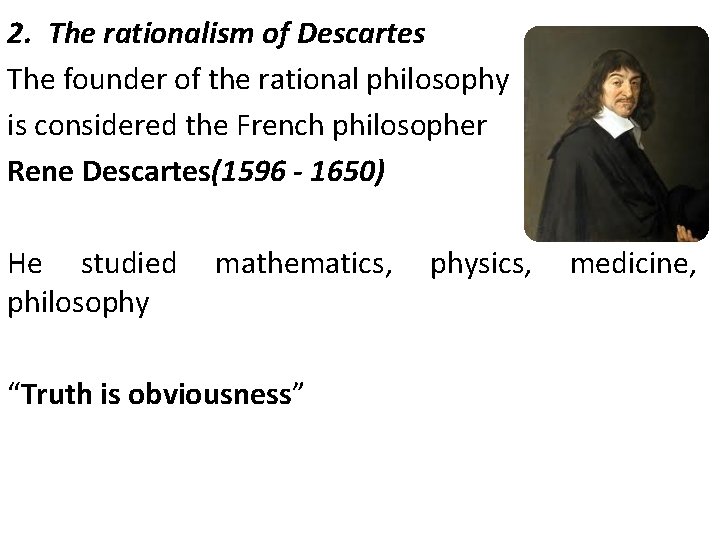
2. The rationalism of Descartes The founder of the rational philosophy is considered the French philosopher Rene Descartes(1596 - 1650) He studied philosophy mathematics, “Truth is obviousness” physics, medicine,
God – world – other people – me Me- others – world - God
The famous Cartesian dictum “Cogito… ergo, sum”
Initially, Descartes arrives at only a single principle: thought exists! Thought cannot be separated from me, therefore, I exist this is known as cogito ergo sum. Therefore, Descartes concluded, if he doubted, then something or someone must be doing the doubting, therefore the very fact that he doubted proved his existence. "The simple meaning of the phrase is that if one is skeptical of existence, that is in and of itself proof that he does exist”
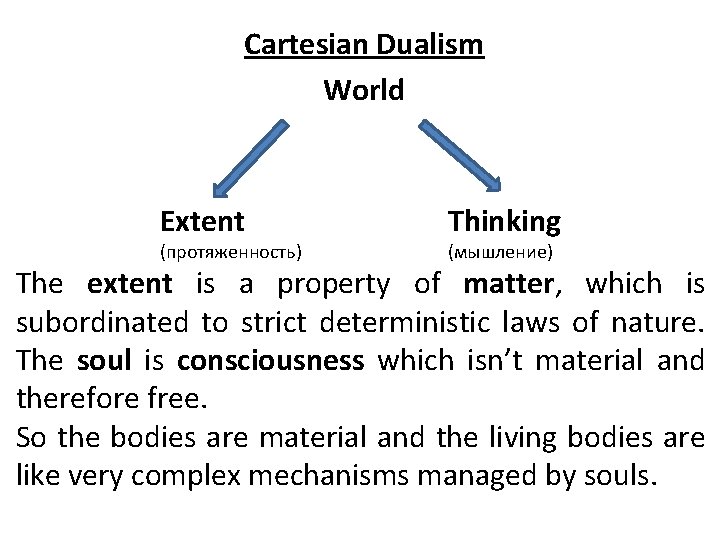
Cartesian Dualism World Extent (протяженность) Thinking (мышление) The extent is a property of matter, which is subordinated to strict deterministic laws of nature. The soul is consciousness which isn’t material and therefore free. So the bodies are material and the living bodies are like very complex mechanisms managed by souls.
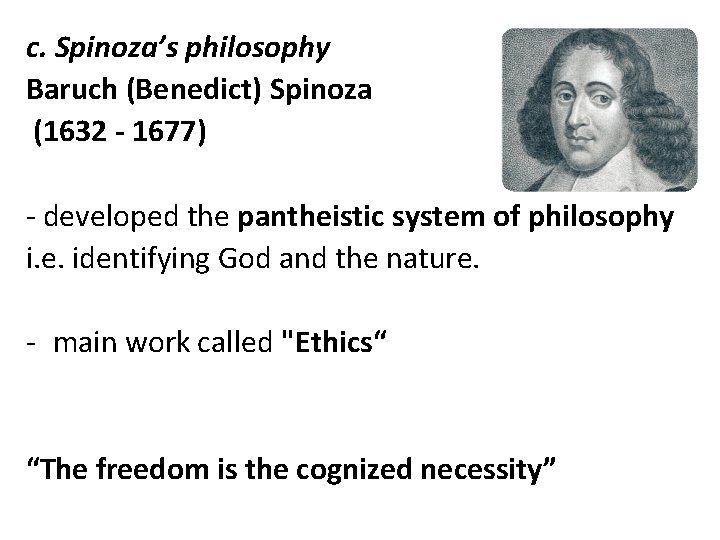
c. Spinoza’s philosophy Baruch (Benedict) Spinoza (1632 - 1677) - developed the pantheistic system of philosophy i. e. identifying God and the nature. - main work called "Ethics“ “The freedom is the cognized necessity”
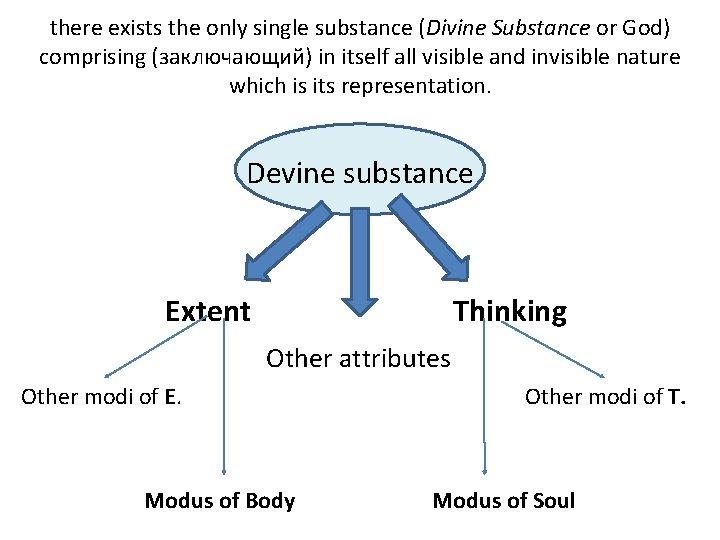
God is no longer the transcendent (? ? ) creator of the universe who rules it via providence, but Nature itself, understood as an infinite, necessary, and fully deterministic system of which humans are a part. Humans find happiness only through a rational understanding of this system and their place within it. The Divine Substance is endowed (наделять) with infinite quantity of different attributes, the main among which are extent and thinking (or consciousness). There also many other attributes but these are main. The individual souls and material things have no independent existence and are nothing else but God's manifestations (of thinking and extent attributes accordingly)
there exists the only single substance (Divine Substance or God) comprising (заключающий) in itself all visible and invisible nature which is its representation. Devine substance Extent Thinking Other attributes Other modi of E. Modus of Body Other modi of T. Modus of Soul
The human who realized his unity with the Whole (with God or the Universe) has nothing more to fear. He gets free from the tyranny of fear and doesn't think of death but of life. The chief thing is the love to God. This is the part of the love with which God loves itself. This love is the highest virtue
d) Leibniz’s philosophy Gottfried Wilhelm Leibniz (1646 - 1717) Leibniz grounds his philosophy on the conception of substance (субстанция) as well as Spinoza. Leibniz's best known contribution to metaphysics is his theory of monads.
Leibniz’ theodicy. Evil exists because if you do not cognize the evil you will not know what good is. It is similar to the well-known idea “Everything is learnt in comparison". To answer the question is it good or bad, successfully or not, you need something to compare with.
3. Enlightnment is the huge cultural, social and political movement of intellectuals based on the rationalism and freethinking. Target – transformation of the society by means of reason, education and science. Emphasis - on the fighting for ones social, political and economical rights.
Peculiarities of the Enlightment 1. Development of deep faith in the unlimited possibilities of science to understand the world – ground - ideas of Francis Bacon and Descartes (the possibility of a empirical and rational study of nature); 2. Development of deistic view of the world, which leads to the formation of materialism as a holistic philosophical doctrine.
Representatives • Thomas Hobbes, • John Locke, • Voltaire, • Diderot, • Montesquieu,
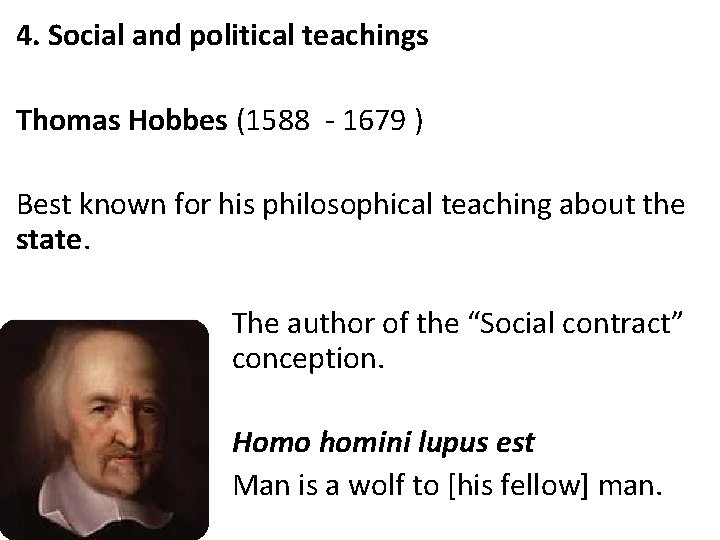
4. Social and political teachings Thomas Hobbes (1588 - 1679 ) Best known for his philosophical teaching about the state. The author of the “Social contract” conception. Homo homini lupus est Man is a wolf to [his fellow] man.
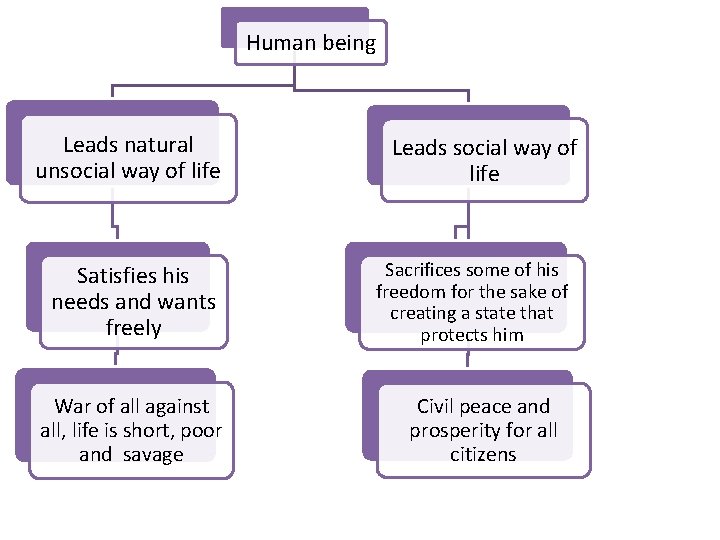
Human being Leads natural unsocial way of life Satisfies his needs and wants freely War of all against all, life is short, poor and savage Leads social way of life Sacrifices some of his freedom for the sake of creating a state that protects him Civil peace and prosperity for all citizens
- In accordance to his nature the human being looks not for friends but for profit he can receive from them. - The main law of the natural state – everybody is free and can do whatever he wants to preserve his life. - When the man limits his natural rights and replaces it with the civil law the civil state appears. - The main civil law (Hobbs offered 19) – put all the strength to look for peace and to keep it.
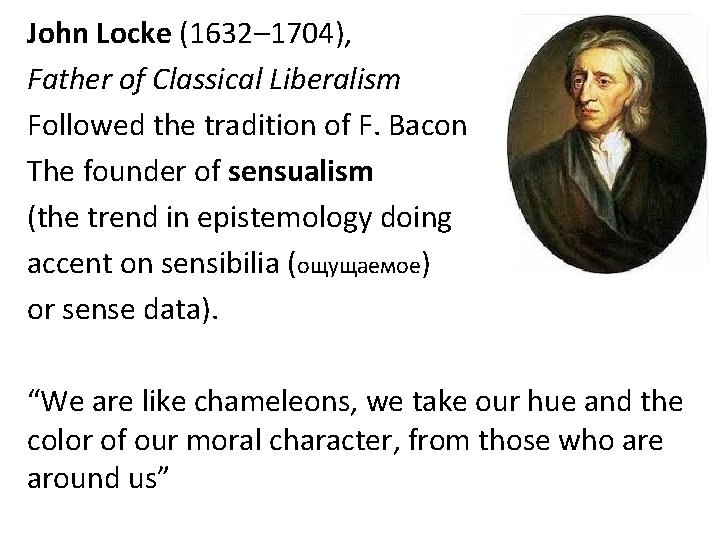
John Locke (1632– 1704), Father of Classical Liberalism Followed the tradition of F. Bacon The founder of sensualism (the trend in epistemology doing accent on sensibilia (ощущаемое) or sense data). “We are like chameleons, we take our hue and the color of our moral character, from those who are around us”
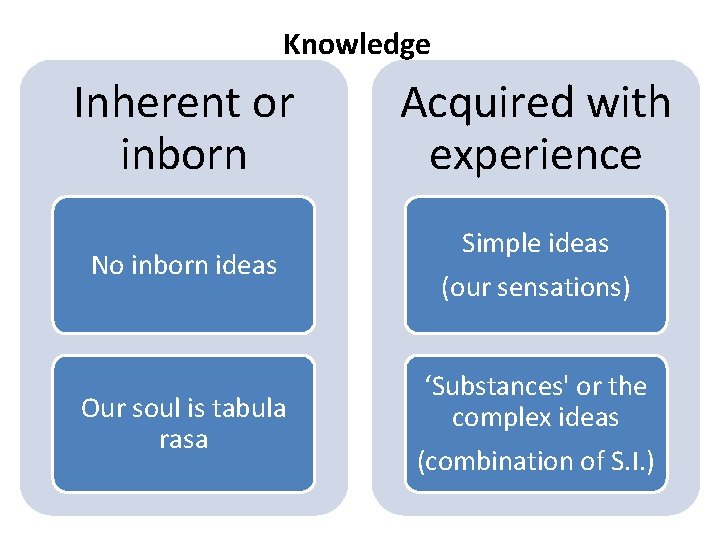
Knowledge Inherent or inborn Acquired with experience No inborn ideas Simple ideas (our sensations) Our soul is tabula rasa ‘Substances' or the complex ideas (combination of S. I. )
The data fill consciousness. These data were those Locke called ideas. The ideas are divided into simple and complex ones. - the simple ideas are elemental sensual perceptions such as 'whiteness', 'hardness' etc. - 'substances' or the complex ideas the bearers of simple ones and modi (sing. modus) the ideas having no independent existence (such as extent, time, space etc. ).
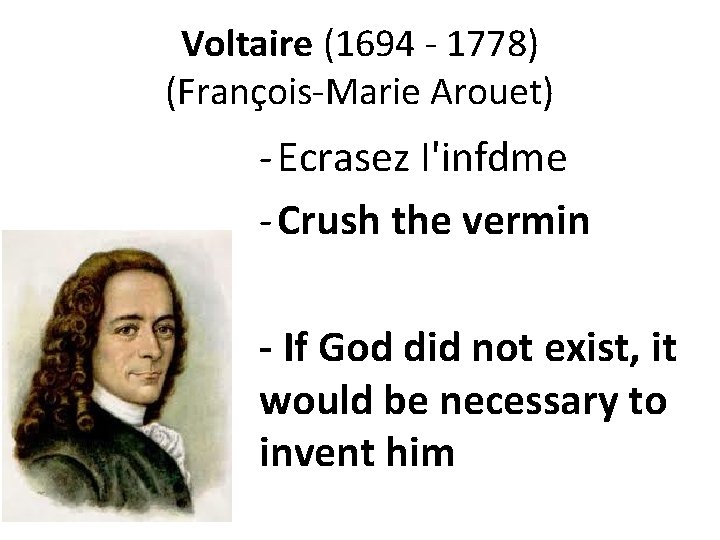
Voltaire (1694 - 1778) (François-Marie Arouet) - Ecrasez I'infdme - Crush the vermin - If God did not exist, it would be necessary to invent him
The Renaissance had taken place within the framework of the Christian Church. A few humanists had shown signs of scepticism, but no one had expressed any doubts about the Christian religion as a whole. People had the comfortable moral freedom that goes with an unquestioned faith. But by the middle of the eighteenth century serious-minded men could see that the Church had become a tied house - tied to property and status and defending its interests by repression and injustice. No one felt this more strongly than Voltaire. 'Ecrasez I'infdme' - untranslatable! 'Crush the vermin', perhaps. So the eighteenth century was faced with the troublesome task of constructing a new morality, without revelation or Christian sanctions.