
The New Testament the Gospels January 13 th


![• Mary’s visit to Elizabeth _________ [Luke 1: 29 -56 ] NAME THAT](https://slidetodoc.com/presentation_image_h2/6de615fefeb38c4df2a0e2f411cebaf8/image-25.jpg "• Mary’s visit to Elizabeth _________ [Luke 1: 29 -56 ] NAME THAT")
![• The raising of Lazarus ________ [John 11: 45 -53] NAME THAT BOOK](https://slidetodoc.com/presentation_image_h2/6de615fefeb38c4df2a0e2f411cebaf8/image-27.jpg "• The raising of Lazarus ________ [John 11: 45 -53] NAME THAT BOOK")




![OUTLINE OF MATTHEW • PROLOGUE: Jesus’ Divine and Human Origins [1: 1 -2: 23]](https://slidetodoc.com/presentation_image_h2/6de615fefeb38c4df2a0e2f411cebaf8/image-51.jpg "OUTLINE OF MATTHEW • PROLOGUE: Jesus’ Divine and Human Origins [1: 1 -2: 23]")

- Slides: 56
The New Testament & the Gospels| January 13 th, 2019 Catie Smith
ADVENTUS - COMING
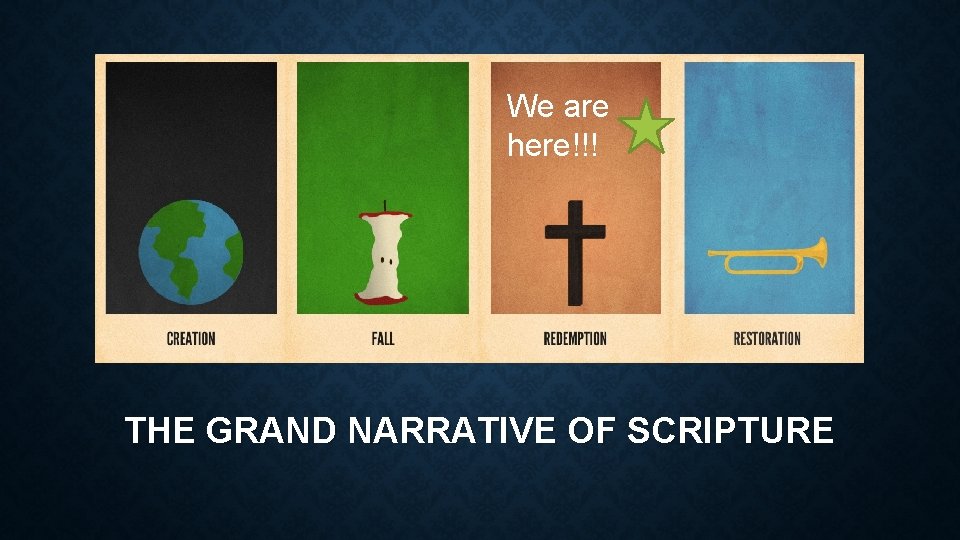
We are here!!! THE GRAND NARRATIVE OF SCRIPTURE
THE WAITING IS OVER!!!
EVERY WEEK… 1 new fact about the New Testament
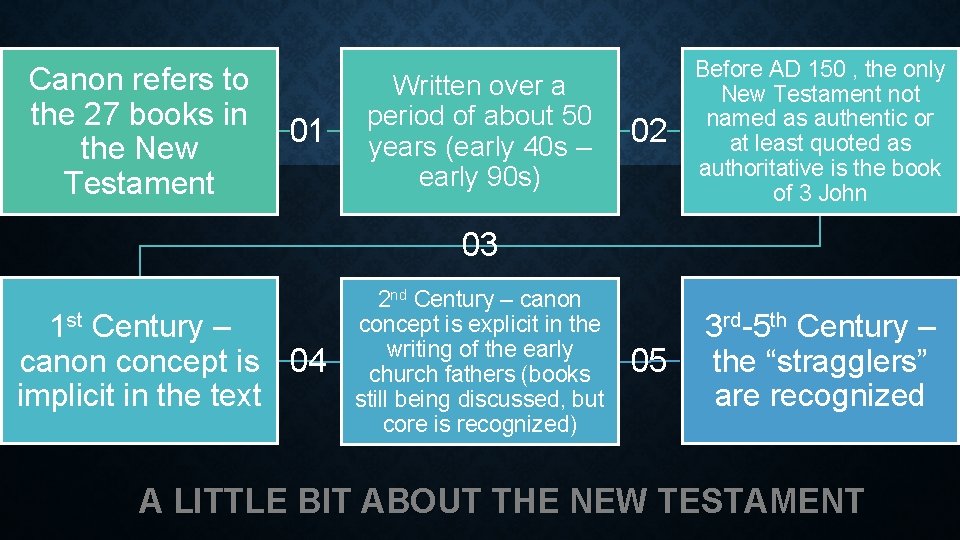
Canon refers to the 27 books in the New Testament 01 Written over a period of about 50 years (early 40 s – early 90 s) 02 Before AD 150 , the only New Testament not named as authentic or at least quoted as authoritative is the book of 3 John 05 3 rd-5 th Century – the “stragglers” are recognized 03 1 st Century – canon concept is 04 implicit in the text 2 nd Century – canon concept is explicit in the writing of the early church fathers (books still being discussed, but core is recognized) A LITTLE BIT ABOUT THE NEW TESTAMENT
BE AWARE OF THE FOLLOWING PEOPLE/THINGS IN THE NEW TESTAMENT Sects of Judaism High Priesthood Temple Taxes Synagogue *See following slides for more information
SECTS OF JUDAISM • Most people fit into one of six classifications: • Am Ha’ eretz: The people of the land (peasants) • Zealots • Essenes: don’t make an appearance in the gospels but the dead sea scrolls give us a lot of info • Pharisees • Sadducees • Herodians
• Am Ha’ eretz—the people of the land (common people). • Usually held in great disrespect. • At least at the beginning of his life on earth, Jesus and his family would have been considered part of this group. AM HA’ ERETZ
• Probably not a formal party until the rebellion in the 60 s. They represent more of a rising violent tide against Roman rule. They were certainly present in the NT. • Beliefs: “This land is our land” • Political desire: Kick out the Romans, repeat the Maccabean revolt. Ultimately led to the rebellion in AD 66 which finally destroyed Judas as a political entity. ZEALOTS
• Nothing of the Essenes is mentioned in the Bible. • Beliefs: “You bunch of slackers. ” • Political Desire: “A pox on all your houses. ” • We know about them because of the Dead Sea Scrolls • They created their own monasticlike communities. ESSENES
• The usual negative portrait of the Pharisees does not fit the picture in the Gospels. They were a diverse group. Many oppose Jesus, but at times the Gospels paint them in a positive light (see Luke 7: 36, 13: 31). Many Pharisees were part of the early expansion of the Church (Acts 15: 5). PHARISEES
• Characteristics and Origins: according to Josephus, they emerged in the reign of John Hyrcanus, opposing the consolidation of royalty and the priesthood. They were religious conservatives who primarily operated in the synagogues, and their foremost concern was to create “a fence around the Torah. ” PHARISEES CONTINUED
• Beliefs: “Sola Scripture, and Oral tradition. ” • Political Desire: Anti-Hasmonean; anti-Herodian/Roman. They looked for a cataclysmic Messianic kingdom to remove the rule of the Herods and Rome. PHARISEES CONTINUED
• Beliefs: “Don’t bother me with all that other stuff. ” They rejected the oral law and held all the OT to be God’s word—as long as it could be backed up in the Pentateuch. • Political aims: “Problem? What Problem? ” They did not resent the Roman rule. They were decidedly pro-Hasmonean. They liked the status quo. SADDUCEES
• These influential men were partisans of the Herodian dynasty and the Roman rule. 3 x mentioned in the NT (MT 22: 16; Mk 3: 6, 12: 13). • Beliefs: “I’m with Him. ” Religiously, the connection to the Sadducees is strong. The Herodians were politically affiliated with Herodian house, but religiously and economically affiliated with the Sadducees. • Political desire: “Herod, He’s our man. ” To see the Herodian rule continue. HERODIANS
• From the time of Solomon, the high priest was to come from the line of Zadok. He was a pivotal figure in the social and religious life of the Jews. HIGH PRIEST
• The continuity between the OT priesthood runs through the NT times. The priests (descendants of Levi) served sacerdotal duties in the Temple. PRIESTHOOD
• The Temple in the NT was the Temple of Herod. Solomon’s Temple had been destroyed by Nebuchadnezzar. Zerubbabel’s temple suffered repeated great damage (especially between 200 – 150 BC). Herod’s Temple was a replacement for Zerubbabel’s Temple. TEMPLE
• The supreme Jewish judicial council of Judaism in NT times (made up of Pharisees and Sadducees). • It appears Paul had been a member of the Sanhedrin. SANHEDRIN
• The synagogue developed in the exile in Mesopotamia. It was the regular Jewish assembly for prayer and worship. It lay at the heart of everyday Jewish society. SYNAGOGUE
At least two levels of taxation: A. Roman Direct taxation (tax collectors come to your door). Indirect taxation (tax goods, etc. ). B. Jewish triple tithe (temple tax, etc. ). C. Relief for the poor TAXES
ARE THEY REALLY THAT DIFFERENT? AT YOUR TABLES Work together to try and identify which gospel talks about which event.
• Mary’s visit to Elizabeth _________ [Luke 1: 29 -56 ] NAME THAT BOOK • The birth of Jesus ______ & ______ [Matt 1: 18 -25] [Luke 2: 1 -7] • The marriage at Cana __________ [John 2: 1 -11]
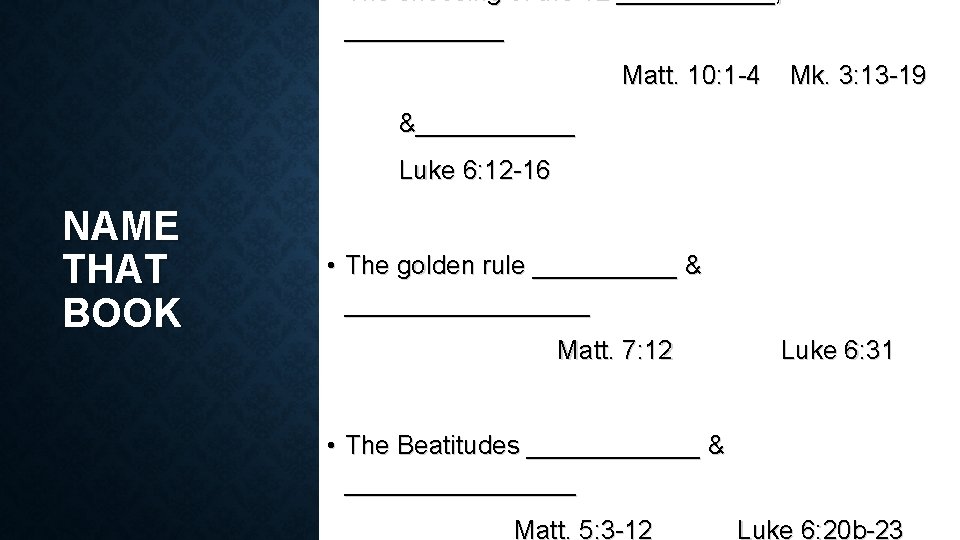
• The choosing of the 12 ______, ______ Matt. 10: 1 -4 Mk. 3: 13 -19 &______ Luke 6: 12 -16 NAME THAT BOOK • The golden rule _____ & _________ Matt. 7: 12 Luke 6: 31 • The Beatitudes ______ & ________ Matt. 5: 3 -12 Luke 6: 20 b-23
• The raising of Lazarus ________ [John 11: 45 -53] NAME THAT BOOK • Jesus before Herod _________ [Luke 23: 6 -12] • Jesus appears to His disciples by the Sea of Tiberias ____________ [John 21: 1 -14]
THE GOSPELS: ONE STORY, MANY DIMENSIONS • Difficulties in interpreting the Gospels stem from two obvious facts: (1) Jesus himself did not write a gospel (2) There are four gospels, three of which have remarkable similarities • Synoptic = “Common view” • Pericope = set of verses that form one coherent unit; an extract from a text
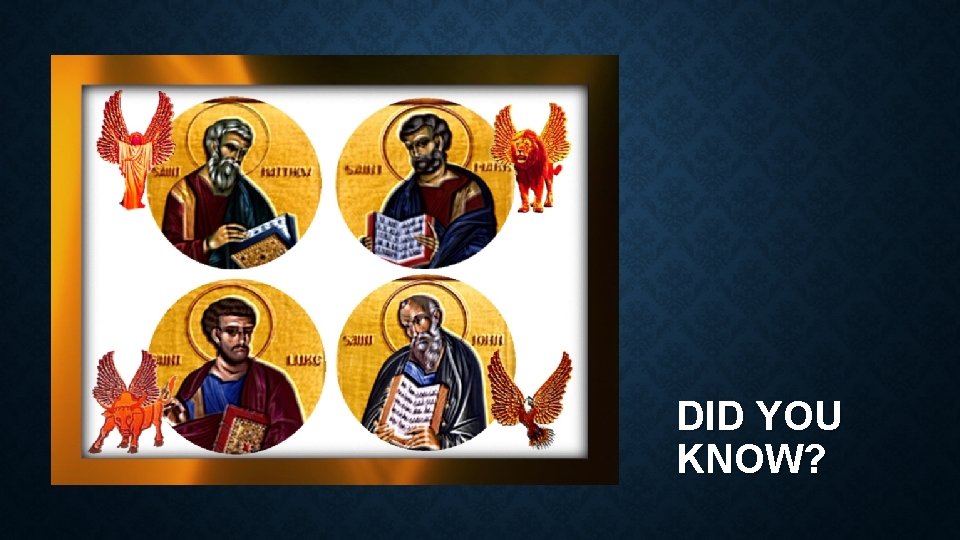
DID YOU KNOW?
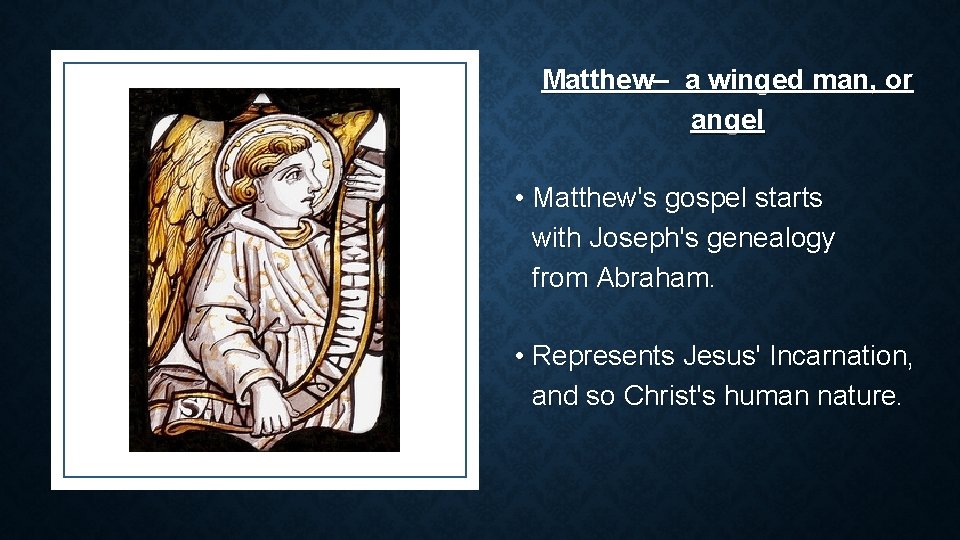
Matthew– a winged man, or angel • Matthew's gospel starts with Joseph's genealogy from Abraham. • Represents Jesus' Incarnation, and so Christ's human nature.
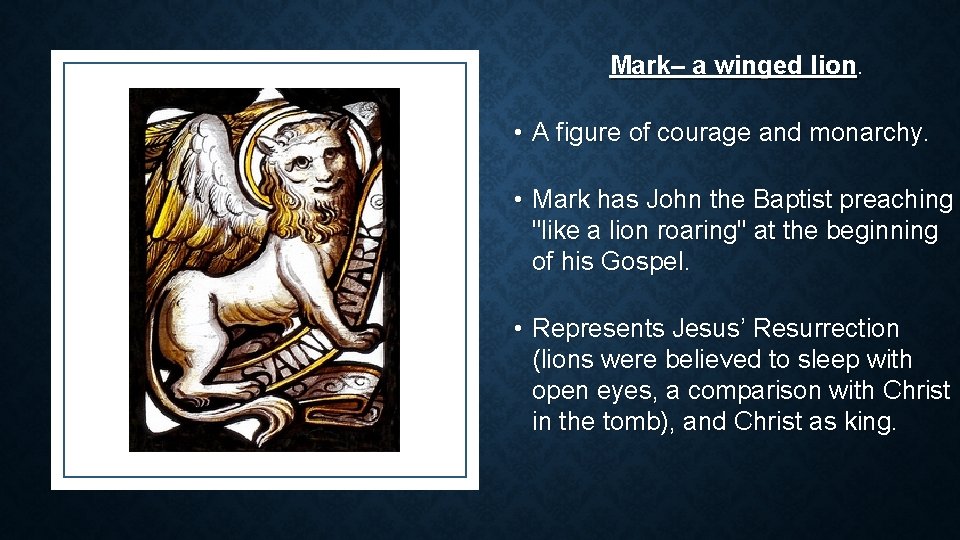
Mark– a winged lion. • A figure of courage and monarchy. • Mark has John the Baptist preaching "like a lion roaring" at the beginning of his Gospel. • Represents Jesus’ Resurrection (lions were believed to sleep with open eyes, a comparison with Christ in the tomb), and Christ as king.
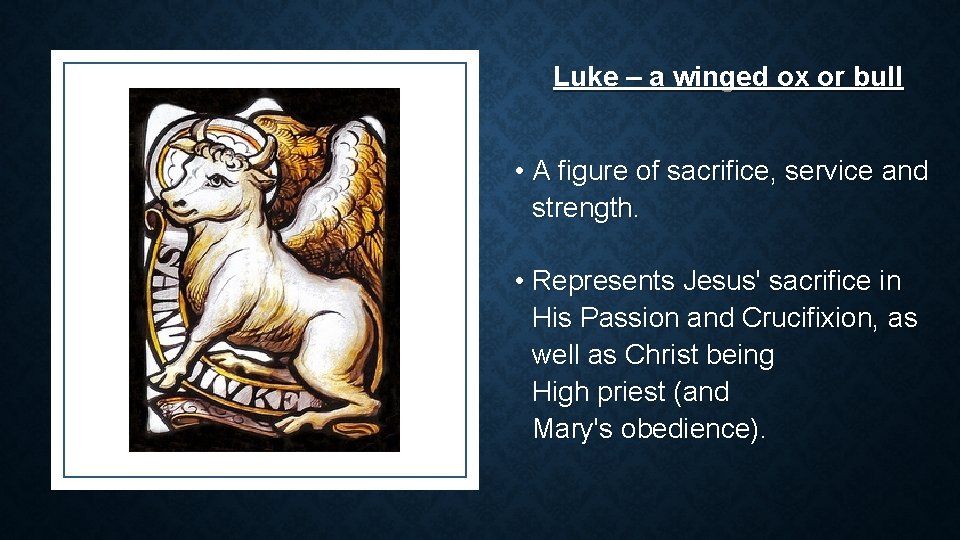
Luke – a winged ox or bull • A figure of sacrifice, service and strength. • Represents Jesus' sacrifice in His Passion and Crucifixion, as well as Christ being High priest (and Mary's obedience).
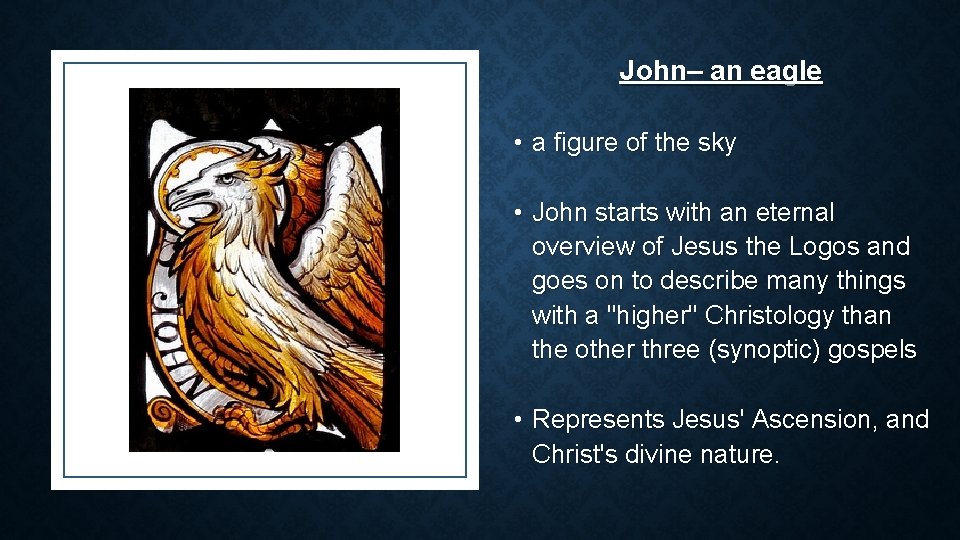
John– an eagle • a figure of the sky • John starts with an eternal overview of Jesus the Logos and goes on to describe many things with a "higher" Christology than the other three (synoptic) gospels • Represents Jesus' Ascension, and Christ's divine nature.
WHY? ? • Why is Matthew the only book with a genealogy? • Why doesn’t John have a birth narrative? • Why doesn’t Luke have the great commission? • Why is Mark so short and to the point?
LITERARY CONTEXT • Think Horizontally – “…when studying a pericope in any one gospel, it is usually helpful to be aware of the parallels in the other gospels. ” • Think Vertically – “… when reading or studying a narrative or teaching in the Gospels, one should try to be aware of both historical contexts that of Jesus and that of the evangelist. ”
Let’s get into MATTHEW
IN A TIME OF WAITING
AND IN THEIR WAITING. . . • They had the Old Testament that we have today • They were looking forward to REDEMPTION…to a redeemer Isaiah 11: 1 A shoot will come up from the stump of Jesse; from his roots a Branch will bear fruit. 2 The Spirit of the LORD will rest on him— the Spirit of wisdom and of understanding, the Spirit of counsel and of might, the Spirit of the knowledge and fear of the LORD— 3 and he will delight in the fear of the LORD.
THE MESSIANIC EXPECTATION • Covenant with King David: Restore a godly king to Israel from the Davidic line (2 Samuel 7) • A Coming Child and Son: Wonderful Counselor, Mighty God, Prince of Peace (Isaiah 9: 6 -7) • Kingdom will never end (Isaiah 11: 1 -5)
MATTHEW 1: 1 -17 • Abraham, Isaac, Jacob • Judah • Boaz (by Rahab) • Jesse • David • Solomon (1/2 Gentile) • Rahab – Gentile • Bathsheba (“wife of Uriah”) • Ruth – Gentile • Tamar
WHY SHOULD WE HIRE YOU?
MY DREAM MAN (EXPECTATIONS) • Loves Jesus • Solid in family relationships • Intelligent • High achiever • Good with people • Attractive Must have Man List • Musical • Funny • Kind • Attentive • Confident • Athletic • Hygienic
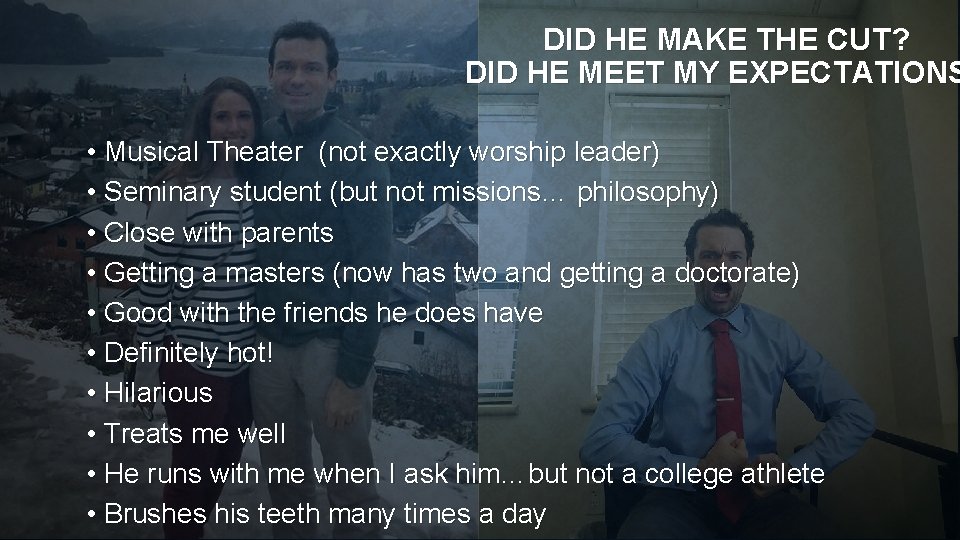
DID HE MAKE THE CUT? DID HE MEET MY EXPECTATIONS • Musical Theater (not exactly worship leader) • Seminary student (but not missions… philosophy) • Close with parents • Getting a masters (now has two and getting a doctorate) • Good with the friends he does have • Definitely hot! • Hilarious • Treats me well • He runs with me when I ask him…but not a college athlete • Brushes his teeth many times a day
MATTHEW ADDRESSES EXPECTATIONS • PROVES that Jesus is meeting the Jew’s expectations • Shows how Jesus is the continuation and the fulfillment of the whole biblical story of God and Israel
OTHER THEMES • Jesus is the New Moses, the new authoritative teacher • Jesus is Immanuel (God with us) – He is the King they have waited for and he is GOD HERE WITH US!!!
A BOOK WRITTEN • By a Jew for Jews • To bring them the good news that THEIR WAITING IS OVER • Their Expectations have been fulfilled…
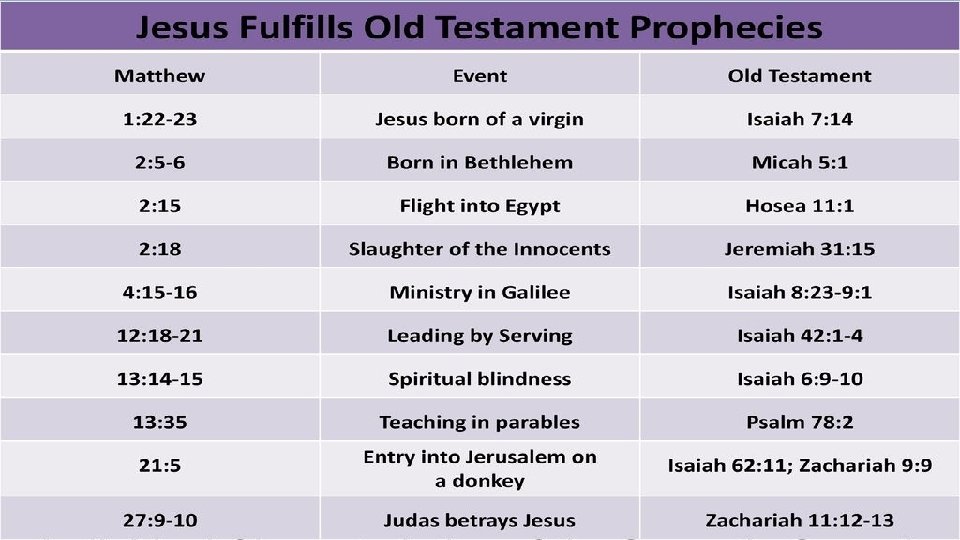
A FEW FULFILLMENTS
YOU HAVE BEEN “OLD TESTAMENT” CHRISTIANS
WE JUST CELEBRATED HIS COMING • Let’s now read about all that he has fulfilled!
OUTLINE OF MATTHEW • PROLOGUE: Jesus’ Divine and Human Origins [1: 1 -2: 23] • INTRODUCTION TO JESUS: His Baptism and the Testing [3: 1 -4: 11] • THE PROCLAMATION OF THE KINGDOM [4: 12 -7: 29] • THE POWER OF THE MISSION OF THE KINGFOM [8: 1 -10: 42] • QUESTIONING OF AND OPPOSITION TO JESUS AND THE KINGDOM [11: 113: 52] • THE OPPOSITION TO AND CONFESSION OF JESUS [13: 53 -18: 35] • JERUSALEM RECEIVES AND REJECTS HER KING [19: 1 -25: 46] • THE KING IS TRIED, CRUCIFIED, AND RAISED [26: 1 -28: 20]
THERE ARE FIVE TEACHING BLOCKS WITHIN THE OUTLINE • 5: 1 -7: 29 • 10: 11 -42 • 13: 1 -52 • 18: 1 -35 • 23: 1, 24: 1 -25: 46 Key marker for Matthew’s outline is the phrase, “And it happened, when Jesus had finished saying these things, that…”
This Week’s Readings PLAN 1 PLAN 2 Matthew (Teaching blocks) 28 chapters 5: 1 -7: 29 5 days x 5 chapters + 3 10: 11 -42 13: 1 -52 18: 1 -35 23: 1, 24: 1 -25: 46
AS YOU READ • Make mental (or actual) notes of prophecies fulfilled in Jesus • Look up the cross references in your Bible • Put yourself in the Jews’ shoes…
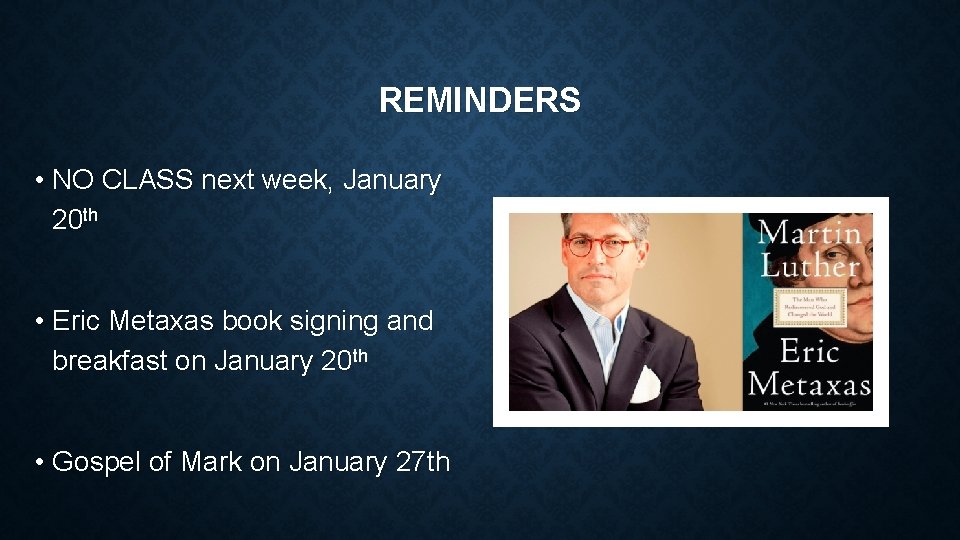
REMINDERS • NO CLASS next week, January 20 th • Eric Metaxas book signing and breakfast on January 20 th • Gospel of Mark on January 27 th