
The New Superconductors Proposed Applications Presented at IEEE
- Slides: 11
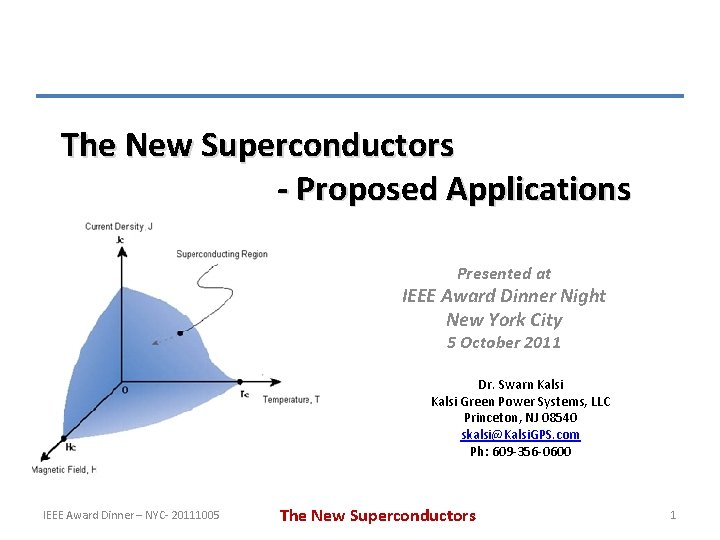
The New Superconductors - Proposed Applications Presented at IEEE Award Dinner Night New York City 5 October 2011 Dr. Swarn Kalsi Green Power Systems, LLC Princeton, NJ 08540 skalsi@Kalsi. GPS. com Ph: 609 -356 -0600 IEEE Award Dinner – NYC- 20111005 The New Superconductors 1
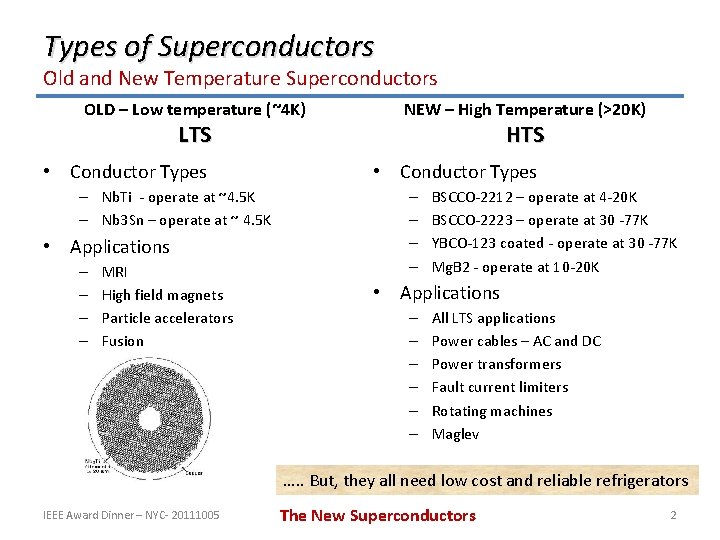
Types of Superconductors Old and New Temperature Superconductors OLD – Low temperature (~4 K) LTS • Conductor Types – Nb. Ti - operate at ~4. 5 K – Nb 3 Sn – operate at ~ 4. 5 K • Applications – – MRI High field magnets Particle accelerators Fusion NEW – High Temperature (>20 K) HTS • Conductor Types – – BSCCO-2212 – operate at 4 -20 K BSCCO-2223 – operate at 30 -77 K YBCO-123 coated - operate at 30 -77 K Mg. B 2 - operate at 10 -20 K • Applications – – – All LTS applications Power cables – AC and DC Power transformers Fault current limiters Rotating machines Maglev …. . But, they all need low cost and reliable refrigerators IEEE Award Dinner – NYC- 20111005 The New Superconductors 2
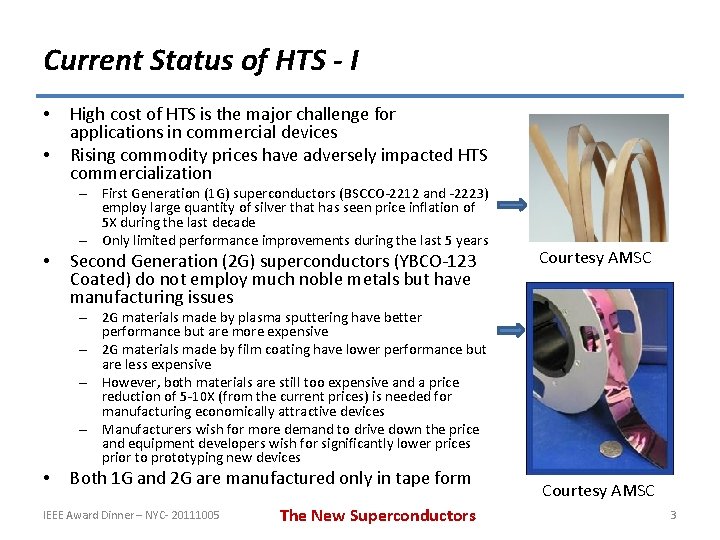
Current Status of HTS - I • • High cost of HTS is the major challenge for applications in commercial devices Rising commodity prices have adversely impacted HTS commercialization – First Generation (1 G) superconductors (BSCCO-2212 and -2223) employ large quantity of silver that has seen price inflation of 5 X during the last decade – Only limited performance improvements during the last 5 years • Second Generation (2 G) superconductors (YBCO-123 Coated) do not employ much noble metals but have manufacturing issues Courtesy AMSC – 2 G materials made by plasma sputtering have better performance but are more expensive – 2 G materials made by film coating have lower performance but are less expensive – However, both materials are still too expensive and a price reduction of 5 -10 X (from the current prices) is needed for manufacturing economically attractive devices – Manufacturers wish for more demand to drive down the price and equipment developers wish for significantly lower prices prior to prototyping new devices • Both 1 G and 2 G are manufactured only in tape form IEEE Award Dinner – NYC- 20111005 The New Superconductors Courtesy AMSC 3
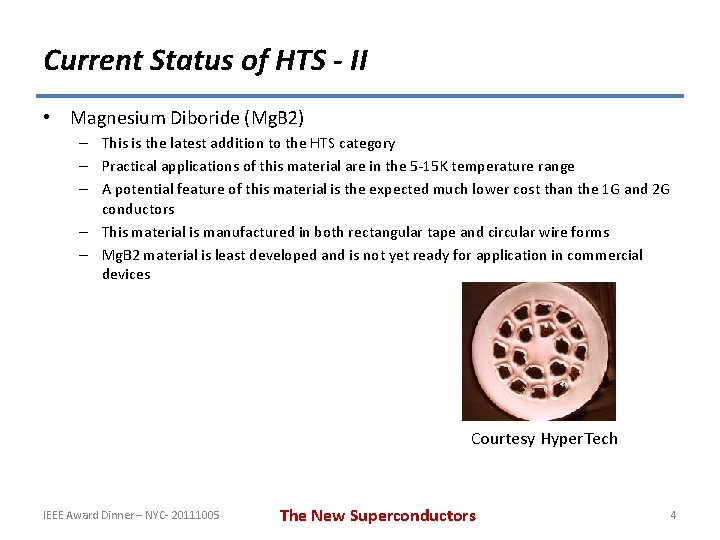
Current Status of HTS - II • Magnesium Diboride (Mg. B 2) – This is the latest addition to the HTS category – Practical applications of this material are in the 5 -15 K temperature range – A potential feature of this material is the expected much lower cost than the 1 G and 2 G conductors – This material is manufactured in both rectangular tape and circular wire forms – Mg. B 2 material is least developed and is not yet ready for application in commercial devices Courtesy Hyper. Tech IEEE Award Dinner – NYC- 20111005 The New Superconductors 4
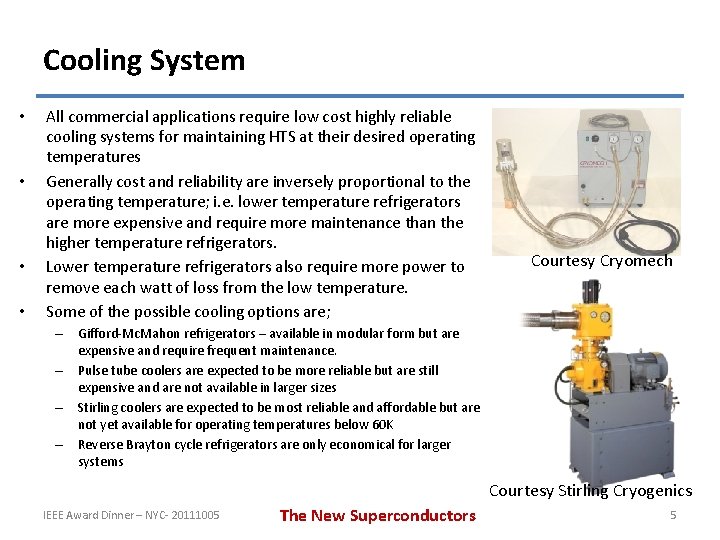
Cooling System • • All commercial applications require low cost highly reliable cooling systems for maintaining HTS at their desired operating temperatures Generally cost and reliability are inversely proportional to the operating temperature; i. e. lower temperature refrigerators are more expensive and require more maintenance than the higher temperature refrigerators. Lower temperature refrigerators also require more power to remove each watt of loss from the low temperature. Some of the possible cooling options are; Courtesy Cryomech – Gifford-Mc. Mahon refrigerators – available in modular form but are expensive and require frequent maintenance. – Pulse tube coolers are expected to be more reliable but are still expensive and are not available in larger sizes – Stirling coolers are expected to be most reliable and affordable but are not yet available for operating temperatures below 60 K – Reverse Brayton cycle refrigerators are only economical for larger systems Courtesy Stirling Cryogenics IEEE Award Dinner – NYC- 20111005 The New Superconductors 5
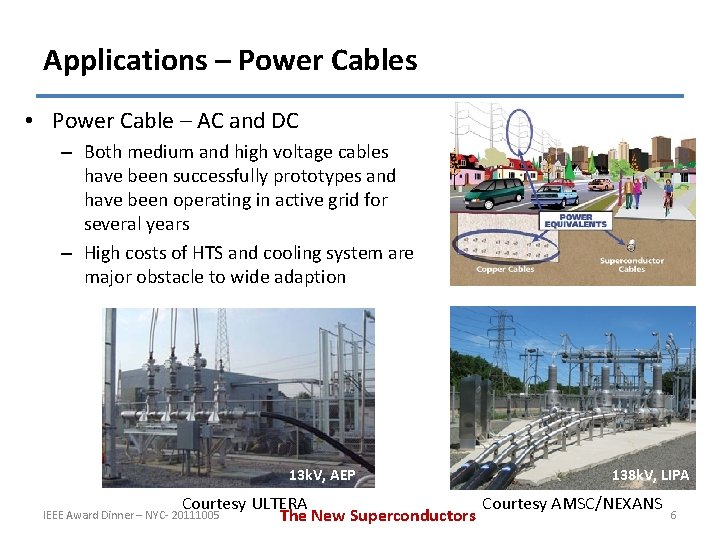
Applications – Power Cables • Power Cable – AC and DC – Both medium and high voltage cables have been successfully prototypes and have been operating in active grid for several years – High costs of HTS and cooling system are major obstacle to wide adaption 13 k. V, AEP 138 k. V, LIPA Courtesy ULTERA Courtesy AMSC/NEXANS The New Superconductors IEEE Award Dinner – NYC- 20111005 6
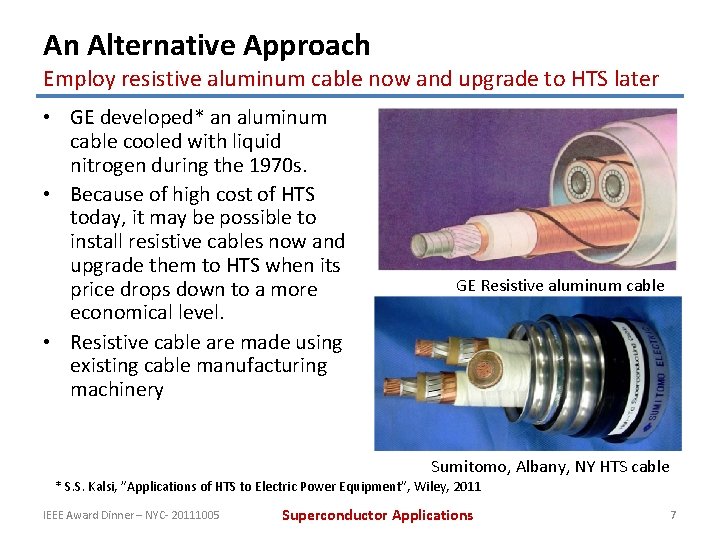
An Alternative Approach Employ resistive aluminum cable now and upgrade to HTS later • GE developed* an aluminum cable cooled with liquid nitrogen during the 1970 s. • Because of high cost of HTS today, it may be possible to install resistive cables now and upgrade them to HTS when its price drops down to a more economical level. • Resistive cable are made using existing cable manufacturing machinery GE Resistive aluminum cable Sumitomo, Albany, NY HTS cable * S. S. Kalsi, ”Applications of HTS to Electric Power Equipment”, Wiley, 2011 IEEE Award Dinner – NYC- 20111005 Superconductor Applications 7
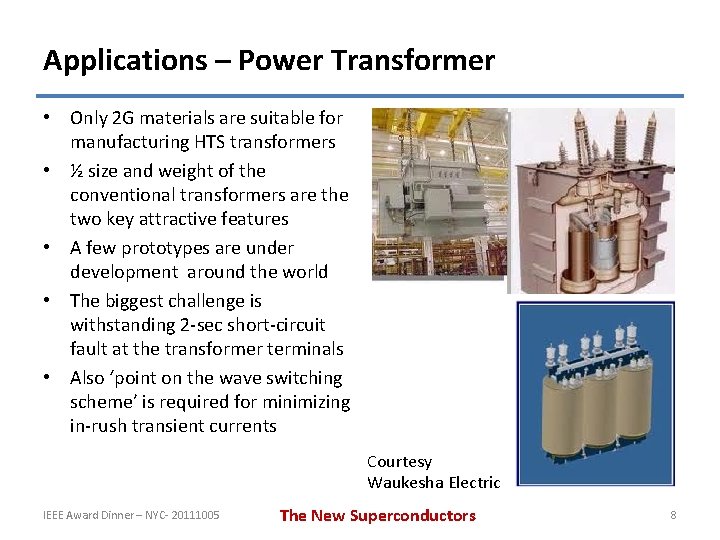
Applications – Power Transformer • Only 2 G materials are suitable for manufacturing HTS transformers • ½ size and weight of the conventional transformers are the two key attractive features • A few prototypes are under development around the world • The biggest challenge is withstanding 2 -sec short-circuit fault at the transformer terminals • Also ‘point on the wave switching scheme’ is required for minimizing in-rush transient currents Courtesy Waukesha Electric IEEE Award Dinner – NYC- 20111005 The New Superconductors 8
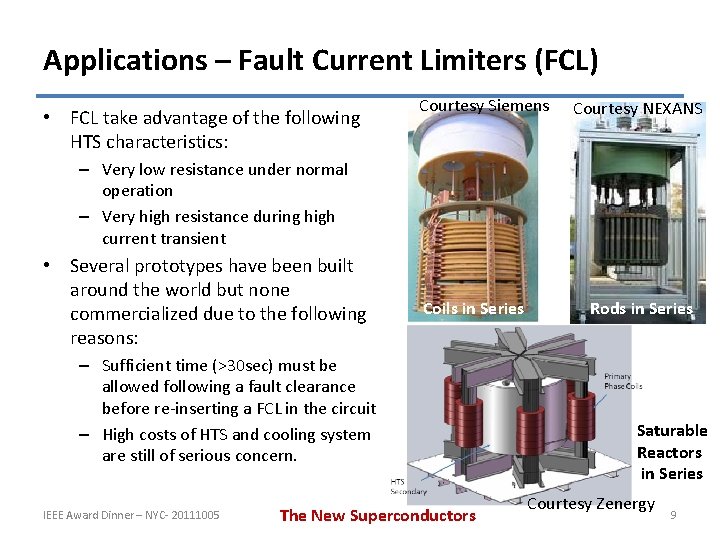
Applications – Fault Current Limiters (FCL) • FCL take advantage of the following HTS characteristics: Courtesy Siemens Courtesy NEXANS – Very low resistance under normal operation – Very high resistance during high current transient • Several prototypes have been built around the world but none commercialized due to the following reasons: Coils in Series – Sufficient time (>30 sec) must be allowed following a fault clearance before re-inserting a FCL in the circuit – High costs of HTS and cooling system are still of serious concern. IEEE Award Dinner – NYC- 20111005 The New Superconductors Rods in Series Saturable Reactors in Series Courtesy Zenergy 9
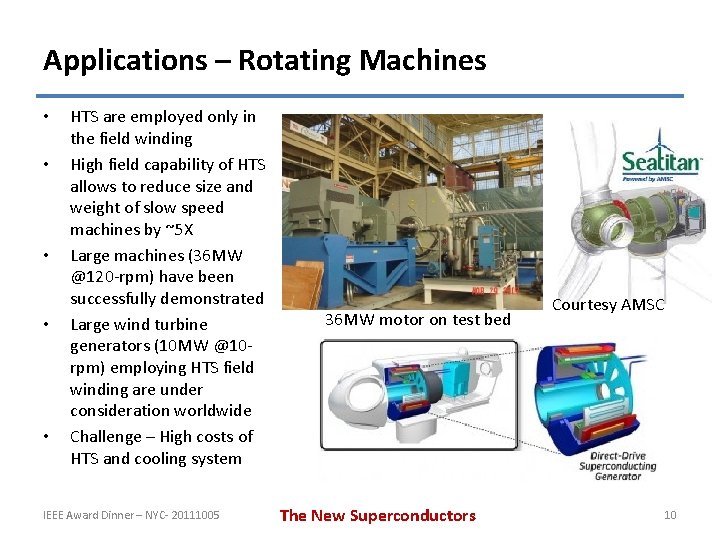
Applications – Rotating Machines • • • HTS are employed only in the field winding High field capability of HTS allows to reduce size and weight of slow speed machines by ~5 X Large machines (36 MW @120 -rpm) have been successfully demonstrated Large wind turbine generators (10 MW @10 rpm) employing HTS field winding are under consideration worldwide Challenge – High costs of HTS and cooling system IEEE Award Dinner – NYC- 20111005 36 MW motor on test bed The New Superconductors Courtesy AMSC 10
Summary • Wider use of HTS superconductors in commercial devices require – Low cost superconductors – Low cost and reliable cooling systems • HTS technology is ready for large scale commercial applications Reference: ‘Applications of High Temperature Superconductors to Electric Power Equipment’, Swarn S. Kalsi, Wiley/IEEE, ISBN 978 -0 -470 -16768 -7 IEEE Award Dinner – NYC- 20111005 The New Superconductors 11