
The New Standardized Approach for Operational Risk Capital
- Slides: 10
The New Standardized Approach for Operational Risk Capital Marco Migueis Federal Reserve Board Governance, Compliance, and Operational Risk Conference April 2018
Disclaimer The views expressed in this presentation belong to the author and are not official views of the Federal Reserve Board or the Federal Reserve System. 2
New Standardized Approach for Operational Risk • In December 2017, the BCBS replaced the three operational risk approaches of Basel II (BIA, TSA, and AMA) with a new standardized approach for operational risk • The BCBS only expects implementation by 2022 • The BCBS deemed AMA models be too complex; also, the framework as a whole was deemed to lack comparability • The new standardized approach sets capital based on a regulatory formula that uses financial statement information and past losses 3
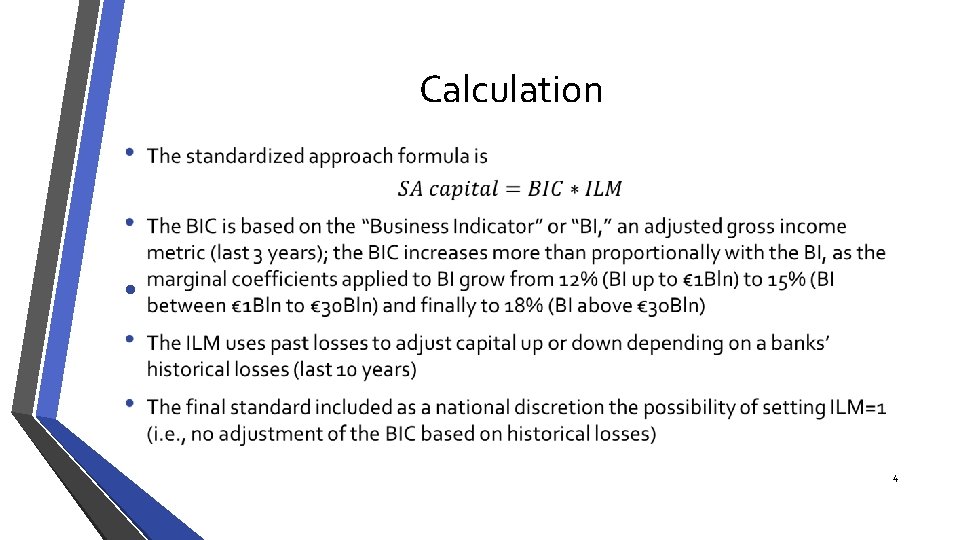
Calculation • 4
Additional Features • Unlike the AMA, the new standardized approach uses losses at date of accounting (rather than having losses be aggregated to date of occurrence or date of discovery) • If a loss event causes impact in multiple years, the impacts should be included in their respective year • • Losses are used net of recoveries • The standard allows banks to request supervisory approval to remove losses that are no longer “relevant” from the calculation • Insurance recoveries are allowed as recoveries (but only after they are paid by the insurance company) BI definitions do not perfectly match to current US regulatory reports 5
Impact • According to BCBS estimates, operational risk capital requirements would decrease 25% for large, internationally active banks globally • Previous studies have shown that the SMA (the previous version of the standardized approach) would have resulted in a smaller change in capital requirements for US banks than for banks in other jurisdictions (ORX 2016) • Thus, the decrease in operational risk capital requirements resulting from the introduction of the new standardized approach as-is is likely larger than 25% • If the US were to adopt the national discretion to set ILM=1, capital decreases would likely be even larger because US banks’ loss experience is typically larger than banks in other countries (largely due to legal losses) 6
HR 4296 • HR 4296, which has been approved by the House and is currently under consideration at the Senate, would limit the approaches used by regulators to set operational risk capital requirements. Under this bill, capital requirements need to: • • Be based on current risk exposures Be forward-looking Not be solely based on past losses Allow for operational risk mitigants • In my view, if it became law, this bill may challenge the application, as-is, of the new standardized approach • See https: //papers. ssrn. com/sol 3/papers. cfm? abstract_id=3159609 7
Evaluation of the New SA (1/2) • Robustness to gaming: Possibility to game models is eliminated; monitoring of data collection still necessary • Risk sensitivity: Industry commenters fiercely criticized the risk sensitivity of the SMA; scenario analysis and BEICF are eliminated from capital calculation; ILM is reactive and may not be forward-looking; risk sensitivity comparison relative to AMA depends on whether standardization hurts risk sensitivity more than the challenges associated with the AMA; limited possibility to manage capital requirement • Simplicity: Simple approach 8
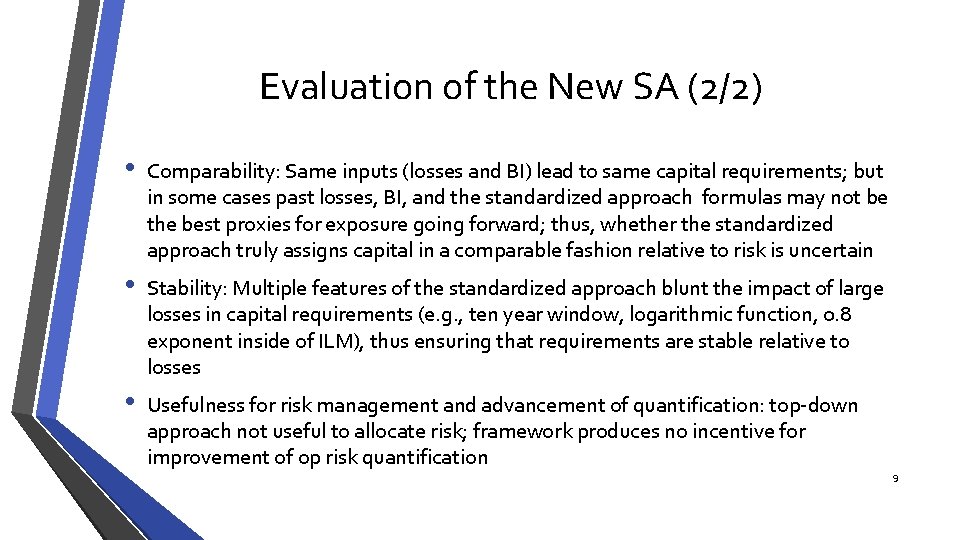
Evaluation of the New SA (2/2) • Comparability: Same inputs (losses and BI) lead to same capital requirements; but in some cases past losses, BI, and the standardized approach formulas may not be the best proxies for exposure going forward; thus, whether the standardized approach truly assigns capital in a comparable fashion relative to risk is uncertain • Stability: Multiple features of the standardized approach blunt the impact of large losses in capital requirements (e. g. , ten year window, logarithmic function, 0. 8 exponent inside of ILM), thus ensuring that requirements are stable relative to losses • Usefulness for risk management and advancement of quantification: top-down approach not useful to allocate risk; framework produces no incentive for improvement of op risk quantification 9
A Forward-looking Framework? • In my view, the US agencies should consider adopting a framework that is forward-looking, rather than backward-looking • I believe this can be accomplished, while limiting opportunities for gaming, by adopting a framework that is also incentive-compatible • I have outlined an approach on how to do so https: //papers. ssrn. com/sol 3/papers. cfm? abstract_id=3159608 10