
The New Revolution in Fire Suppression Technology International
- Slides: 41
The New Revolution in Fire Suppression Technology International Aircraft Systems Fire Protection Working Group Atlantic City NJ. 29 Aug 2000
Introduction Contents 1 2 3 4 5 Evolution of Pyrogen Technical Characteristics Performance and Benefits Typical Applications & Installations Comparison with Other Gases
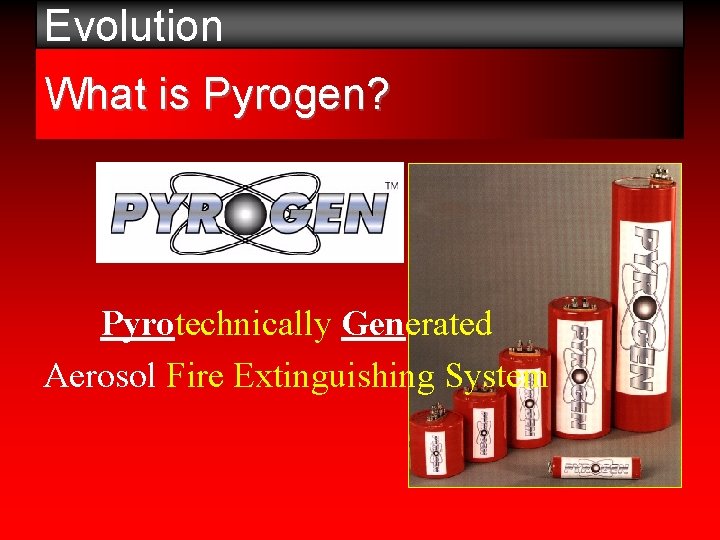
Evolution What is Pyrogen? Pyrotechnically Generated Aerosol Fire Extinguishing System
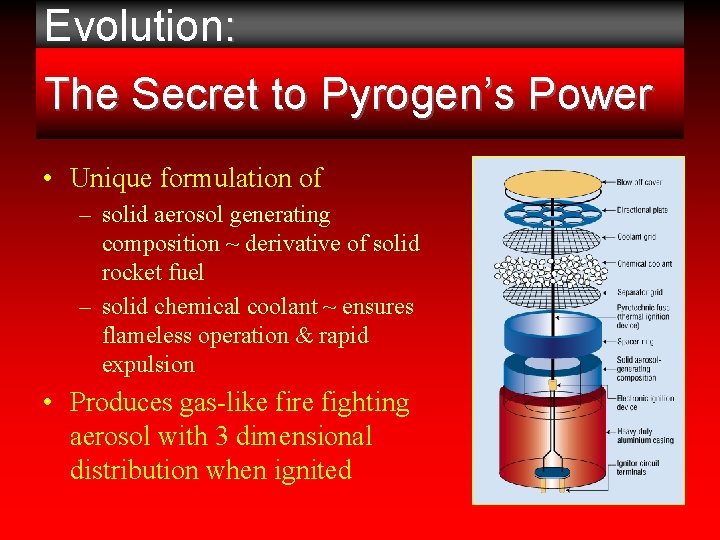
Evolution: The Secret to Pyrogen’s Power • Unique formulation of – solid aerosol generating composition ~ derivative of solid rocket fuel – solid chemical coolant ~ ensures flameless operation & rapid expulsion • Produces gas-like fire fighting aerosol with 3 dimensional distribution when ignited
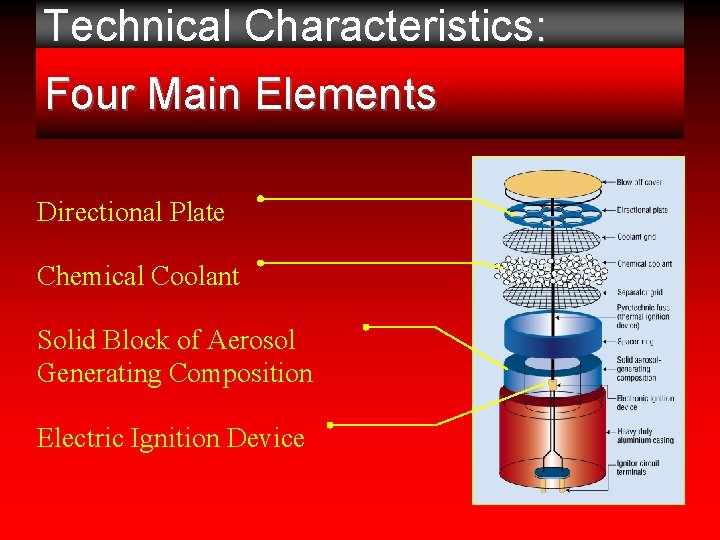
Technical Characteristics: Four Main Elements Directional Plate Chemical Coolant Solid Block of Aerosol Generating Composition Electric Ignition Device
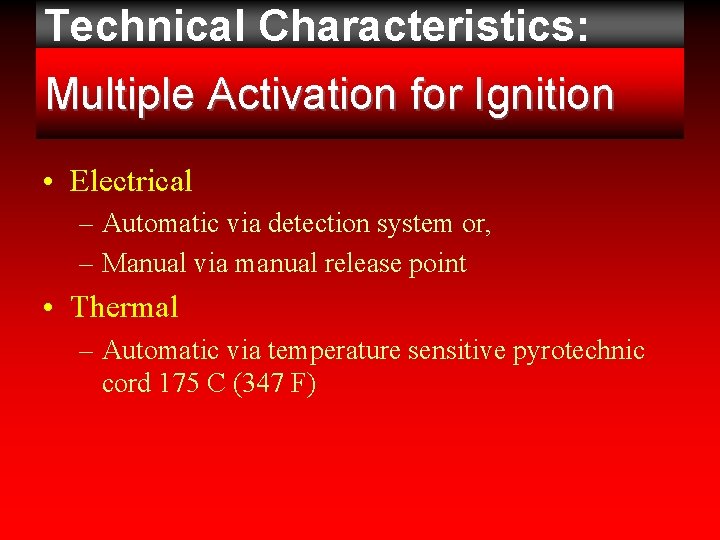
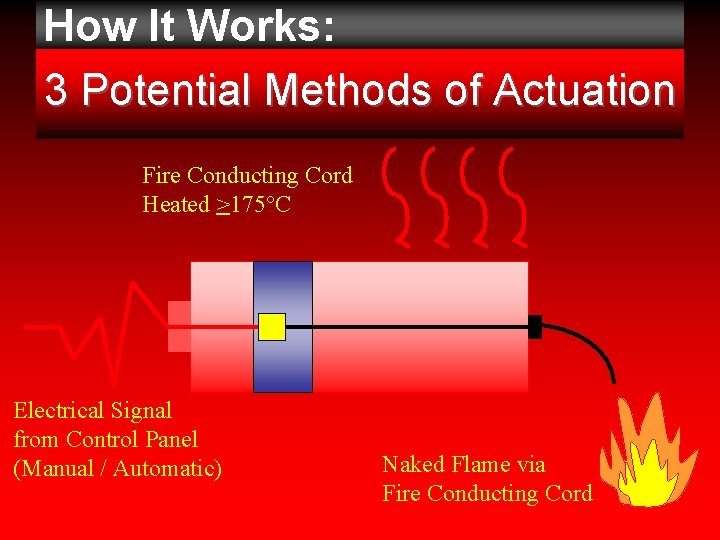
Technical Characteristics: Multiple Activation for Ignition • Electrical – Automatic via detection system or, – Manual via manual release point • Thermal – Automatic via temperature sensitive pyrotechnic cord 175 C (347 F)
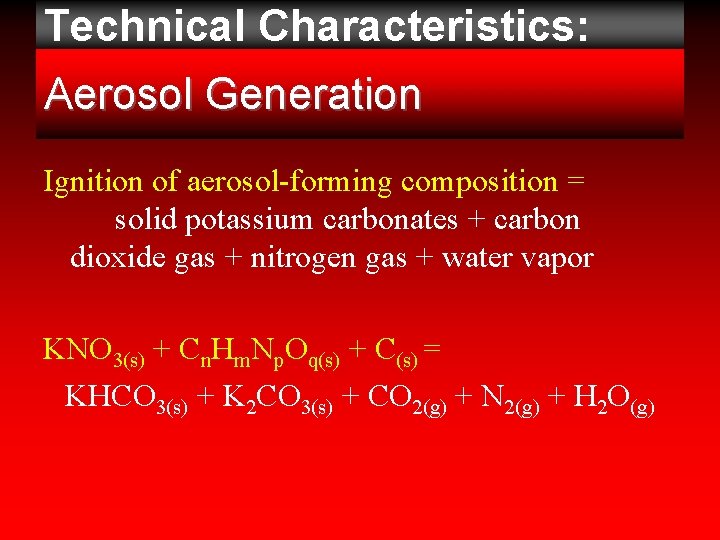
Technical PRODUCTCharacteristics: DESCRIPTION: Aerosol Generation Ignition of aerosol-forming composition = solid potassium carbonates + carbon dioxide gas + nitrogen gas + water vapor KNO 3(s) + Cn. Hm. Np. Oq(s) + C(s) = KHCO 3(s) + K 2 CO 3(s) + CO 2(g) + N 2(g) + H 2 O(g)
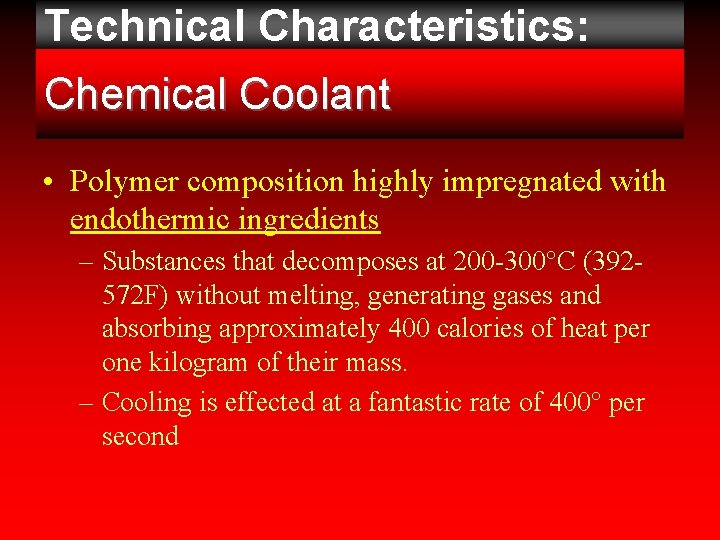
Technical Characteristics: Chemical Coolant • Polymer composition highly impregnated with endothermic ingredients – Substances that decomposes at 200 -300°C (392572 F) without melting, generating gases and absorbing approximately 400 calories of heat per one kilogram of their mass. – Cooling is effected at a fantastic rate of 400° per second
Technical Characteristics: BENEFITS: Micron Size Aerosol Particles • Large surface area for extinguishing actions • Small amount required for reliable extinguishing • Gas-like 3 dimensional distribution • Long suspension times
How It Works: 3 Potential Methods of Actuation Fire Conducting Cord Heated >175°C Electrical Signal from Control Panel (Manual / Automatic) Naked Flame via Fire Conducting Cord
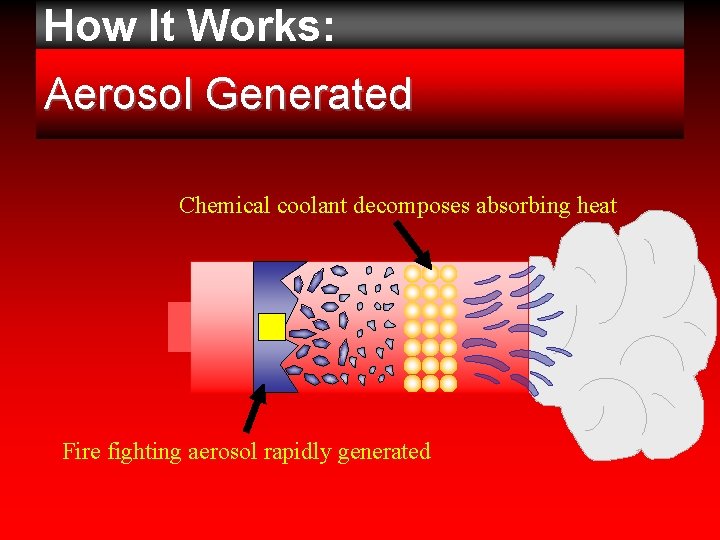
How It Works: Aerosol Generated Chemical coolant decomposes absorbing heat Fire fighting aerosol rapidly generated
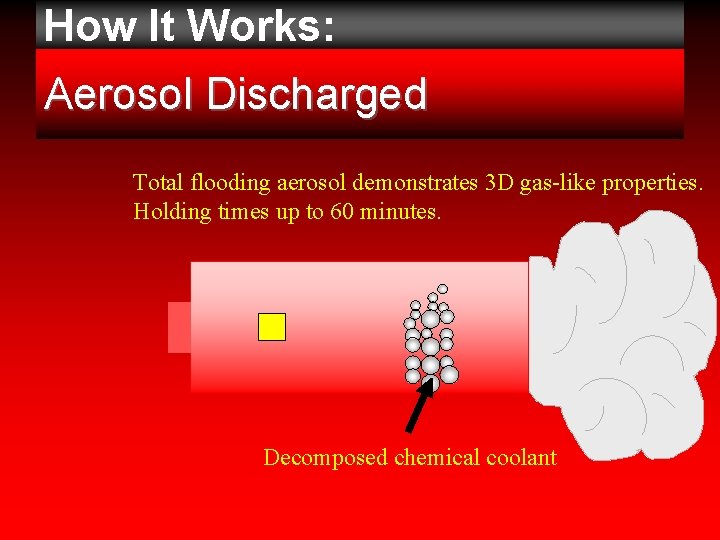
How It Works: Aerosol Discharged Total flooding aerosol demonstrates 3 D gas-like properties. Holding times up to 60 minutes. Decomposed chemical coolant
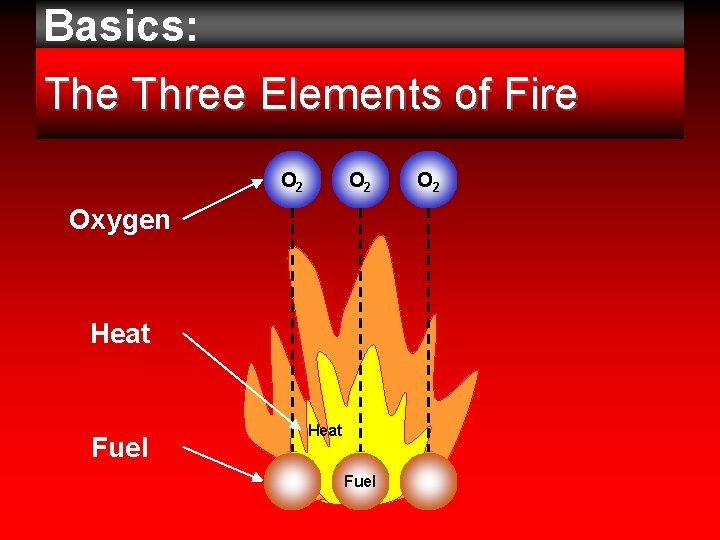
Basics: BENEFITS: The Three Elements of Fire O 2 Oxygen Heat Fuel O 2
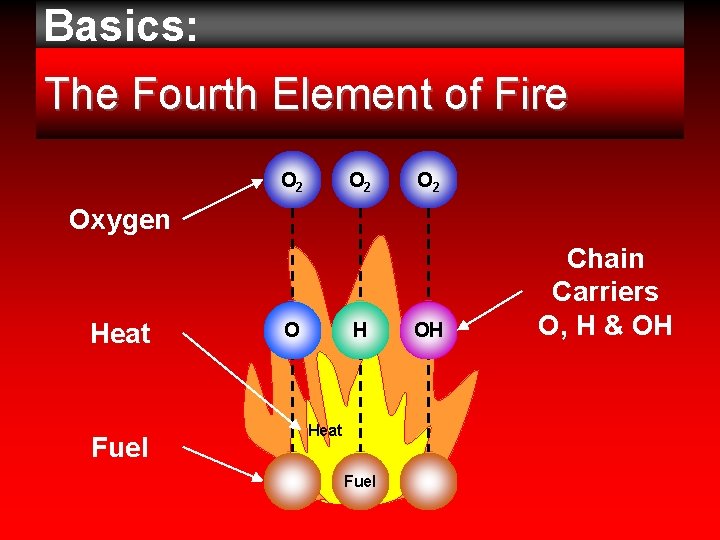
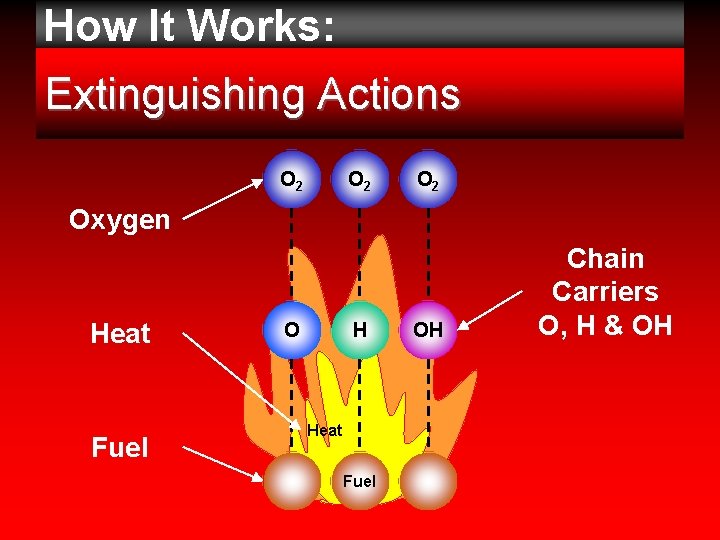
Basics: BENEFITS: The Fourth Element of Fire O 2 O 2 Oxygen Heat Fuel O H Heat Fuel OH Chain Carriers O, H & OH
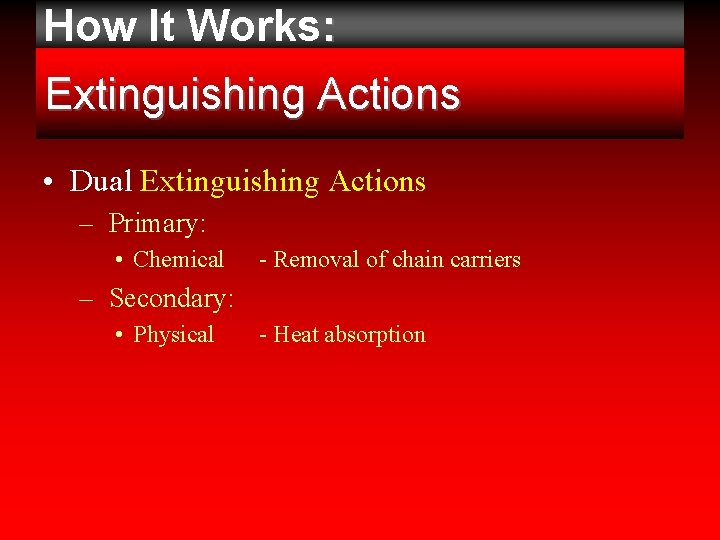
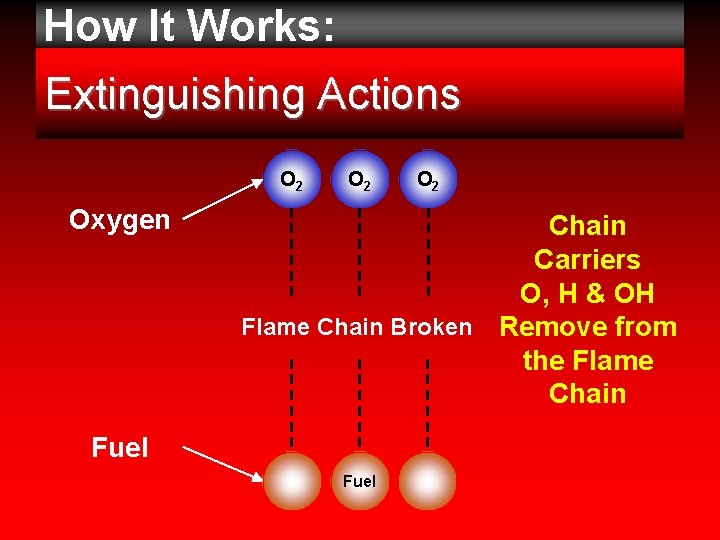
How It Works: Extinguishing Actions • Dual Extinguishing Actions – Primary: • Chemical - Removal of chain carriers – Secondary: • Physical - Heat absorption
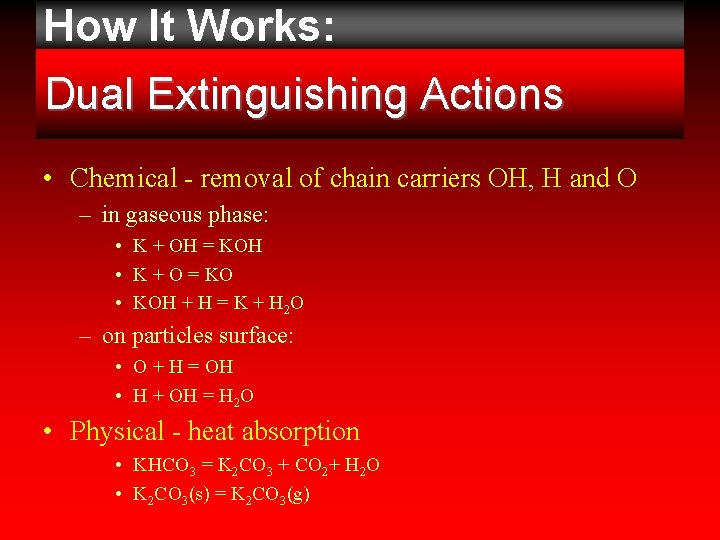
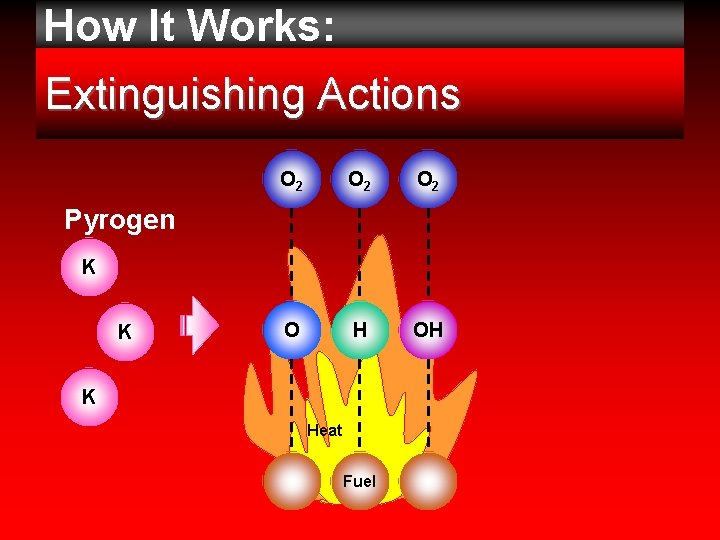
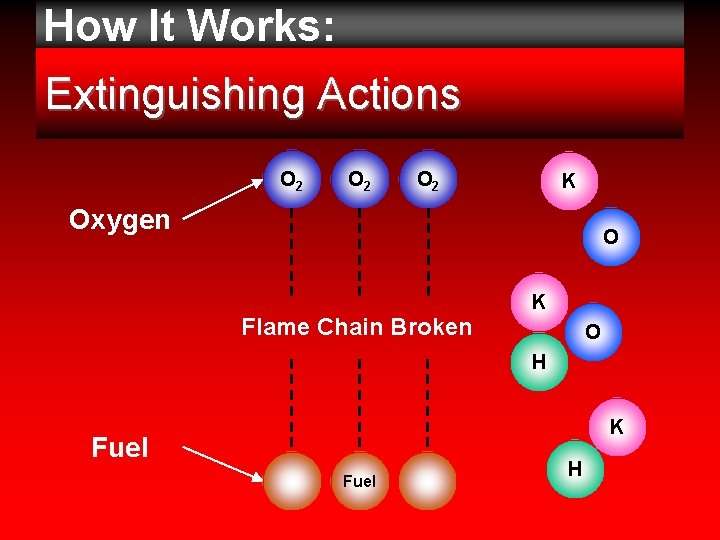
How It Works: BENEFITS: Dual Extinguishing Actions • Chemical - removal of chain carriers OH, H and O – in gaseous phase: • K + OH = KOH • K + O = KO • KOH + H = K + H 2 O – on particles surface: • O + H = OH • H + OH = H 2 O • Physical - heat absorption • KHCO 3 = K 2 CO 3 + CO 2+ H 2 O • K 2 CO 3(s) = K 2 CO 3(g)
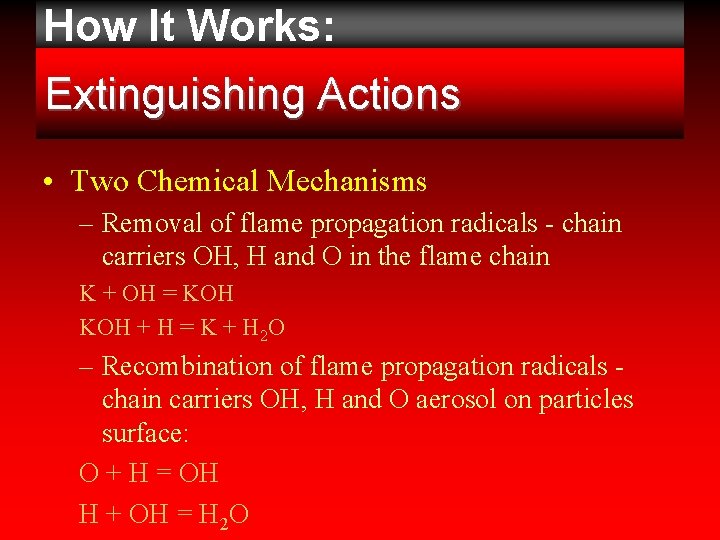
How It Works: BENEFITS: Extinguishing Actions • Two Chemical Mechanisms – Removal of flame propagation radicals - chain carriers OH, H and O in the flame chain K + OH = KOH + H = K + H 2 O – Recombination of flame propagation radicals chain carriers OH, H and O aerosol on particles surface: O + H = OH H + OH = H 2 O
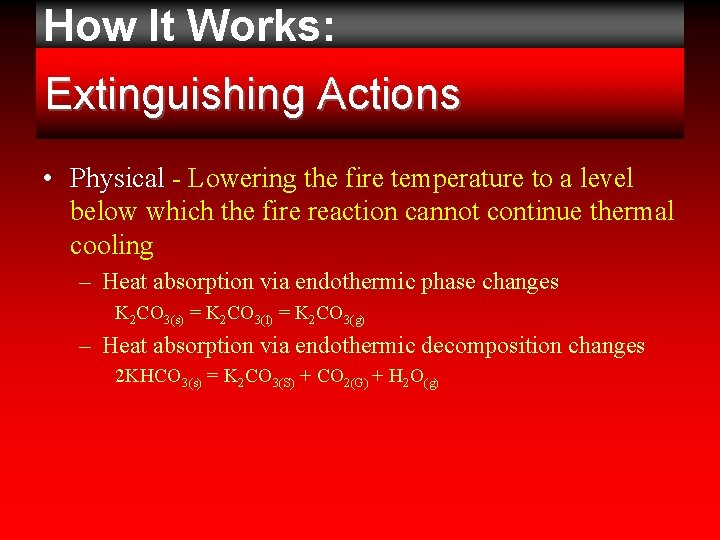
How It Works: BENEFITS: Extinguishing Actions • Physical - Lowering the fire temperature to a level below which the fire reaction cannot continue thermal cooling – Heat absorption via endothermic phase changes K 2 CO 3(s) = K 2 CO 3(l) = K 2 CO 3(g) – Heat absorption via endothermic decomposition changes 2 KHCO 3(s) = K 2 CO 3(S) + CO 2(G) + H 2 O(g)
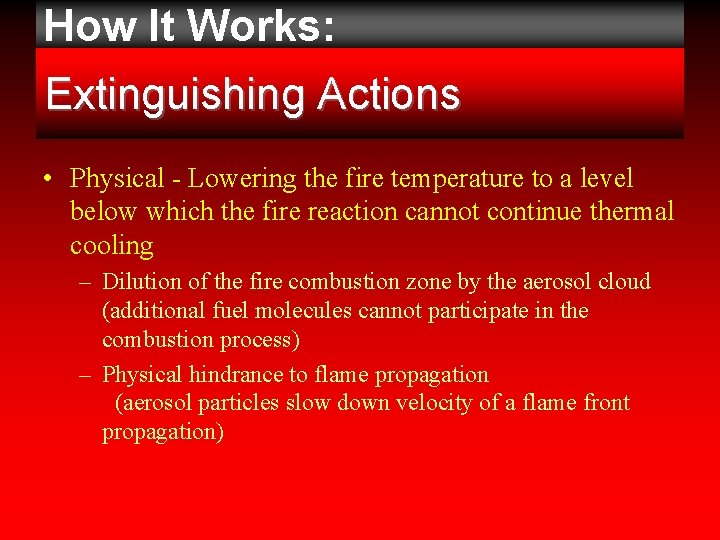
How It Works: BENEFITS: Extinguishing Actions • Physical - Lowering the fire temperature to a level below which the fire reaction cannot continue thermal cooling – Dilution of the fire combustion zone by the aerosol cloud (additional fuel molecules cannot participate in the combustion process) – Physical hindrance to flame propagation (aerosol particles slow down velocity of a flame front propagation)
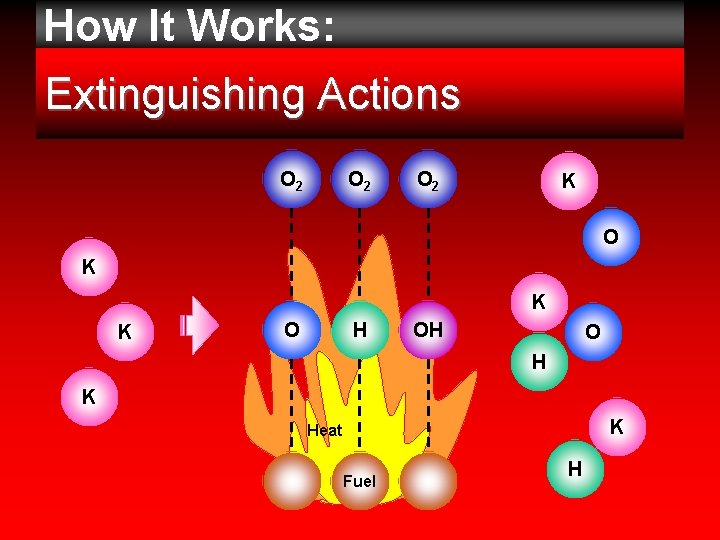
How It Works: BENEFITS: Extinguishing Actions O 2 O 2 K O K K K O H OH O H K K Heat Fuel H
How It Works: BENEFITS: Extinguishing Actions O 2 O 2 Oxygen Heat Fuel O H Heat Fuel OH Chain Carriers O, H & OH
How It Works: BENEFITS: Extinguishing Actions O 2 O 2 O H OH Pyrogen K K K Heat Fuel
How It Works: BENEFITS: Extinguishing Actions O 2 O 2 K Oxygen O Flame Chain Broken K O H K Fuel H
How It Works: BENEFITS: Extinguishing Actions O 2 Oxygen O 2 Chain Carriers O, H & OH Flame Chain Broken Remove from the Flame Chain Fuel
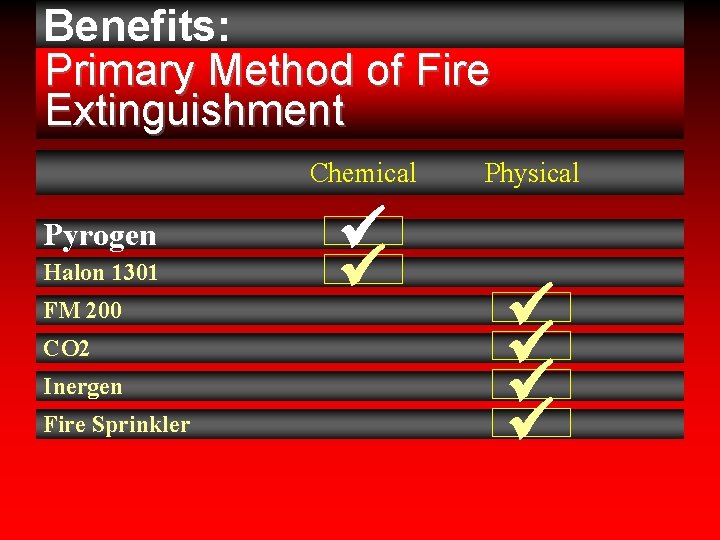
Benefits: Primary Method of Fire Extinguishing Extinguishment Chemical Pyrogen Halon 1301 FM 200 CO 2 Inergen Fire Sprinkler Physical
Benefits: No Effect On The Environment! • No effect on the ozone layer as Pyrogen does not contain C
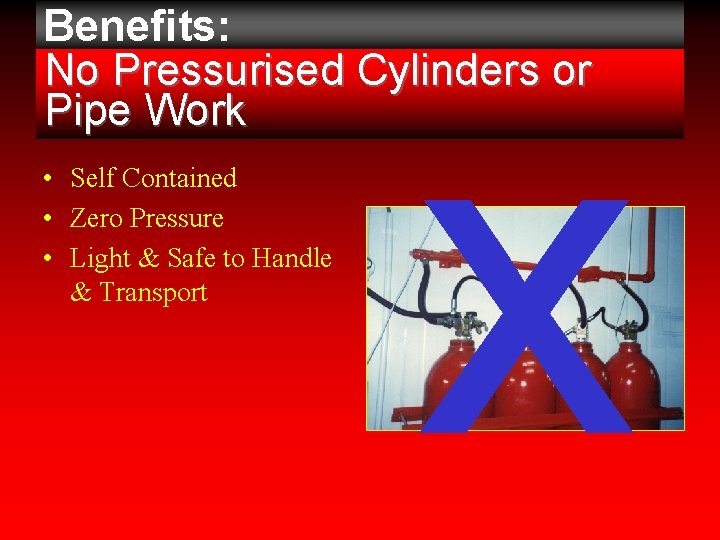
Benefits: No Pressurised Cylinders or Pipe Work • Self Contained • Zero Pressure • Light & Safe to Handle & Transport x
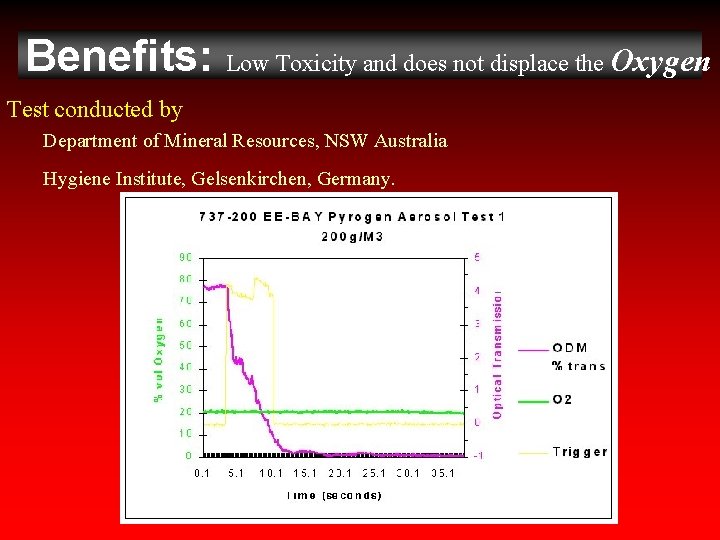
Benefits: Low Toxicity and does not displace the Oxygen Test conducted by Department of Mineral Resources, NSW Australia Hygiene Institute, Gelsenkirchen, Germany.
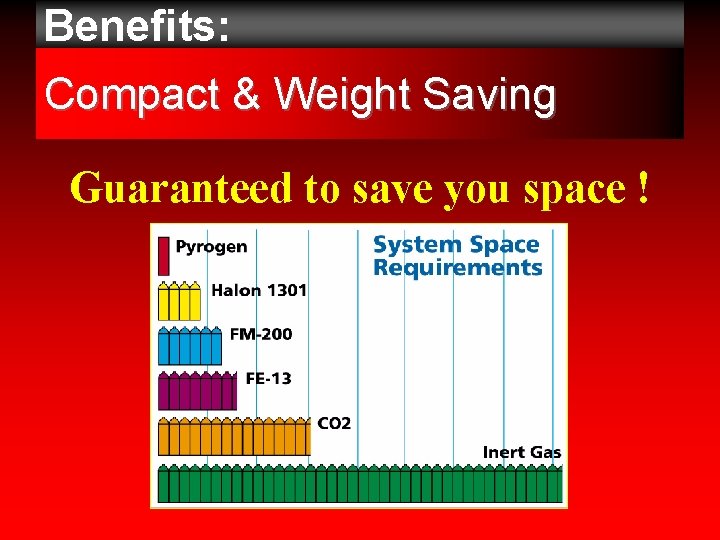
Benefits: Compact & Weight Saving Guaranteed to save you space !
Benefits: $ Significant Cost Savings • No Piping or Pressure Cylinders Required • Minimal Maintenance – No leakage – No recharge • Simple Installation
Benefits: BENEFITS: Recognized by International Authorities • Listed by US EPA under SNAP program Adopted by Standards Australia / Standards New Zealand • Approved by Waterways Authority Australia for use on commercial vessels • Approved by Maritime and Coastguard Agency (MCA)United Kingdom
Benefits: Test Certifications • Scientific Services Laboratories (Australia) – Pyrogen Fire Extinguishing Design Factor Test – Compliance of 30 days Elevated Temperature Test and Salt Spray Corrosion Test in accordance to UL 1058
Benefits: Test Certifications • Sydney Electricity – Conductivity Test at 75, 000 volts • Waterways Authority – Certification and Acceptance • Work Cover Authority – Performance Test UL 1058
Pyrogen: One of the World’s Leading Fire Suppression System • • 3 Times More Efficient than Halon 1301 No Effect on the Environment No Pressurised Cylinders or Pipe Work Compact & Light Weight Easy Maintenance Simple to Install & Re-Commission Significant Cost Savings
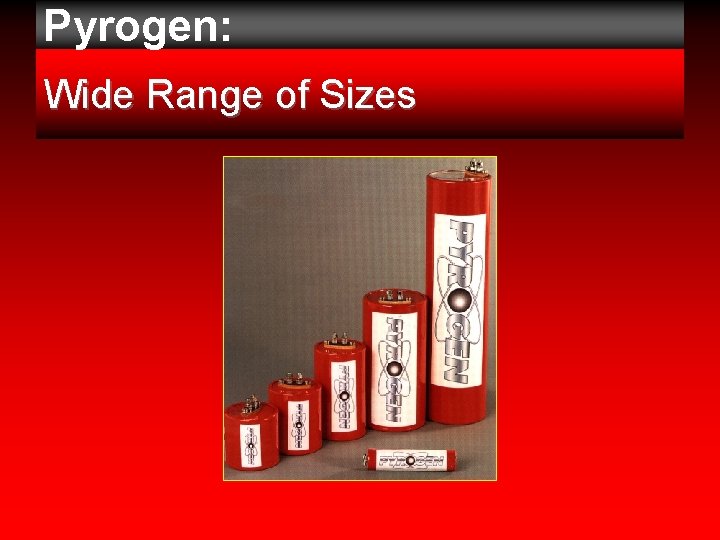
Pyrogen: Wide Range of Sizes
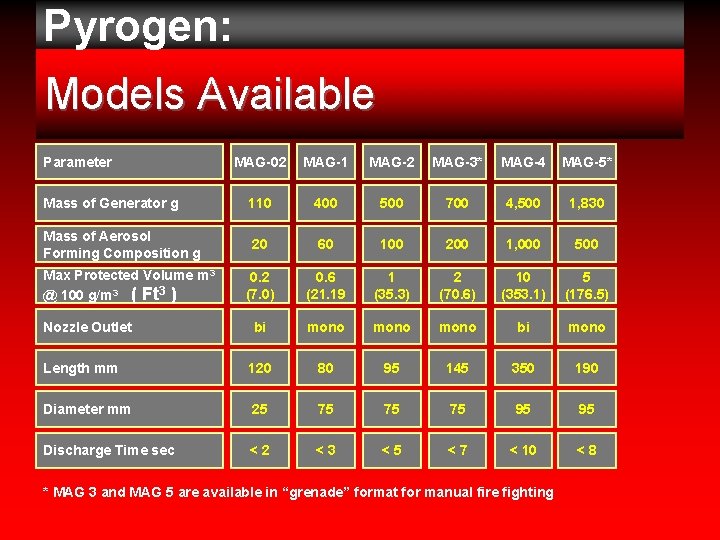
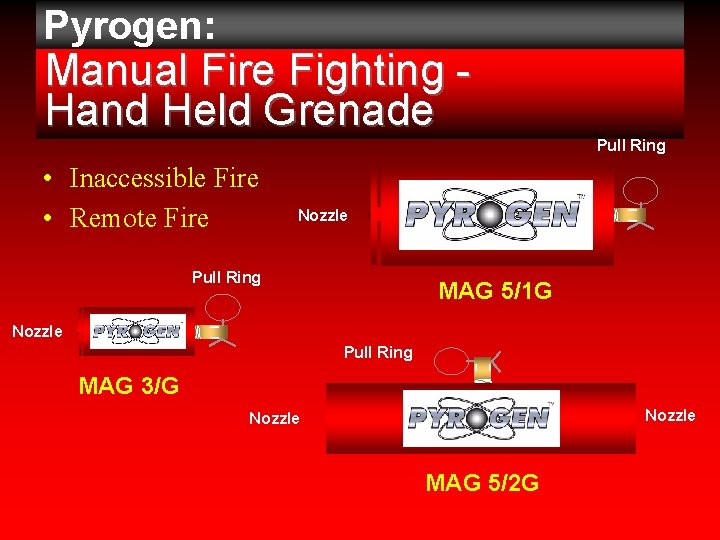
Pyrogen: Models Available Parameter MAG-02 MAG-1 MAG-2 MAG-3* MAG-4 MAG-5* Mass of Generator g 110 400 500 700 4, 500 1, 830 Mass of Aerosol Forming Composition g 20 60 100 200 1, 000 500 0. 2 (7. 0) 0. 6 (21. 19 1 (35. 3) 2 (70. 6) 10 (353. 1) 5 (176. 5) bi mono bi mono Length mm 120 80 95 145 350 190 Diameter mm 25 75 75 75 95 95 Discharge Time sec <2 <3 <5 <7 < 10 <8 Max Protected Volume m 3 @ 100 g/m 3 ( Ft 3 ) Nozzle Outlet * MAG 3 and MAG 5 are available in “grenade” format for manual fire fighting
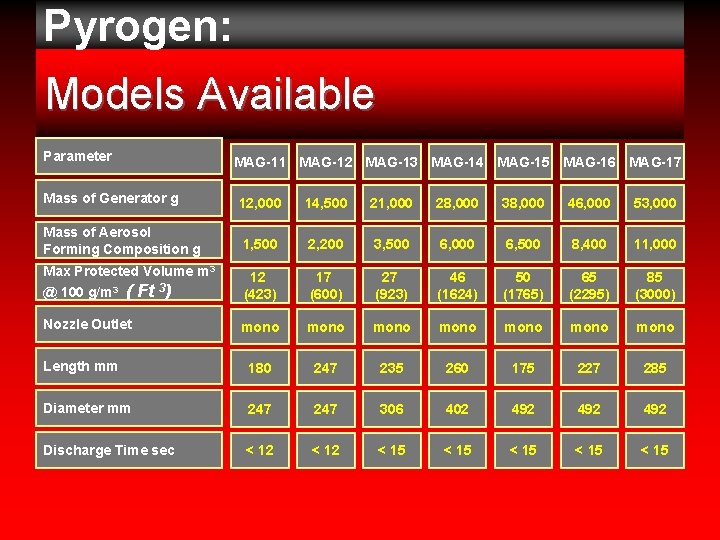
Pyrogen: Models Available Parameter MAG-11 MAG-12 MAG-13 MAG-14 MAG-15 MAG-16 MAG-17 Mass of Generator g 12, 000 14, 500 21, 000 28, 000 38, 000 46, 000 53, 000 Mass of Aerosol Forming Composition g 1, 500 2, 200 3, 500 6, 000 6, 500 8, 400 11, 000 Max Protected Volume m 3 @ 100 g/m 3 ( Ft 3) 12 (423) 17 (600) 27 (923) 46 (1624) 50 (1765) 65 (2295) 85 (3000) Nozzle Outlet mono mono Length mm 180 247 235 260 175 227 285 Diameter mm 247 306 402 492 492 Discharge Time sec < 12 < 15 < 15
Pyrogen: Manual Fire Fighting Hand Held Grenade Pull Ring • Inaccessible Fire • Remote Fire Nozzle Pull Ring MAG 5/1 G Nozzle Pull Ring MAG 3/G Nozzle MAG 5/2 G
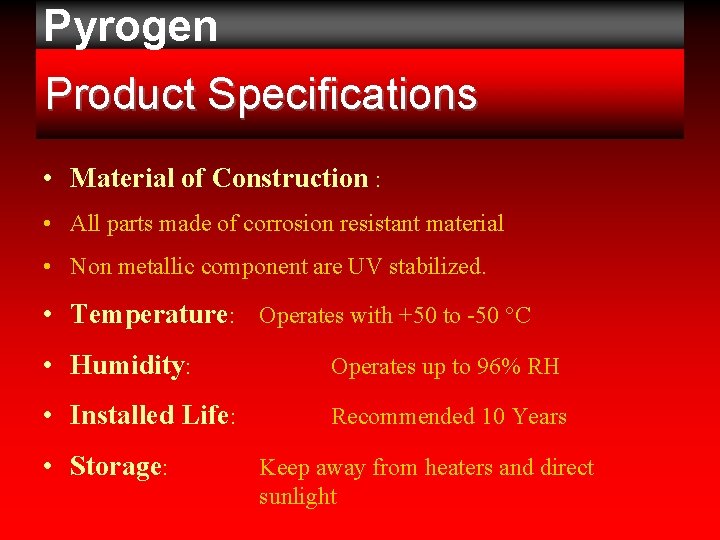
Pyrogen Product Specifications • Material of Construction : • All parts made of corrosion resistant material • Non metallic component are UV stabilized. • Temperature: Operates with +50 to -50 °C • Humidity: Operates up to 96% RH • Installed Life: Recommended 10 Years • Storage: Keep away from heaters and direct sunlight
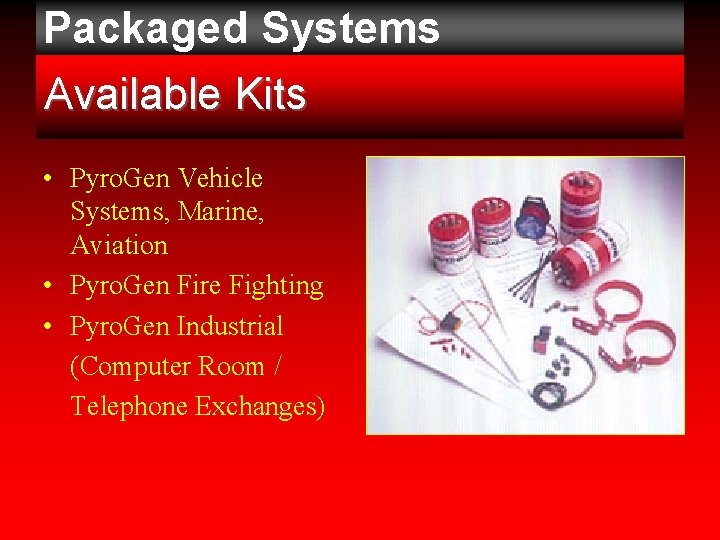
Packaged Systems Available Kits • Pyro. Gen Vehicle Systems, Marine, Aviation • Pyro. Gen Fire Fighting • Pyro. Gen Industrial (Computer Room / Telephone Exchanges)
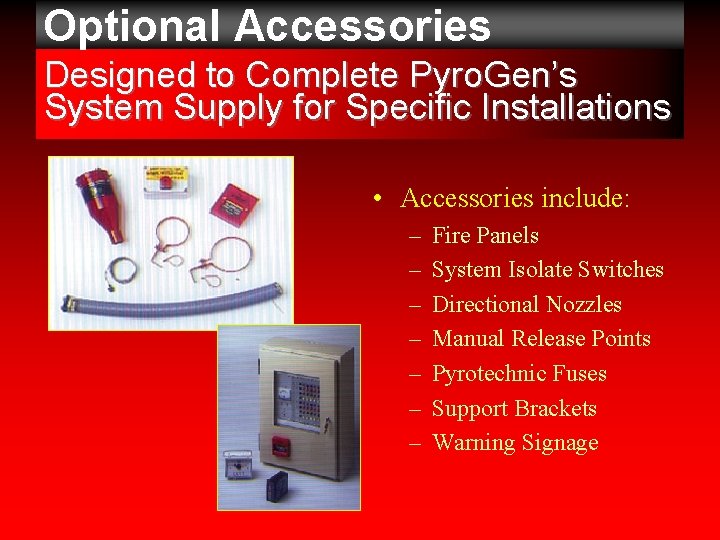
Optional Accessories Designed to Complete Pyro. Gen’s System Supply for Specific Installations • Accessories include: – – – – Fire Panels System Isolate Switches Directional Nozzles Manual Release Points Pyrotechnic Fuses Support Brackets Warning Signage