
The New Revised IFRS 3 Business Combinations International
The New Revised IFRS 3 Business Combinations International Accounting Training Webinar – 13 July 2010 Presented by Aletta Boshoff Technical Director, Australia & New Zealand (aboshoff@nexiaaustralia. com. au)
Roadmap for this session § Part A – Background to development of IFRS 3 Revised § Part B - What has changed in IFRS 3 Revised? § Part C - What has changed in IAS 27 Revised Consolidated and Separate Financial Statements?
Part A Background to the Development of IFRS 3 Revised (IFRS 3 R)
What is the core principle of IFRS 3 and IFRS 3 Revised? An acquirer of a business recognises the assets acquired and liabilities assumed at their acquisition-date fair values and discloses information that enable users to evaluate the nature and financial effects of the acquisition
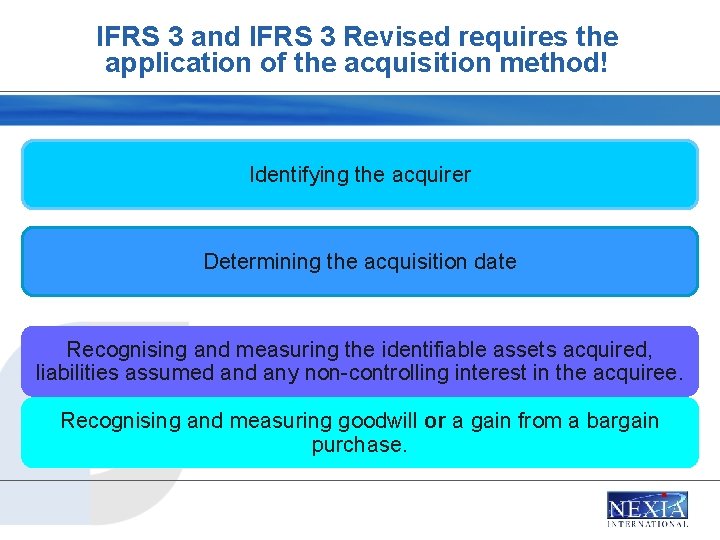
IFRS 3 and IFRS 3 Revised requires the application of the acquisition method! Identifying the acquirer Determining the acquisition date Recognising and measuring the identifiable assets acquired, liabilities assumed any non-controlling interest in the acquiree. Recognising and measuring goodwill or a gain from a bargain purchase.
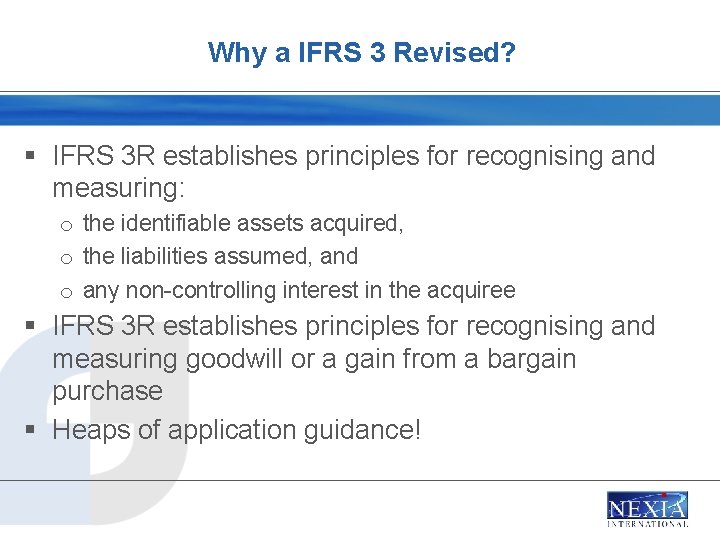
Why a IFRS 3 Revised? § IFRS 3 R establishes principles for recognising and measuring: o the identifiable assets acquired, o the liabilities assumed, and o any non-controlling interest in the acquiree § IFRS 3 R establishes principles for recognising and measuring goodwill or a gain from a bargain purchase § Heaps of application guidance!
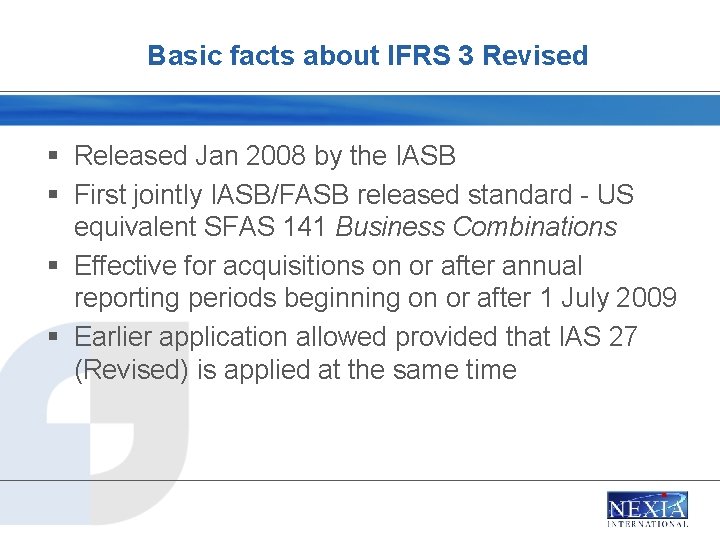
Basic facts about IFRS 3 Revised § Released Jan 2008 by the IASB § First jointly IASB/FASB released standard - US equivalent SFAS 141 Business Combinations § Effective for acquisitions on or after annual reporting periods beginning on or after 1 July 2009 § Earlier application allowed provided that IAS 27 (Revised) is applied at the same time
Part B What has change in IFRS 3 Revised?
Change No 1 The scope was broadened § The scope of IFRS 3 R was broadened to cover: o business combinations involving only mutual entities, and § business combinations achieved by contract alone § What is not covered within IFRS 3 R? o Formation of joint ventures o Acquisition of asset or group of assets that does not constitute a business o Combination of entities under common control
Change No 2 Broader definition of what constitutes a ‘business combination’ § What is a business combination? o A transaction or other event in which an acquirer obtains control of one or more businesses o Transactions sometimes referred to as ‘true mergers’ or ‘mergers of equals’ are also business combinations as that term is used in IFRS 3 R
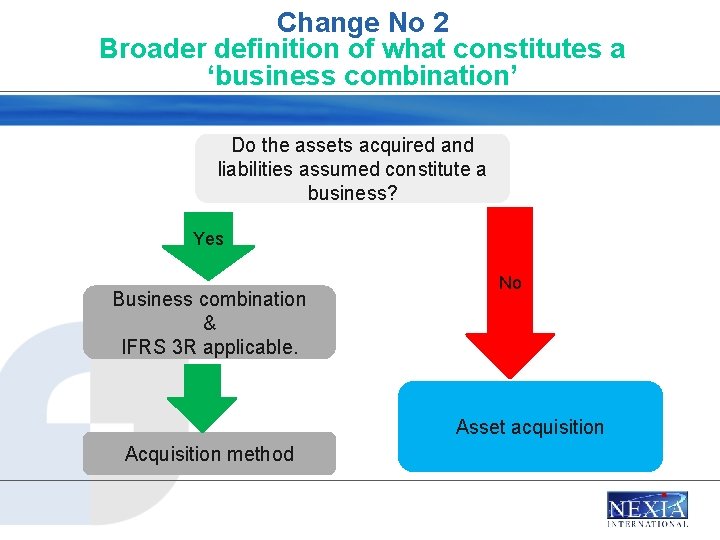
Change No 2 Broader definition of what constitutes a ‘business combination’ Do the assets acquired and liabilities assumed constitute a business? Yes Business combination & IFRS 3 R applicable. No Asset acquisition Acquisition method
Change No 2 Broader definition of what constitutes a ‘business combination’ § A business is an integrated set of activities and assets that is capable of being conducted and managed for the purpose of: o providing a return in the form of dividends, o lower costs, or o other economic benefits directly to investors or other owners, members or participants § Assets and activities need not be conducted and managed as a business as at acquisition date, so long as they can be in the future
Example A Does this constitute a business combination? § IT department is a cost centre to K&K Co a legal firm § IT Outsourced Ltd, specialises in the provision of IT services to legal firms. § K&K Co sells its IT department to IT Outsourced Ltd, consisting of plant and equipment, working capital and staff § Assets and staff transferred to IT Outsourced Ltd is capable of being operated as a business
Example B Does this constitute a business combination? § Company E’s contains assets of: o Electricity grids o Tracking system o Working capital $10, 000 $2, 500, 000 $500, 000 § Company A acquires from Company E the electricity grids and the tracking system for $14, 000. Consider the relevant industry, certain industries requires relative low inputs of working capital and labour.
Change No 3 Limits the scope of reverse acquisitions § The accounting acquiree must meet the definition of a business § A Pty Ltd reversing into a listed cash shell with no business activities, is no longer a reverse acquisition
Change No 4 Transaction costs to be expensed § Acquisition-related costs are expensed in the periods in which the costs are incurred and the services are received § Examples: o Finder’s fees, advisory, legal, accounting, valuation and other professional or consulting fees, costs of internal acquisition department, etc § One exception: o Costs of issuing debt/equity will continue to be offset against the proceeds in accordance with IAS 32 & IAS 39
Change No 5 Introduction of application guidance re acquisition-date fair values of asset and liabilities § The acquirer shall measure the identifiable assets acquired and the liabilities assumed at their acquisition-date fair values § For example, application guidance in relation to the following: o separate valuation allowances re assets with uncertain cash flows; o assets subject to operating leases in which the acquiree is the lessor; and o assets that the acquirer intends not to use or to use in a way that is different from the way other market participants would use them
Change No 6 Option to “gross-up” goodwill for non-controlling interest § The acquirer shall measure any non-controlling interest (formerly known as minority interest) in the acquiree either at: o fair value, or o the NCI’s proportionate share of the acquiree’s identifiable net assets
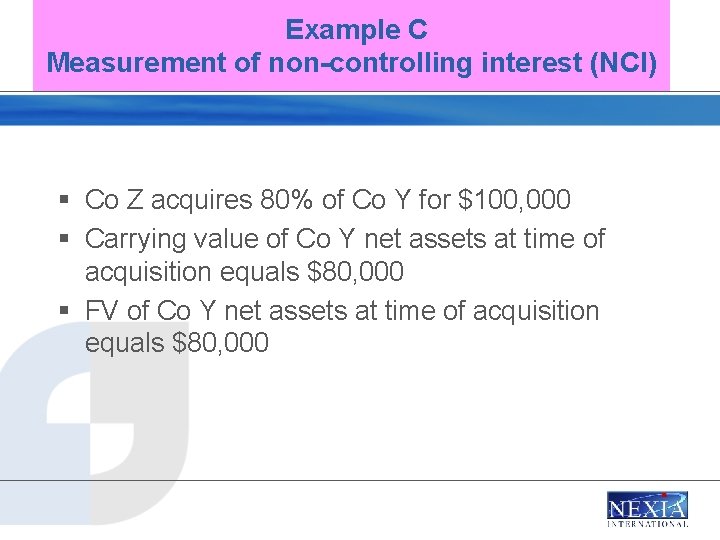
Example C Measurement of non-controlling interest (NCI) § Co Z acquires 80% of Co Y for $100, 000 § Carrying value of Co Y net assets at time of acquisition equals $80, 000 § FV of Co Y net assets at time of acquisition equals $80, 000
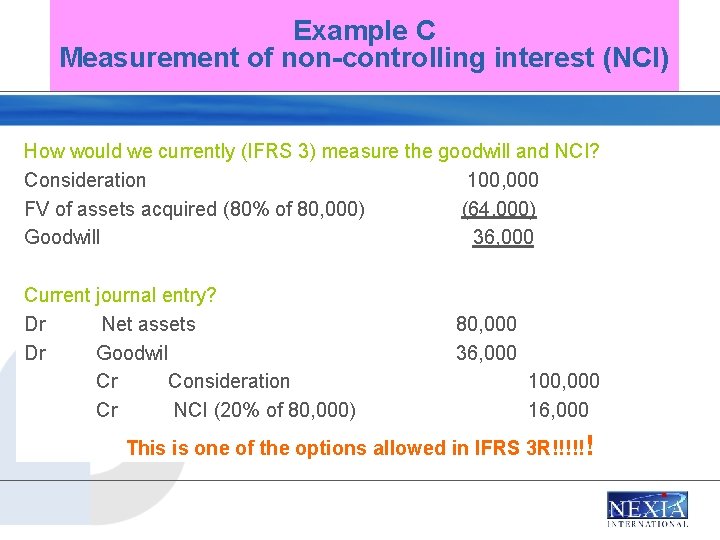
Example C Measurement of non-controlling interest (NCI) How would we currently (IFRS 3) measure the goodwill and NCI? Consideration 100, 000 FV of assets acquired (80% of 80, 000) (64, 000) Goodwill 36, 000 Current journal entry? Dr Net assets Dr Goodwil Cr Consideration Cr NCI (20% of 80, 000) 80, 000 36, 000 100, 000 16, 000 This is one of the options allowed in IFRS 3 R!!!!!!
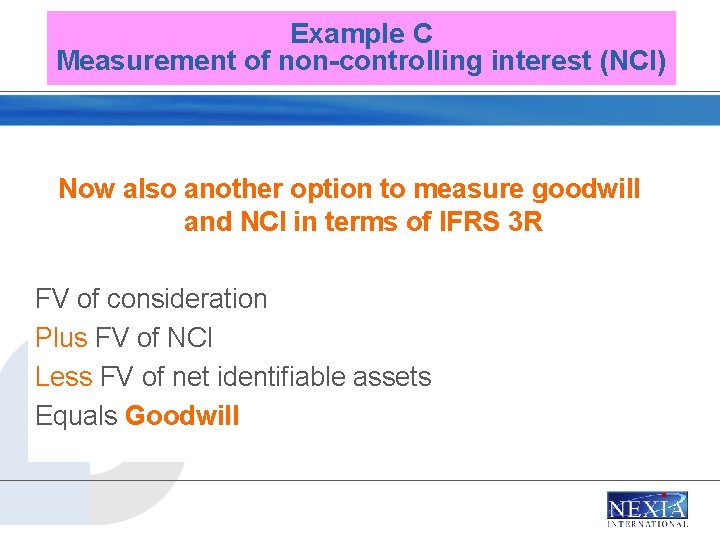
Example C Measurement of non-controlling interest (NCI) Now also another option to measure goodwill and NCI in terms of IFRS 3 R FV of consideration Plus FV of NCI Less FV of net identifiable assets Equals Goodwill
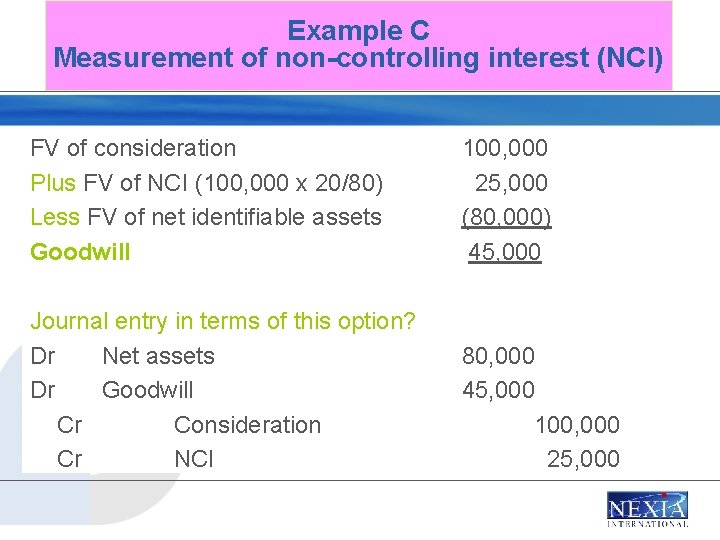
Example C Measurement of non-controlling interest (NCI) FV of consideration Plus FV of NCI (100, 000 x 20/80) Less FV of net identifiable assets Goodwill 100, 000 25, 000 (80, 000) 45, 000 Journal entry in terms of this option? Dr Net assets Dr Goodwill Cr Consideration Cr NCI 80, 000 45, 000 100, 000 25, 000
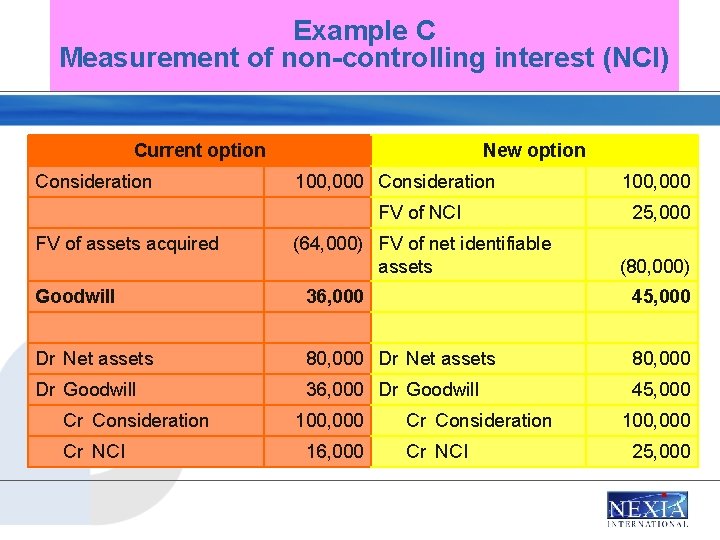
Example C Measurement of non-controlling interest (NCI) Current option Consideration New option 100, 000 Consideration FV of NCI FV of assets acquired (64, 000) FV of net identifiable assets 100, 000 25, 000 (80, 000) Goodwill 36, 000 45, 000 Dr Net assets 80, 000 Dr Goodwill 36, 000 Dr Goodwill 45, 000 Cr Consideration Cr NCI 100, 000 16, 000 Cr Consideration Cr NCI 100, 000 25, 000
Change No 7 More intangible assets being recognised § Why? o Requirement to be reliably measurable has been removed
Change No 8 Possible profit implications when obtaining control of company in which a NCI was held § In a business combination achieved in stages, the acquirer shall: o remeasure its previously held equity interest in the acquiree at its acquisition-date fair value and o recognise the resulting gain or loss, if any, in profit or loss § What does this mean? o Possible to generate a profit by obtaining control of an entity previously held as an investment or an associate
Example D Obtaining control of company in which a NCI was held § In 2000, Co X acquires a 10% holding in Co A for a cost of $1, 000 § In 2009, Co X acquires the remaining 90% of Co A for $18, 000 § The fair value of the net tangible assets of Co A at date of acquisition in 2009 was $10, 000 § Co X accounted for investment in Co A at cost (IAS 27 R. 38)
Example D Obtaining control of company in which a NCI was held Consideration consists of: FV at 2009 of the 10% holding Cost of 90% holding 2, 000 * 18, 000 20, 000 * 18, 000 (Cost of 90% holding) x 10/90 = 2, 000 Goodwill is: Consideration Less FV of net assets acquired Goodwill 20, 000 (10, 000) 10, 000
Example D Obtaining control of company in which a NCI was held What journal entry did we process with the purchase of the original 10% investment in Co A? Dr Investment in Co A 1, 000 Cr Cash 1, 000 What journal entry do we need to process with the purchase of the additional 90% investment in Co A? Dr Net assets @ FVs 10, 000 Dr Goodwill 10, 000 Cr Cash 18, 000 Cr Investment in Co A 1, 000 Cr Profit 1, 000
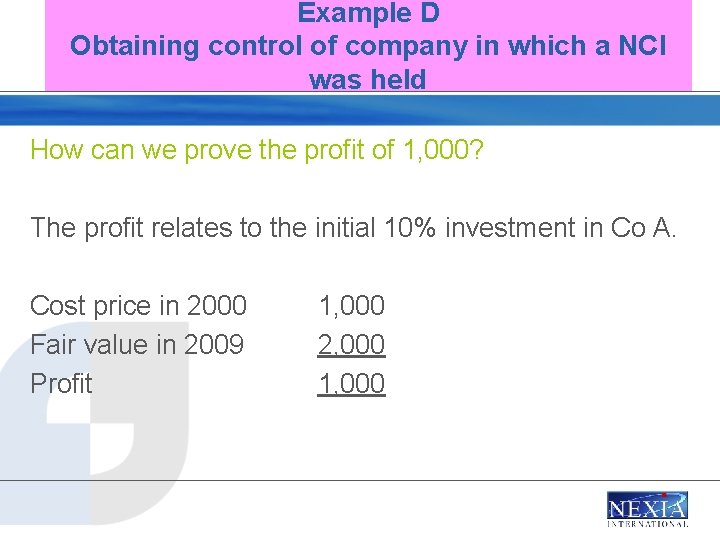
Example D Obtaining control of company in which a NCI was held How can we prove the profit of 1, 000? The profit relates to the initial 10% investment in Co A. Cost price in 2000 Fair value in 2009 Profit 1, 000 2, 000 1, 000
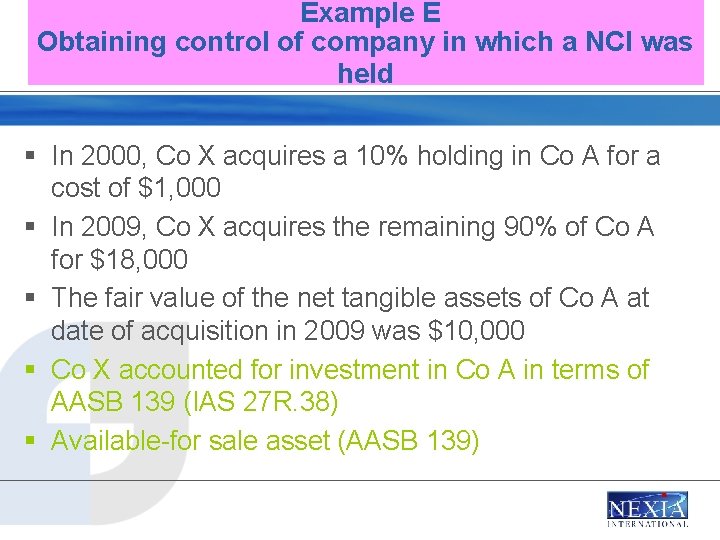
Example E Obtaining control of company in which a NCI was held § In 2000, Co X acquires a 10% holding in Co A for a cost of $1, 000 § In 2009, Co X acquires the remaining 90% of Co A for $18, 000 § The fair value of the net tangible assets of Co A at date of acquisition in 2009 was $10, 000 § Co X accounted for investment in Co A in terms of AASB 139 (IAS 27 R. 38) § Available-for sale asset (AASB 139)
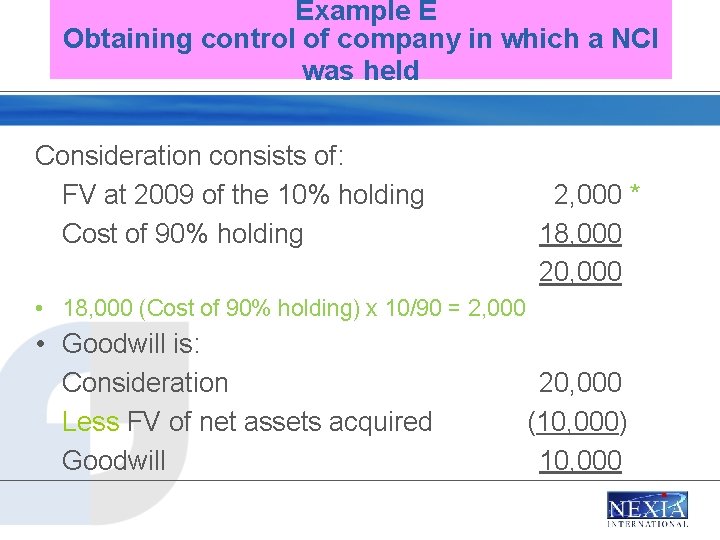
Example E Obtaining control of company in which a NCI was held Consideration consists of: FV at 2009 of the 10% holding Cost of 90% holding 2, 000 * 18, 000 20, 000 • 18, 000 (Cost of 90% holding) x 10/90 = 2, 000 • Goodwill is: Consideration Less FV of net assets acquired Goodwill 20, 000 (10, 000) 10, 000
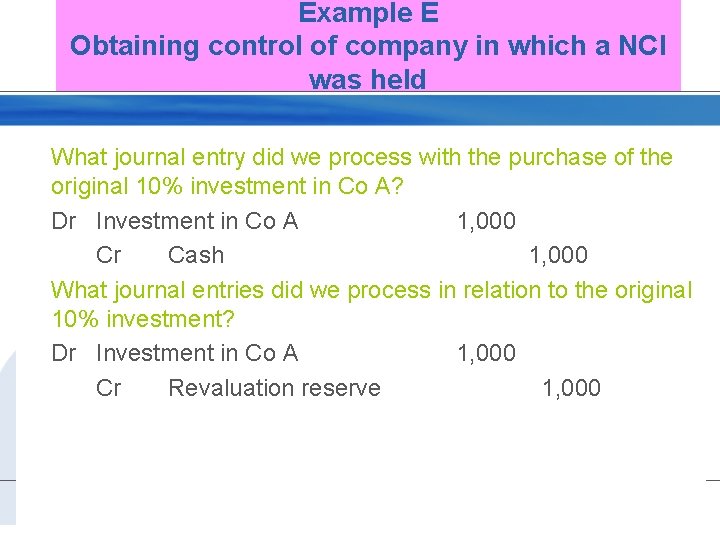
Example E Obtaining control of company in which a NCI was held What journal entry did we process with the purchase of the original 10% investment in Co A? Dr Investment in Co A 1, 000 Cr Cash 1, 000 What journal entries did we process in relation to the original 10% investment? Dr Investment in Co A 1, 000 Cr Revaluation reserve 1, 000
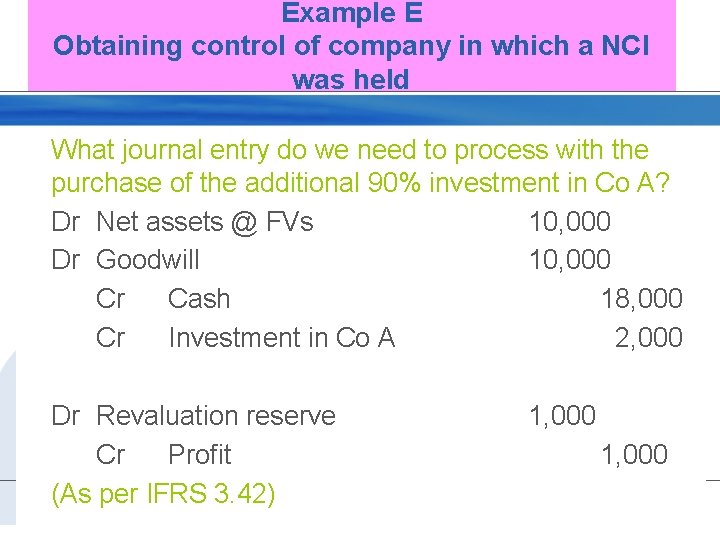
Example E Obtaining control of company in which a NCI was held What journal entry do we need to process with the purchase of the additional 90% investment in Co A? Dr Net assets @ FVs 10, 000 Dr Goodwill 10, 000 Cr Cash 18, 000 Cr Investment in Co A 2, 000 Dr Revaluation reserve Cr Profit (As per IFRS 3. 42) 1, 000
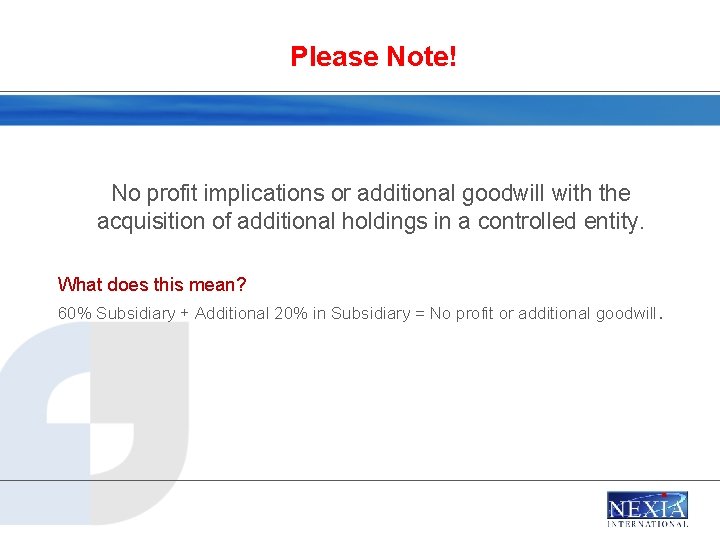
Please Note! No profit implications or additional goodwill with the acquisition of additional holdings in a controlled entity. What does this mean? 60% Subsidiary + Additional 20% in Subsidiary = No profit or additional goodwill.
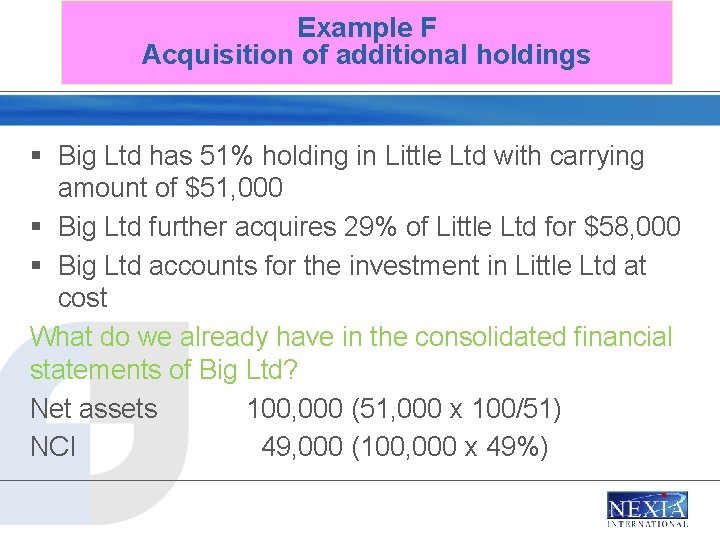
Example F Acquisition of additional holdings § Big Ltd has 51% holding in Little Ltd with carrying amount of $51, 000 § Big Ltd further acquires 29% of Little Ltd for $58, 000 § Big Ltd accounts for the investment in Little Ltd at cost What do we already have in the consolidated financial statements of Big Ltd? Net assets 100, 000 (51, 000 x 100/51) NCI 49, 000 (100, 000 x 49%)
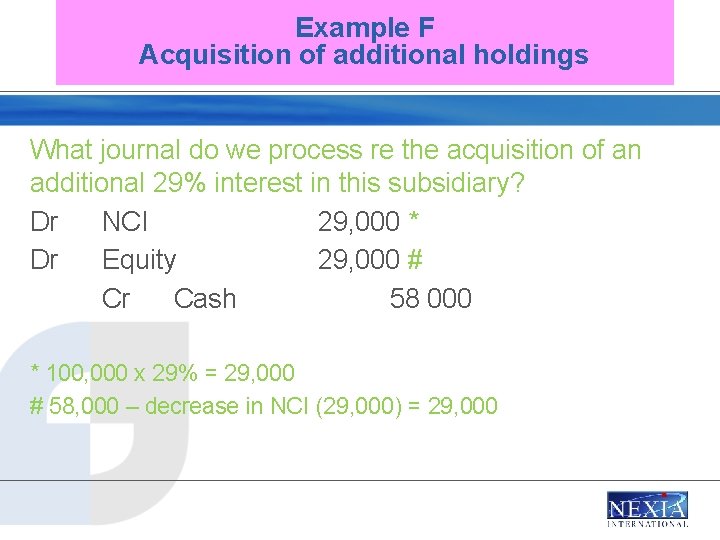
Example F Acquisition of additional holdings What journal do we process re the acquisition of an additional 29% interest in this subsidiary? Dr NCI 29, 000 * Dr Equity 29, 000 # Cr Cash 58 000 * 100, 000 x 29% = 29, 000 # 58, 000 – decrease in NCI (29, 000) = 29, 000
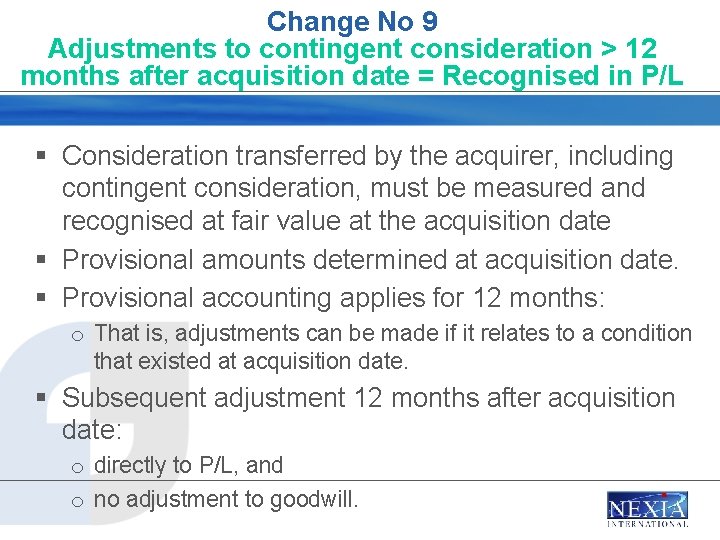
Change No 9 Adjustments to contingent consideration > 12 months after acquisition date = Recognised in P/L § Consideration transferred by the acquirer, including contingent consideration, must be measured and recognised at fair value at the acquisition date § Provisional amounts determined at acquisition date. § Provisional accounting applies for 12 months: o That is, adjustments can be made if it relates to a condition that existed at acquisition date. § Subsequent adjustment 12 months after acquisition date: o directly to P/L, and o no adjustment to goodwill.
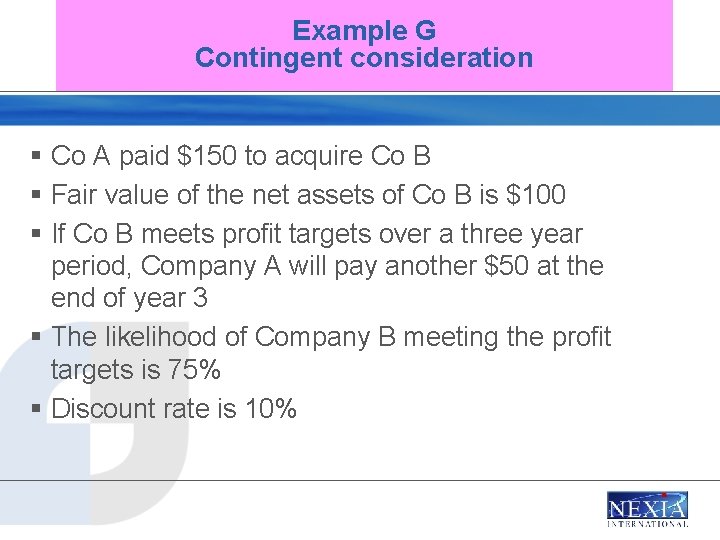
Example G Contingent consideration § Co A paid $150 to acquire Co B § Fair value of the net assets of Co B is $100 § If Co B meets profit targets over a three year period, Company A will pay another $50 at the end of year 3 § The likelihood of Company B meeting the profit targets is 75% § Discount rate is 10%
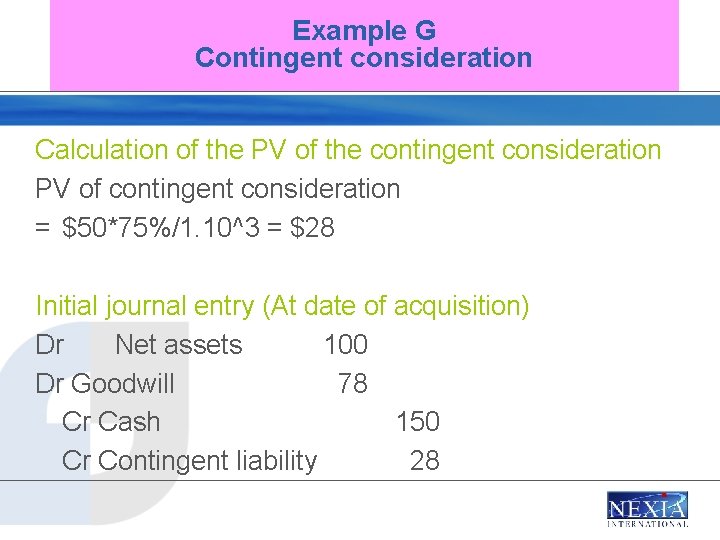
Example G Contingent consideration Calculation of the PV of the contingent consideration PV of contingent consideration = $50*75%/1. 10^3 = $28 Initial journal entry (At date of acquisition) Dr Net assets 100 Dr Goodwill 78 Cr Cash 150 Cr Contingent liability 28
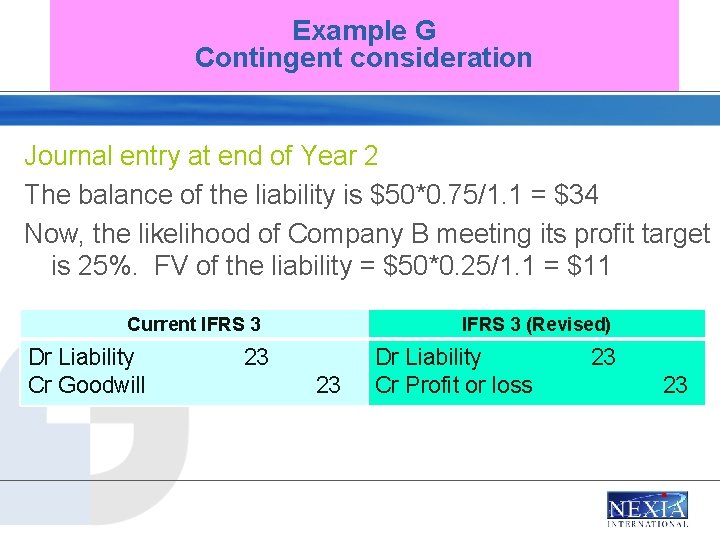
Example G Contingent consideration Journal entry at end of Year 2 The balance of the liability is $50*0. 75/1. 1 = $34 Now, the likelihood of Company B meeting its profit target is 25%. FV of the liability = $50*0. 25/1. 1 = $11 Current IFRS 3 Dr Liability Cr Goodwill IFRS 3 (Revised) 23 23 Dr Liability Cr Profit or loss 23 23
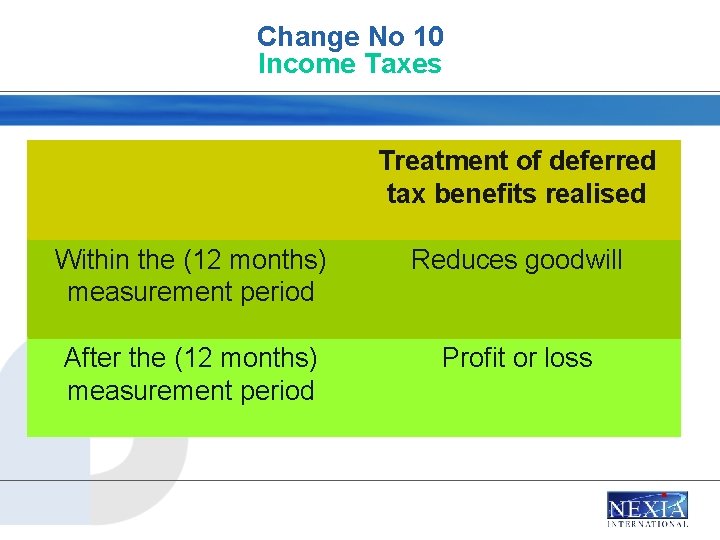
Change No 10 Income Taxes Treatment of deferred tax benefits realised Within the (12 months) measurement period Reduces goodwill After the (12 months) measurement period Profit or loss
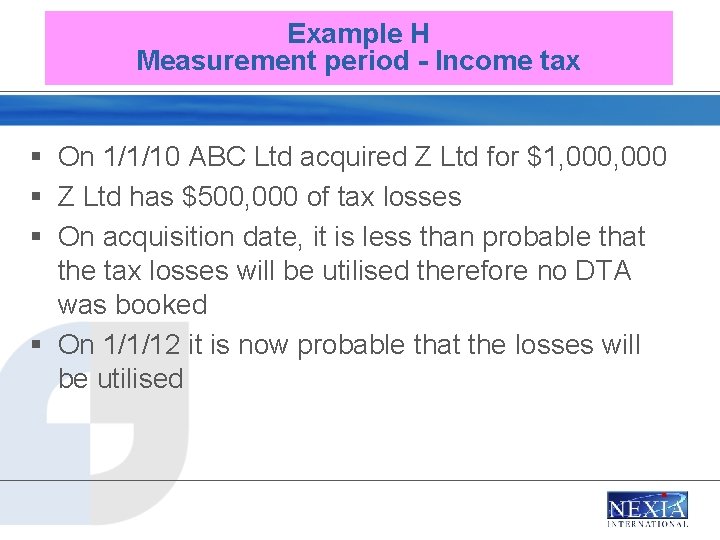
Example H Measurement period - Income tax § On 1/1/10 ABC Ltd acquired Z Ltd for $1, 000 § Z Ltd has $500, 000 of tax losses § On acquisition date, it is less than probable that the tax losses will be utilised therefore no DTA was booked § On 1/1/12 it is now probable that the losses will be utilised
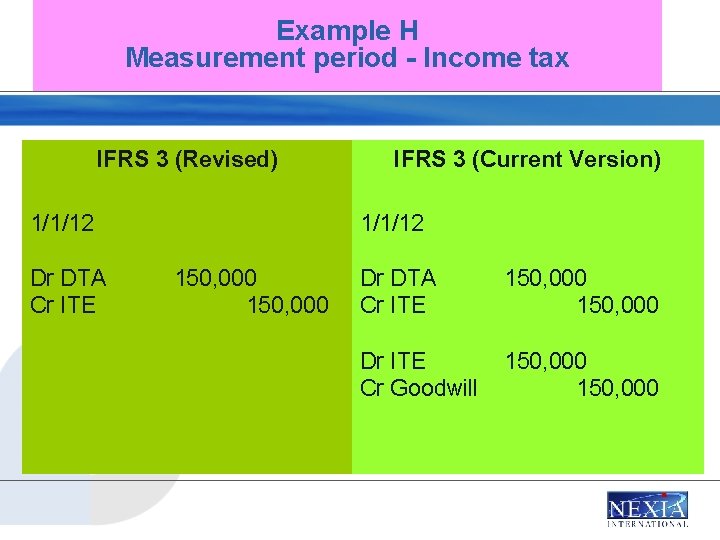
Example H Measurement period - Income tax IFRS 3 (Revised) 1/1/12 Dr DTA Cr ITE IFRS 3 (Current Version) 1/1/12 150, 000 Dr DTA Cr ITE 150, 000 Dr ITE Cr Goodwill 150, 000
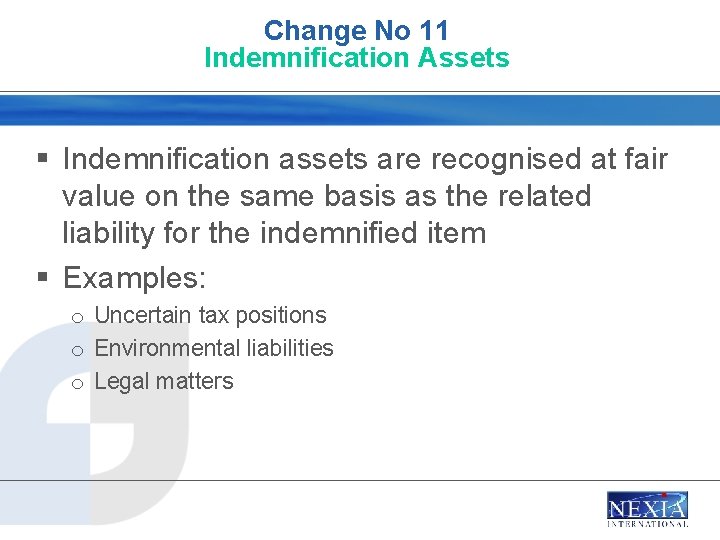
Change No 11 Indemnification Assets § Indemnification assets are recognised at fair value on the same basis as the related liability for the indemnified item § Examples: o Uncertain tax positions o Environmental liabilities o Legal matters
Example I Measurement period - Indemnification assets § Company A acquired Company B § Company B is currently undergoing a tax audit. Original owners of Company B has agreed to reimburse Company A for any future tax expense incurred as a result of the current tax audit § It has been estimated that there is a 40% chance that Company A will have to pay $500, 000 as a result of the tax audit in 3 years time § Discount rate is 10%
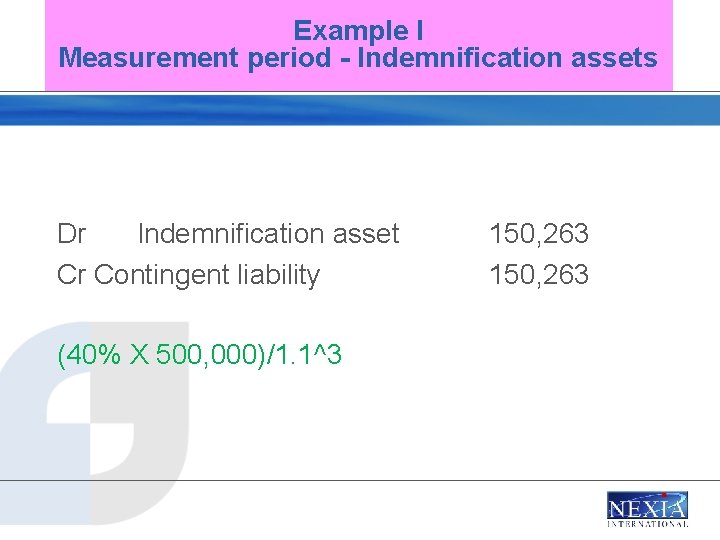
Example I Measurement period - Indemnification assets Dr Indemnification asset Cr Contingent liability (40% X 500, 000)/1. 1^3 150, 263
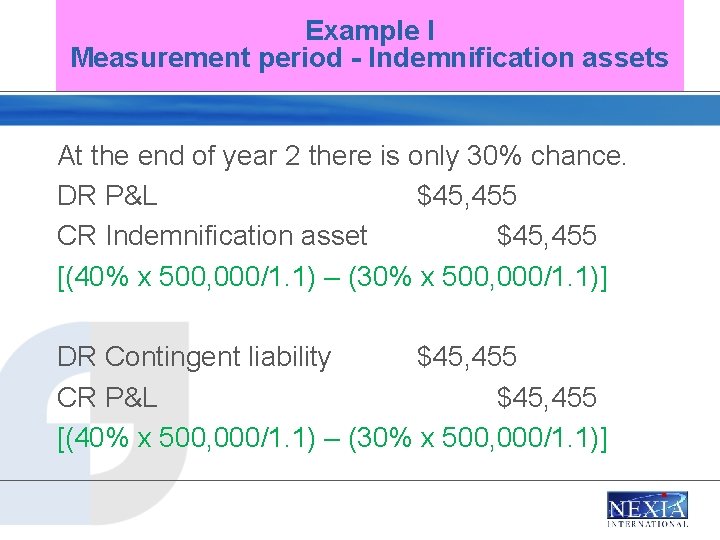
Example I Measurement period - Indemnification assets At the end of year 2 there is only 30% chance. DR P&L $45, 455 CR Indemnification asset $45, 455 [(40% x 500, 000/1. 1) – (30% x 500, 000/1. 1)] DR Contingent liability $45, 455 CR P&L $45, 455 [(40% x 500, 000/1. 1) – (30% x 500, 000/1. 1)]
Change No 12 Determining what is part of the business combination transaction The following are examples of separate transactions that are not to be included in applying the acquisition method: § a transaction that in effect settles pre-existing relationships between the acquirer and acquiree; § a transaction that remunerates employees or former owners of the acquiree for future services; and § a transaction that reimburses the acquiree or its former owners for paying the acquirer’s acquisitionrelated costs
Part C What has changed in IAS 27 Revised?
Change No 1 No profit implications when change in interest without losing control § Requirements were added to specify that changes in a parent’s ownership interest in a subsidiary that do not result in a loss of control must be accounted for as equity transactions § Previous IAS 27 did not have requirements for such transactions
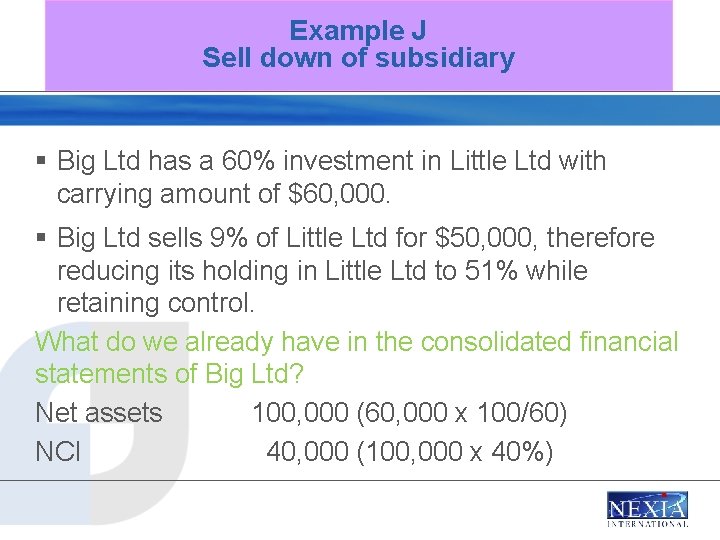
Example J Sell down of subsidiary § Big Ltd has a 60% investment in Little Ltd with carrying amount of $60, 000. § Big Ltd sells 9% of Little Ltd for $50, 000, therefore reducing its holding in Little Ltd to 51% while retaining control. What do we already have in the consolidated financial statements of Big Ltd? Net assets 100, 000 (60, 000 x 100/60) NCI 40, 000 (100, 000 x 40%)
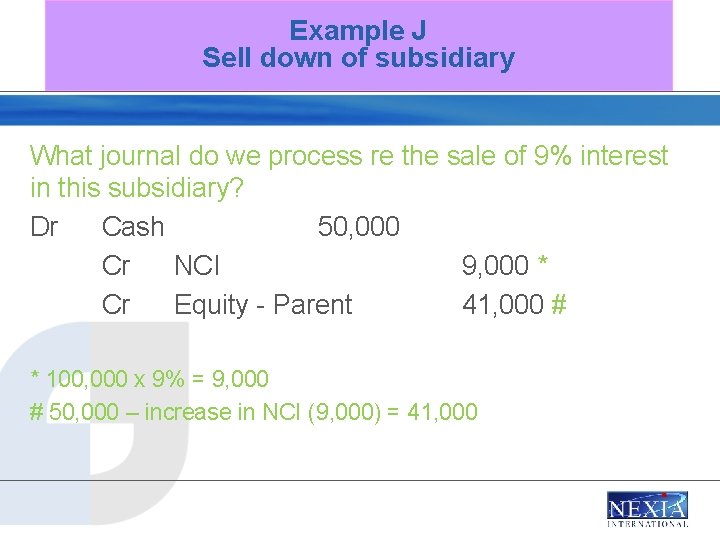
Example J Sell down of subsidiary What journal do we process re the sale of 9% interest in this subsidiary? Dr Cash 50, 000 Cr NCI 9, 000 * Cr Equity - Parent 41, 000 # * 100, 000 x 9% = 9, 000 # 50, 000 – increase in NCI (9, 000) = 41, 000
Change No 2 Profit implications when change in interest that results in losing control § Requirements were added to specify how an entity measures any gain or loss arising on the loss of control of a subsidiary § Any such gain or loss is recognised in P/L § Any investment retained in the former subsidiary is measured at its fair value at the date when control is lost
Example K Sell down of subsidiary § Big Ltd has a 60% investment in Little Ltd with carrying amount of $60, 000 § Big Ltd sells 11% of Little Ltd for $50, 000, therefore reducing its holding in Little Ltd to 49% § Big Ltd no longer has control
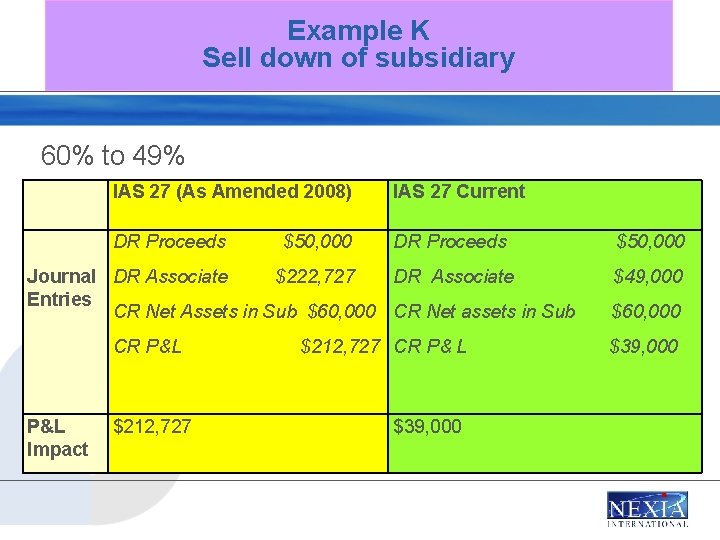
Example K Sell down of subsidiary 60% to 49% IAS 27 (As Amended 2008) IAS 27 Current DR Proceeds $50, 000 Journal DR Associate $222, 727 DR Associate Entries CR Net Assets in Sub $60, 000 CR Net assets in Sub CR P&L Impact $212, 727 CR P& L $39, 000 $50, 000 $49, 000 $60, 000 $39, 000
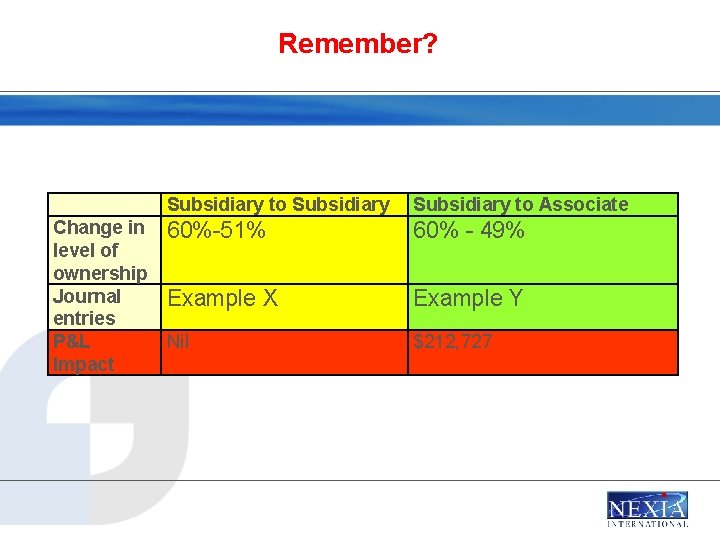
Remember? Subsidiary to Subsidiary Change in 60%-51% level of ownership Journal Example X entries P&L Nil Impact Subsidiary to Associate 60% - 49% Example Y $212, 727
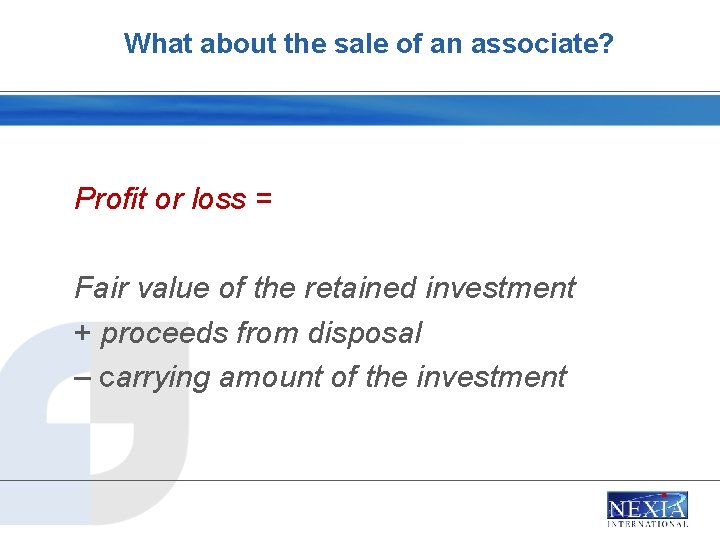
What about the sale of an associate? Profit or loss = Fair value of the retained investment + proceeds from disposal – carrying amount of the investment
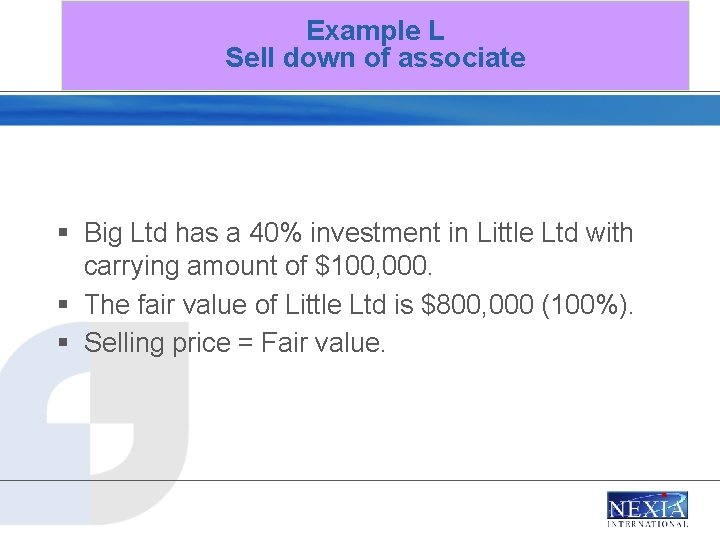
Example L Sell down of associate § Big Ltd has a 40% investment in Little Ltd with carrying amount of $100, 000. § The fair value of Little Ltd is $800, 000 (100%). § Selling price = Fair value.
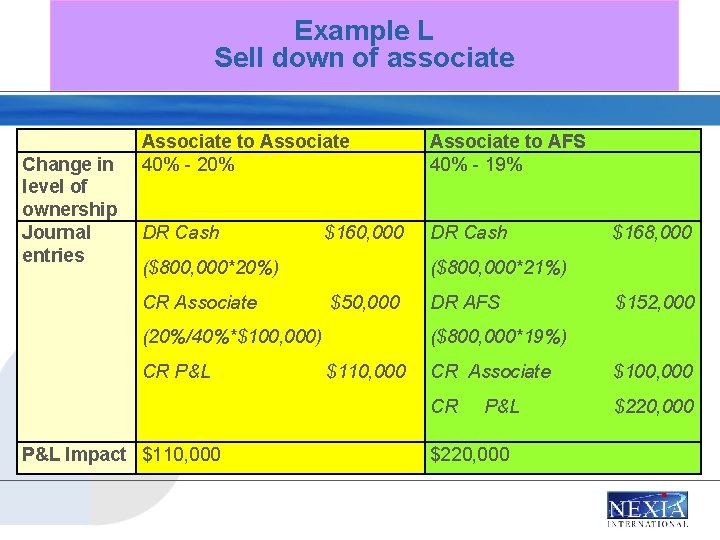
Example L Sell down of associate Change in level of ownership Journal entries Associate to Associate 40% - 20% Associate to AFS 40% - 19% DR Cash $160, 000 ($800, 000*20%) CR Associate ($800, 000*21%) $50, 000 (20%/40%*$100, 000) CR P&L Impact $110, 000 $168, 000 DR AFS $152, 000 ($800, 000*19%) $110, 000 CR Associate $100, 000 CR $220, 000 P&L $220, 000
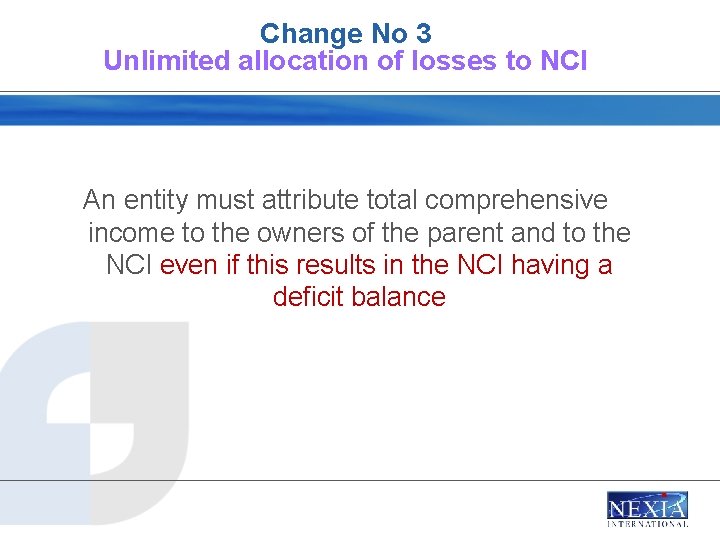
Change No 3 Unlimited allocation of losses to NCI An entity must attribute total comprehensive income to the owners of the parent and to the NCI even if this results in the NCI having a deficit balance
Comments and/or Questions
The End Thank you for attending the International Accounting Training Webinar!
- Slides: 62