
The New Pyramid Nutrition What are nutrients Essential
- Slides: 15
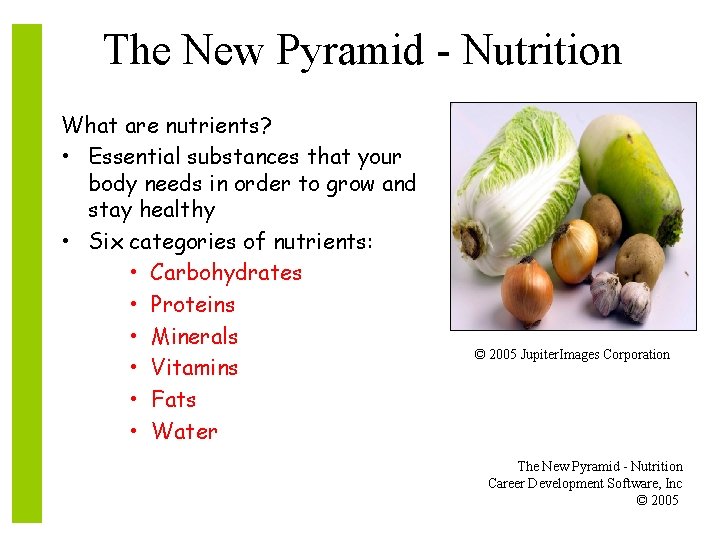
The New Pyramid - Nutrition What are nutrients? • Essential substances that your body needs in order to grow and stay healthy • Six categories of nutrients: • Carbohydrates • Proteins • Minerals • Vitamins • Fats • Water © 2005 Jupiter. Images Corporation The New Pyramid - Nutrition Career Development Software, Inc © 2005
• Pass Out work from the box • Label a clean sheet of paper: Chapter 6 Corrections • Write the question and the entire CORRECT answer to the ones that you missed. • Staple and turn in to the box • Beginning Reading Ch. 8 on Nutrition
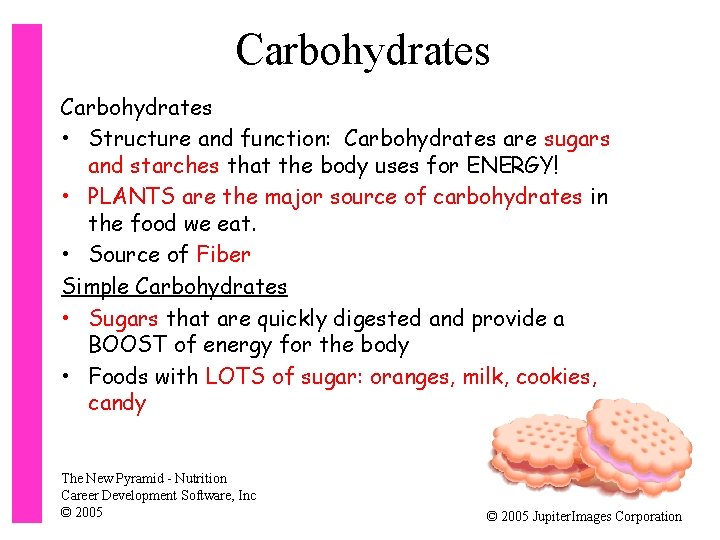
Carbohydrates • Structure and function: Carbohydrates are sugars and starches that the body uses for ENERGY! • PLANTS are the major source of carbohydrates in the food we eat. • Source of Fiber Simple Carbohydrates • Sugars that are quickly digested and provide a BOOST of energy for the body • Foods with LOTS of sugar: oranges, milk, cookies, candy The New Pyramid - Nutrition Career Development Software, Inc © 2005 Jupiter. Images Corporation
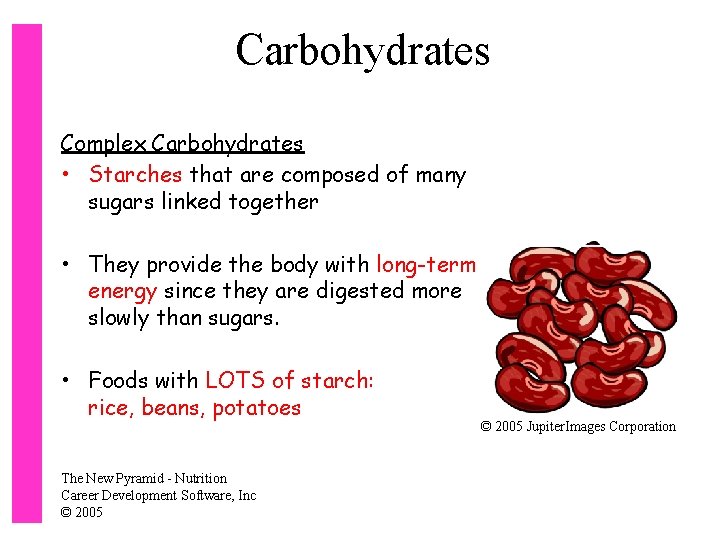
Carbohydrates Complex Carbohydrates • Starches that are composed of many sugars linked together • They provide the body with long-term energy since they are digested more slowly than sugars. • Foods with LOTS of starch: rice, beans, potatoes The New Pyramid - Nutrition Career Development Software, Inc © 2005 Jupiter. Images Corporation
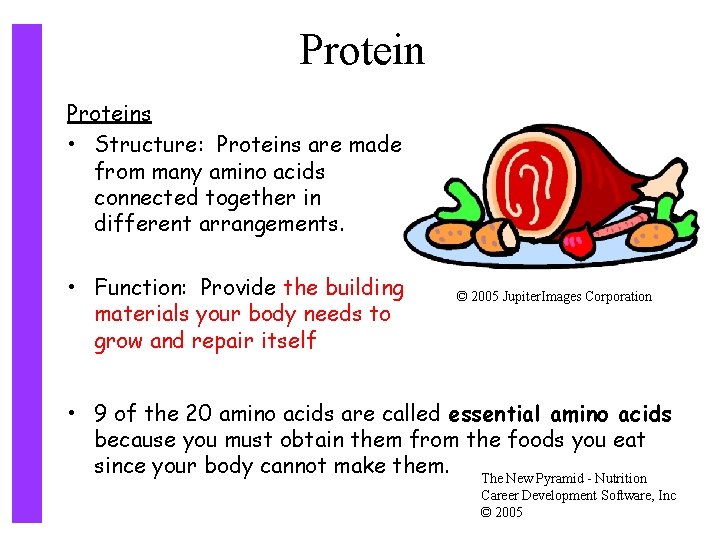
Proteins • Structure: Proteins are made from many amino acids connected together in different arrangements. • Function: Provide the building materials your body needs to grow and repair itself © 2005 Jupiter. Images Corporation • 9 of the 20 amino acids are called essential amino acids because you must obtain them from the foods you eat since your body cannot make them. The New Pyramid - Nutrition Career Development Software, Inc © 2005
Protein Sources: anything that walks, flies, or swims as well as beans and peanuts Complete proteins: • Foods containing all the essential amino acids Examples: fish, meat, eggs, milk, cheese Incomplete proteins: • Foods that are missing some essential amino acids Examples: Legumes, nuts, whole grains The New Pyramid - Nutrition Career Development Software, Inc copyright 2005
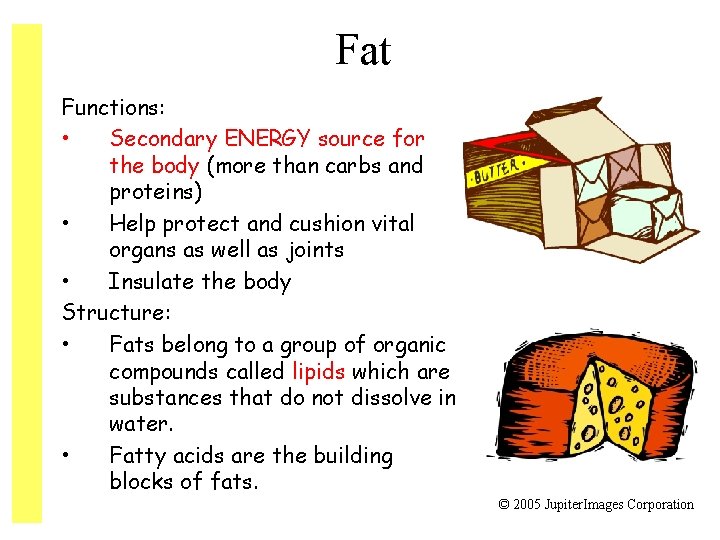
Fat Functions: • Secondary ENERGY source for the body (more than carbs and proteins) • Help protect and cushion vital organs as well as joints • Insulate the body Structure: • Fats belong to a group of organic compounds called lipids which are substances that do not dissolve in water. • Fatty acids are the building blocks of fats. © 2005 Jupiter. Images Corporation
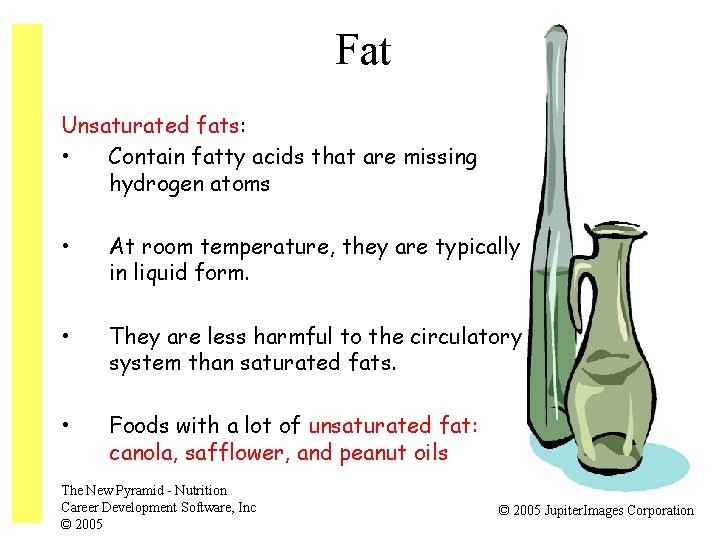
Fat Unsaturated fats: • Contain fatty acids that are missing hydrogen atoms • At room temperature, they are typically in liquid form. • They are less harmful to the circulatory system than saturated fats. • Foods with a lot of unsaturated fat: canola, safflower, and peanut oils The New Pyramid - Nutrition Career Development Software, Inc © 2005 Jupiter. Images Corporation
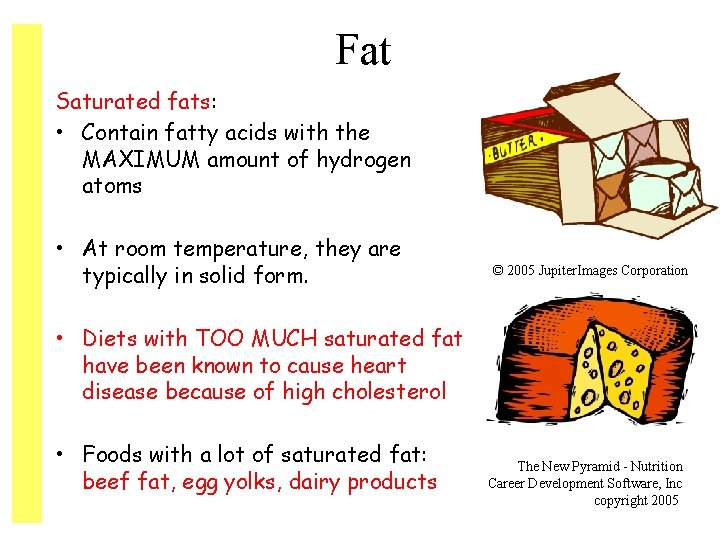
Fat Saturated fats: • Contain fatty acids with the MAXIMUM amount of hydrogen atoms • At room temperature, they are typically in solid form. © 2005 Jupiter. Images Corporation • Diets with TOO MUCH saturated fat have been known to cause heart disease because of high cholesterol • Foods with a lot of saturated fat: beef fat, egg yolks, dairy products The New Pyramid - Nutrition Career Development Software, Inc copyright 2005
Calories What is a calorie? • The energy obtained from carbohydrates, proteins, and fats is measured in units called calories. • 3500 calories make up 1 pound of fat © 2005 Jupiter. Images Corporation The New Pyramid - Nutrition Career Development Software, Inc copyright 2005
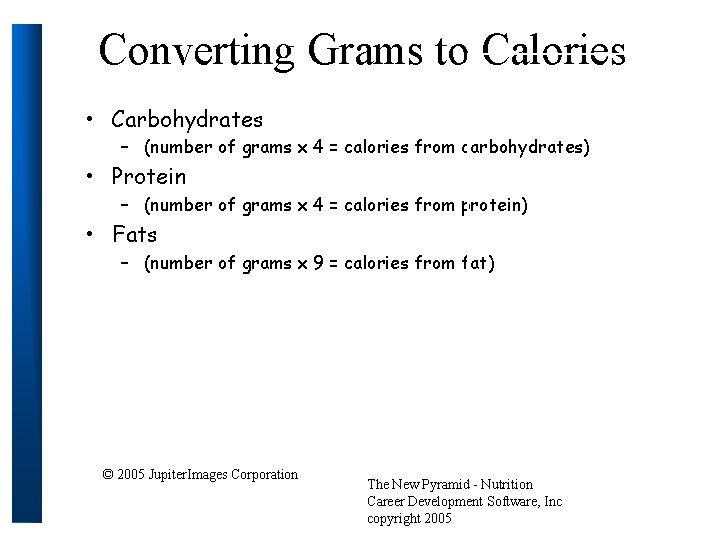
Converting Grams to Calories • Carbohydrates – (number of grams x 4 = calories from carbohydrates) • Protein – (number of grams x 4 = calories from protein) • Fats – (number of grams x 9 = calories from fat) © 2005 Jupiter. Images Corporation The New Pyramid - Nutrition Career Development Software, Inc copyright 2005
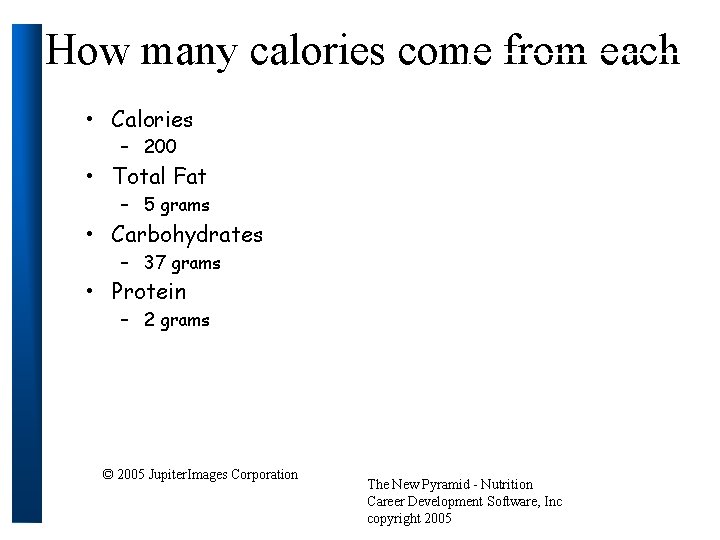
How many calories come from each • Calories – 200 • Total Fat – 5 grams • Carbohydrates – 37 grams • Protein – 2 grams © 2005 Jupiter. Images Corporation The New Pyramid - Nutrition Career Development Software, Inc copyright 2005
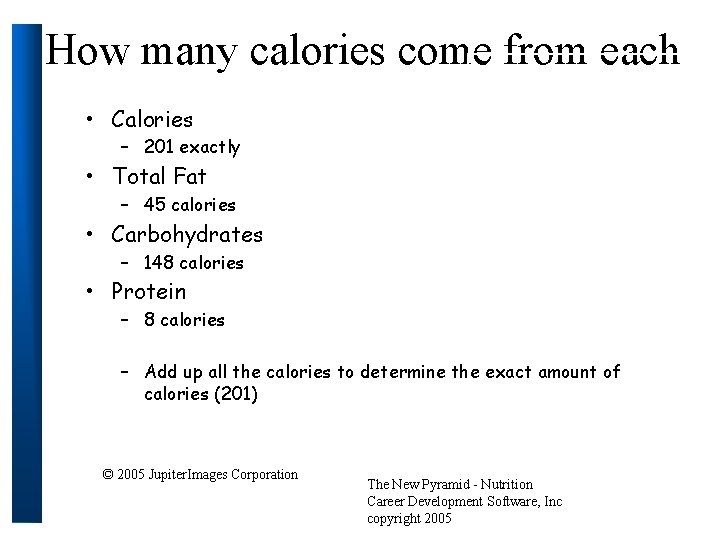
How many calories come from each • Calories – 201 exactly • Total Fat – 45 calories • Carbohydrates – 148 calories • Protein – 8 calories – Add up all the calories to determine the exact amount of calories (201) © 2005 Jupiter. Images Corporation The New Pyramid - Nutrition Career Development Software, Inc copyright 2005
Assignment 1. Read and study Figure 8. 2 Sample Food Label on page 146 2. Write Ques. and Ans. for pg. 150 Comprehension Check 3. Do Chapter Review WS (Do Not do Take it Home) © 2005 Jupiter. Images Corporation The New Pyramid - Nutrition Career Development Software, Inc copyright 2005
Bibliography “Benefits of Exercise. ” Healthclubs. com. 2005. IHRSA. org. 19 Sept. 2005. <http: //www. healthclubs. com/benefits/>. “Fad Diets: What You Need to Know. ” Familydoctor. org. Apr. 2005. American Academy of Family Physicians. 19 Sept. 2005. <http: //familydoctor. org/784. xml>. “Glossary. ” Beaumont Hospitals. 2005. William Beaumont Hospitals. 19 Sept. 2005. <http: //www. beaumonthospitals. com>. Holt, Rinehart, and Winston. Life Science (Teacher Edition). Prentice Hall. Englewood Cliffs, New Jersey. , 2005. “Iron – Sources and Functions. ” Nutrition and Fitness Software by Nutri. Strategy. 2005. Nutri. Strategy. 19 Sept. 2005. <http: //www. nutristrategy. com/nutrition/iron. htm>. Kemp, Gina, M. A. , and Robert Segal, M. A. “Healthy Restaurant Eating / Fast Food Nutrition: Guide to Making Healthy Choices. ” Helpguide. org. 10 June 2004. Rotary Club of Santa Monica. 19 Sept. 2005. <http: //www. helpguide. org/aging/fast_food_nutrition. htm>. “Medline Plus Medical Encyclopedia. ” Medline Plus. 9 July 2004. U. S. Library Of Medicine. 19 Sept. 2005. <http: //www. nlm. nih. gov/medlineplus/ency/article/002468. htm>. Merki, Mary Bronson, Ph. D. , Merki, Don, Ph. D. Health: A Guide to Wellness. Glencoe Mc. Graw-Hill, 2001. “Vitamins. ” A. D. A. M. Healthcare Center. 2005. New York Times Company. 19 Sept. 2005. <http: //adam. about. com/encyclopedia/002399. htm>. “What does organic mean? . ” Pick. Your. Own. org. 9 Jan. 2003. Benivia, LLC. 19 Sept. 2005. <http: //www. pickyourown. org/organic. htm>.