
The New OSHA Hazard Communication Program Friday September
The New OSHA Hazard Communication Program Friday, September 23, 2016 Barry Hartman Barry. Hartman@klgates. com © Copyright 2016 by K&L Gates LLP. All rights reserved. 11: 00 AM Kate Dewberry Kate. Dewberry@klgates. com
© Copyright 2016 by K&L Gates LLP. All rights reserved. klgates. com 2
WHAT WE WILL COVER § What is the Hazard Communication Standard § Why is it important now? § How do I comply? © Copyright 2016 by K&L Gates LLP. All rights reserved. klgates. com 3
WHAT IS OSHA’S HAZARD COMMUNICATION STANDARD (HCS)? § Employees learn about work hazards from chemicals; § How to protect themselves § How to handle spills § Goal: Reduce incidence of illness/ injuries from chemicals in the workplace. © Copyright 2016 by K&L Gates LLP. All rights reserved. klgates. com 4
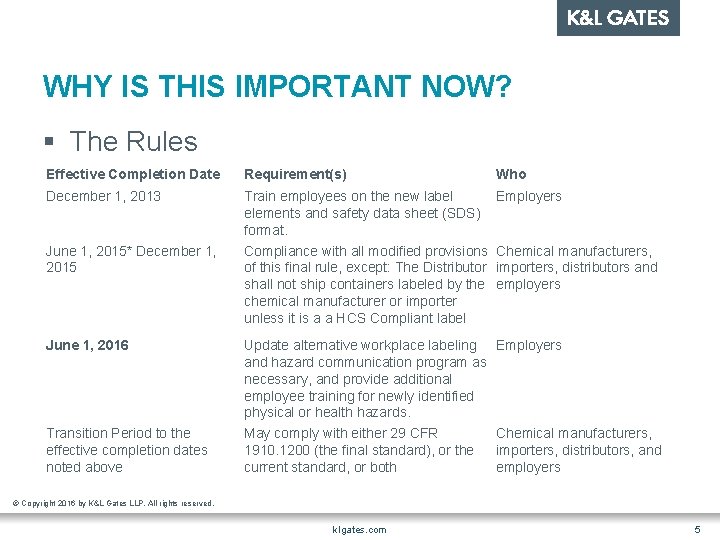
WHY IS THIS IMPORTANT NOW? § The Rules Effective Completion Date Requirement(s) December 1, 2013 Train employees on the new label Employers elements and safety data sheet (SDS) format. Compliance with all modified provisions Chemical manufacturers, of this final rule, except: The Distributor importers, distributors and shall not ship containers labeled by the employers chemical manufacturer or importer unless it is a a HCS Compliant label June 1, 2015* December 1, 2015 June 1, 2016 Transition Period to the effective completion dates noted above Update alternative workplace labeling and hazard communication program as necessary, and provide additional employee training for newly identified physical or health hazards. May comply with either 29 CFR 1910. 1200 (the final standard), or the current standard, or both Who Employers Chemical manufacturers, importers, distributors, and employers © Copyright 2016 by K&L Gates LLP. All rights reserved. klgates. com 5
HOW HAVE THE RULES CHANGED? § Align information with the United Nations’ Globally Harmonized System of Classification and Labeling of Chemicals (GHS). § Reduce trade barriers posed by differing global requirements for classification and labeling of chemicals. § Revisions mostly relate to how chemical manufacturers/importers classify chemical hazards and prepare labels and SDSs. § But training must be to the new classifications © Copyright 2016 by K&L Gates LLP. All rights reserved. klgates. com 6
EXEMPTIONS FROM HCS 1. Hazardous waste regulated under the Resource Conservation and Recovery Act (RCRA) 2. Tobacco and tobacco products 3. Wood and wood products, 4. Food, drugs, and cosmetics for use by employees in the workplace 5. Articles. 1. Exempt articles are those which are formed to a specific shape or design, have end use functions dependent on that shape or design, and do not release or produce exposure to hazardous substances under normal conditions of use. © Copyright 2016 by K&L Gates LLP. All rights reserved. klgates. com 7
COMPONENTS OF HCS § Safety Data Sheets (“SDS”) § Container Labeling § Hazard Communication Program © Copyright 2016 by K&L Gates LLP. All rights reserved. klgates. com 8
WHO MUST COMPLY? § General industry, shipyard, marine terminals, longshoring, and construction employers § Chemical manufacturers, importers, employers, and employees exposed to chemical hazards © Copyright 2016 by K&L Gates LLP. All rights reserved. klgates. com 9
MANUFACTURERS/IMPORTERS § Required to perform hazard classifications on the chemicals they produce or import. § “manufactures, processes, formulates, blends, mixes, repackages, or otherwise changes the composition of a hazardous chemical is considered a “chemical manufacturer. ” § Distributors or resellers of consumer fireworks are only required to have SDSs for the consumer fireworks, not for the individual chemicals that make up those fireworks. © Copyright 2016 by K&L Gates LLP. All rights reserved. klgates. com 10
FIRST QUESTION: WHAT AM I? ? §Manufacturer §Importer §Distributor §Employer © Copyright 2016 by K&L Gates LLP. All rights reserved. klgates. com 11
MANUFACTURERS § It all starts here. § If you mix chemicals to produce a particular type of pyrotechnic article (“pyrotechnic manufacturer”). § The hazard information from the suppliers of the individual ingredients is critical to the classification of the pyrotechnic article’s composition. § U. S. pyrotechnic manufacturers are equivalent to manufacturers in other industries. © Copyright 2016 by K&L Gates LLP. All rights reserved. klgates. com 12
IMPORTERS § Importers of pyrotechnic articles and consumer fireworks are essentially distributors. § Responsible for making sure that compliant labels and SDSs are available for the products they import. § Must get them from manufacturer. § Still legally responsible even if you don’t have them. © Copyright 2016 by K&L Gates LLP. All rights reserved. klgates. com 13
MANUFACTURERS / IMPORTERS § Both U. S. manufacturers and importers of consumer fireworks must provide SDSs to their downstream distributors, including those at the retail level. © Copyright 2016 by K&L Gates LLP. All rights reserved. klgates. com 14
TWO BIG EXCEPTIONS FOR CONSUMER FIREWORKS § HCS 2012 -compliant labels are not required on consumer fireworks as long as they are labeled in conformance with Consumer Product Safety Commission (CPSC) requirements. 15 U. S. C. § 1261. See http: //www. cpsc. gov/en/Business-Manufacturing/Business-Education/Business. Guidance/Fireworks/ § SDSs are not required to be provided to consumers at retail sales locations. © Copyright 2016 by K&L Gates LLP. All rights reserved. klgates. com 15
EMPLOYERS § Most manufacturers, importers and distributors are employers (they employ people). § Not all employers are manufactures, importers or distributors. © Copyright 2016 by K&L Gates LLP. All rights reserved. klgates. com 16
EMPLOYER RESPONSIBILITIES § Employers only have to focus on: § establishing a workplace program and § communicating information to their workers. © Copyright 2016 by K&L Gates LLP. All rights reserved. klgates. com 17
EMPLOYER RESPONSIBILITIES • Chemical Manufacturers and Importers classify the hazards of chemical s they produce or import, and prepare labels and safety data sheets based on the classifications Chemicals are Shipped to Employers by Chemical Manufacturers, Importers or Distributors Implement the Program • All Employers receive labeled containers and safety data sheets with shipped chemicals • All Employers must prepare a written hazard communication program, including a list of the hazardous chemicals in the workplace • Employers must ensure: • All containers of hazardous chemicals are labeled • Safety data sheets are maintained for all hazardous chemicals • Workers are trained on program elements, hazards, protective measures, etc. Keep Information Up-to. Date © Copyright 2016 by K&L Gates LLP. All rights reserved. klgates. com 18
EMPLOYER RESPONSIBILITIES § Inventory: Identify and list hazardous chemicals in workplaces § SDS & Labeling: Obtain Safety Data Sheets and labels for each hazardous chemical, if not provided by the manufacturer, importer, or distributor § Written Program: Implement a written Haz. Com program, including labels, SDS, and employee training § Communication & Training: Communicate hazard information to employees through labels, SDSs, and formal training programs © Copyright 2016 by K&L Gates LLP. All rights reserved. klgates. com 19
WHAT DO I INVENTORY? § Inventory any hazardous chemicals defined as § “any chemical which is classified as a physical hazard or a health hazard, a simple asphyxiant, combustible dust, pyrophoric gas, or hazard not otherwise classified. ” § Household consumer product - do not need to provide SDSs when the products are used in the workplace in the same manner that a consumer would use them. https: //www. osha. gov/html/faq-hazcom. html#faq 8 © Copyright 2016 by K&L Gates LLP. All rights reserved. klgates. com 20
HOW DO I INVENTORY? § Start with invoices. § Walk around just like you would inventory product. § If you find things you don’t use, properly discard them. § If it’s there and not exempt, it requires SDS and training. § “Old” stock needs new SDS. © Copyright 2016 by K&L Gates LLP. All rights reserved. klgates. com 21
SDS AND LABELLING § Demand it from seller or don’t buy the product; § Make it a condition of payment in order; § Take a look at SDS date: § If before June 1 2015, beware § If it says “MSDS” beware. § If it is dog-eared, beware. § You are legally liable for fines if you don’t have the SDS © Copyright 2016 by K&L Gates LLP. All rights reserved. klgates. com 22
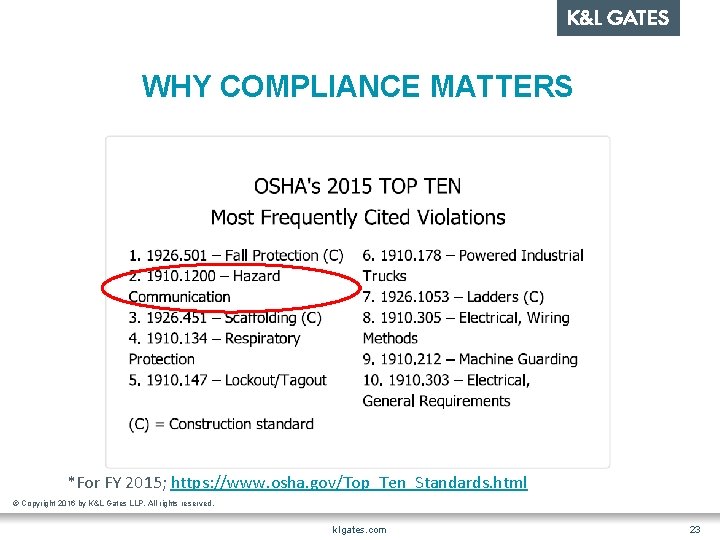
WHY COMPLIANCE MATTERS *For FY 2015; https: //www. osha. gov/Top_Ten_Standards. html © Copyright 2016 by K&L Gates LLP. All rights reserved. klgates. com 23
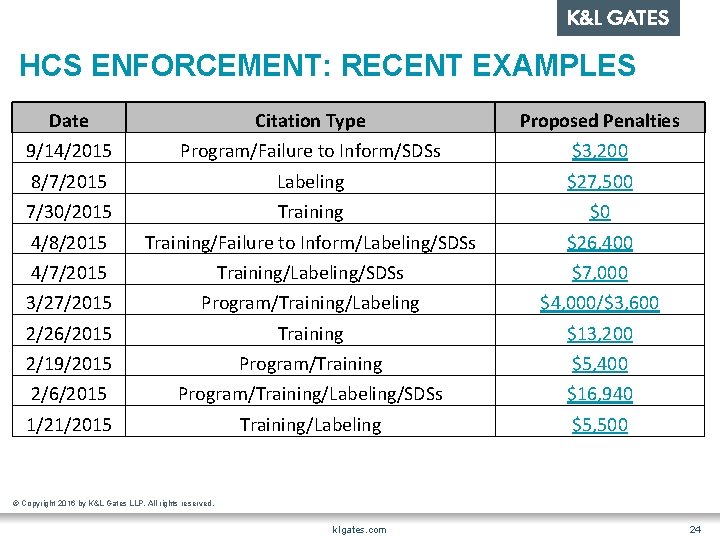
HCS ENFORCEMENT: RECENT EXAMPLES Date Citation Type Proposed Penalties 9/14/2015 Program/Failure to Inform/SDSs $3, 200 8/7/2015 Labeling $27, 500 7/30/2015 Training $0 4/8/2015 Training/Failure to Inform/Labeling/SDSs $26, 400 4/7/2015 Training/Labeling/SDSs $7, 000 3/27/2015 Program/Training/Labeling $4, 000/$3, 600 2/26/2015 Training $13, 200 2/19/2015 Program/Training $5, 400 2/6/2015 Program/Training/Labeling/SDSs $16, 940 1/21/2015 Training/Labeling $5, 500 © Copyright 2016 by K&L Gates LLP. All rights reserved. klgates. com 24
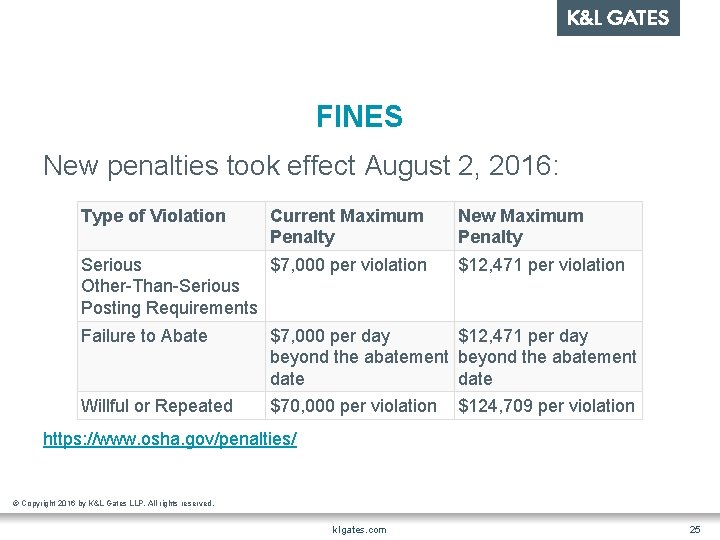
FINES New penalties took effect August 2, 2016: Type of Violation Current Maximum Penalty Serious $7, 000 per violation Other-Than-Serious Posting Requirements New Maximum Penalty $12, 471 per violation Failure to Abate $7, 000 per day $12, 471 per day beyond the abatement date Willful or Repeated $70, 000 per violation $124, 709 per violation https: //www. osha. gov/penalties/ © Copyright 2016 by K&L Gates LLP. All rights reserved. klgates. com 25
HAZARD COMMUNICATION PROGRAM
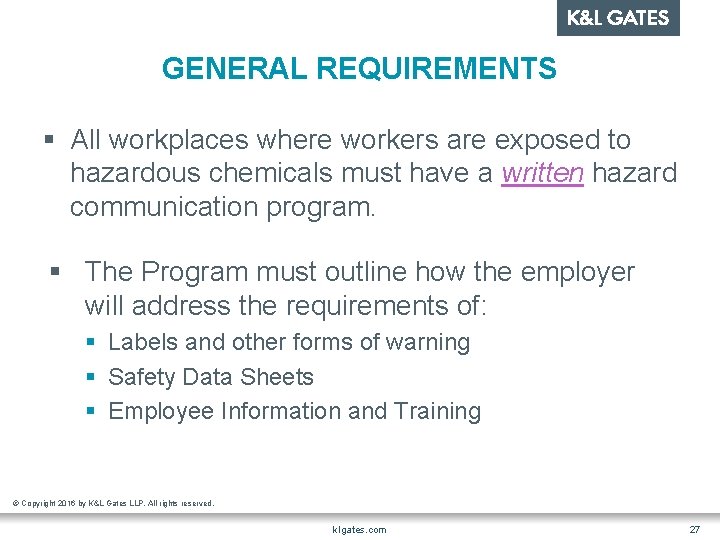
GENERAL REQUIREMENTS § All workplaces where workers are exposed to hazardous chemicals must have a written hazard communication program. § The Program must outline how the employer will address the requirements of: § Labels and other forms of warning § Safety Data Sheets § Employee Information and Training © Copyright 2016 by K&L Gates LLP. All rights reserved. klgates. com 27
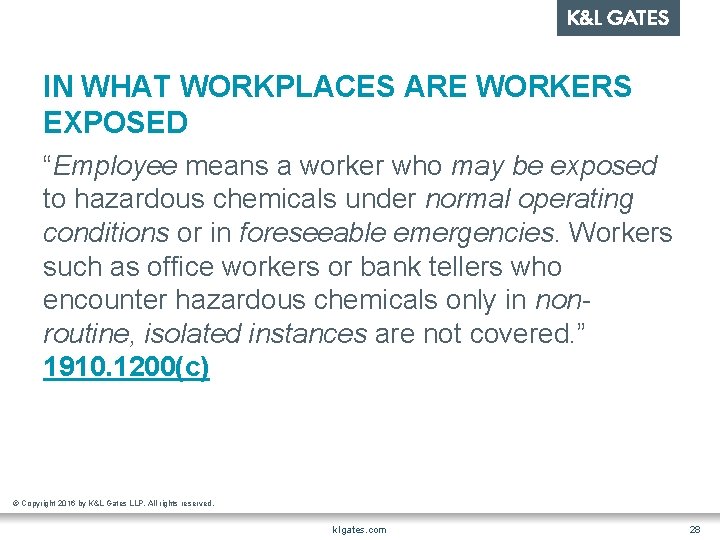
IN WHAT WORKPLACES ARE WORKERS EXPOSED “Employee means a worker who may be exposed to hazardous chemicals under normal operating conditions or in foreseeable emergencies. Workers such as office workers or bank tellers who encounter hazardous chemicals only in nonroutine, isolated instances are not covered. ” 1910. 1200(c) © Copyright 2016 by K&L Gates LLP. All rights reserved. klgates. com 28
IN WHAT WORKPLACES ARE WORKERS EXPOSED § § § “Office workers who encounter hazardous chemicals only in isolated instances are not covered intermittent or occasional use of a copying machine does not result in coverage under the rule. However, if an employee handles the chemicals to service the machine, or operates it for long periods of time, then the program would have to be applied. ” https: //www. osha. gov/html/faq-hazcom. html#faq 10 Reference Interpretation and Compliance Letters: § Applicability of the HCS to office workers and copy machine operators. [3/31/89] § Application of the Hazard Communication Standard to art materials industry. [9/17/87] § See Also: OSHA Instruction CPL 2 -2. 38 D, Inspection Procedures for the Hazard Communication Standard, 29 CFR 1910. 1200, 1915. 99, 1917. 28, 1918. 90, 1926. 59, 1928. 21 [3/20/98] © Copyright 2016 by K&L Gates LLP. All rights reserved. klgates. com 29
GENERAL REQUIREMENTS § Must also include: § List of the hazardous chemicals known to be present in the workplace (identified by product identifier from the SDS) § Methods to inform employees of the hazards of nonroutine tasks © Copyright 2016 by K&L Gates LLP. All rights reserved. klgates. com 30
MULTI EMPLOYER WORK SITES § For multi-employer worksites § How on-site access to SDSs will be provided to the other employer(s). § How such employers will be informed of needed precautionary measures. § How such employers will be informed of the on-site labeling system if it is different from the labels specified for shipped containers under the standard. © Copyright 2016 by K&L Gates LLP. All rights reserved. klgates. com 31
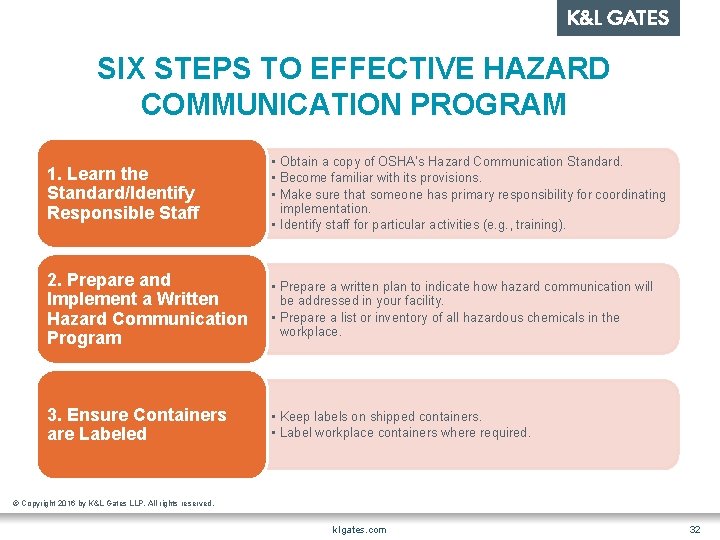
SIX STEPS TO EFFECTIVE HAZARD COMMUNICATION PROGRAM 1. Learn the Standard/Identify Responsible Staff • Obtain a copy of OSHA’s Hazard Communication Standard. • Become familiar with its provisions. • Make sure that someone has primary responsibility for coordinating implementation. • Identify staff for particular activities (e. g. , training). 2. Prepare and Implement a Written Hazard Communication Program • Prepare a written plan to indicate how hazard communication will be addressed in your facility. • Prepare a list or inventory of all hazardous chemicals in the workplace. 3. Ensure Containers are Labeled • Keep labels on shipped containers. • Label workplace containers where required. © Copyright 2016 by K&L Gates LLP. All rights reserved. klgates. com 32
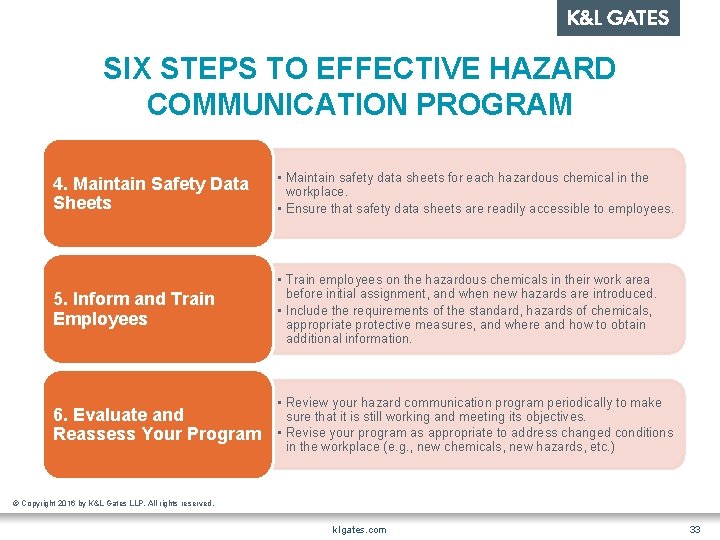
SIX STEPS TO EFFECTIVE HAZARD COMMUNICATION PROGRAM 4. Maintain Safety Data Sheets • Maintain safety data sheets for each hazardous chemical in the workplace. • Ensure that safety data sheets are readily accessible to employees. 5. Inform and Train Employees • Train employees on the hazardous chemicals in their work area before initial assignment, and when new hazards are introduced. • Include the requirements of the standard, hazards of chemicals, appropriate protective measures, and where and how to obtain additional information. 6. Evaluate and Reassess Your Program • Review your hazard communication program periodically to make sure that it is still working and meeting its objectives. • Revise your program as appropriate to address changed conditions in the workplace (e. g. , new chemicals, new hazards, etc. ) © Copyright 2016 by K&L Gates LLP. All rights reserved. klgates. com 33
CONTENTS OF HAZARD COMMUNICATION PROGRAM 1. Summary of the Occupational Health and Safety Administration (OSHA) Standard 2. Hazard Determination Policy 3. List of the Hazardous Chemicals Used in this location 4. Safety Data Sheets (SDSs) for every known hazardous chemical found in this location 5. Hazardous Chemical Container Labeling Policy 6. Employee Information and Training Material © Copyright 2016 by K&L Gates LLP. All rights reserved. klgates. com 34
HAZARD DETERMINATION POLICY: IF COMPANY IS NOT A MANUFACTURER OR IMPORTER “The company relies on suppliers to make the determinations required under the OSHA Standard concerning the hazards of the products they sell. The company in no way undertakes to verify the information provided and relies on the suppliers to provide accurate, up-to-date information on their products. “ © Copyright 2016 by K&L Gates LLP. All rights reserved. klgates. com 35
HAZARD DETERMINATION POLICY: IF COMPANY IS A MANUFACTURER OR IMPORTER Determine which chemicals require a hazard classification. § Prepare an inventory of all the chemicals you manufacture or import, as well as a list of the ingredients in the mixtures produced. § To create the list of ingredients from the mixtures produced, consider information found in the chemical formula, on order receipts, batch sheets, and so on. § While a single SDS must be created for the mixtures produced, you may rely upon the information provided on the SDSs and labels for ingredients obtained from the chemical manufacturer or importer, unless you have reason to believe the information is incorrect. § Or you may choose to conduct a hazard classification for those ingredients if there is concern about the adequacy of the hazard information received. © Copyright 2016 by K&L Gates LLP. All rights reserved. klgates. com 36
HAZARDOUS CHEMICALS INVENTORY § List of every hazardous substance known to be present in the workplace § Should include a product identifier for each chemical on the list that matches and can be easily cross-referenced with the product identified on its label and on its SDS. § Must be updated whenever necessary to reflect accurately all the hazardous chemicals that are present in the workplace. § All mixtures (stars, fountain composition, fuse powder, etc. ) prepared at this facility are listed on the Hazardous Chemical Inventory. § Obtain a list of all hazardous chemicals to be used at the worksite by outside contractors © Copyright 2016 by K&L Gates LLP. All rights reserved. klgates. com 37
INFORM AND TRAIN EMPLOYEES Training must consist of instruction in: 1. The requirements of the OSHA Standard. 2. Operations in their work areas where hazardous chemicals are present. 3. The location and availability of the Hazard Communication Program § 4. 5. 6. Details of Hazard Communication Program developed by the company, including an explanation of the labeling systems and the SDSs, and how employees can obtain and use appropriate hazard information. Methods and observations to detect the presence or release of hazardous chemicals in the work area. Physical and health hazards of chemicals in the work area. Measures employees can take to protect themselves (e. g. , work practices, emergency procedures, protective equipment, etc. ). © Copyright 2016 by K&L Gates LLP. All rights reserved. klgates. com 38
INFORM AND TRAIN EMPLOYEES § At the time of employee’s initial assignment to work with hazardous chemicals, or whenever a new hazard is introduced. § Before any non-routine task that could involve exposure to hazardous chemicals § Before any contractors work on company property § Periodic updates and seminars regarding the Hazardous Communication Program and workplace safety © Copyright 2016 by K&L Gates LLP. All rights reserved. klgates. com 39
CONTAINER LABELING
EXEMPTION FROM LABELING IF LABELED UNDER OTHER LAWS § finished consumer fireworks, labeled in compliance with consumer product safety regulations § pesticides, § foods and food ingredients, § distilled spirits § consumer products § certain other hazardous substances © Copyright 2016 by K&L Gates LLP. All rights reserved. klgates. com 41
EXEMPTION FOR ARTICLES § “If a manufacturer makes a reasonable determination that its product satisfies the requirements specified at 29 CFR 1910. 1200(c), including that it poses no health risk or physical hazard to downstream workers, the product would then be considered an article. ” https: //www. osha. gov/pls/oshaweb/owadisp. show_document? p_table=INTE RPRETATIONS&p_id=28664 © Copyright 2016 by K&L Gates LLP. All rights reserved. klgates. com 42
EXEMPTION FOR ARTICLES § The ‘article’ exemption can pose difficulties for manufacturers in determining whether their products meet the definition. The key to the definition of an “article, ” and thus exemption, is the requirement that the manufactured item does ". . . not release, or otherwise result in exposure to, a hazardous chemical under normal conditions of use. . . ” Many items appear to meet the definition in their manufactured form, but, manufacturers must consider their products’ end use before the “article” exemption may apply. ” https: //www. osha. gov/pls/oshaweb/owadisp. show_document? p_table=INTERPRETATIONS&p_id=19490 © Copyright 2016 by K&L Gates LLP. All rights reserved. klgates. com 43
LABELING POLICY § No hazardous chemicals are accepted for use in the company unless the chemicals are labeled with at least the following information: § Identity of the hazardous chemical(s) § Appropriate hazard warnings § Name and address of the chemical manufacturer, importer, or other responsible party © Copyright 2016 by K&L Gates LLP. All rights reserved. klgates. com 44
LABELING POLICY No hazardous chemical is used in the work area unless labeled with at least the following information: § The original manufacturer’s label -includes a product identifier, an appropriate signal word, hazard statement(s), pictogram(s), precautionary statement(s) and the name, address, and telephone number of the chemical manufacturer, importer, or other responsible party. § Workplace labeling includes the product identifier and words, pictures, symbols, or combination that provides at least general information regarding the hazards of the chemicals. © Copyright 2016 by K&L Gates LLP. All rights reserved. klgates. com 45
LABELING POLICY -SAMPLE § “John Smith is responsible for ensuring all containers are appropriately labeled and update workplace label information as necessary. ” § Policy to provide persons with reading disabilities and language difficulties are provided with appropriate information. © Copyright 2016 by K&L Gates LLP. All rights reserved. klgates. com 46
LABELS: REQUIRED INFORMATION “THE BIG 6” § § § Product Identifier Signal Word Hazard Statement(s) Pictogram(s) Precautionary Statement(s) Name, address, and phone number of responsible party © Copyright 2016 by K&L Gates LLP. All rights reserved. klgates. com 47
PSHPNN © Copyright 2016 by K&L Gates LLP. All rights reserved. klgates. com 48
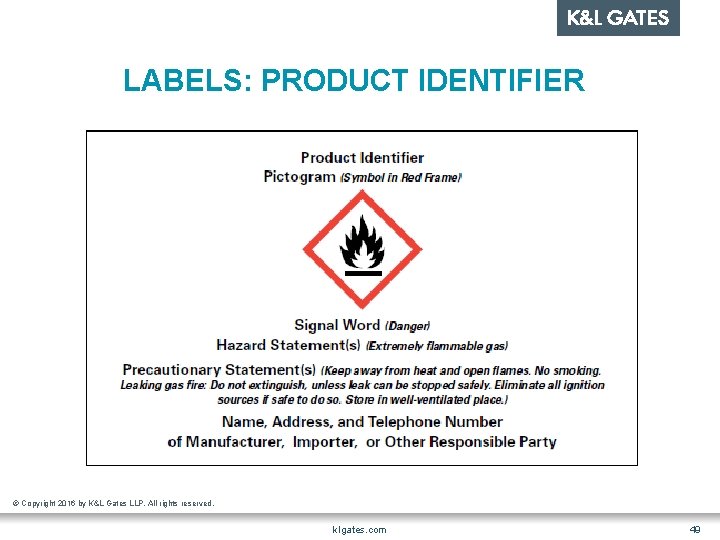
LABELS: PRODUCT IDENTIFIER © Copyright 2016 by K&L Gates LLP. All rights reserved. klgates. com 49
PRODUCT IDENTIFIER § Any chemical, common, or trade name or designation that the chemical manufacturer or importer chooses to use on the label § The term must also appear on the SDS © Copyright 2016 by K&L Gates LLP. All rights reserved. klgates. com 50
LABELS – SIGNAL WORD © Copyright 2016 by K&L Gates LLP. All rights reserved. klgates. com 51
LABELS: SIGNAL WORD § Word used to indicate the relative level of severity of hazard and alert the reader to a potential hazard on the label § The signal words used in the HCS are “danger” and “warning. ” § “Danger” is used for the more severe hazards § “Warning” is used for the less severe hazards © Copyright 2016 by K&L Gates LLP. All rights reserved. klgates. com 52
LABEL: HAZARD STATEMENT § Statement assigned to a hazard class and category that describes the nature of the hazard(s) of a chemical, including, where appropriate, the degree of hazard. § Example: Fatal if swallowed § There is a hazard statement for each hazard category of a hazard class, and it will vary depending on the degree of hazard. © Copyright 2016 by K&L Gates LLP. All rights reserved. klgates. com 53
HAZARD CLASSIFICATION GUIDANCE FOR MANUFACTURERS, IMPORTERS, AND EMPLOYERS https: //www. osha. gov/Publications/OSHA 3844. pdf © Copyright 2016 by K&L Gates LLP. All rights reserved. klgates. com 54
PICTOGRAM § a composition § may include a symbol plus other graphic elements, such as a border, background pattern, or color § that is intended to convey specific information about the hazards of a chemical. § Eight pictograms are designated under this standard for application to a hazard category © Copyright 2016 by K&L Gates LLP. All rights reserved. klgates. com 55
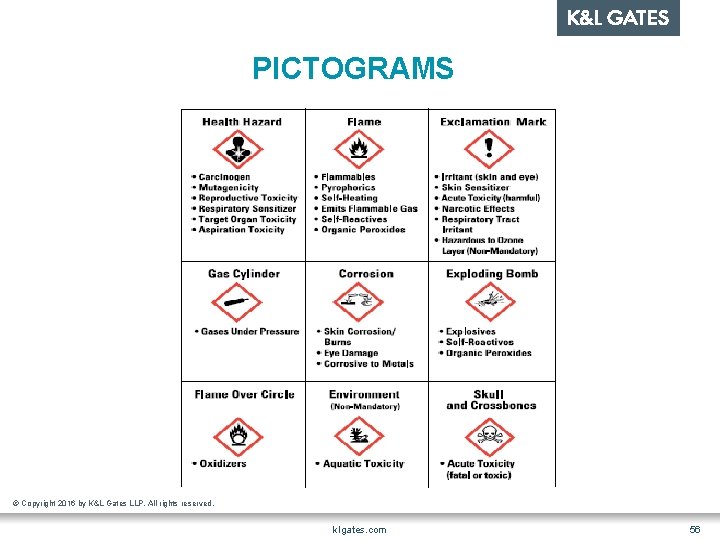
PICTOGRAMS © Copyright 2016 by K&L Gates LLP. All rights reserved. klgates. com 56
LABEL: PRECAUTIONARY STATEMENT § Phrase that describes recommended measures that should be taken to minimize or prevent adverse effects resulting from exposure to a hazardous chemical, or improper storage or handling. § Example: Do not eat, drink, or smoke when using this product. © Copyright 2016 by K&L Gates LLP. All rights reserved. klgates. com 57
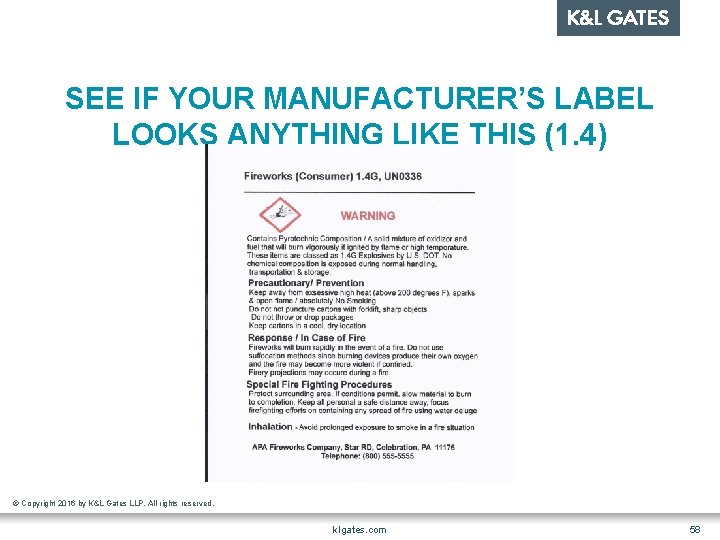
SEE IF YOUR MANUFACTURER’S LABEL LOOKS ANYTHING LIKE THIS (1. 4) © Copyright 2016 by K&L Gates LLP. All rights reserved. klgates. com 58
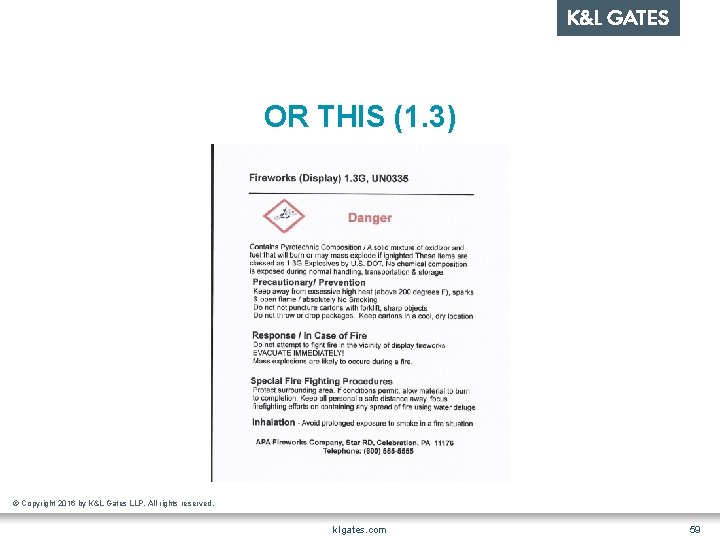
OR THIS (1. 3) © Copyright 2016 by K&L Gates LLP. All rights reserved. klgates. com 59
PORTABLE CONTAINERS § HCS does not require a label if § Portable containers into which hazardous chemicals are transferred § From labeled containers § and which are intended only for the immediate use of the employee who performs the transfer. (e. g. , Temporary containers of star composition to be pressed by an operator do not need to be labeled if the operator who performs the composition transfer also performs the pressing operation. ) © Copyright 2016 by K&L Gates LLP. All rights reserved. klgates. com 60
IF PORTABLE CONTAINERS ARE LABELED § Do not deface or remove unless container is immediately marked with required information. § Any container without a label - report immediately to supervisor. § Identity of the material on the manufacturer’s label or on the in-house label - same name used to identify the material on the Hazardous Chemicals Inventory and the SDS for that substance. © Copyright 2016 by K&L Gates LLP. All rights reserved. klgates. com 61
SAFETY DATA SHEETS (SDS)
SDS POLICY § An SDS containing the information required by the HCS is kept for each substance listed on the Hazardous Chemical Inventory. § The SDS is the most current one supplied by the chemical manufacturer, importer, or distributor. § All SDSs for this location are filed and readily accessible to any employee during his or her work shift. § No hazardous material is used in the workplace unless an SDS has been obtained and is on file in the work area. © Copyright 2016 by K&L Gates LLP. All rights reserved. klgates. com 63
SDS POLICY § Chemical manufacturers, importers, or distributers ensure that each container of hazardous chemicals leaving the workplace is labeled, tagged or marked in accordance with the OSHA Standard in manner that does not conflict with the requirements of the Hazardous Materials Transportation Act. § If the company becomes aware of new and significant health information about any hazardous material on the inventory, a revised SDS is placed in the SDS file. All employees who handle or are exposed to the material are notified of any changes in work procedures or personal protective equipment required to protect their health and safety. § Any time a revised SDS is received, a notice to that effect is posted and affected employees shall be notified that a new SDS is available for their review. When necessary, revised and/or new SDSs will be discussed with affected employees. © Copyright 2016 by K&L Gates LLP. All rights reserved. klgates. com 64
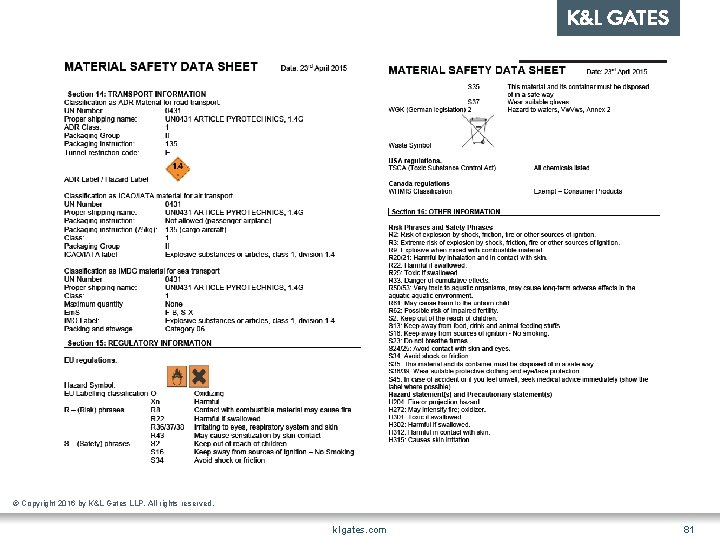
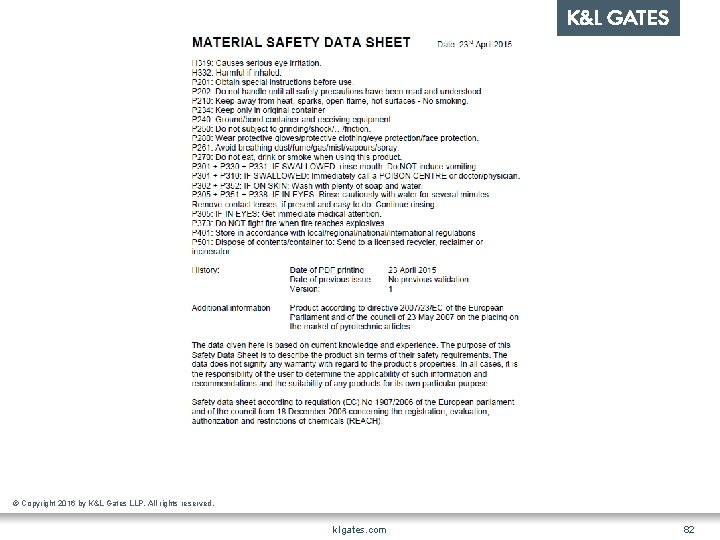
THE SDS CHALLENGE § There are no government approved SDSs that everyone can use. § Many chemicals are different and proprietary § So buying the ‘same’ product from different manufacturers may mean getting two different SDSs. § Need to keep track of this! © Copyright 2016 by K&L Gates LLP. All rights reserved. klgates. com 65
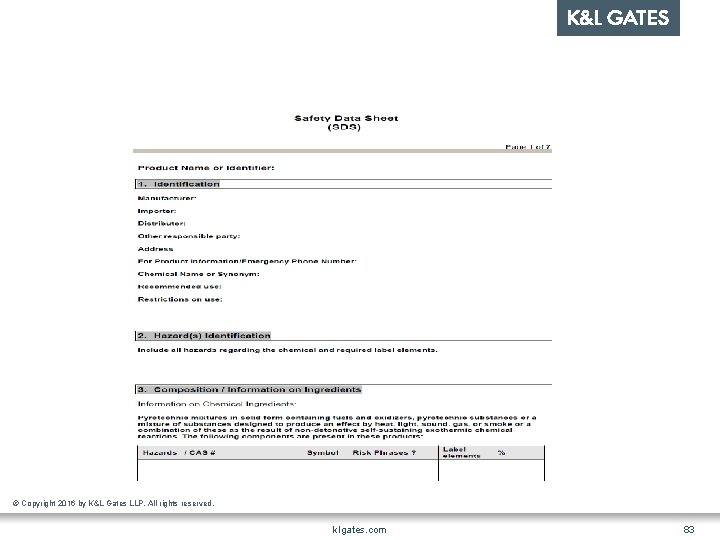
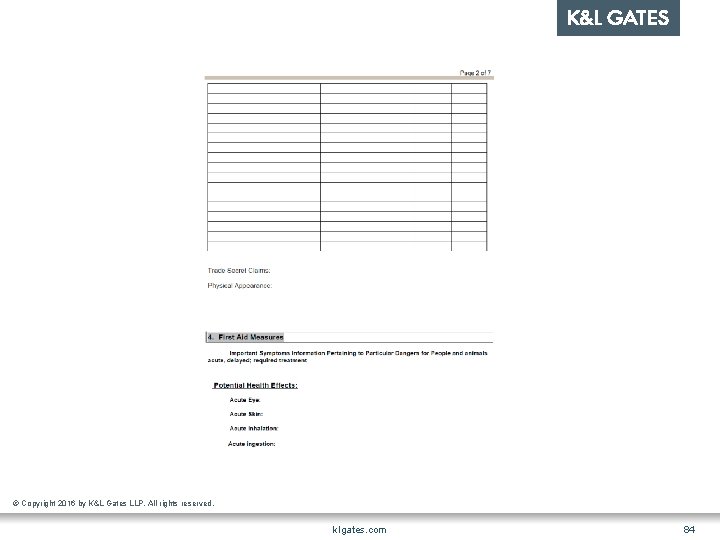
HOW TO READ AN SDS § Must be in English § No requirement to transate BUT regulations mention four times that organizations with speakers of other languages may provide HCS materials in other languages. For resources regarding Spanish-speaking employees, see: https: //www. osha. gov/dcsp/compliance_assistance/quickstarts/hi spanic/hispanic_step 2. html § If an employee does not speak or comprehend English, training must be provided in a language the employee can understand. https: //www. osha. gov/dep/standards-policy-statement-memo-0428 -10. html § Must contain specific minimum information as detailed in Appendix D of 29 CFR 1910. 1200. © Copyright 2016 by K&L Gates LLP. All rights reserved. klgates. com 66
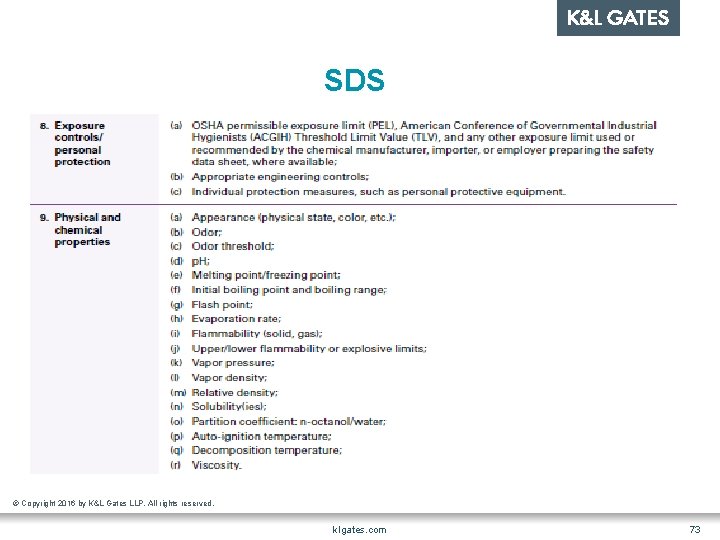
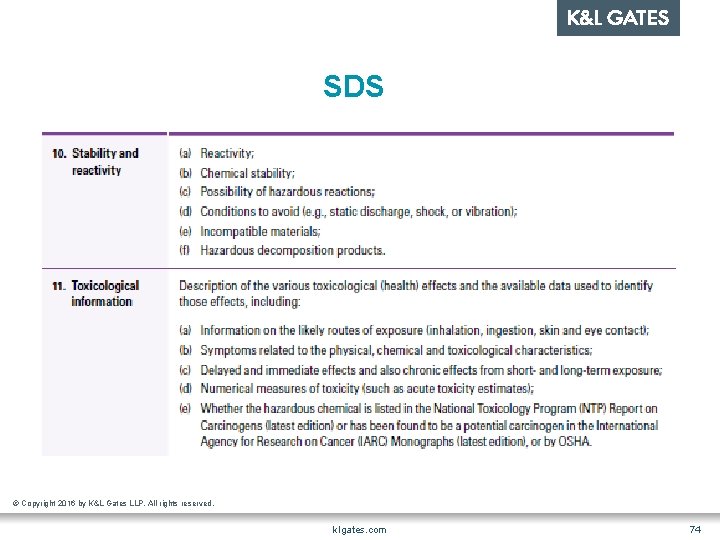
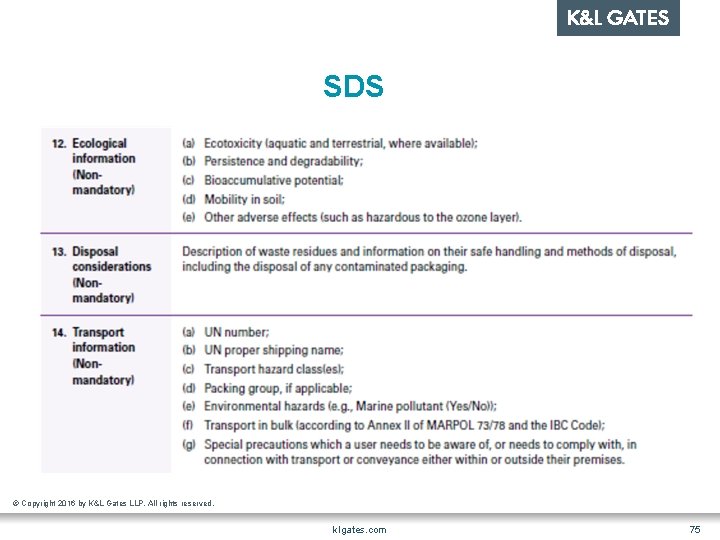
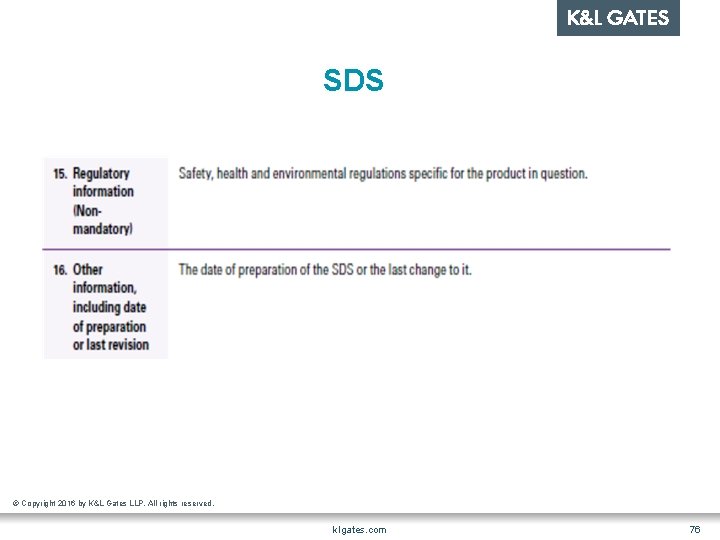
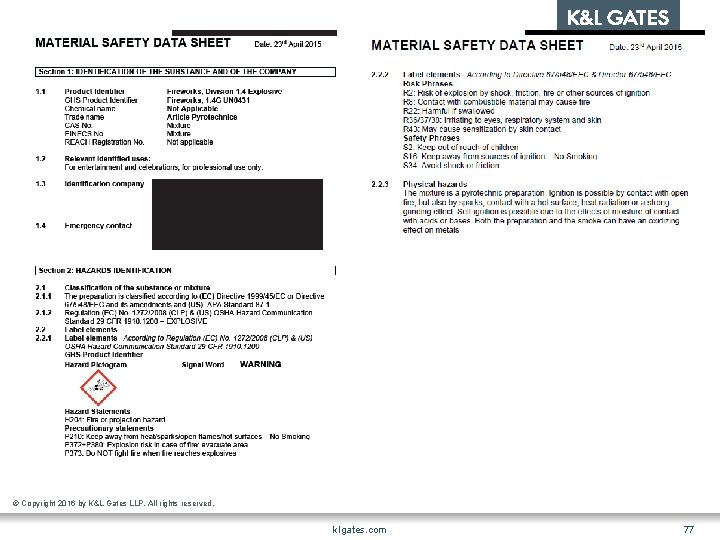
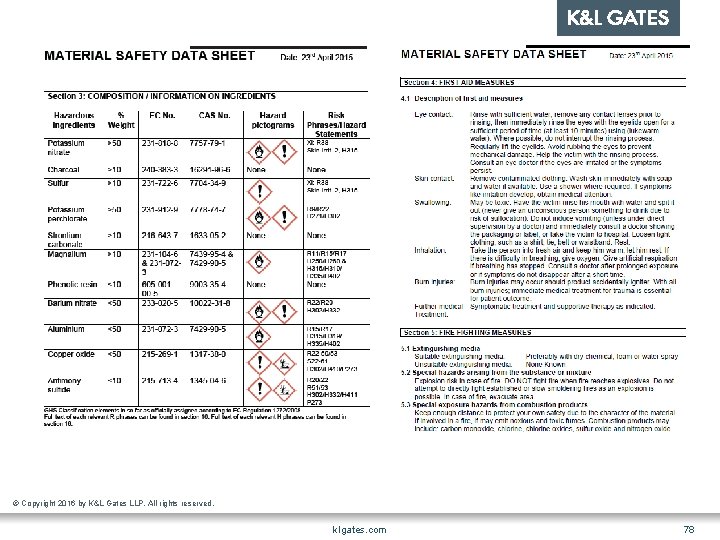
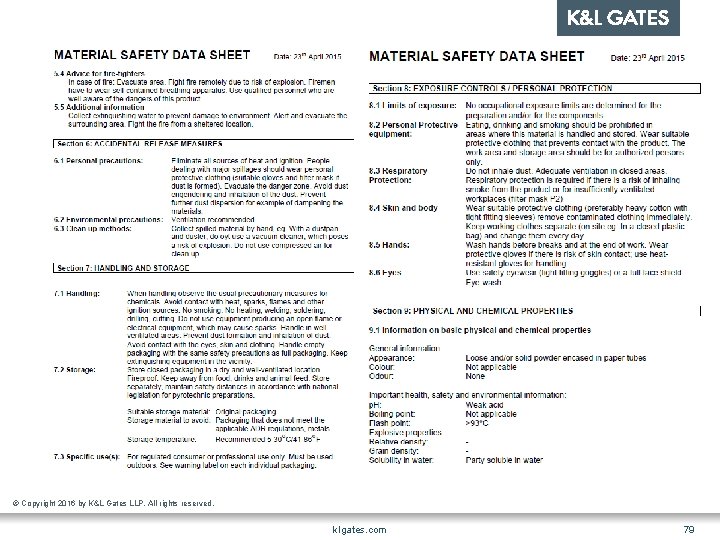
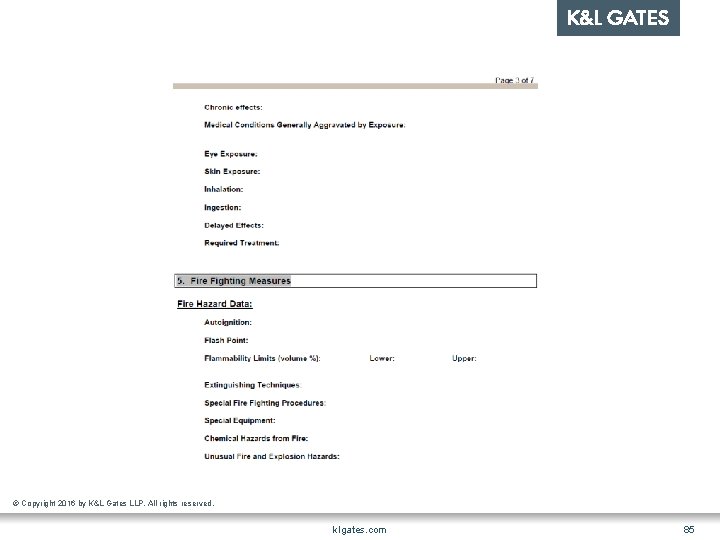
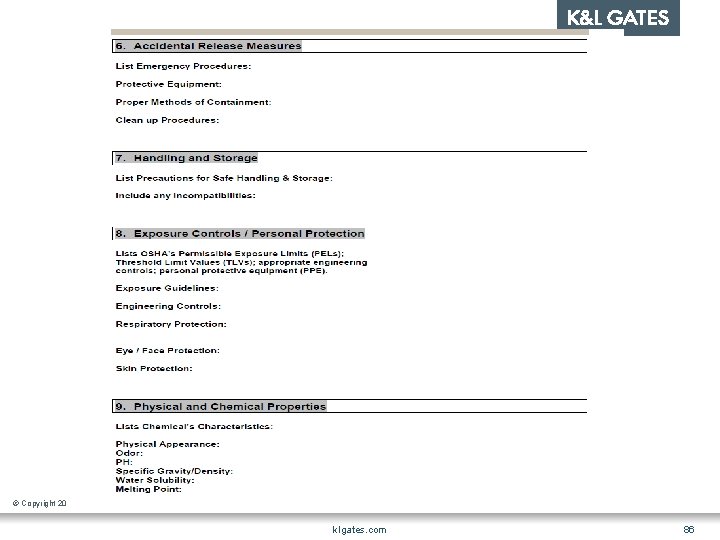
SECTIONS 1 -8 § General information about the chemical, identification, hazards, composition, safe handling practices, and emergency control measures (e. g. , fire fighting). © Copyright 2016 by K&L Gates LLP. All rights reserved. klgates. com 67
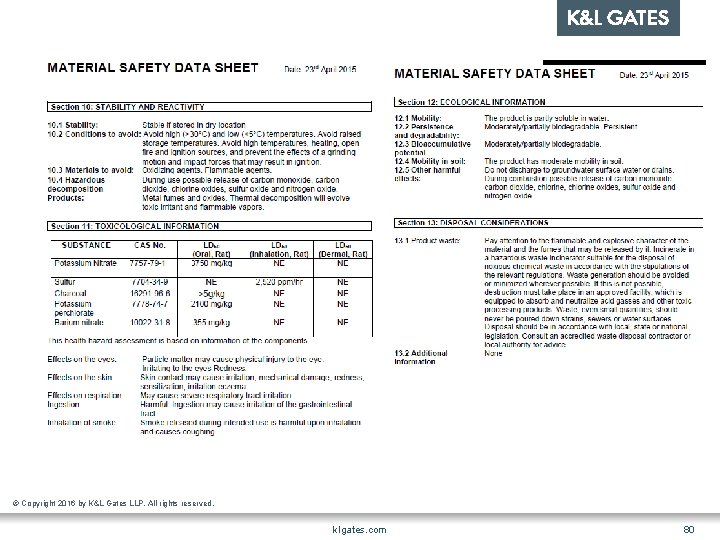
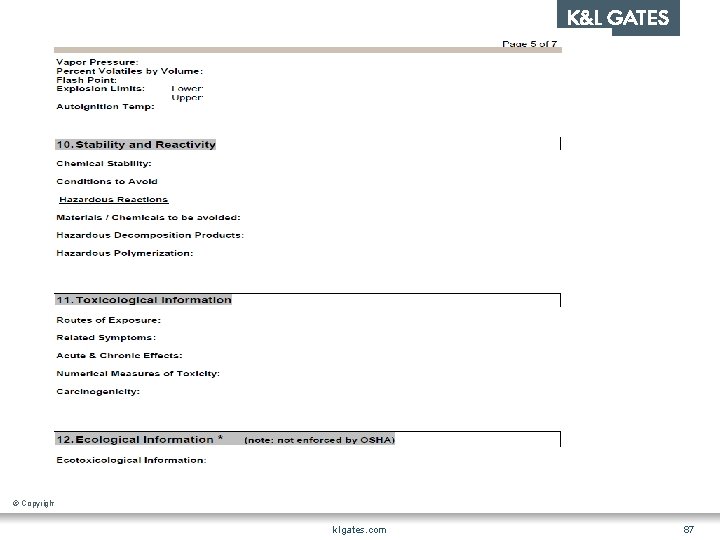
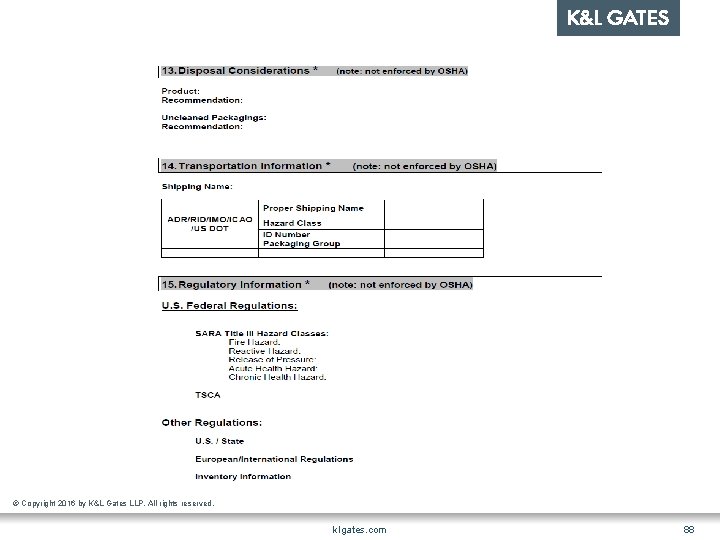
SECTIONS 11 -16 Other technical and scientific information, such as § physical and chemical properties, § stability and reactivity information, § toxicological information, § exposure control information, § other information including the date of preparation or last revision. © Copyright 2016 by K&L Gates LLP. All rights reserved. klgates. com 68
SECTION 12 -15 § Additional information required to be consistent with the GHS § OSHA unlikely to enforce the content of these sections because they concern matters handled by other agencies. https: //www. osha. gov/Publications/OSH A 3514. html © Copyright 2016 by K&L Gates LLP. All rights reserved. klgates. com 69
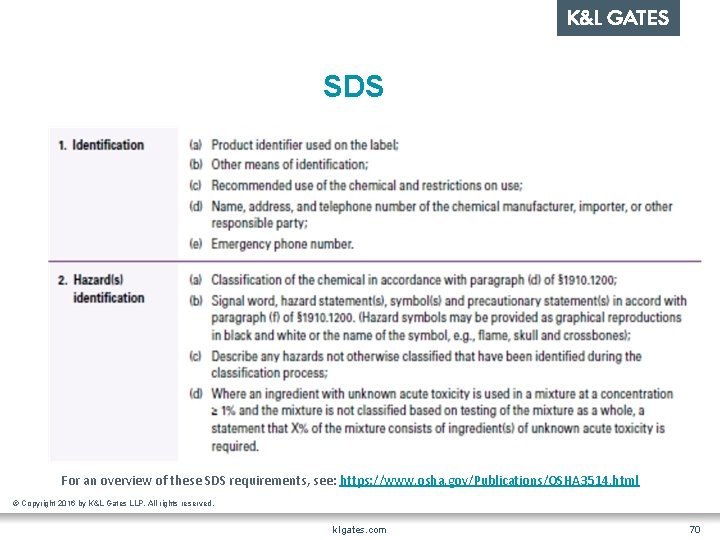
SDS For an overview of these SDS requirements, see: https: //www. osha. gov/Publications/OSHA 3514. html © Copyright 2016 by K&L Gates LLP. All rights reserved. klgates. com 70
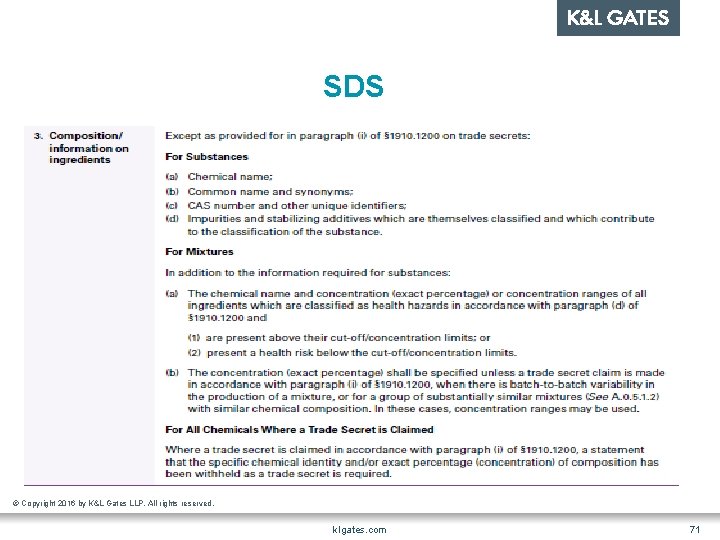
SDS © Copyright 2016 by K&L Gates LLP. All rights reserved. klgates. com 71
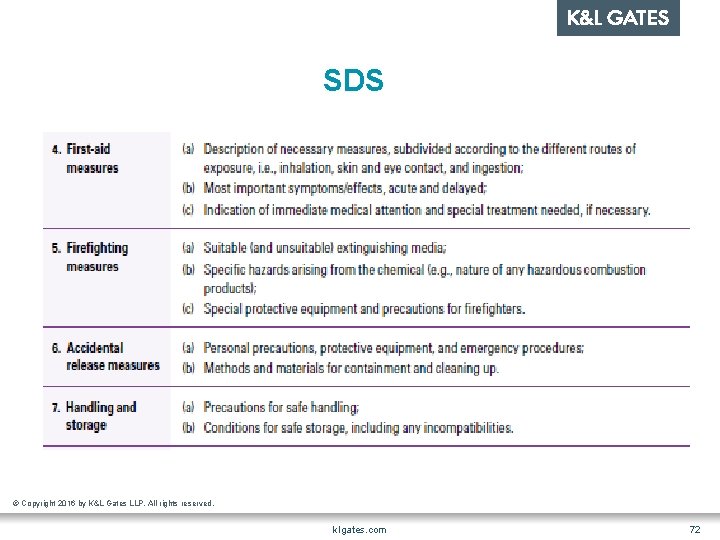
SDS © Copyright 2016 by K&L Gates LLP. All rights reserved. klgates. com 72
SDS © Copyright 2016 by K&L Gates LLP. All rights reserved. klgates. com 73
SDS © Copyright 2016 by K&L Gates LLP. All rights reserved. klgates. com 74
SDS © Copyright 2016 by K&L Gates LLP. All rights reserved. klgates. com 75
SDS © Copyright 2016 by K&L Gates LLP. All rights reserved. klgates. com 76
© Copyright 2016 by K&L Gates LLP. All rights reserved. klgates. com 77
© Copyright 2016 by K&L Gates LLP. All rights reserved. klgates. com 78
© Copyright 2016 by K&L Gates LLP. All rights reserved. klgates. com 79
© Copyright 2016 by K&L Gates LLP. All rights reserved. klgates. com 80
© Copyright 2016 by K&L Gates LLP. All rights reserved. klgates. com 81
© Copyright 2016 by K&L Gates LLP. All rights reserved. klgates. com 82
© Copyright 2016 by K&L Gates LLP. All rights reserved. klgates. com 83
© Copyright 2016 by K&L Gates LLP. All rights reserved. klgates. com 84
© Copyright 2016 by K&L Gates LLP. All rights reserved. klgates. com 85
© Copyright 2016 by K&L Gates LLP. All rights reserved. klgates. com 86
© Copyright 2016 by K&L Gates LLP. All rights reserved. klgates. com 87
© Copyright 2016 by K&L Gates LLP. All rights reserved. klgates. com 88
Questions? Contact: Barry Hartman Kaitlin Dewberry Partner Washington DC 202. 778. 9338 Barry. Hartman@klgates. com Associate Raleigh, NC 919. 743. 7327 Kate. Dewberry@klgates. com © Copyright 2016 by K&L Gates LLP. All rights reserved. klgates. com 89
FOR A COPY OF THIS PRESENTATION, PLEASE GO TO: http: //www. klgateshub. com/details/? event=American-Pyrotechnics-Association-Annual-Meeting-and. Convention-09 -20 -2016 § OR http: //www. klgates. com/american-pyrotechnics-association-annual-meeting-and-convention-09 -202016/ © Copyright 2016 by K&L Gates LLP. All rights reserved. klgates. com 90

- Slides: 91