
The New Kingdom Important Figures 1112022 1 Hatshepsut
- Slides: 23
The New Kingdom Important Figures 1/11/2022 1
Hatshepsut • means “Foremost of Noble Ladies” • her reign as king is usually given as twenty-two years (1479 BC - 1458 BC) • Although it was uncommon, Hatshepsut was the second female to have formally assumed power as "King of Upper and Lower Egypt" after Queen Sobekneferu • most notable example of another woman who became pharaoh was Cleopatra VII, the last pharaoh of Ancient Egypt 1/11/2022 2
Hatshepsut • She oversaw the trade mission to the Somalia • Many trade goods were bought in Punt, notably myrrh, her favorite fragrance • the Egyptians returned bearing 31 live frankincense trees, the first recorded attempt to transplant foreign trees 1/11/2022 3
Building projects by Hatshepsut • so much statuary was produced that almost every major museum in the world has Hatshepsut among their collections • Hatshepsut had monuments constructed at the Temple of Karnak • the masterpiece of Hatshepsut's building projects was her mortuary temple complex at Deir el-Bahri 1/11/2022 4
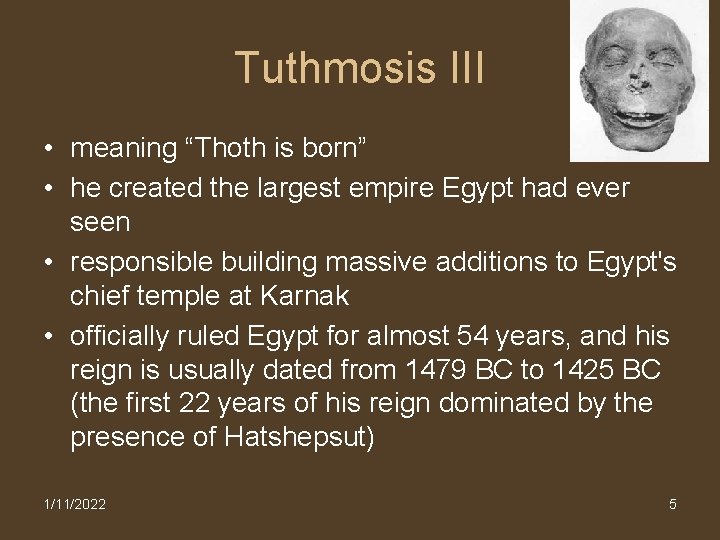
Tuthmosis III • meaning “Thoth is born” • he created the largest empire Egypt had ever seen • responsible building massive additions to Egypt's chief temple at Karnak • officially ruled Egypt for almost 54 years, and his reign is usually dated from 1479 BC to 1425 BC (the first 22 years of his reign dominated by the presence of Hatshepsut) 1/11/2022 5
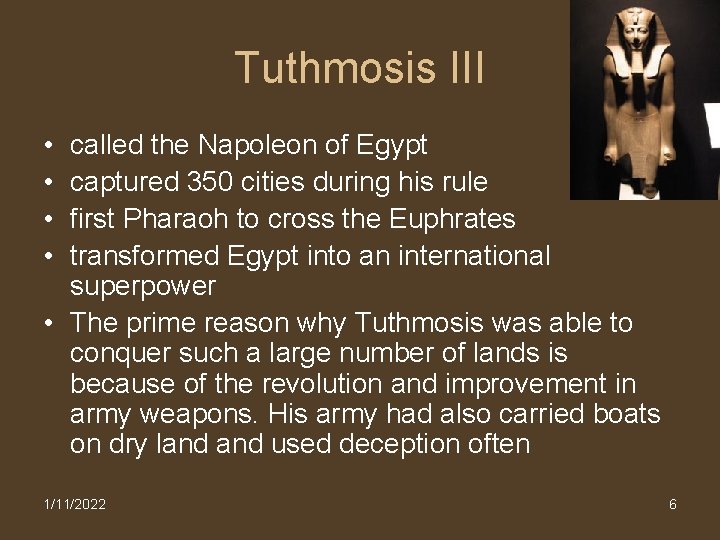
Tuthmosis III • • called the Napoleon of Egypt captured 350 cities during his rule first Pharaoh to cross the Euphrates transformed Egypt into an international superpower • The prime reason why Tuthmosis was able to conquer such a large number of lands is because of the revolution and improvement in army weapons. His army had also carried boats on dry land used deception often 1/11/2022 6
Tuthmosis III - Artistic developments • built Egypt's only known set of heraldic pillars, two large columns standing alone instead of being part of a set supporting the roof • tombs were entirely painted instead of painted reliefs • Thutmose's artisans learned the skill of glass making to create drinking vessels 1/11/2022 7
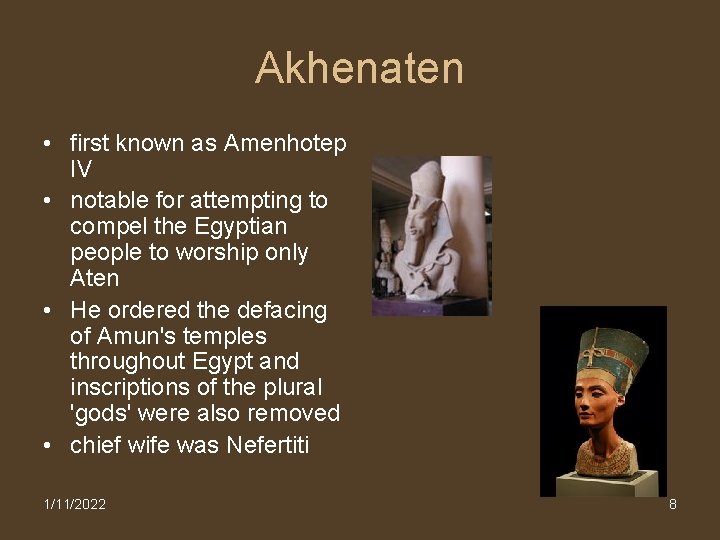
Akhenaten • first known as Amenhotep IV • notable for attempting to compel the Egyptian people to worship only Aten • He ordered the defacing of Amun's temples throughout Egypt and inscriptions of the plural 'gods' were also removed • chief wife was Nefertiti 1/11/2022 8
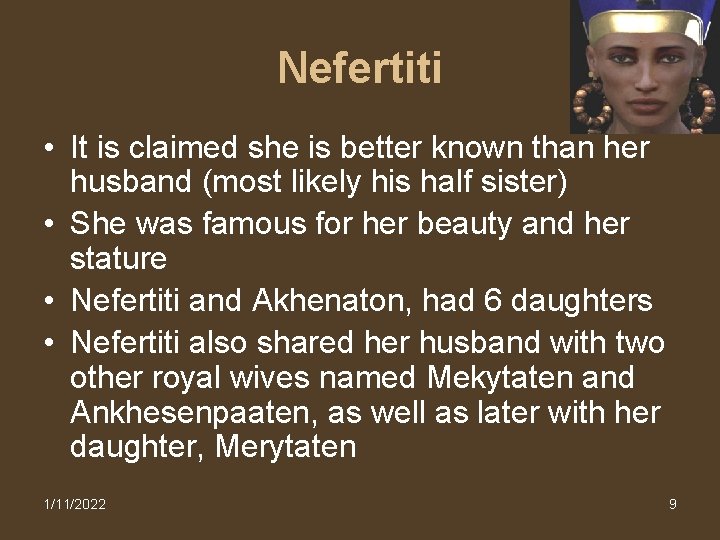
Nefertiti • It is claimed she is better known than her husband (most likely his half sister) • She was famous for her beauty and her stature • Nefertiti and Akhenaton, had 6 daughters • Nefertiti also shared her husband with two other royal wives named Mekytaten and Ankhesenpaaten, as well as later with her daughter, Merytaten 1/11/2022 9
Tutankhamun • Means “living image of Amun” • Assumed the throne at age 9 • He did not extend Egypt's borders nor did he experience victories like other pharaohs before him • supported his father’s belief in one god, Aton…not! • King Tut died at the age of 20 and ruled from 1333 BC to 1324 BC 1/11/2022 10
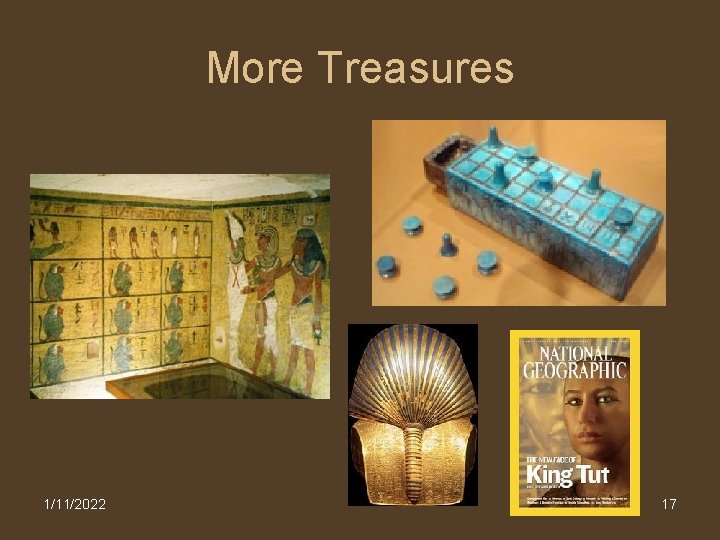
Tutankhamun • Of moderate significance and most of his popularity stems from the fact that his tomb in the Valley of the Kings was discovered almost completely intact • he managed the beginning of the transition from the Atenism to the familiar Egyptian religion 1/11/2022 11
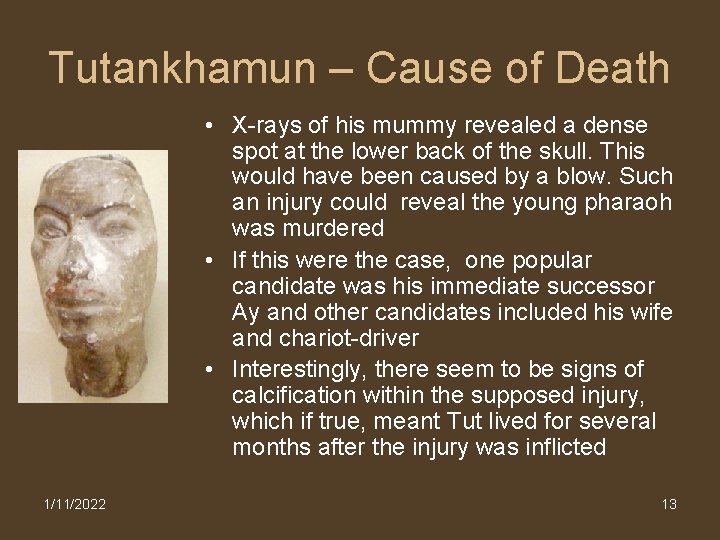
Tutankhamun – Cause of Death • For a long time the cause of death was unknown and it is still the root of speculation • How old was the king when he died? • Did he suffer from any physical abnormalities? Had he been murdered? • Some of these questions were finally answered in early 2005 when the results of a set of CT scans on the mummy were released, but many still remain to be solved 1/11/2022 12
Tutankhamun – Cause of Death • X-rays of his mummy revealed a dense spot at the lower back of the skull. This would have been caused by a blow. Such an injury could reveal the young pharaoh was murdered • If this were the case, one popular candidate was his immediate successor Ay and other candidates included his wife and chariot-driver • Interestingly, there seem to be signs of calcification within the supposed injury, which if true, meant Tut lived for several months after the injury was inflicted 1/11/2022 13
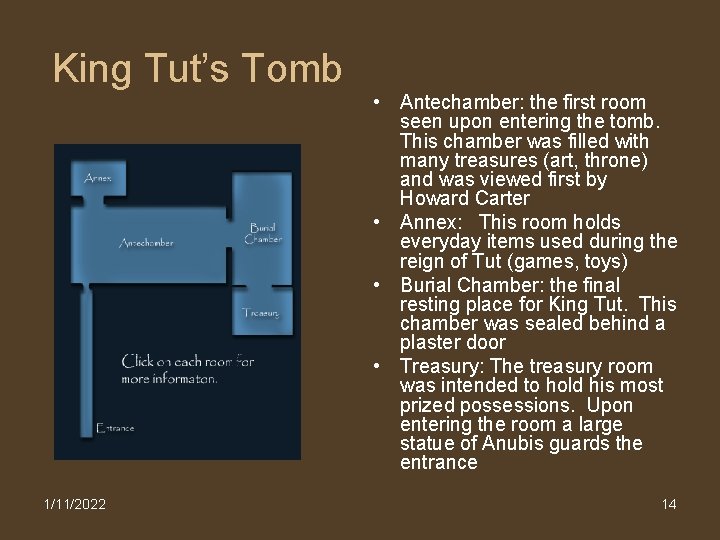
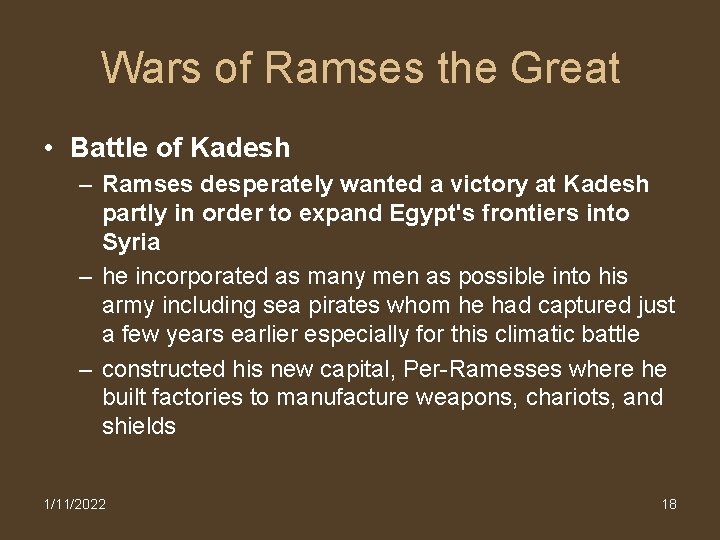
King Tut’s Tomb • Antechamber: the first room seen upon entering the tomb. This chamber was filled with many treasures (art, throne) and was viewed first by Howard Carter • Annex: This room holds everyday items used during the reign of Tut (games, toys) • Burial Chamber: the final resting place for King Tut. This chamber was sealed behind a plaster door • Treasury: The treasury room was intended to hold his most prized possessions. Upon entering the room a large statue of Anubis guards the entrance 1/11/2022 14
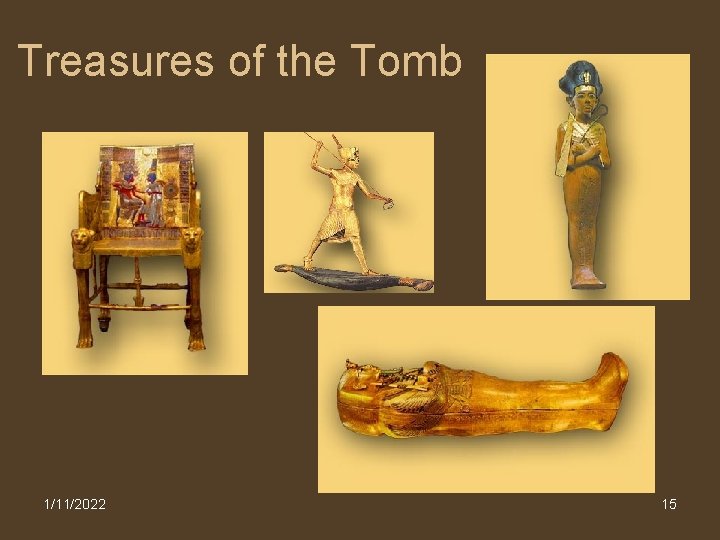
Treasures of the Tomb 1/11/2022 15
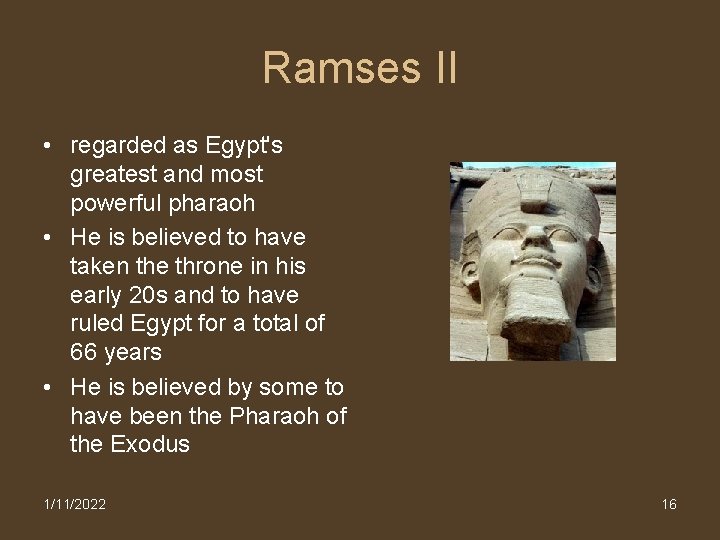
Ramses II • regarded as Egypt's greatest and most powerful pharaoh • He is believed to have taken the throne in his early 20 s and to have ruled Egypt for a total of 66 years • He is believed by some to have been the Pharaoh of the Exodus 1/11/2022 16
More Treasures 1/11/2022 17
Wars of Ramses the Great • Battle of Kadesh – Ramses desperately wanted a victory at Kadesh partly in order to expand Egypt's frontiers into Syria – he incorporated as many men as possible into his army including sea pirates whom he had captured just a few years earlier especially for this climatic battle – constructed his new capital, Per-Ramesses where he built factories to manufacture weapons, chariots, and shields 1/11/2022 18
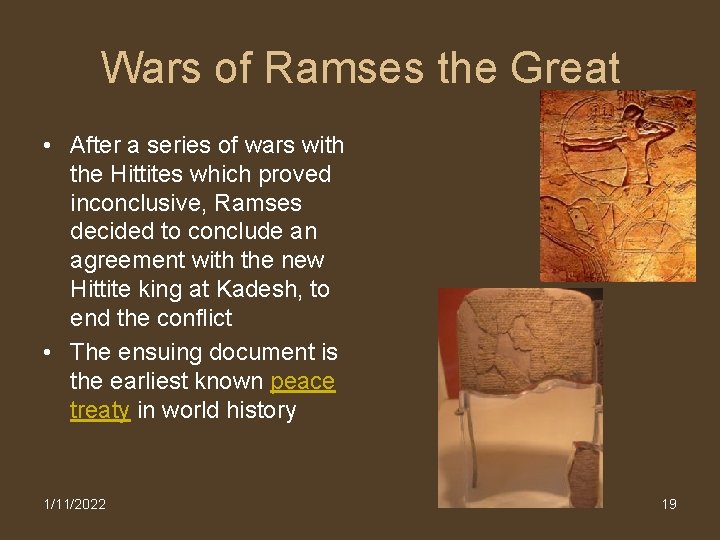
Wars of Ramses the Great • After a series of wars with the Hittites which proved inconclusive, Ramses decided to conclude an agreement with the new Hittite king at Kadesh, to end the conflict • The ensuing document is the earliest known peace treaty in world history 1/11/2022 19
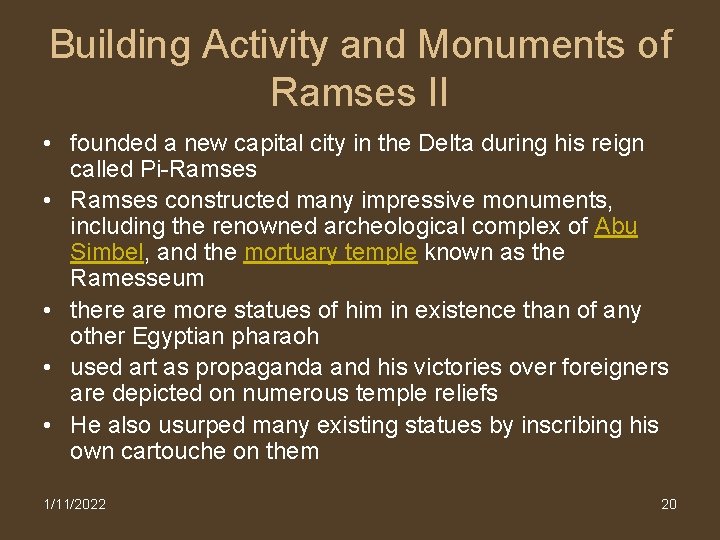
Building Activity and Monuments of Ramses II • founded a new capital city in the Delta during his reign called Pi-Ramses • Ramses constructed many impressive monuments, including the renowned archeological complex of Abu Simbel, and the mortuary temple known as the Ramesseum • there are more statues of him in existence than of any other Egyptian pharaoh • used art as propaganda and his victories over foreigners are depicted on numerous temple reliefs • He also usurped many existing statues by inscribing his own cartouche on them 1/11/2022 20
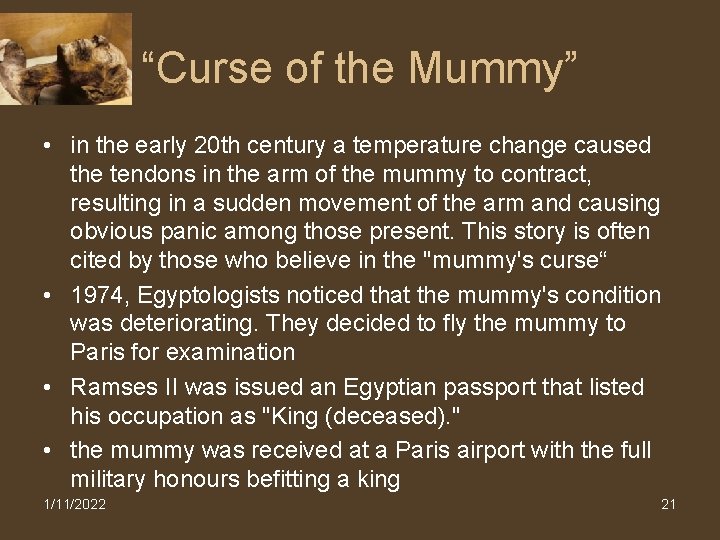
“Curse of the Mummy” • in the early 20 th century a temperature change caused the tendons in the arm of the mummy to contract, resulting in a sudden movement of the arm and causing obvious panic among those present. This story is often cited by those who believe in the "mummy's curse“ • 1974, Egyptologists noticed that the mummy's condition was deteriorating. They decided to fly the mummy to Paris for examination • Ramses II was issued an Egyptian passport that listed his occupation as "King (deceased). " • the mummy was received at a Paris airport with the full military honours befitting a king 1/11/2022 21
“Curse of the Mummy” • In Paris, Ramses' mummy was diagnosed and treated for a fungal infection • analysis revealed battle wounds and old fractures, arthritis and poor circulation • For the last decades of his life, Ramses II was crippled with arthritis and walked with a hunched back 1/11/2022 22
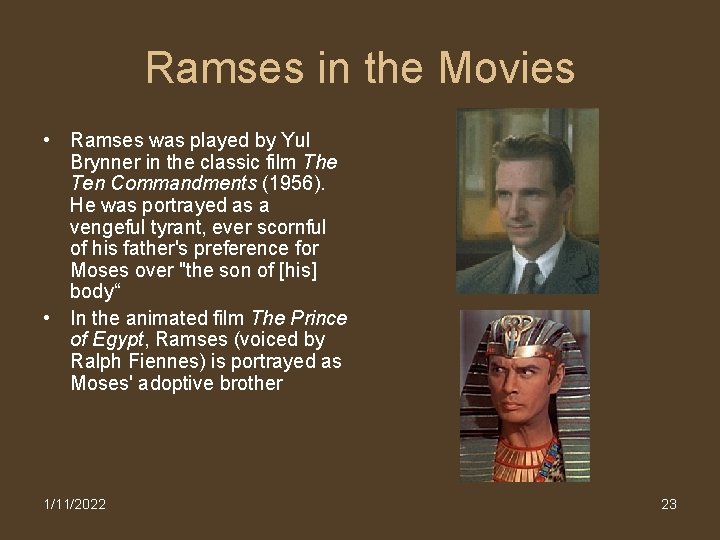
Ramses in the Movies • Ramses was played by Yul Brynner in the classic film The Ten Commandments (1956). He was portrayed as a vengeful tyrant, ever scornful of his father's preference for Moses over "the son of [his] body“ • In the animated film The Prince of Egypt, Ramses (voiced by Ralph Fiennes) is portrayed as Moses' adoptive brother 1/11/2022 23