
The NEW ISTE Standards for Educators of Computer


- Slides: 20
The NEW ISTE Standards for Educators of Computer Science - All Educators! Joe Kmoch <joe@jkmoch. com> With support from Octavia Abell <oabell@iste. org>
The NEW ISTE Standards for Educators: Computational Thinking Competencies
Preparing students for their future where computing power underpins every aspect of systems they’ll encounter…
Agenda ● ● Development Process CS for all educators Activity 1: Standards implementation Activity 2: Domain specific implementation
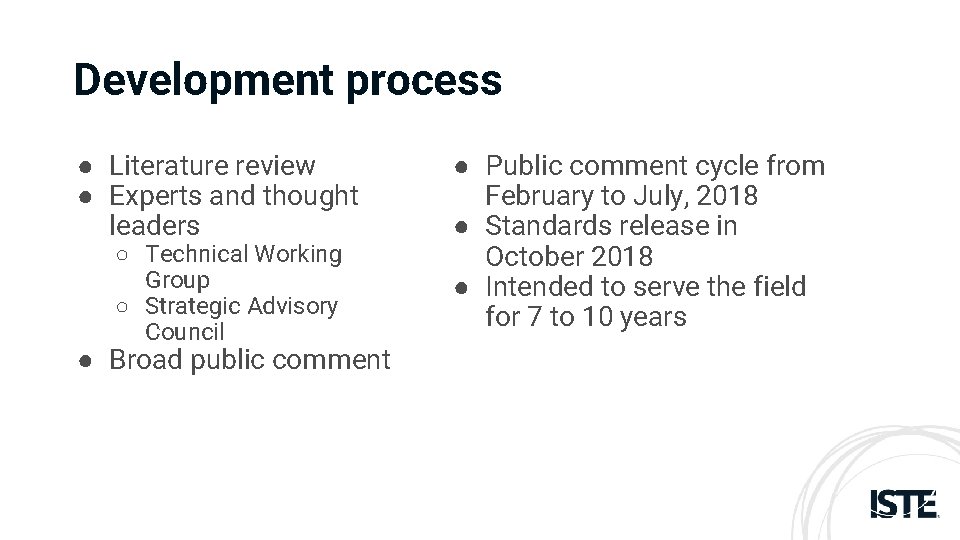
Development process ● Literature review ● Experts and thought leaders ○ Technical Working Group ○ Strategic Advisory Council ● Broad public comment ● Public comment cycle from February to July, 2018 ● Standards release in October 2018 ● Intended to serve the field for 7 to 10 years
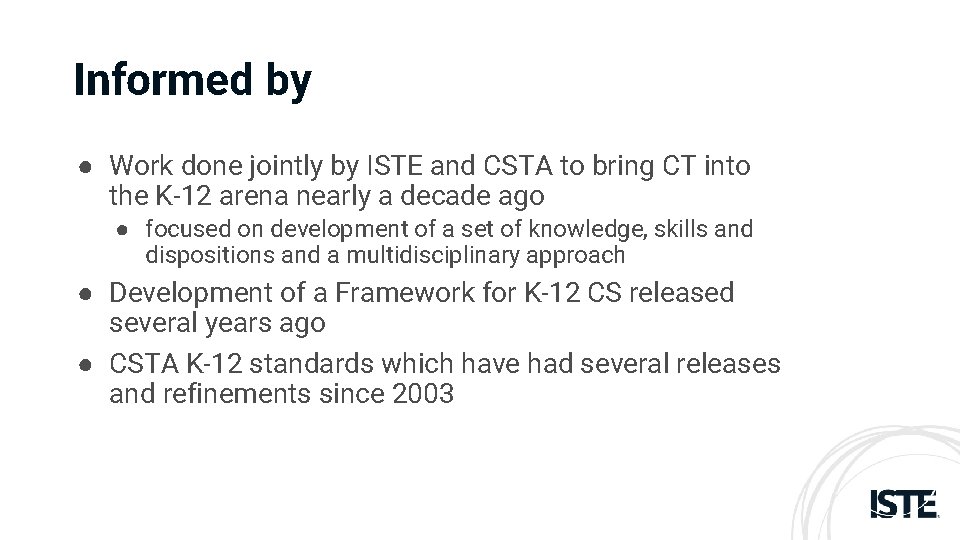
Informed by ● Work done jointly by ISTE and CSTA to bring CT into the K-12 arena nearly a decade ago ● focused on development of a set of knowledge, skills and dispositions and a multidisciplinary approach ● Development of a Framework for K-12 CS released several years ago ● CSTA K-12 standards which have had several releases and refinements since 2003
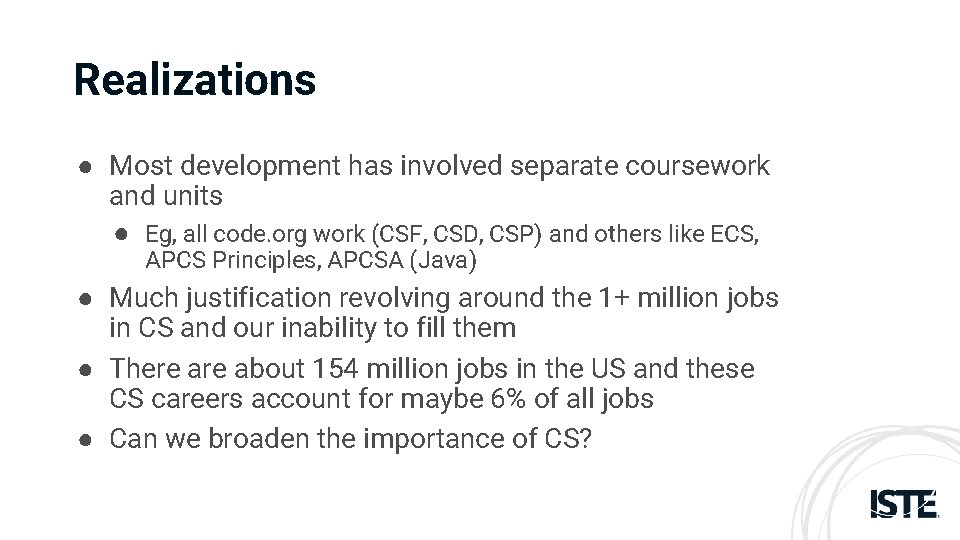
Realizations ● Most development has involved separate coursework and units ● Eg, all code. org work (CSF, CSD, CSP) and others like ECS, APCS Principles, APCSA (Java) ● Much justification revolving around the 1+ million jobs in CS and our inability to fill them ● There about 154 million jobs in the US and these CS careers account for maybe 6% of all jobs ● Can we broaden the importance of CS?
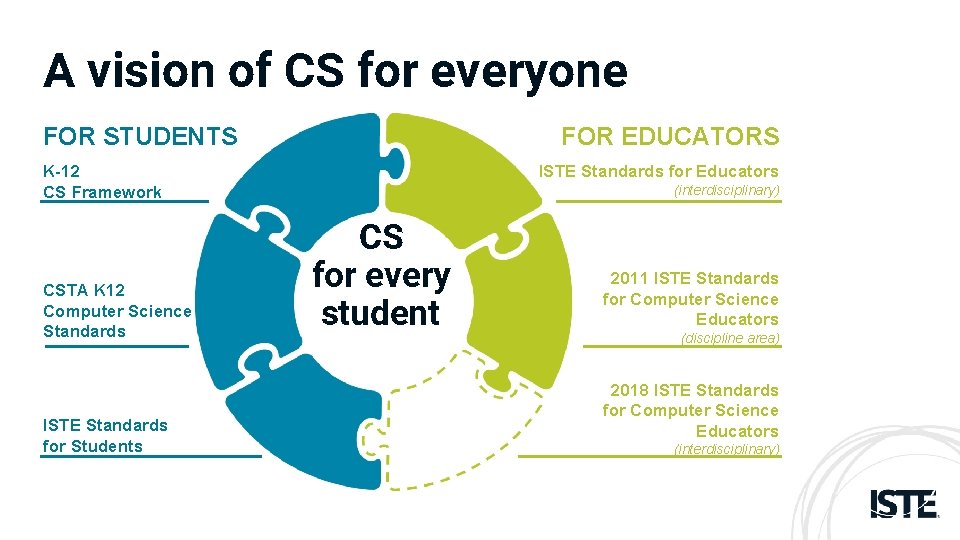
Our goal is to achieve a vision of CS for every student by defining the knowledge, skills and mindsets that all educators need to propel students’ 21 st century problem solving skills.
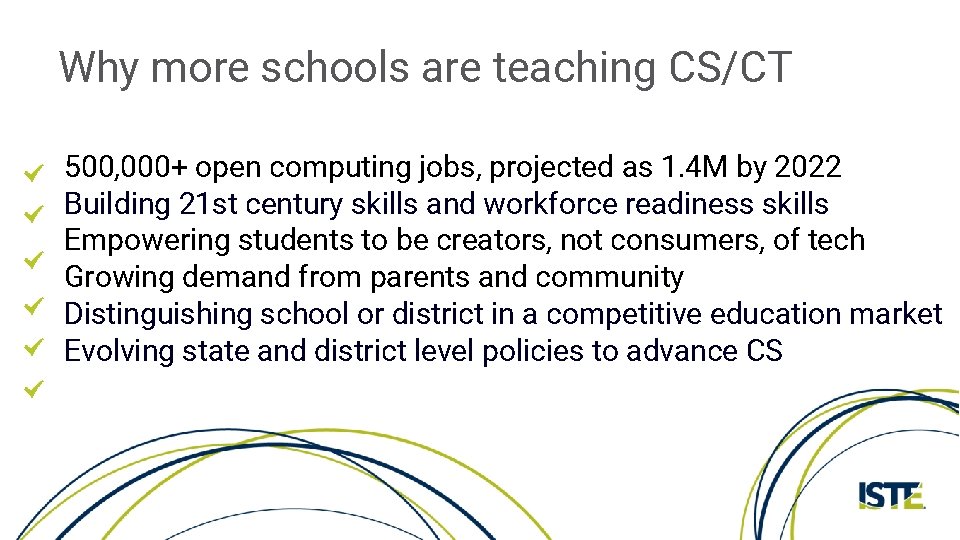
Why more schools are teaching CS/CT 500, 000+ open computing jobs, projected as 1. 4 M by 2022 Building 21 st century skills and workforce readiness skills Empowering students to be creators, not consumers, of tech Growing demand from parents and community Distinguishing school or district in a competitive education market Evolving state and district level policies to advance CS
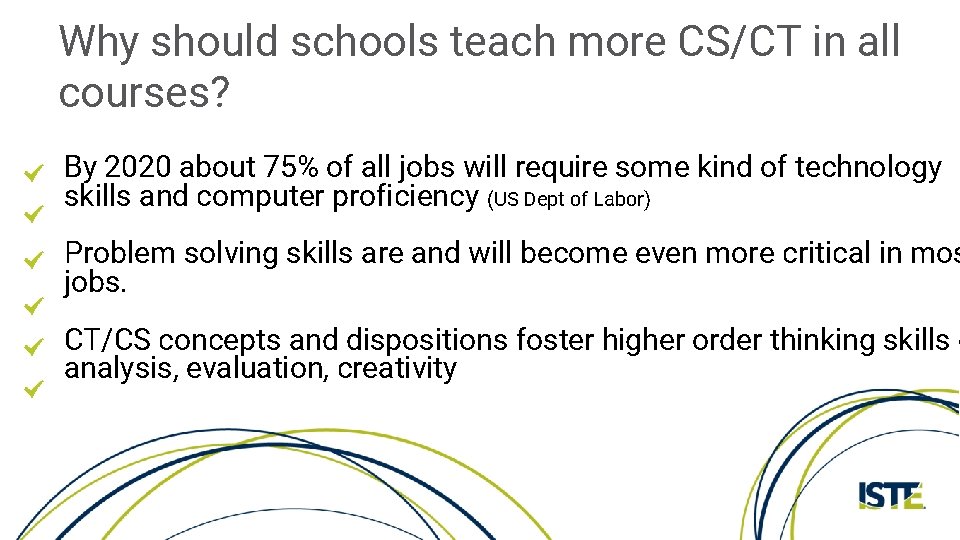
Why should schools teach more CS/CT in all courses? By 2020 about 75% of all jobs will require some kind of technology skills and computer proficiency (US Dept of Labor) Problem solving skills are and will become even more critical in mos jobs. CT/CS concepts and dispositions foster higher order thinking skills o analysis, evaluation, creativity
A vision of CS for everyone FOR STUDENTS FOR EDUCATORS K-12 CS Framework CSTA K 12 Computer Science Standards ISTE Standards for Students ISTE Standards for Educators (interdisciplinary) CS for every student 2011 ISTE Standards for Computer Science Educators (discipline area) 2018 ISTE Standards for Computer Science Educators (interdisciplinary)
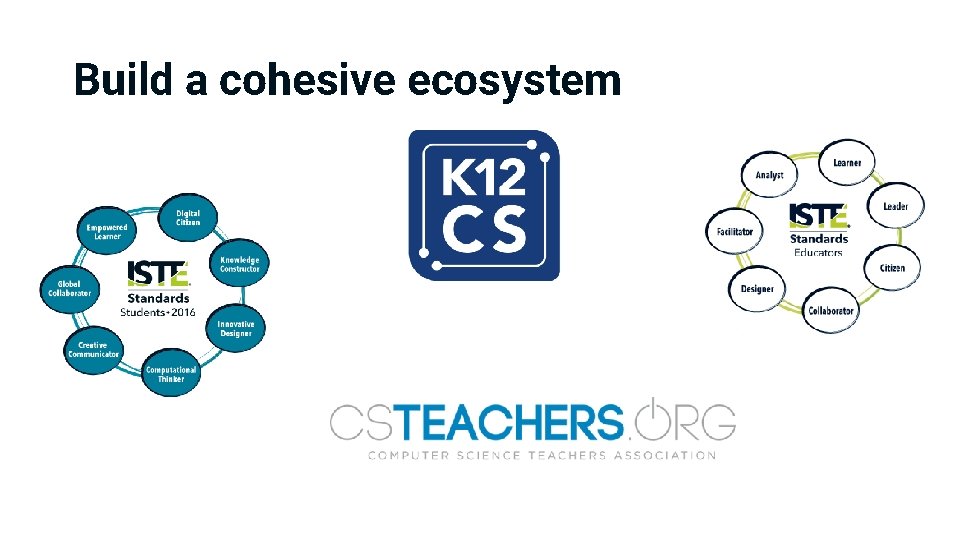
Build a cohesive ecosystem
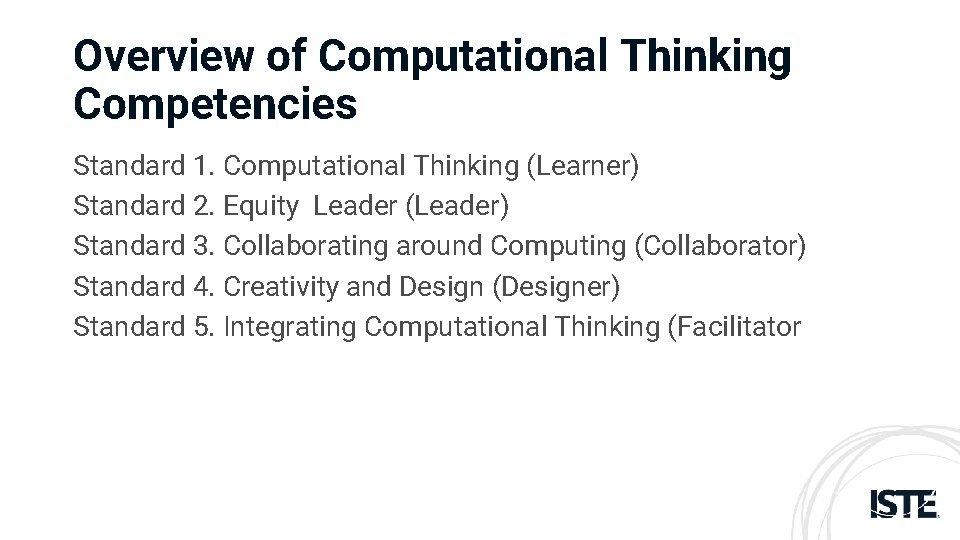
Overview of Computational Thinking Competencies Standard 1. Computational Thinking (Learner) Standard 2. Equity Leader (Leader) Standard 3. Collaborating around Computing (Collaborator) Standard 4. Creativity and Design (Designer) Standard 5. Integrating Computational Thinking (Facilitator
Let’s dig in. . . ● Choose a facilitator and a notetaker at each table ● Go to the Google Folder xxx and open the document corresponding to the Standard you’ll be discussing ● Notetakers should participate in the discussions and submit feedback based on ideas from the group
Think about. . . ● How can we convince yourself and others of the importance of including these CT Competencies in every subject area ● What approaches including PD could be created to help teachers in various subject areas infuse CT and CS
Activity 1: Standards implementation ● Take a few minutes to read through the standards handout ● Each table should have a number 1 through 5 ● Round robin review: Start your review of the draft based on the number at your table ○ Provide guidance on how the standard can be implemented ○ What will teachers need to understand apply them? What resources will be helpful? ● Continue providing feedback on all 5 standards
Activity 2: Domain implementation questions 1. Focus on the essential CT concepts • Pattern analysis • Decomposition • Abstraction • Algorithm development 2. Share thoughts about a lesson or unit you teach which would be enhanced by including and explicitly identifying some or all of these concepts
Activity 3: Share out 1. Implementing each standard 2. Specific examples of including CT concepts in a course you teach
Questions? This handout will be available at http: //computationalthinking. pbworks. com Thank you for participating Joe Kmoch joe@jkmoch. com