
The New Hungary Development Plan From concept to

- Slides: 36
The New Hungary Development Plan: From concept to realization dr. Tamás Tétényi Head of Strategy and Evaluation Department National Development Agency
Basis of the new programming period • Past experiences • EU Lisbon strategy • EU cohesion policy for the years 2007 -2013 Conceptualisation of the overall strategic development
The past experiences PHARE programme, from 1989 – Aid programme – Aim: Restructuring the economy 1 st National Development Plan, 2004 -2006: – Structural Funds, – Cohesion Fund, – Comprehensive plan, in line with the EU cohesion policy: economy, infrastructure, human resources, agriculture Results: • additional resources for national development, • setting up of a new institutional system, • strengthening of strategic thinking.
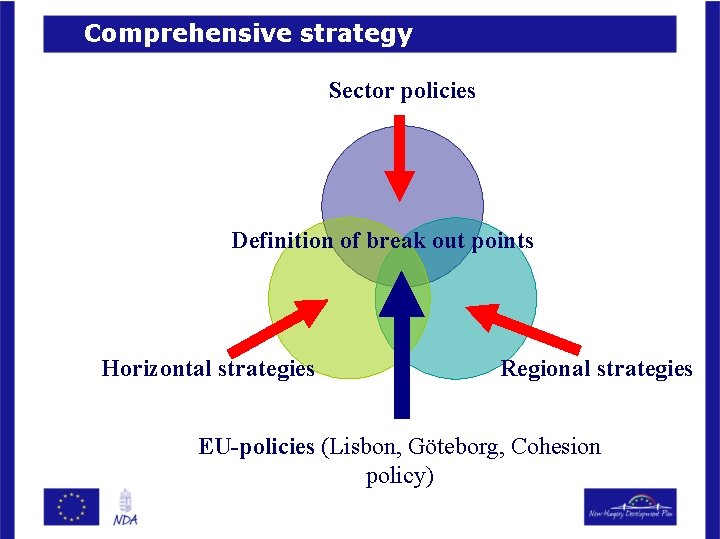
Comprehensive strategy Sector policies Definition of break out points Horizontal strategies Regional strategies EU-policies (Lisbon, Göteborg, Cohesion policy)
Conceptualization Strategic framework till 2020: – National Development Policy Concept, – National Regional Development Concept • • Definition of the national demands and objectives Consensus based documents Parliamentary approval (December 2005) Programming platform, sets the framework of the planning procedure – Conceptual framework for EU and national financial assistance – 2020 perspective
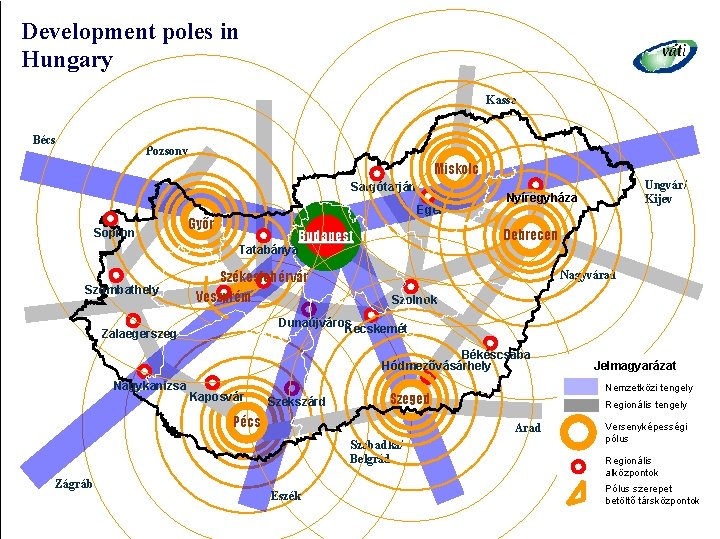
Development poles in Hungary Kassa Bécs Pozsony Miskolc Salgótarján Sopron Eger Győr Tatabánya Szombathely Debrecen Budapest Székesfehérvár Veszprém Nagyvárad Szolnok Dunaújváros Kecskemét Zalaegerszeg Békéscsaba Hódmezővásárhely Nagykanizsa Kaposvár Szekszárd Regionális tengely Arad Szabadka/ Belgrád Eszék Jelmagyarázat Nemzetközi tengely Szeged Pécs Zágráb Ungvár/ Kijev Nyíregyháza Versenyképességi pólus Regionális alközpontok Pólus szerepet betöltő társközpontok
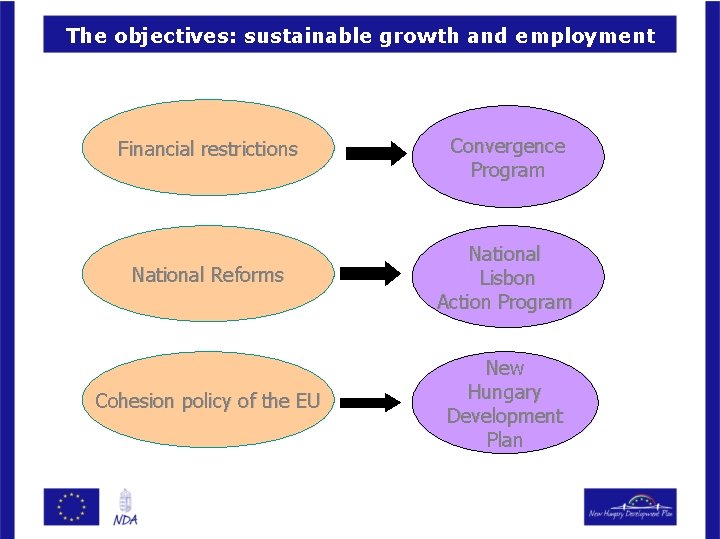
The objectives: sustainable growth and employment Financial restrictions Convergence Program National Reforms National Lisbon Action Program Cohesion policy of the EU New Hungary Development Plan
EU Financial Perspective 2007 -2013 European Council 15 and 16 December 2005: Presidency Conclusions: • Concerning cohesion policy, the Presidency conclusions confirm the new structure of objectives (convergence; regional competitiveness and employment; European territorial cooperation) and the policy’s role in pursuing the Lisbon agenda (expenditure concentrated on Lisbon objectives). • They fix the level of allocations between objectives, geographical eligibility and the allocation method (by region or Member State), including upper transfer limits. • In addition, the conclusions define several transitional arrangements (e. g. phasing out the Cohesion Fund for certain countries), exceptions (e. g. eligibility; co-financing), and a list of special treatments (e. g. additional financial allocations) of several Member States and regions.
Concentration: a more strategic approach • Adoption of overall strategic document for cohesion policy by the Council with an opinion from the European Parliament before the new programming period: Defining clear priorities for Member States and regions • Clear link between cohesion policy and Lisbon & Gothenburg strategies, increase consistency with broad economic policy Guidelines and the European Employment Strategy • Annual report by the Commission to EU institutions to assess Member States’ progress and examination by the Council
Financial resources More concentration on less developed regions • Convergence objective: 78. 5% (EUR 264 bn. ) of the total allocation to Member States and regions at NUTS level II, allocation by eligible population, regional and national prosperity and unemployment • Regional competitiveness and employment: 17. 2% (EUR 57. 9 bn. ) of the total allocation to regions at NUTS level I or II, allocation by eligible population, regional prosperity, unemployment, employment rate, education level of those employed, and population density • European territorial co-operation: 3. 94% (EUR 13. 2 bn. ) of the total allocation to Member States, using eligible population
The new Strategic guidelines Building on the Lisbon agenda (1) 1) Making Europe and its regions a more attractive place to invest and work – expand improve transport infrastructures – improve the environmental contribution to growth and jobs – address the intensive use of traditional energy sources 2) Improving knowledge and innovation for growth – – increase and improve investment in RTD facilitate innovation and promote entrepreneurship promote the information society for all improve access to finance
The new Strategic guidelines Building on the Lisbon agenda (2) 3) More and better jobs – Attracting and retaining more people in employment and modernising social protection systems – Improving adaptability of workers and enterprises and the flexibility of the labour market – Increasing investment in human capital through better education and skills Territorial Cohesion and cooperation Part IV) – The contribution of cities to growth and jobs – Supporting the economic diversification of rural areas – Cooperation: cross-border/trans-national/interregional
The new programming period: EU funds for Hungary • EU cohesion policy: 25. 3 billion € – Cohesion Fund, 35% – Structural Funds: 65% • ERDF (infrastructure) 51% • ESF (human capital, and organisational development) 14% – Framework for financing: • New Hungary Development Plan: 24. 9 billion €, (National Strategic Reference Framework) • European Territorial Cooperation: 0. 39 billion € • European Agricultural Fund for Rural Development: 3. 8 billion € – Framework for financing: New Hungary Rural Development Programme • Additionally various joint EU-programmes (e. g. 7 th Framework-programme for S&T, Competitiveness and Innovation Programme) /Prices: current prices/
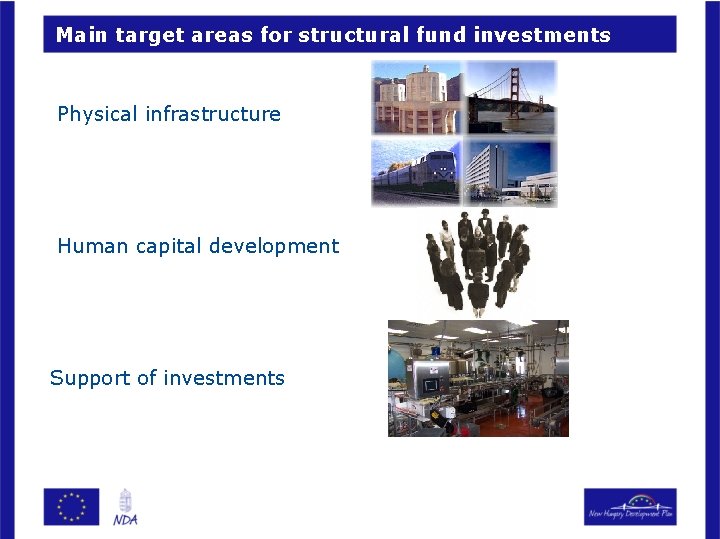
Main target areas for structural fund investments Physical infrastructure Human capital development Support of investments
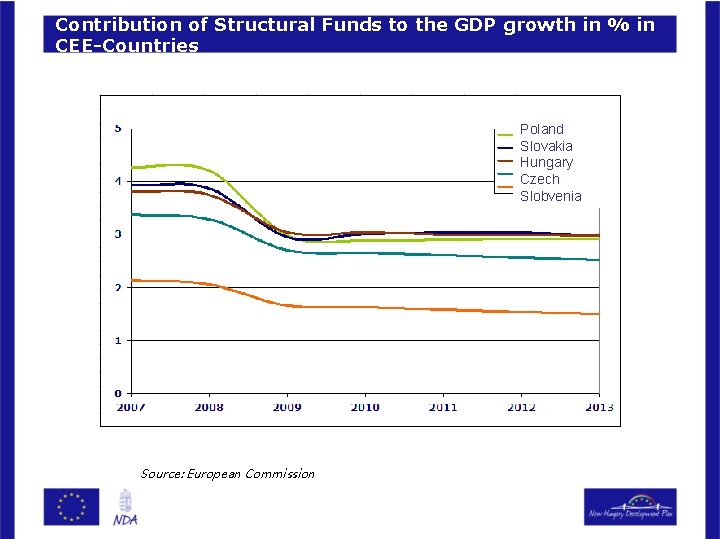
Contribution of Structural Funds to the GDP growth in % in CEE-Countries Poland Slovakia Hungary Czech Slobvenia Source: European Commission
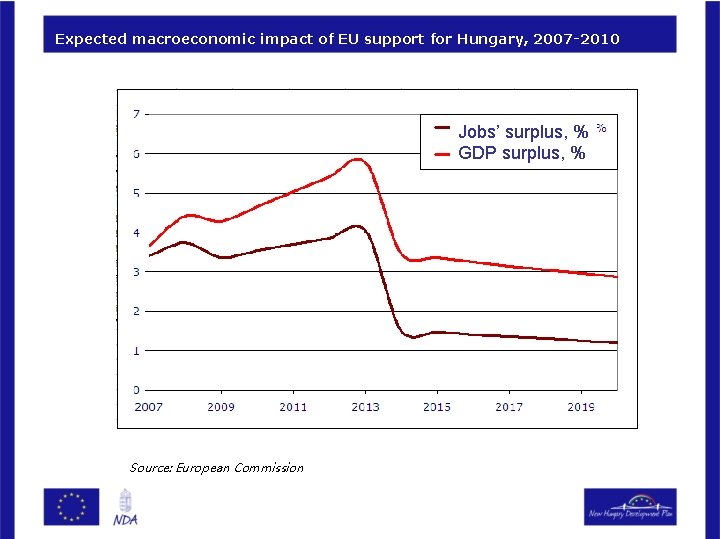
Expected macroeconomic impact of EU support for Hungary, 2007 -2010 Jobs’ surplus, % GDP surplus, % Source: European Commission
New Hungary Development Plan: Overall objectives q Increased employment – increasing supply: health, skills, motivation – more jobs; – improved co-ordinates between supply and demand q Economic growth – Higher added value – Unlocking economic potential – improving the business environment: not to hinder economic development
Horizontal goals q Sustainability – environment – economy – society q Cohesion – creating new chances – decreasing territorial differences – social cohesion, equal opportunities for disadvantaged groups and nondiscrimination (esp. the roma)
Regional development q 19 counties + Budapest (autonomous local governments) q NUTS-II. level: 7 statistical regions, set up in 2000 to receive the EU regional funds: – Regional competitiveness and employment objective: Central Hungary, – Convergence Objective: 6 regions
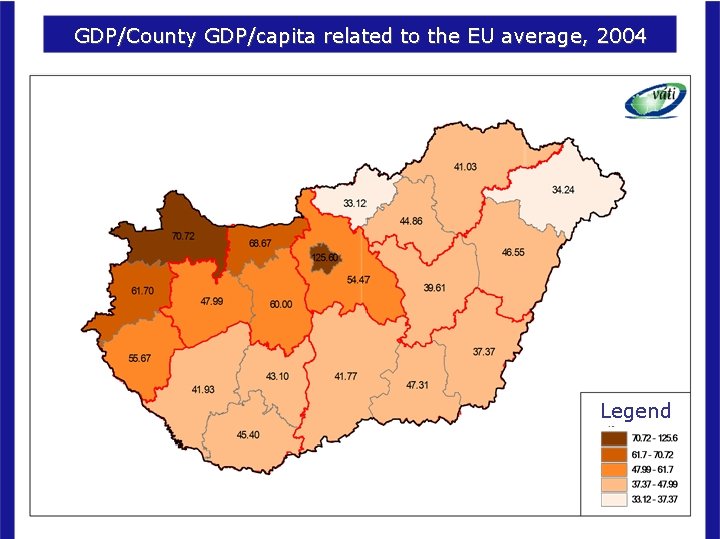
GDP/County GDP/capita related to the EU average, 2004 Subtitle… Legend
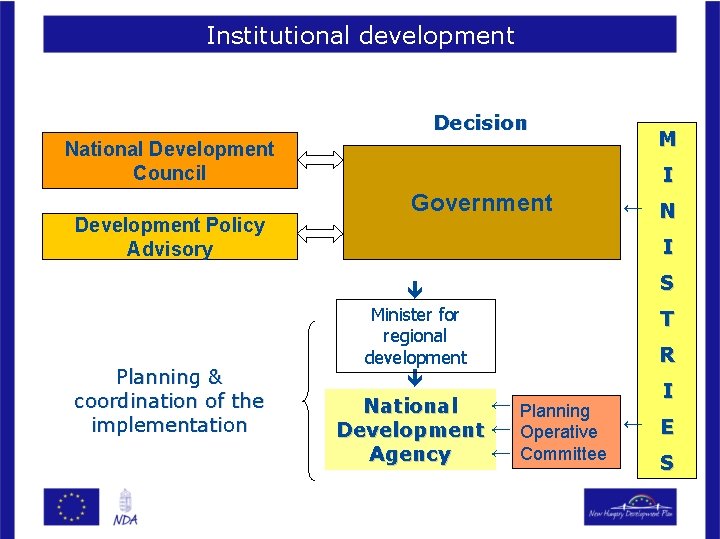
Institutional development Decision National Development Council Development Policy Advisory I Government ← N I Planning & coordination of the implementation M Minister for regional development S T R I ← National Planning Development ← Operative ← E ← Committee Agency S
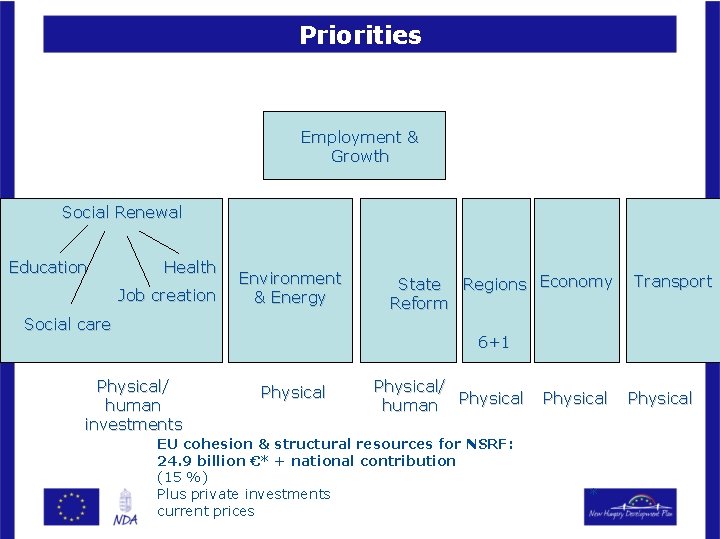
Priorities Employment & Growth Social Renewal Education Health Job creation Environment & Energy Social care State Regions Economy Reform Transport 6+1 Physical/ human investments Physical/ human Physical EU cohesion & structural resources for NSRF: 24. 9 billion €* + national contribution (15 %) Plus private investments current prices Physical * Physical
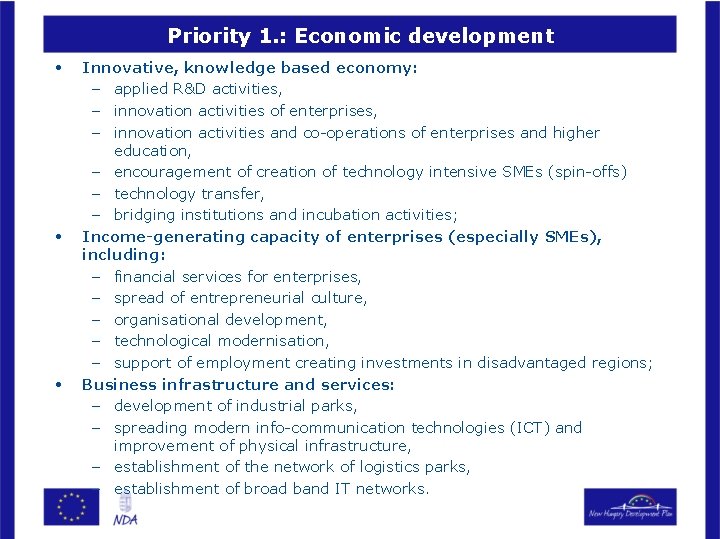
Priority 1. : Economic development • • • Innovative, knowledge based economy: – applied R&D activities, – innovation activities of enterprises, – innovation activities and co-operations of enterprises and higher education, – encouragement of creation of technology intensive SMEs (spin-offs) – technology transfer, – bridging institutions and incubation activities; Income-generating capacity of enterprises (especially SMEs), including: – financial services for enterprises, – spread of entrepreneurial culture, – organisational development, – technological modernisation, – support of employment creating investments in disadvantaged regions; Business infrastructure and services: – development of industrial parks, – spreading modern info-communication technologies (ICT) and improvement of physical infrastructure, – establishment of the network of logistics parks, – establishment of broad band IT networks.
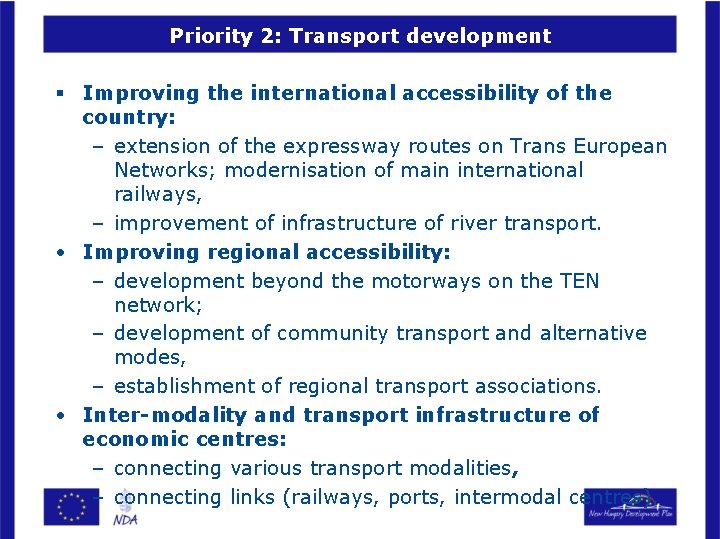
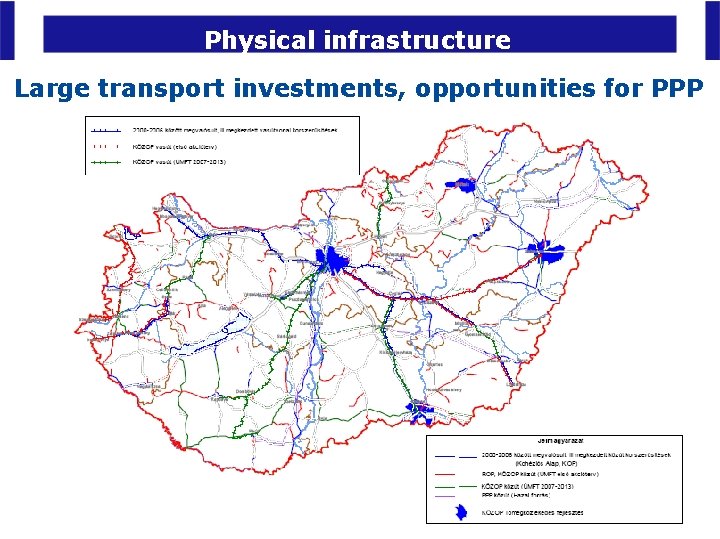
Priority 2: Transport development § Improving the international accessibility of the country: – extension of the expressway routes on Trans European Networks; modernisation of main international railways, – improvement of infrastructure of river transport. • Improving regional accessibility: – development beyond the motorways on the TEN network; – development of community transport and alternative modes, – establishment of regional transport associations. • Inter-modality and transport infrastructure of economic centres: – connecting various transport modalities, – connecting links (railways, ports, intermodal centres).
Priority 3: Social renewal • • Improving employability Improving adaptability High quality education and availability for all Developing human resources necessary for research and development and innovation • Conservation of health, social inclusion and participation • Developing the human infrastructure
Priority 4: Environment and energy development • Environment: – healthy and clean settlements (waste and waste water management, quality of drinking water), – protection against floods, – protection of our waters, – recultivation of waste deposits and environmental remediation, – state measures of WFD implementation, – wise management of our natural assets, – promotion of sustainable production and consumption habits, – raising awareness of environmental and climate issues. • Environment-friendly energy developments: – energy efficiency and saving, – renewable sources of energy.
Priority 5: Regional development § Co-operative and competitive urban network based primarily on the establishment of developmental poles. § Renewing countryside: integrated and sustainable development of villages and rural areas. § Realignment of backward regions, meaning the implementation of complex realignment programmes. § Sustainable development of the region of Lake Balaton, and additionally the regions of the rivers Danube and Tisza.
7 ROPs: Objectives of the regional operational programmes - strengthening regional competitiveness; - increasing the tourism attractiveness of regions; - developing regional transport infrastructure and community transport, improving the status of local alignment; - promoting energy efficiency and saving as well as the use of renewable energy sources; - general, integrated development of settlements, - reducing social and regional disparities within the regions, - developing social infrastructure.
Priority 6: State reform • Renewal of governance, improvement of policy making (legislation and implementation); • Strengthening civil society participation in public affairs; • Transforming public administration to a service oriented way; • Higher organizational performance and more cost-effective operation of institutions; • Improvement of the human resources skills; • Strengthening the decision making on integrated micro-regional and regional level.
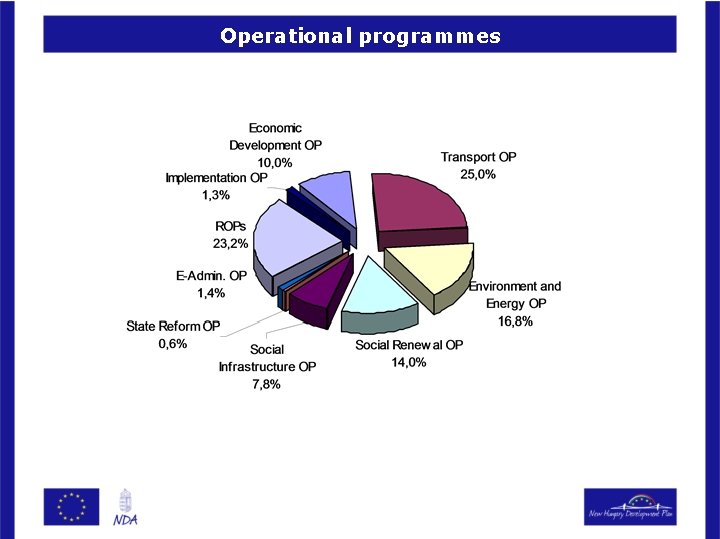
Operational programmes
Physical infrastructure Large transport investments, opportunities for PPP
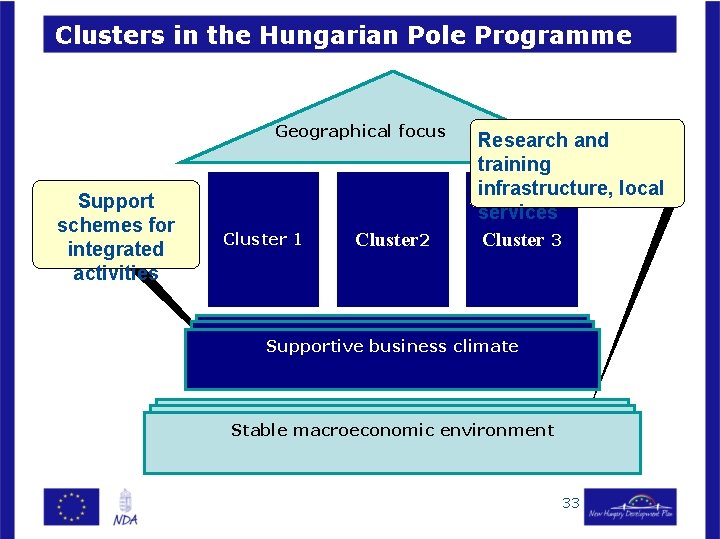
Flagship programmes • Growth poles - Concentrating innovation activities, Clusters and specialisation, Spillover effect, Attractive business investment environment, Increased integration into international trade flows
Clusters in the Hungarian Pole Programme Geographical focus Support schemes for integrated activities Cluster 1 Cluster 2 Research and training infrastructure, local services Cluster 3 Supportive business climate Stable macroeconomic environment 33
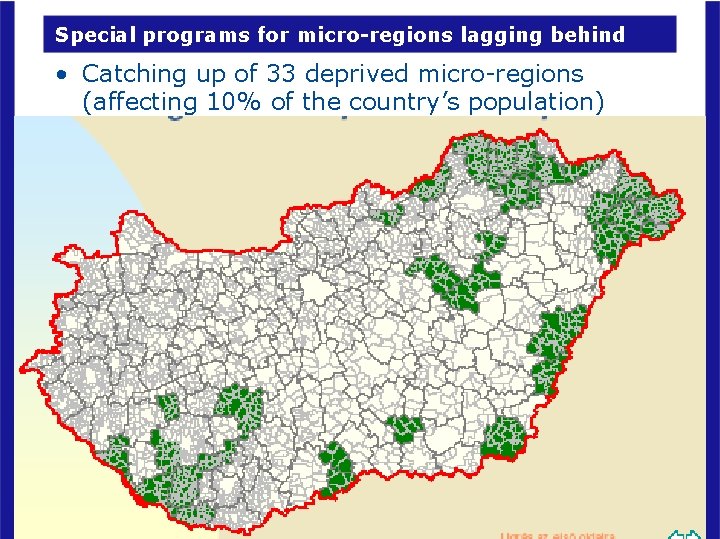
Special programs for micro-regions lagging behind • Catching up of 33 deprived micro-regions (affecting 10% of the country’s population)
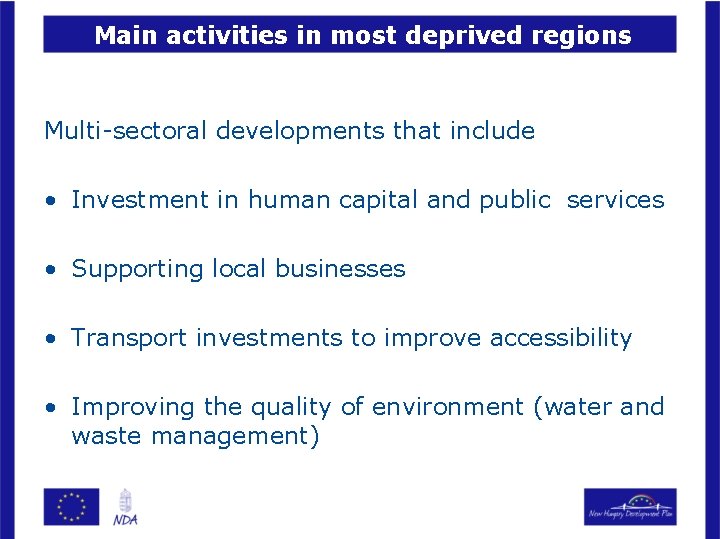
Main activities in most deprived regions Multi-sectoral developments that include • Investment in human capital and public services • Supporting local businesses • Transport investments to improve accessibility • Improving the quality of environment (water and waste management)
Thanks for your kind attention! Further information: www. nfu. hu