
The New Hungarian Civil Code from Comparative Law

![§ 6: 409 of the Civil Code [Financial leasing agreements] Under a financial leasing](https://slidetodoc.com/presentation_image_h2/5f7f80ee6a247195ad35c4f6bf395c7a/image-26.jpg "§ 6: 409 of the Civil Code [Financial leasing agreements] Under a financial leasing")



![§ 6: 405 of the Civil Code [Factoring contracts] Under a factoring contract the](https://slidetodoc.com/presentation_image_h2/5f7f80ee6a247195ad35c4f6bf395c7a/image-32.jpg "§ 6: 405 of the Civil Code [Factoring contracts] Under a factoring contract the")


- Slides: 50
The New Hungarian Civil Code from Comparative Law Aspect Dr. habil. István Sándor, Ph. D Associate professor Brno, 9 November 2017
The Brief History of the Hungarian Private Law After the foundation of the Hungarian State by St. István I in 1000, the kingdom consisting of tribal alliances formed into a Christian monarchy. The history of Hungarian private law can be divided into several periods. The main periods are identified as follows: • Period until Werbőczy’s Tripartitum (1514); • Period until the laws passed in 1848; • 1848 -1861, the National judicial conference; • 1861 -1945; • 1945 -1989; • 1989 until today.
The Brief History of the Hungarian Civil Law, cont. - Werbőczy István: Tripartitum opus juris consuetudinarii inclyti regni Hungariae (1514) – it was based on feudal custom law. - Act XV of 1848: abolished aviticity and the royal donation system, - Act IX of 1848: stopped serf relationships with possible reimbursements for landowners, - Act XV of 1848: directed the ministry of justice to draft a civil code. - After the defeat of the freedom fight, the Austrian ABGB came into effect on 29 November 1852. - The Austrian land registry system, mining law and bankruptcy law was introduced in Hungary. - In 1861 the National Judicial Conference announced the Provisional Rules of Jurisdiction. - Act XXXVII of 1875: Commercial Code.
The drafting of the Civil Code Some partial drafts: - General private Law Code, 1871, - István Teleszky: inheritance law, 1882, - István Apáthy: law of obligations, 1882, - Endre Halmossy: law of things, 1882, - Béni Grosschmid: marital (personal and property) law. - From 1900 five complete drafts were prepared, the 5 th one was the most entire one: Recommendation for a Private Law Bill. Features: - Strong influence of Austrian, German law and Swiss law. - It was applied by the courts as law in force.
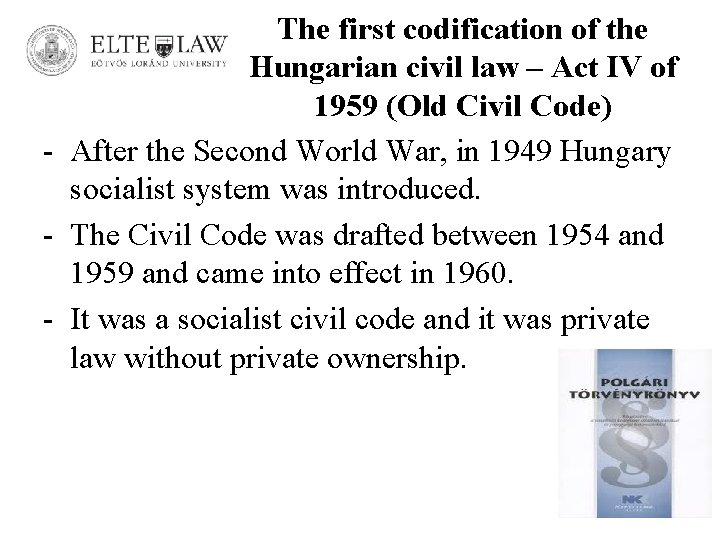
The first codification of the Hungarian civil law – Act IV of 1959 (Old Civil Code) - After the Second World War, in 1949 Hungary socialist system was introduced. - The Civil Code was drafted between 1954 and 1959 and came into effect in 1960. - It was a socialist civil code and it was private law without private ownership.
The Hungarian private law between 1960 and 2013 • 1968: the new economic mechanism came into effect, • 1977: the main modification of the old Civil Code: „goulash-communism”, • during the 1980’s several modifications were made in aim of developing the private sector, • 1989: transition from socialism to democracy, • From 1990 several changes were made. • 2004: Hungary joined the EU.
Reasons to codify a new Civil Code • The earlier one was old? (see Code civil, ABGB, ZGB, Codice civile etc. ) • The earlier one was based on soviet law? (more then fifty modifications after 1990) • The earlier one did not contain the requirements of the EU? (from 1994 several changes according to the legal harmonization obligations) • Most important reasons: - unified structure, real code (to gather as many rules as possible), - modernization and regulation of new legal institutions.
Codification of the New Hungarian Civil Code – Act V of 2013 • 1998: Beginning of the codification: Chief Codification Committee, • 2002: concept of the new Civil Code, • 2004 – 2012: parallel drafts by the Chief Codification Committee and the Ministry of Justice, • 11 February 2013: the National Assembly adopted the Civil Code, • it came into effect on 15 March 2014.
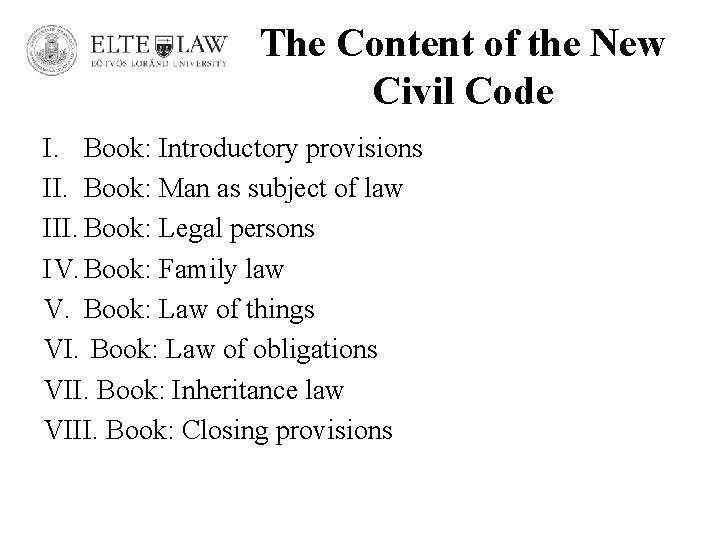
The Content of the New Civil Code I. Book: Introductory provisions II. Book: Man as subject of law III. Book: Legal persons IV. Book: Family law V. Book: Law of things VI. Book: Law of obligations VII. Book: Inheritance law VIII. Book: Closing provisions
New features in the structure of the Civil Code • The modern structure is monist, it contains the most important commercial and consumer protection rules (Cf. ZGB, Codice civile, Burgerlijk Wetboek). • It is structured in books. • It contains the family law and also the company law.
Book I: Introductory provisions 6 articles: • Scope of the Code (governs the property and personal relations of persons), • Interpretation principle (constitutional order of Hungary, other legislations relating to civil law) • Principle of good faith and fair dealing, • Principle of reasonable conduct, • Prohibition of abuse of rights, • Judicial process.
Book II: Man as subject of law 1. Rules of legal capacity and legal competency, • Guardianship, • Council of Europe, Recommendation No. R (99) 4, on principles concerning the legal protection of incapable adults (flexibility in legal response, maximum preservation of capacity, necessity and subsidiarity, proportionality, respect for wishes and feelings of the person concerned etc. ). New rules: • Advocated decision-making without prejudice to legal capacity, • Pre-arranged limitation of legal competency for future considerations. 2. Rights relating to personality. • Restitution for non-material violation of the personality.
§ 2: 38 of the Civil Code (1) Where a person of legal age is in need of assistance due to the partial loss of his/her discretionary ability in certain matters, the guardian authority shall appoint an advocate upon his/her request with a view to avoiding conservatorship invoking limited legal competency. (2) If in an action for the placement of a person under conservatorship or guardianship the court considers that there is no justification to limit that person’s legal competency even partially, yet he/she is in need of assistance due to the partial loss of his/her discretionary ability in certain matters, the court shall dismiss the action for placement under conservatorship or guardianship, and shall deliver its decision to the guardian authority. The advocate is appointed by the guardian authority based on the court ruling, in agreement with the person affected. (3) The appointment of an advocate shall not affect the legal competency of a person of legal age.
Book III: Legal persons • • General rules, Associations, Business associations (companies): General rules, General partnership (OG), Limited partnership (KG), Private limited liability company (Gmb. H), Limited companies (AG): private and public, Cooperative societies, Groupings, Foundation, State involvment in civil law relations.
Some new rules in the book on legal persons • The regulation contains mainly default rules. • The general partnership and the limited partnership are legal persons. • The capital of the limited liability company was raised from HUF 500 000 to HUF 3 000. • Only private limited companies can be established, the public limited companies are those, whose shares are listed on a stock exchange (corporations). • The establishment of private foundations are allowed.
Book IV: Family Law • • The institution of marriage (personal and proprietary features), civil partnerships, family relationships, adoption, parental custody, maintenance of relatives, guardianship.
Book V: Law of things • • - Possession, ownership right, limited rights in rem (iura in re aliena): lien, collateral security, right of use: land use, beneficial interest (ususfructus), use (usus), easement (servitutes), rights of access and use for public purposes, land registry.
Book VI: Law of obligations Part I: Common provisions relating to obligations: - general provisions. Part II: General provisions of contracts: - basic principles, concluding contracts, invalidity, contract performance, breach of contract, modification, termination. Part III: Express contracts. Part IV: Liability for damages. Part V: Securities. Part VI: Other facts establishing obligations.
Book VII: Law of succession • • General rules, succession by will, succession agreement, testamentary gifts, disposition of ecpected inheritance, intestate succession, compulsory share of inheritance (debita portio), acquisition of inheritance.
Book VIII: Closing provisions • Interpretative provisions, • entry into force and transitional provisions, • compliance with the legislation of the EU.
Impacts of foreign law on the Civil Code • The codificators wanted to change the law only in case it was necessary. • They wanted to built in the code the developments of the judicial practice. • They took into consideration the EU law, especially in connection with consumer protection and company law. • The Civil Code is not a copy of any foreign private law codes, but used the achievements of some of them, e. g. the Dutch (Burgerlijk Wetboek) and the Québec. • The rules of international agreements were also samples, e. g. : - United Nations Convention on Contracts for the International Sale of Goods (Vienna, 1980) (CISG), - Principles of International Commercial Contracts (UNIDROIT Principles), - Principles of European Contract Law (PECL), - Draft Common Frame of Reference, - Principles of European Law, Commercial Agency, Franchise and Distribution Contracts (PEL CAFD).
Some rules from foreign law in the law of obligations • The rules of the Council Directive 93/13/EEC of 5 April 1993 on unfair terms in consumer contracts were built in the § 6: 77 – 81. • The rules of the Directive 2000/31/EC of the European Parliament and of the Council of 8 June 2000 on certain legal aspects of information society services, in particular electronic commerce, in the Internal Market („Directive on electronic commerce”) were built in the § 6: 82 – 85. • The rule of PECL Art. 2: 105(3), and UNIDROIT Principles Art. 2. 1. 17. : merger clause was built in § 6: 87. • The rules of the Directive 2011/7/EU of the European Parliament and of the Council of 16 February 2011 on combating late payment in commercial transactions were built in § 6: 155(2).
Some rules from foreign law in the law of obligations, cont. • PECL Art. 12: 201 (Transfer of contract, Vertragsübertragung), UNIDROIT Principles Art. 9. 3. 1. (Assignment of contracts) were built in § 6: 208. • In connex lien as statuory lien was introduced for the contract of carriage upon international practice. • The rules of Council Directive 85/374/EEC of 25 July 1985 on the approximation of the laws, regulations and administrative provisions of the Member States concerning liability for defective products were built in § 6: 550 – 559.
Leasing • History of leasing: US → Western Europe → Eastern Europe. • Economic background: need of financial sources. - 1 st generation: 1877 Bell Telephone Company – classical lease with placing the risk on the lessee, - 2 nd generation: 1952 Henry Schoenfeld – United States Leasing Corporation (Ford), 1960 s in Europe – financial leasing, - 3 rd generation: further services. • Legal background: UNIDROIT Agreement (Ottawa, 1988). • Legal features: preliminary agreement of lease, sale agreement, leasing agreement. • Main types: financial leasing, operative leasing, sale and lease back. • Parties: direct lease, indirect lease, sub-lease. • Subject: movables, immovables, capital, personal (individual). • Obligations: full service leasing, financial leasing. • Duration: revolving, termination.
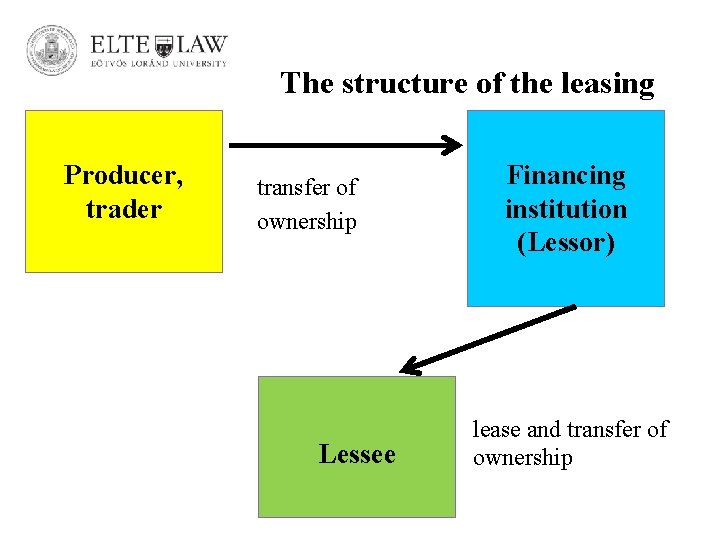
The structure of the leasing Producer, trader transfer of ownership Lessee Financing institution (Lessor) lease and transfer of ownership
§ 6: 409 of the Civil Code [Financial leasing agreements] Under a financial leasing agreement the lessor undertakes to make available for use, for a limited period of time a thing or a right he owns (hereinafter referred to as „leased asset”), and the lessee undertakes to accept the leased asset and to make lease payments if the lessee is given the right under the agreement to use the leased asset up to or surpassing its economic lifetime, or - if use is stipulated for a shorter period to acquire the leased asset at the end of the term of the contract without any consideration or at a price considerably lower than the market value prevailing at the time of conclusion of the contract, or the total sum of lease payments reaches or exceeds the leased asset’s market value prevailing at the time of conclusion of the contract.
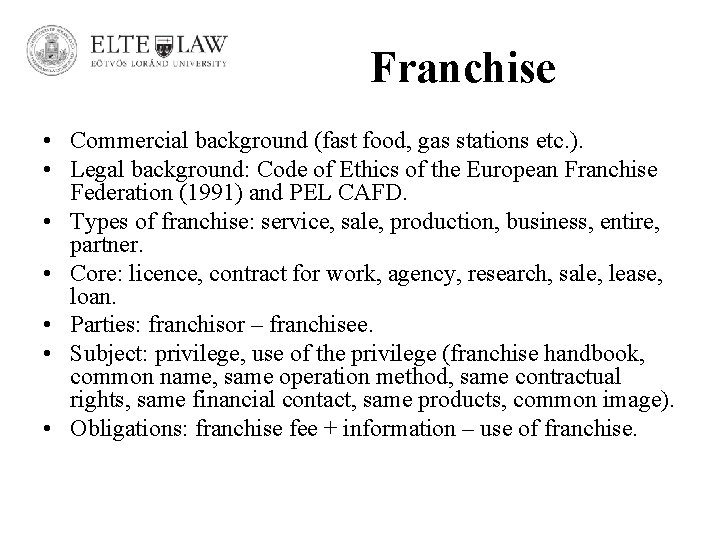
Franchise • Commercial background (fast food, gas stations etc. ). • Legal background: Code of Ethics of the European Franchise Federation (1991) and PEL CAFD. • Types of franchise: service, sale, production, business, entire, partner. • Core: licence, contract for work, agency, research, sale, lease, loan. • Parties: franchisor – franchisee. • Subject: privilege, use of the privilege (franchise handbook, common name, same operation method, same contractual rights, same financial contact, same products, common image). • Obligations: franchise fee + information – use of franchise.
§ 6: 376 of the Civil Code „Under a franchise agreement the franchisor undertakes to grant rights of use, utilization and exploitation rights relating to assets protected by copyright or industrial property rights, including know-how, and the franchisee undertakes to produce and supply goods and/or services through the use, utilization or exploitation of such assets protected by copyright or industrial property rights, including know-how, and to pay the fee agreed upon”.
Commercial Agency Contract, § 6: 288 – 301. • Business background: work on performance basis. • Legal background: Council Directive 86/653/EEC of 18 December 1986 on the coordination of the laws of the Member States relating to self-employed commercial agents furthermore the PEL CAFD. Earlier in Hungary Act CXVII of 2000. • Parties: mandator – agent – third parties. • Obligations of the agent: diligence, information, preparation of concluding contracts. • Obligations of the mandator: cooperation, information, fee and commission. • Protection of the agent: compensation in case of termination of the contract.
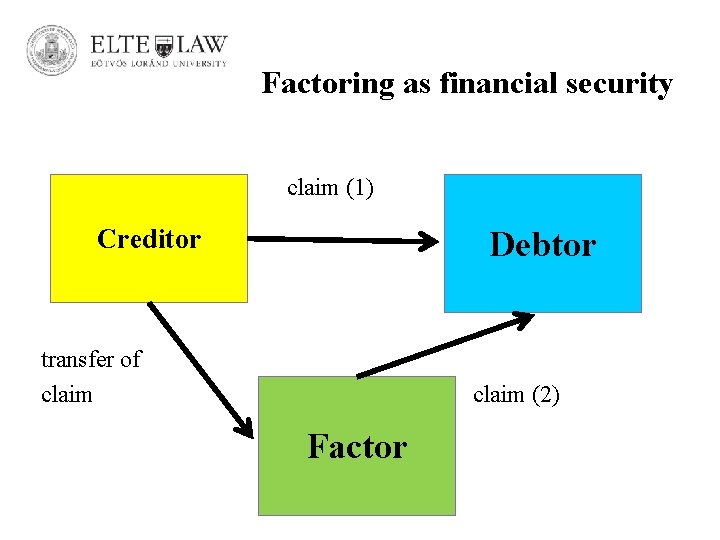
Factoring contract - § 6: 405 – 408. • Business background: financing the cash-flow. • Legal background: UNIDROIT Agreement on Factoring (28 May 1988) – Act 1997: LXXXV + Civil Code. • The main feature: purchase of claim. • Parties: creditor, factor, debtor. • Subject: claim. • Legal effect: notice of the debtor. • Types: guaranteed, insecure.
Factoring as financial security claim (1) Creditor Debtor transfer of claim (2) Factor
§ 6: 405 of the Civil Code [Factoring contracts] Under a factoring contract the factor undertakes to pay a certain amount of money, and the debtor undertakes to assign his claim from a third party to the factor; if the obligor fails to satisfy the assigned claim at the time when due, the debtor shall be liable to repay the funds received with interest, and the factor shall be liable to re-assign the claim.
Left out from the Civil Code – some examples • Directive 97/7/EC of the European Parliament and of the Council of 20 May 1997 on the protection of consumers in respect of distance contracts. • Directive 1999/44/EC of the European Parliament and of the Council of 25 May 1999 on certain aspects of the sale of consumer goods and associated guarantees. • Directive 94/47/EC of the European Parliament and the Council of 26 October 1994 on the protection of purchasers in respect of certain aspects of contracts relating to the purchase of the right to use immovable properties on a timeshare basis. • Directive 90/314/EEC on package travel, package holidays and package tours. • These topics are regulated in separate laws.
The introduction of the Hungarian trust „The trust is a cuckoo in the nest of the Civil Law” (Sir Maurice Amos)
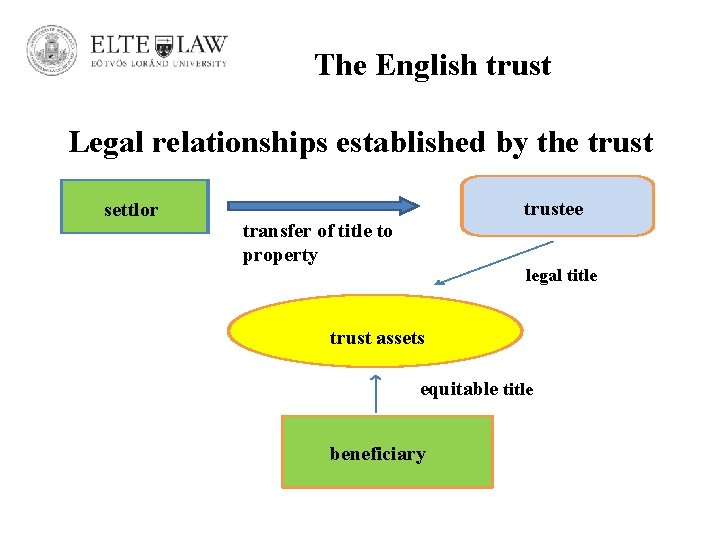
The English trust Legal relationships established by the trust settlor trustee transfer of title to property legal title trust assets equitable title beneficiary
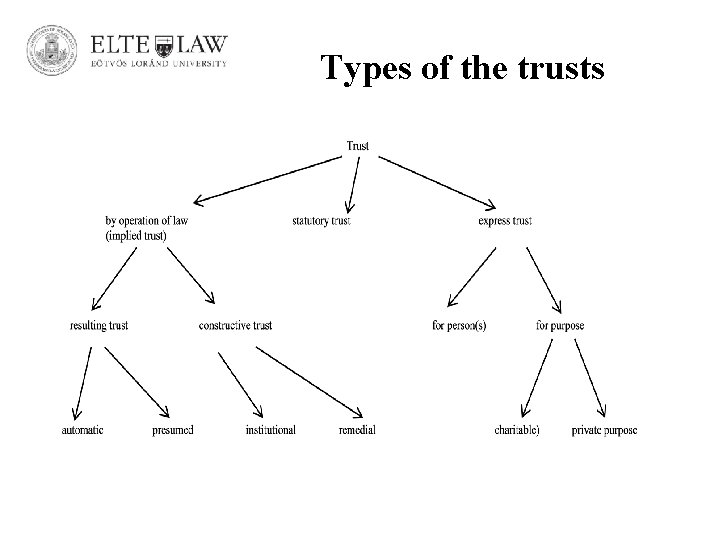
Types of the trusts
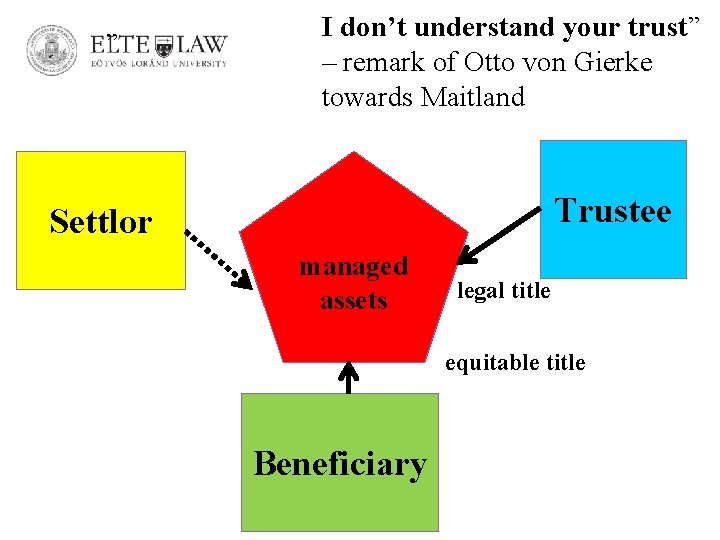
„ I don’t understand your trust” – remark of Otto von Gierke towards Maitland Trustee Settlor managed assets legal title equitable title Beneficiary
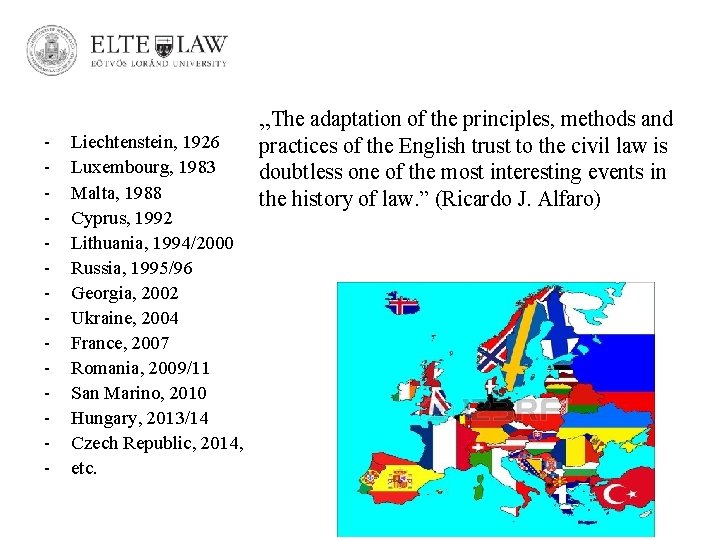
- „The adaptation of the principles, methods and Liechtenstein, 1926 practices of the English trust to the civil law is Luxembourg, 1983 doubtless one of the most interesting events in Malta, 1988 the history of law. ” (Ricardo J. Alfaro) Cyprus, 1992 Lithuania, 1994/2000 Russia, 1995/96 Georgia, 2002 Ukraine, 2004 France, 2007 Romania, 2009/11 San Marino, 2010 Hungary, 2013/14 Czech Republic, 2014, etc.
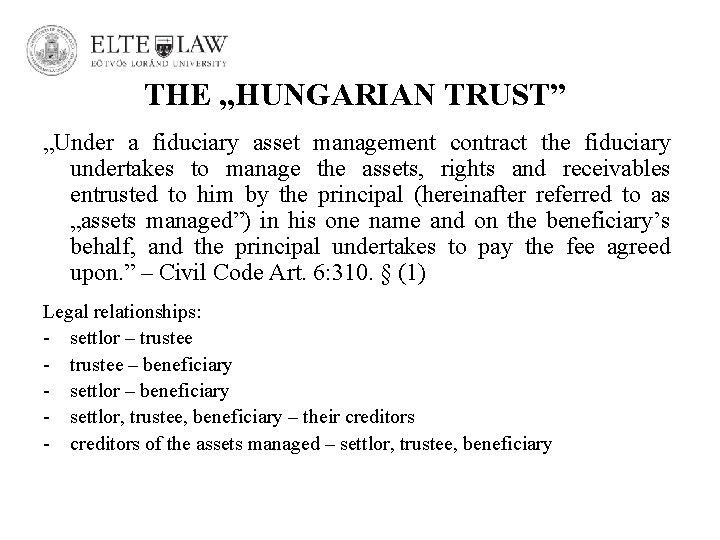
THE „HUNGARIAN TRUST” „Under a fiduciary asset management contract the fiduciary undertakes to manage the assets, rights and receivables entrusted to him by the principal (hereinafter referred to as „assets managed”) in his one name and on the beneficiary’s behalf, and the principal undertakes to pay the fee agreed upon. ” – Civil Code Art. 6: 310. § (1) Legal relationships: - settlor – trustee - trustee – beneficiary - settlor, trustee, beneficiary – their creditors - creditors of the assets managed – settlor, trustee, beneficiary
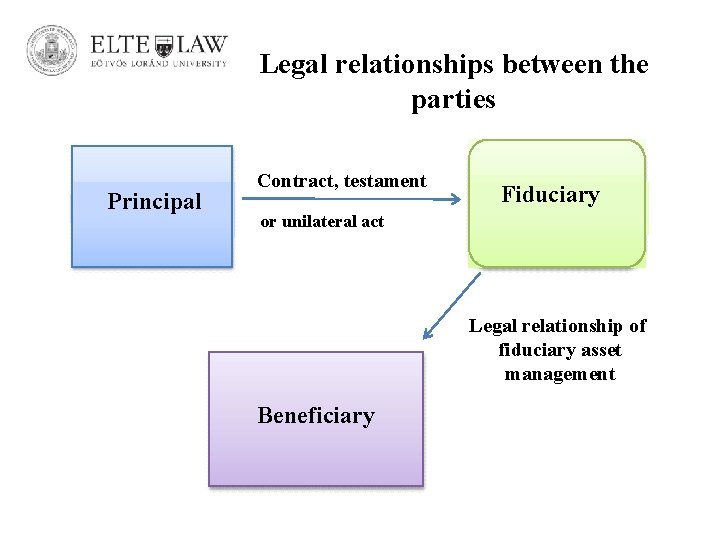
Legal relationships between the parties Principal Contract, testament Fiduciary or unilateral act Legal relationship of fiduciary asset management Beneficiary
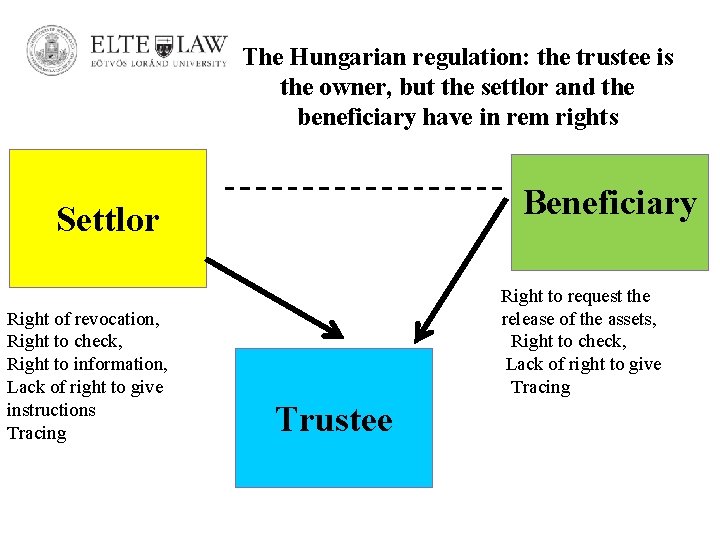
The Hungarian regulation: the trustee is the owner, but the settlor and the beneficiary have in rem rights Beneficiary Settlor Right of revocation, Right to check, Right to information, Lack of right to give instructions Tracing Right to request the release of the assets, Right to check, Lack of right to give Tracing Trustee instructions
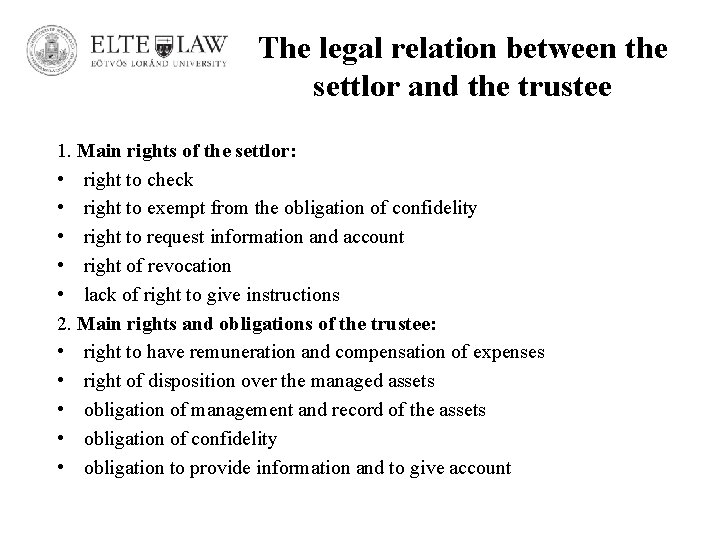
The legal relation between the settlor and the trustee 1. Main rights of the settlor: • right to check • right to exempt from the obligation of confidelity • right to request information and account • right of revocation • lack of right to give instructions 2. Main rights and obligations of the trustee: • right to have remuneration and compensation of expenses • right of disposition over the managed assets • obligation of management and record of the assets • obligation of confidelity • obligation to provide information and to give account
The legal relation between the trustee and the beneficiary Obligations of the trustee: • obligation under contract to release the assets managed and its proceeds to the beneficiary • obligation to provide information and to give account Rights of the beneficiary: • right to request information and account • lack of right to give instructions
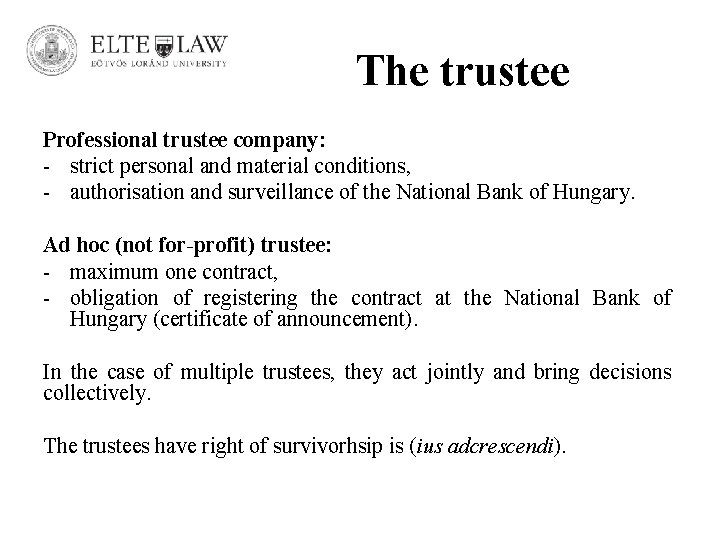
The trustee Professional trustee company: - strict personal and material conditions, - authorisation and surveillance of the National Bank of Hungary. Ad hoc (not for-profit) trustee: - maximum one contract, - obligation of registering the contract at the National Bank of Hungary (certificate of announcement). In the case of multiple trustees, they act jointly and bring decisions collectively. The trustees have right of survivorhsip is (ius adcrescendi).
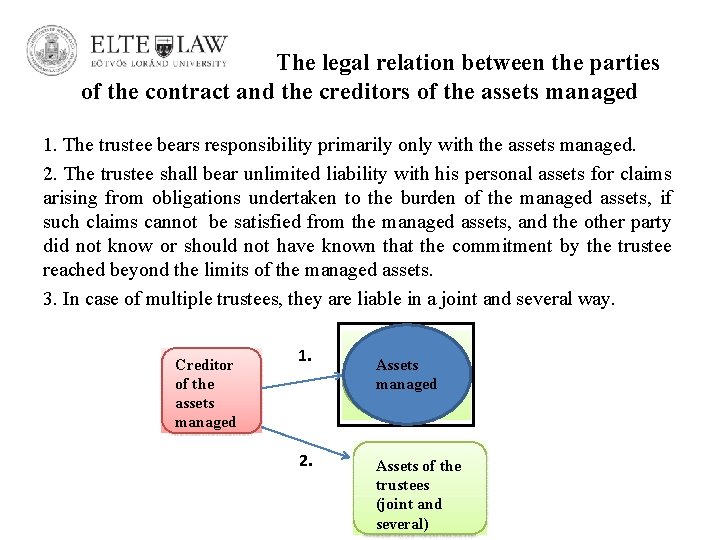
The legal relation between the parties of the contract and the creditors of the assets managed 1. The trustee bears responsibility primarily only with the assets managed. 2. The trustee shall bear unlimited liability with his personal assets for claims arising from obligations undertaken to the burden of the managed assets, if such claims cannot be satisfied from the managed assets, and the other party did not know or should not have known that the commitment by the trustee reached beyond the limits of the managed assets. 3. In case of multiple trustees, they are liable in a joint and several way. Creditor of the assets managed 1. Assets managed 2. Assets of the trustees (joint and several)
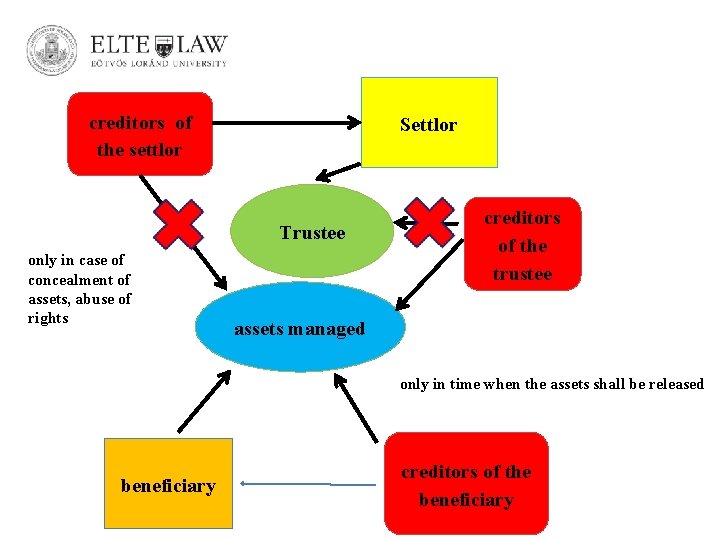
creditors of the settlor Settlor Trustee only in case of concealment of assets, abuse of rights creditors of the trustee assets managed only in time when the assets shall be released beneficiary creditors of the beneficiary
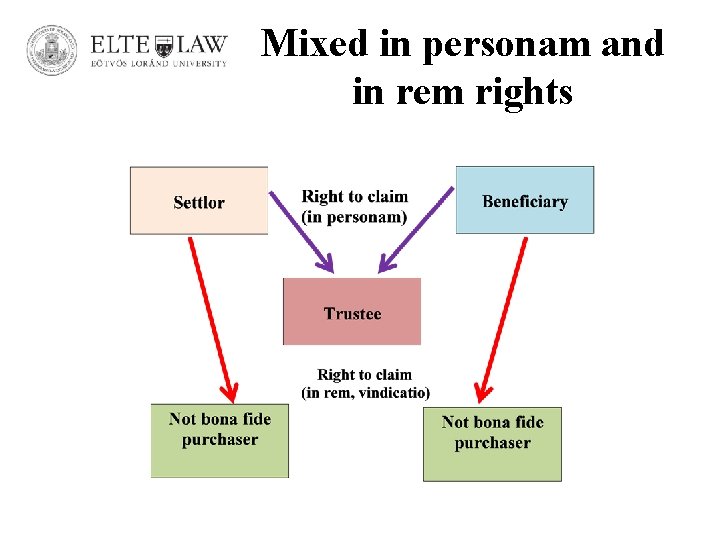
Trustee’s liability towards the settlor and the beneficiary 1. The trustees hall be held liable for any breach of his obligations towards the settlor and the beneficiary. 2. The settlor and the beneficiary is entitled to claim to the assets transfered to third party by the trustee, if the third person - did not act in good faith, or - acquired the assets gratuitously (tracing).
Mixed in personam and in rem rights
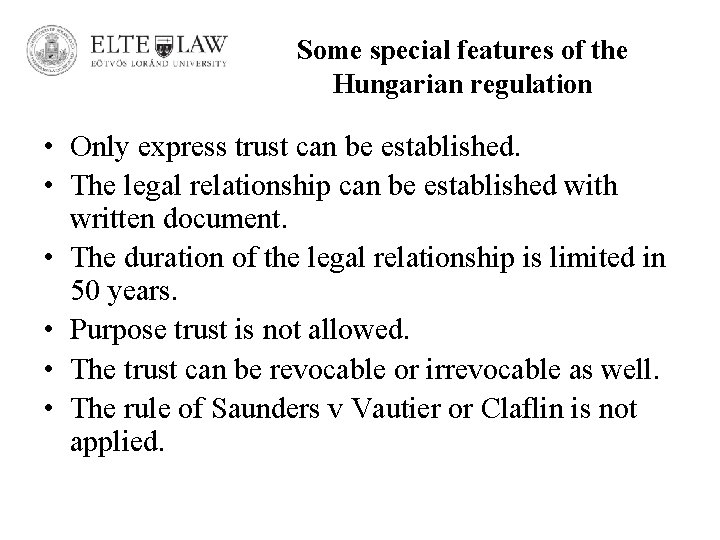
Some special features of the Hungarian regulation • Only express trust can be established. • The legal relationship can be established with written document. • The duration of the legal relationship is limited in 50 years. • Purpose trust is not allowed. • The trust can be revocable or irrevocable as well. • The rule of Saunders v Vautier or Claflin is not applied.
Thank you for your attention! sandor. istvan@ajk. elte. hu istvan. sandor@kelemen-lawfirm. hu