
The New Frontiers of Innovation Policy Richard Halkett




- Slides: 44
The New Frontiers of Innovation Policy Richard Halkett, NESTA Policy & Research Unit SPRU, Freeman Centre Seminar Series 30 th November, 2007
The UK’s ‘poor performance’ in innovation Policy has focused on improving the UK’s ‘poor performance’ The UK lags behind its competitors on traditional indicators § Overall per capita expenditure on R&D § Business levels of innovative activity § Extent of patenting activity The overall impression is that the UK wastes its potential by failing to invest in innovation, particularly the commercialisation of ideas
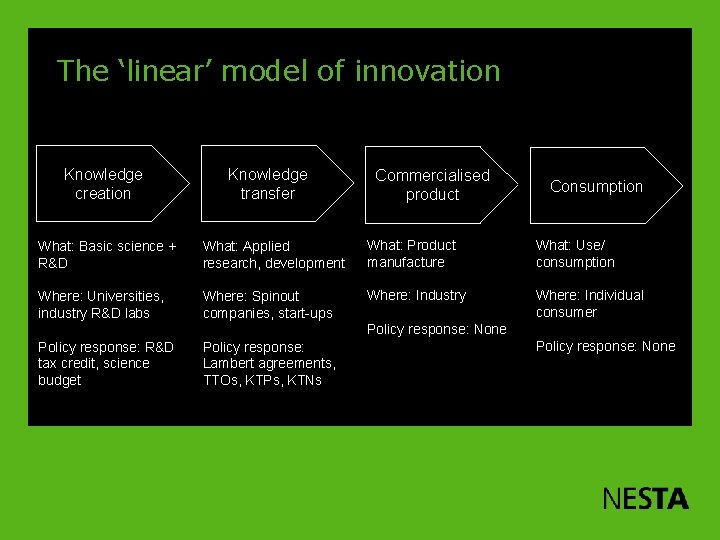
The ‘linear’ model of innovation Knowledge creation Knowledge transfer Commercialised product Consumption What: Basic science + R&D What: Applied research, development What: Product manufacture What: Use/ consumption Where: Universities, industry R&D labs Where: Spinout companies, start-ups Where: Industry Where: Individual consumer Policy response: None Policy response: R&D tax credit, science budget Policy response: Lambert agreements, TTOs, KTPs, KTNs Policy response: None
Hidden innovation Innovation that goes uncounted by traditional indicators
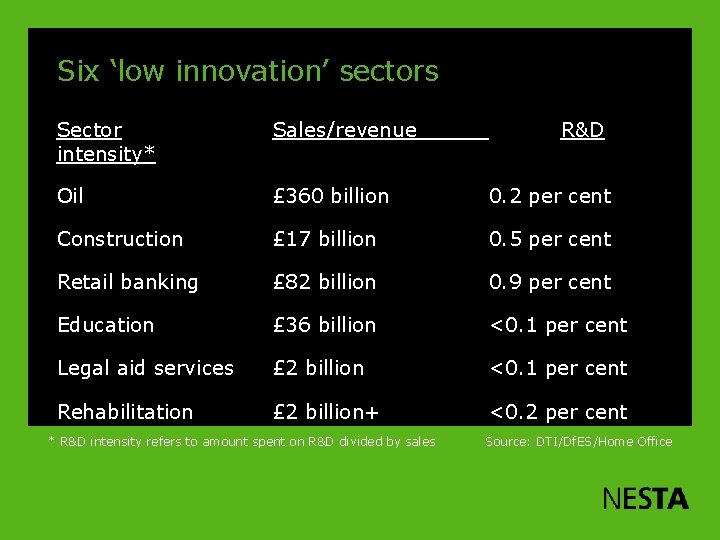
Six ‘low innovation’ sectors Sector intensity* Sales/revenue Oil £ 360 billion 0. 2 per cent Construction £ 17 billion 0. 5 per cent Retail banking £ 82 billion 0. 9 per cent Education £ 36 billion <0. 1 per cent Legal aid services £ 2 billion <0. 1 per cent Rehabilitation £ 2 billion+ <0. 2 per cent * R&D intensity refers to amount spent on R&D divided by sales R&D Source: DTI/Df. ES/Home Office
Type I hidden innovation Based on science and technology but excluded from traditional indicators
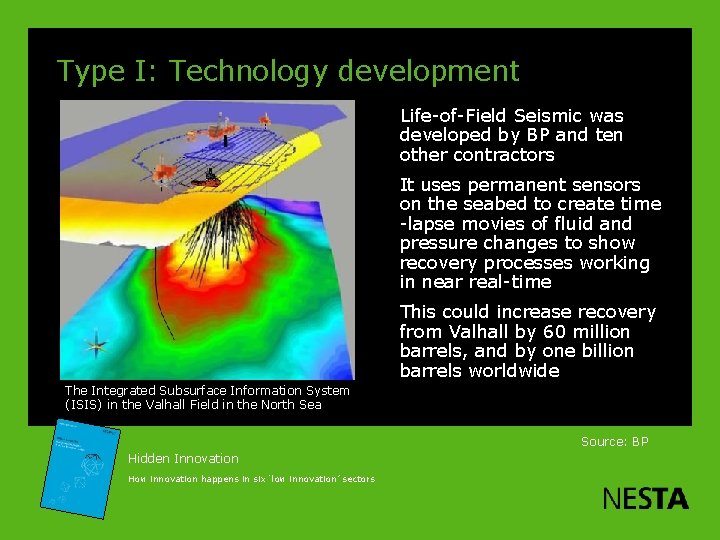
Type I: Technology development Life-of-Field Seismic was developed by BP and ten other contractors It uses permanent sensors on the seabed to create time -lapse movies of fluid and pressure changes to show recovery processes working in near real-time This could increase recovery from Valhall by 60 million barrels, and by one billion barrels worldwide The Integrated Subsurface Information System (ISIS) in the Valhall Field in the North Sea Source: BP Hidden Innovation How innovation happens in six ‘low innovation’ sectors
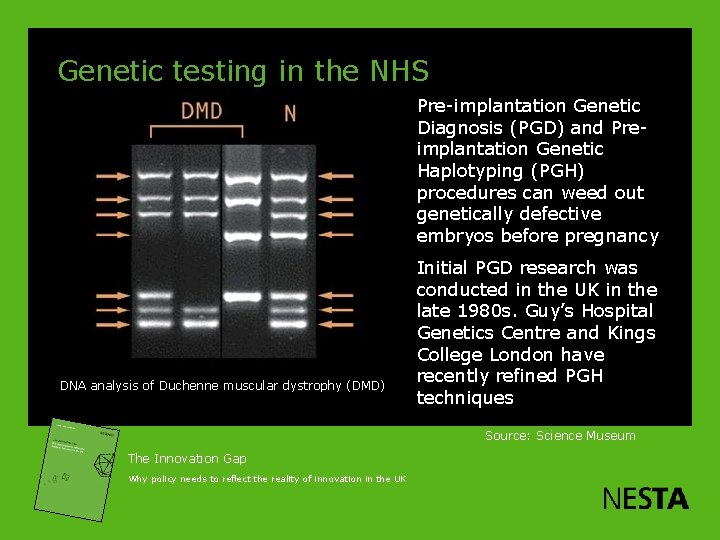
Genetic testing in the NHS Pre-implantation Genetic Diagnosis (PGD) and Preimplantation Genetic Haplotyping (PGH) procedures can weed out genetically defective embryos before pregnancy DNA analysis of Duchenne muscular dystrophy (DMD) Initial PGD research was conducted in the UK in the late 1980 s. Guy’s Hospital Genetics Centre and Kings College London have recently refined PGH techniques Source: Science Museum The Innovation Gap Why policy needs to reflect the reality of innovation in the UK
Type II hidden innovation Innovation in processes, organisational forms or business models
BAA’s Heathrow Terminal 5
Type III hidden innovation Innovation from the novel combination of existing technologies and processes
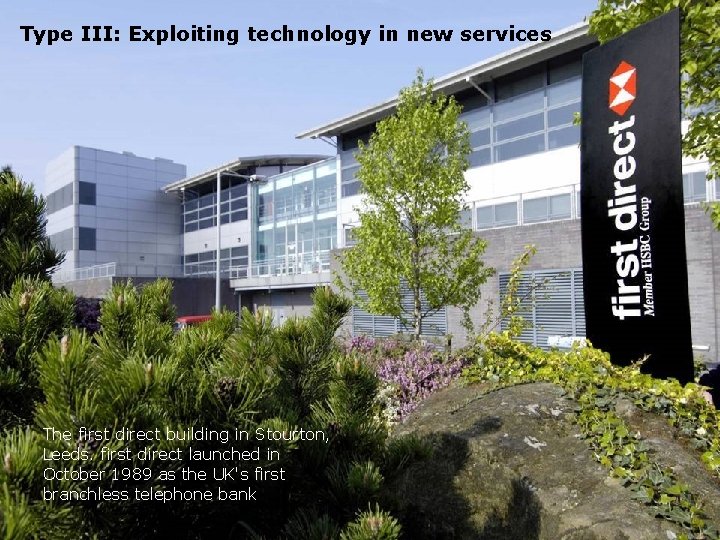
Type III: Exploiting technology in new services The first direct building in Stourton, Leeds. first direct launched in October 1989 as the UK's first branchless telephone bank
Type IV hidden innovation Innovation that takes place ‘under the radar’ of many surveys
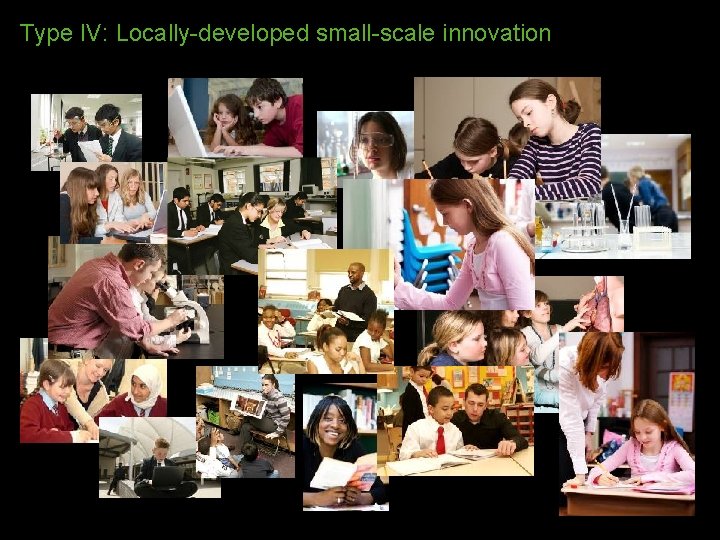
Type IV: Locally-developed small-scale innovation
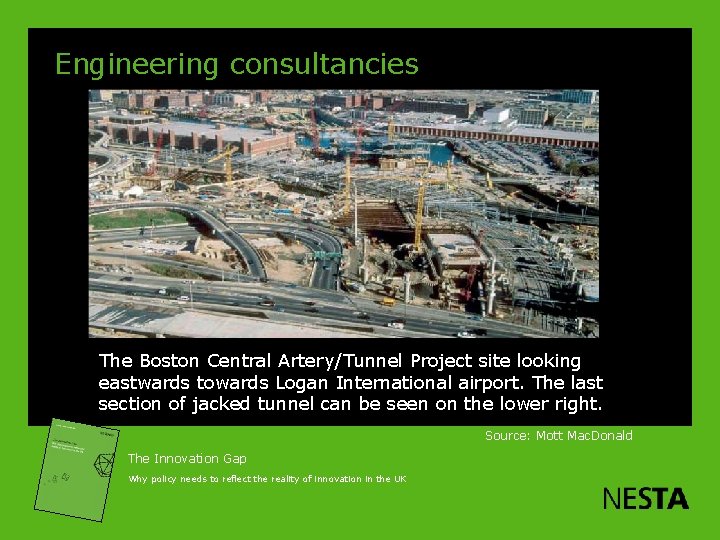
Engineering consultancies The Boston Central Artery/Tunnel Project site looking eastwards towards Logan International airport. The last section of jacked tunnel can be seen on the lower right. Source: Mott Mac. Donald The Innovation Gap Why policy needs to reflect the reality of innovation in the UK
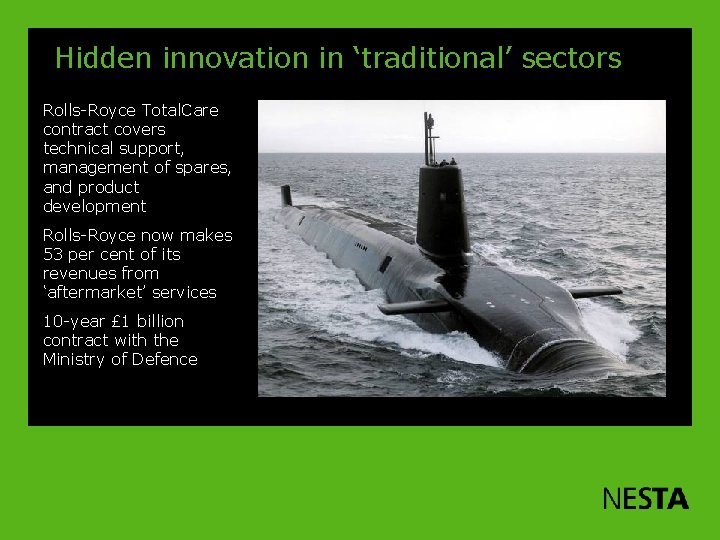
Hidden innovation in ‘traditional’ sectors Rolls-Royce Total. Care contract covers technical support, management of spares, and product development Rolls-Royce now makes 53 per cent of its revenues from ‘aftermarket’ services 10 -year £ 1 billion contract with the Ministry of Defence
Users as innovators
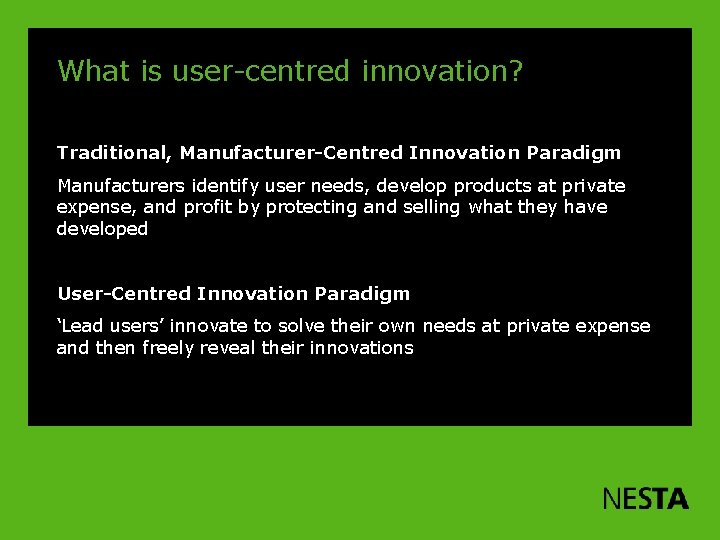
What is user-centred innovation? Traditional, Manufacturer-Centred Innovation Paradigm Manufacturers identify user needs, develop products at private expense, and profit by protecting and selling what they have developed User-Centred Innovation Paradigm ‘Lead users’ innovate to solve their own needs at private expense and then freely reveal their innovations
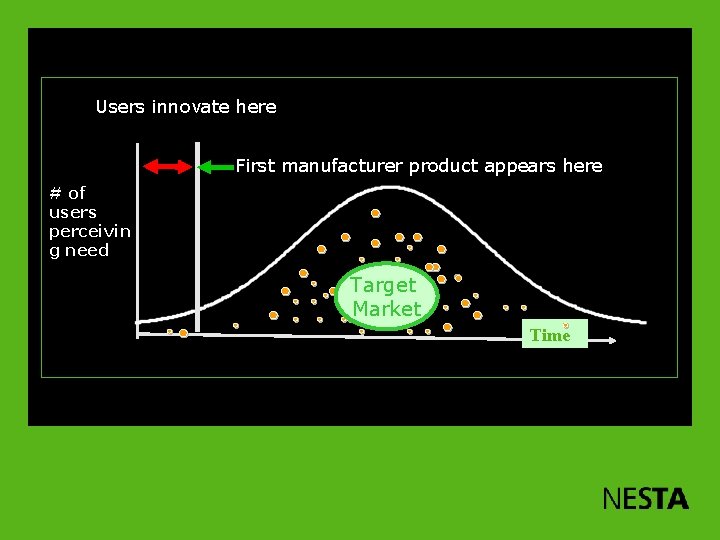
Users innovate here First manufacturer product appears here # of users perceivin g need Target Market Time
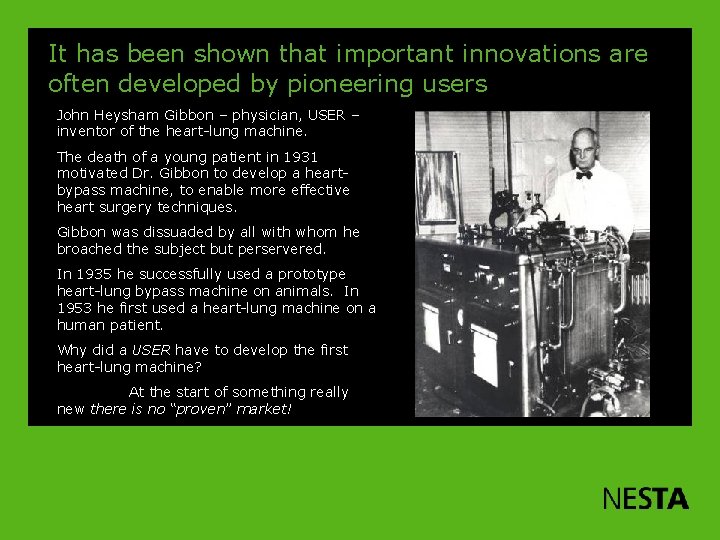
It has been shown that important innovations are often developed by pioneering users John Heysham Gibbon – physician, USER – inventor of the heart-lung machine. The death of a young patient in 1931 motivated Dr. Gibbon to develop a heartbypass machine, to enable more effective heart surgery techniques. Gibbon was dissuaded by all with whom he broached the subject but perservered. In 1935 he successfully used a prototype heart-lung bypass machine on animals. In 1953 he first used a heart-lung machine on a human patient. Why did a USER have to develop the first heart-lung machine? At the start of something really new there is no “proven” market!
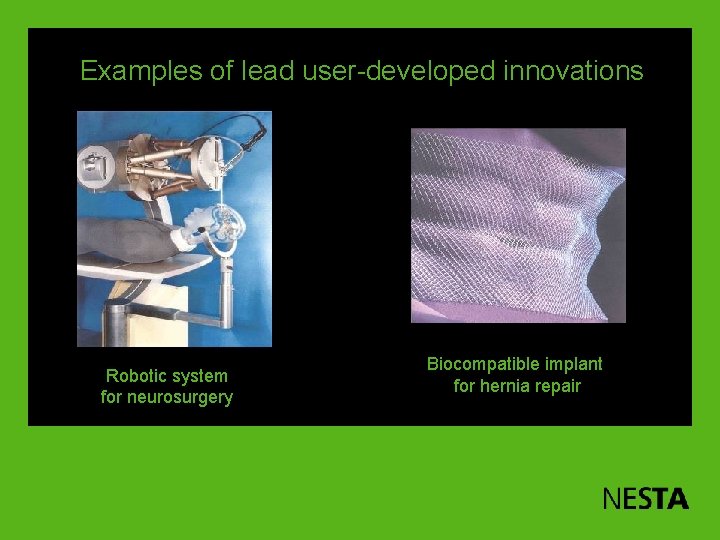
Examples of lead user-developed innovations Robotic system for neurosurgery Biocompatible implant for hernia repair
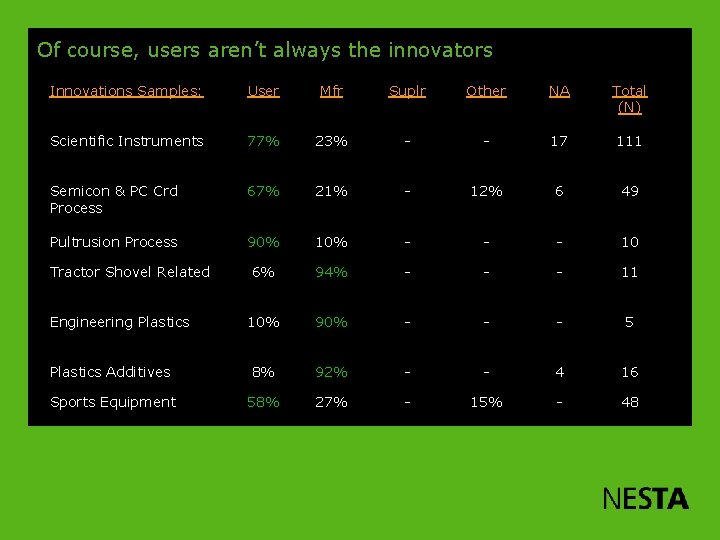
Of course, users aren’t always the innovators Innovations Samples: User Mfr Suplr Other NA Total (N) Scientific Instruments 77% 23% - - 17 111 Semicon & PC Crd Process 67% 21% - 12% 6 49 Pultrusion Process 90% 10% - - - 10 6% 94% - - - 11 10% 90% - - - 5 Plastics Additives 8% 92% - - 4 16 Sports Equipment 58% 27% - 15% - 48 Tractor Shovel Related Engineering Plastics
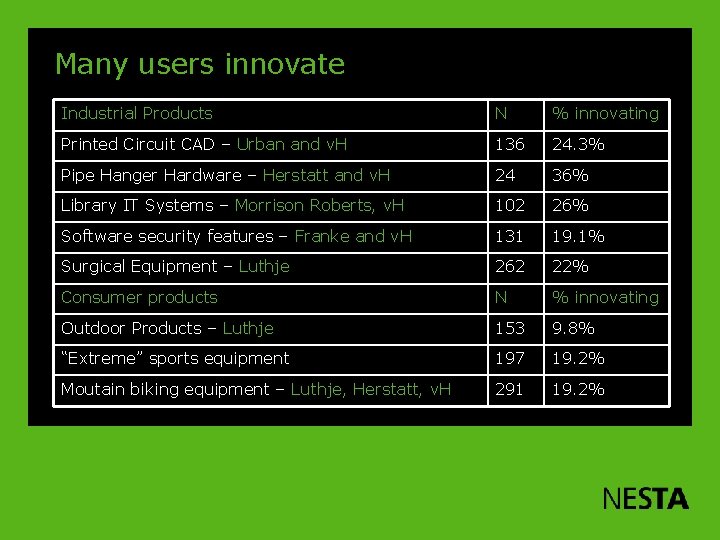
Many users innovate Industrial Products N % innovating Printed Circuit CAD – Urban and v. H 136 24. 3% Pipe Hanger Hardware – Herstatt and v. H 24 36% Library IT Systems – Morrison Roberts, v. H 102 26% Software security features – Franke and v. H 131 19. 1% Surgical Equipment – Luthje 262 22% Consumer products N % innovating Outdoor Products – Luthje 153 9. 8% “Extreme” sports equipment 197 19. 2% Moutain biking equipment – Luthje, Herstatt, v. H 291 19. 2%
Open innovation
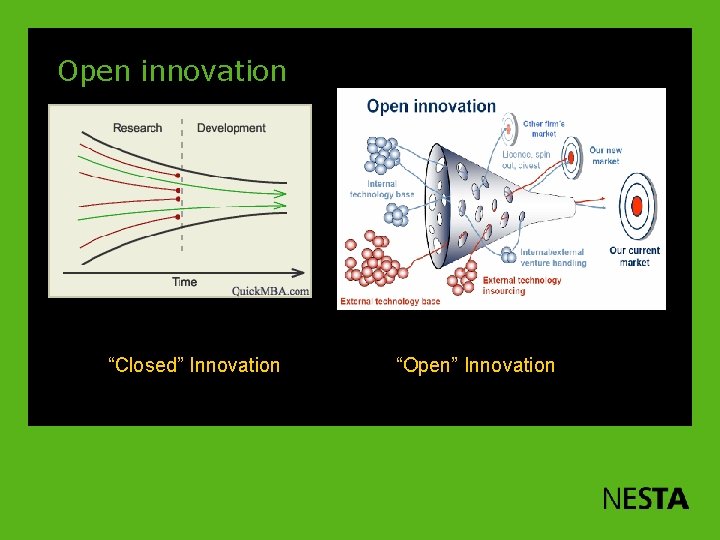
Open innovation “Closed” Innovation “Open” Innovation
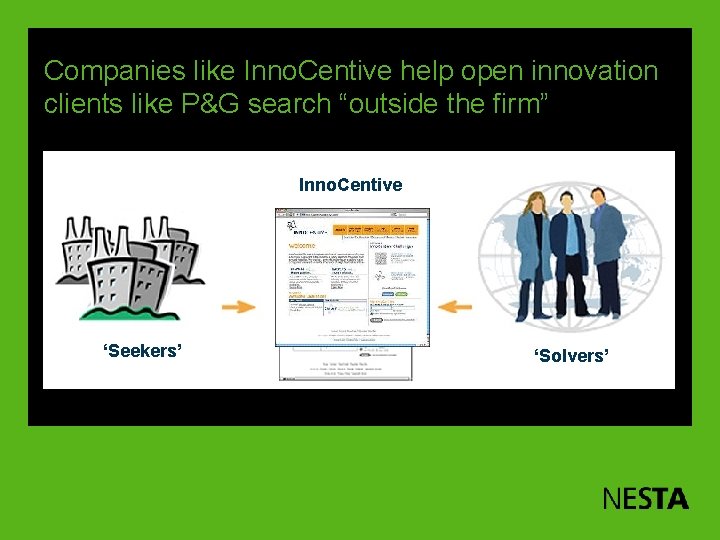
Companies like Inno. Centive help open innovation clients like P&G search “outside the firm” Inno. Centive ‘Seekers’ ‘Solvers’
Other exciting areas…
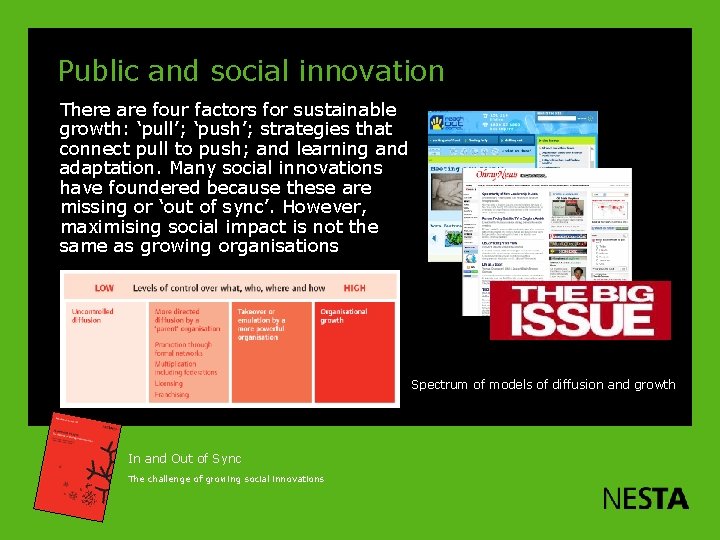
Public and social innovation There are four factors for sustainable growth: ‘pull’; ‘push’; strategies that connect pull to push; and learning and adaptation. Many social innovations have foundered because these are missing or ‘out of sync’. However, maximising social impact is not the same as growing organisations Spectrum of models of diffusion and growth In and Out of Sync The challenge of growing social innovations
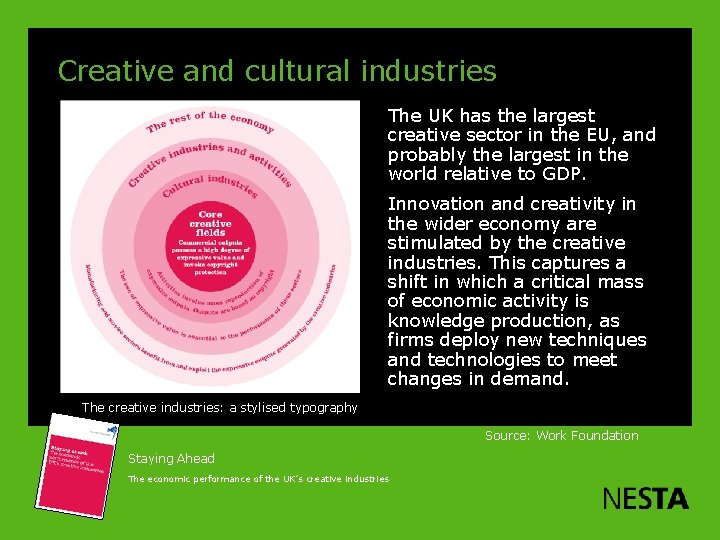
Creative and cultural industries The UK has the largest creative sector in the EU, and probably the largest in the world relative to GDP. Innovation and creativity in the wider economy are stimulated by the creative industries. This captures a shift in which a critical mass of economic activity is knowledge production, as firms deploy new techniques and technologies to meet changes in demand. The creative industries: a stylised typography Source: Work Foundation Staying Ahead The economic performance of the UK’s creative industries
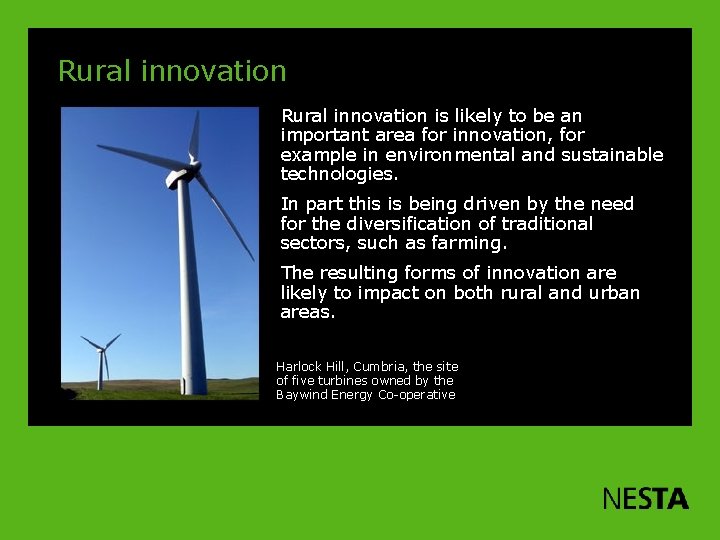
Rural innovation is likely to be an important area for innovation, for example in environmental and sustainable technologies. In part this is being driven by the need for the diversification of traditional sectors, such as farming. The resulting forms of innovation are likely to impact on both rural and urban areas. Harlock Hill, Cumbria, the site of five turbines owned by the Baywind Energy Co-operative
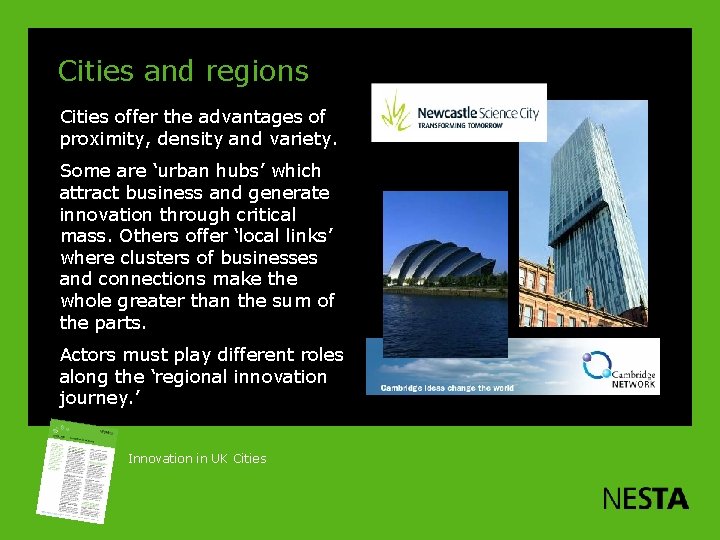
Cities and regions Cities offer the advantages of proximity, density and variety. Some are ‘urban hubs’ which attract business and generate innovation through critical mass. Others offer ‘local links’ where clusters of businesses and connections make the whole greater than the sum of the parts. Actors must play different roles along the ‘regional innovation journey. ’ Innovation in UK Cities
Findings & policy implications
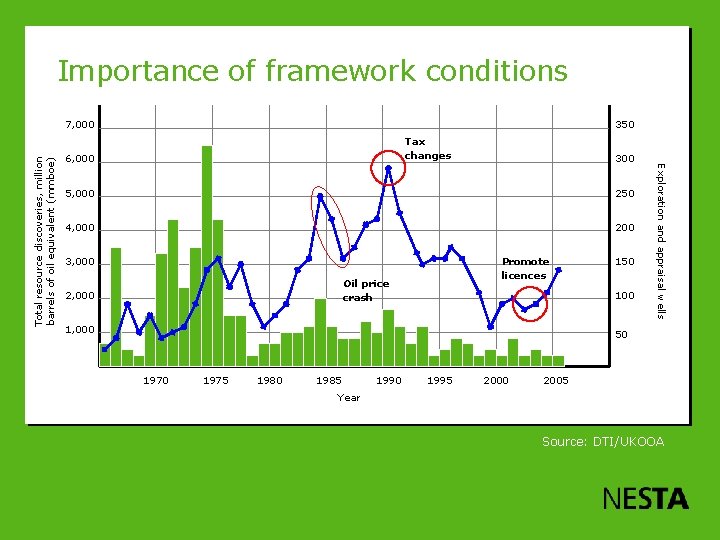
Importance of framework conditions 350 Tax changes 6, 000 300 5, 000 250 4, 000 200 3, 000 Promote licences Oil price crash 2, 000 150 100 1, 000 Exploration and appraisal wells Total resource discoveries, million barrels of oil equivalent (mmboe) 7, 000 50 1975 1980 1985 1990 1995 2000 2005 Year Source: DTI/UKOOA
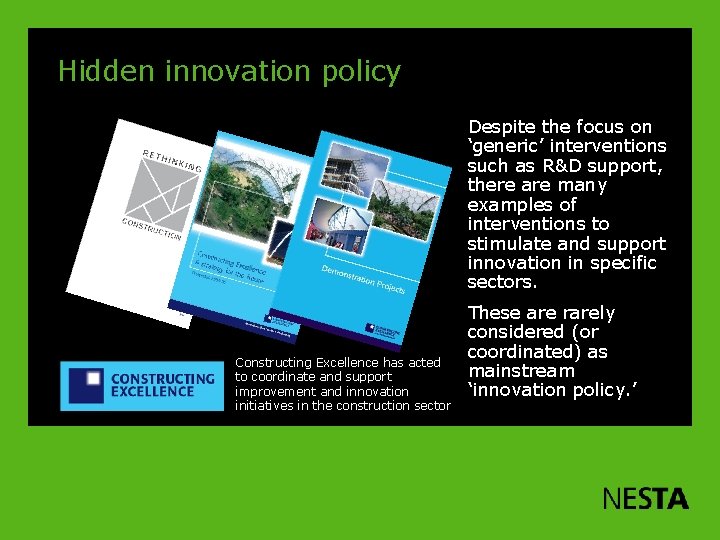
Hidden innovation policy Despite the focus on ‘generic’ interventions such as R&D support, there are many examples of interventions to stimulate and support innovation in specific sectors. Constructing Excellence has acted to coordinate and support improvement and innovation initiatives in the construction sector These are rarely considered (or coordinated) as mainstream ‘innovation policy. ’
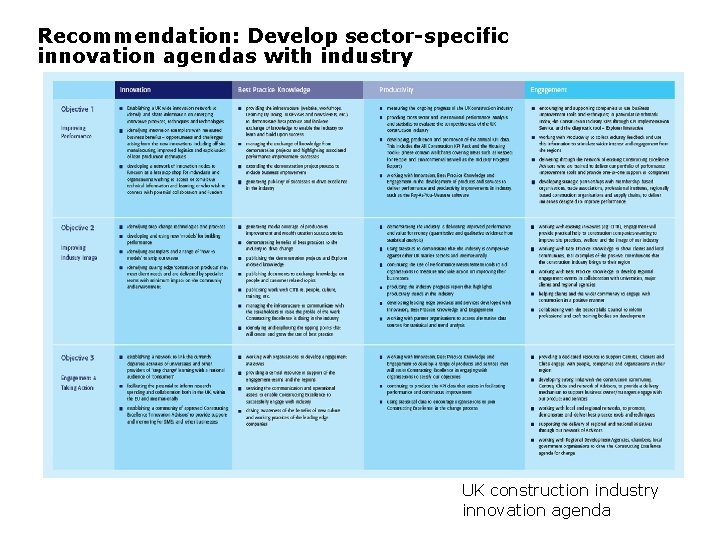
Recommendation: Develop sector-specific innovation agendas with industry UK construction industry innovation agenda
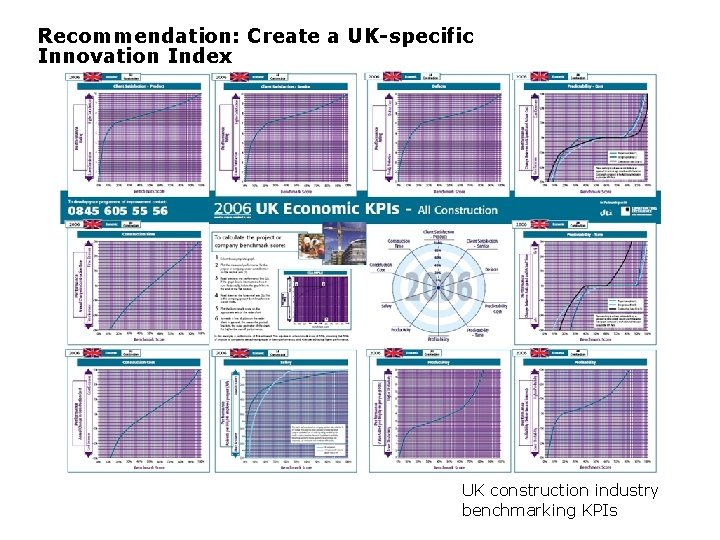
Recommendation: Create a UK-specific Innovation Index UK construction industry benchmarking KPIs
What we’re learning § There are not always policy recommendations… § Government cannot do this alone § Policy must move beyond science-based manufacturer-led innovation to encompass other forms that come from elsewhere in the supply chain § Policy needs to support systems and include diffusion and adoption, not just invention § Developing a full innovation strategy will depend on working closely with industry to identify the innovation that matters most to each sector § A sector-relevant Innovation Index would better guide policy development § Innovation needs to be at the heart of – and across – policy
Recommendation: Place innovation at the heart of government
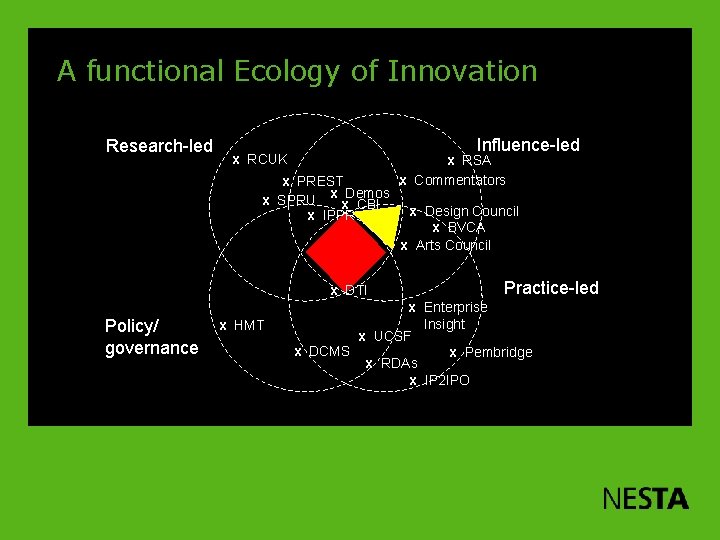
Many dimensions of comparison • What organisations say they do • What organisations actually do • Which portions & linkages of the innovation system they are positioned to address • Coverage of relevant stakeholders • Coverage of the UK • Size & source of budget • etc…
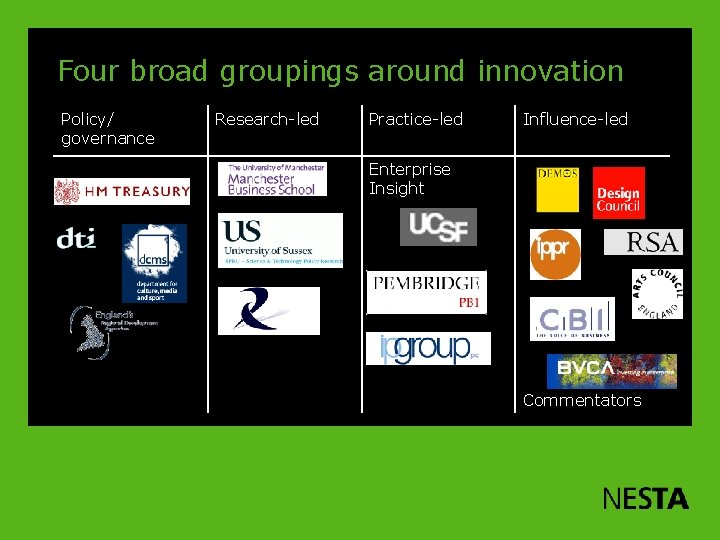
Four broad groupings around innovation Policy/ governance Research-led Practice-led Influence-led Enterprise Insight Commentators
A functional Ecology of Innovation Research-led Influence-led x RCUK x PREST x Demos x SPRU x CBI x IPPR x DTI Policy/ governance x HMT x RSA x Commentators x Design Council x BVCA x Arts Council Practice-led x Enterprise Insight x UCSF x DCMS x Pembridge x RDAs x IP 2 IPO
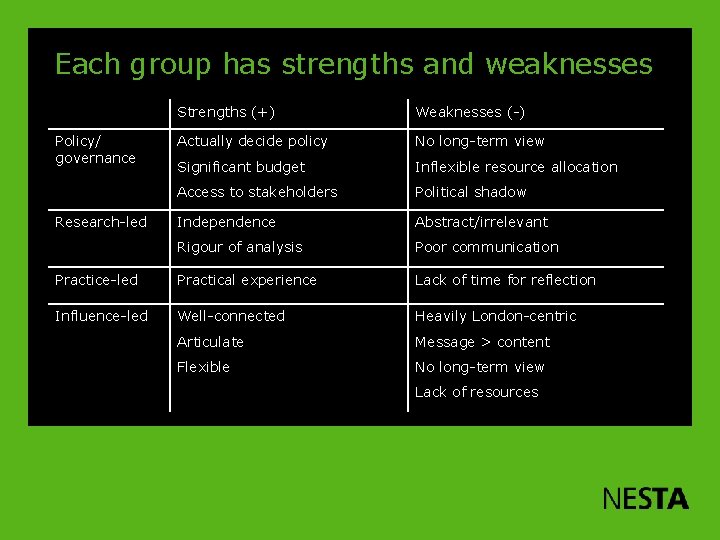
Each group has strengths and weaknesses Strengths (+) Weaknesses (-) Actually decide policy No long-term view Significant budget Inflexible resource allocation Access to stakeholders Political shadow Independence Abstract/irrelevant Rigour of analysis Poor communication Practice-led Practical experience Lack of time for reflection Influence-led Well-connected Heavily London-centric Articulate Message > content Flexible No long-term view Policy/ governance Research-led Lack of resources
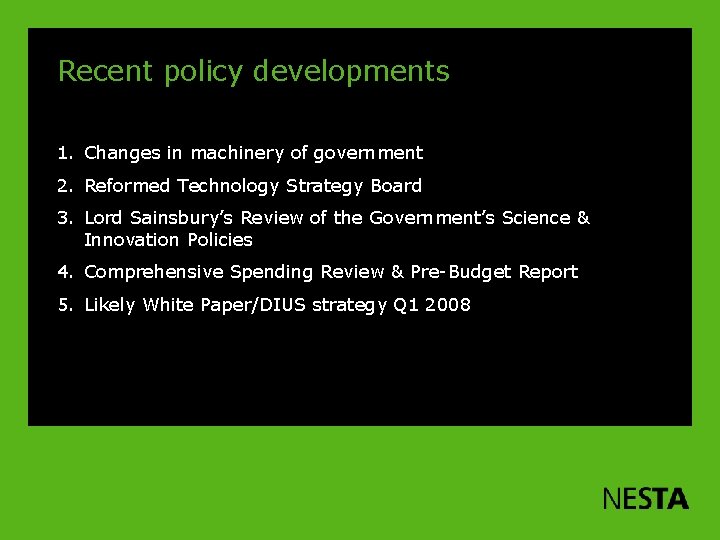
Recent policy developments 1. Changes in machinery of government 2. Reformed Technology Strategy Board 3. Lord Sainsbury’s Review of the Government’s Science & Innovation Policies 4. Comprehensive Spending Review & Pre-Budget Report 5. Likely White Paper/DIUS strategy Q 1 2008
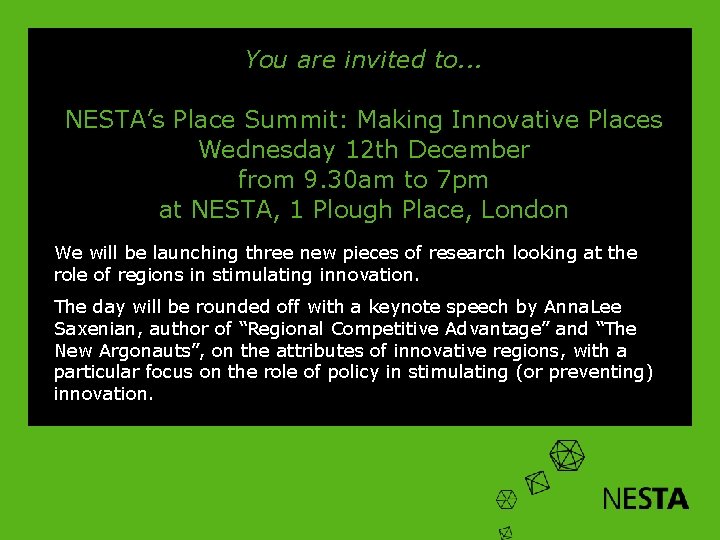
You are invited to. . . NESTA’s Place Summit: Making Innovative Places Wednesday 12 th December from 9. 30 am to 7 pm at NESTA, 1 Plough Place, London We will be launching three new pieces of research looking at the role of regions in stimulating innovation. The day will be rounded off with a keynote speech by Anna. Lee Saxenian, author of “Regional Competitive Advantage” and “The New Argonauts”, on the attributes of innovative regions, with a particular focus on the role of policy in stimulating (or preventing) innovation.