
The New EU Consumer Sales Directive and Sustainable
The New EU Consumer Sales Directive and Sustainable Consumption Elias Van Gool – Ph. D. Researcher at KU Leuven and Université de Lille 21 August 2020 Conference "Private law challenges in the 21 st Century“ University of Wrocław, Poland
Overview • Sustainable consumption and EU consumer law • Level of harmonisation and scope • Conformity • Liability: legal guarantee; burden of proof; commercial guarantee • Remedies • Conclusion 2 Faculty of Law, Consumer Competition Market Institute (CCM)
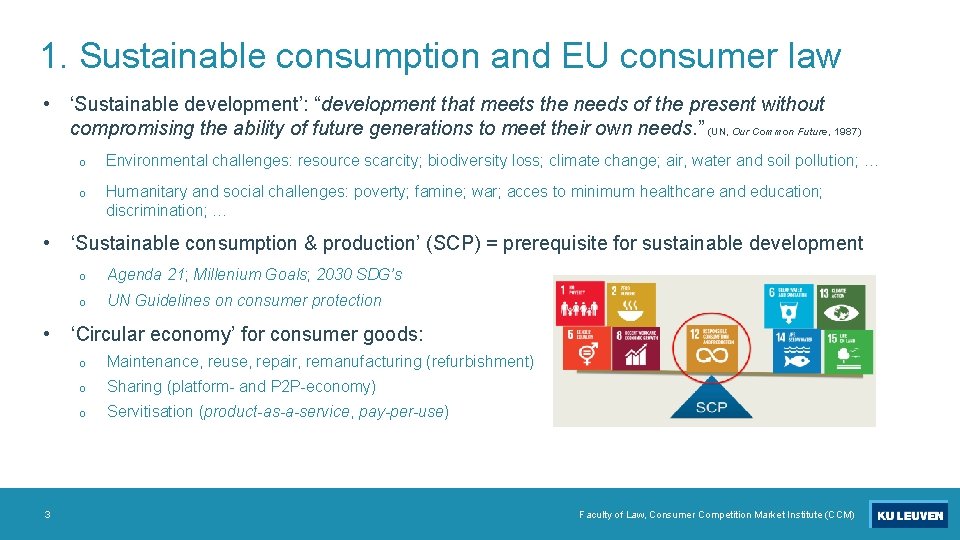
1. Sustainable consumption and EU consumer law • ‘Sustainable development’: “development that meets the needs of the present without compromising the ability of future generations to meet their own needs. ” (UN, Our Common Future, 1987) • • 3 o Environmental challenges: resource scarcity; biodiversity loss; climate change; air, water and soil pollution; … o Humanitary and social challenges: poverty; famine; war; acces to minimum healthcare and education; discrimination; … ‘Sustainable consumption & production’ (SCP) = prerequisite for sustainable development o Agenda 21; Millenium Goals; 2030 SDG’s o UN Guidelines on consumer protection ‘Circular economy’ for consumer goods: o Maintenance, reuse, repair, remanufacturing (refurbishment) o Sharing (platform- and P 2 P-economy) o Servitisation (product-as-a-service, pay-per-use) Faculty of Law, Consumer Competition Market Institute (CCM)
• EU and national SC policy: isolated policy declarations + ‘soft approach’ of ‘consumer enablement’ New Commission: European Green Deal; 2 nd CEAP • Traditional consumer policy vs. sustainable consumption policy • ‘Soft approach’ reaches its limits o SC&P continues to be the SDG on which EU has the lowest score o Insights from behavioural science • EU: art. 3 (3)-(5) TEU; art. 21 (2) TEU; art. 37 Charter; art. 11 TFEU. • Need to critically re-evaluate current consumer law. Towards a new paradigm, ‘the consumer as citizen’? (°Wilhelmsson 1998) • CSD 2019/771 and SDCS 2019/770 (= Digital Single Market; little to no SC-integration) 4 Faculty of Law, Consumer Competition Market Institute (CCM)
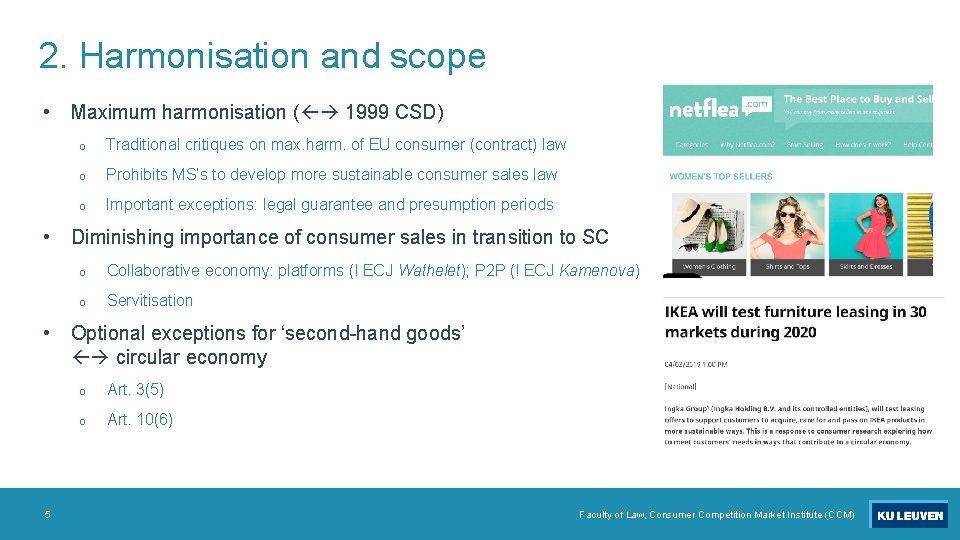
2. Harmonisation and scope • Maximum harmonisation ( 1999 CSD) • • 5 o Traditional critiques on max. harm. of EU consumer (contract) law o Prohibits MS’s to develop more sustainable consumer sales law o Important exceptions: legal guarantee and presumption periods Diminishing importance of consumer sales in transition to SC o Collaborative economy: platforms (! ECJ Wathelet); P 2 P (! ECJ Kamenova) o Servitisation Optional exceptions for ‘second-hand goods’ circular economy o Art. 3(5) o Art. 10(6) Faculty of Law, Consumer Competition Market Institute (CCM)
3. Conformity - new • ‘Durability’ as objective conformity criterion in art. 7(1), d) • 6 o Only symbolic: already possible under CSD 1999 o Does it include ‘repairability’? yes, i. m. o. (circular interpretation) ‘Digitalized’ new conformity criteria = contribution to combatting ‘technological obsolescence o Compatibility and interoperability, when contractually agreed (art. 6, a)) or reasonably expected (art. 7(1), d)) o Update obligation (art. 7(3)-(4) and art. 10(2)): security and other updates necessary to keep ‘smart goods’ in conformity, during period that consumer may reasonably expect / contractually agreed continuous supply period o + Italian/French UCPD decisions on ‘firmware updates’ Faculty of Law, Consumer Competition Market Institute (CCM)
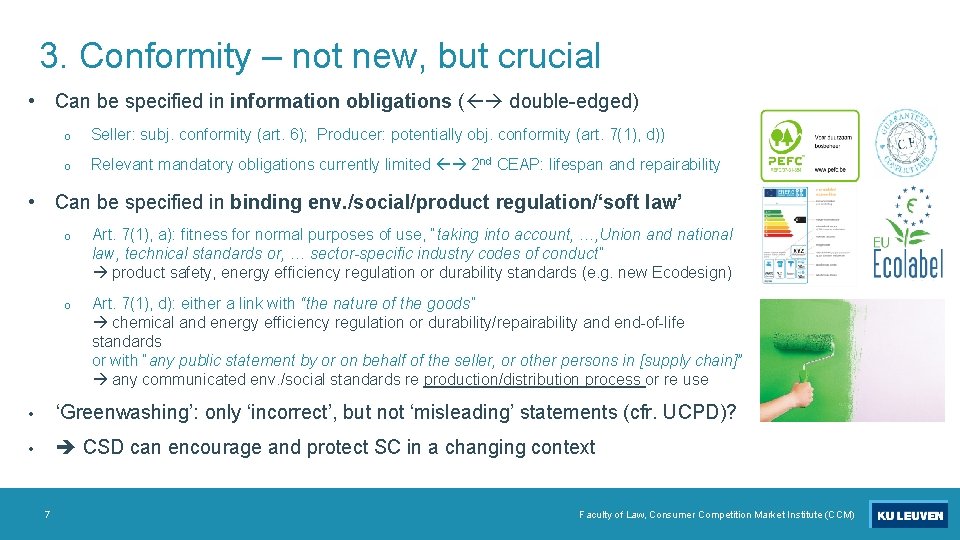
3. Conformity – not new, but crucial • Can be specified in information obligations ( double-edged) o Seller: subj. conformity (art. 6); Producer: potentially obj. conformity (art. 7(1), d)) o Relevant mandatory obligations currently limited 2 nd CEAP: lifespan and repairability • Can be specified in binding env. /social/product regulation/‘soft law’ o Art. 7(1), a): fitness for normal purposes of use, “taking into account, …, Union and national law, technical standards or, … sector-specific industry codes of conduct” product safety, energy efficiency regulation or durability standards (e. g. new Ecodesign) o Art. 7(1), d): either a link with “the nature of the goods” chemical and energy efficiency regulation or durability/repairability and end-of-life standards or with “any public statement by or on behalf of the seller, or other persons in [supply chain]” any communicated env. /social standards re production/distribution process or re use • ‘Greenwashing’: only ‘incorrect’, but not ‘misleading’ statements (cfr. UCPD)? • CSD can encourage and protect SC in a changing context 7 Faculty of Law, Consumer Competition Market Institute (CCM)
4. Liability • Legal guarantee period remains 2 years, but min. harm. (unlimited) o due to fear of decreasing consumer protection, but also beneficial to SC. o options: (i) single longer period (IE, UK, SW); (ii) a longer (e. g. 5 y) and shorter (e. g. 2 y) period; (iii) the average economic lifespan of each product, min. 2 y (NL, FI). • Presumption period extended to 1 year, but min. harm. (max. 2 y) Important for consumer protection, but comparatively less for SC. 8 ! Moral hazard risk • Weak right of redress (only principle, MS fragmentation and contr. exonerations) and no producer’s liability (cheapest cost-avoiders for most SDG externalities). • Commercial guarantees: • can contribute to (e. g. “repair + temporary replacement”) but also harm SC (e. g. “warranty void if seal broken”) • new “comm. g. of durability” is well-intended, but creates confusion. • soft law (e. g. Ecolabel) is likely best method to enforce sustainable comm. g. ’s. Faculty of Law, Consumer Competition Market Institute (CCM)

5. Remedies - repair • Policy declarations supporting repair (Green Deal; 2 nd CEAP; recital 48) in practice, repair less attractive than “co-equal” replacement: o time required for repair vs. instantaneous replacement o consumers receiving a ‘brand new’ good without paying for prior use (ECJ Quelle; art. 14(4)). o replacement often also cheaper for sellers in current linear economy • Consumer contract law solutions o Repair = sole primary remedy (Dir. ) o Requiring consumers choosing replacement to pay for prior use (Dir. ) o Broader interpretation of ‘disproportionality-test’ in art. 13(2)-(3) (ECJ) o Temporary replacement good (MS’s) o Suspending/extending legal guarantee period after repair (MS’s) Regulatory solutions 2 nd CEAP; French 2020 CE Law; … • 9 Faculty of Law, Consumer Competition Market Institute (CCM)
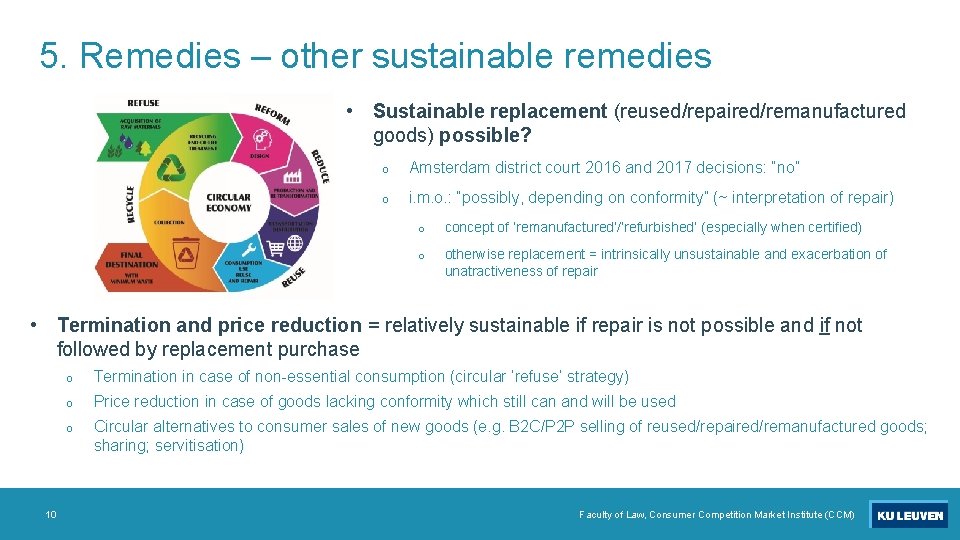
5. Remedies – other sustainable remedies • Sustainable replacement (reused/repaired/remanufactured goods) possible? o Amsterdam district court 2016 and 2017 decisions: “no” o i. m. o. : “possibly, depending on conformity” (~ interpretation of repair) o concept of ‘remanufactured’/’refurbished’ (especially when certified) o otherwise replacement = intrinsically unsustainable and exacerbation of unatractiveness of repair • Termination and price reduction = relatively sustainable if repair is not possible and if not followed by replacement purchase 10 o Termination in case of non-essential consumption (circular ‘refuse’ strategy) o Price reduction in case of goods lacking conformity which still can and will be used o Circular alternatives to consumer sales of new goods (e. g. B 2 C/P 2 P selling of reused/repaired/remanufactured goods; sharing; servitisation) Faculty of Law, Consumer Competition Market Institute (CCM)
Conclusion • 2/3 of CSD 2019/771 main contributions to SC are nothing new o Open and flexible subj. /obj. conformity assessment, which can interact with sustainable information obligations, product regulation, ‘soft law’, etc. o Repair as a primary remedy o Digitalized conformity and liability rules, which will help combatting ‘technological obsolescence’ • Still possibilities for MS’s to opt for a sustainable transposition • o legal guarantee period o repair modalities, e. g. temporary replacement good, suspension/extension of legal guarantee period o possibly encouraging sustainable replacements and broad ‘proportionality’ interpretation ( ECJ) Nevertheless, so many ‘missed opportunities’ in recent but already ‘old-fashioned’ CSD Commission already considering changes (2 nd CEAP, p. 5). 11 Faculty of Law, Consumer Competition Market Institute (CCM)
Questions? Comments? Contact : elias. vangool@kuleuven. be Paper soon available : E. VAN GOOL and A. MICHEL, “The New Consumer Sales Directive and Sustainable Consumption: A Critical Analysis” Research made possible with the support of : 12 Faculty of Law, Consumer Competition Market Institute (CCM)
- Slides: 12