
The new ECB statistical framework for securitisation Antonio

The new ECB statistical framework for securitisation Antonio Matas Mir OECD Workshop on Securitisation Madrid, 27 -28 May 2010
User needs at the Eurosystem (I) v Data on securitisation are needed for a reliable interpretation of MFI credit data: ücorrect for negative financial transactions when loans are securitised üfollow loan redemption and repayment patterns irrespective of securitisation Both of the above could arguably be met through consolidated reporting by originator 2

User needs at the Eurosystem (II) But data also needed to monitor securitisation process itself and its impact on: üthe creation of money and credit üthe capital markets üfinancial stability üthe incentives at play to use it as funding source, risk diversification, regulatory capital management, etc. Most of the above best fulfilled by treating FVCs as separate entities 3
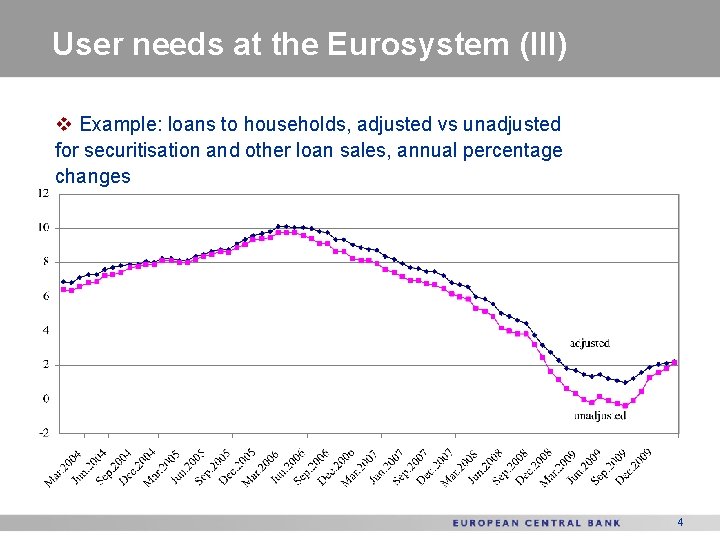
User needs at the Eurosystem (III) v Example: loans to households, adjusted vs unadjusted for securitisation and other loan sales, annual percentage changes 4
Situation prior to the new framework v Data were insufficient: ü non-harmonised definitions and compilation approaches; ü different availability and coverage across euro area; ü highly sensitive to different national accounting rules on asset derecognition; ü no sectoral detail available; ü no coverage of re-intermediation (FVC securities bought by the MFI sector, unwinding of securitisations) 5

The ECB ‘integrated approach’ at a glance As servicers As originators MFI reporting FVC reporting Loan securitisation flows Securitised loans o/w originated by MFIs Effect on the balance sheet (de-recognition issues) Loan outstandings postsecuritisation o/w serviced for euro area FVCs s g on i t a D ero o/w originated by non. MFIs and Ro. W Other securitised assets Other assets Debt securities issued Other liabilities 6
New statistical requirements for MFIs (1) v New statistics on MFI loan securitisation and other loan transfers are an extension of existing statistical requirements on MFIs. Cover: 1. Traditional MFI loan securitisation (including via nonresident vehicles). 2. Other MFI loan transfers to/from non-MFIs. Do not cover: Synthetic loan securitisation (covered by FVC statistics) First reporting July 2010 (ref. June) with data provision back to Dec 2009. 7
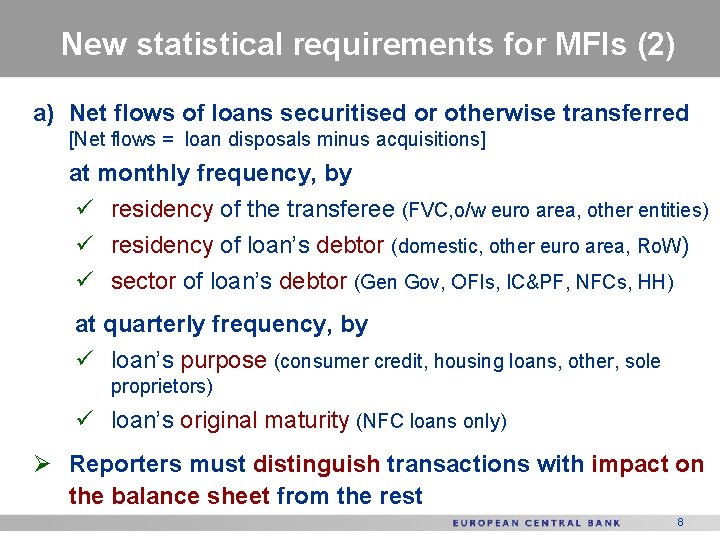
New statistical requirements for MFIs (2) a) Net flows of loans securitised or otherwise transferred [Net flows = loan disposals minus acquisitions] at monthly frequency, by ü residency of the transferee (FVC, o/w euro area, other entities) ü residency of loan’s debtor (domestic, other euro area, Ro. W) ü sector of loan’s debtor (Gen Gov, OFIs, IC&PF, NFCs, HH) at quarterly frequency, by ü loan’s purpose (consumer credit, housing loans, other, sole proprietors) ü loan’s original maturity (NFC loans only) Ø Reporters must distinguish transactions with impact on the balance sheet from the rest 8
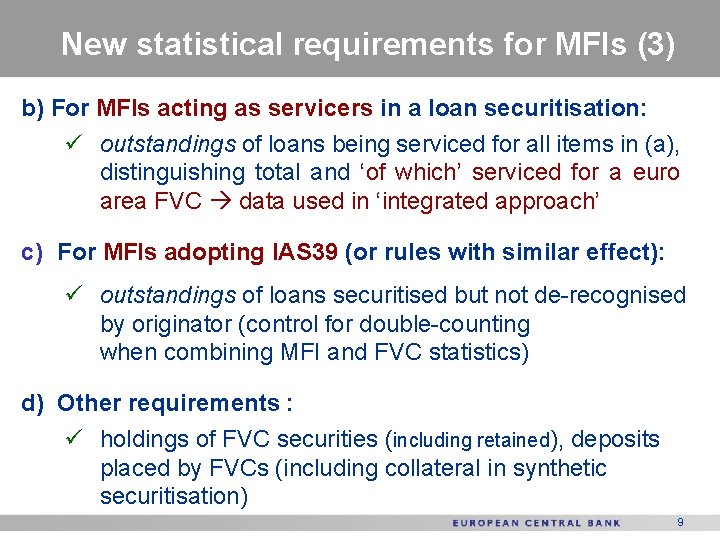
New statistical requirements for MFIs (3) b) For MFIs acting as servicers in a loan securitisation: ü outstandings of loans being serviced for all items in (a), distinguishing total and ‘of which’ serviced for a euro area FVC data used in ‘integrated approach’ c) For MFIs adopting IAS 39 (or rules with similar effect): ü outstandings of loans securitised but not de-recognised by originator (control for double-counting when combining MFI and FVC statistics) d) Other requirements : ü holdings of FVC securities (including retained), deposits placed by FVCs (including collateral in synthetic securitisation) 9
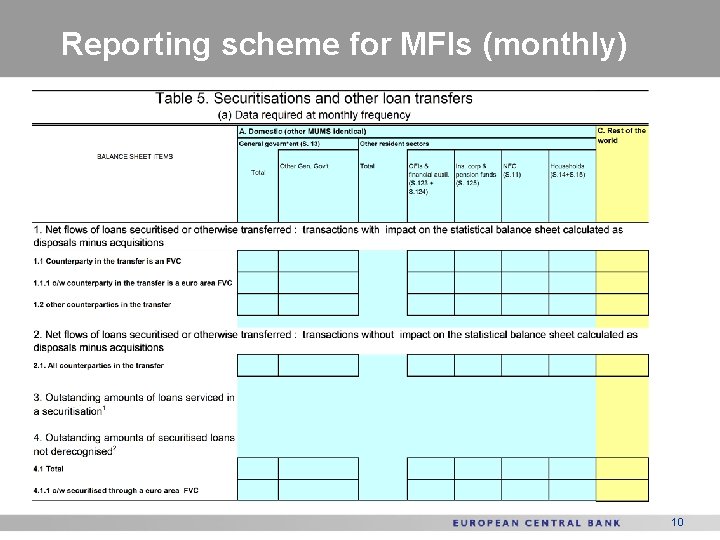
Reporting scheme for MFIs (monthly) 10
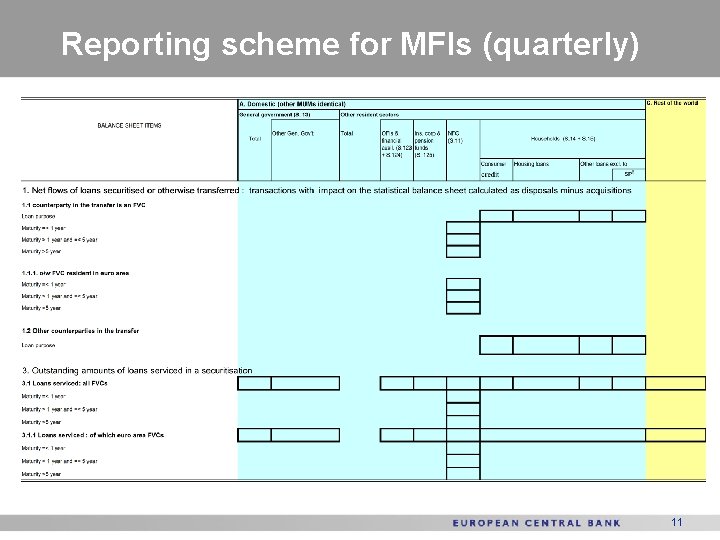
Reporting scheme for MFIs (quarterly) 11
Statistical requirements for FVCs (1/4) v A new statistical ECB Regulation addressing the vehicles in the euro area directly ü Includes a requirement of self-identification Publication of FVC list in February 2010 ü First reporting of balance sheet data: February 2010 ü First reporting of financial transactions data + data on write-downs or similar information: May 2010 12
Statistical requirements for FVCs (2/4) v Each NCB may choose one of three compilation approaches, or combination thereof: ü Direct reporting by the resident FVCs complemented by reporting of loans serviced by MFIs (‘integrated approach’) ü Compilation of FVC data using other statistical, public or supervisory data sources v All cases, quarterly frequency, timeliness t+28 days 13
Statistical requirements for FVCs (3/4) v If direct reporting by FVCs: ü derogations for FVCs making up to 5% of national total assets ü derogations from mark-to-market accounting for difficult to value items (e. g. bespoke CDS) ü deviations of reporting period from natural quarter allowed provided large transactions within natural quarter are included 14
Statistical requirements for FVCs (4/4) v Data to be compiled separately for traditional, synthetic and other FVCs v Stocks and financial transactions of: a) Securitised loans : ü fully sectorised wrt to borrower if MFI-originated ü only totals for other originators b) Debt securities: MFIs/non-MFIs/FVCs/Ro. W c) Sufficient information on inter-FVC positions to consolidate sector d) Write-downs only for total assets (compiler assigns to most likely asset class) 15
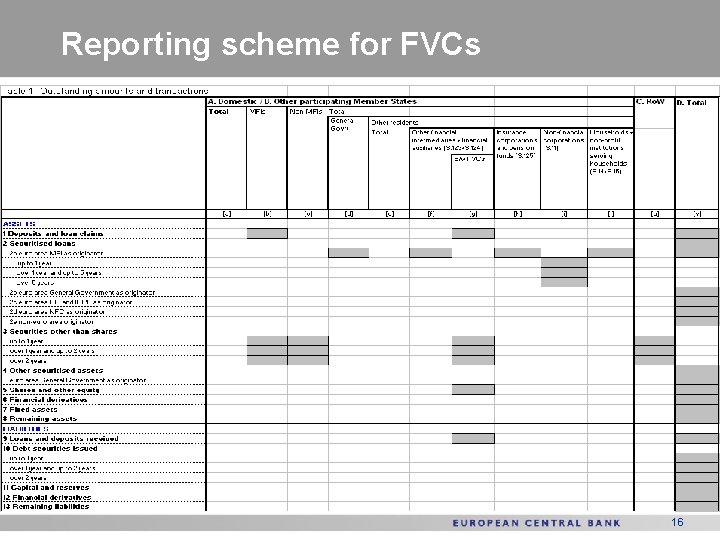
Reporting scheme for FVCs 16
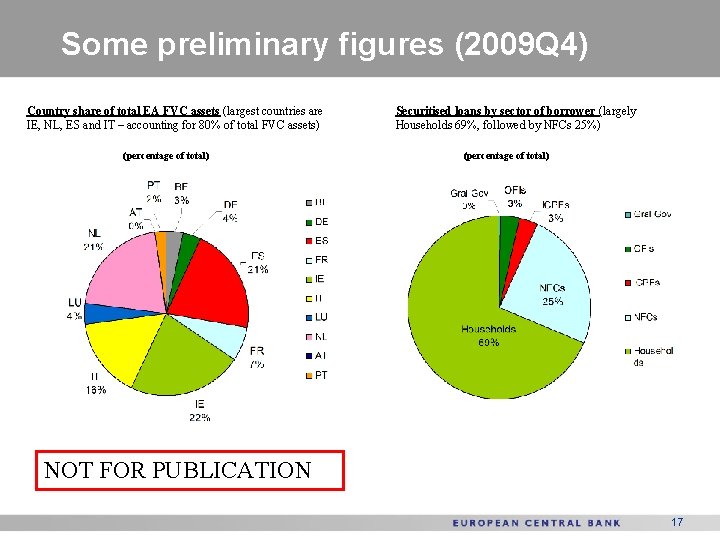
Some preliminary figures (2009 Q 4) Country share of total EA FVC assets (largest countries are IE, NL, ES and IT – accounting for 80% of total FVC assets) (percentage of total) Securitised loans by sector of borrower (largely Households 69%, followed by NFCs 25%) (percentage of total) NOT FOR PUBLICATION 17
Summary • Harmonised and complementary MFI and FVC data on securitisation for the euro area beginning 2009 Q 4 • MFI data covers also securitisations via non-resident vehicles • FVC data restricted to euro area vehicles (plus some EU countries, but not UK) 18
- Slides: 18