
The New CIE Standard Test Method for LED
- Slides: 28
The New CIE Standard Test Method for LED Lamps, LED Luminaires and LED Modules: CIE S 025/E: 2015 Tony Bergen Technical Director, Photometric Solutions International Secretary, CIE Division 2 Australian National Representative, CIE Division 2
Contents • • • Introduction to the CIE Need for an International Standard Development of the Standard Features of the Standard Conclusion
Introduction • The CIE is the International Commission on Illumination • Abbreviated to CIE from its French form: Commission Internationale de l'Eclairage • The global peak body on matters relating to the science and art of lighting • Responsible for creating and maintaining standards and technical reports within the fields such as: – – vision and colour; photometry and radiometry; lighting and signalling; and photobiology
Introduction • Has seven scientific divisions: – – – – Division 1: Vision and Colour; Division 2: Measurement of Light and Radiation; Division 3: Interior Environment and Lighting Design; Division 4: Lighting and Signalling for Transport; Division 5: Exterior Lighting and Other Applications; Division 6: Photobiology and Photochemistry; Division 8: Image Technology • Each of these divisions has Technical Committees which carry out the scientific work • CIE also has national committees with voting rights at a general assembly and which support the CIE’s interests within their jurisdiction
Introduction • CIE experts are on the BIPM’s Consultative Committee on Photometry and Radiometry and provide advice in relation to the SI unit for light: – the Candela. • CIE has agreements with ISO and IEC: these agreements recognise the CIE as an official standardising body for light and lighting matters.
Introduction • Foundation work for CIE’s formation started in 1901, but…. . • CIE’s Statutes have operative date of September 1913, which means that…. . • CIE turned 100 two years ago! x 100!
Contents • • • Introduction to the CIE Need for an International Standard Development of the Standard Features of the Standard Conclusion
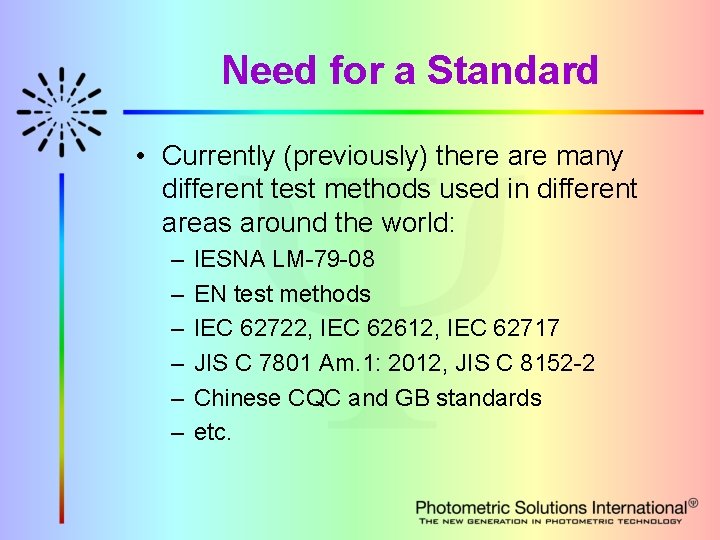
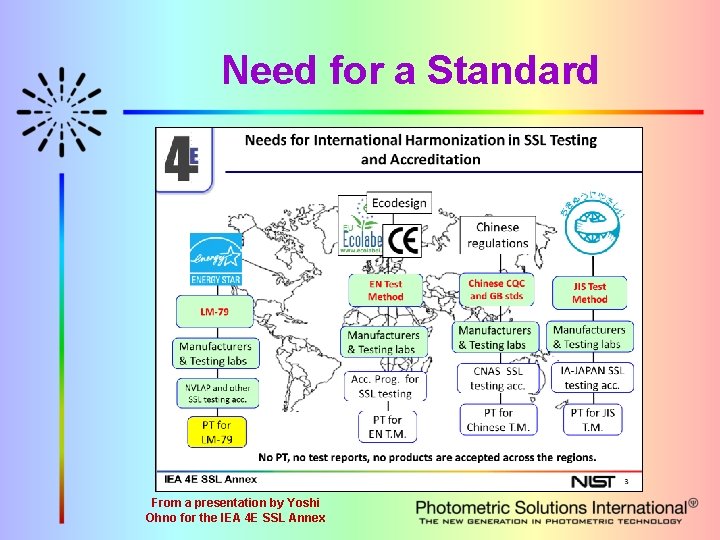
Need for a Standard • Currently (previously) there are many different test methods used in different areas around the world: – – – IESNA LM-79 -08 EN test methods IEC 62722, IEC 62612, IEC 62717 JIS C 7801 Am. 1: 2012, JIS C 8152 -2 Chinese CQC and GB standards etc.
Need for a Standard From a presentation by Yoshi Ohno for the IEA 4 E SSL Annex
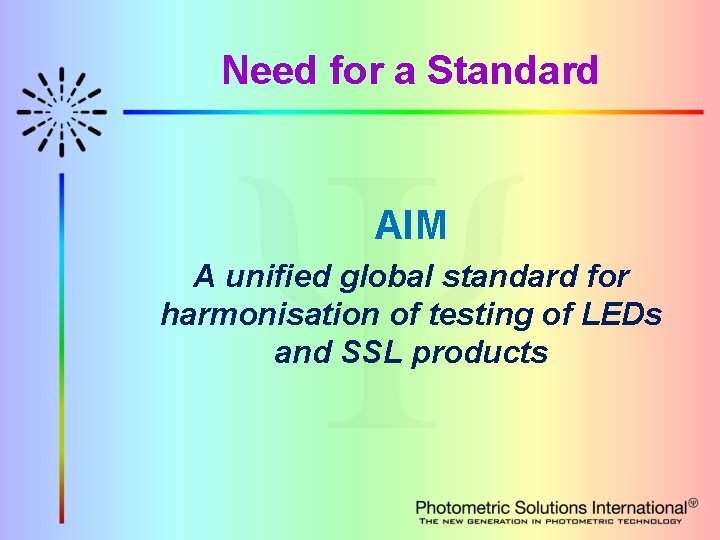
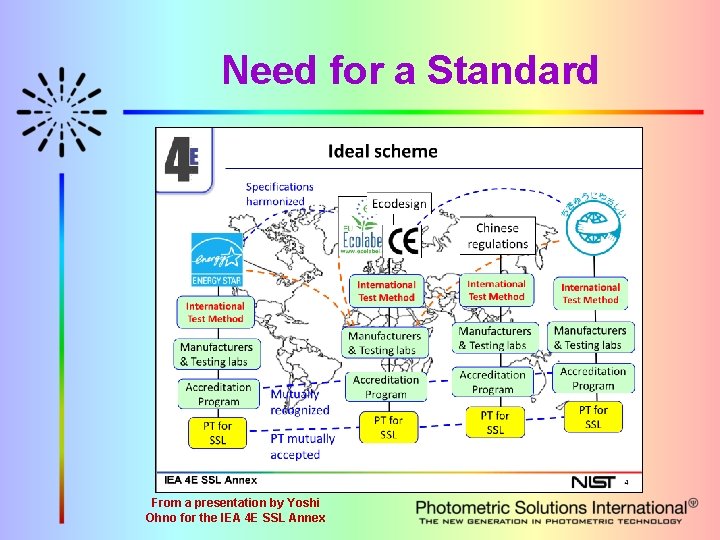
Need for a Standard AIM A unified global standard for harmonisation of testing of LEDs and SSL products
Need for a Standard From a presentation by Yoshi Ohno for the IEA 4 E SSL Annex
Contents • • • Introduction to the CIE Need for an International Standard Development of the Standard Features of the Standard Conclusion
Development of the Standard • A CIE Division 2 Technical Committee worked on the standard: – TC 2 -71: CIE Standard on Test Methods for LED Lamps, luminaires and modules • The TC has 37 members from 16 countries in 5 continents • Working closely with CEN-TC 169 -WG 7 • Draft published in September 2014 • Final version published in March 2015
Development of the Standard • Has had significant difficulties establishing a consensus amongst the stakeholders: – – – Public testing labs; LED/Lighting manufacturers; Test equipment manufacturers; Regulatory bodies; NMIs; etc…
Development of the Standard • Also needed a consensus with the CENTC 169 -WG 7 working group, whom we were partnering in the development – (It is technically identical to the CEN standard EN 13032 -4, which will be released soon)
Development of the Standard • There have been some robust discussions and disagreements • Difficulties were largely overcome so that we could move forward to begin the publication phase
Contents • • • Introduction to the CIE Need for an International Standard Development of the Standard Features of the Standard Conclusion
Features of the Standard • The draft Standard defines standard test conditions and requirements for equipment • It covers electric, photometric and spectral/colorimetric properties • It covers LED lamps, LED luminaires and LED modules • Testing should ideally be performed according to the standard test conditions
Features of the Standard • Some of the standard test conditions have tolerances to take into account practical laboratory situations • Example 1: – The ambient test temperature should be 25°C – In practice it can be in the range 25 ± 1. 2 °C (including uncertainty in measurement of temperature) • Example 2: – The air should be still – In practice it is allowed to be up to 0. 25 m/s (including uncertainty in measurement of air speed)
Features of the Standard • If the standard test conditions are not met, then a correction must be made • For example: – A goniophotometric test is made with ambient temperature of 23 ± 0. 5 °C – This is outside the range 25 ± 1. 2 °C – An additional test must be made, eg: with the device in a temperature controlled chamber, to correct the measured value to what it would be if the test were performed at 25°C
Features of the Standard • The equipment and electrical supply also have tolerances • Examples: – The test voltage shall be measured at the supply terminals of the DUT, not at the output terminals of the power supply – Tolerance interval: ± 0. 4 % for RMS AC voltage; 0. 2 % for DC voltage. – The total harmonic content of the voltage waveform shall not exceed 1. 5 % of the fundamental (except if PF > 0. 9, then it shall be less than 3 %).
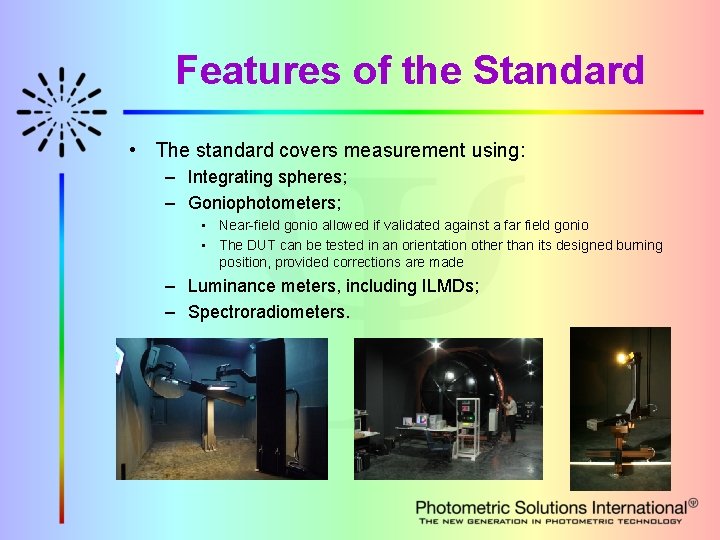
Features of the Standard • The standard covers measurement using: – Integrating spheres; – Goniophotometers; • Near-field gonio allowed if validated against a far field gonio • The DUT can be tested in an orientation other than its designed burning position, provided corrections are made – Luminance meters, including ILMDs; – Spectroradiometers.
Features of the Standard • Measurements must be traceable – Equipment must be properly calibrated – Traceability chain must be maintained back to a national laboratory (National Measurement Institute) • All test reports must contain a statement of uncertainty of measurement – The standard gives a guide for how to make an uncertainty budget • The Standard really just focuses on quality and compatibility of measurement, and not product performance as such.
What it covers • The draft Standard covers: – Environmental conditions (air temperature, air movement, stray light); – Electrical supply and quality; – Measurement instruments (photometric & electrical); – Lamp mounting / operating position; – Lamp Operating Conditions; – Lamp stabilisation; – Initial total luminous flux; – Centre beam and beam angles; – Partial luminous flux (useful lumens); – Test distance for far-field goniophotometry; – Colour and chromaticity measurements.
What it doesn’t cover • The draft Standard does not cover or partially covers: – Dimmable, internal feedback, adjustable colour, adjustable white, multicolour; – Maintained luminous flux; – Omni-directional assessment; – Maintained colour measurements; – Harmonics & EMC; – Start time / activation time; – Switch withstand; – Lamp Life; – Temperature cycling shock; – Endurance; – Photobiological hazards; – Flicker; – Dimmer compatibility. • Note: Many of these are already covered satisfactorily in other Standards.
Contents • • • Introduction to the CIE Need for an International Standard Development of the Standard Features of the Standard Conclusion
Conclusions • The CIE is the world’s premier scientific organisation responsible for matters relating to light and lighting • Celebrated its official centenary in 2013 • CIE has developed an International Standard Test Method for LED Lamps, LED Luminaires and LED Modules • This will enable accurate and repeatable measurements for harmonisation and intercomparison around the globe
Thank you for your kind attention Tony Bergen Technical Director Photometric Solutions International Factory Two, 21 -29 Railway Avenue Huntingdale, Vic, 3166, Australia Tel: +61 3 9568 1879 Fax: +61 3 9568 4667 Email: tonyb@photometricsolutions. com Web: www. photometricsolutions. com