
The new CEFR Companion Volume and the Online


- Slides: 27
The new CEFR Companion Volume and the Online Interaction Scales Enrica Piccardo OISE-University of Toronto 31/10/2020 1
Outline • The Companion Volume: Updating and extending the CEFR • Key considerations • Conceptualisation / methodology / rationale • Potential exploitation for teaching and learning
Outline • The Companion Volume: Updating and extending the CEFR • Key considerations • Conceptualisation / methodology / rationale • Potential exploitation for teaching and learning
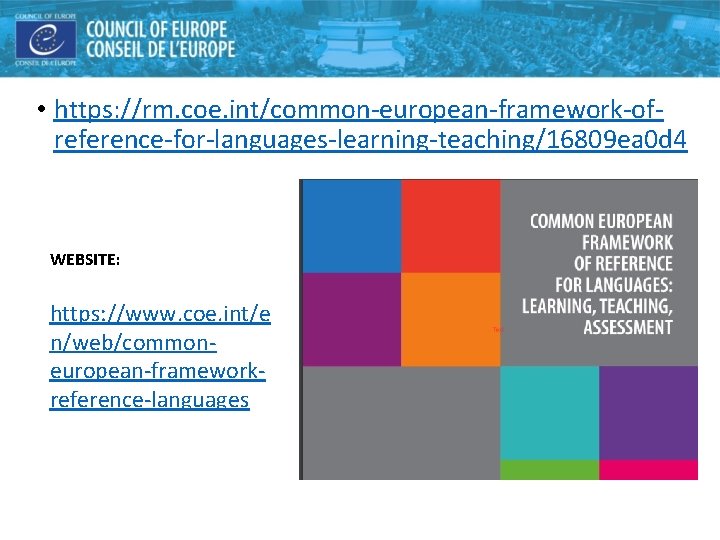
• https: //rm. coe. int/common-european-framework-ofreference-for-languages-learning-teaching/16809 ea 0 d 4 WEBSITE: https: //www. coe. int/e n/web/commoneuropean-frameworkreference-languages
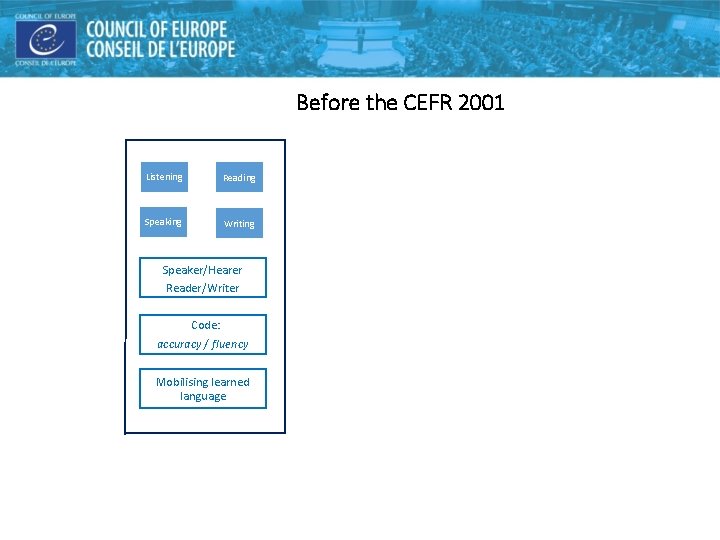
Before the CEFR 2001 Listening Reading Speaking Writing Speaker/Hearer Reader/Writer FCode: accuracy / fluency Mobilising learned language
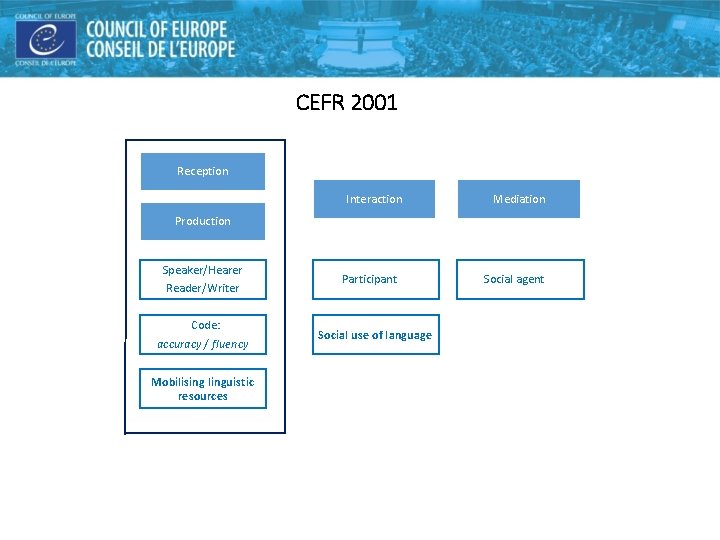
CEFR 2001 Reception Interaction Mediation Pr. Participantructi Pr. Social agentructi Production Speaker/Hearer Reader/Writer FCode: accuracy / fluency Mobilising linguistic resources Social use of language
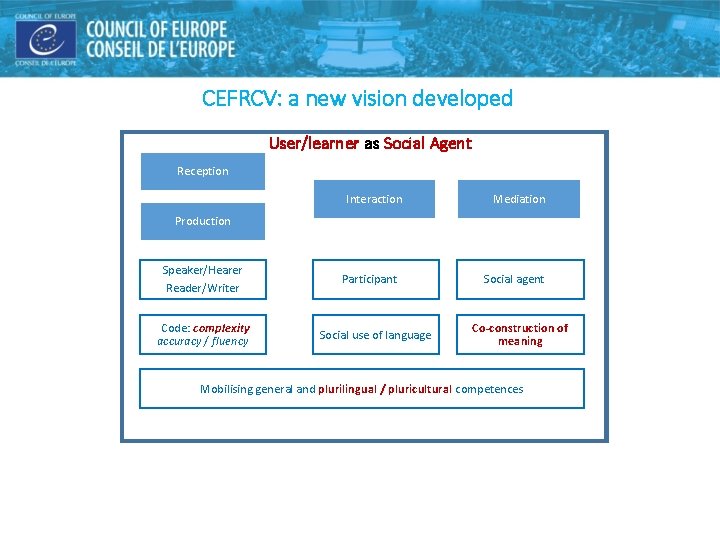
CEFRCV: a new vision developed User/learner as Social Agent Reception Interaction Mediation Speaker/Hearer Reader/Writer Pr. Participantructi Pr. Social agentructi FCode: complexity accuracy / fluency Social use of language Co-construction of meaning Production Mobilising general and plurilingual / pluricultural competences
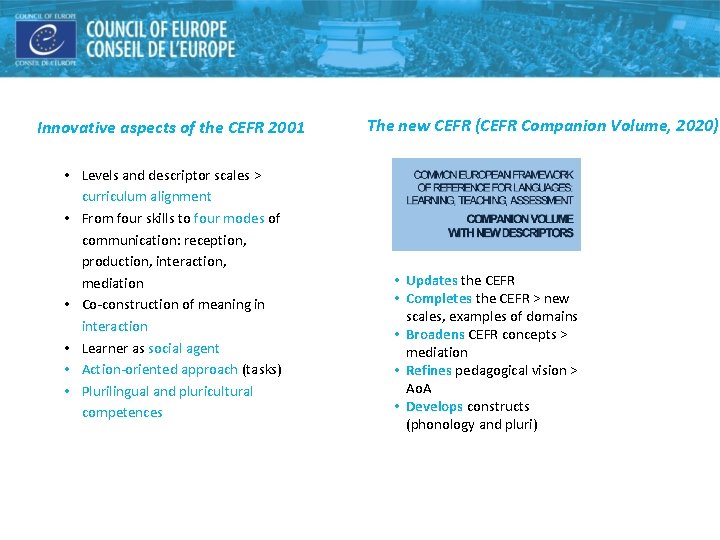
Innovative aspects of the CEFR 2001 • Levels and descriptor scales > curriculum alignment • From four skills to four modes of communication: reception, production, interaction, mediation • Co-construction of meaning in interaction • Learner as social agent • Action-oriented approach (tasks) • Plurilingual and pluricultural competences The new CEFR (CEFR Companion Volume, 2020) • Updates the CEFR • Completes the CEFR > new scales, examples of domains • Broadens CEFR concepts > mediation • Refines pedagogical vision > Ao. A • Develops constructs (phonology and pluri)
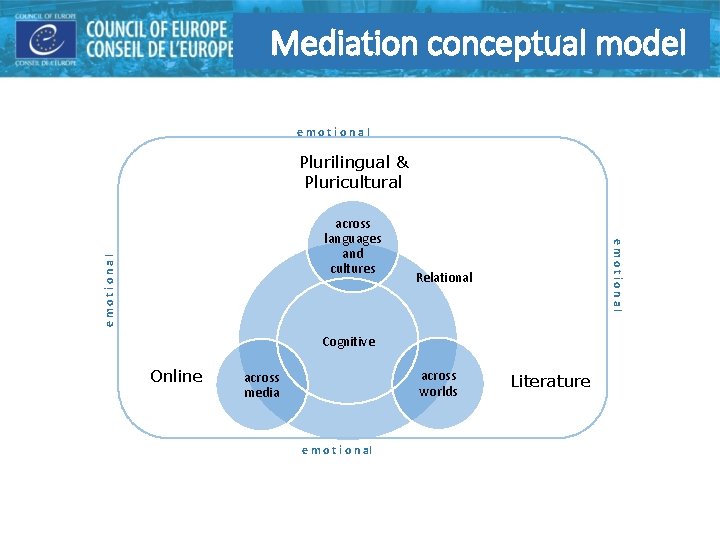
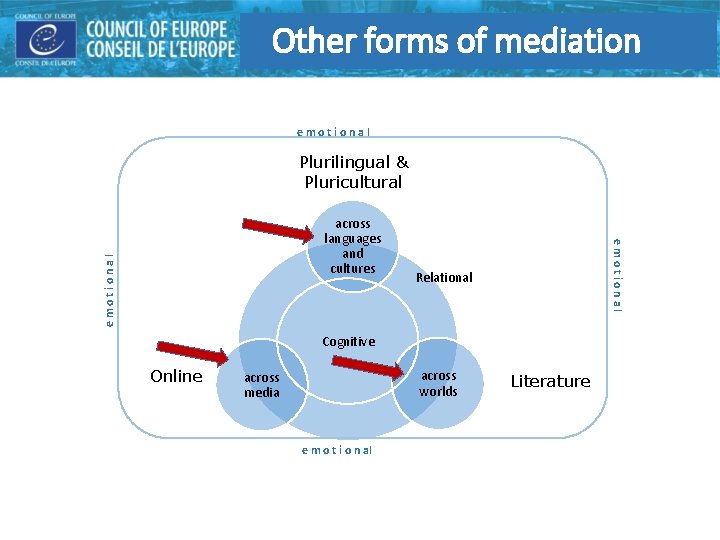
Mediation conceptual model emotional Plurilingual & Pluricultural emotional across languages and cultures Relational Cognitive Online across worlds across media e m o t i o n al Literature
Other forms of mediation emotional Plurilingual & Pluricultural emotional across languages and cultures Relational Cognitive Online across worlds across media e m o t i o n al Literature
Outline • The Companion Volume: Updating and extending the CEFR • Key considerations • Conceptualisation / methodology / rationale • Potential exploitation for teaching and learning
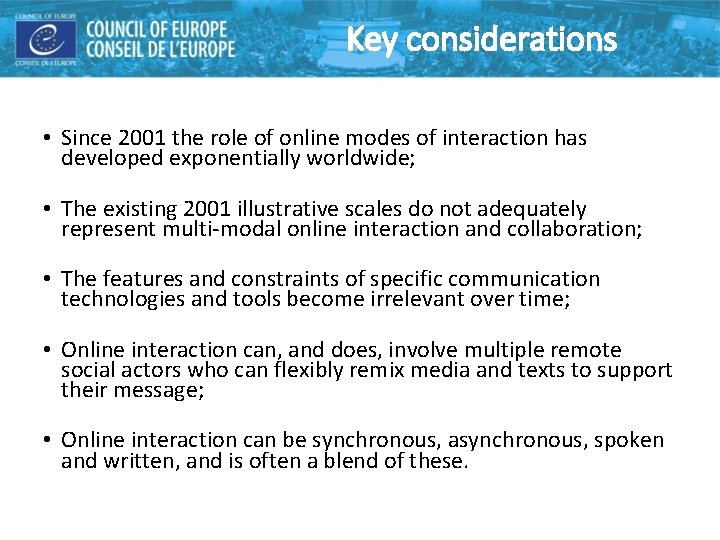
Key considerations • Since 2001 the role of online modes of interaction has developed exponentially worldwide; • The existing 2001 illustrative scales do not adequately represent multi-modal online interaction and collaboration; • The features and constraints of specific communication technologies and tools become irrelevant over time; • Online interaction can, and does, involve multiple remote social actors who can flexibly remix media and texts to support their message; • Online interaction can be synchronous, asynchronous, spoken and written, and is often a blend of these.
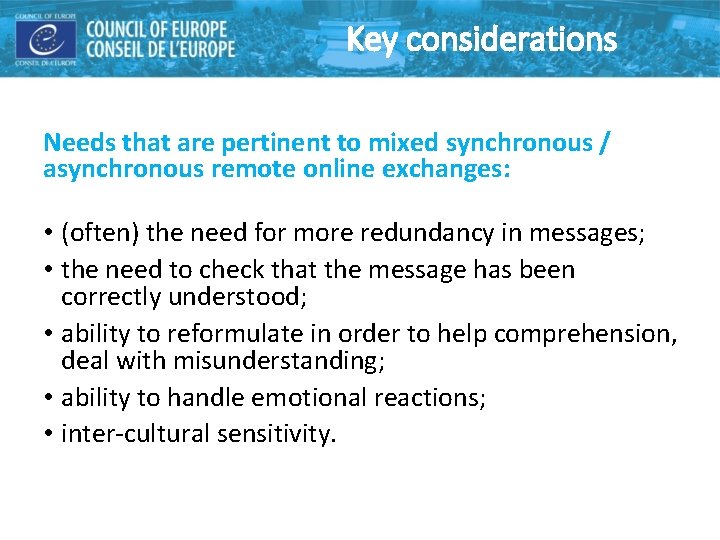
Key considerations Needs that are pertinent to mixed synchronous / asynchronous remote online exchanges: • (often) the need for more redundancy in messages; • the need to check that the message has been correctly understood; • ability to reformulate in order to help comprehension, deal with misunderstanding; • ability to handle emotional reactions; • inter-cultural sensitivity.
Outline • The Companion Volume: Updating and extending the CEFR • Key considerations • Conceptualisation / methodology / rationale • Potential exploitation for teaching and learning
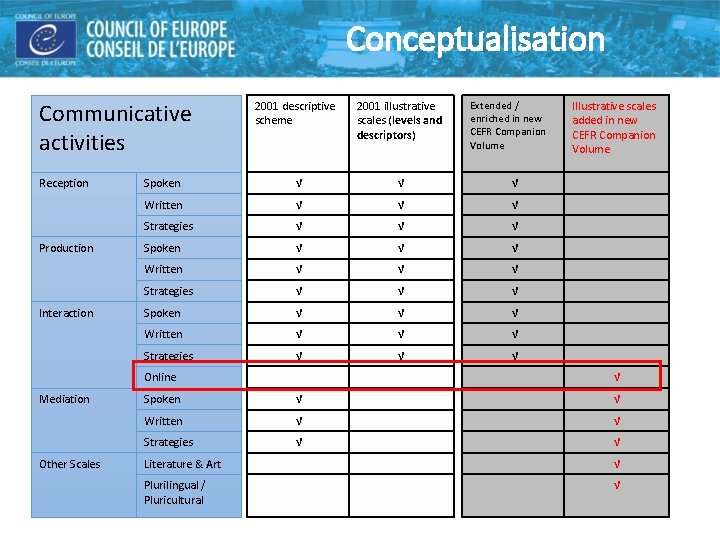
Conceptualisation Communicative activities Reception Production Interaction 2001 descriptive scheme Other Scales Extended / enriched in new CEFR Companion Volume Spoken √ √ √ Written √ √ √ Strategies √ √ √ Online Mediation 2001 illustrative scales (levels and descriptors) Illustrative scales added in new CEFR Companion Volume √ Spoken √ √ Written √ √ Strategies √ √ Literature & Art √ Plurilingual / Pluricultural √
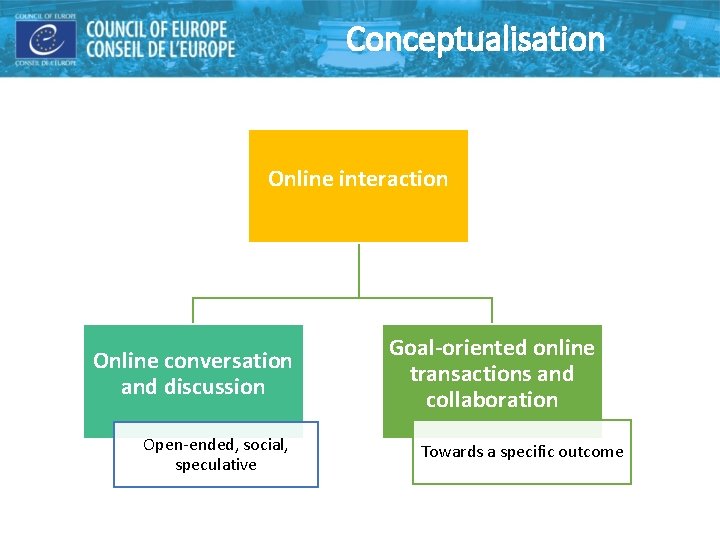
Conceptualisation Online interaction Online conversation and discussion Open-ended, social, speculative Goal-oriented online transactions and collaboration Towards a specific outcome
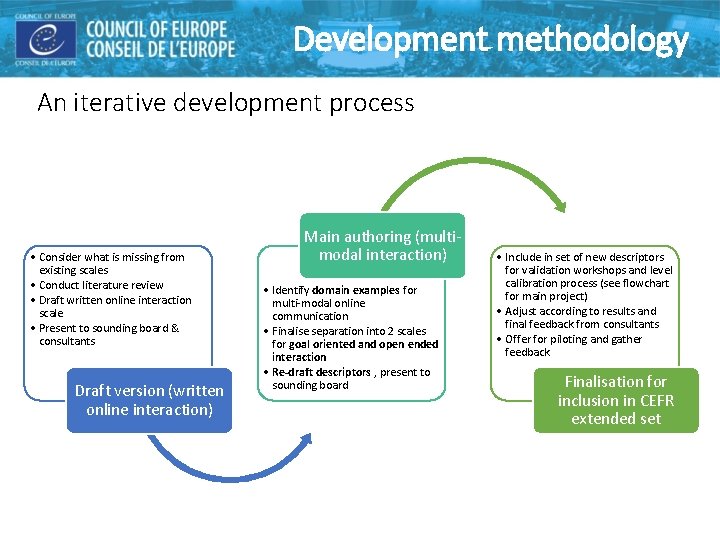
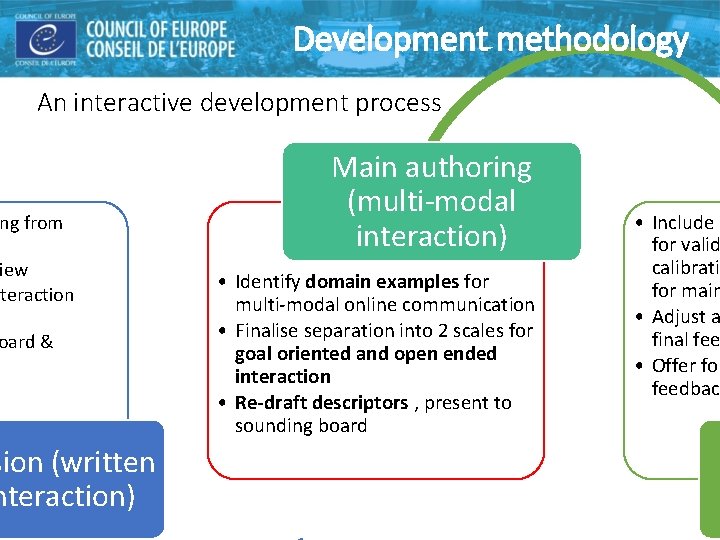
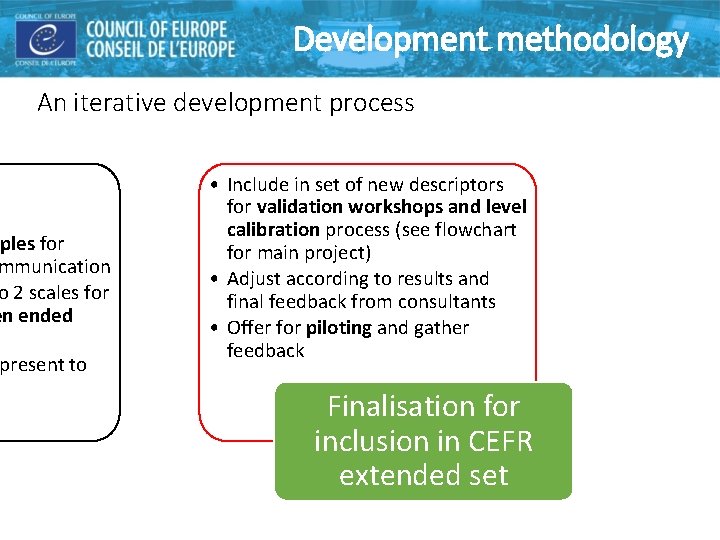
Development methodology An iterative development process • Consider what is missing from existing scales • Conduct literature review • Draft written online interaction scale • Present to sounding board & consultants Draft version (written online interaction) Main authoring (multimodal interaction) • Identify domain examples for multi-modal online communication • Finalise separation into 2 scales for goal oriented and open ended interaction • Re-draft descriptors , present to sounding board • Include in set of new descriptors for validation workshops and level calibration process (see flowchart for main project) • Adjust according to results and final feedback from consultants • Offer for piloting and gather feedback Finalisation for inclusion in CEFR extended set
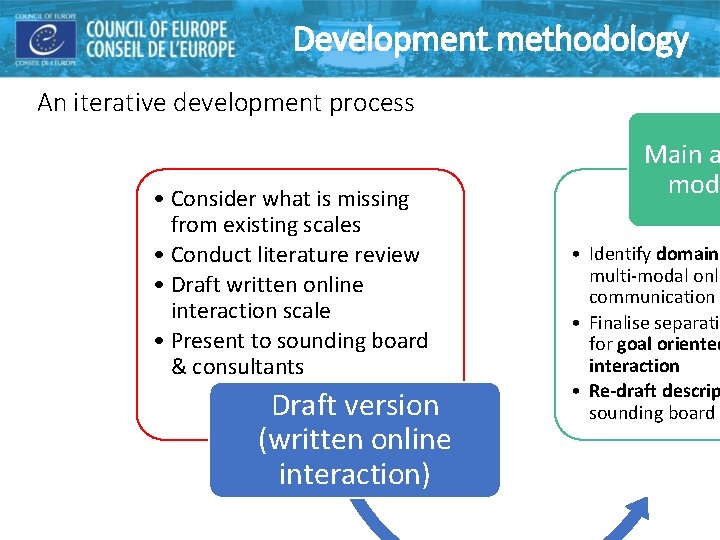
Development methodology An iterative development process • Consider what is missing from existing scales • Conduct literature review • Draft written online interaction scale • Present to sounding board & consultants Draft version (written online interaction) Main a moda • Identify domain multi-modal onli communication • Finalise separatio for goal oriented interaction • Re-draft descrip sounding board
Development methodology An interactive development process ng from iew nteraction oard & sion (written nteraction) Main authoring (multi-modal interaction) • Identify domain examples for multi-modal online communication • Finalise separation into 2 scales for goal oriented and open ended interaction • Re-draft descriptors , present to sounding board • Include i for valid calibrati for main • Adjust a final fee • Offer for feedback
Development methodology An iterative development process ples for mmunication o 2 scales for en ended present to • Include in set of new descriptors for validation workshops and level calibration process (see flowchart for main project) • Adjust according to results and final feedback from consultants • Offer for piloting and gather feedback Finalisation for inclusion in CEFR extended set
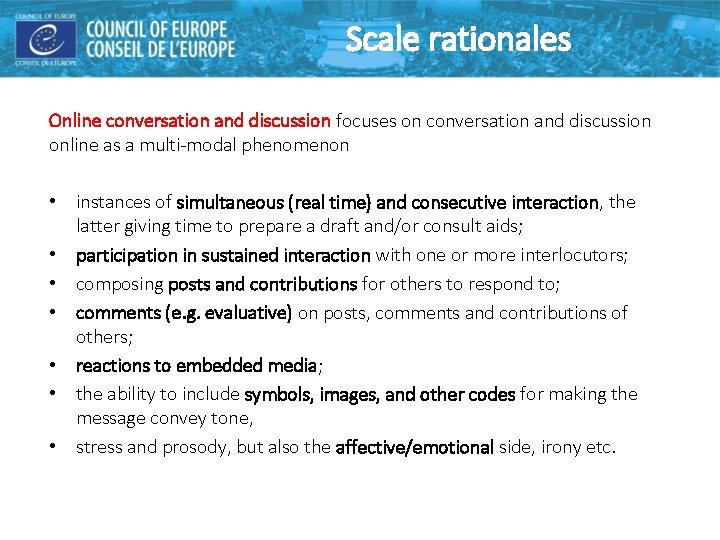
Scale rationales Online conversation and discussion focuses on conversation and discussion online as a multi-modal phenomenon • instances of simultaneous (real time) and consecutive interaction, the latter giving time to prepare a draft and/or consult aids; • participation in sustained interaction with one or more interlocutors; • composing posts and contributions for others to respond to; • comments (e. g. evaluative) on posts, comments and contributions of others; • reactions to embedded media; • the ability to include symbols, images, and other codes for making the message convey tone, • stress and prosody, but also the affective/emotional side, irony etc.
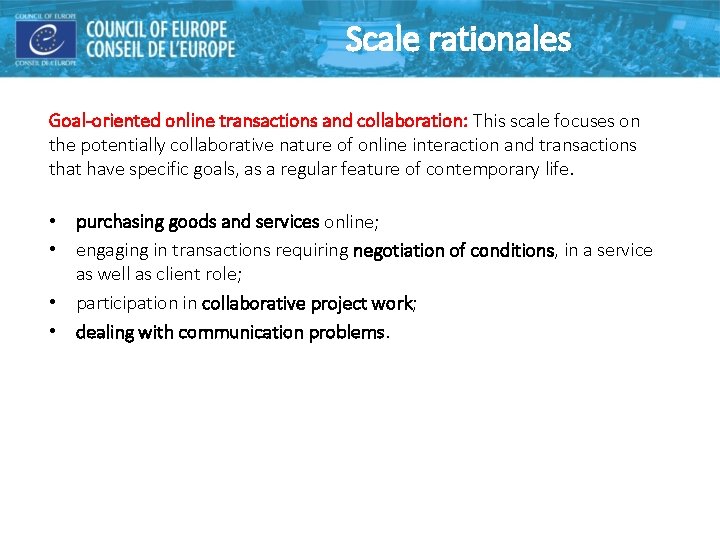
Scale rationales Goal-oriented online transactions and collaboration: This scale focuses on the potentially collaborative nature of online interaction and transactions that have specific goals, as a regular feature of contemporary life. • purchasing goods and services online; • engaging in transactions requiring negotiation of conditions, in a service as well as client role; • participation in collaborative project work; • dealing with communication problems.
Outline • The Companion Volume: Updating and extending the CEFR • Key considerations • Conceptualisation / methodology / rationale • Potential exploitation for teaching and learning
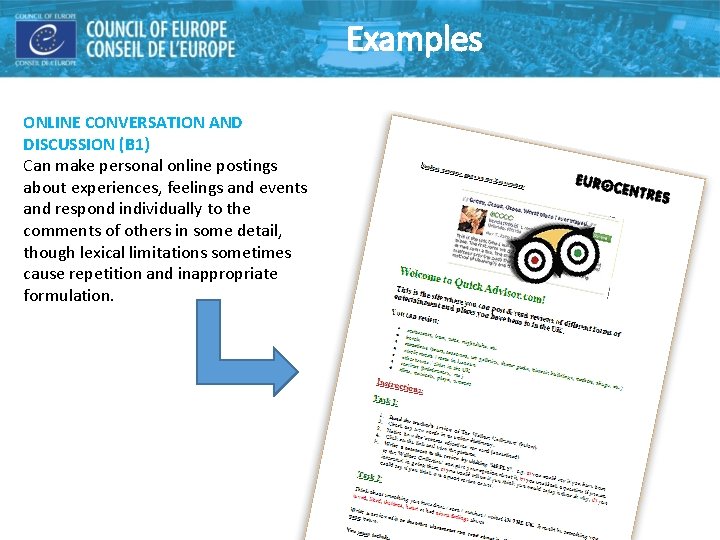
Examples ONLINE CONVERSATION AND DISCUSSION (B 1) Can make personal online postings about experiences, feelings and events and respond individually to the comments of others in some detail, though lexical limitations sometimes cause repetition and inappropriate formulation.
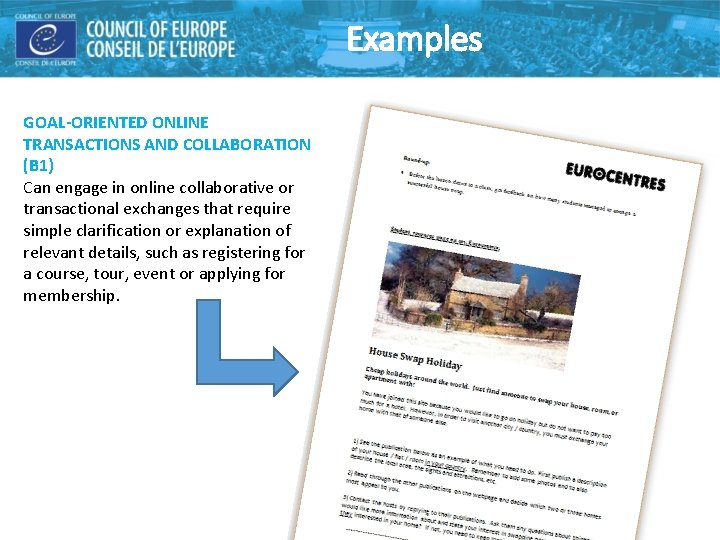
Examples GOAL-ORIENTED ONLINE TRANSACTIONS AND COLLABORATION (B 1) Can engage in online collaborative or transactional exchanges that require simple clarification or explanation of relevant details, such as registering for a course, tour, event or applying for membership.
Piloting feedback Tertiary B 1: ‘Most of the students wrote in the questionnaire that it was nice to work online, but a small group said that it was a little bit too difficult. . . The exercises based on the chat worked surprisingly well. ’ Tertiary/YL teaching prac. B 2 ‘The descriptors …helped students focus on the task … They serve for both students and the professor alike. ’ Primary: A 1/A 2 ‘a CLIL project about earthquakes. . . through a platform (e. Twinning) where students can meet each other (chat, forum, live events), share materials (presentations on padlet)’ Impact on T&L : ‘More focused on development of competences’
merci grazie gracias tesçekkurler danke faleminderit obrigado thank you efcharisto 27